First sentence: Under certain circumstances there are few hours in life more agreeable than the hour dedicated to the ceremony known as afternoon tea.
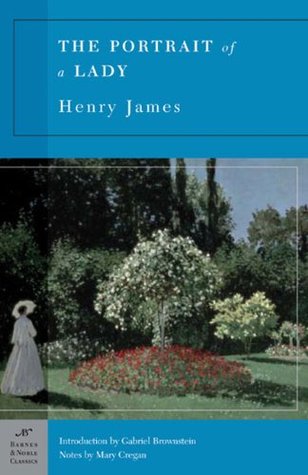
Premise/plot: The lady in question is a Miss Isabel Archer. James' novel chronicles her adventures and misadventures. Miss Archer is an American, but, most of the novel is set in England and in Italy. There must be something about Miss Archer, for, every man--no matter their age, no matter their prospects--seems to want her--to need her. The men in her life: Ralph, her cousin, who seems to genuinely care for her wellbeing; Lord Warburton, who is not the first or last apparently to fall in love with her at first sight. (I have a soft spot for both Ralph and Lord Warburton). Caspar Goodwood is an old suitor who is so besotted he follows her across the globe. Last but not least, there is Gilbert Osmond. Lady Merle, one of her aunt's friends, insists that she absolutely has to go to Italy to meet HIM. He is her most special friend, and, worthy of her acquaintance to be sure. Of course, she can marry only once--for better or worse. When the novel starts, Miss Archer is convinced that marriage isn't for her, and, that she may never marry at all. She's certainly not ready to say yes to just anyone who asks her. Even if she really, really, really likes someone. Even if she could see herself being happy with that person. She wants to make her own path and walk it. With the help of her uncle's money--he dies and leaves her a good portion of his fortune--she has a way to fund her way across Europe. But she finds it isn't easy to break free from convention altogether. She's wooed and courted wherever she goes. And marriage seems more and more inevitable despite her initial intentions. As to why she chooses WHO she chooses, James' lost me on that one!!! Readers see her as a happy, determined woman with strong opinions, then, later as an unhappy woman with a brave resilience, a if-life-gives-you-lemons-you-stay-and-make-lemonade resilience. I can see how readers might see her as both weak and strong.
Of course, Miss Archer isn't the only woman in the novel. Readers also meet the aunt, Mrs. Touchett, Henrietta Stackpole, Madame Merle, Countess Gemini, and Pansy. Mrs. Touchett, how to describe her? A bit cold and definitely shallow, in my opinion. She lives an almost completely separated life from her husband. She travels between America, Europe, and England on a strict routine or schedule. Her friends are superficial friends only. If she has feelings for her son and husband, then she conceals them completely. She's certainly no role model wife. Henrietta Stackpole is SPUNKY and unpredictable. She is definitely a busy body, wanting into EVERYONE'S business. She's always looking for a story, a scoop. She wants DETAILS. And she's not at all your typical young woman. While the men all long for Miss Archer, plenty are frightened away by Henrietta's point of view, way of living. Madame Merle is calculating and ambitious. She lacks sincerity and warmth. She knows just what to say to gain the trust of unsuspecting folks, for sure. Yet, is there something more behind her mask? James won't let her put it down, so I'll never know. Countess Gemini is the sister of Gilbert Osmond. She's lonely and discontent. Being a wife hasn't brought her happiness. She like so many women in this novel are stuck with their lot. Last but not least, there is the young woman, Pansy. She is the daughter of Gilbert Osmond. Miss Archer becomes her stepmother. The last half of the novel she becomes a heroine of some importance. Two men are pursuing her. One has the father's approval. One has the daughter's approval. The father is absolute and the daughter is subservient and submissive. Readers are left to conclude that Pansy's fate won't be of her own choosing. Though Pansy may make the most of it and find her own way of being joyful and content.
This novel is very much relationship-driven. There are deep friendships, not just romantic entanglements.
My thoughts: I really loved both Ralph and his father. I liked Lord Warburton. I think Miss Archer would have been much happier if she'd said yes to his proposal in the opening chapters of the book! That being said, Miss Archer wanted something more than just to be someone's wife. And even though she ultimately failed, she did try. It was scary to try at this point in history. And not many women dared to make their own path and live on their own terms. It required money and eccentricity, I think, to comfortably succeed. Henrietta was a hoot. I didn't always agree with some of the 'wild' things she said and did. But she was always good at stealing a scene and bringing some lightness to the novel.
Gilbert Osmond is a character I won't miss--not even slightly. There was one scene that just got under my skin. I am still furious with him. (Osmond is saying really horribly, utterly unforgivable things about RALPH.)
Overall, even though I didn't love everything about this one, I am glad I read it.
Quotes:
“Have you drunk your tea?” asked the son. “Yes, and enjoyed it.” “Shall I give you some more?” The old man considered, placidly. “Well, I guess I’ll wait and see.” He had, in speaking, the American tone. “Are you cold?” the son enquired. The father slowly rubbed his legs. “Well, I don’t know. I can’t tell till I feel.” “Perhaps some one might feel for you,” said the younger man, laughing. “Oh, I hope some one will always feel for me! Don’t you feel for me, Lord Warburton?” “Oh yes, immensely,” said the gentleman addressed as Lord Warburton, promptly. “I’m bound to say you look wonderfully comfortable.”
“The fact is I’ve been comfortable so many years that I suppose I’ve got so used to it I don’t know it.” “Yes, that’s the bore of comfort,” said Lord Warburton. “We only know when we’re uncomfortable.”
His son broke into a laugh. “He’ll think you mean that as a provocation! My dear father, you’ve lived with the English for thirty years, and you’ve picked up a good many of the things they say. But you’ve never learned the things they don’t say!”
“I’ve never kept up with Isabel — it would have taken all my time,” she had often remarked; in spite of which, however, she held her rather wistfully in sight; watching her as a motherly spaniel might watch a free greyhound. “I want to see her safely married — that’s what I want to see,” she frequently noted to her husband. “Well, I must say I should have no particular desire to marry her,” Edmund Ludlow was accustomed to answer in an extremely audible tone. “I know you say that for argument; you always take the opposite ground. I don’t see what you’ve against her except that she’s so original.” “Well, I don’t like originals; I like translations,” Mr. Ludlow had more than once replied. “Isabel’s written in a foreign tongue. I can’t make her out. She ought to marry an Armenian or a Portuguese.” “That’s just what I’m afraid she’ll do!” cried Lilian, who thought Isabel capable of anything.
Clearness is too expensive.
In matters of opinion she had had her own way, and it had led her into a thousand ridiculous zigzags.
There are as many points of view in the world as there are people of sense to take them.
“I shall always tell you,” her aunt answered, “whenever I see you taking what seems to me too much liberty.” “Pray do; but I don’t say I shall always think your remonstrance just.” “Very likely not. You’re too fond of your own ways.” “Yes, I think I’m very fond of them. But I always want to know the things one shouldn’t do.” “So as to do them?” asked her aunt. “So as to choose,” said Isabel.
Shall I love her or shall I hate her?” Ralph asked while they moved along the platform. “Whichever you do will matter very little to her,” said Isabel. “She doesn’t care a straw what men think of her.” “As a man I’m bound to dislike her then. She must be a kind of monster. Is she very ugly?” “No, she’s decidedly pretty.” “A female interviewer — a reporter in petticoats? I’m very curious to see her,” Ralph conceded. “It’s very easy to laugh at her but it is not easy to be as brave as she.”
“My poor Henrietta,” she said, “you’ve no sense of privacy.” Henrietta coloured deeply, and for a moment her brilliant eyes were suffused, while Isabel found her more than ever inconsequent. “You do me great injustice,” said Miss Stackpole with dignity. “I’ve never written a word about myself!” “I’m very sure of that; but it seems to me one should be modest for others also!”
“Yes, you’re changed; you’ve got new ideas over here,” her friend continued. “I hope so,” said Isabel; “one should get as many new ideas as possible.” “Yes; but they shouldn’t interfere with the old ones when the old ones have been the right ones.”
We see our lives from our own point of view; that is the privilege of the weakest and humblest of us;
“It seems to me I’ve told you very little.” “You’ve told me the great thing: that the world interests you and that you want to throw yourself into it.” Her silvery eyes shone a moment in the dusk. “I never said that.” “I think you meant it. Don’t repudiate it. It’s so fine!” “I don’t know what you’re trying to fasten upon me, for I’m not in the least an adventurous spirit. Women are not like men.” Ralph slowly rose from his seat and they walked together to the gate of the square. “No,” he said; “women rarely boast of their courage. Men do so with a certain frequency.” “Men have it to boast of!” “Women have it too. You’ve a great deal.”
I wish to choose my fate and know something of human affairs beyond what other people think it compatible with propriety to tell me.
“I’m afraid there are moments in life when even Schubert has nothing to say to us. We must admit, however, that they are our worst.” “I’m not in that state now then,” said Isabel.
One can’t judge till one’s forty; before that we’re too eager, too hard, too cruel, and in addition much too ignorant. I’m sorry for you; it will be a long time before you’re forty. But every gain’s a loss of some kind; I often think that after forty one can’t really feel. The freshness, the quickness have certainly gone. You’ll keep them longer than most people; it will be a great satisfaction to me to see you some years hence. I want to see what life makes of you. One thing’s certain — it can’t spoil you. It may pull you about horribly, but I defy it to break you up.
A woman, it seems to me, has no natural place anywhere; wherever she finds herself she has to remain on the surface and, more or less, to crawl. You protest, my dear? you’re horrified? you declare you’ll never crawl? It’s very true that I don’t see you crawling; you stand more upright than a good many poor creatures. Very good; on the whole, I don’t think you’ll crawl.
When you’ve lived as long as I you’ll see that every human being has his shell and that you must take the shell into account. By the shell I mean the whole envelope of circumstances. There’s no such thing as an isolated man or woman; we’re each of us made up of some cluster of appurtenances.
What shall we call our ‘self’? Where does it begin? where does it end? It overflows into everything that belongs to us — and then it flows back again. I know a large part of myself is in the clothes I choose to wear. I’ve a great respect for things! One’s self — for other people — is one’s expression of one’s self; and one’s house, one’s furniture, one’s garments, the books one reads, the company one keeps — these things are all expressive.
My clothes may express the dressmaker, but they don’t express me. To begin with it’s not my own choice that I wear them; they’re imposed upon me by society.” “Should you prefer to go without them?” Madame Merle enquired in a tone which virtually terminated the discussion.
“I never sacrificed my husband to another,” Mrs. Touchett continued with her stout curtness. “Oh no,” thought Madame Merle; “you never did anything for another!”
Whatever life you lead you must put your soul in it — to make any sort of success of it; and from the moment you do that it ceases to be romance, I assure you: it becomes grim reality! And you can’t always please yourself; you must sometimes please other people. That, I admit, you’re very ready to do; but there’s another thing that’s still more important — you must often displease others. You must always be ready for that — you must never shrink from it. That doesn’t suit you at all — you’re too fond of admiration, you like to be thought well of. You think we can escape disagreeable duties by taking romantic views — that’s your great illusion, my dear. But we can’t. You must be prepared on many occasions in life to please no one at all — not even yourself.
“I don’t pretend to know what people are meant for,” said Madame Merle. “I only know what I can do with them.”
We know too much about people in these days; we hear too much. Our ears, our minds, our mouths, are stuffed with personalities.
Don’t mind anything any one tells you about any one else. Judge everyone and everything for yourself.” “That’s what I try to do,” said Isabel “but when you do that people call you conceited.” “You’re not to mind them — that’s precisely my argument; not to mind what they say about yourself any more than what they say about your friend or your enemy.” Isabel considered. “I think you’re right; but there are some things I can’t help minding: for instance when my friend’s attacked or when I myself am praised.” “Of course you’re always at liberty to judge the critic. Judge people as critics, however,” Ralph added, “and you’ll condemn them all!”
“I’m rather ashamed of my plans; I make a new one every day.”
It’s one’s own fault if one isn’t happy.
The two words in the language I most respect are Yes and No.
Changing the form of one’s mission’s almost as difficult as changing the shape of one’s nose: there they are, each, in the middle of one’s face and one’s character — one has to begin too far back.
“My envy’s not dangerous; it wouldn’t hurt a mouse. I don’t want to destroy the people — I only want to be them. You see it would destroy only myself.”
Henrietta contracted friendships, in travelling, with great freedom, and had formed in railway-carriages several that were among her most valued ties.
Doing all the vain things one likes is often very tiresome.
You could criticise any marriage; it was the essence of a marriage to be open to criticism.
I’ve only one ambition — to be free to follow out a good feeling.
A mistake’s made before one knows it.
You must save what you can of your life; you mustn’t lose it all simply because you’ve lost a part.
© 2017 Becky Laney of Becky's Book Reviews