Showing posts with label 1934. Show all posts

Tuesday, December 26, 2023

194. The Mysterious Mr. Badman


The Mysterious Mr. Badman. W.F. Harvey. 1934. 204 pages. [Source: Library]

First sentence: When at two o'clock on a sultry July afternoon Athelstan Digby undertook to keep an eye on the contents of the old bookshop in Keldstone High Street, he deliberately forgot to mind his own business. 

Premise/plot: This one is a vintage mystery from the 1930s. Athelstan Digby, one of our protagonists, is on holiday. He's temporarily minding a bookshop--while the owners are away for a day (possibly one day and one night). He has THREE people come in and all ask for the same book--The Life and Death of Mr. Badman by John Bunyan. He finds this strange, strange, super-strange. Events in the small village soon reflect this, Athelstan and his nephew, Jim, soon find themselves amateur detectives trying to solve multiple crimes--including murder. 

My thoughts: I LOVED, LOVED, LOVED this one. It reminded me of all the reasons I love vintage mysteries, particularly British mysteries. I enjoyed getting to know the characters. I loved the bookish plot. I loved finding a new-to-me author. Definitely recommended.


© 2023 Becky Laney of Becky's Book Reviews

Monday, May 27, 2019

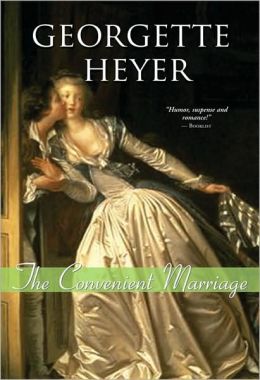
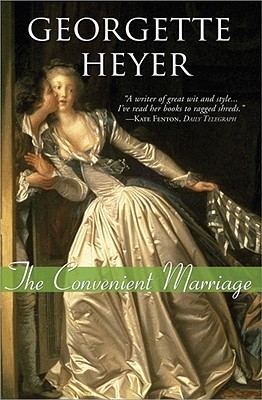
The Convenient Marriage

The Convenient Marriage. Georgette Heyer. 1934. 322 pages. [Source: Bought]

First sentence: Lady Winwood being denied, the morning caller inquired with some anxiety for Miss Winwood, or, in fact, for any of the young ladies.


Premise/plot: Lord Rule has offered for the eldest Winwood daughter little knowing that Elizabeth's heart belongs to a soldier. Elizabeth Winwood being a dutiful daughter has determined to break off the love match and please her mother. After all the Winwoods desperately needs Rule's money in order to satisfy their brother's debts. Horatia, the youngest, won't have it. Everyone knows she's fierce and a bit reckless. But no one suspects that she--accompanied by a maid--will go to Rule's house, request to see him, and bluntly tell him to marry HER and NOT ELIZABETH. This makes for the BEST SECOND CHAPTER IN A BOOK OF ALL TIME. He agrees despite her stammer and eyebrows or perhaps because of them. There is something fiery and unique about Horry. Readers can tell that this will be everything but a marriage of convenience.

My thoughts: Georgette Heyer's The Convenient Marriage is a historical romance novel that I love and adore. It may just be my all-time favorite Heyer romance. It is without a doubt in my top two. I love everything about it and would change nothing.

I love the setting. It is set in the GEORGIAN period. The American Revolution is going on in the background. Elizabeth's soldier has been to America and back--he was injured in the fighting. The main character, Horatia, is named after her godfather, Horatio (Horace) Walpole. The book immerses you in the times--fashion and etiquette for men and women.

I love the humor and wit. It isn't just that there's great chemistry in the dialogue of Horry and Marcus (Lord Rule). That I would expect from any and every romance novel--especially those of Heyer. No, it seems the dialogue sparkles for ALL the characters. In particular I love, love, love Horry's brother, whom we mostly see as VISCOUNT or PEL.

 I love the characterization. Usually romance novels have two well-developed characters--the hero and the heroine. The whole point of the novel usually building up their relationship and leading to a happily ever after. Horry and Marcus enter the novel fully developed. They had me at hello--nearly. Again, a great second chapter that HOOKS you. But The Convenient Marriage is peopled with characters that I either love, love, love or love to hate. (Caroline Massey, Crosby Drelincourt and Robert Lethbridge).

I love the pacing. This story never once drags. There is not even one unnecessary scene. Everything is building to a GIDDY-MAKING conclusion. The journey is just as enjoyable as that ultimately satisfying conclusion you know is coming.

I love the action. Now, the action isn't the first thing that comes to mind. It does require a bit of imagination. But this one has sword-fighting and duels. It has highway men. I think it would make an absolutely thrilling film. Everything about this romance novel begs for a film adaptation. It is funny. It is romantic. It is dashing.

I also love the action you don't see--this is clean romance.  I wish clean romances were more common.

I mentioned this already but the writing is wonderful. All these quotes come from the second chapter.
 
‘Are you L-Lord Rule?’ demanded the lady. He was amused. ‘I have always believed so,’ he replied. ‘Why, I th-thought you were quite old!’ she informed him ingenuously. Did you come to see me in order to–er–satisfy yourself as to my appearance?’ She blushed fierily. ‘P-please forgive m-me!’ she begged, stammering dreadfully. ‘It w-was very r-rude of m-me, only you s-see I was surprised just for the m-moment.’‘If you were surprised, ma’am, what can I be but deeply flattered?’ said the Earl. ‘But if you did not come to look me over, do you think you could tell me what it is I am to have the honour of doing for you?’
‘It is because of L-Lizzie–my sister. You have offered for her, haven’t you?’
Slightly taken aback, the Earl bowed. Horatia said in a rush: ‘C-could you–would you m-mind very much–having m-me instead?’
‘Of c-course I know it ought to be Charlotte, for she is the elder, but she said nothing would induce her to m-marry you.’
His lips quivered. ‘In that case,’ he said, ‘it is fortunate that I did not solicit the honour of Miss Charlotte’s hand in marriage.’  
 ‘But may I know whether I appear to all the members of your family in this disagreeable light?’ ‘Oh no!’ said Horatia earnestly. ‘M-mama is excessively pleased with you, and I myself d-don’t find you disagreeable in the least. And if only you would be so v-very obliging as to offer for m-me instead of Lizzie I should like you very well.’ ‘But why,’ asked Rule, ‘do you want me to offer for you?’
 Horatia said eagerly: ‘Oh, you will take m-me instead?’ ‘No,’ said Rule, with a faint smile. ‘I won’t do that. But I will engage not to marry your sister. It’s not necessary to offer me an exchange, my poor child.’
‘B-but it is!’ said Horatia vigorously. ‘One of us m-must marry you!’ The Earl looked at her for a moment.
‘I think you must explain it all to me,’ he said. ‘I seem to be more than ordinarily dull this morning.’
Horatia knit her brows. ‘Well, I’ll t-try,’ she said. ‘You see, we’re so shockingly poor. Charlotte says it is all P-Pelham’s fault, and I dare say it may be, but it is no use blaming him, b-because he cannot help it. G-gambling, you know. Do you gamble?’
‘Sometimes,’ answered his lordship. The grey eyes sparkled. ‘So do I,’ declared Horatia unexpectedly. ‘N-not really, of course, but with Pelham. He taught me.
‘It’s v-vulgar to care about Settlements, but you are very rich, are you not?’ ‘Very,’ said his lordship, preserving his calm.  
Horatia seemed determined to make a clean breast of her blemishes.
‘And p-perhaps you could become used to my eyebrows?’ The smile lurked at the back of Rule’s eyes. ‘I think, quite easily.’
She said sadly: ‘They won’t arch, you know. And I ought to t-tell you that we have quite given up hope of my g-growing any taller.’ ‘It would certainly be a pity if you did,’ said his lordship.
‘You m-may have n-noticed that I have a–a stammer.’ ‘Yes, I had noticed,’ the Earl answered gently.
‘If you f-feel you c-can’t bear it, sir, I shall quite understand,’ Horatia said in a small, anxious voice. ‘I like it,’ said the Earl.
‘It is very odd of you,’ marvelled Horatia. ‘But p-perhaps you said that to p-put me at my ease?’ ‘No,’ said the Earl. ‘I said it because it was true. Will you tell me how old you are?’
‘D-does it matter?’ Horatia inquired forebodingly. ‘Yes, I think it does,’ said his lordship. ‘I was afraid it m-might,’ she said. ‘I am t-turned seventeen.’
‘Turned seventeen!’ repeated his lordship. ‘My dear, I couldn’t do it.’ ‘I’m too young?’ ‘Much too young, child.’
Horatia swallowed valiantly. ‘I shall grow older,’ she ventured. ‘I d-don’t want to p-press you, but I am thought to be quite sensible.’
‘But I think that thirty-five makes a poor husband for seventeen.’ ‘P-pray do not give that a thought, sir!’ said Horatia earnestly. ‘I assure you, for my p-part I do not regard it at all.
In f-fact, I think I should quite like to marry you.’ ‘Would you?’ he said. ‘You do me great honour, ma’am.’ He came towards her, and she got up.  
Other favorite quotes:
‘Well, to tell you the truth, Lizzie, I would like to m-marry him. But I c-can’t help wondering whether you are quite sure you d-don’t want to?’ 
‘I thought of that myself,’ admitted Horatia. ‘He s-says he thinks he will grow used to my horrid eyebrows quite easily. And I will t-tell you something, Charlotte! He said it would be a p-pity if I became any taller.’ 
‘My lord, let my treasured child answer you with her own lips. Horatia love, Lord Rule has done you the honour to request your hand in marriage.’
‘I t-told you he was going to, M-mama!’ said Horatia incorrigibly. ‘Horatia–I beg of you!’ implored the long-suffering lady. ‘Your curtsy, my love!’ Horatia sank obediently into a curtsy.
Mr Walpole’s face wore an approving smile, though he regretted that his god-daughter should be marrying a Tory. But then Mr Walpole was so very earnest a Whig, and even he seemed to think that Lady Winwood was right to disregard Rule’s political opinions.
The Macaroni, Mr Crosby Drelincourt, mechanically straightened the preposterous bow he wore in place of a cravat.
You do not look at all the thing, my dear fellow. In fact, I should almost feel inclined to recommend another hairpowder than this blue you affect. A charming tint, Crosby: you must not think I don’t admire it, but its reflected pallor upon your countenance.
But how in the world came they to put “Horatia” for “Elizabeth”?’ ‘You see,’ said Rule apologetically, ‘Arnold sent the advertisement to the Gazette.’
‘Well, I never would have believed Mr Gisborne to be so big a fool!’ declared her ladyship. ‘But perhaps I ought to explain, my dear Louisa, that he had my authority,’ said Rule still more apologetically.
‘Lord, Rule, what can you possibly mean?’ she demanded. ‘You’re not going to marry Horatia Winwood!’ ‘But I am,’ said his lordship calmly.
‘I don’t know what you’re talking about, and how you can mean to marry Horatia, who must be still in the schoolroom, for I’m sure I have never clapped eyes on her–in place of that divinely beautiful Elizabeth–’
‘Ah, but I am going to grow used to the eyebrows,’ interrupted Rule. ‘And she has the Nose.’
‘When did you have this notion of marrying her?’ she asked. ‘Oh, I didn’t,’ replied the Earl. ‘It was not my notion at all.’ ‘Whose, then?’
‘Horatia’s, my dear. I thought I had explained.’ ‘Do you tell me, Marcus, the girl asked you to marry her?’ said Lady Louisa sarcastically.
‘Marcus, is the girl a minx?’ she asked. ‘No,’ he answered. ‘She is not, Louisa. I am not at all sure that she is not a heroine.’
The Earl’s eyes gleamed. ‘Well, I am rather old, you know, though no one would think it to look at me. But she assures me she would quite like to marry me. If my memory serves me, she prophesied that we should deal famously together.’  
 ‘But for all that you are at my feet, Marcus, you have offered for another woman.’
‘Marriage,’ said his lordship pensively, ‘is such a very dull affair, you know.’ ‘Is it, my lord? Even marriage with the noble Earl of Rule?’
‘Even with me,’ agreed Rule. He looked down at her, a curious expression that was not quite a smile in his eyes. ‘You see, my dear, to use your own words, you would have to love me–only me.’
‘That would certainly be very dull,’ she said. She glanced sideways at him. ‘Are you perhaps jealous, my lord?’ ‘Not in the least,’ said the Earl placidly.
 ‘Not that I’m in the habit of borrowing from my friends, y’know, but I count you one of the family, Rule.’ ‘And admit me to its privileges,’ said the Earl gravely. ‘Admit me still further and let me have a list of your debts.’
The Viscount was momentarily startled. ‘Hey? What, all of ’em?’ He shook his head. ‘Devilish handsome of you, Rule, but can’t be done.’ ‘You alarm me,’ said Rule. ‘Are they beyond my resources?’ ‘The trouble is,’ said the Viscount confidentially, ‘I don’t know what they are.’
‘My resources, or your debts?’  
‘I wanted her to lead you a dance,’ she [Louisa] said candidly. ‘I thought it would be very good for you. But I never dreamed she would make herself the talk of the town while you stood by and watched.’
‘You see, I hardly ever dance,’ Rule excused himself.
‘C-Crosby, your wig is l-like the last verse of the song. You know, it runs like this: Five pounds of hair they wear behind, the ladies to delight, O!–only it doesn’t delight us at all.’
‘Oh, and you c-carry a fan! Lady Amelia, only see! Mr Drelincourt has a fan m-much prettier than mine!’
‘Do you find me a sore trial, Arnold? I am sure you must. It is time I made amends.’ ‘Does that mean you will look over the accounts, sir?’ asked Mr Gisborne hopefully.
‘No, my dear boy, it does not. But you may–ah–use your own discretion in the matter of Mr Drelincourt’s embarrassments.’
Mr Gisborne gave a short laugh. ‘If I were to use my own discretion, sir, Mr Drelincourt’s ceaseless demands on your generosity would find their way into the fire!’ he said roundly. ‘Precisely,’ nodded the Earl, and went on up the stairs.  
Attracted by Lethbridge she might be, but there was a very cogent reason why she should not be in the least in love with him. The reason stood well over six foot in height, and was going to be shown, in vulgar parlance, that what was sauce for the goose could be sauce for the gander as well.
Glamour might still have clung to a rakehell who abducted noble damsels, but no glamour remained about a man who had been pushed into a pond in full ball-dress. 
‘If a man gives a party, he ought to know what kind of party it is,’ argued the Viscount. ‘If you don’t know, how are we to know? It might be a damned soirée, in which case we wouldn’t have come. Let’s go home, Pom.’
‘Rid yourself of the notion that any of you are here by my invitation,’ said Lethbridge unpleasantly, and moved across to the table.
‘If your object was to drag my name in the mud, why, certainly!’ said Rule. ‘My wife remains my wife. Presently you shall tell me by what means you forced her to enter your house.’
Lethbridge raised his brows. ‘And what makes you so sure that I had any need to employ force, my lord?’
‘Merely my knowledge of her,’ replied the Earl. ‘You have a vast deal of explaining to do, you see.’  
  ‘Oh, make no mistake! I am all the villain you think me. She saved herself.’
 ‘When I married you there was another woman in my life. She is not there now, my darling, and in my heart she never had a place.’
‘Oh, M-Marcus, put m-me there!’ Horatia said on a sob. ‘You are there,’ he answered, and caught her up in his arms and kissed her, not gently at all, but ruthlessly, crushing all the breath out of her body. ‘Oh!’ gasped Horatia. ‘Oh, I n-never knew you could k-kiss like that!’
‘But I can, you see,’ said his lordship. ‘And–I am sorry if you do not like it, Horry–I am going to do it again.’
‘But I d-do like it!’ said Horatia. ‘I l-like it very m-much!’  
© 2019 Becky Laney of Becky's Book Reviews

Monday, March 18, 2019

Miss Buncle's Book

Miss Buncle's Book. D.E. Stevenson. 1934. 304 pages. [Source: Bought] 

First sentence: One fine summer’s morning the sun peeped over the hills and looked down upon the valley of Silverstream.

Premise/plot: Miss Barbara Buncle lives in the quiet and peaceful village of Silverstream. But Miss Buncle has a secret which is so BIG, so EXPLOSIVE, that it will shake up an entire community. Her secret? Necessity has driven her to write a book, and since she lacks an imagination, her book is peopled with her actual neighbors. In some ways no one is more surprised that the book will be published than Miss Buncle herself. Can she keep her secret intact and protect herself from a potential mob? The book is published under the name JOHN SMITH. This gives Miss Buncle some time at least! But there are a few people who will dedicate their lives to uncovering the REAL identity of the author. While there are busybodies trying to discover John Smith's identity, Miss Buncle is spending her time WRITING A SEQUEL.

My thoughts: I loved, loved, LOVED this one. I wish I'd known about it sooner in my life. I loved spending time with Miss Buncle. I loved meeting everyone in the village. I especially loved the doctor's wife, Sarah, and the young Sally Carter. (I also loved, loved, loved the publisher, Mr. Abbott.)

This is a novel that is just OH-SO-RIGHT that you can't help wanting to live in it and savor every single minute of it. I loved the characterization, as I've hinted at, but I also loved the WRITING. One could almost open it up to any page and find something worthy of quoting.

I loved how the events of Miss Buncle's books start happening in real life...

Favorite quotes:
What fools the public were! They were exactly like sheep…thought Mr. Abbott sleepily…following each other’s lead, neglecting one book and buying another just because other people were buying it, although, for the life of you, you couldn’t see what the one lacked and the other possessed. But this book, said Mr. Abbott to himself, this book must go—it should be made to go. Pleasant visions of bookstalls piled with neat copies of Chronicles of an English Village and the public clamoring for more editions passed dreamily through his mind.
John Smith, what a name! An assumed name, of course, and rather a good one considering the nature of the book. Every single character breathed the breath of life. There was not a flat two-dimensional character in the book—rather unusual that!
It was queer, it was unusual, it was provocative, and, strangely enough, it was also extremely funny.
“Why did you write it? How did you feel when you were writing it? Have you ever written anything before?” he explained. “I wanted money,” said Miss Buncle simply. Mr. Abbott chuckled. This was a new kind of author. Johnson’s dictum that nobody but a donkey wrote for anything except money was as true today as it had ever been and always would be, but how few authors owned to the fact so simply! They either told you that something stronger than themselves compelled them to write, or else that they felt they had a message to give the world. 
In his opinion Disturber of the Peace was a golden egg, but whether Miss Goose Buncle would lay anymore was beyond the power of man to tell.
 Barbara watched it all with interest; it was such fun to watch people and see how they reacted to one another’s personality.
Nobody in Silverstream cared what Barbara Buncle thought; the woman was nothing but an idiot.
She had lived for so long among these people and had suffered so many afternoon teas that she was able to say the expected thing without thinking about it at all. You simply put a penny in the machine and the expected thing came out at once, all done up in a neat little packet, and suitably labeled.
He had already noticed that Miss Buncle was either monosyllabic and completely inarticulate, or else overpowered by a stream of words which forced themselves between her lips like water from a bursting dam.
(It was almost as if she were on oath to speak the truth, the whole truth, and nothing but the truth all day long and every day of the week).  
“Ugh, damn and blast!” he cried, rubbing his ear with a thoroughly grimy hand, and decided for a bath. The decision had been made for him by a spider (not for the first time had this intelligent insect helped a gallant soldier to make an important decision at a critical moment. It will be remembered that Robert the Bruce was similarly guided).
She tried to fix her mind on the sermon. It was all about loving your neighbor, and how you must seek out the good in people and only see the good. Mr. Hathaway said that was the way to make people good—by refusing to see the evil. Barbara wondered if this were true, and, if so, how deep it went. If you refused to see the evil in a murderer, did that cure him? Doubtful.
 “Ladies and gentlemen, we have met together today to discuss this book—Disturber of the Peace—which has been flung into our peaceful village like a poison bomb. Before the publication of this book we were all living together like a big happy family, but now there are rifts in the lute and the music is discordant and harsh.
A person can read when they’re knitting, but they can’t write, can they? 
“What about history?” suggested Sally. “I’m awfully ignorant about history, you know.” “We had better start with history, then,” Ernest said. “Everyone should know something about history, shouldn’t they?” Sally demanded.
“Nobody even thought of you. You could never have written Disturber of the Peace. Sarah Walker has brains. I don’t care for the woman at all—never did. She has no idea of how a lady ought to behave. Barbara was hurt, and amused, intensely relieved, and very much annoyed all at the same time.
Christmas came and went; Silverstream went to church and gave each other small and somewhat useless presents just as it always did at this season of the year.
Ernest learned quite as much as Sally at these history lessons—not much history, of course, but there are other things just as important as history.
 Mr. Abbott had never before read a novel about a woman who wrote a novel about a woman who wrote a novel—it was like a recurring decimal, he thought, or perhaps even more like a perspective of mirrors such as tailors use, in which the woman and her novel were reflected back and forth to infinity. It made your brain reel if you pursued the thought too far, but there was no need to do so, unless you wanted to, of course. So much for the main theme.
 Miss Buncle’s writing had come on a lot, and yet it had not lost the extraordinary simplicity which some people had taken for satire.
Mr. Abbott sat and thought about it for a long time, and then he smiled. He saw the end of the book quite clearly, and it was an end that satisfied him—he hoped sincerely that it would satisfy Miss Buncle. He found a sheet of foolscap and outlined his idea for the completion of The Pen is Mightier—. The letter which he enclosed with the manuscript and the notes took him much longer to write, and he re-wrote it several times before he was satisfied with its wording.
An episode that has actually happened in real life cannot be said to be too improbable for a novel.
 
© 2019 Becky Laney of Becky's Book Reviews

Thursday, August 30, 2018

The Boomerang Clue

The Boomerang Clue. Agatha Christie. 1934. 224 pages. [Source: Bought]

First sentence: Bobby Jones teed up his ball, gave a short preliminary waggle, took the club back slowly, then brought it down and through with the rapidity of lightning.

Premise/plot: Bobby Jones, the vicar's son, is playing a round of golf with a friend when they discover a dying man. Did he fall to his death quite by accident, or was he pushed off the cliff? His death is ruled an accident, but Bobby and his friend, Lady Frances (aka Frankie) disagree. Primarily they disagree because soon after this incident an attempt is made on Bobby's life. There is a murderer about who seems to think that Bobby knows more than he actually does--that Bobby is a threat to him. Frankie and Bobby team up to find the murderer, but the clues are few and far between. They have so little to go on and the man--or woman--they're searching for is DANGEROUS. Will they discover the truth of his identity in time? And will he--or she--be brought to justice?

My thoughts: This one is also titled Why Didn't They Ask Evans? That phrase was the last thing uttered by the victim. Bobby the only one who heard it. (His friend had gone for help already). Who is Evans? What question should they have asked Evans? And for that matter WHO is this dead man? Bobby and Frankie are amateurs at best. This is, as far as I know, their only case.

I will say that this one kept me guessing until the very, very end. I don't know why I was so horrible at solving this one. Well, that's not true. The clues are so teeny tiny and there really isn't much to go on except instincts. And readers' impressions are formed largely from the impressions of the characters themselves. Have you read this one? Did you guess who did it?


© 2018 Becky Laney of Becky's Book Reviews

Friday, June 09, 2017

Dawn's Early Light

Dawn's Early Light. Elswyth Thane. 1934/2017. Chicago Review Press. 336 pages. [Source: Review copy]

First sentence: He stood remote and alone amid the cheerful bustle of the dock at Yorktown. Around his feet in their silver-buckled shoes was stacked enough luggage for two men. Behind him rose the proud, sharp prow and slender spars of the Mary Jones, which had brought him across the Atlantic from Southampton.

Premise/plot: Julian Day, one of our heroes, is a newly arrived Englishman. He's come to America, to Virginia, to be a school master. He becomes great friends with St. John Sprague. In fact he becomes almost one of the family--this in spite of the fact that he's on the 'wrong side' of the conflict or tensions. St. John is madly in love with Regina Greensleeves. Regina vows never to marry a man who'd fight against the King. This coming from the woman who'd flirt with any man within sight. (Think Scarlett O'Hara.) But St. John sees past the surface problems and is convinced he's the only man he'd be able to put her and keep her in place. (He may be right on that.) Julian, meanwhile, is blinded by two things: Regina's beauty AND Tibby's undying love for him. Who is Tibby? Well, she's a young girl, an abused and troubled girl, an impoverished girl who wants to be allowed to attend school with her twin brother. It's just not fair--she insists--that her brother gets an opportunity to go to school and she doesn't. After all, she's just as bright--if not more so--than her brother. After getting to know her better, Julian agrees. He becomes her greatest champion and supporter. It's no surprise that she loves, loves, loves, loves, LOVES him. But will he ever see her as a potential wife? It doesn't seem likely--at least not at first. But as the years go by, as the tensions turn into WAR, much changes.

My thoughts: I really loved this one. I love that it's a first in a series. I love that the series is a family saga that will span generations. I love that it's set in America. So often I'm drawn to books and series set in England, it is nice for me to be able to be swept away by American history. I love the historical aspects of it. I love that some of the characters interacted with real, historical people.

© 2017 Becky Laney of Becky's Book Reviews
Monday, May 02, 2016

Mary Poppins

Mary Poppins. P.L. Travers. Illustrated by Mary Shepard. 1934/2015. Houghton Mifflin Harcourt. 224 pages. [Source: Review Copy]

If you want to find Cherry-Tree Lane all you have to do is ask the Policeman at the cross-roads. He will push his helmet slightly to one side, scratch his head thoughtfully, and then he will point his huge white-gloved finger and say: "First to your right, second to your left, sharp right again, and you're there. Good-morning."

Premise/plot: The Banks family is in need of a nanny. The children's idea of a 'perfect' nanny is far different from their parents idea. Mary Poppins is the practically-perfect nanny that transforms a family though this transformation is not overnight and without struggle. Each chapter is an adventure of sorts.


My thoughts: I enjoyed this one. It wasn't the first time I read it. I've reread it a few times even. Some chapters I love and adore. Other chapters I merely like. But if you haven't read it, I think it's one you should consider reading! It is really different from the movie and live musical.
 
My favorite song from the live musical is Practically Perfect.

© 2016 Becky Laney of Becky's Book Reviews

Wednesday, February 13, 2013

The Convenient Marriage (1934)

The Convenient Marriage. Georgette Heyer. 1934/2009. Sourcebooks. 318 pages.

"Lady Winwood being denied, the morning caller inquired with some anxiety for Miss Winwood, or, in fact, for any of the young ladies. In face of the rumour which had come to her ears it would be too provoking if all the Winwood ladies were to withhold themselves."

The Convenient Marriage is one of my top Georgette Heyer novels. I've previously reviewed the book and the audiobook. The romance in this novel occurs after the marriage making this Heyer read a bit different.

Horatia is the youngest in the Winwood family. She knows that the family NEEDS to accept the marriage offer from Lord Rule because they are so in debt. (He's offered for Elizabeth, the oldest daughter). But she also knows that her sister could never be happy marrying for convenience when she's already in love with someone else. But why couldn't Lord Rule be made to understood the situation? Why couldn't he offer for her instead? The families would still be "aligned", her family would still be saved...and she'd be the one to have the good life in society. So she goes to Lord Rule secretly and explains the situation to him, making him a proposition of her own...

Her plan is quite bold and quite wonderful. By that I mean it is deliciously entertaining. The first few chapters of this one are so full of promise. Especially the second and third chapters. If there was an award for the best-ever-second-chapter-in-a-book, I'd nominate The Convenient Marriage.

I absolutely love this one. I love getting to know all of the characters: Horry (Horatia), Lord Rule (Marcus Drelincourt), Pelham Winwood (Horry's brother), Sir Roland (Pelham's best friend), Lord Robert Lethbridge (Rule's nemesis), Crosby Drelincourt (Rule's cousin). And that's just to name a few. I loved the storytelling, the dialogue, the glimpses into society life. It can be dramatic and romantic. Most of all I loved the characterization!!! These characters are so flawed and yet lovable!

This Heyer novel is quite memorable and very satisfying! I LOVED it.

From chapter two:
'Will you tell me how old you are?'
'Does it matter?' Horatia inquired forebodingly.
'Yes, I think it does,' said his lordship.
'I was afraid it m-might,' she said. 'I am turned seventeen.'
'Turned seventeen!' repeated his lordship. 'My dear, I couldn't do it.'
'I'm too young?'
'Much too young, child.'
Horatia swallowed valiantly. 'I shall grow older,' she ventured. 'I d-don't want to p-press you, but I am thought to be quite sensible.'
'Do you know how old I am?' asked the Earl.
'N-no, but my cousin, Mrs. M-Maulfrey, says you are not a d-day above thirty-five.'
'Does not that seem a little old to you?' he suggested.
'Well, it is rather old, perhaps, b-but no one would think you as much,' said Horatia kindly.
At that a laugh escaped him. 'Thank you,' he bowed. 'But I think that thirty-five makes a poor husband for seventeen.'
'P-pray do not give that a thought, sir!' said Horatia earnestly. 'I assure you, for my p-part I do not regard it at all. In f-fact, I think I should quite like to marry you.'
'Would you?' he said. 'You do me a great honour, ma'am.' (24-25)
Read The Convenient Marriage
  • If you enjoy (clean) romance novels
  • If you enjoy historical romance novels
  • If you enjoy Georgette Heyer 
© 2013 Becky Laney of Becky's Book Reviews

Tuesday, December 06, 2011

The Nine Tailors

The Nine Tailors. Dorothy L. Sayers. 1934. 312 pages.

"That's torn it!" said Lord Peter Wimsey.

While I enjoyed The Nine Tailors--in some places really loved it--I can't say that The Nine Tailors is my favorite Lord Peter mystery by Dorothy L. Sayers. I do love the series. I have enjoyed the time I've spent in each and every book. And I definitely see myself rereading these in the future. But. This one, for me, had such a slow start!

Last year before I "discovered" how much I love mysteries--vintage mysteries, cozy mysteries--I tried The Nine Tailors. But the slow start didn't quite work for me. I decided I should start at the beginning of the series. Which ended up being THE BEST decision I could have made.

So Lord Peter Wimsey (and Bunter) have a small car accident over winter holidays that leaves them stranded in the country. They're taken in by the vicar, I believe, who is just delighted with the company. (Who wouldn't be?! It's LORD PETER WIMSEY!) His accident is providential because he can ring one of the bells in the church tower for an oh-so-special service or observation. (All the bell-ringing, well, it BORED me. That could be just me. And I am not saying you'll be bored by the focus of this one.) Of course, that's just the beginning of this one.

It will be months before the real action begins, months before Lord Peter Wimsey's real services are needed. For it is in this quiet country community that a body is discovered in a grave. An extra body is discovered in a grave that is. Who was he?

There are actually a few mysteries for Lord Peter to solve in this novel, and once the body is discovered, well, this book just keeps getting better and better and better. When Lord Peter is busy on a case, well, he's irresistible.

So there is much to love in this one....after the first fifty pages. It is possible that this one will improve upon rereading. Because I am guessing that if you read it knowing how it all comes together, it may prove interesting...

Lord Peter to Bunter:

"I am always so delighted to find that there are things you cannot do." (15)

About the bells...

The art of change-ringing is peculiar to the English, and, like most English peculiarities, unintelligible to the rest of the world. (17)


Lord Peter to Hilary:

"If that's the way your mind works, you'll be a writer one day."
"Do you think so? How funny! That's what I want to be. But why?"
"Because you have the creative imagination, which works outwards, till finally you will be able to stand outside your own experience and see it as something you have made existing independently of yourself. You're lucky."
"Do you really think so?" Hiilary looked excited.
"Yes--but your luck will come more at the end of life than at the beginning, because the other sort of people won't understand the way your mind works. They will start by thinking you dreamy and romantic, and then they'll be surprised to discover that you are really hard and heartless. They'll be quite wrong both times--but they won't ever know it, and you won't know it at first, and it'll worry you."
"But that's just what the girls say at school. How did you know?...Though they're all idiots--mostly that is."
"Most people are," said Wimsey, gravely "but it isn't kind to tell them so. I expect you do tell them so. Have a heart; they can't help it." (106)

Lord Peter on Uncle Edward...

"Frightful blithering ass. Handy thing to be, sometimes. Easily cultivated. Five minutes' practice before the glass every day, and you will soon acquire that vacant look so desirable for all rogues, detectives, and Government officials." (121)

Lord Peter on gossip...

"In a quiet place like this, if one doesn't talk about one's neighbors, what is there to talk about?" (140)

Mr. Blundell on his witnesses...

"I don't like witnesses to be so damned particular about exact truth. They get away with it as often as not, and then where are you?"

Lord Peter being Lord Peter...

"My family," observed Lord Peter, "have frequently accused me of being unrestrained and wanting in self-control. They little know me. Instead of opening this letter at once, I reserve it for Superintendent Blundell. Instead of rushing off at once to Superintendent Blundell, I remain quietly at Walbeach and eat roast mutton. It is true that the good Blundell is not at Leamholt today, so that nothing would be gained if I did rush back, but still, it just shows you. (153)

A good example Sayer's writing style:

There are harder jobs in detective work than searching a couple of French departments for a village ending in "y," containing a farmer's wife whose first name is Suzanne, whose children are Pierre, aged nine, Marie and a baby of unknown age and sex, whose husband is an Englishman. All the villages in the Marne district end, indeed, in "y," and Suzanne, Pierre and Marie are all common names enough, but a foreign husband is rarer. (161)

Others in the series:


© 2011 Becky Laney of Becky's Book Reviews

Monday, September 19, 2011

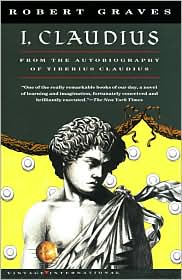
I, Claudius

I, Claudius. Robert Graves. 1934. 480 pages.

I, Tiberius Claudius Drusus Nero Germanicus This-that-and-the-other (for I shall not trouble you yet with all my titles) who was once, and not so long ago either, known to my friends and relatives and associates as “Claudius the Idiot,” or “That Claudius,” or “Claudius the Stammerer” or “Clau-Clau-Claudius” or at best as “Poor Uncle Claudius,” am now about to write this strange history of my life; starting from my earliest childhood and continuing year by year until I reach the fateful point of change where some eight years ago, at the age of fifty-one, I suddenly found myself caught in what I may call the “golden predicament” from which I have never since become disentangled.

This was an impulse read--or reread. I first read it in 2008 and I liked it. I didn't quite love it. I remember thinking at some point I want to read the sequel, one day I want to finish the story. But I wasn't in a rush. Obviously. But a few weeks ago, I saw it on the library shelf, and, well, I just HAD to read it. (I picked up both books because of course I wanted to read them both.)

What did I think the second time through this one? Well, I just LOVED it. I just loved, loved, loved it. Perhaps because I've changed as a reader. Perhaps because I knew the basic story and was free to enjoy the details more. I don't know why some books are just better the second time around. I would say the biggest difference--for me--was that there was no confusion the second time round. I wasn't lost with the names, I wasn't struggling with piecing together the story. The more I read, the more right it felt.

Anyway, the essentials remain:

Narrated by Claudius, I, Claudius is an often bloody memoir of the Roman empire under Augustus, Tiberius, and Caligula. (It might reference pre-Augustan Roman history, but it does so in a flashback kind of way.) What can I say about this one? The narration varies between being very witty and dry and sarcastic and just downright fun in that sort of way. But I won't lie either. There are hundreds of names from first to last. Some turn out to be key players, some disappear a page or two later--and it's hard to distinguish between the two. I did get lost in more than a few places trying to puzzle out who was who. But at the same time, it was enjoyable. Even though I didn't pick up on every single little detail, what I did pick up on and follow I enjoyed for the most part. The book is full of politics, plots, crimes, murders, and plenty of drama both small and grand in scale. Claudius had three wives and two main mistresses, for example, (one at a time though) and a few of them were truly scary. Livia, Claudius's grandmother, is one of the stars of the novel. She's a truly despicable character--poisoning and plotting to kill off most of the opposition even if the opposition were completely innocent and were her own flesh and blood.

© 2011 Becky Laney of Becky's Book Reviews

Wednesday, June 15, 2011

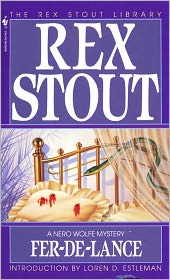
Fer-de-lance

Fer-de-lance. A Nero Wolfe Mystery. Rex Stout. 1934/1997. Random House. 304 pages.

There was no reason why I shouldn't have been sent for the beer that day, for the last ends of the Fairmont National Bank case had been gathered in the week before and there was nothing for me to do but errands, and Wolfe never hesitated about me running down to Murray Street for a can of shoe polish if he happened to need one. But it was Fritz who was sent for the beer.  

Fer-de-lance is the first Nero Wolfe mystery. It introduces readers to two private detectives, Nero Wolfe, and Archie Goodwin. I'm tempted to add in two of the BEST DETECTIVES in the world. But, I suppose that's just my opinion!

In Fer-de-lance, Fred Durkin introduces a woman to Nero Wolfe, Maria Maffei. This woman is worried about her brother, Carlo Maffei, who has gone missing. Archie Goodwin is sent to investigate. First he interviews those in the boarding house where Carlo lived--those that overheard Carlo's phone conversation; he then looks at Carlo's room, goes through his room looking for clues. He learns from Miss Anna Fiore that Carlo often gave her his newspaper after he was finished with it. The newspaper she got that Monday afternoon had a big hole in it--an entire article had been cut out. Nero Wolfe wants to know what article it was Carlo took such an interest in. After discovering the article was about the death of a golfer, Peter Oliver Barstow, he becomes interested in that death. Soon after Carlo Maffei is no longer missing at all--his body has been found. Though there is no obvious reason to link the two deaths together, to investigate them at the same time--especially since Barstow's death has been accepted as natural--Wolfe is convinced that the two are related. That Barstow was murdered. That his body should be exhumed and tested for poison. He's convinced that finding the murderer of one will lead him to solving the other murder. Who killed Peter Oliver Barstow? Was it poison? Who had motive and opportunity? And did Carlo know it was murder? Did Carlo know who killed Mr. Barstow? Is that how he ended up dead?

So Archie and Nero have plenty of work to do, plenty of clues to follow!

I enjoyed Fer-de-lance. It was fun to read the first mystery in this series. Archie and Nero are great fun in this one. Their dialogue still satisfies me. It's just so delightful to spend time with these two!

Nero Wolfe:

"A pessimist gets nothing but pleasant surprises, an optimist nothing but unpleasant." (3)

Nero Wolfe:

"Some day, Archie, when I decide you are no longer worth tolerating, you will have to marry a woman of very modest mental capacity to get an appropriate audience for your wretched sarcasms." (54)

Nero Wolfe:

"People often find it difficult to think in my presence, I do not leave enough space." (96)

Archie Goodwin:

"Everything that the doctor could tell me I had read three days earlier in the newspapers except for a bunch of medical terms which the papers hadn't tried to print for fear of a typesetters' strike." (139)

Archie Goodwin:

"You know what my boss says? He says that skepticism is a good watchdog if you know when to take the leash off." (143)

Nero Wolfe and Archie Goodwin:

"Tell Fritz there will be guests at lunch. What do boys that age eat?"
"They eat everything."
"Tell Fritz to have that." (165)


© 2011 Becky Laney of Becky's Book Reviews

Wednesday, March 02, 2011

A Man Lay Dead

A Man Lay Dead. Ngaio Marsh. 1934/1997. St. Martin's Press. 192 pages.

Nigel Bathgate, in the language of his own gossip column, was "definitely intrigued" about his weekend at Frantock. At twenty-five he had outgrown that horror of enthusiasm which is so characteristic of youth grown-up. 

A Man Lay Dead is the first mystery by Ngaio Marsh. It stars Roderick Alleyn as a detective, though it is narrated by Nigel Bathgate. Nigel's cousin, Charles Rankin, is quite good friends with Sir Hubert Handesley, a passionate collector, who enjoys throwing weekend parties for his closest friends. This weekend's guests includes: Charles, Nigel, Doctor Tokareff, Arthur and Marjorie Wilde, Angela North, and Rosamund Grant. The theme that weekend is murder. One guest will be assigned the role of murderer and given twenty-four hours to choose the victim and method. He or she will whisper to the 'victim', turn out the lights, and sound the gong. This will signal to everyone that a murder has been committed, everyone will wait two minutes, and then the second half of the game will begin. Each will try to solve the mystery. But. Of course, that is not how the weekend unfolds. For, as you might expect, a real murder will be committed. And it will be up to Inspector Roderick Alleyn to solve this one. Which of the guests--or was it the butler--had murder on his mind?!

I liked this one. I enjoyed it.

© 2011 Becky Laney of Becky's Book Reviews