Showing posts with label 1943. Show all posts

Monday, January 12, 2026

6. These Happy Golden Years


6. These Happy Golden Years. Laura Ingalls Wilder. Illustrated by Garth Williams. 1943. HarperCollins. 289 pages. [Source: Library] [5 stars, historical fiction, classic, audiobook]

First sentence: Sunday afternoon was clear, and the snow-covered prairie sparkled in the sunshine. A little wind blew gently from the south, but it was so cold that the sled runners squeaked as they slid on the hard-packed snow.

Why is it that reading These Happy Golden Years makes me giddy? Could it be my actual favorite of the series after all? Perhaps. It has been such a treat for me to reread these Little House books this past month. I've enjoyed visiting with Laura and her family. I've enjoyed watching 'the romance' unfold with Almanzo in Little Town on the Prairie and These Happy Golden Years.

In These Happy Golden Years Laura has accepted--for better or worse--that she is all grown up. In this book, she teaches several different schools. Each teaching term is short--a few months here, a few months there. Her first teaching position lasts eight weeks, and, it is mostly a nightmare for her. She's rooming with Mr. and Mrs. Brewster. And Mrs. Brewster must be suffering from some mental illness. I feel sorry for Mr. Brewster and their baby, Johnny. There's a helplessness in the situation. Laura realizes how blessed she's been for a happy home life. The opening chapters dwell on her homesickness and gratitude. And she owes much to Almanzo Wilder. For HE comes to "rescue" her from the Brewsters every single weekend no matter how cold the weather. And it all comes as such a surprise to her that she'll get to spend her weekends at home.

When she's not teaching school, she's attending it. Every few months, it seems, she receives an opportunity to teach and earn money, and she'll take a teacher's exam, and get another certificate. But teaching isn't the only way she's able to earn money. She really, truly wants to earn money, not for herself, but to help keep Mary in college.

Most of the book focuses on the courtship of Laura and Almanzo. How he comes to take her sledding or for buggy rides. Laura does love his horses.

I love this book! I do.

© 2026 Becky Laney of Becky's Book Reviews

Sunday, May 22, 2022

62. Meet the Malones


Meet the Malones. (Beany Malone #1) Lenora Mattingly Weber. 1943. 282 pages. [Source: Borrowed from a friend]

First sentence: MARY FRED MALONE had just bought a horse. He was black and his name was Mr. Chips and Mary Fred was riding him home.

Premise/plot: Meet the Malones is the first in a series of books that chronicles the [fictional] Malone family. Elizabeth, Mary Fred, Johnny, and Beany. The book is set during the Second World War in Colorado. Elizabeth's husband, Don, is overseas fighting. Their father, a journalist, has gone to Hawaii. The family is mostly on their own--except for when they aren't. Nonna, the grandmother, is a FIERCE force to be reckoned with when she does arrive. She does change the family dynamics quite a bit. 

The point of view in this one is all Mary Fred. She has her first misadventure with "love" in this one. As this "mop-squeezer" is swept off her feet by the super-popular football player who typically dates "queens." Elizabeth returns home with a newborn son to care for! The whole family helps out...not just with Elizabeth but with other children in need. There is a real spirit of hospitality and compassion in this one. (Though that may not extend all the way to the neighbor's dog.)

My thoughts: I enjoyed this one very much! I enjoyed getting to know the family. At times I was left wanting more--which overall I think is better than reverse. Each chapter is a "snapshot." Some focus more on family life at home, their relationships with each other. Others focus more on school OR the community. You do get a sense of how life on the home front is during the war. The war is never far from their minds, they are always thinking of ways they can help out the war effort and encourage/support those serving. 

Quotes:

  • The young Malones made their own decisions about lamb chops and life.  He was the delight of his English Lit teacher, gray-haired, gray-eyed, gray-garbed Miss Hewlitt.
  • ‘The highest price you can pay for a thing is to get it for nothing.’ That’s the trouble with this generation; they want everything—” 
  • Mary Fred said softly, “I read some place where courage is fear that has said its prayers.” 
  • “Rabbits,” groaned Beany. “Why do people always poke rabbits at children when they’re too young to defend themselves?” “They’re beautiful blankets,” Elizabeth insisted. 
  • Shame was different from grief or anxiety. You could share those with the ones you loved.
  • Elizabeth said earnestly, “I don’t think they ought to end stories like that for children. It gives them the wrong idea. There’s happiness in love—oh, happiness that shakes you and enriches you, but love and marriage isn’t a happy-ever-after thing. Love and marriage has so much ache and emptiness and hurt with the happiness.” 
  • Elizabeth detained them for one last word of admonition. “Now listen, gals, be sure you go out there to this soldiers’ dance with only one idea—not to have a good time yourselves but to give them one. Because you’ve got other good times ahead of you. But these kids—we don’t know what’s ahead for them.”
  • “I didn’t bring you here to gloat over you,” he said quietly, as he swerved the car around and started home. “I wanted you to see for yourself. You’re always talking about Nonna and her being like a fairy godmother. I’m not up on my fairy tales but it seems to me I read about some old woman who fed a girl a poisoned apple and it stuck in her throat and she lay in a coma until something jolted her and it fell out. I wanted to jolt you.”


© 2022 Becky Laney of Becky's Book Reviews

Monday, June 01, 2020

77. The Rat Began to Gnaw the Rope

The Rat Began to Gnaw the Rope. C.W. Grafton. 2020. Poisoned Pen Press. 304 pages. [Source: Review copy]

First sentence: My secretary said that there was a Miss Ruth McClure to see me and I said that she could come on in. The girl who stood in the doorway a moment later was small and lovely but she was obviously very unhappy and looked as if she were not sure she wanted to come in after all.

Premise/plot: As adults we don't really have D.E.A.R scheduled into our days, well, most don't. D.E.A.R. if you don't know means Drop Everything And Read. But this vintage mystery should be a must-must-must read for all mystery lovers.

Originally published in 1943, it stars an amateur detective, Gilmore "Gil" Henry, a lawyer. A young woman, Ruth McClure, comes to him--as a lawyer--seeking his services. She has a couple of questions about some stock she has inherited after her father's death. Henry takes the case, and, well a lot more comes with that--than he was expecting! His close encounters with death start piling up!!!! Somebody does not want him helping out Miss McClure. But why?!?!

My thoughts: I loved, loved, loved, loved, LOVED this vintage mystery. It perhaps isn't perfectly perfect. It is very much a product of its time. It was written and published during the second world war. But for adult readers with an appreciation for context that don't find offense at the drop of a hat, I think it would prove a delightful escape.

I love the narrative! I love Gil Henry. It's not often you get pudgy, chubby detectives that are way out of their element but super stubborn. I love the description as well.

As I reached the city limits I turned on the radio and caught a hot swing band with one of these women crooners who sounds as if she has gallstones. It was starting to rain a little and the black-top road was shiny like seals in the circus.


I was about halfway down the steep hill when there was a sharp explosion and the car jumped and twisted under me like a hula dancer. I went down that hill in a wild zigzag, keeping to the road for fifty or seventy-five yards by pressing my hundred and eighty pounds against the wheel and trying to anticipate each move. Then I went into a spin and the last thing I heard was the high whine of the tires skidding sidewise. I ought to be dead. How many times the car turned over I don’t know but when I came to, I was hanging halfway out of the door by the driver’s seat and the car was upright some thirty feet off the road down a slight incline.


I began to get a pretty good idea of what Tim McClure might look like when I tried to put on the suit I found on the bed. It may not have been a zoot suit6 but the way I wore it, it certainly had a drape shape. I rolled up probably eight inches around my ankles and the overlap at my waistline was something to look at. The shoulders of the coat hung down almost to my elbows and, of course, my hands were clear out of sight up the sleeves. No wonder Miss Ruth McClure laughed when she saw me. I was a dead ringer for the smallest of the seven dwarfs and sure enough she called me Dopey.


Every person has some cross to bear. Mine is that I am not shaped like people who are intended to get their clothes in ready-to-wear shops. If clothes are to fit me in the middle, they have to be too long at the ends and if they are to fit me at the ends, they hurt me in the middle.


I didn’t want to take the time to wait while alterations were made so I took a suit which hurt when I buttoned it at the waist. Mr. Silverstein had on a black skull cap and a measuring tape hung around his neck. He patted and smoothed and pulled at things to make them hang right and appeared to approve in every particular although he finally said that maybe it was a little snug. I thought snug was hardly the appropriate word since my belt was almost out of sight and I could tell that I would not want to sit down very often.


I regretted my decision when I crawled in under the wheel of the car. They say when you cut earthworms in two, the halves go about their own business and supply whatever it takes to carry on, but I am no earthworm and I had no faith in my ability to do the same.


I wondered if there was any way to grow a new tooth, remove bruises, reduce thirty pounds or grow eight inches taller in a few minutes, but decided there wasn’t. I thought about buying a new suit and incidentally giving my tortured stomach a rest, but with the other details so accurately reported, I thought it would be a waste of time and money. There wasn’t any water at the newsstand so I took two tablets out of the box and munched them disagreeably as I walked down the street wondering how long it would be before I was on the inside looking out.


People who fix things to eat like to see other people eat them, especially when they are hungry and say so, and I was so hungry it must have been shining out of my eyes for anybody to see.


Well, you can’t stand in one spot forever. Acorns do it and get to be oak trees and leaves grow all over them and by and by they can’t move at all.


© 2020 Becky Laney of Becky's Book Reviews

Wednesday, June 24, 2015

The Little Prince (1943)

The Little Prince. Antoine de Saint-Exupery. Translated by Richard Howard. 1943/2013. Houghton Mifflin Harcourt. 112 pages. [Source: Review copy]

Once when I was six I saw a magnificent picture in a book about the jungle, called True Stories. It showed a boa constrictor swallowing a wild beast... 

I've read Little Prince twice now. I've enjoyed it both times. The book is quirky and at times quite delightful. Its story is definitely unique!

A pilot crashes in the desert and meets a strange 'little prince.' They have many conversations together over the course of a week. These conversations make up the heart of The Little Prince. It's a quick little read.


Favorite quotes:

"It is only with the heart that one can see rightly. What is essential is invisible to the eye.”
“All grown-ups were once children... but only few of them remember it.”
“But if you tame me, then we shall need each other. To me, you will be unique in all the world. To you, I shall be unique in all the world.”
© 2015 Becky Laney of Becky's Book Reviews

Friday, March 27, 2015

These Happy Golden Years (1943)

These Happy Golden Years. Laura Ingalls Wilder. Illustrated by Garth Williams. 1943. HarperCollins. 289 pages. [Source: Library]

Why is it that reading These Happy Golden Years makes me giddy? Could it be my actual favorite of the series after all? Perhaps. It has been such a treat for me to reread these Little House books this past month. I've enjoyed visiting with Laura and her family. I've enjoyed watching 'the romance' unfold with Almanzo in Little Town on the Prairie and These Happy Golden Years.

In These Happy Golden Years Laura has accepted--for better or worse--that she is all grown up. In this book, she teaches several different schools. Each teaching term is short--a few months here, a few months there. Her first teaching position lasts eight weeks, and, it is mostly a nightmare for her. She's rooming with Mr. and Mrs. Brewster. And Mrs. Brewster must be suffering from some mental illness. I feel sorry for Mr. Brewster and their baby, Johnny. There's a helplessness in the situation. Laura realizes how blessed she's been for a happy home life. The opening chapters dwell on her homesickness and gratitude. And she owes much to Almanzo Wilder. For HE comes to "rescue" her from the Brewsters every single weekend no matter how cold the weather. And it all comes as such a surprise to her that she'll get to spend her weekends at home.

When she's not teaching school, she's attending it. Every few months, it seems, she receives an opportunity to teach and earn money, and she'll take a teacher's exam, and get another certificate. But teaching isn't the only way she's able to earn money. She really, truly wants to earn money, not for herself, but to help keep Mary in college.

Most of the book focuses on the courtship of Laura and Almanzo. How he comes to take her sledding or for buggy rides. Laura does love his horses.

I love this book! I do.

© 2015 Becky Laney of Becky's Book Reviews
Sunday, December 21, 2014

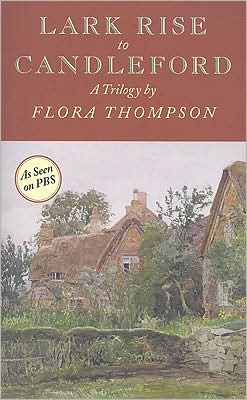
Lark Rise to Candleford (1943)

Lark Rise to Candleford. Flora Thompson. 1943. 537 pages. [Source: Bought]

Did I enjoy reading Flora Thompson's Lark Rise to Candleford? Yes. Did I enjoy all three books equally? Probably not. Did I enjoy any one book as much as I loved the TV adaptation? Probably not. Lark Rise to Candleford is an omnibus edition of a trilogy: Lark Rise, Over to Candleford, and Candleford Green.

The first book in the series is Lark Rise. What I liked about Lark Rise was the fact that it had a cozy yet realistic feel to it. The chapters capture what life was like in a specific time and place, a particular part of the country in the 1880s. Rural vignettes. The book is rich in detail and description. Nothing happens but description. A sampling of chapter titles: "A Hamlet Childhood," "Men Afield," "At the 'Wagon and Horses'," "Callers," "Country Playtime," "School," "May Day," "To Church on Sunday."

The second book in the series is Over to Candleford. This book is definitely more personal in nature. For the most part, it focuses on one young girl, Laura. Readers see Laura at home, at school, at play, at church, visiting cousins, aunts, and uncles, etc. It is still rich in description and detail. Even though it is a more personal look at life in the country in the 1880s and 90s, it is still heavier on the descriptions than the action. This isn't a book that focuses on stories and storytelling. The book ends with a young Laura--perhaps twelve or thirteen--getting an apprentice job in Candleford Green with the postmistress Miss Dorcas Lane.

The third book in the series is Candleford Green. The book opens with Laura leaving home. She's excited and timid. The book will see her established in this new life. She'll be meeting new people, living in a new place, experiencing new things, growing up into a young woman. I was disappointed with this book. I haven't decided if I'm disappointed because it lacks characterization and plot in general OR if I'm disappointed because it lacks the characterization and plot that the television adaptation brought to it. The book's strength is in description and vignettes. The book's weakness is that there are not really any connecting stories or plot sequences. People are mentioned by name, perhaps, but in a very superficial just a few paragraphs way. The characters lack depth. A sentence or two here and there does not make good characterization. If the heroine, Laura, was fully developed and the chapters worked as a personal narrative capturing her experiences, thoughts, and struggles, then I think it might have worked better for me. But there was no person to connect to, no connecting-story to follow. It was just one description after another. There were passages I enjoyed reading. Laura does like to read! But nothing about it that made me LOVE it. I liked it well enough.

© 2014 Becky Laney of Becky's Book Reviews
Tuesday, June 10, 2014

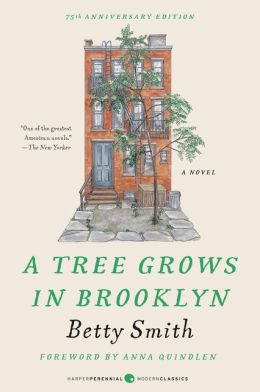
A Tree Grows In Brooklyn (1943)

A Tree Grows in Brooklyn. Betty Smith. 1943/2006. HarperCollins. 496 pages. [Source: Bought]

Oh how I loved Betty Smith's A Tree Grows in Brooklyn. Readers get the chance to get to know Francie, the heroine, her brother, Neeley, her mother, Katie, her father, Johnny, her aunts, Sissy and Evy, and her grandmother, Mary Rommely. A Tree Grows in Brooklyn is set circa 1910-1918 in Brooklyn, New York; it is very much a coming-of-age novel focusing on Francie, yet expanding to include several generations of her family. The book has a good number of flashbacks letting readers get to know all the members of the family before getting good and settled in Francie's life. It is a book that embraces ALL of life: the big things, the little things: no matter how ugly or beautiful. Truth does not equal beauty as Francie learns. I loved Francie's passion for living. I loved her observations.

A Tree Grows In Brooklyn is rich in detail AND rich in characterization. It is not a fast-paced action, adventure novel. It is a character-driven, family-focused historical novel. It doesn't try to make people better than they are. It is realistic and honest. The characters are very human, very fallible. One of the themes is in fact being true and honest. Francie has a confrontation with an English teacher. The teacher is trying to shame Francie into writing only about the beautiful, precious things of life. Sunsets. Stars. Flowers. She has been writing about her life, about her father, about her childhood. Her teacher tells her to go home and burn these writings and say "this is ugliness, this is ugliness, this is ugliness." Francie finally submits enough to be able to end the conversation and leave the room, but she's holding strong to who she is and where she comes from.

It is a beautifully written novel. It is very quotable.
The one tree in Francie’s yard was neither a pine nor a hemlock. It had pointed leaves which grew along green switches which radiated from the bough and made a tree which looked like a lot of opened green umbrellas. Some people called it the Tree of Heaven. No matter where its seed fell, it made a tree which struggled to reach the sky. It grew in boarded-up lots and out of neglected rubbish heaps and it was the only tree that grew out of cement. It grew lushly, but only in the tenements districts.
An eleven-year-old girl sitting on this fire escape could imagine that she was living in a tree. That’s what Francie imagined every Saturday afternoon in summer.
THE LIBRARY WAS A LITTLE OLD SHABBY PLACE. FRANCIE THOUGHT it was beautiful. The feeling she had about it was as good as the feeling she had about church. She pushed open the door and went in. She liked the combined smell of worn leather bindings, library paste and freshly inked stamping pads better than she liked the smell of burning incense at high mass.
Francie thought that all the books in the world were in that library and she had a plan about reading all the books in the world. She was reading a book a day in alphabetical order and not skipping the dry ones.
“Mother, I am young. Mother, I am just eighteen. I am strong. I will work hard, Mother. But I do not want this child to grow up just to work hard. What must I do, Mother, what must I do to make a different world for her? How do I start?” “The secret lies in the reading and the writing. You are able to read. Every day you must read one page from some good book to your child. Every day this must be until the child learns to read. Then she must read every day, I know this is the secret.”
“I will read,” promised Katie. “What is a good book?” “There are two great books. Shakespeare is a great book. I have heard tell that all the wonder of life is in that book; all that man has learned of beauty, all that he may know of wisdom and living are on those pages. It is said that these stories are plays to be acted out on the stage. I have never spoken to anyone who has seen this great thing. But I heard the lord of our land back in Austria say that some of the pages sing themselves like songs.”
“And what is the other great book?” “It is the Bible that the Protestant people read.” “We have our own Bible, the Catholic one.” Mary looked around the room furtively. “It is not fitting for a good Catholic to say so but I believe that the Protestant Bible contains more of the loveliness of the greatest story on this earth and beyond it. A much-loved Protestant friend once read some of her Bible to me and I found it as I have said.
“That is the book, then, and the book of Shakespeare. And every day you must read a page of each to your child—even though you yourself do not understand what is written down and cannot sound the words properly. You must do this that the child will grow up knowing of what is great—knowing that these tenements of Williamsburg are not the whole world.”
Everything struggles to live. Look at that tree growing up there out of that grating. It gets no sun, and water only when it rains. It’s growing out of sour earth. And it’s strong because its hard struggle to live is making it strong. My children will be strong that way.”
Well, everybody’s something. We all got a tag of some kind.
She found to her agony, that the doctor was still there, poised needle and all. He was staring at her arm in distaste. Francie looked too. She saw a small white area on a dirty dark-brown arm. She heard the doctor talking to the nurse. “Filth, filth, filth, from morning to night. I know they’re poor but they could wash. Water is free and soap is cheap. Just look at that arm, nurse.” The nurse looked and clucked in horror. Francie stood there with the hot flamepoints of shame burning her face.
After the doctor’s outburst, Francie stood hanging her head. She was a dirty girl. That’s what the doctor meant. He was talking more quietly now asking the nurse how that kind of people could survive; that it would be a better world if they were all sterilized and couldn’t breed anymore. Did that mean he wanted her to die? Would he do something to make her die because her hands and arms were dirty from the mud pies?
“My brother is next. His arm is just as dirty as mine so don’t be surprised. And you don’t have to tell him. You told me.” They stared at this bit of humanity who had become so strangely articulate. Francie’s voice went ragged with a sob. “You don’t have to tell him. Besides it won’t do no good. He’s a boy and he don’t care if he is dirty.”
She put her arm around her and held her close to her own life warmth. “Francie, baby, you’re trembling like a leaf.” Francie had never heard that expression and it made her thoughtful. She looked at the little tree growing out of the concrete at the side of the house. There were still a few dried leaves clinging to it. One of them rustled dryly in the wind. Trembling like a leaf. She stored the phrase away in her mind.
“Forgiveness,” said Mary Rommely, “is a gift of high value. Yet its cost is nothing.”
OH, MAGIC HOUR WHEN A CHILD FIRST KNOWS IT CAN READ PRINTED WORDS!
For quite a while, Francie had been spelling out letters, sounding them and then putting the sounds together to mean a word. But one day, she looked at a page and the word “mouse” had instantaneous meaning. She looked at the word, and the picture of a gray mouse scampered through her mind. She looked further and when she saw “horse,” she heard him pawing the ground and saw the sun glint on his glossy coat. The word “running” hit her suddenly and she breathed hard as though running herself. The barrier between the individual sound of each letter and the whole meaning of the word was removed and the printed word meant a thing at one quick glance. She read a few pages rapidly and almost became ill with excitement. She wanted to shout it out. She could read! She could read! From that time on, the world was hers for the reading. She would never be lonely again, never miss the lack of intimate friends. Books became her friends and there was one for every mood. There was poetry for quiet companionship. There was adventure when she tired of quiet hours. There would be love stories when she came into adolescence and when she wanted to feel a closeness to someone she could read a biography. On that day when she first knew she could read, she made a vow to read one book a day as long as she lived.
She liked numbers and sums. She devised a game in which each number was a family member and the “answer” made a family grouping with a story to it. Naught was a babe in arms. He gave no trouble. Whenever he appeared you just “carried” him. The figure 1 was a pretty baby girl just learning to walk, and easy to handle; 2 was a baby boy who could walk and talk a little. He went into family life (into sums, etc.) with very little trouble. And 3 was an older boy in kindergarten, who had to be watched a little. Then there was 4, a girl of Francie’s age. She was almost as easy to “mind” as 2. The mother was 5, gentle and kind. In large sums, she came along and made everything easy the way a mother should. The father, 6, was harder than the others but very just. But 7 was mean. He was a crotchety old grandfather and not at all accountable for how he came out. The grandmother, 8, was hard too, but easier to understand than 7. Hardest of all was 9. He was company and what a hard time fitting him into family life! When Francie added a sum, she would fix a little story to go with the result. If the answer was 924, it meant that the little boy and girl were being minded by company while the rest of the family went out. When a number such as 1024 appeared, it meant that all the little children were playing together in the yard. The number 62 meant that papa was taking the little boy for a walk; 50 meant that mama had the baby out in the buggy for an airing and 78 meant grandfather and grandmother sitting home by the fire of a winter’s evening. Each single combination of numbers was a new set-up for the family and no two stories were ever the same.
Francie was ten years old when she first found an outlet in writing. What she wrote was of little consequence. What was important was that the attempt to write stories kept her straight on the dividing line between truth and fiction.
“TODAY, I AM A WOMAN,” WROTE FRANCIE IN HER DIARY IN THE summer when she was thirteen. She looked at the sentence and absently scratched a mosquito bite on her bare leg. She looked down on her long thin and as yet formless legs. She crossed out the sentence and started over. “Soon, I shall become a woman.” She looked down on her chest which was as flat as a washboard and ripped the page out of the book. She started fresh on a new page.
“But poverty, starvation and drunkenness are ugly subjects to choose. We all admit these things exist. But one doesn’t write about them.” “What does one write about?” Unconsciously, Francie picked up the teacher’s phraseology. “One delves into the imagination and finds beauty there. The writer, like the artist, must strive for beauty always.” “What is beauty?” asked the child. “I can think of no better definition than Keats’: ‘Beauty is truth, truth beauty.’”
Francie took her courage into her two hands and said, “Those stories are the truth.”
“Nonsense!” exploded Miss Garnder. Then, softening her tone, she continued: “By truth, we mean things like the stars always being there and the sun always rising and the true nobility of man and mother-love and love for one’s country,” she ended anti-climactically. “I see,” said Francie. As Miss Garnder continued talking, Francie answered her bitterly in her mind. “Drunkenness is neither truth nor beauty. It’s a vice. Drunkards belong in jail, not in stories. And poverty. There is no excuse for that. There’s work enough for all who want it. People are poor because they’re too lazy to work. There’s nothing beautiful about laziness. (Imagine Mama lazy!) “Hunger is not beautiful. It is also unnecessary. We have well-organized charities. No one need go hungry.” Francie ground her teeth. Her mother hated the word “charity” above any word in the language and she had brought up her children to hate it too. “Now, I’m not a snob,” stated Miss Garnder. “I do not come from a wealthy family. My father was a minister with a very small salary.” (But it was a salary, Miss Garnder.)
“And the only help my mother had was a succession of untrained maids, mostly girls from the country.” (I see. You were poor, Miss Garnder, poor with a maid.) “Many times we were without a maid and my mother had to do all the housework herself.” (And my mother, Miss Garnder, has to do all her own housework, and yes, ten times more cleaning than that.) “I wanted to go to the state university but we couldn’t afford it. My father had to send me to a small denominational college.” (But admit you had no trouble going to college.) “And believe me, you’re poor when you go to such a college. I know what hunger is, too. Time and time again my father’s salary was held up and there was no money for food. Once we had to live on tea and toast for three days.” (So you know what it is to be hungry, too.) “But I’d be a dull person if I wrote about nothing but being poor and hungry, wouldn’t I?” Francie didn’t answer. “Wouldn’t I?” repeated Miss Garnder emphatically. “Yes ma’am.”
“I’ve taken all this time with you because I honestly believe that you have promise. Now that we’ve talked things out, I’m sure you’ll stop writing those sordid little stories.” Sordid. Francie turned the word over. It was not in her vocabulary. “What does that mean—sordid?”
Sordid: Filthy. Filthy? She thought of her father wearing a fresh dicky and collar every day of his life and shining his worn shoes as often as twice a day. Dirty. Papa had his own mug at the barber shop. Base. Francie passed that up not knowing exactly what it meant. Gross. Never! Papa was a dancer. He was slender and quick. His body wasn’t gross. Also mean and low. She remembered a hundred and one little tendernesses and acts of thoughtfulness on the part of her father. She remembered how everyone had loved him so. Her face got hot. She couldn’t see the next words because the page turned red under her eyes. She turned on Miss Garnder, her face twisted with fury. “Don’t you ever dare use that word about us!” “Us?” asked Miss Garnder blankly. “We were talking about your compositions. Why, Frances!” Her voice was shocked. “I’m surprised! A well-behaved girl like you. What would your mother say if she knew you had been impertinent to your teacher?” Francie was frightened. Impertinence to a teacher was almost a reformatory offense in Brooklyn. “Please excuse me. Please excuse me,” she repeated abjectly. “I didn’t mean it.” “I understand,” said Miss Garnder gently. She put her arm around Francie and led her to the door. “Our little talk has made an impression on you, I see. Sordid is an ugly word and I’m glad you resented my using it. It shows that you understand. Probably you don’t like me any more, but please believe that I spoke for your own good.
 Yes, the world was changing rapidly and this time she knew it was the world and not herself.
“Dear God,” she prayed, “let me be something every minute of every hour of my life. Let me be gay; let me be sad. Let me be cold; let me be warm. Let me be hungry…have too much to eat. Let me be ragged or well dressed. Let me be sincere—be deceitful. Let me be truthful; let me be a liar. Let me be honorable and let me sin. Only let me be something every blessed minute. And when I sleep, let me dream all the time so that not one little piece of living is ever lost.”
The last time of anything has the poignancy of death itself. This that I see now, she thought, to see no more this way. Oh, the last time how clearly you see everything; as though a magnifying light had been turned on it. And you grieve because you hadn’t held it tighter when you had it every day. What had Granma Mary Rommely said? “To look at everything always as though you were seeing it either for the first or last time: Thus is your time on earth filled with glory.”

© 2014 Becky Laney of Becky's Book Reviews

Friday, March 15, 2013

The Little Prince (1943)

The Little Prince. Antoine de Saint-Exupery. 1943/2013. Houghton Mifflin Harcourt. 112 pages.

The Little Prince is unique and delightfully odd. A pilot crashes in the desert and meets a strange 'little prince.' They have many conversations together over the course of a week. These conversations make up the heart of The Little Prince. It's a quick little read. I am glad I read it.

Favorite quotes:
"It is only with the heart that one can see rightly. What is essential is invisible to the eye.”
“All grown-ups were once children... but only few of them remember it.”
“But if you tame me, then we shall need each other. To me, you will be unique in all the world. To you, I shall be unique in all the world.”
Read The Little Prince
  • If you enjoy children's classics
  • If you enjoy beautiful writing
  • If you like quirky, unique stories
  • If you like reading books in translation

© 2013 Becky Laney of Becky's Book Reviews