Showing posts with label 1977. Show all posts

Friday, January 26, 2024

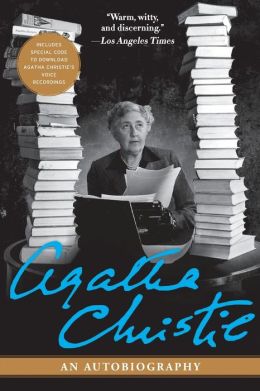
12. Agatha Christie: An Autobiography


An Autobiography. Agatha Christie. 1977/1996. Berkley. 635 pages. [Source: Bought] 

ETA: I reread this one in January 2024. It had been years since I first read this one. I have so many dog-eared pages from both readings. If I was to quote everything I marked to "remember" to come back to, it would be so long. Definitely glad I reread this one.

Agatha Christie's autobiography has been on my tbr pile for years now. I have looked forward to reading it for so long! I must admit the length had me a little intimidated. But once I started reading this one, I found myself completely absorbed in it. It is truly a fascinating read cover to cover. I think this one could prove appealing to a variety of readers.

Do you love history? I found Agatha Christie's Autobiography to be fascinating. This book is rich in details. Readers learn in great detail about her family and her growing up years. What Christie is describing is a way of life, and the way she saw the world around her. Her thoughts on her parents, grandparents, siblings, the family servants--the cook and the maids and nannies. You get a real sense of what it was to be a child (and teen) growing up in England in the 1890s and 1900s. She was "out" (ready to date) a year or two (or even three) before World War I began.

Are you interested in World War I? in World War II? Christie details what life was like during the war years. She was a nurse for a great part of World War I. She also assisted in dispensing drugs. She fell in love and got married during this time. During World War II she again did her part in the war effort. I believe volunteering in a hospital. She was in and around London during the War. She recalls how she rarely (if ever) took shelter during the raids because she was afraid of being buried alive under all the rubble. She had a grown daughter by that point. A daughter who fell in love, got married, and had a child during this time.

England was at war. It had come. I can hardly express the difference between our feelings then and now. Now we might be horrified, perhaps surprised, but not really astonished that war should come, because we are all conscious that war does come; that it has come in the past and that, at any moment, it might come again. But in 1914 there had been no war for--how long? Fifty years--more? True, there had been the "Great Boer War," and skirmishes on the Northwest frontier, but those had not been wars involving one's own country--they had been large army exercises, as it were; the maintenance of power in far places. This was different--we were at war with Germany. (257)
Are you interested in archaeology? in world-traveling? She spends a good deal of time recalling her travels around the world. She accompanied her first husband on an extended trip--covering several continents. (She left her (quite young) daughter with her mother and sister.) After her divorce--he fell in love with another woman and blamed her for it--she traveled on her own. On one of her trips to the Middle East, she met the man who would become her second husband. He was an archaeologist. While she did not stay with him the duration of all of his digs, she accompanied him on some, and visited on others. Readers learn that Christie LOVED, LOVED, LOVED to travel.

Are you a rehab addict? Christie loved looking at houses, buying houses in need of repair, fixing them up, renting them out, and selling them. She owned many properties at various points in her life. I believe the book said she owned eight during World War II. The book talks about her remodeling and redesigning houses.

Are you interested in writing, in her writing life? You'll find plenty to delight you within her autobiography. She talks about different sides of her writing life. Her novels. Her mystery novels. Her plays. Her short stories. Her poems. She talks about her mistakes and successes. Readers learn about which books she liked best and which book she really, really hated!
It was while I was working in the dispensary that I first conceived the idea of writing a detective story. (289)
People never stop writing to me nowadays to suggest that Miss Marple and Hercule Poirot should meet--but why should they? I am sure the would not enjoy it at all. Hercule Poirot, the complete egoist, would not like being taught his business by an elderly spinster lady. He was a professional sleuth, he would not be at home all in Miss Marple's world. No, they are both stars, and they are stars in their own right. (502)
Do you love to read? Christie shares her thoughts on her favorite writers and books!

I want to emphasize the fact that you do not have to love mysteries in order to find this autobiography of a mystery writer fascinating! I marked so many passages that I wanted to share with you. Too many to actually share. It would overwhelm any post. So just trust me, read this one!

I will choose a quote which happens to bring to mind a certain song from Frozen.
One of the first things that happens when you are attracted to a man and he is to you is that extraordinary illusion that you think exactly alike about everything, that you each say the things the other has been thinking. (228)


© 2024 Becky Laney of Becky's Book Reviews

Monday, January 14, 2019

Seven Alone

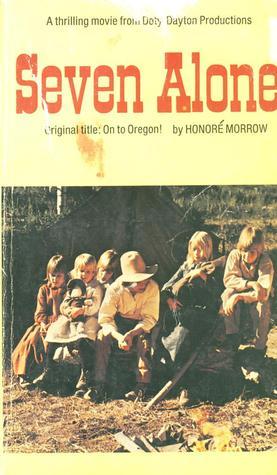
Seven Alone. Honore Willsie Morrow. 1926/1977. Scholastic. 240 pages. [Source: Own]

First sentence: This is the story of a great boy pioneer. Perhaps there have been other boy pioneers, thirteen years of age, who were as great as John Sager, but, if so, I have not heard about them.

Premise/plot: Seven Alone is based on the true story of the Sager family. It was originally published as On to Oregon in 1926. It was retitled Seven Alone in the 1970s when a movie adaptation was made.

Henry and Naomi Sager had seven children: John, Francis, Catherine, Elizabeth, Matilda, Louisa, and Henrietta. Their seventh was born on the Oregon Trail. Both parents died on their way west; first the father and then the mother. Before she died she urged her oldest, John, to keep the family together no matter what.

The book chronicles their journey from start to finish. Even if the parents had not died, it would have been a difficult, near-impossible journey for a family to make. The trail was unkind to all alike--men, women, children, babies. There were many, many dangers. No day was without risks and dangers.

The last third of the book has John and his siblings essentially traveling the trail on their own as they seek--in vain, for the most part--to catch up with the wagon train. The wagon train, meanwhile, had broken up into different groups. It became obvious that the family's only hope was to reach the Whitman Mission.

The book--for better or worse--ends happily with the family reaching the Whitmans. (The Whitman Massacre was in November 1847. John and Francis were among those massacred. The other Sager children were among those held captive.)

My thoughts: I remember watching the movie as a child. I honestly can't remember if I read this one as a child. If I'd known--as a child--how the story really ended, I'm sure I would not have read it. If I didn't know, then there's a possibility I read it oblivious to the tragic ending. I did enjoy--then and now--a good pioneer story.

John's story is one of transformation. When the book opens he is a rebellious, selfish, irresponsible brat. But as the journey progresses as he comes to realize the life-and-death nature of the trail, he matures quickly. He becomes courageous, determined, resilient, responsible. His parents' God becomes his God as he comes to rely on Him. When the book opened, John almost rolled his eyes at the daily Bible reading and prayer. But that foundation was not built in vain as John came to see.
© 2019 Becky Laney of Becky's Book Reviews

Wednesday, August 23, 2017

Nate the Great and the Phony Clue

Nate the Great and the Phony Clue. (Nate the Great #4) Marjorie Weinman Sharmat. Illustrated by Marc Simont. 1977. 80 pages. [Source: Library]

First sentence: I, Nate the Great, am a great detective. I have just solved a big case. It did not look like a big case when it started this morning.

Premise/plot: This case isn't like an ordinary case for Nate. Though he doesn't know that at the beginning. Careful readers can pick up on this from the start: "The Phony Clue." Nate follows clues throughout, but, the first clue is a piece of paper he finds with the word "vita" on it. It's a ripped piece of paper--Nate knows it's part of a larger message. But what is the message, and, who is it for?

My thoughts: Of the books I've read so far in the series, this is my least favorite. Though I must say it was nice to see Annie and Fang again. And also we meet Finley and Pip. I like meeting the kids in the neighborhood. And Nate himself is always fun to spend time with.

© 2017 Becky Laney of Becky's Book Reviews

Friday, December 04, 2015

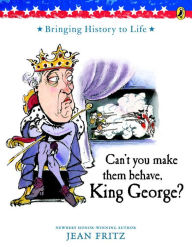
Can't You Make Them Behave, King George

Can't You Make Them Behave, King George? Jean Fritz. Illustrated by Tomie dePaola. 1977/1996. 48 pages. [Source: Library]

I am so glad I read Jean Fritz's Can't You Make Them Behave, King George? I found this one to be a delight. And not just because I happen to love Horrible Histories' Born 2 Rule. (I should probably make that love, love, love, LOVE. I love Horrible Histories, the show in general, and the songs very, very much.) I've almost always enjoyed studying British literature and British history more than American. Though in the case of this book, you get a bit of both!

Can't You Make Them Behave, King George? is about the reign of George III. How he came to the throne, what kind of king he was, what he was remembered for, etc. A lot of the focus is on the conflict, the war, with the American colonies. But it isn't just about the American Revolution either. Plenty of attention is placed on the royal family which I loved.

This biography is definitely for mid-to-upper elementary students. A good read aloud for first grade it isn't! There is a lot of text per page, but, there are also plenty of illustrations. And the illustrations are by Tomie dePaola. Some are in color, others are in black and white. But the important thing is that there are illustrations. I've mentioned it before, but, it's worth repeating. When I had to choose a nonfiction book for report, required reading, I decided which book based on the length and the number of illustrations. This one would have been well received by me!

I read a reprint edition that came out circa 2009. It was originally published in 1977.

© 2015 Becky Laney of Becky's Book Reviews

Saturday, October 10, 2015

Seuss on Saturday #41

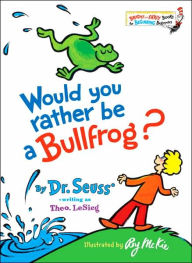
Would You Rather Be A Bullfrog? Theo LeSieg (Dr. Seuss). Illustrated by Roy McKie. 1975. Random House. 36 pages. [Source: Library]

First sentence: Tell me! Would you rather be a Dog...or be a Cat? It's time for you to think about important things like that. 

Premise/plot: The narrator asks readers a long series of questions. All questions are silly--or at the very least playful--but some are sillier than others. Some questions are about which animal you'd rather be. Others are about inanimate objects like...would you rather be a ball or a bat OR would you rather be a door or window.

My thoughts: First time reading this one. Honestly I'm not sure I have a decided opinion on it. I certainly liked it better than I thought I would. But I had low expectations in mind. I wasn't expecting it to be a great find, something I'd been "missing" in my life. It was fun in its way. And I think I liked it well enough. Perhaps it will help me remember the difference between rather and whether.

Have you read Would You Rather Be A Bullfrog? Did you like it? love it? hate it? I'd love to know what you thought of it!

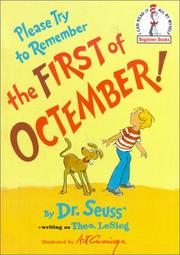
Please Try to Remember the First of Octember. Theo LeSieg (Dr. Seuss). Illustrated by Art Cumings. 1977. Random House. 48 pages. [Source: Library]

First sentence: Everyone wants a big green kangaroo. Maybe, perhaps, you would like to have TWO. I want you to have them. I'll buy them for you... if you'll wait till the first of Octember.

Premise/plot: All your dreams and wishes will come true...on the first of Octember. "You'll get all that you want. You just write out your list. Everyone has an Octember First list. Write slowly now! Don't break your wrist.

My thoughts: Dare I admit I want to write an Octember First list?!?! I had low expectations for this one. I didn't think it would be much of a book. But I really ended up liking it. If you haven't read it yet, you should!

 Have you read Please Try to Remember The First of Octember!? Did you like it? love it? hate it? I'd love to know what you thought of it!

If you'd like to join me in reading or rereading Dr. Seuss (chronologically) I'd love to have you join me! The next book I'll be reviewing is I Can Read With My Eyes Shut.

© 2015 Becky Laney of Becky's Book Reviews

Tuesday, June 30, 2015

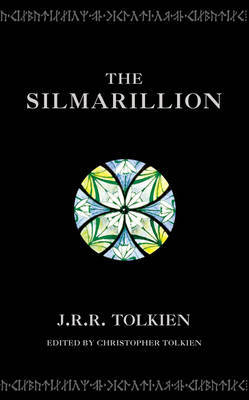
The Silmarillion (1977)

The Silmarillion. J.R.R. Tolkien. 1977. 386 pages. [Source: Bought]
 There was Eru, the One, who in Arda is called Ilúvatar; and he made first the Ainur, the Holy Ones, that were the offspring of his thought, and they were with him before aught else was made. And he spoke to them, propounding to them themes of music; and they sang before him, and he was glad. But for a long while they sang only each alone, or but few together, while the rest hearkened; for each comprehended only that part of the mind of Ilúvatar from which he came, and in the understanding of their brethren they grew but slowly. Yet ever as they listened they came to deeper understanding, and increased in unison and harmony. And it came to pass that Ilúvatar called together all the Ainur and declared to them a mighty theme, unfolding to them things greater and more wonderful than he had yet revealed; and the glory of its beginning and the splendour of its end amazed the Ainur, so that they bowed before Ilúvatar and were silent.
I loved reading J.R.R. Tolkien's The Silmarillion. That doesn't mean I found it easy the first time I attempted it. Or even the second. I do think you have to be in the proper mood to fully enjoy it--to appreciate it. There is a beauty to it, a certain grace to the language. Something that you don't see all that often. Something that brings to my mind--at least--the beauty and grace of the Authorized Version of the Bible (KJV). But with that beauty and grace there is a certain strangeness, a foreignness. Something that puts distance between the book and the reader. It's all about the world-building.

The Silmarillion is divided into several sections:
  • AINULINDALË
  • VALAQUENTA
  • QUENTA SILMARILLION
  • AKALLABÊTH 
  • OF THE RINGS OF POWER AND THE THIRD AGE  
Each section is unique, has its own style or tone. The longest section is Quenta Silmarillion. The section probably with the most reader appeal is Of The Rings of Power and the Third Age.

So is The Silmarillion similar to his other works? Yes and no. There are orcs, dwarves, elves, eagles, dragons, balrogs, wolves, giant spiders, humans, and wizards. And certainly much of The Silmarillion concerns the battle between good and evil. The two main "bad guys" are Melkor (Morgoth) and Sauron. And the book is about greed, ambition, honor, love, and friendship. There's plenty of action, and even some romance. The book features origin or creation stories. So there's a good chance that you can learn more background for putting The Lord of the Rings and The Hobbit into context. But it does require some patience perhaps. For example, people rarely have one name--they may have up to a dozen! Turin Turambar comes to mind. I wish I'd known about the family trees at the end of the book while I was actually reading it!

Yes, The Silmarillion is beautifully written. But that isn't its only strength. The world-building is incredibly detailed. Its also packed with stories and interesting characters.

© 2015 Becky Laney of Becky's Book Reviews

Saturday, April 11, 2015

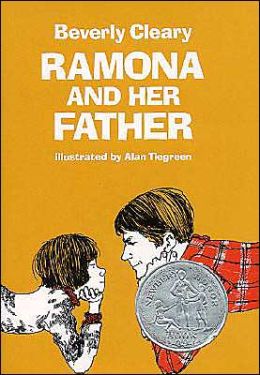
Ramona and Her Father (1977)

Ramona and Her Father. Beverly Cleary. 1977. HarperCollins. 208 pages. [Source: Library]

Ramona and Her Father is the fourth book in the Ramona series. This wonderful, unforgettable series was written over five decades. The first book, Beezus and Ramona was published in 1955! The fourth book in the series was published in 1977! The last book in the series was published in 1999! Many changes occurred throughout the decades, yet, Ramona remains timeless and just-about-perfect.

In Ramona and Her Father, Ramona is in second grade. (Have you noticed how almost all the books start in the late summer or early fall?!) Ramona's worries in this book mainly relate to her father. He loses his job, and, she's worried about him. She's worried for the family too, in a way, but, she's worried about him specifically. How he's coping, how he's handling it. (Not that she uses those words.) She's also worried about his physical health. She's worried that he's killing himself by smoking. And this fear is very real and very strong. She LOVES her Dad and sincerely cares for him.

"Payday" The family learns that Mr. Quimby lost his job.
"Ramona and the Million Dollars" Ramona gets the idea that she can star in commercials and make a lot of money. It gets her into trouble!
"The Night of the Jack-O'Lantern. The family carves a pumpkin only to have the cat ruin it all.
"Ramona to the Rescue" Ramona and Beezus team up to try to convince their dad to stop smoking.
"Beezus's Creative Writing" Ramona accompanies Beezus on a homework assignment, and a new game is discovered.
"The Sheep Suit" Christmas is a coming. Ramona wants to be a sheep. She volunteers her mom to make her a costume. (At least she didn't volunteer her mom to make all three costumes! So it could always be worse!) But will her mom have time to make the costume?! It doesn't look like it! Will Ramona get to be a sheep?
"Ramona and the Three Wise Persons" Pageant night! Ramona may not be wearing a satisfactory costume, but, will she go on and participate anyway? Three older girls filling in for the wise men may help her out! The book which has had its serious moments ends on a joyful tone.

Do you have a favorite cover?

© 2015 Becky Laney of Becky's Book Reviews

Monday, October 13, 2014

An Autobiography Agatha Christie

An Autobiography. Agatha Christie. 1977/1996. Berkley. 635 pages. [Source: Bought]

Agatha Christie's autobiography has been on my tbr pile for years now. I have looked forward to reading it for so long! I must admit the length had me a little intimidated. But once I started reading this one, I found myself completely absorbed in it. It is truly a fascinating read cover to cover. I think this one could prove appealing to a variety of readers.

Do you love history? I found Agatha Christie's Autobiography to be fascinating. This book is rich in details. Readers learn in great detail about her family and her growing up years. What Christie is describing is a way of life, and the way she saw the world around her. Her thoughts on her parents, grandparents, siblings, the family servants--the cook and the maids and nannies. You get a real sense of what it was to be a child (and teen) growing up in England in the 1890s and 1900s. She was "out" (ready to date) a year or two (or even three) before World War I began.

Are you interested in World War I? in World War II? Christie details what life was like during the war years. She was a nurse for a great part of World War I. She also assisted in dispensing drugs. She fell in love and got married during this time. During World War II she again did her part in the war effort. I believe volunteering in a hospital. She was in and around London during the War. She recalls how she rarely (if ever) took shelter during the raids because she was afraid of being buried alive under all the rubble. She had a grown daughter by that point. A daughter who fell in love, got married, and had a child during this time.
England was at war. It had come. I can hardly express the difference between our feelings then and now. Now we might be horrified, perhaps surprised, but not really astonished that war should come, because we are all conscious that war does come; that it has come in the past and that, at any moment, it might come again. But in 1914 there had been no war for--how long? Fifty years--more? True, there had been the "Great Boer War," and skirmishes on the Northwest frontier, but those had not been wars involving one's own country--they had been large army exercises, as it were; the maintenance of power in far places. This was different--we were at war with Germany. (257)
Are you interested in archaeology? in world-traveling? She spends a good deal of time recalling her travels around the world. She accompanied her first husband on an extended trip--covering several continents. (She left her (quite young) daughter with her mother and sister.) After her divorce--he fell in love with another woman and blamed her for it--she traveled on her own. On one of her trips to the Middle East, she met the man who would become her second husband. He was an archaeologist. While she did not stay with him the duration of all of his digs, she accompanied him on some, and visited on others. Readers learn that Christie LOVED, LOVED, LOVED to travel.

Are you a rehab addict? Christie loved looking at houses, buying houses in need of repair, fixing them up, renting them out, and selling them. She owned many properties at various points in her life. I believe the book said she owned eight during World War II. The book talks about her remodeling and redesigning houses.

Are you interested in writing, in her writing life? You'll find plenty to delight you within her autobiography. She talks about different sides of her writing life. Her novels. Her mystery novels. Her plays. Her short stories. Her poems. She talks about her mistakes and successes. Readers learn about which books she liked best and which book she really, really hated!
It was while I was working in the dispensary that I first conceived the idea of writing a detective story. (289)
People never stop writing to me nowadays to suggest that Miss Marple and Hercule Poirot should meet--but why should they? I am sure the would not enjoy it at all. Hercule Poirot, the complete egoist, would not like being taught his business by an elderly spinster lady. He was a professional sleuth, he would not be at home all in Miss Marple's world. No, they are both stars, and they are stars in their own right. (502)
Do you love to read? Christie shares her thoughts on her favorite writers and books!

I want to emphasize the fact that you do not have to love mysteries in order to find this autobiography of a mystery writer fascinating! I marked so many passages that I wanted to share with you. Too many to actually share. It would overwhelm any post. So just trust me, read this one!

I will choose a quote which happens to bring to mind a certain song from Frozen.
One of the first things that happens when you are attracted to a man and he is to you is that extraordinary illusion that you think exactly alike about everything, that you each say the things the other has been thinking. (228)

© 2014 Becky Laney of Becky's Book Reviews
Tuesday, January 07, 2014

The Revolt of the Eaglets (1977)

The Revolt of the Eaglets. Jean Plaidy. 1977. 320 pages. [Source: Bought]

I have not read the first novel in Plaidy's Plantagenet series. The Revolt of the Eaglets is the second in the series. It opens with the King Henry II learning of the murder of Thomas Becket, and it ends with his own death, or, news of his death reaching his prisoner-wife Eleanor. The novel is focused on the strife between Henry and his family. Any "love" once felt for his wife, Eleanor, the mother of all his legitimate children, has vanished now that she's older and past her usefulness. The two live separate lives for a short time, but, he eventually holds her prisoner. HATE isn't too strong a word for how these two feel towards one another! It is also focused on "Young Henry" (the oldest son and heir), Richard, Geoffrey, and John. Henry II had a "brilliant" idea to have his heir crowned king. Having two crowned monarchs is a big, big mess. It does not inspire family harmony. The son has no actual power, authority, dominion, or independence. Richard is another son that comes into the story quite a bit. Oh the plotting and scheming that goes on...as his sons "turn" against their father and fight for what is "theirs" by right. Is it horrible for sons to turn against their fathers and lead armies? Of course. But the truth is it is hard to find good excuses for Henry II's bad behavior. Plaidy is very matter-of-fact about his weaknesses, mistakes, or sins.

What might be hardest for modern readers to understand is Henry's relationship with Alice. Richard and Alice were betrothed to each other as young children. She is a French princess. She leaves France to live in England at a young age. When the king first takes notice of his future daughter-in-law she is eleven or possibly twelve. It is lust pure and simple. The book presents the seduction (without graphic details, but what is there is CREEPY ENOUGH) very matter of fact without judgment or commentary. Alice believes this special but must keep it secret attention is marvelous. She expects to be made Queen one day. Alice and Henry's relationship continues throughout the book.

Readers get a glimpse of British history and French history. It isn't always a cozy, satisfying glimpse. But it was an interesting read with plenty of characters.

© 2014 Becky Laney of Becky's Book Reviews