Showing posts with label Hercule Poirot. Show all posts

Tuesday, April 11, 2023

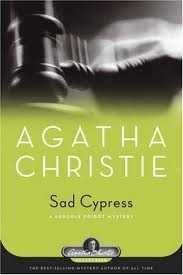
72. Sad Cypress


Sad Cypress. Agatha Christie. (Hercule Poirot #22). 1940. 256 pages. [Source: Library]

First sentence: "Elinor Katharine Carlisle. You stand charged upon this indictment with the murder of Mary Gerrard upon the 27th of July last. Are you guilty or not guilty?"

Premise/plot: Harriet Vane had Lord Peter Wimsey, and Elinor Katharine Carlisle has Peter Lord. Though her hero is not an amateur detective, but a country doctor. Still, Peter Lord, who fell in love with Elinor at first sight, has the wisdom to seek the best of the best to clear her name: Hercule Poirot. He wants Poirot to find evidence that will acquit her of murder. Is love blinding him? Is the woman he loves guilty of murder? It seems that she had opportunity to kill her aunt (supposedly out of greed) and Mary (supposedly out of jealousy). But Lord and Poirot doubt the supposed motives. They see other possibilities.  

My thoughts: I loved this one. I just LOVED it. I loved the characterization! I loved the story! While Peter Lord is no Lord Peter, I did enjoy him very much! I was quite surprised by how pleased I was that Elinor had someone on her side. Not that Elinor was completely lovable. She was flawed--very flawed. But still. By the end, I was seeing her through Peter Lord's eyes, I was seeing her with love.

"One does not practice detection with a textbook! One uses one's natural intelligence." (196)
"One must understand with the cells of one's brain before one uses one's eyes."(196)
"One always likes to know exactly what lies have been told one."
"Did Welman tell you a lie?"
"Definitely."
"Who else has lied to you?"
"Everybody. I think: Nurse O'Brien romantically; Nurse Hopkins stubbornly; Mrs. Bishop venomously; You yourself--"
"Good God!" Peter Lord interrupted him unceremoniously. "You don't think I've lied to you, do you?"
"Not yet," Poirot admitted.
Dr. Lord sank back in his chair. He said, "You're a disbelieving sort of fellow, Poirot." (198)

ETA: I first read this one in 2011. So it has been quite a while. I haven't reread many Christie novels. So it's always tricky for me to match plot points and characters with titles. I don't always even remember if it's Miss Marple or Hercule Poirot. I read this one for the 1940 Book Club. As soon as I realized it was THIS MYSTERY, I was so excited. I remembered loving these characters! 


© 2023 Becky Laney of Becky's Book Reviews

Wednesday, May 23, 2018

Thirteen at Dinner

Thirteen at Dinner. Agatha Christie. 1933. 228 pages. [Source: Bought]

First sentence: The memory of the public is short. Already the intense interest and excitement aroused by the murder of George Alfred St. Vincent Marsh, fourth Baron Edgware, is a thing past and forgotten. Newer sensations have taken its place. My friend, Hercule Poirot, was never openly mentioned in connection with the case. This, I may say, was entirely in accordance with his own wishes.

Premise/plot: Thirteen at Dinner is the ninth novel in the Hercule Poirot mystery series by Agatha Christie. It is narrated by Poirot's good friend Captain Hastings. He is recounting for readers a case that Poirot himself was a bit ashamed of being involved in.

It begins with a performance: Hastings and Poirot witness a one-woman show, Carlotta Adams. One of the imitations she does is of actress Jane Wilkinson. Wilkinson has married into the nobility, Lord Edgware, but it has not been a successful match--at all.

Later that evening, Poirot meets Jane Wilkinson for himself. She has come to him--pleading with him. Will he be willing to go to Lord Edgware and ask him to grant her a divorce so she can remarry? If not she doesn't know what she'll do. Poirot agrees to go. Lord Edgware agrees to a divorce promptly. In fact, he claims that he agreed over six months ago letting her know by letter!

The next day Lord Edgware is DEAD. Who murdered him and why?!

My thoughts: If you've read Lord Edgware Dies, you've read Thirteen at Dinner. But. If you're like me, you won't mind a bit rereading this Christie mystery. It is one of my favorites. Why? Not because of the details of the mystery. But because of the WRITING. I love Hastings' narration. I love the banter between Hastings and Poirot. Poirot can be such a hoot! It was a TREAT to reread this one.

Quotes:
"Do you not know, my friend, that each one of us is a dark mystery, a maze of conflicting passions and desires and aptitudes? Mais oui, c'est vrai. One makes one's little judgments--but nine times out of ten, one is wrong."
"Not Hercule Poirot," I said smiling.
"Even Hercule Poirot! Oh! I know very well that you have always a little idea that I am conceited, but indeed, I assure you, I am really a very humble person."
I laughed.
"You--humble!"
"It is so. Except--I confess it--that I am a little proud of my moustaches. Nowhere in London have I observed anything to compare with them. (5-6)
"Stop Poirot!" I cried. "You are making my head spin. "
"No, no, my friend. We are only considering possibilities. It is like trying on the clothes. Does this fit? No, it wrinkles on the shoulder? This one? Yes, that is better--but not quite large enough. This other one is too small. So on and so on, until we reach the perfect fit--the truth." (65)
"I always find alibis very enjoyable," he remarked. "Whenever I happen to be reading a detective story I sit up and take notice when the alibi comes along." (101)
"Between the deliberate falsehood and the disinterested inaccuracy it is very hard to distinguish sometimes.."
"What do you mean?"
"To deceive deliberately--that is one thing. But to be so sure of your facts, of your ideas and of their essential truth that the details do not matter--that, my friend, is a special characteristic of particularly honest persons." (107)
"The positive witness should always be treated with suspicion, my friend. The uncertain witness who doesn't remember, isn't sure, will think a minute--ah! yes, that's how it was--is infinitely more to be depended upon!"
"Dear me, Poirot," I said. "You upset all my preconceived ideas about witnesses." (107-8)
"My good friend," he said. "I depend upon you more than you know."
I was confused and delighted by these unexpected words. He had never said anything of the kind to me before. Sometimes, secretly, I had felt slightly hurt. He seemed almost to go out of his way to disparage my mental powers.
Although I did not think his own powers were flagging, I did realize suddenly that perhaps he had come to depend on my aid more than he knew.
"Yes," he said dreamily. "You may not always comprehend just how it is so--but you do often, and often point the way."
I could hardly believe my ears.
"Really, Poirot," I stammered. "I'm awfully glad, I suppose I've learnt a good deal from you one way or another--"
He shook his head.
"Mais non, ce n'est pas ca. You have learnt nothing."
"Oh!" I said, rather taken aback.
"That is as it should be. No human being should learn from another. Each individual should develop his own powers to the uttermost, not try to imitate those of someone else. I do not wish you to be a second and inferior Poirot. I wish you to be the supreme Hastings. In you, Hastings, I find the normal mind almost perfectly illustrated." (111)
"You are like someone who reads the detective story and who starts guessing each of the characters in turn without rhyme or reason." (112)
"You have a theory, then?"
"A detective, M. Martin, always has a theory. It is expected of him. I do not call it a theory myself. I say that I have a little idea. That is the first stage."
"And the second stage?"
"If the little idea turns out to be right, then I know! It is quite simple, you see." (129)
"Do not antagonize your son! He is of an age to choose for himself. Because his choice is not your choice, do not assume that you must be right. If it is a misfortune, then accept misfortune. Be at hand to aid him when he needs aid. But do not turn him against you." (145)

© 2018 Becky Laney of Becky's Book Reviews

Thursday, July 18, 2013

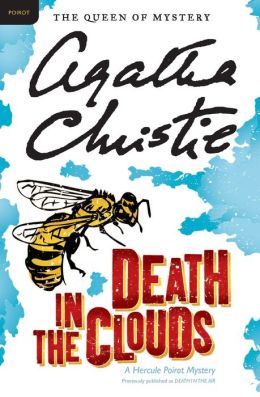
Death in the Clouds (1935)

Death in the Clouds (Death in the Air). Agatha Christie. 1935. 253 pages [Source: Library]

I really enjoyed this Hercule Poirot novel. In this mystery, Poirot is traveling from France to England via airplane. On his trip, one of the passengers dies. For a few seconds at least, it is suspected that a wasp sting is to blame for Madame Giselle's death. But only for a few seconds. A dart is found, a poisoned dart, no doubt. The question is which passenger is a murderer? Poirot has quite a mystery to solve. 

I definitely enjoyed this one! Readers get to know many of the passengers. In particular readers get to know a certain young lady, a hair dresser named Jane Grey. This mystery will take Poirot (and others) back and forth between the two countries. Some clues can only be found in France, for example. Can Poirot solve the crime before the police?

The more I read of Hercule Poirot, the more forgiving I am of his arrogance. Poirot can brag and boast; I'm not sure there is any of his mysteries where he doesn't have a big ego. But Poirot is impressive, and his reputation is well-earned.

Do you have a favorite Hercule Poirot novel? 

© 2013 Becky Laney of Becky's Book Reviews

Tuesday, July 09, 2013

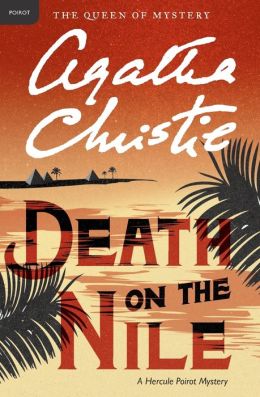
Death on the Nile (1937)

Death on the Nile. Agatha Christie. 1937/2007. Black Dog & Leventhal. 352 pages. [Source: Library]

I LOVED, LOVED, LOVED Agatha Christie's Death on the Nile. It is such a great mystery, very complex! Hercule Poirot and Colonel Race find themselves on board a ship on the Nile, they are in interesting company. Poirot notices the tension between some of his fellow travelers from the very start. And as he takes the time to get to know everyone, to have personal chats with almost every one, his unease only increases. He fears that before the trip is over, murder will have been committed. But who shall the victim be? And who the murderer? Meanwhile, Race is on a mission of his own before a body is even found. He is on the trail of a killer, a radical. He's not sure WHO his man is, just knows that he is almost certainly on board, that is where his clues have led him. When the oh-so-wealthy heiress, Linnet Ridgeway, is murdered on her honeymoon with Simon Doyle, there are plenty of suspects. For not all of the passengers on board are exactly strangers to her....

The first part of this one is set in England, but the rest is all set in Egypt.

This one had me from the start. It was so thrilling! Not only was the plot interesting and surprising and wonderful, the characterization was so well done!!!

My favorite quote:
"Do people interest you too, Monsieur Poirot? Or do you reserve your interest for potential criminals?"
"Madame--that category would not leave many people outside it." (96)
ETA: After reading the book, I wanted to watch the movie adaptation. I really ENJOYED the movie. It stars David Suchet as Hercule Poirot, JJ Feild as Simon Doyle, and Emily Blunt as Linnet Ridgeway, to name just a few. Feild, of course, "is" Henry Tilney. I recognized him right away. And Emily Blunt is equally "Queen Victoria." It was fun to see familiar faces in fascinating roles. If you've read the book recently OR if you remember the characters you'll guess just why. This was my first Poirot adaptation. I've seen plenty of Miss Marple, however.

© 2013 Becky Laney of Becky's Book Reviews

Wednesday, March 13, 2013

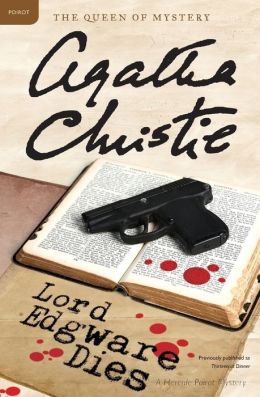
Lord Edgware Dies (1933)

Lord Edgware Dies (OR Thirteen at Dinner). Agatha Christie. 1933. 260 pages.

I absolutely LOVE, LOVE, LOVE this Agatha Christie mystery. It stars both Hercule Poirot and Captain Hastings, a combination I find very hard to resist. The mystery begins with an American celebrity--an actress, Jane Wilkinson--asking Poirot for help. She's not asking him to solve a crime, exactly. She's asking him to go to her husband--whom she hates--and ask him if he'll grant her a divorce. After this consultation, she "carelessly" mentions how she wants her husband to die; at one point she even shares just how she would kill her husband. A few take her seriously pointing out to Poirot that Wilkinson is the type of woman who would kill without thinking it wrong. But Poirot likes to make up his own mind, come to his own conclusions about people's characters and motives.
So when a little time later, Lord Edgware is killed, Poirot becomes interested in the case...

This one was a delightful mystery! I just love Agatha Christie! This may be among my favorite Poirot mysteries!!!

Favorite quotes:
"I always find alibis very enjoyable," he remarked. "Whenever I happen to be reading a detective story I sit up and take notice when the alibi comes along." (122)
"Between the deliberate falsehood and the disinterested inaccuracy it is very hard to distinguish sometimes.."
"What do you mean?"
"To deceive deliberately--that is one thing. But to be so sure of your facts, of your ideas and of their essential truth that the details do not matter--that, my friend, is a special characteristic of particularly honest persons." (128)
"The positive witness should always be treated with suspicion, my friend. The uncertain witness who doesn't remember, isn't sure, will think a minute--ah! yes, that's how it was--is infinitely more to be depended upon!"
"Dear me, Poirot," I said. "You upset all my preconceived ideas about witnesses." (129)
"My good friend," he said. "I depend upon you more than you know."
I was confused and delighted by these unexpected words. He had never said anything of the kind to me before. Sometimes, secretly, I had felt slightly hurt. He seemed almost to go out of his way to disparage my mental powers.
Although I did not think his own powers were flagging, I did realize suddenly that perhaps he had come to depend on my aid more than he knew.
"Yes," he said dreamily. "You may not always comprehend just how it is so--but you do often, and often point the way."
I could hardly believe my ears.
"Really, Poirot," I stammered. "I'm awfully glad, I suppose I've learnt a good deal from you one way or another--"
He shook his head.
"Mais non, ce n'est pas ca. You have learnt nothing."
"Oh!" I said, rather taken aback.
"That is as it should be. No human being should learn from another. Each individual should develop his own powers to the uttermost, not try to imitate those of someone else. I do not wish you to be a second and inferior Poirot. I wish you to be the supreme Hastings. In you, Hastings, I find the normal mind almost perfectly illustrated." (133)
"You are like someone who reads the detective story and who starts guessing each of the characters in turn without rhyme or reason." (135)
Read Lord Edgware Dies
  • If you enjoy murder mysteries with more than one murder
  • If you enjoy Agatha Christie
  • If you love Hercule Poirot and Captain Hastings
  • If you enjoy vintage, British mysteries
© 2013 Becky Laney of Becky's Book Reviews
Tuesday, June 19, 2012

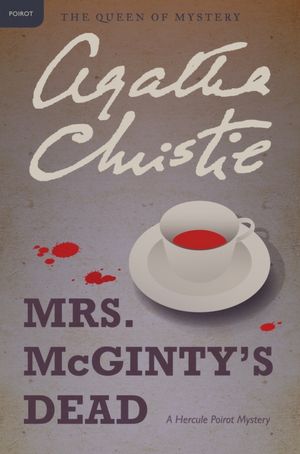
Mrs. McGinty's Dead

Mrs. McGinty's Dead. Agatha Christie. 1952/2011. HarperCollins. 272 pages. 

I definitely LOVED Mrs. McGinty's Dead. I really, really, really LOVED the surprise appearance of Ariadne Oliver. But, of course, the main star of this one is Hercule Poirot. The novel starts off rather unpleasantly with Poirot thinking to himself how wonderful he is, how marvelous he is, and how much he needs someone to talk to so he can show off how wonderful he is. So when he receives an unexpected visit from Superintendent Spence who is asking him to take on a closed case, well, he can't resist. Spence was one of the men who helped convict James Bentley of murder, but, he's having doubts, strong doubts. He believes that if Bentley is executed, well, they'll be executing an innocent man. He's not sure who killed Mrs. McGinty, but he knows that Poirot can solve this case better than anyone else. So Poirot travels to the village of the crime and he learns what only he can learn...

I LOVED this one!!! Loved hearing Mrs. Oliver talk about her writing, loved seeing her "work with" someone who is adapting her character, her main detective, into a play. Loved hearing her grumble and complain about her Finn detective.

This one is a great mystery, and, it was just so much fun to spend time with Christie's characters.

Read Mrs. McGinty's Dead
  • If you're a fan of Agatha Christie, Hercule Poirot, or Mrs. Oliver
  • If you're a mystery lover
© 2012 Becky Laney of Becky's Book Reviews
Tuesday, September 13, 2011

A Murder on the Links

A Murder on the Links. Agatha Christie. 1923.  272 pages.

I just LOVED, LOVED, LOVED this mystery novel starring Hercule Poirot and his close friend Arthur Hastings. The novel, I believe, is narrated by Hastings, the same narrator introduced in Poirot's first novel, The Mysterious Affair At Styles.

I usually find Christie's Miss Marple novels to be more delightful, more charming, more satisfying than those starring Hercule Poirot. But this one is definitely an exception. I just loved it from cover to cover.

This mystery, for the most part, occurs in France. And it just works really, really well. I don't want to say too much about the mystery itself. I mean the less you know the better...but you really should give Agatha Christie a try!

© 2011 Becky Laney of Becky's Book Reviews
Tuesday, July 05, 2011

Elephants Can Remember

Elephants Can Remember. Agatha Christie. (Hercule Poirot). 1972. 212 pages.
Mrs. Oliver looked at herself in the glass. 

While I tend to prefer Miss Marple to Hercule Poirot most of the time, when Christie's Poirot novels feature Ariadne Oliver, it becomes trickier to play favorites. For Ariadne Oliver is a writer, a writer of detective fiction or mysteries. And her perspective on the genre--and on writing in general--which is shared with readers is just fun. In Elephants Can Remember, Mrs. Oliver is approached by a woman who is memorable for all the wrong reasons:
 A large woman. Ample proportions, large white champing teeth. What in French could have been called une femme formidable, but who definitely had not only the French variety of being formidable, but the English one of being supremely bossy. Obviously she either knew Mrs. Oliver, or was intent on making her acquaintance there and then. The last was how it happened to go. (8)
 Mrs. Burton-Cox is "concerned" about her son who is contemplating marrying Mrs. Oliver's goddaughter. Now, Mrs. Oliver has had many goddaughters through the decades, and this particular one has slipped her mind completely. Well, until forced to remember by Burton-Cox's persistence. Celia Ravenscroft is the goddaughter in question, the "inappropriate" young woman, that Burton-Cox does not want for her daughter-in-law. Why? Well, there was a family tragedy when Celia was just a girl. Her parents died in an apparent suicide. No one knows if her father shot her mother or if her mother shot her father. No one knows what provoked this murder-suicide. Was her mother involved with another man? Was her father involved with another woman? And though it seems almost everyone has forgotten this tragedy except Mrs. Burton-Cox, she's convinced that Celia is not good for her son.

Mrs. Oliver is annoyed by Mrs. Burton-Cox. But she is also curious. She was out of the country when the tragedy happened all those years ago, and, well, part of her wants to know the truth--or as much of the truth can be discerned or concluded--herself. So she decides that if Celia will give her blessing, she'll begin to snoop around. And she'll even call her old friend, Hercule Poirot. He may be able to connect the dots and solve this one.


I enjoyed this one. I did. I don't know that it is my favorite Agatha Christie, but it is a good read.


Favorite quote:
"Human curiosity," said Poirot. "Such a very interesting thing." He sighed. "To think that we owe to it throughout history. Curiosity. I don't know who invented curiosity. It is said to be usually associated with the cat. Curiosity killed the cat. But I should say really that the Greeks were the inventors of curiosity. They wanted to know. Before them, as far as I can see, nobody wanted to know much. They just wanted to know what the rules of the country they were living in were, and how they could avoid having their heads cut off or being impaled on spikes or something disagreeable happening to them. But they either obeyed or disobeyed. They didn't want to know why. But since then a lot of people have wanted to know why and all sorts of things have happened because of that. Boats, trains, flying machines and atom bombs and penicillin and cures for various illnesses. A little boy watches his mother's kettle raising its lid because of the steam. And the next thing we know is we have railway trains, leading on in due course to railway strikes and all that. And so on and so on." (25)
"As one journeys through life," said Poirot, "one finds more and more that people are often interested in things that are none of their business. Even more so than they are in things that could be considered their business." (117)


© 2011 Becky Laney of Becky's Book Reviews

Tuesday, March 01, 2011

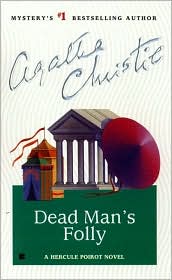
Dead Man's Folly

Dead Man's Folly. Agatha Christie. 1956/2000. Penguin. 240 pages.


It was Miss Lemon, Poirot's efficient secretary, who took the telephone call. 

Hercule Poirot is coming to the aid of his friend Ariadne Oliver. This mystery writer is planning a fun weekend game of mock murder. But days away from the big event, she's getting this uncomfortable feeling. Her instincts are telling her that something is wrong. She's not sure exactly what is wrong. But she feels the need for Poirot. And he's happy to help--happy to show off, perhaps?

Dead Man's Folly has an interesting cast of characters. And I enjoyed reading this one. Christie has a wonderful gift with characterization--each man and woman so complex, so layered. And it's always interesting to see how her stories unfold. To see how the clues unfold. There are plenty of clues--true and false--in this one.

I liked this one. It was a compelling read. I am so happy I discovered Agatha Christie this year!

"The fatal flaw, eh?" he remarked.
"That's just it," said Mrs. Oliver. "There always is one. Sometimes one doesn't realize it until a book's actually in print. And then it's agony!" Her face reflected this emotion. She sighed. "The curious thing is that most people never notice it. I say to myself, 'But of course the cook would have been bound to notice that two cutlets hadn't been eaten.' But nobody else thinks of it at all." (56)

It would be difficult, Bland thought, to forget Hercule Poirot, and this not entirely for complimentary reasons. (101)

"What can you say about how you write books? What I mean is, first you've got to think of something, and when you've thought of it you've got to force yourself to sit down and write it. That's all. It would have taken me just three minutes to explain that, and then the Talk would have been ended and everyone would have been very fed up. I can't imagine why everybody is always so keen for authors to talk about writing. I should have thought it was an author's business to write, not talk." (209)

© 2011 Becky Laney of Becky's Book Reviews
Thursday, February 24, 2011

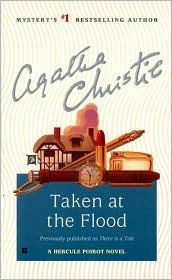
Taken at the Flood

Taken at the Flood. Agatha Christie. 1948/1984. Penguin. 256 pages.


In every club there is a club bore. The Coronation Club was no exception; and the fact that an Air Raid was in progress made no difference to normal procedure.

 Set, for the most part, in Warmsley Vale, this Hercule Poirot mystery focuses on a dysfunctional family in crisis: the Cloade family. Gordon Cloade made a lot of promises--promises it turns out he couldn't keep. He promised to provide for many--if not most--of his family. He helped them with their bills. He helped them with their dreams. His family was comfortable accepting his financial assistance. So when Gordon Cloade dies shortly after his marriage, everyone is upset. For his marriage changes everything, his wife will receive everything. His wife, an American widow, is a young beauty named Rosaleen. She's accompanied by her brother, David Hunter. The Cloade family hates them both. Though some family members play friendly--hoping to get a little money from her now and then. But David is always at her side telling her that her husband's family would love to see her dead.

So who's the victim? How does Poirot get involved? Well. A man shows up in town wanting to see David Hunter. He claims that he has proof that Rosaleen's first husband, a Mr. Underhay, is still alive. He wants money, of course, or he threatens to go to the Cloade family who will only be too happy to have this proof. For if Rosaleen's first husband was still alive when she married Gordon, then she wasn't legally his wife, and the family would get the money. This "Enoch Arden" is murdered--and the main suspect is David Hunter! But did he do it?

Lynn, one of the family, is involved in a very unhealthy love triangle in Taken at The Flood. Since returning home from the war, she's been restless. She's engaged to Rowley, but she's finding herself fascinated by the devilish David Hunter. And he's flirting back. Which will she choose? And will her choice prove deadly?

I enjoyed this one. It was exciting and fascinating. The family is a tangled mess, and Poirot has much to untangle before he can find all the pieces he needs to solve this one.

"Rowley. What's Rowley?"
"A better man than you--touch him if you dare," she said lightly.
"I've no doubt he's a better man than me--but I do dare. I'd dare anything for you, Lynn."
She was silent for a moment or two. She said at last.
"What you don't understand is that I love Rowley."
"I wonder."
She said vehemently: "I do, I tell you, I do."
David looked at her searchingly.
"We all see pictures of ourselves--of ourselves as we want to be. You see yourself in love with Rowley, settling down with Rowley, living here contented with Rowley, never wanting to get away. But that's not the real you, is it, Lynn?"
"Oh what is the real me? What's the real you, if it comes to that? What do you want?"
"I'd have said I wanted safety, peace after storm, ease after troubled seas. But I don't know. Sometimes I suspect, Lynn, that both you and I want--trouble." (58)

© 2011 Becky Laney of Becky's Book Reviews

Wednesday, February 23, 2011

Evil Under the Sun

Evil Under the Sun. Agatha Christie. 1940/2006. Black Dog & Leventhal. 224 pages.

When Captain Roger Angmering built himself a house in the year 1782 on the island off Leathercombe Bay, it was thought the height of eccentricity on his part. A man of good family such as he was should have had a decorous mansion set in wide meadows with, perhaps, a running stream and good pasture.

Will Hercule Poirot ever vacation in peace? He doesn't get that opportunity in Evil Under the Sun. He may be on vacation at the Jolly Roger, a hotel resort, but the warning signs are there. Murder is probably inevitable as tensions rise between hotel guests. The victim is Mrs. Arlena Stuart Marshall. The suspects? Well, principally her husband, Captain Kenneth Marshall, her lover, Patrick Redfern, the angry wife, Christine Redfern, and the angry step-daughter, Linda Marshall. Of course, there are other guests at the hotel, but these are the ones with possible motives.

I am still enjoying Agatha Christie. I am still finding myself surprised by her revelations. (Some books there is more of a surprise than others!) But this one wasn't my favorite Hercule Poirot.

© 2011 Becky Laney of Becky's Book Reviews

Thursday, February 17, 2011

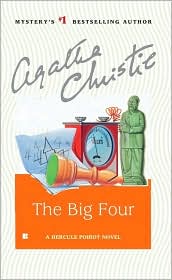
The Big Four

The Big Four. Agatha Christie. 1927/2001. Penguin. 208 pages.

I have met people who enjoy a channel crossing; men who can sit calmly in their deck-chairs and, on arrival, wait until the boat is moored, then gather their belongings together without fuss and disembark.

Captain Hastings narrates this Hercule Poirot novel. First, I must say that it was GREAT to have him back as narrator. I'd missed him lately. Second, I must say that this Hercule Poirot is very different from others I've read. There is a big mystery to be solved. And there are plenty of little mysteries to be solved. The motives for these crimes are very different. More political, more conspiracy theory, more intellectual intrigue than the traditional murder mystery.

Who are the Big Four? Well, Poirot believes them to be a secret organization running the world behind the scenes. The masterminds behind several political upheavals. One from China. One from France. One from the United States. And the fourth, well, that's the mystery. For this "destroyer" is the most elusive of them all. An expert at disguise he certainly must be. For Hastings and Poirot believe they've encountered him at many, many of their recent crime scenes. But no matter how many times they catch a glimpse, they're never able to describe him.

At the beginning, they've only got a lead on the identity of one of the members. But they're hoping to find all four so they can be brought to justice. For the bodies do begin to pile up in this one--and each one gives them a little clue. It won't be an easy case to solve--for it's all a game with traps hidden within traps within traps. But if anyone can solve it, Poirot's the man for the job.

I liked this one. I didn't love it exactly. But it was a good read, a compelling one!

© 2011 Becky Laney of Becky's Book Reviews

Tuesday, February 15, 2011

The Murder of Roger Ackroyd

The Murder of Roger Ackroyd. Agatha Christie. 1926/2006. Black Dog & Leventhal. 288 pages.

Mrs. Ferrars died on the night of the 16th-17th September--a Thursday.

Someone has killed Roger Ackroyd, but who? The police are doing their best--no doubt. But one member of the family wants the best on the case, and the best would be Hercule Poirot, of course. Only he will be able to see through the holes of everyone's stories--their lies and half-truths. Only he will be able to piece together the strange motive for the crime. 

Dr. Sheppard narrates this Hercule Poirot mystery novel. And he's no Hastings, I'll tell you that now! I'll also admit from the start that I did not like this one at all. If I had been reading Christie's Poirot chronologically--there's a good chance I would not have continued on past this one. And I don't think Poirot is to blame. I just had a very difficult time with our narrator.

The Murder of Roger Ackroyd made me appreciate Agatha Christie more. It made me thankful for the Poirot novels that I have enjoyed--really enjoyed. And it made me thankful for the Miss Marple books which--with one exception--I've loved and adored. I picked up A Caribbean Mystery after completing The Murder of Roger Ackroyd, and I realized that I got more enjoyment out of that one chapter of a Marple novel then in the entirety of this one.


© 2011 Becky Laney of Becky's Book Reviews
Friday, February 11, 2011

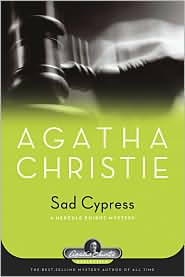
Sad Cypress

Sad Cypress. Agatha Christie. 1939/2007. Black Dog & Leventhal. 256 pages.

"Elinor Katharine Carlisle. You stand charged upon this indictment with the murder of Mary Gerrard upon the 27th of July last. Are you guilty or not guilty?"

Harriet Vane had Lord Peter Wimsey, and Elinor Katharine Carlisle has Peter Lord. Though her hero is not an amateur detective, but a country doctor. Still, Peter Lord, who fell in love with Elinor at first sight, has the wisdom to seek the best of the best to clear her name: Hercule Poirot. He wants Poirot to find evidence that will acquit her of murder. Is love blinding him? Is the woman he loves guilty of murder? It seems that she had opportunity to kill her aunt (supposedly out of greed) and Mary (supposedly out of jealousy). But Lord and Poirot doubt the supposed motives. They see other possibilities. 

I loved this one. I just LOVED it. I loved the characterization! I loved the story! While Peter Lord is no Lord Peter, I did enjoy him very much! I was quite surprised by how pleased I was that Elinor had someone on her side. Not that Elinor was completely lovable. She was flawed--very flawed. But still. By the end, I was seeing her through Peter Lord's eyes, I was seeing her with love.

"One does not practice detection with a textbook! One uses one's natural intelligence." (196)
"One must understand with the cells of one's brain before one uses one's eyes."(196)
"One always likes to know exactly what lies have been told one."
"Did Welman tell you a lie?"
"Definitely."
"Who else has lied to you?"
"Everybody. I think: Nurse O'Brien romantically; Nurse Hopkins stubbornly; Mrs. Bishop venomously; You yourself--"
"Good God!" Peter Lord interrupted him unceremoniously. "You don't think I've lied to you, do you?"
"Not yet," Poirot admitted.
Dr. Lord sank back in his chair. He said, "You're a disbelieving sort of fellow, Poirot." (198)

© 2011 Becky Laney of Becky's Book Reviews
Thursday, February 10, 2011

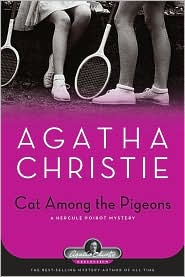
Cat Among the Pigeons

Cat Among the Pigeons. Agatha Christie. 1959/2007. Black Dog & Leventhal. 272 pages.

It was the opening day of the summer term at Meadowbank school.

Set at a girls' boarding school, this Hercule Poirot mystery was oh-so-fascinating. I enjoyed it so much! It's a mystery novel with plenty of narrators--from teachers and secretaries to students. This school term is unlike previous terms--for one of the new students brings mystery and danger to the prestigious school. And this "danger" will cost a few teachers their lives. A quick-thinking student, Julia Upjohn, decides to seek out Hercule Poirot believing that this detective is the man for the job. If anyone can stop this murderer and solve the mystery, he can.

I loved this one. I loved how this mystery unfolds. How Hercule Poirot does not enter into the book too early. How other characters are given the opportunity to shine. So when he does appear, I almost felt like cheering. (I wasn't expecting that!) I am still loving Agatha Christie. I'm still finding her novels clever and wonderful and oh-so-compelling. There is just something so delightful, so satisfying about reading her books!

© 2011 Becky Laney of Becky's Book Reviews

Tuesday, February 08, 2011

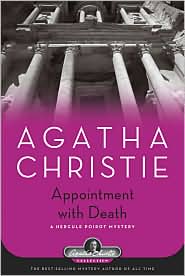
Appointment With Death

Appointment with Death. Agatha Christie. 1937/2007. Black Dog & Leventhal. 256 pages.

"You do see, don't you, that she's got to be killed?" The question floated out into the still night air, seemed to hang there a moment and then drift away down into the darkness towards the Dead Sea. Hercule Poirot paused a minute with his hand on the window catch.

Hercule Poirot is vacationing in Jerusalem when he overhears a private conversation. A man and woman discussing murder quite matter-of-factly. Who are they wanting to murder? Their stepmother. Is their stepmother really wicked? Well, many fellow vacationers seem to think so! She's a mean bully. A cruel tyrant. A woman almost impossible to love, to pity. She "manages" her adult children through fear and manipulation. Though alive, they appear lifeless. This 'strange' American family catches the interest of several fellow travelers including Miss Sarah King and Dr. Theodore Gerard. The family inspires pity--for the most part--and discussion. In just a few short days, this family becomes THE topic of discussion wherever they go--first in Jerusalem, and later in Petra. But when this matriarch, Mrs. Boynton, dies Poirot recalls this conversation. And that, along with a puncture wound on the wrist, becomes enough to interrogate this family and investigate this death. Can he come to the truth in just 24 hours? Even if he discovers the truth, will there be enough evidence to bring to convict should it ever go to trial?

I didn't love this one. It was more like than love. I found it compelling enough to finish. I thought it got off to a nice start--with its reference to Anthony Trollope, it had me hooked actually. But it doesn't do that well when compared to the other Christie mysteries I've read so far. Still, I'm glad I've read it.

© 2011 Becky Laney of Becky's Book Reviews
Saturday, February 05, 2011

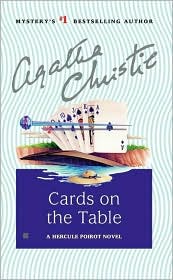
Cards on the Table

Cards on the Table. Agatha Christie. 1937. Penguin. 224 pages.

"My dear Monsieur Poirot!" 

I loved this one. I just loved, loved, loved this one. In this Hercule Poirot mystery, we meet four sleuths and four criminals. They are brought together by a strange man who loves to collect things, Mr. Shaitana. He boasts one day that he'll be happy to exhibit for his friend, Hercule Poirot, his collection of murderers--men and women who have all gotten away with murder. He suggests an evening of entertainment. The guests (of sleuths) include Hercule Poirot, Ariadne Oliver, Colonel Race, and Superintendent Battle. My favorite of the new characters is Ariadne Oliver, a mystery writer. The four (potential) criminals are Dr. Roberts, Mrs. Lorrimer, Miss Meredith, and Major Despard. Of course, Shaitana doesn't tell his guests his purpose, his plan. Only Poirot knows the reason behind the night's festivities. Two bridge games in two different rooms. Mr. Shaitana is enjoying a cozy night in front of the fire, until, he isn't! For he's murdered! The four guests say that no one entered the room. So it isn't hard to conclude that one of his guests murdered him. But who was it?

These four sleuths decide to work together to solve the crime. Each will interview the suspects. Each will go about it in their own way. (Each has their own method, their own philosophy, their own contacts.) It's fine to keep their own conclusions secret, but all the clues are supposed to be shared with one another. All their cards are to be on the table, so to speak. Readers get to see glimpses of each of these sleuths at work. Through dialogue, we get to know each sleuth, each criminal a little bit better. And I must say it makes for a compelling read! This one was impossible to put down!

I definitely consider this Hercule Poirot to be among my favorite and best. I really enjoyed so many things about it!

Here are a few of my favorite quotes:

"Ask Doctor Roberts if he'll be so good as to step this way."
"I should have kept him to the end," said Mrs. Oliver.
"In a book I mean," she added apologetically.
"Real life's a bit different," said Battle.
"I know," said Mrs. Oliver. "Badly constructed." (25)

"Man is an unoriginal animal," said Hercule Poirot.
"Women," said Mrs. Oliver, "are capable of infinite variation. I should never commit the same type of murder twice running."
"Don't you ever write the same plot twice running?" asked Battle.
"The Lotus Murder," murmured Poirot. "The Clue of the Candle Wax."
Mrs. Oliver turned on him, her eyes beaming appreciation.
"That's clever of you--that's really very clever of you. Because of course those two are exactly the same plot, but nobody else has seen it." (54)

"You are an extraordinary man, Monsieur Poirot."
"I am as the good God made me, Madame."
"We are all that, I suppose."
"Not all, Madame. Some of us have tried to improve on his pattern." (79-80)

"We all make mistakes, Monsieur Poirot."
"Some of us," said Poirot with a certain coldness possibly due to the pronoun the other had used, "make less than others."
Despard looked at him, smiled slightly and said:
"Don't you ever have a failure, Monsieur Poirot?"
"The last time was twenty-eight years ago," said Poirot with dignity. "And even then, there were circumstances--but no matter." (106)


© 2011 Becky Laney of Becky's Book Reviews

Thursday, January 27, 2011

Five Little Pigs

Five Little Pigs. (Hercule Poirot) Agatha Christie. 1941/2006. Black Dog & Leventhal. 256 pages.

Hercule Poirot looked with interest and appreciation at the young woman who was being ushered into the room. 

I've enjoyed a couple of other Hercule Poirot stories this past month--including The Mysterious Affair at Styles, Murder on the Orient Express, and ABC Murders--but, I must say that Five Little Pigs is my favorite so far. In this one, Hercule Poirot is investigating a sixteen-year-old murder--a case of poisoning. He's doing this at the request of a young woman, the child of the victim and convicted murderer. Before Caroline Crale's death, she wrote her daughter--then just a child--a letter saying that she was innocent of the crime. Now that the child is all grown up, now that she's twenty-one and has read that letter for herself, well, she needs to know one way or another before she can move on with her life, before she can get married and have kids of her own. Is her mother guilty of the crime of which she's been convicted? If she is innocent, was it suicide like the defense argued? Or was the crime committed by someone else?

Poirot's investigations will lead him to five people: Philip Blake (the best friend who proclaims his hatred for the wife a little too loudly), Meredith Blake (Philip's brother who had a fondness for growing poisonous plants in his lab at the time of the crime), Elsa Greer (the adulteress who announced the affair to the wife the day before), Angela Warren (the half-sister of Mrs. Caroline Crale, she was being 'raised' by her older sister), and Cecilia Williams (the governess hired to teach Angela). These were the people closest to the victim, Amyas Crale, on the last two days of his life. Could one of them be guilty of the crime?

I loved this one. I loved how this one was told. I loved the characters. I loved the narration. I loved how we learn about the crime, how the clues are revealed. Poirot is interviewing these people, but he's also urging them to write their own accounts of the crime.

My favorite lines:

"M. Poirot, you--you don't look exactly the way I pictured you."
"And I am old, am I not? Older than you imagined?"
"Yes, that too." She hesitated. "I'm being frank, you see. I want--I've got to have--the best."
"Rest assured," said Hercule Poirot, "I am the best!"
Carla said, "You're not modest....All the same, I'm inclined to take you at your word."
Poirot said placidly, "One does not, you know, employ merely the muscles. I do not need to bend and measure the footprints and pick up the cigarette ends and examine the bent blades of grass. It is enough for me to sit back in my chair and think. It is this"--he tapped his egg-shaped head--"this, that functions!" (6)

"It is inevitable," Hercule Poirot said. "Women will always see a private detective. Men will tell him to go to the devil."
"Some women might tell him to go to the devil too."
"After they have seen him--not before."
"Perhaps." (103)

© 2011 Becky Laney of Becky's Book Reviews
Friday, January 21, 2011

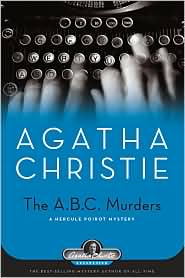
The A.B.C. Murders

The A.B.C. Murders. (Hercule Poirot). Agatha Christie. 1935/2006. Black Dog & Leventhal. 256 pages.

It was in June of 1935 that I came home from my ranch in South America for a stay of about six months. 

I liked The A.B.C. Murders. But I didn't love it. I'm not sure why. It had Hastings, the same narrator found in The Mysterious Affair at Styles; and, of course, it had Hercule Poirot. (My favorite of the three Poirot mysteries that I've read this year would probably be Murder on the Orient Express.) It had four murders instead of one, which is perhaps, why it wasn't love--for me. Instead of following the clues for one murder, instead of narrowing in on the motives for wanting one person dead, instead of figuring out who had the most to gain from the death, and all the 'good stuff' revealed along the way, Poirot is trying to outwit a serial killer. The crimes appear to be randomly connected--by the alphabet--as you can imagine. But are these murders random?

Poirot is taking this case personally because the killer has been sending him notes--warnings--about the crimes before they're committed. He's challenging Poirot, daring him to be clever enough to solve the crimes and identify him. He's an arrogant man, a seemingly insane man, who hides behind the initials ABC.

As I said, I liked this one. I don't regret reading it. And at the time I was reading I certainly found it entertaining enough. (I just had to read until I found out who the killer was.)

"Who are you? You don't belong to the police?"
"I am better than the police," said Poirot. He said it without conscious arrogance. It was, to him, a simple statement of fact. (90)

The spoken word and the written--there is an astonishing gulf between them. there is a way of turning sentences that completely reverses the original meaning. (122)

"Words, mademoiselle, are only the outer clothing of ideas." (132)

© 2011 Becky Laney of Becky's Book Reviews
Tuesday, January 11, 2011

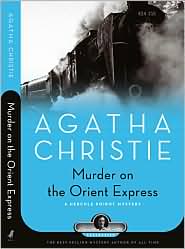
Murder on the Orient Express

Murder on the Orient Express. Agatha Christie. 1933/2006. Black Dog & Leventhal. 272 pages.

It was five o'clock on a winter's morning in Syria. Alongside the platform at Aleppo stood the train grandly designated in railway guides as the Taurus Express. It consisted of a kitchen and a dining car, a sleeping car and two local coaches.

Murder on the Orient Express is my second Agatha Christie. It stars Inspector Hercule Poirot. The murder occurs in the middle of a night on a train--as you probably know already. The train becomes snowbound, and it is up to Hercule Poirot, one of the passengers, to solve the crime. (The murderer has to still be on board.) After examining the crime scene for clues, he interviews each of the passengers one by one: Mary Debenham, Colonel Arbuthnot, Hector MacQueen, Antonio Foscarelli, Edward Henry Masterman, Cyrus Hardman, Princess Dragomiroff, Greta Ohlsson, Mrs. Hubbard, Hildegarde Schmidt, Count and Countess Andrenyi. What clues did the murderer leave behind him/her? Which passenger has the greatest motive for wanting M. Ratchett dead?

I really loved this one. It was so compelling, so suspenseful. I loved the way this one was told, loved the way we got to know the suspects. And, of course, I loved Hercule Poirot. I would definitely recommend this one.

"Madame," Poirot waved an airy hand, "detectives have to ask all sorts of questions. For instance, perhaps you will tell me the colour of your dressing gown?"
She stared at him. Then she laughed. "It is corn-coloured chiffon. Is that really important?"
"Very important, Madame."
She asked curiously: "Are you really a detective, then?"
"At your service, Madame."
"I thought there were no detectives on the train when it passed through Jugo-Slavia--not until one got to Italy."
"I am not a Jugo-Slavian detective, Madame. I am an international detective."
"You belong to the League of Nations?"
"I belong to the world, Madame." said Poirot dramatically. He went on: "I work mainly in London. You speak English?" he added in that language. (128)


© 2011 Becky Laney of Becky's Book Reviews