Showing posts with label 1923. Show all posts

Thursday, December 13, 2018

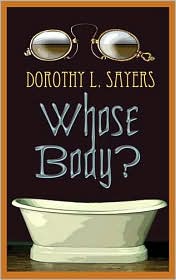
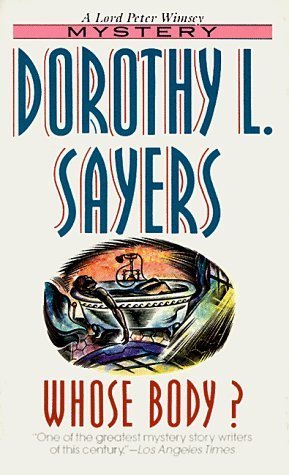
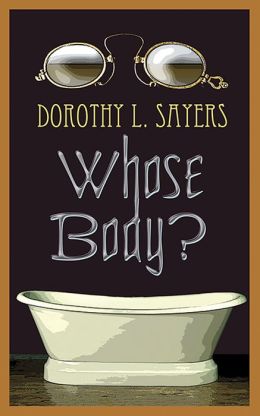
Whose Body?

Whose Body? Dorothy L. Sayers. 1923/1995. HarperTorch. 224 pages. [Source: Bought]

First sentence: "Oh damn!" said Lord Peter Wimsey at Piccadilly Circus.

Premise/plot: Whose Body? is the first novel in a mystery series starring Lord Peter Wimsey as an amateur detective. (He solves crimes with a little help from his butler/valet, Bunter, and in later mysteries with his girlfriend/wife.) In the opening pages of the novel, Lord Peter receives a phone call--or 'phone call--from his mother the Dowager Duchess. A murder has been committed. A naked man has been found in a bath tub of an acquaintance of hers. Is he interested in solving the case and working with Scotland Yard?

My thoughts: As a whole, I love, love, love the series by Dorothy Sayers. That being said, I don't love each and every book in the series equally. I enjoyed this one very much. I found it to be witty and delightful. It was super quotable. I would recommend it as a starting point for reading the series.

Quotes:
  • Exit the amateur of first editions; new motive introduced by solo bassoon; enter Sherlock Holmes, disguised as a walking gentleman. There goes Bunter. Invaluable fellow--never offers to do his job when you've told him to do somethin' else. (5)
  • "Sugg's a beautiful, braying ass," said Lord Peter. "He's like a detective in a novel." (18)
  • "I love trifling circumstances," said Lord Peter. "so many men have been hanged by trifling circumstances." (20)
  •  "Parker, acushla, you're an honour to Scotland Yard. I look at you, and Sugg appears a myth, a fable, an idiot-boy, spawned in a moonlight hour by some fantastic poet's brain. Sugg is too perfect to be possible." (23)
  • "Look here, Wimsey--you've been reading detective stories; you're talking nonsense." (29)
  • Of course, if this were a detective story, there'd have been a convenient shower exactly an hour before the crime and a beautiful set of marks which could only have come between two and three in the morning, but this being real life in a London November, you might as well expect footprints in Niagra. (44)
  • "It's a hard life, valeting by day and developing by night--morning tea at any time from 6:30 to 11, and criminal investigation at all hours. It's wonderful, the ideas these rich men with nothing to do get into their heads." (49)
  • "Have you any Scotch blood in you, Parker?" inquired his colleague, bitterly.
    "Not that I know of," replied Parker. "Why?"
    "Because of all the cautious, ungenerous, deliberate and cold-blooded devils I know," said Lord Peter, "you are the most cautious, ungenerous, deliberate and cold-blooded. Here I am, sweating my brains out to introduce a really sensational incident into your dull and disreputable little police investigation, and you refuse to show a single spark of enthusiasm."
    "Well, it's no good jumping at conclusions."
    "Jump? You don't even crawl distantly within sight of a conclusion. I believe if you caught the cat with her head in the cream-jug you'd say it was conceivable that the jug was empty when she got there."
    "Well, it would be conceivable, wouldn't it?" (51)
  • "There's nothing you can't prove if your outlook is only sufficiently limited. Look at Sugg." (69)
  • Assigning a motive for the murder of a person without relations or antecedents or even clothes is like trying to visualize the fourth dimension--admirable exercise for the imagination, but arduous and inconclusive. (82)
  • "One demands a little originality in these days, even from murderers," said Lady Swaffham. "Like dramatists, you know--so much easier in Shakespeare's time, wasn't it? Always the same girl dressed up as a man, and even that borrowed from Boccaccio or Dante or somebody. I'm sure if I'd been a Shakespeare hero, the very minute I saw a slim-legged young page-boy I'd have said: "Odsbodikins! There's that girl again!" (123)
  • "And in short stories," said Lord Peter, "it has to be put in statement form, because the real conversation would be so long and twaddly and tedious, and nobody would have the patience to read it. Writers have to consider their readers, you see." (158)


© 2018 Becky Laney of Becky's Book Reviews

Tuesday, January 23, 2018

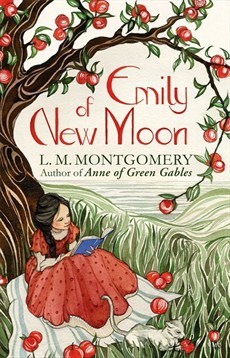
Emily of New Moon

Emily of New Moon. L.M. Montgomery. 1923. Bantam. 352 pages. [Source: Bought]

First sentence: The house in the hollow was “a mile from anywhere” — so Maywood people said. It was situated in a grassy little dale, looking as if it had never been built like other houses but had grown up there like a big, brown mushroom. It was reached by a long, green lane and almost hidden from view by an encircling growth of young birches. No other house could be seen from it although the village was just over the hill.

Premise/plot: When Emily Starr's father dies, she goes to live with Aunt Elizabeth, Aunt Laura, and Cousin Jimmy at New Moon on Prince Edward Island. She makes friends (Ilse, Teddy, and Perry) and pursues writing as she faces the ordinary and sometimes not-so-ordinary challenges of growing up.

My thoughts: I do love Emily of New Moon. This Montgomery novel has so many cats and kittens! Another plus, in my opinion, is Emily's pursuit of writing. Writing is part of who she is. She can't quite decide if she wants to write poetry, to write novels, or to write both. But one thing is certain: she will write no matter the cost. 

How does Emily's personality compare to Anne Shirley's? Both have a fierceness to them. Anne is definitely more prone to making mistakes and getting into TROUBLE. Emily actually reminded me more of one of Anne's daughters than Anne herself. Though I can't remember which one at the moment. (I'm thinking of a moment in Anne of Ingleside or maybe Rainbow Valley?)

There's something cozy about reading this one even if there's some sadness to it. In addition to the sadness, there's also a touch of creepiness. Though I wonder if Dean Priest came across as super-creepy to the original readers in the 1920s.

Favorite quotes:
“A living present is so nice,” she told Ellen, “because it keeps on getting nicer all the time.”
But Emily had inherited certain things from her fine old ancestors — the power to fight — to suffer, — to pity — to love very deeply — to rejoice — to endure. These things were all in her and looked out at you through her purplish-grey eyes.
“I wish people could remember from the very moment they’re born,” said Emily. “It would be so very interesting.” “I dare say we’d have a lot of uncomfortable memories,” said her father, laughing a little.
Death isn’t terrible. The universe is full of love — and spring comes everywhere — and in death you open and shut a door. There are beautiful things on the other side of the door. I’ll find your mother there — I’ve doubted many things, but I’ve never doubted that.
“She will love deeply — she will suffer terribly — she will have glorious moments to compensate — as I have had. As her mother’s people deal with her, so may God deal with them,” he murmured brokenly.
“I don’t want to learn sense and be done a world of good to,” cried Emily with a quivering lip. “I — I want somebody to love me.”
“I don’t want any of your pertness, miss. You are not to kiss cats at all.” “But Aunt Elizabeth, I didn’t kiss her on her mouth, of course. I just kissed her between her ears. It’s nice — won’t you just try it for once and see for yourself?”
I read the story of Red Riding Hood to-day. I think the wolf was the most interesting character in it. Red Riding Hood was a stupid little thing so easily fooled.
I like Perry but in a different way from Teddy. Isn’t it funny, dear Father, how many kinds of ways of liking there are?
“I see you have a cat.” “Wrong.” Father Cassidy shook his head and groaned dismally. “A cat has me.”
“Keep on — keep on writing poetry.” “You mean — ?” Emily was breathless. “I mean you’ll be able to do something by and by. Something — I don’t know how much — but keep on — keep on.”
I think maybe I’ll write novels when I grow up as well as poetry. But Aunt Elizabeth won’t let me read any novels so how can I find out how to write them? Another thing that worries me, if I do grow up and write a wonderful poem, perhaps people won’t see how wonderful it is.
Things that were inside of you were not to be read about.
I can read all the books in Aunt Nancy’s bookcase except the row on the top shelf. I wonder why I can’t read them. Aunt Nancy said they were French novels but I just peeped into one and it was English. I wonder if Aunt Nancy tells lies.
To love is easy and therefore common — but to understand — how rare it is!
“I’ve had only books for companions most of my life,” he said. “Is it any wonder I talk like them?”
“The happiest countries, like the happiest women, have no history,” said Dean. “I hope I’ll have a history,” cried Emily. “I want a thrilling career.”
“Kittens don’t want to be worshipped,” she said. “They just want to be cuddled.”
“I wouldn’t want to be anybody but myself even if I am plain. Besides,” she added impressively as she turned to go out of the room, “though I may not be very good-looking now, when I go to heaven I believe I’ll be very beautiful.”
Outgrowing things we love is never a pleasant process.
“For heaven’s sake, girl, don’t write what you can’t understand yourself. And this — To Life—’Life, as thy gift I ask no rainbow joy’ — is that sincere? Is it, girl? Stop and think. Do you ask ‘no rainbow joy’ of life?” “No — o,” she answered reluctantly, “I do want rainbow joy — lots of it.” “Of course you do. We all do. We don’t get it — you won’t get it — but don’t be hypocrite enough to pretend you don’t want it, even in a sonnet.
“Why, I have to write — I can’t help it at times — I’ve just got to.”
There are those who must lift their eyes to the hills — they can’t breathe properly in the valleys. God help them if there’s some weakness in them that prevents their climbing.

© 2018 Becky Laney of Becky's Book Reviews

Friday, March 22, 2013

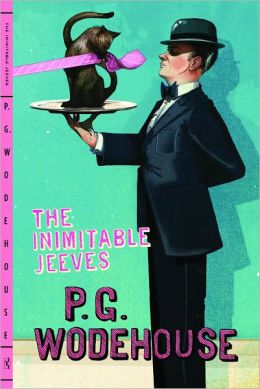
The Inimitable Jeeves (1923)

The Inimitable Jeeves (Jeeves). P.G. Wodehouse. 1923. 225 pages.

The Inimitable Jeeves is my favorite Wodehouse yet. (I've also read The Man With Two Left Feet and My Man Jeeves.) I loved this short story collection because it is all devoted to Bertie and Jeeves! Featured stories include: "Jeeves Exerts the Old Cerebellum," "No Wedding Bells for Bingo," "Aunt Agatha Speaks Her Mind," "Pearls Mean Tears," "The Pride of the Woosters is Wounded," "The Hero's Reward," "Introducing Claude and Eustace," "Sir Roderick Comes to Lunch," "A Letter of Introduction," Startling Dressiness of a Lift Attendant," Comrade Bingo," "Bingo Has a Bad Goodwood," "The Great Sermon Handicap," "The Purity of the Turf," "The Metropolitan Touch," "The Delayed Exit of Claude and Eustace," "Bingo and the Little Woman," and "All's Well."

These stories introduce one of Bertie's friends, Bingo Little. He is quite the character. He is always falling in love with someone. And there's always drama that Bertie and Jeeves get drawn into! But Bingo Little isn't the only source of drama! There's also Bertie's family, including Aunt Agatha and two of his cousins, Claude and Eustace, to name a few. Some of the stories are set in the city, others take place in the country. All are delightful!!!


My favorite sequence of stories is "The Hero's Reward," "Introducing Claude and Eustace," and "Sir Roderick Comes to Lunch." In this sequence, Bertie finds himself accidentally engaged to a girl, Honoria, a young woman that Bingo was once quite smitten with! Sir Roderick is Honoria's father, and their lunch together is quite delightful! He's not quite sure he likes Bertie, not quite sure Bertie is sane... enter an insane number of cats, fish under Bertie's bed, and a stolen hat... and you've got an unforgettable chapter!

Read The Inimitable Jeeves
  • If you like short stories
  • If you love short stories
  • If you hate short stories
  • If you enjoy P.G. Wodehouse
  • If you want more Bertie and Jeeves
  • If you love to laugh
© 2013 Becky Laney of Becky's Book Reviews

Wednesday, January 09, 2013

Whose Body? (1923)

Whose Body? Dorothy L. Sayers. 1923/1995. HarperCollins. 224 pages. 

"Oh damn!" said Lord Peter Wimsey at Piccadilly Circus.

In 2013, I am going to try to reread all the Lord Peter mysteries by Dorothy Sayers. The first mystery in the series is Whose Body? (My original review.) In this mystery, readers are introduced to Lord Peter Wimsey, an aristocratic gentleman whose hobby is being a detective. The mystery begins with a telephone call from his mother...

The case Peter Wimsey is working on involves an unidentified dead man in a bathtub. WHO IS HE? Where did he come from? Was he murdered there? Or did someone dump his body there? Since no one knows his identity, it's hard to arrive at motives and work out a narrative for the crime. 

The case Wimsey's friend, Inspector Parker, is working on involves a missing person. A well-known Jewish financier has gone missing. There is no body, no evidence of violent crime, but Parker suspects that a crime has been committed.

These two friends are helping each other out, helping piece clues together for both cases. Though neither man is sure that the two are connected cases. It does help having someone to reason things out with.

Favorite quotes:

"Sugg's a beautiful, braying ass," said Lord Peter. "He's like a detective in a novel." (18)
"I love trifling circumstances," said Lord Peter. "so many men have been hanged by trifling circumstances." (20)
"Parker, acushla, you're an honour to Scotland Yard. I look at you, and Sugg appears a myth, a fable, an idiot-boy, spawned in a moonlight hour by some fantastic poet's brain. Sugg is too perfect to be possible." (23) 
"Look here, Wimsey--you've been reading detective stories; you're talking nonsense." (29)
"Have you any Scotch blood in you, Parker?" inquired his colleague, bitterly.
"Not that I know of," replied Parker. "Why?"
"Because of all the cautious, ungenerous, deliberate and cold-blooded devils I know," said Lord Peter, "you are the most cautious, ungenerous, deliberate and cold-blooded. Here I am, sweating my brains out to introduce a really sensational incident into your dull and disreputable little police investigation, and you refuse to show a single spark of enthusiasm."
"Well, it's no good jumping at conclusions."
"Jump? You don't even crawl distantly within sight of a conclusion. I believe if you caught the cat with her head in the cream-jug you'd say it was conceivable that the jug was empty when she got there."
"Well, it would be conceivable, wouldn't it?" (51)
 "There's nothing you can't prove if your outlook is only sufficiently limited. Look at Sugg." (69)
Assigning a motive for the murder of a person without relations or antecedents or even clothes is like trying to visualize the fourth dimension--admirable exercise for the imagination, but arduous and inconclusive. (82)
"One demands a little originality in these days, even from murderers," said Lady Swaffham. "Like dramatists, you know--so much easier in Shakespeare's time, wasn't it? Always the same girl dressed up as a man, and even that borrowed from Boccaccio or Dante or somebody. I'm sure if I'd been a Shakespeare hero, the very minute I saw a slim-legged young page-boy I'd have said: "Odsbodikins! There's that girl again!" (123)
Read Whose Body?
  • If you like vintage mysteries, cozy mysteries, or mystery series
  • If you enjoy mysteries set in Britain
  • If you want to spend time with some memorable characters

© 2013 Becky Laney of Becky's Book Reviews
Tuesday, January 08, 2013

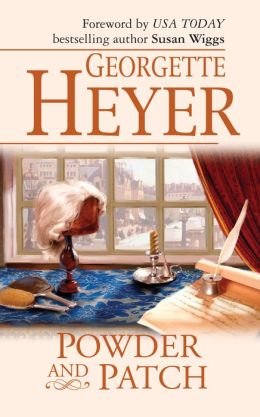
Powder and Patch (1930)

Powder and Patch. Georgette Heyer. 1930. 284 pages. (Originally published as THE TRANSFORMATION OF PHILIP JETTAN in 1923.)

There is something teasing and playful about Georgette Heyer's romance novel, Powder and Patch. The hero is a young man named Philip Jettan. He's a good man, down-to-earth. He'd rather be sincere than frivolous; he'd rather have the love of one good woman than the flirtatious attentions of sixty society ladies. He doesn't see the need to dress a certain way, talk a certain way, call attention to himself. But there are those in his life--his father and the woman he loves--who urge him to change, to transform himself into who they would have him to be. So he does. He leaves England and heads to Paris. And oh the sensation he gives there, oh what a performer he is! But will this "new-and-improved" Philip be everything Cleone dreamed she wanted? Will she be satisfied now...? Or will he be too much for her?

This one is full of duels and silly society gatherings...

A scene between Cleone and Philip:
"Cleone--do you--could you--love me?"
Cleone was silent.
Closer still came Philip, and spoke rather huskily.
"Will you--marry me, Cleone?"
Still silence, but the blue eyes were downcast.
"Cleone," blundered Philip, "you--don't want a--mincing, powdered--beau."
"I do not want a--a--raw--country-bumpkin," she said cruelly.
Philip drew himself up.
"That is what you think me, Cleone?"
Something in his voice brought tears to her eyes.
"I--no--I--oh, Philip, I could not marry you as you are!"
"No?" Philip spoke evenly. "But if I became--your ideal--you could marry me?"
"I--oh, you should not--ask such questions!"
"As I am--you'll none of me. You do not want--an honest man's love. You want the pretty compliments of a doll. If I will learn to be--a doll--you'll wed me. Well, I will learn. You shall not be annoyed by an honest man's love--any longer. I will go to London--and one day I'll return. Farewell, Cleone."
"Oh--goodness--are you--going to Town?" she gasped.
"Since that is your desire, yes." he answered.
She held out her hand, and when he kissed it her fingers clung for an instant.
"Come back to me, Philip," she whispered. (81-2)
A scene between Cleone and Philip's father, Maurice:
"Do you think--harm could have come to him, sir?"
 "No. Else had I heard. Faith, it's our own fault, Cleone, and we are grumbling!"
"I never--"
"My dear, don't pretend to me! Do you think I don't know?"
Cleone was silent.
"We sent Philip to acquire polish. Heavens knows what has happened to him! Would you care greatly if he returned--without the polish, child?"
"No!" whispered Cleone.
"Nor should I. Strange! But I should prefer it, I confess." (139)
Another quote:
“You're only a man! You've not our gifts! I can tell you! Why, a woman can think of a hundred different things at once, all them contradictory!” 
 This one has plenty of delightful scenes in it. It's a light read. It isn't her best novel, and these characters aren't her best characters. But there are places I really did enjoy it. Like when Cleone finds herself in quite a mess at the end of the novel!

Read Powder and Patch
  • If you enjoy romance, clean romance
  • If you enjoy historical romance (set in England and France)
  • If you enjoy romances with duels

© 2013 Becky Laney of Becky's Book Reviews
Tuesday, September 13, 2011

A Murder on the Links

A Murder on the Links. Agatha Christie. 1923.  272 pages.

I just LOVED, LOVED, LOVED this mystery novel starring Hercule Poirot and his close friend Arthur Hastings. The novel, I believe, is narrated by Hastings, the same narrator introduced in Poirot's first novel, The Mysterious Affair At Styles.

I usually find Christie's Miss Marple novels to be more delightful, more charming, more satisfying than those starring Hercule Poirot. But this one is definitely an exception. I just loved it from cover to cover.

This mystery, for the most part, occurs in France. And it just works really, really well. I don't want to say too much about the mystery itself. I mean the less you know the better...but you really should give Agatha Christie a try!

© 2011 Becky Laney of Becky's Book Reviews
Tuesday, January 04, 2011

Whose Body?

Whose Body? Dorothy L. Sayers. 1923/1995. HarperCollins. 224 pages. 

"Oh damn!" said Lord Peter Wimsey at Piccadilly Circus.

Whose Body? is Sayers first mystery novel. It stars Lord Peter Wimsey, a man who enjoys doing detective work as a hobby. In Whose Body? Wimsey becomes fascinated by a curious case. His mother phones him to say that a dead body has been found in Mr. Thipp's bathroom. Though he had plans for the day, he reasons that it's not every day you get to go see a crime scene like this one. The dead man is naked in a bath tub, naked except for a pince-nez. He is able to examine the crime scene thoroughly before Inspector Sugg--the 'official' investigator arrives. Wimsey does NOT get along with Sugg! However, he is quite good friends with Inspector Parker, who has quite an interesting case of his own.

These two friends exchange details about their cases and decide to help one another out as needed. Parker is happy to 'help' Wimsey piece together the details of his case. (Why did the dead body have such horrible teeth--and toenails? He has well manicured hands. He's well scented. He's clean-shaven.) And Wimsey is happy to 'help' Parker with his case. (Parker has no body, no "proof" that a murder has been committed. But this important (Jewish) financier has gone missing.)

Can both crimes be solved? Are they in any way connected?

I loved Whose Body. I just LOVED it. I think Lord Peter Wimsey is such a great narrator! The writing style is 'just right' for me. It matches my taste exactly. It's funny--witty--and charming. Wimsey has quirks and flaws--which are necessary in my opinion. But he's also very intelligent, very clever.

Some of my favorite lines:

"Sugg's a beautiful, braying ass," said Lord Peter. "He's like a detective in a novel." (18)

"I love trifling circumstances," said Lord Peter. "so many men have been hanged by trifling circumstances." (20)

"Parker, acushla, you're an honour to Scotland Yard. I look at you, and Sugg appears a myth, a fable, an idiot-boy, spawned in a moonlight hour by some fantastic poet's brain. Sugg is too perfect to be possible." (23)

"Look here, Wimsey--you've been reading detective stories; you're talking nonsense." (29)

Assigning a motive for the murder of a person without relations or antecedents or even clothes is like trying to visualize the fourth dimension--admirable exercise for the imagination, but arduous and inconclusive. (82)

"One demands a little originality in these days, even from murderers," said Lady Swaffham. "Like dramatists, you know--so much easier in Shakespeare's time, wasn't it? Always the same girl dressed up as a man, and even that borrowed from Boccaccio or Dante or somebody. I'm sure if I'd been a Shakespeare hero, the very minute I saw a slim-legged young page-boy I'd have said: "Odsbodikins! There's that girl again!" (123)

© 2011 Becky Laney of Becky's Book Reviews