Showing posts with label Miss Marple. Show all posts

Tuesday, October 02, 2012

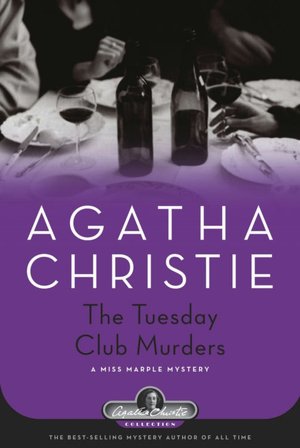
Tuesday Club Murders

The Tuesday Club Murders. Agatha Christie. 1932/2007. Black Dog & Leventhal Publishers. 256 pages.

I enjoyed The Tuesday Club Murders. While short stories are not my favorite, I prefer novels to short stories, I still enjoyed Miss Marple. This one may best be enjoyed one story at a time. There really isn't a need to rush through these stories all at once. There are thirteen stories in all: The Tuesday Night Club, The Idol House of Astarte, Ingots of Gold, The Blood-Stained Pavement, Motive v. Opportunity, The Thumb Mark of St. Peter, The Blue Geranium, The Companion, The Four Suspects, A Christmas Tragedy, The Herb of Death, The Affair at the Bungalow, and Death by Drowning. It wasn't so much that any one story WOWED me, it was more the fact that I enjoyed the cozy atmosphere of the stories as a whole. I liked Christie's writing and her characters. It was a pleasant way to spend my time.  

Read The Tuesday Club Murders
  • If you like short stories
  • If you like mysteries
  • If you like Agatha Christie
  • If you like Miss Marple

© 2012 Becky Laney of Becky's Book Reviews

Friday, August 05, 2011

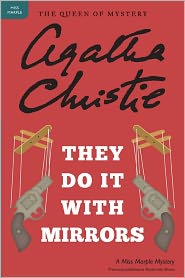
They Do It With Mirrors

They Do It With Mirrors. (Miss Marple). Agatha Christie. 1952/2011. HarperCollins 224 pages.

Mrs. Van Rydock moved a little back from the mirror and sighed. 

Ruth Van Rydock wants her good friend, Jane Marple, to do her a favor. She's worried about their mutual friend Carrie Louise Serrocold. She has a feeling that Carrie Louise is in trouble or in danger. And so she's arranged a visit for Miss Marple. After a few small lies are told to smooth the way, Carrie Louise is happy to welcome her old friend into her home. Miss Marple is introduced to the STRANGE, STRANGE bunch of folks living or working on the estate. Her husband, Lewis. Her daughter, Mildred. Her granddaughter, Gina, and her husband, Walter. Her stepsons from her second marriage, Stephen and Alex Restarick. Her companion-caretaker, Juliet Bellever. Her husband's assistant, Edgar Lawson. (Carrie Louise has been married three times--and it shows. She's carried over wealth and property, but, also children and grandchildren, etc.) Her husband's pet project has him working with juvenile delinquents with part of the estate being converted into a school of sorts. I won't lie, it was a bit confusing at first to see how these characters connect to one another--if they connect to one another. It helps that almost every character seeks out Miss Marple in the days after her arrival. One by one they "unburden" themselves and complain freely about anything and everything.

Of course, it turns out that Ruth had VERY good reason to worry about her friend. And Miss Marple it seems arrived just in time for the drama. Soon there's a murder to be solved...can she solve it in time before more lives are lost?

I enjoy Miss Marple. I do. There is just something satisfying about reading Agatha Christie. While They Do It With Murders isn't my new favorite or anything, it is an enjoyable mystery. Not perfect. But definitely enjoyable enough to recommend.

Ruth to Miss Marple:
"You've always been a sweet innocent looking creature, Jane, and all the time underneath nothing has ever surprised you, you always believe the worst."
"The worst is so often true," murmured Miss Marple.
"Why you have such a poor idea of human nature, I can't think--living in that sweet peaceful village of yours, so old world and pure."
"You have never lived in a village, Ruth. The things that go on in a pure peaceful village would probably surprise you."
"Oh I daresay. My point is that they don't surprise you." (9)

Inspector Curry and Miss Marple:
"This is all very distressing I know. But we've just got to get the facts clear. Get it all clear."
"Oh yes, I know," said Miss Marple. "So difficult, isn't it? To be clear about anything, I mean. Because if you're looking at one thing, you can't be looking at another. And one so often looks at the wrong thing, though whether because one happens to do so or because you're meant to, it's very hard to say. Misdirection, the conjurers call it. So clever, aren't they?" (90)

© 2011 Becky Laney of Becky's Book Reviews

Friday, June 24, 2011

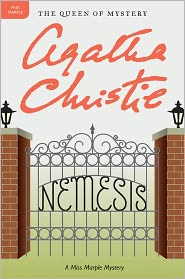
Nemesis

Nemesis. Agatha Christie. 1971/2011. HarperCollins. 304 pages.

In the afternoons it was the custom of Miss Jane Marple to unfold her second newspaper.

I wouldn't say that it's essential that you read A Caribbean Mystery before reading Nemesis. But. If you have read it, you might appreciate Nemesis more.

Nemesis opens with Miss Marple reading about the death of Mr. Rafiel in the newspaper. She met him in the Caribbean, and he was her greatest ally there when she was busy solving that mystery. She liked him a good deal, even though they never reconnected in England afterward. And Mr. Rafiel had great respect for Miss Marple!

One day Miss Marple is contacted by Rafiel's lawyers. They have something important to tell her. It seems that Mr. Rafiel left her a final challenge, a final mystery to solve.

Have you read the book of Daniel? Do you remember when King Nebuchadnezzar dreamed something disturbing and wanted help interpreting that dream. He asked all the wise men for help. But. He refused to tell them the dream. They must come up with the dream and the interpretation. If they weren't able to do both, then they'd be killed.

Nemesis reminded me of this Bible story. For Mr. Rafiel has not provided Miss Marple with any details. Not a where. Not a when. Not a how. Not a who. Not a why. Her greatest chance for solving this one and earning the money he's left her, is for her to go on the vacation he's planned for her: a tour group traveling by bus through England visiting beautiful, historic homes and gardens.

Can Miss Marple do the seemingly impossible?

I enjoyed this one. I wouldn't say it is my favorite Miss Marple mystery. But I'm very glad my library got a copy of this one! (And very happy that HarperCollins has recently published such lovely editions of the Miss Marple mysteries.) If you don't mind a couple of small spoilers, I have something to discuss at the end of this post.

Professor Wanstead and Miss Marple:
"I don't think I know exactly what you mean."
"You are being careful. You are quite right to be careful."
"I have made it a habit," said Miss Marple.
"To be careful?"
"I should not put it exactly like that, but I have made a point of being always ready to disbelieve anything that is told to me." (127)
S
P
O
I
L
E
R

I was disappointed with the way rape was presented in Nemesis. The discussions about rape in the novel were unsettling to say the least. Now, these words weren't coming from Miss Marple herself. So I don't blame the character of Miss Marple for these careless and harmful words.

Professor Wanstead:
"That told against him, of course. Not in the jury's mind, because of course they did not hear about that until after the judge's summing up, but certainly in the judge's mind. It told against him, but I made a few enquiries myself afterwards. He had assaulted a girl. He had conceivably raped her, but he had not attempted to strangle her and in my opinion--I have seen a great many cases which come before the Assizes--it seemed to me highly unlikely that there was a very definite case of rape. Girls, you must remember, are far more ready to be raped nowadays than they used to be. Their mothers insist, very often, that they should call it rape. The girl in question had had several boyfriends who had gone further than friendship. I did not think it counted very greatly as evidence against him." (136)
Mr. Broadribb:
"Well, we all know what rape is nowadays. Mum tells the girl she's got to accuse the young man of rape even if the young man hasn't had much chance, with the girl at him all the time to come to the house while mum's away at work or dad's gone on holiday. Doesn't stop badgering him until she's forced him to sleep with her. Then, as I say, mum tells the girl to call it rape." (165)
These passages made me angry! They did. I wanted to shout at the book. So it's only rape if the woman is a virgin? So the fact that a woman says yes to one man means that she doesn't have the right to say no to any other man...ever? So women are "ready" to be raped? In fact they are out pursuing it?! They are "badgering" and "forcing" them to have sex. Yes, that's right, these poor guys are the victims. Accusing someone of rape is SO MUCH FUN that the women just can't help themselves. They're just begging to be assaulted and raped so they can tell their story to anyone and everyone dumb enough to believe them. What kind of crazy logic is this? It's just wrong on SO MANY levels.


© 2011 Becky Laney of Becky's Book Reviews

Wednesday, February 16, 2011

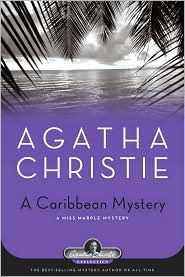
A Caribbean Mystery

A Caribbean Mystery. Agatha Christie. 1964/2007. Black Dog & Leventhal. 256 pages.

"Take all this business about Kenya," said Major Palgrave. 

 Miss Marple is on vacation. And, for the most part, she's enjoying herself. Enjoying getting to know the other people staying at the resort owned by a husband and wife, Tim and Molly Kendal. When the novel opens, she is listening--or pretending to listen--to Major Palgrave. Little knowing that within twenty-four hours this man will be dead. Did he die because he talked too much? Could one of his stories have led to his death? Maybe. Miss Marple will have to investigate to know for sure. But she suspects that his story about having a snapshot of a murderer might be to blame. Since this snapshot is not found after his death.

I enjoyed this one. I wouldn't say it is my absolute favorite Miss Marple--I don't know that I could really choose just one for that. But it was certainly enjoyable! I enjoyed the unfolding mystery of this one. I enjoyed the characters. I enjoyed the setting. I enjoyed the dialogue! It was a fun read!

Miss Marple woke early. Like many old people, she slept lightly and had periods of wakefulness which she used for the planning of some action or actions to be carried out on the next or following days. Usually, of course, these were of a wholly private or domestic nature, of little interest to anybody but herself. But this morning Miss Marple lay thinking soberly and constructively of murder, and what, if her suspicions were correct, she would do about it. It wasn't going to be easy. She had one weapon and one weapon only--and that was conversation.
Old ladies were given to a good deal of rambling conversation. People were bored by this, but certainly did not suspect them of ulterior motives. It would not be a case of asking direct questions. (Indeed, she would have found it difficult to know what questions to ask!) It would be a question of finding out a little more about certain people. (46)
"Conversations with you might be dangerous," he said.
"Conversations are always dangerous, if you have something to hide," said Miss Marple. (142)
"I've been wrong about her," said Mr. Rafiel with characteristic frankness. "Never been much of a one for the old pussies. All knitting wool and tittle-tattle. But this one's got something. Eyes and ears, and she uses them." (148)


© 2011 Becky Laney of Becky's Book Reviews
Monday, February 14, 2011

The Moving Finger

The Moving Finger. Agatha Christie. 1942/2007. Black Dog & Leventhal. 208 pages.

I have often recalled the morning when the first of the anonymous letters came.

Jerry Burton, our hero, has taken a house in the country with his sister, Joanna. He's recuperating from an injury, and his doctor has definitely suggested some rest and relaxation. As for Joanna, she's recuperating from a broken heart. But rural village life isn't as uneventful and peaceful as he expected. For soon after his arrival, an anonymous "poison pen" begins a nasty letter campaign. Which is unpleasant enough, he supposes, but things turn deadly after a woman's "suicide" after receiving a vile letter. The victim leaves behind two young sons, an older daughter from her first marriage, a husband, and a rather pretty governess. Megan, the daughter from the first marriage, soon becomes a major player in this Miss Marple mystery. This "suicide" becomes a bit suspicious when a second death occurs--that of a maid--within the home. The question becomes did this maid--on her day off--see something?

I loved this one. I just LOVED it. It wasn't a purely pleasant read for me. I wouldn't exactly say I was praying throughout, but I was certainly wishful with my repeated pleas, please don't let it be Megan, please don't let it be Megan, please don't let it be Megan. Never have I gotten that involved with a mystery. Who is Megan? For better or worse, she's the young woman our hero described thusly, "She looked much more like a horse than a human being. In fact, she would have been a very nice horse with a little grooming" (17). She's largely ignored not only by the village but by her family as well. But there is something about her that Jerry, our hero, can't ignore. He goes out of his way--time and time and time again--to include her. He even invites her to stay with him and his sister after her mother's death. He is the one person, she's found, willing to listen to her.

While Jerry is making friends with Megan--not always an easy task--Joanna, his sister, is trying to make friends with the local doctor. That is an uphill battle. Joanna has never, ever had to work this hard to get a guy to like her.

So this mystery has a romantic element to it which I just loved. It also stars Miss Marple, though she doesn't enter the case until after the second death occurs. Miss Marple finds Jerry Burton a great help in this one! The details he's observed through his stay, makes solving this one so much easier for her! It gives her quite the lead. But she still has to *prove* it.

The Moving Finger is very compelling! I loved it for so many different reasons.

My favorite quotes:

Emily Barton, I think, has a mental picture of men as interminably consuming whisky-and-sodas and smoking cigars, and in the intervals dropping out to do a few seductions of village maidens, or to conduct a liaison with a married woman.
When I said this to Joanna later, she replied that it was probably wishful thinking, that Emily Barton would have liked to come across such a man, but alas, had never done so. (85)

"The police are doing their best."
"If Agnes could be killed yesterday, their best isn't good enough."
"So you know better than they do?"
"Not at all. I don't know anything at all. That's why I'm going to call in an expert."
I shook my head. "You can't do that. Scotland Yard will only take over on a demand from the chief constable of the county. Actually they have sent Graves."
"I don't mean that kind of an expert. I don't mean someone who knows about anonymous letters or even about murder. I mean someone who knows people. Don't you see? We want someone who knows a great deal about wickedness!"
It was a queer point of view. But it was, somehow, stimulating. (141)

"Yes, it was dangerous, but we are not put into this world, Mr. Burton, to avoid danger when an innocent fellow creature's life is at stake. You understand me?"
I understood. (199)

© 2011 Becky Laney of Becky's Book Reviews

Wednesday, February 09, 2011

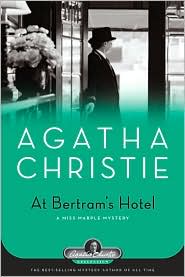
At Bertram's Hotel

At Bertram's Hotel. Agatha Christie. 1965/2007. Black Dog & Leventhal. 272 pages.

In the heart of the West End, there are many quiet pockets, unknown to almost all but taxi drivers who traverse them with expert knowledge, and arrive triumphantly thereby at Park Lane, Berkeley Square, or South Audley Street.

Is Bertram's Hotel too good to be true? Miss Marple senses something is not as it should be. She senses that there is something unreal about this place. It's in the little things, really, and it's hard to put into words almost. But the hotel seems more like an act, a show, a theatrical production, than a proper hotel. Miss Marple is on vacation in London. And she's as observant as ever--which proves useful as a mystery begins to unfold concerning the hotel and its guests. (One guest ends up missing! One clerk ends up dead!) The novel focuses on a broken relationship between mother and daughter and the race car driver that may just come between them in the end.

Though it stars Miss Marple--a character I've come to love and adore--I did not love and adore At Bertram's Hotel. I found it confusing. The shifts in narration. The introduction of new characters, new stories, new mysteries. It felt so chaotic, so unconnected. I knew if I kept reading, it would make sense in the end. I knew that all these elements would come together nicely. That Miss Marple would be Miss Marple and all would be right with the world. And I was right. I did find it compelling by the end. Still. I was a little disappointed that it wasn't love through and through.

Miss Marple seldom gave anyone the benefit of the doubt; she invariably thought the worst, and nine times out of ten, so she insisted, she was right in so doing. (119)

"I learned (what I suppose I really knew already) that one can never go back, that one should not ever try to go back--that the essence of life is going forward. Life is really a one way street, isn't it?" (194)


© 2011 Becky Laney of Becky's Book Reviews

Wednesday, February 02, 2011

4:50 From Paddington

4:50 From Paddington. Agatha Christie. 1957/2007. Black Dog & Leventhal. 288 pages.

Mrs. McGillicuddy panted along the platform in the wake of the porter carrying her suitcase. Mrs. McGillicuddy was short and stout, the porter was tall and free-striding. 

Mrs. McGillicuddy was returning from a busy day Christmas shopping, she certainly didn't expect to witness a murder. No, when she boarded her train, she had no idea that she'd witness a murder--a man strangling a woman--on another train, a passing train. It's a shock to be sure. What's even more shocking, perhaps, though frustrating may be the better word, is the fact that no one believes her story. No one except Miss Marple, her friend. So despite the fact that Mrs. McGillicuddy reported the crime--and Miss Marple joined forces with her to report the crime to all the proper people, this crime remains a non-crime. Why? No body was found on the train. No body was found on the tracks. But Miss Marple knows that her friend is telling the truth. And she's willing to hire someone--a younger woman, Lucy Eyelesbarrow, to help her find the body and solve the case. Will they find the body? Will they learn her identity? Will they be able to find the murderer? Can they reason together his motive for the crime? The first step, for Miss Marple, is to make a reasonable guess as to where a body could be thrown from the train (and concealed). Lucy then takes her place at the closest residence--a large estate, it happens to be, as a servant. She'll "snoop" around to see if she can find the body. And if she does, when she does, she may just stick around to see if the family has been involved in the crime...

I enjoyed this one. I enjoyed Miss Lucy Eyelesbarrow! I did. And, of course, I loved Miss Marple. I found this a satisfying, compelling read!

© 2011 Becky Laney of Becky's Book Reviews
Tuesday, February 01, 2011

A Murder is Announced

A Murder is Announced. Agatha Christie. 1950/2006. Black Dog & Leventhal. 288 pages.

Between 7:30 and 8:30 every morning except Sundays, Johnnie Butt made the round of the village of Chipping Cleghorn on his bicycle, whistling vociferously through his teeth and alighting at each house or cottage to shove through the letter box such morning papers as had been ordered by the occupants of the house in question from Mr. Totman, stationer, of the High Street.

The local paper has a reputation for having the juiciest gossip, but no one expected to read an announcement quite like this one: A murder is announced and will take place on Friday, October 29th, at Little Paddocks, at 6:30 PM. Friends please accept this, the only intimation. What could it mean? Readers see several households reaction to the announcement, including the reaction of the Blacklock household. Miss Letitia Blacklock, owner of Little Paddocks, is just as shocked as shocked can be. What kind of joke is this? What kind of game is this? If she's not responsible for setting up this announcement, who is? Though she never planned a party--let alone this kind of party--it looks like she'll be expected to play hostess anyway.

A handful of men and women 'attend' the big event at Little Paddocks. Many arriving just minutes before the 'murder' is supposed to occur. Many believing all along that this is a planned joke, a game, a trivial matter meant to bring people together to eat and drink and scream. But they're in for a surprise of their own when the lights go out and shots are fired. Lights reveal one dead man--the supposed mastermind of the robbery--and one bloodied woman, the hostess herself. The injury is slight, still many questions remain. The biggest question of all is was this a burglary gone wrong or a premeditated attempt at murder. Was Miss Blacklock the intended victim? Did the shooter have a motive for wanting the woman dead? And Miss Marple may be the best woman for solving this mystery...unofficially of course.

I enjoyed this one very much! I am just loving Miss Marple and this one was no exception. I enjoyed Inspector Craddock too. The characters, as always, were well done. It was just a satisfying read. And I was certainly surprised by this one!

Sir Henry on Miss Marple:
She's just the finest detective God ever made. Natural genius cultivated in a suitable soil....Remember that an elderly unmarried woman who knits and gardens is streets ahead of any detective sergeant. She can tell you what might have happened and what ought to have happened and even what actually did happen! And she can tell you why it happened! (47-8)

© 2011 Becky Laney of Becky's Book Reviews
Tuesday, January 25, 2011

The Body in the Library

The Body in the Library. (Miss Marple) Agatha Christie. 1941/2006. Black Dog & Leventhal. 192 pages.


Mrs. Bantry was dreaming. 

The Bantrys are about to get a great shock when this novel opens. They're awakened by their maid, Mary, proclaiming that she's found a dead body in their library! The body is that of a young, beautiful woman--a blond. At first Colonel Bantry doesn't believe it could be true. But Mrs. Bantry handles the situation surprisingly well: with a quick phone call to Miss Marple. She is more than happy to 'help' the police detectives solve another case. Who is this dead woman? How did she come to be in their library? Who killed her and why?

I enjoyed this mystery very much. I am enjoying my time with Miss Marple. She's such a wonderful character! So many of the characters in these Agatha Christie novels are well done. I'm enjoying the descriptions and dialogue very much! There's just something so cozy, so charming about these stories.

"I like your friend," said Adelaide Jefferson to Mrs. Bantry. The two women were sitting on the terrace.
"Jane Marple's a very remarkable woman," said Mrs. Bantry.
"She's nice too," said Addie, smiling.
"People call her a scandalmonger," said Mrs. Bantry, "but she isn't really."
"Just a low opinion of human nature?"
"You could call it that." (124)
 "As I've told you, I've got a very suspicious mind. My nephew Raymond tells me, in fun, of course--that I have a mind like a sink. He says that most Victorians have. All I can say is that the Victorians knew a good deal about human nature." (184)

© 2011 Becky Laney of Becky's Book Reviews
Monday, January 17, 2011

The Murder at the Vicarage


Murder at the Vicarage. A Miss Marple Mystery. Agatha Christie. 1930/2006. Black Dog & Leventhal. 288 pages.

It is difficult to know quite where to begin this story, but I have fixed my choice on a certain Wednesday at luncheon at the Vicarage. The conversation, though in the main irrelevant to the matter in hand, yet contained one or two suggestive incidents which influenced later developments.

Murder at the Vicarage is the first Agatha Christie novel starring Miss Marple. And it was a delight. A pure and simple delight. It is narrated by the vicar, a Mr. Clement. His narrative was just right--for me. It was a perfect blend of humor and charm. And, of course, suspense! Mr. Clement is shocked to discover a dead man in his study. Colonel Protheroe had his moments--he's a man most would find difficult to live with. But no one *really* expected him to be murdered! He was supposed to be having a private meeting with the vicar that evening. But a phone call changes all that...

Inspector Slack is the "official" detective on the case. The man responsible for solving this crime and bringing the murderer to justice....

Miss Marple, one of the elderly women in the community, tells Mr. Clement that there are seven people she suspects capable of the murder. But she's not naming names--at least not yet. Which leaves Mr. Clement trying to guess the identity of the murderer as well.

Chapter by chapter, readers find clues. Can they guess the identity of the murderer before Miss Marple's big reveal?

I found both Mr. Clement and Miss Marple charming. I just LOVED the characterization in this one. The humor, the wit, the drama. It was just a satisfying read.

Here are some of my favorite lines:

"Dear Vicar," said Miss Marple, "you are so unworldly. I'm afraid that, observing human nature for as long as I have done, one gets not to expect very much from it. I daresay idle tittle-tattle is very wrong and unkind, but it is so often true, isn't it?" (23)


Thursday started badly. Two of the ladies of my parish elected to quarrel about the church decorations. I was called in to adjudicate between two middle-aged ladies, each of whom was literally trembling with rage. If it had not been so painful, it would have been quite an interesting physical phenomenon. (40)


"Ah!" said Miss Marple. "But I always find it prudent to suspect everybody just a little. What I say is, you really never know, do you?" (154)


"I remember a saying of my Great Aunt Fanny's. I was sixteen at the time and thought it particularly foolish."
"Yes?" I inquired.
"She used to say, "The young people think the old people are fools--but the old people know the young people are fools!" (282)


At that moment Anne Protheroe entered the room.
She was dressed very quietly in black. She carried in her hand a Sunday paper, which she held out to me with a rueful glance.
"I've never had any experience of this sort of thing. It's pretty ghastly, isn't it? I saw a reporter at the inquest. I just said that I was terribly upset and had nothing to say, and then he asked me if I wasn't anxious to find my husband's murderer, and I said 'Yes.' And then whether I had any suspicions and I said 'No.' And where I didn't think the crime showed local knowledge, and I said it seemed to, certainly. And that was all. And now look at this!"
In the middle of the page was a photograph, evidently taken at least ten years ago--Heaven knows where they had dug it out. There were large headlines.

WIDOW DECLARES SHE WILL NEVER REST TILL SHE HAS HUNTED DOWN HUSBAND'S MURDERER.

Mrs. Protheroe, the widow, of the murdered man, is certain that the murderer must be looked for locally. She has suspicions but no certainty. She declared herself prostrated with grief, but reiterated her determination to hunt down the murderer.

"It doesn't sound like me, does it?" said Anne.
"I daresay it might have been worse," I said handing back the paper. (201-02)


© 2011 Becky Laney of Becky's Book Reviews