Friday, January 16, 2026
7. The First Four Years
7. The First Four Years. Laura Ingalls Wilder. 1971. 134 pages. [Source: Library] [historical fiction, classic, series book, 3 stars]
First sentence: The stars hung luminous and low over the prairie.
The First Four Years was published several decades after the death of Laura Ingalls Wilder. It was published after the death of Laura and Almanzo's daughter, Rose Wilder Lane. It is based on three hand-written notebooks. The story is believed to have been written in the mid to late forties. It is also believed to have been shelved by Laura Ingalls Wilder after the death of Almanzo. She never went back to work on it again. She never polished it up. She never sent it to the publishers. It is what it is, a first draft.
It has a completely different feel than the other Little House books. It doesn't have chapters, for one thing. But more than that there is an emotional undertone of sadness and regret that makes it pointedly different than its predecessors. It is just very melancholy. Yes, it captures all the horrible things that happened next. Yes, it's probably accurate enough to assume that most if not all farmers experienced this many brutal hardships. The other Little House books often dealt with hard issues as well. But I suppose they felt more balanced. I think she injected enough hope and light to lift them up.
Personally, I'd rather have the "happily ever after" ending of These Happy Golden Years than the brutal hardships of The First Four Years. Not that I'm promoting the unrealistic fairy-tale ending where marriage is problem-free. But to read of all the hardships with the farm, the land, the money problems, the debt, the worries, the health problems, the weather/environment problems, etc. It's just so hard, so brutal, so depressing.
© 2026 Becky Laney of Becky's Book Reviews
Friday, June 23, 2023
122. When Hitler Stole Pink Rabbit
When Hitler Stole Pink Rabbit. Judith Kerr. 1971. 191 pages. [Source: Library] [Middle Grade, Historical, World War II]
First sentence: Anna was walking home from school with Elsbeth, a girl in her class. A lot of snow had fallen in Berlin that winter. It did not melt, so the street cleaners had swept it to the edge of the pavement, and there it had lain for weeks in sad, greying heaps.
Premise/plot: Anna and her family are Jewish. In the week leading up to elections, her father flees Germany just in case Hitler wins the election. If Hitler does win, his family will follow him to Switzerland. (The dad is a writer. His views will not be appreciated by Hitler and the Nazi party.) He tries to sell enough of his writing in Switzerland...and then France. But the economy of the 1930s isn't all that great. The family left everything behind--including Anna's pink rabbit--and are essentially penniless. By the end of the novel, Anna and her brother, Max, I believe have been sent to England.
The novel takes place circa 1933/1934.
My thoughts: This is my second time to read When Hitler Stole Pink Rabbit. It is set in the early 1930s. Many of the policies had not come into play yet. There were warning signs which this family heeds. But it is very early days. It is set in Germany, Switzerland, France, and England. (The last chapter is set in England.) I believe this one is in part autobiography. I don't know how much is based on her experiences and how much is pure fiction. The novel's conflict is subtle and perhaps more about a family's economic and financial struggles as they are displaced. The novel is about learning new languages, trying to economize as much as possible, struggling to make ends meet. Perhaps subtle isn't the best word. I mean that this isn't so driven by external events happening--like so many books set during the second world war.
© 2023 Becky Laney of Becky's Book Reviews
Saturday, May 13, 2017
Leo the Late Bloomer
First sentence: Leo couldn't do anything right. He couldn't read. He couldn't write. He couldn't draw. He was a sloppy eater. And, he never said a word.
Premise/plot: Much of Leo the Late Bloomer covers conversations between a mother and father as they discuss their late bloomer, Leo. The father worries that Leo will never, ever bloom. His mother is confident that Leo will bloom. Seasons come and go but Leo hasn't bloomed. Then one day, he does. And Leo's "first word" isn't a first word, but a sentence: "I made it!"
My thoughts: I did not grow up with this one. In fact, I didn't meet Leo until I was in college. But I definitely connected with him once I met him. I liked the optimism of the mother tiger. I could understand, in part, the frustration of the father. And I cheered the happy, happy ending. Overall, I'm not sure that it's perfectly-perfect in terms of modeling what to do if your child has learning difficulties. But I'm not convinced that it has to be. This isn't a how-to book for children or parents.
Text: 5 out of 5
Illustrations: 4 out of 5
Total: 9 out of 10
© 2017 Becky Laney of Becky's Book Reviews
Thursday, February 16, 2017
Mandy
First sentence: On the outskirts of a pretty country village called St. Martin's Green, there stand a large, white house called St. Martin's orphanage.
Premise/plot: Mandy, the heroine, is a ten year old orphan. Soon after the novel opens, Mandy climbs over the wall near the orphanage and discovers a hidden-away-in-the-woods cottage. She decides the place is hers--and goes about creating a special place inside-and-out where she belongs. She cleans. She gardens. She collects. But most of all: she guards and protects her secret. Mostly.
My thoughts: I love, love, love Mandy. This book is one of my favorites from childhood. Years before I discovered The Secret Garden, I was best friends with Mandy. I think I loved Mandy because she may have been the first heroine who dealt with some of the darker (but natural) emotions like sadness, loneliness, and disappointment.
She was a dreamer. Most of the time she lived in a make-believe world of her own. She loved to read. She exchanged books at the local library at least once a week. The wonders of Robinson Crusoe and Alice in Wonderland and Gulliver's Travels were very real to her and offered far more excitement than the reality of her life could ever provide. (6)
She occasionally experienced sad, disturbing feelings. Sometimes she felt an ache inside that would not go away. It seemed then as though her life were very empty. She would cry for no reason at all, seemingly, and it frightened her when she did. She tried to be brave and put away her feelings.
"I'm having one of my attacks again," she would think, trying hard not to let people see her tears.
Her attempts to keep busy were mostly an effort to fill her life so that she had no time to feel disconsolate. But the nagging sadness was persistent, and it would envelop her when she least expected it.
As Mandy grew, her longings grew stronger and sometimes she felt as though she must surely break apart with so much going on inside her. It was as though she were searching for something though what or where it was she could not say. (7-8)
© 2017 Becky Laney of Becky's Book Reviews
Wednesday, November 23, 2016
House My Grandpa Built
First sentence: This is the lot my grandparents found, with maple trees and high, dry ground. These are the plans that Grandpa drew, showing the rooms and outside view--a small sort of house, for their children have grown and left the big house for homes of their own.
Premise/plot: Grandpa and Grandma are moving into a house that he is having built. The book follows the construction of the house from beginning to end. And it's all done in rhyme--for better or worse!
My thoughts: I liked this one. I like that we get to see the plans of this house too. I'm an addict for HGTV, I admit. And even before that This Old House was one of my favorite, favorite shows. So this cute little book has a just right feel for me.
Text: 3 out of 5
Illustrations 3 out of 5
Total: 6 out of 10
© 2016 Becky Laney of Becky's Book Reviews
Tuesday, August 30, 2016
The Day You Were Born
First sentence: Do you remember the day you were born? Do you remember how you felt? First, you were safe and small, growing in a special place inside your mother, and getting ready for the world. You could stand on your head in there and kick and turn and never be afraid. Sometimes you heard noises from the outside world--music, voices, a bang, or a bell. You wondered about them. But you had some more growing to do before you could find out for yourself. Soon you were ready to be born.
Premise/plot: The book chronicles a baby's first day. For the most part, I'd say it has a hospital setting. Baby is introduced to doctors, nurses, a mother, a father, etc. So many "firsts."
The nurse took you to your mother. Your mother reached out her arms and held you close. She was very happy. She undressed you, and looked at you, and played with your fingers and your toes. She hugged you and gave you a kiss. It was your first kiss. You liked it. You liked her, too.My thoughts: I definitely had this one. I really like it. It reminds me of the beginning of Inside Out.
Text: 4 out of 5
Illustrations: 3 out of 5
Total: 7 out of 10
© 2016 Becky Laney of Becky's Book Reviews
Thursday, July 14, 2016
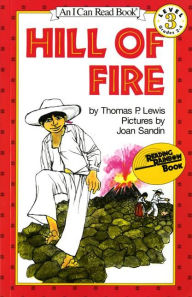
Hill of Fire
Hill of Fire. Thomas P. Lewis. Illustrated by Joan Sandin. 1971. 64 pages. [Source: Bought]
First sentence: Once there was a farmer who lived in Mexico. He lived in a little village, in a house which had only one room.
Premise/plot: Pablo's father, a farmer, is always, always saying nothing EVER happens on their farm, in their village. Every day is the same: dull and predictable. But one day SOMETHING happens, and Pablo witnesses it all. The two are in their field plowing when suddenly a VOLCANO begins to form. What started as crack in the ground soon becomes a big volcano--an erupting volcano. From the moment "it" appears--the crack-soon-to-be-a-volcano--Pablo runs to warn the villagers. It isn't long before the villagers are fleeing the village for safety. Indeed the whole village will have to be relocated and rebuilt.
This is a nonfiction early reader set in Mexico in 1943. A father and son truly witnessed the formation of a new volcano. That is far from an ordinary occurrence. The author's note states that human eyes--so far as we know from records--have only witnessed two such events. (Paricutin in Mexico and Tenerife in the Canary Islands.)
My thoughts: I remembered this book from Reading Rainbow. I'm not sure I ever read it myself until I found it in my local charity shop. Even though it was not in the best shape--a discarded library copy from Connecticut of all places--I knew I had to have it. The story was just as absorbing as I remembered it. Definitely recommended.
© 2016 Becky Laney of Becky's Book Reviews
Saturday, August 01, 2015
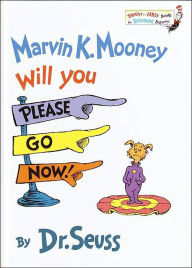
Seuss on Saturday #31
First sentence: The time has come. The time has come. The time is now. Just go. Go. GO! I don't care how. You can go by foot. You can go by cow. Marvin K. Mooney, will you please go now!
Premise/plot: The narrator REALLY, REALLY, wants Marvin K. Mooney to GO. But will Marvin K. Mooney be so obliging?
My thoughts: I liked it. It is definitely one of the catchier Seuss books. (Though not as fun or as silly as say Fox in Socks or Green Eggs and Ham. Still. There's something pleasant about it.) It's just FUN to say phrases like "You can go by foot. You can go by cow. Marvin K. Mooney, will you please go now!" It just is.
Have you read Marvin K. Mooney Will You Please Go Now! Did you like it? love it? hate it? I'd love to know what you thought of it!
If you'd like to join me in reading or rereading Dr. Seuss (chronologically) I'd love to have you join me! The next book I'll be reviewing is In A People House.
© 2015 Becky Laney of Becky's Book Reviews
Saturday, July 25, 2015
Seuss on Saturday #30
First sentence: At the far end of town where the Grickle-grass grows and the wind smells slow-and-sour when it blows and no birds ever sing excepting old crows...is the Street of the Lifted Lorax.
Premise/Plot: Readers hear about the Lorax from the Once-ler. It's a story of lessons not learned in time, a story of an environment abused and wasted. It is a heavy tale for a picture book. Perhaps the heaviest of Seuss' picture books.
UNLESS someone like you cares a whole awful lot, nothing is going to get better. It's not.My thoughts: The Lorax is my least favorite Seuss book. I won't lie and say it is the only Seuss novel with a moral or lesson, it's not. Many of Seuss's books have a moral in them. Some are subtle. Some are in-your-face obvious. I prefer the subtler moral. I do.
Have you read The Lorax? Did you like it? love it? hate it? I'd love to know what you thought of it!
If you'd like to join me in reading or rereading Dr. Seuss (chronologically) I'd love to have you join me! The next book I'll be reviewing is Marvin K. Mooney Will You Please Go Now.
© 2015 Becky Laney of Becky's Book Reviews
Friday, June 12, 2015
The Far Side of Evil
The wind is howling through the trees outside, a cold, hateful wind. By standing on the bunk I can just barely reach the window. It's quite dark now, and the stars are brilliant, though they seem terribly far away. They, at least, are familiar and comforting, a reminder of home.
Elana, our heroine, has just graduated from the Federation Anthropological Service Academy. Her first "official" assignment has her going undercover on the youngling planet, Toris. The planet is in the "Critical Stage," and the Federation is sending dozens of agents in undercover. It's an information gathering mission, not one of intervention. The goal: blend in as much as possible with the Younglings, and transmit your observations when possible. It's dangerous because if Toris goes critical--uses nuclear weapons--then all the agents are essentially just as doomed as the younglings themselves. The only other agent Elana knows is another recent graduate. His name is Randil. He's a mess.
Toris has two "warring" governments, which is putting the planet in "Critical Stage." Elana's cover gets blown, and she's captured as a spy. The book is her report of how she become imprisoned and how she's handling the daily torture.
The premise of Far Side of Evil is simple. All civilizations--all planets--evolve through a critical stage, a stage where they choose to use their technology for weapons--nuclear warfare--or they choose to use their technology to go to the stars, to explore and colonize space.
Did I like The Far Side of Evil? Not really. Why? That's a good question. Was it because the chapters were way too long? Perhaps. Was it because it lacked the charm of The Enchantress From the Stars? Perhaps. I will say that Enchantress from the Stars has an almost fairy-tale feel to it in places. It reads like a fantasy book. Was it Randil's fault? Probably. He certainly proves irritating and infuriating. But it wasn't his fault alone. I also found Elana's narration to be less than ideal. I found her to be smug, arrogant, condescending, and repetitive. Why was Elana so likeable in Enchantress from the Stars and so unlikeable in Far Side of Evil? I think in the first book she was more vulnerable, and less confident in her abilities. She wasn't alone. She was acting under the advice of other older-and-wiser Federation agents, including her father. Both books are premise-driven to a certain extent; but Far Side of Evil is only premise-driven, and Enchantress from the Stars is plot-driven and character-driven too.
© 2015 Becky Laney of Becky's Book Reviews
Wednesday, May 13, 2015
When Hitler Stole Pink Rabbit (1971)
I enjoyed reading Judith Kerr's When Hitler Stole Pink Rabbit. The book is set in Germany, Switzerland, and France in the 1930s. The book opens several weeks before Hitler comes to power. Anna's father, a famous writer, decides to flee Germany before the election, just in case. A wise decision, it turns out. His family follows a week or two later, I believe. The family may have escaped immediate danger, but life won't exactly be easy either. He has to find a way to support his family--to continue to support his family no matter the economics or politics of Europe. The family first attempt to resettle in Switzerland, but, he's unable to find a paying audience for his work. That is, no one wants to publish his work. The family then moves to France to resettle. They spend more time in France than they did in Switzerland. But it's still a rough transition. The book is told through Anna's perspective. And the challenges are real. Learning new languages, going to new schools, general anxiety, etc.
The book has an unusual title. If you've read the book, it makes sense. The family leaves on relatively short notice. They can only take a few suitcases. They cannot take everything, of course. Anything they leave behind will most likely be taken or confiscated. Anna, for better or worse, chooses a new stuffed toy--a dog--over her favorite, beloved "pink rabbit." She hates the idea of it being gone forever and being confiscated or "stolen" by the Nazis.
The book does a good job of capturing what it might have been like to be Jewish in Europe in the 1930s. Though this one is set many years before World War II.
© 2015 Becky Laney of Becky's Book Reviews
Sunday, November 03, 2013
Sunday Salon: Reading Mandy (1971)
Long before I met Anne, Heidi, Pollyanna, Mary, Emily, or Sara, I met a young orphan girl named Mandy. She was quiet and loved to read. She had an inner thought life, as well as complex emotions that she just could not comprehend. There was something under the surface of Mandy that made her a good choice for me. It wasn't pity I felt. It was genuine affection. The story of Mandy is simple and straightforward. Young orphan climbs over wall and discovers an abandoned cottage (of sorts) with an out-of-control garden. She decides to adopt this place as her very own. She becomes completely absorbed in the home of her own creation. She weeds. She plants. She waters. She cleans. She scrubs. She has LOTS of tea. It is not a magical cure, and yet, it sets something in motion that helps her in the end. In the process of making this place hers, Mandy abandons her good-but-thoughtless obedience and begins to tell lies, to bend the truth, to sneak around, to covet, to steal. Mandy isn't a perfect heroine. She is all-too-human. She makes mistakes. She doesn't always think things through. I think I loved Mandy because she may have been the first heroine who dealt with some of the darker (but natural) emotions like sadness, loneliness, and disappointment.
She was a dreamer. Most of the time she lived in a make-believe world of her own. She loved to read. She exchanged books at the local library at least once a week. The wonders of Robinson Crusoe and Alice in Wonderland and Gulliver's Travels were very real to her and offered far more excitement than the reality of her life could ever provide. (6)
She occasionally experienced sad, disturbing feelings. Sometimes she felt an ache inside that would not go away. It seemed then as though her life were very empty. She would cry for no reason at all, seemingly, and it frightened her when she did. She tried to be brave and put away her feelings.© 2013 Becky Laney of Becky's Book Reviews
"I'm having one of my attacks again," she would think, trying hard not to let people see her tears.
Her attempts to keep busy were mostly an effort to fill her life so that she had no time to feel disconsolate. But the nagging sadness was persistent, and it would envelop her when she least expected it.
As Mandy grew, her longings grew stronger and sometimes she felt as though she must surely break apart with so much going on inside her. It was as though she were searching for something though what or where it was she could not say. (7-8)
Friday, June 24, 2011
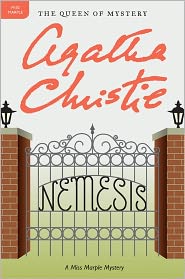
Nemesis
In the afternoons it was the custom of Miss Jane Marple to unfold her second newspaper.
I wouldn't say that it's essential that you read A Caribbean Mystery before reading Nemesis. But. If you have read it, you might appreciate Nemesis more.
Nemesis opens with Miss Marple reading about the death of Mr. Rafiel in the newspaper. She met him in the Caribbean, and he was her greatest ally there when she was busy solving that mystery. She liked him a good deal, even though they never reconnected in England afterward. And Mr. Rafiel had great respect for Miss Marple!
One day Miss Marple is contacted by Rafiel's lawyers. They have something important to tell her. It seems that Mr. Rafiel left her a final challenge, a final mystery to solve.
Have you read the book of Daniel? Do you remember when King Nebuchadnezzar dreamed something disturbing and wanted help interpreting that dream. He asked all the wise men for help. But. He refused to tell them the dream. They must come up with the dream and the interpretation. If they weren't able to do both, then they'd be killed.
Nemesis reminded me of this Bible story. For Mr. Rafiel has not provided Miss Marple with any details. Not a where. Not a when. Not a how. Not a who. Not a why. Her greatest chance for solving this one and earning the money he's left her, is for her to go on the vacation he's planned for her: a tour group traveling by bus through England visiting beautiful, historic homes and gardens.
Can Miss Marple do the seemingly impossible?
I enjoyed this one. I wouldn't say it is my favorite Miss Marple mystery. But I'm very glad my library got a copy of this one! (And very happy that HarperCollins has recently published such lovely editions of the Miss Marple mysteries.) If you don't mind a couple of small spoilers, I have something to discuss at the end of this post.
Professor Wanstead and Miss Marple:
"I don't think I know exactly what you mean."S
"You are being careful. You are quite right to be careful."
"I have made it a habit," said Miss Marple.
"To be careful?"
"I should not put it exactly like that, but I have made a point of being always ready to disbelieve anything that is told to me." (127)
P
O
I
L
E
R
I was disappointed with the way rape was presented in Nemesis. The discussions about rape in the novel were unsettling to say the least. Now, these words weren't coming from Miss Marple herself. So I don't blame the character of Miss Marple for these careless and harmful words.
Professor Wanstead:
"That told against him, of course. Not in the jury's mind, because of course they did not hear about that until after the judge's summing up, but certainly in the judge's mind. It told against him, but I made a few enquiries myself afterwards. He had assaulted a girl. He had conceivably raped her, but he had not attempted to strangle her and in my opinion--I have seen a great many cases which come before the Assizes--it seemed to me highly unlikely that there was a very definite case of rape. Girls, you must remember, are far more ready to be raped nowadays than they used to be. Their mothers insist, very often, that they should call it rape. The girl in question had had several boyfriends who had gone further than friendship. I did not think it counted very greatly as evidence against him." (136)Mr. Broadribb:
"Well, we all know what rape is nowadays. Mum tells the girl she's got to accuse the young man of rape even if the young man hasn't had much chance, with the girl at him all the time to come to the house while mum's away at work or dad's gone on holiday. Doesn't stop badgering him until she's forced him to sleep with her. Then, as I say, mum tells the girl to call it rape." (165)These passages made me angry! They did. I wanted to shout at the book. So it's only rape if the woman is a virgin? So the fact that a woman says yes to one man means that she doesn't have the right to say no to any other man...ever? So women are "ready" to be raped? In fact they are out pursuing it?! They are "badgering" and "forcing" them to have sex. Yes, that's right, these poor guys are the victims. Accusing someone of rape is SO MUCH FUN that the women just can't help themselves. They're just begging to be assaulted and raped so they can tell their story to anyone and everyone dumb enough to believe them. What kind of crazy logic is this? It's just wrong on SO MANY levels.
© 2011 Becky Laney of Becky's Book Reviews