Showing posts with label 1983. Show all posts

Sunday, September 04, 2022

107. The Robots of Dawn


The Robots of Dawn. Isaac Asimov. 1983. 438 pages. [Source: Library]

First sentence: Elijah Baley found himself in the shade of the tree and muttered to himself, "I knew it. I'm sweating."

Premise/plot: Detective Elijah Baley stars in his third science-fiction mystery in Isaac Asimov's The Robots of Dawn. The first two books are Caves of Steel and The Naked Sun. All have Baley working closely with R. Daneel Olivaw, a humanoid robot, to solve a murder. In this third book, Baley finds himself heading to Aurora to solve the "murder" of a robot. It is not so much a criminal investigation. The "murder" being more a matter for the civil courts. But this is a case that might very well have huge implications. It isn't so much the destruction of one robot, as it is a fiery political mess of WHO should be colonizing planets in the future. The options being a) humanoid robots only but preparing the way for human colonists centuries later b) humans and robots working together c) Spacer humans only NOT those from Earth. d) Aurorans (humans from the planet Aurora) only, no other spacers, e) Earthmen and Spacers f) only Earthmen. Essentially, what role (if any) should robots have in colonizing space. Will the robots being ruled by the three laws interfere with the natural order of things? Will robots over-protective nature of "saving" humans at all costs, keep humans from taking the risks necessary to colonize space? 

My thoughts: This book felt like it was 800 pages, and not in a good way. It is without a doubt a premise driven novel. It is not really a mystery novel, not really. Of course that is my opinion. It is so DRY and BORING and INFO-DUMP-y when it comes to interrogating and interviewing everyone he meets. Info-Dump is a great word for the narrative style. Little character development. If I wasn't already attached to Baley and Daneel, then I would have refused to finish it. The topics are mainly sociology (particularly sexuality, reproduction/parenthood, marriage) science (inventors, researchers, ethical responsibilities), and politics.

 When it wasn't being incredibly boring, this book was disturbing. And not because of the adulterous one-night affair between Baley and Gladia. There's a fine balance between odd/weird and disturbing. The Aurora society is so SEX with no prohibitions or inhibitions, no taboos, that they see absolutely NOTHING wrong with incestuous relationships. In fact, it's thought "odd" if fathers refuse daughters, or daughters refuse fathers. (It is a little more complicated than that. But still disgusting). Children are encouraged from a young age, instructed and taught. It wasn't that every time the subject of sex was brought up in the book, it involved children. But even a couple of times makes this a weird read.

I was disappointed. I enjoyed the first two books so much. The first two books were not as weird/creepy.

© 2022 Becky Laney of Becky's Book Reviews

Friday, January 27, 2017

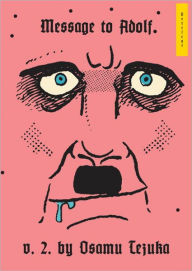
Message to Adolf #2

Message to Adolf, part 2. Osamu Tezuka. 1983/2012. Translated by Kumar Sivasubramanian. Vertical. 608 pages. [Source: Library]

First sentence: Mama, today I killed people.

Premise/plot: The second half of Message to Adolf begins with a letter of 'confession' from Adolf Kaufman to his Japanese mother. This book sees us through World War II and beyond. If there is a main character, it is Sohei Toge. But really there are dozens of characters. All falling somewhere between extremes. Good and evil. Sane and insane. Smart and stupid.

My thoughts: This will cover my thoughts on both books. I can understand that it would be really difficult to read a graphic novel that was 1200+ pages, so it had to be broken up into parts. But there is one story, not two.

Did I like the characters? Not really. I think perhaps with the exception of one or two characters--mainly the women characters--every character made big mistakes. It feels wrong to call these ethical slips, "big mistakes" when we're talking about things like rape, beating up women, and murder. It's not just the "bad guys" that are committing these crimes. But the good guys too. Even the main character--in the first book. My favorite characters were probably Mrs. Kaufman and Mrs. Kamil. One woman ended up running a restaurant and marrying the 'hero' Sehei Toge. The other was a Jewish baker.

Did I like the story or the action? Again the answer is not really. The story is very brutal and violent. This is expected in part. Japan and Germany were at war with the world. I did not expect the Nazis to be portrayed as "nice." The book depicts the casualness, the nothingness, of murder felt by the Nazis. What I wasn't really expecting to see depicted in both books was rape. Two main characters (Adolf Kaufman and Sohei Toge) essentially RAPE women and get away with it for the most part. They never once think, hey, what I did was wrong. While Kaufman really never recovers his boyish innocence--once he joins the Hitler Youth, it's over for him--Toge essentially is depicted as a great guy, the hero we all should be cheering for.

As I mentioned, murder is all too commonly depicted in these books. Because of the brutal violence (scenes of torture, rape, murder, physical abuse) and the sex scenes (some consensual, some definitely NOT) this is definitely an ADULT book.

What was the message of the book? I'm not sure. During the war, the tension (in the plot) came from people wanting to reveal "secrets" that could destroy Hitler and "end the war" and those wanting to protect Hitler and destroy the secret documents and kill anyone who had seen them.

I am sure there is some significance to the book being titled Message to Adolf, but, I'm not quite sure I can guess the author's intent fully. It's easy--for me--to conclude that WAR IS UGLY AND BRUTAL AND MAKES YOU DO HORRIBLE, HORRIBLE THINGS TO OTHER HUMAN BEINGS. But was that the author's message?

© 2017 Becky Laney of Becky's Book Reviews
Thursday, January 26, 2017

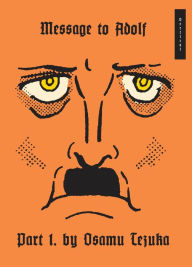
Message to Adolf #1

Message to Adolf. Osamu Tezuka. Translated by Kumar Sivasubramanian. 1983/2012. Vertical. 648 pages. [Source: Library]

First sentence: This is the story of three men named Adolf.

Premise/plot: Message to Adolf is a massive two volume graphic novel set for the most part in Japan (and Germany) during the 1930's and 40's. The 'hero' is a Japanese reporter named Sohei Toge. After his brother is murdered by Nazis during the 1936 Olympic Games, he vows vengeance, to find the murderers and finish his brother's work. A political secret led to his brother's death, will it lead to his own?

My thoughts: This one was originally serialized in the early 80's. It has been newly translated into English and in book format. I found it very dramatic--a cliffhanger every chapter at least, dozens of close calls. The action follows several families connected in some way to Kobe, Japan. That is where two of the three Adolf's enter in. One Adolf (Kaufman ) has a German father and Japanese mother. He's best fiends with another boy, another Adolf. His family disapproves because Adolf Kamil is Jewish. There are several stories throughout, but essentially it is about the war and the choices one is forced to make.

I'm not sure how I feel about part one. Honestly, it kept me reading, but, it doesn't really have a proper ending. Will seek out the other volume.

© 2017 Becky Laney of Becky's Book Reviews
Tuesday, January 03, 2017

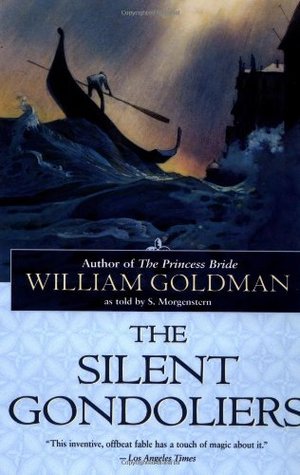
The Silent Gondoliers

The Silent Gondoliers. William Goldman. 1983/2001. 128 pages. [Source: Library]

First sentence: Everyone knows that the gondoliers of Venice are the greatest--correction, sorry--everyone used to know that the gondoliers of Venice are the greatest singers in the world.

Premise/plot: Why are the gondoliers of Venice now silent? Why do they no longer sing as they row? S. Morgenstern (Yes, that Morgenstern who gave us The Princess Bride) has researched this extensively and is sharing with us why. At the heart of this one is Luigi, the one gondolier who could not sing.

Luigi loved, loved, loved to sing. Heart and soul he loved to sing. But he was so bad, so incredibly bad, that he was forbidden to sing. People would see him coming--see him in his gondola--and start to throw things at him just in case he was thinking about singing.

This is HIS story. And it's a great one.

My thoughts: I love this one. I think it would be a great one to adapt to film. I really do. So I definitely recommend you read this little novella if you get the chance. I loved Luigi especially. I loved the story and the storytelling. The climax was something! This one hits the emotions in all the right ways.

© 2017 Becky Laney of Becky's Book Reviews
Tuesday, July 28, 2015

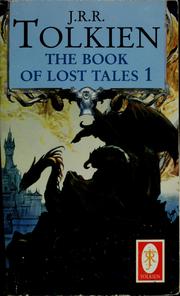
The Book of Lost Tales, Part One

The Book of Lost Tales. J.R.R. Tolkien. 1983/1992. 345 pages. [Source: Library]

Did I enjoy reading The Book of Lost Tales, Part One? Yes and no. I'll try my best to explain why. First, The Book of Lost Tales traces Tolkien's writings about Middle Earth from the very beginnings. Many of these stories and poems (yes, poems) date from around the first World War. Tolkien sets up a framework for his fantasy stories. A man, Eriol, stumbles across The Cottage of Lost Play, and, meets a bunch of storytellers essentially. Tolkien's mythology is at its earliest and in some ways its weakest. It was interesting to read these early pieces, in a way, to see the origins of what would become a great fantasy. And a handful of these stories can be seen--to a certain degree--in what would be published as The Silmarillion. I'll be honest though, I preferred the more-polished stories of The Silmarillion. One does learn that Tolkien kept working and working and working and working on some of these stories. That this mythology was always a work in progress. From the first version of the story to the latest version of the story, they'd be BIG changes. Other stories he edited or rewrote perhaps only two or three times, and then almost sort of forgot about. Some stories he never finished at all. I believe there is at least one unfinished story in The Book of Lost Tales. Since I've started reading the introduction to the Book of Lost Tales, Part Two, I might be slightly confused. But. Generally speaking, what readers are being "treated" to is fragments, captured moments of his early writings.

In addition to reading Tolkien's own work, one also is privileged to read Christopher Tolkien's commentaries on the stories included. At first I had my doubts that commentaries would be interesting. But I can say that without the commentaries, the stories themselves wouldn't make much cohesive sense. So I was quickly proven wrong!

But as interesting as I found it. (And I didn't mind the poetry, by the way) I can't say that I "loved" it or found it wonderful or thrilling. I'm undecided on if I'll continue on with Book of Lost Tales Part Two.  

© 2015 Becky Laney of Becky's Book Reviews
Saturday, June 05, 2010

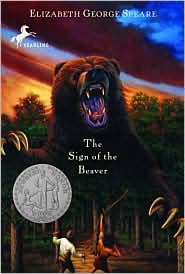
The Sign of the Beaver


The Sign of the Beaver. Elizabeth George Speare. 1983. Random House. 135 pages.

It took me less than an hour to read this Newbery Honor book. What did I think about it? Well, it's flawed for one thing. With its use of words like "savage" and "squaw" etc. to describe American Indians. (One of the things that I noticed throughout was the broken English used by the Indian characters.)

The book stars a young boy named Matt. He's twelve or thirteen. And his father has left him in the family's new cabin in the wilderness of Maine. His father needed his son's help in building the cabin and planting the corn. And now he needs his son's help in "protecting" this new home while he returns to his family to bring back his wife and daughter.

Should Matt have been able to survive on his own? Maybe, maybe not. Certain circumstances come about leaving Matt's survival in question--his gun is stolen, much of his food is destroyed. Fortunately, there are a few local Indians who go out of their way to befriend the young boy. Through the months as he waits for his family to return, Matt slowly but surely sees Attean--the Indian boy--as a friend, a true friend, almost a brother. There are layers of distrust and hatred--on both sides--that must be overcome for this friendship to work. That doesn't mean Attean trusts white men. That doesn't mean Attean is happy that white settlers are moving onto his people's hunting grounds. That he is happy to be moving because of all this "progress."

One of the interesting aspects of this one is that Matt shares with Attean Daniel Defoe's Robinson Crusoe. He reads--albeit an edited version of the tale--aloud to him. Matt's commentary--his observations--on Robinson Crusoe are interesting--to me. His little asides, his little realizations. His friendship with Attean lead him to question (though perhaps not drastically enough) his favorite book. Though Matt has his flawed moments--he is meant to represent (I believe) a thinking person.

The novel is flawed in my opinion. I think readers should think about the way Attean is presented, how he is portrayed. To consider that this is Matt's story, his perspective. And that Attean's story would be different.

See More On Sign Of the Beaver at American Indians in Children's Literature.
And When Books Fall Out of Fashion at The Miss Rumphius Effect.
He opened Robinson Crusoe at the first page and began to read. I was born in the year 1632, in the city of York....He stopped. He remembered suddenly how the first time he had tried to read this book he had found that first page so dull he had come close to giving up right there. He had better skip the beginning and get on with the story if he wanted to catch Attean's attention. "I'll read the part about the storm at sea," he said.


© Becky Laney of Becky's Book Reviews
Thursday, January 15, 2009

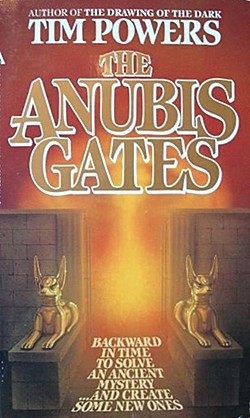
The Anubis Gates


Powers, Tim. 1983. The Anubis Gates.

The Anubis Gates is a pleasantly weird novel. Stealing directly from the back cover, "The Anubis Gates is the classic, Philip K. Dick Award-winning time travel novel that took the fantasy world by storm a decade ago. Only the dazzling imagination of Tim Powers could have assembled such an insane cast of characters: an ancient Egyptian sorcerer, a modern millionaire, a body-switching werewolf, a hideously deformed clown, a young woman disguised as a boy, a brainwashed Lord Byron, and finally, our hero, Professor Brendan Doyle."

When two men--under the direction of a seemingly evil Master--invoke a spell from an ancient Egyptian book, it creates holes in time--among other things. Amenophis Fikee and Doctor Romany are the two men responsible. Fikee suffers worse--in my opinion--in that the spell transforms him into a werewolf. Fortunately for him, unfortunately for nineteenth century England, he's now got the power to switch bodies with others. Which wreaks havoc, of course, because Fikee is a murderous monster with ever-changing identities.

Enter Professor Brendan Doyle. He's a twentieth-century professor (1980s) down on his luck. When the DIRE company offers him a unique job, he's quick to take it. They want him merely to give a lecture on Coleridge. Now Coleridge isn't his poet of choice. No, he's spent most of his adult life studying the more obscure poet--a contemporary of Lord Byron--William Ashbless. There are so many puzzles in this life that are unsolved. He seems to show up out of the blue in England in 1810. No details are known about where he was born, who his parents were, where he went to school, etc. Doyle would love to solve the mystery of this little-known poet. And the good money that DIRE is offering may just be what he needs to fund his project.

Doyle has been employed by Mr. Darrow to give a lecture about Coleridge to a very select group of people--all wealthy and willing to pay huge sums of money. What he discovers is that this is a once-in-a-lifetime, out-of-this-world experience. For the group will begin in 1983, travel back in time to 1810 to actually hear Coleridge give a lecture in a tavern, and then return to 1983--all in a period of four hours. Doyle is ready to dress the part and have some intellectually stimulating fun.

Sounds like fun, right? Well, for Doyle, things don't go quite according to plan. He's kidnapped by Dr. Romany and separated from the others. Though he manages to escape his initial capture, now, Doyle is trapped in 1810--without money and street smarts--and danger abounds everywhere. That's all I have to say about that.

This novel had many individual elements that intrigued me: ties to Ancient Egyptian culture, ties to the British Romantic poets, time travel, werewolves, etc. I liked it. I did find it a bit confusing at times with all the body-switching going on. I'm sure a second reading would probably clear up a few of my lingering questions. But overall, I liked it.

© Becky Laney of Becky's Book Reviews