Showing posts with label Horror. Show all posts

Friday, July 16, 2021

61. The Bone Maker


The Bone Maker. Sarah Beth Durst. 2021. [March] 496 pages. [Source: Review copy]

First sentence: Kreya always wore her coat with many pockets when she went out to steal bones.

Premise/plot: The war has been over for twenty-five years, but for the five heroes of Vos who "saved the world," it feels like yesterday. Especially for our heroine, Kreya, who has never come to terms with her husband's death. But all five heroes--Kreya, Jentt, Zera, Marso and Stran--have paid dearly for their so-called victory. 

The Bone Maker is dark fantasy with elements of horror, romance, and comedy. Definitely an adult novel. Mainly we get two points of view that of Kreya and Zera. Though readers get to know all five (yes, even the supposedly "dead" Jentt) heroes to some extent. (There are a few scenes from other points of view.)

So essentially the premise is, what if the grand victory wasn't really so FINAL and "the end." What if the heroes--twenty-five years later--are called upon to save the world again...in their middle age years.

My thoughts: The Bone Maker is an odd book. I think it will definitely appeal to some readers. Those that like their books spooky, creepy, with gothic, horror vibes. An unsettling discomfort that drives the plot forward. We've got dark magic that is ethically suspect. Big time ethically suspect. We've got heroes--and villains--using dark magic to raise the dead. The world building in this one has depth--we've got layers upon layers. Not just with the world-building but with the characterization as well. Perhaps not all five characters are given equal treatment. But what is spared on some of the heroes perhaps is poured out onto the villain. And perhaps that is how it should be. 

The book deals with some serious issues--grief, post traumatic stress disorder, trauma, war, mental health, etc. Not to mention the ethics of using dark magic. It explores what it means to be labeled a "hero" vs. labeled a "villain." But it also blends in some crude passages and slightly distasteful humor. Perhaps for a comedic effect that did nothing for me. I did at times expect it to veer into a philosophical direction and go a bit deeper, but it didn't really. 

The Bone Maker is set in a fantasy world. I have to keep reminding myself of that. The characters do not have any hope of resurrection (and reunion) outside of dark magic. This made me a bit sad.

This one reminded me of a couple science fiction shows. Babylon 5's "Quality of Mercy" and "Rising Star." (The first being from season one and the second being from season four.) There is a device in those episodes. If you've seen Babylon 5 you probably know what I'm talking about. Once you've seen how it is used in season four, even the introduction of the device in season one is brutal to the heart.

Star Trek The Next Generation's Time Arrow (Part I and II) also comes to mind.


© 2021 Becky Laney of Becky's Book Reviews

Monday, October 15, 2018

Dracula

Dracula. Bram Stoker. 1897/2005. 448 pages. [Source: Bought]

First sentence: 3 May. Bistritz. -- Left Munich at 8.35 PM on 1st May, arriving at Vienna early next morning; should have arrived at 6.46, but train was an hour late.

Premise/plot: This classic Victorian horror novel opens with Jonathan Harker's journal. He is soon to meet Count Dracula. He's yet unaware of how quickly his life is about to be turned topsy-turvy. The good news is that he won't have to face this epic battle between good and evil alone. He'll be surrounded by friends: Abraham Van Helsing, Dr. John Seward, Quincey Morris, Arthur Holmwood (aka Lord Godalming), and his wife, Mina Harker.

They were awakened to the danger through the tragic loss of their dear, dear friend and companion Miss Lucy Westenra.

The novel consists of diaries, journals, letters, records, etc.

My thoughts: I first read Dracula in 2007. That almost seems a lifetime ago. I reread Dracula because I needed a qualifying read for the 2018 #Victober reading challenge. Dracula could fulfill Katie's challenge or Kate's challenge.

Quotes:
  • "You may go anywhere you wish in the castle, except where the doors are locked, where of course you will not wish to go. There is reason that all things are as they are, and did you see with my eyes and know with my knowledge, you would perhaps better understand." (31)
  • What does it all mean? I am beginning to wonder if my long habit of life amongst the insane is beginning to tell upon my own brain. (157)
  • "If I could, I would take on myself the burden that you do bear. But there are things that you know not, but that you shall know, and bless me for knowing, though they are not pleasant things. (190)
  • I suppose a cry does us all good at times--clears the air as other rain does. (206)
  • "My friends, this is much; it is a terrible task, that we undertake, and there may be consequence to make the brave shudder. For if we fail in this our fight he must surely win; and then where end we? Life is nothings; I heed him not. But to fail here, is not mere life or death. It is that we become as him; that we henceforward become foul things of the night like him--without heart or conscience, preying on the bodies of those we love best." (269)


© 2018 Becky Laney of Becky's Book Reviews

Friday, September 28, 2018

Frankenstein

Frankenstein (Oxford World's Classics). Mary Wollstonecraft Shelley. 1818/1998. 261 pages. [Source: Bought in College.]

You will rejoice to hear that no disaster has accompanied the commencement of an enterprise which you have regarded with such evil forebodings.

Premise/plot: Robert Walton is on the adventure of a lifetime; he's always, always, always wanted to be an arctic explorer. He just wishes he had a best-good-buddy to share it with. As he's sharing his longing for a friend with his sister--via letter--he stumbles across a candidate for the job. He's a strange, odd man with one super-crazy story to tell. He's also a man full of warnings and woes. His name is Victor Frankenstein. You might have heard of him. Maybe.

Victor Frankenstein understands dreaming big. If asked what he wanted to be when he grew up, he might have responded oh-so-seriously: GOD. You see, Victor spends way too much time thinking about how life is created. Well. Perhaps I should rephrase that. When he's thinking about creation, he's thinking about how to reanimate DEAD BODIES and RECREATE life.

Frankenstein becomes more than a little obsessed with his science project. I personally could never figure out the appeal. He isn't interested in bringing the dead back to life--as is. That is, reanimating the life of a specific person. He is interested in piecing together bits and pieces of dead humans into a new super-human form. Taller. Stronger. Bigger. And definitely uglier. He isn't interested in prolonging life or reuniting families. What does he hope to gain by his creation? Does he see himself as a Creator? What does he owe his creature--if anything? What does his creature owe him--if anything?

If man is created in the image of God, is the monster created in the image of Frankenstein? Does the monster share the characteristics of Victor Frankenstein? Are the two more alike or different? Does the monster reveal the heart and mind of his Creator?

My thoughts: I've read Frankenstein so many times now. I think I've really only ever read the 1818 text of the novel. Most of the time I stick with the same copy I used in college.

I love the book.


© 2018 Becky Laney of Becky's Book Reviews

Tuesday, October 21, 2014

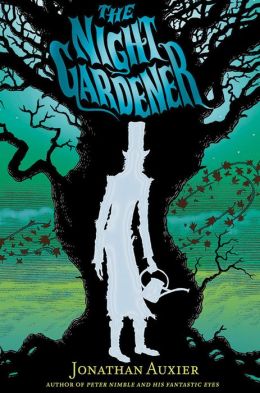
The Night Gardener (2014)

The Night Gardener. Jonathan Auxier. 2014. Abrams. 350 pages. [Source: Library]

I loved, loved, LOVED Jonathan Auxier's The Night Gardener. It may just be my favorite new book published in 2014. I loved so many things about it: the atmospheric setting, the creepy world-building, the storytelling, the writing, and the characterization. (Yes, those overlap, I imagine.) I could just say that I loved all the elements of this one; that I loved it absolutely from cover to cover. (Which does more justice for the book?)

Here's how the story opens. I'm curious if it will grab you like it did me!
The calendar said early March, but the smell in the air said late October. A crisp sun shone over Cellar Hollow, melting the final bits of ice from the bare trees. Steam rose from the soil like a phantom, carrying with it a whisper of autumn smoke that had been lying dormant in the frosty underground. Squinting through the trees, you could just make out the winding path that ran from the village all the way to the woods in the south. People seldom traveled in that direction, but on this March-morning-that-felt-like-October, a horse and cart rattled down the road. It was a fish cart with a broken back wheel and no fish. Riding atop the bench were two children, a girl and a boy, both with striking red hair. The girl was named Molly, and the boy, her brother, was Kip. And they were riding to their deaths. This, at least, was what Molly had been told by no fewer than a dozen people as they traveled from farm to farm in search of the Windsor estate.
I loved Molly and Kip. It wasn't that either protagonist was perfect. It was that I felt both were oh-so-human. These two do find the Windsor estate. And they do manage to stay on as help. Even though they don't necessarily receive wages--just room and board. This country estate is...well, I don't want to spoil it. But the people who warned them to stay away from the estate, from the sour woods, well they had good intentions. The book is creepy in all the right ways. It is a WONDERFUL read if you love rich, detailed storytelling.

I also loved Hester Kettle. She is the old woman--Kip thought she was a witch at first glance--who tells them the directions to the estate. She also proves to be a friend and kindred spirit. She is, like Molly, a story-teller.
Hester touched the button, "Funny things, wishes. You can't hold'em in your hand, and yet just one could unmake the world." She looked up at Molly. (214)
"You asked me for a story; now you call it a lie." She folded her arms. "So tell me, then: What marks the difference between the two?"
Agitated as she was, Molly couldn't help but consider the question. It was something she had asked herself in one form or another many times in her life. Still, Molly could tell the difference between the two as easily as she could tell hot from cold--a lie put a sting in her throat that made the words catch. It had been some time, however, since she had felt that sting. "A lie hurts people," she finally answered. "A story helps 'em."
"True enough! But helps them do what?" She wagged a finger. "That's the real question..." (214)
I loved the story. I loved the pacing. It was a great read!!! Definitely recommended!

© 2014 Becky Laney of Becky's Book Reviews

Wednesday, September 03, 2014

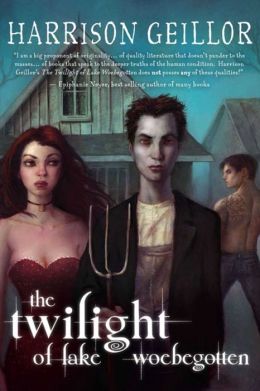
The Twilight of Lake Woebegotten

The Twilight of Lake Woebegotten. Harrison Geillor. 2011. Night Shade Books. 320 pages. [Source: Review copy]

Is it a horror novel or comedy? Readers will be the final judge in the end.

I do not like horror novels. There are a few slight exceptions now and then that I've discovered by accident. But. For the most part, I don't seek out horror novels. So, if I don't seek out horror novels, why would I read The Twilight of Lake Woebegotten? For one reason, primarily. The book pokes fun at Stephanie Meyer's Twilight series. It asks a big 'what if?' What if the heroine is not good, clumsy, and naive? What if the heroine is evil and manipulative? What if she wears a mask in every relationship? Being who she needs to be--in that moment--to get what she ultimately wants?

Bonnie Grayduck is the heroine who appears to fall madly and deeply in love with Edwin Scullen, a vampire. And she is one of the monsters in this horror novel. The events loosely fit into the Twilight books, so, one could definitely see the book as being a parody. But this parody isn't a ha-ha parody.

Bonnie is a dark person. She doesn't think nice, happy thoughts. She wants what she wants when she wants it. It is all about power and control and desire. And she has adult desires. Don't expect the "innocent" tension or chemistry from Twilight. This book is for more mature readers, I'd say.
So Edwin had taken a sudden trip to Canada. Interesting. It was insane to think he'd left town because of me...but in my experience, most things in the world do seem to resolve around me. And if they don't start out that way, they get there eventually. (50, ARC)
"Ike's great," I said, because if I told her I thought he was podgy and dull she'd get offended, "but I like Edwin."
She looked at me, now. "Really? Scullen? You don't like Ike?"
"I like him, what's not to like, but, not that way."
"I don't understand you," J said, voice heavy with mistrust. "Ike is so sweet and good and kind, and Edwin...he's so cold and condescending and superior."
I gave a great sigh. "I know. I've always been attracted to boys like that." (80, ARC)
I'm not much of a reader, but if I was, apparently I'd have a hard time reading any novel written in the last fifty years that didn't have a brooding sexy conflicted vampire in it--the shelves were just full of the stuff. (91, ARC)
"You are a brave, wonderful, suicidally stupid, diplomatic-incident-causing, amazing woman," Edwin said, kissing my face all over. We were in my bed, two nights after Gretchen's very timely demise. He'd only been back for about ten minutes, and he'd already called me names, clutched me to his bosom, sobbed a bit, brooded a fair amount, and proclaimed his love in a fairly operatic fashion. He'd finally settled down to snuggling me in bed which was rather less exhausting. (196, ARC)
© 2014 Becky Laney of Becky's Book Reviews

Tuesday, February 22, 2011

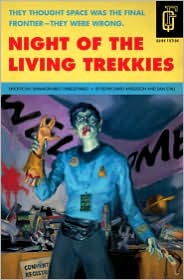
Night of the Living Trekkies

Night of the Living Trekkies. Kevin David Anderson & Sam Stall. 2010. July 2010. Quirk Publishing. 256 pages.

It was late winter of 2009, and Jim Pike was in Afghanistan.

Jim Pike, our narrator and a war veteran, is working security for a Houston hotel hosting GulfCon, a Star Trek Convention. But this convention will soon be unlike any other--for the convention--and eventually Houston itself--will be overrun with zombies. Pike teams up with an assorted crew of survivors--many Trekkies--their mission is to survive long enough to escape Houston, for they fear that when help comes, it will not be a distinguishing help. It's dramatic; it's violent; it's funny.

I am not a fan of zombie novels. I'm not. I am not a big fan of violence--blood, guts, etc. But I am a Star Trek fan. And I can appreciate a good, quirky read. So while this one may not be for everyone, I enjoyed spending an afternoon with this one.

© 2011 Becky Laney of Becky's Book Reviews

Saturday, February 12, 2011

And Then There Were None

And Then There Were None. Agatha Christie. 1939/2000. Buccaneer Books. 192 pages.

In the corner of a first-class smoking carriage, Mr. Justice Wargrave, lately retired from the bench, puffed at a cigar and ran an interesting eye through the political news in the Times. He laid the paper down and glanced out of the window. They were running now through Somerset. He glanced at his watch--another two hours to go.

Ten men and women arrive on Indian island never suspecting the dangers and thrills that are to come. None will leave the island alive. Mr. Justice Wargrave, Vera Claythorne, Captain Philip Lombard, Emily Brent, General MacArthur, Dr. Armstrong, Anthony Marston, Mr. Blore, Mr. and Mrs. Rogers. It seems each has been lured to the island without really knowing their host or hostess. Mr. and Mrs. Rogers being engaged as servants. Miss Vera Claythorne being engaged as a temporary secretary. The others all received letters of invitation. It soon becomes clear that not everything is as it appears.

There are some not-so-hidden clues embodied within a nursery rhyme poem, "Ten Little Indians" (found on pages 21-22 of my edition; you can get an idea of it from this site, though it's not an easy read, it seems it's a combination of two poems, one from 1868 and the other from 1869).  There are also ten little figurines--as each guest dies, a figurine from the table vanishes as well.

Readers get a chance to learn a little about each character. Especially the ones that survive the first few deadly days. None of the characters are particularly likable--none so delightful that you'd want to know them--especially not under these circumstances.

I would say this Christie novel comes the closest to inspiring fear and horror in its readers. There isn't anything particularly cozy or delightful or charming about this one. There are no clever detectives--arrogant or not--to counterbalance the violence. Almost everything that I love about Christie's mysteries seems to be missing in this one. But even though I don't especially "like" this one, I can't deny that it was cleverly written.

© 2011 Becky Laney of Becky's Book Reviews

Sunday, October 31, 2010

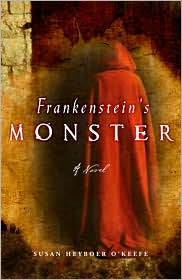
Frankenstein's Monster

Frankenstein's Monster. Susan Heyboer O'Keefe. 2010. October 2010. Crown Publishing. 352 pages. 

I killed my father again last night.

I'm not sure I can say I loved this one. At least not love, love, love. But. I really liked this one. There were places that I just LOVED it--and other places where I began to have doubts. Frankenstein's Monster is a sequel to Mary Shelley's Frankenstein. For the most part, it is set ten years after the original novel.

Time has not treated Robert Walton well. For his brief friendship with Victor Frankenstein has led to madness. After Walton speaks with the monster--the creature--he has no choice (or he claims to have no choice) but to follow in Frankenstein's footsteps. He must see to the destruction of the creature. He must make sure the earth is rid of such a monstrous beast. For better or worse, Walton gives himself over to this one path, one obsession. (It doesn't help that his first 'battle' with the creature lost him a finger.)

But while this is a story of madness, of obsession, of the consequences of extremes, it isn't Walton's story. It is the story of the ever-hunted monster. A monster who is still pondering philosophy--does he have a soul; is he a man, monster, or beast--and dealing (sometimes surprisingly well) with his anger, his frustrations. (After all, he could kill Walton at any time. Why let this mad man chase him all over the world?)

In Frankenstein's Monster we meet the Winterbournes. Margaret, Robert Walton's sister, her husband, who becomes (for a brief time) a father-figure to the monster (now calling himself Victor Hartman), and their daughter, Lily, whose madness is already evident. Lily teases and provokes him like no other woman has ever done. He's drawn to her beauty. And there are times she seems to like him, to accept him, to treat him (almost) decently. But then there are times he sees hatred in her eyes, repulsion, anger, madness. Lily has her violent moments. Her rages. She's self-destructive. In a way, Lily 'reflects' some of his own weaknesses. Could Lily be the companion he's wanted for years? 

Frankenstein's Monster is about the monster coming to terms with who he is. He's learning to accept the fact that he can make his own decisions, his own choices, that he doesn't have to be the 'monster' Frankenstein created him to be. He can choose to be better than that. He can choose to live with hope.

The writing was good. I thought it was a compelling story. I thought O'Keefe did a good job with Victor Hartman--showing his strengths and weaknesses, balancing his good and bad impulses. Lily was an interesting character--as were her parents and uncle. I thought the relationship--complicated as it was, complicated as it would have to be--added depth to this one. It took Victor finding a Lily for him to realize some things about himself. And though O'Keefe made a few decisions that I'm not completely happy with--I still enjoyed this one. (There was one scene that I could have done without completely. One of Victor's lowest moments.)

I did like the ending. I would recommend this one to fans of the original. To any reader who has had a little sympathy (or perhaps compassion is the better word?) with 'the monster' Shelley created. It is definitely my favorite sequel/retelling of this classic.


© Becky Laney of Becky's Book Reviews
Saturday, October 02, 2010

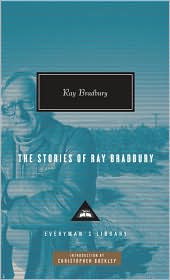
The First Twelve: Stories of Ray Bradbury, part one

The Stories of Ray Bradbury. Introduction by Christopher Buckley. 2010. April 2010. Knopf, Doubleday. 1112 pages. [I've read 127/1112]

I am really enjoying reading The Stories of Ray Bradbury. While I haven't consistently been reading from it the past few weeks, I have managed to read the first twelve stories--the first 127 pages. (I hope to read more in it throughout October. It is the perfect read for R.I.P. V.)

I've read:

The Night
You are a child in a small town. You are, to be exact, eight years old, and it is growing late at night.
Homecoming
"Here they come," said Cecy, lying there flat in her bed.
"Where are they?" cried Timothy from the doorway.
Uncle Einar
"It will take only a minute," said Uncle Einar's sweet wife.
"I refuse," he said. "And that takes but a second."
The Traveler
Father looked into Cecy's room just before dawn. She lay upon her bed. He shook his head uncomprehendingly and waved at her.
The Lake
They cut the sky down to my size and threw it over the Michigan lake, put some kids yelling on yellow sand with bouncing balls, a gull or two, a criticizing parent, and me breaking out of a wet wave, finding this world very bleary and moist.
The Coffin
There was any amount of banging and hammering for a number of days; deliveries of metal parts and oddments which Mr. Charles Braling took into his little workshop with a feverish anxiety. 
The Crowd
 Mr. Spallner put his hands over his face. There was the feeling of movement in space, the beautifully tortured scream, the impact and tumbling of the car with wall, through wall, over and down like a toy, and him hurled out of it. Then--silence.
The Scythe
Quite suddenly there was no more road. 
There Was an Old Woman
"No, there's no lief arguin'. I got my mind fixed. Run along with your silly wicker basket. Land, where you ever get notions like that? You just skit out of here; don't bother me, I got my tattin' and knittin' to do, and no never minds about tall, dark gentlemen with fangled ideas."
There Will Come Soft Rains
In the living room the voice-clock sang, Tick-tock, seven o'clock, time to get up, time to get up, seven o'clock! as if it were afraid that nobody would. The morning house lay empty.  
Mars is Heaven
The ship came down from space. It came from the stars and the black velocities, and the shining movements, and the silent gulfs of space.  
The Silent Towns
There was a little white silent town on the edge of the dead Martian sea.
I don't read many short stories. I wouldn't say that I dislike short stories. But. It is rare for me to love--or love, love, love a collection of short stories. What I love about Ray Bradbury is the delicious creepiness--this eeriness--of the atmosphere. Many stories read like a good episode of the Twilight Zone.

For example, "The Coffin" is just creepy. Readers meet two brothers--Charles and Richard. One brother dies soon after completing his "custom" coffin. He boasts to his brother about how revolutionary this coffin is--how it is a complete all-in-one funeral experience. "Simply place body in coffin--and music will start." His brother is curious. Perhaps a little too curious?!

"There Was An Old Woman" shows just how stubborn one woman is to conquer death. She refuses--I mean REFUSES to believe in death. So what happens when she dies and her body is taken away? You might just be surprised.

"The Scythe" is also quite interesting! It is about a desperate man with a family who suddenly finds himself in a new situation. Finds himself in plenty for once. But there is a price to pay for having everything so perfect. Is he willing to pay that price? He may have no choice!

"There Will Come Soft Rains" is so very haunting! It's incredibly--masterfully--eery.

Have you read any of these? What did you think? Do you have a favorite Ray Bradbury story?


© Becky Laney of Becky's Book Reviews
Sunday, January 31, 2010

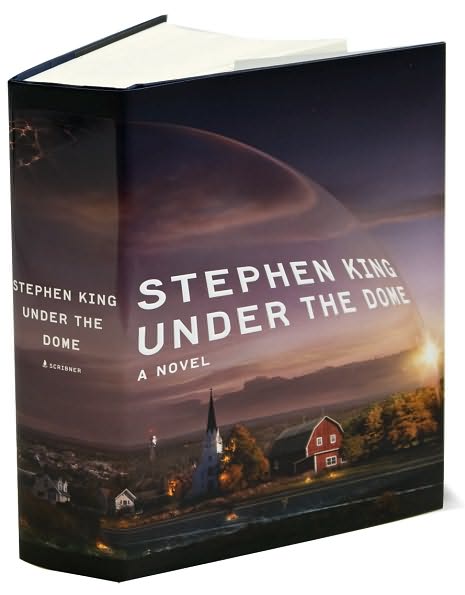
Under the Dome


Under the Dome by Stephen King. 2009. [November 2009]. Simon & Schuster. 1088 pages.

From two thousand feet, where Claudette Sanders was taking a flying lesson, the town of Chester's Mill gleamed in the morning light like something freshly made and just set down.

How many books can you think of that make you thankful--really thankful--for fresh air, for oxygen?

Stephen King's Under the Dome is quite a book. At over a thousand pages, it has plenty of drama to offer readers. King's message that absolute power corrupts absolutely is well played out in its pages. As readers meet some really dirty, really corrupt, downright evil politicians.

The book begins by introducing us to Dale Barbara, one of the heroes--one of the good guys; he is on his way out of town. After having one too many confrontations with "Junior" the son of the most evil politician (who just happens to be a used car salesman too) in town, Barbie has decided he's had enough. It's time to move on. And quickly. But. He never makes it out of town. Something stops him. The dome. On the day the dome appears (October 21), life changes dramatically and drastically. The dome isolates this little town. No one can get in or out. In fact, nothing can get in or out. Not water. Not wind. Not rain. Not air. (Not much air at any rate.)

What's to keep the residents from panicking? Not much! Especially with Jim Rennie in charge. In fact, he thinks Dome Day is just about the best thing that ever happened to him. Suddenly, he's the guy in charge. There is no one to stop him. He can implement anything in the name of "doing good for the city" and who can challenge his authority? The fact that the President of the United States has chosen Dale Barbara to take command? Not gonna stop Big Jim! It's just one more reason why Barbie (or Baaarbie needs to be taken care of). And Barbie knows it. As do his friends.

How long can a community stay a community? How long before residents start turning on one another? How long before they become "us" and "them"? How long before the mob mentality takes over completely? Will any one be safe under the dome?

I imagine it has enough appeal for readers of horror and readers of science fiction. Is it for everyone? No. I don't think a book has to be for everyone. This one has plenty of horrific details. The language. The graphic nature of death and violence and sex and drug use. It's going to turn some readers off. Also this one could definitely be offensive to those who are religious. King's depiction of Christianity is abrasive, harsh. (No question about that!) What I wasn't expecting exactly in this very dark, very horrific book is the humor. (Though it was often a dark sense of humor.) Like this description of a trucker colliding with the Dome:

The trucker might have been overloaded and moving too fast, Barbie thought, but at least he was getting a Viking funeral. (41)
Or this one of an unlucky farmer:
On God Creek Road, Bob Roux had been digging potatoes. He came in for lunch (more commonly known as "dinnah" in those parts), sitting astride his old Deere tractor and listening to his brand new iPod, a gift from his wife on what would prove to be his final birthday. His house was only half a mile from the field he'd been digging, but unfortunately for him, the field was in Motton and the house was in Chester's Mill. He struck the barrier at fifteen miles an hour, while listening to James Blunt sing "You're Beautiful." He had the loosest of grips on the tractor's steering wheel, because he could see the road all the way to his house and there was nothing on it. So when his tractor came to a smash-halt, the potato-digger rising up behind and then crashing back down, Bob was flung forward over the engine block and directly into the Dome. His iPod exploded in the wide front pocket of his bib overalls, but he never felt it. He broke his neck and fractured his skull on the nothing he collided with and died in the dirt shortly thereafter, by one tall wheel of his tractor, which was still idling. Nothing, you know, runs like a Deere. (34)
Expect plenty of drama and devastation. But I found the book to be an engaging read.

© Becky Laney of Becky's Book Reviews
Thursday, September 17, 2009

Vampire A Go-Go


Gischler, Victor. 2009. Vampire A Go-Go. Simon & Schuster. 337 pages.

I'm not the hero of this story.
There are a number of important things you need to know up front. Pay attention.
I'm not the hero of this story, but I am the guy telling it. It has to be me. I'm in a unique position. I know all the players, know how they mix and match and come together to make everything happen.


Allen Cabbot is a graduate student at Gothic State University. Academically, he's not the best of students. But he's about to have an "opportunity" to change all that. A summer trip to Prague. To assist Dr. Evergreen in his research. Who is Allen Cabbot? He's a Bronte-loving English major. In fact he wants to write his dissertation "on gender coding in Wuthering Heights." How many people think this trip will go according to plan?

What is Vampire A Go-Go about? Well, it's not about go-go dancers who are vampires. It's about ancient secrets. It's about the philosopher's stone and the quest for immortality. It's about men and women (some more undead than others) who would do anything and everything to obtain what they want. It's a story that spans centuries. With a name like Vampire A Go-Go, you know to expect quirky. And quirky is part of what you get. Zombies. Vampires. Werewolves. Ghosts. Witches and Wizards. A little bit of everything really.

It's a mystery-thriller with some romance.

© Becky Laney of Becky's Book Reviews