Showing posts with label "V" Authors. Show all posts

Thursday, December 24, 2009

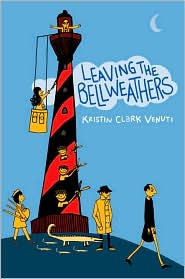
Leaving the Bellweathers (MG)


Venuti, Kristin. 2009. Leaving the Bellweathers. Egmont. 242 pages.

It is nighttime in the village of Eel-Smack-by-the-Bay.

If ever a book surprised me--completely surprised me--it was this one. Looking at the title, the cover, even the first sentence, nothing whispered the promise of how much fun this book would be, how funny and how right this book would be. Will every reader love this one? Will every reader fall for the quirky humor? Well, it would be nearly impossible for any one book to be beloved by every reader. But oh-how-I-wish this one would find a large fan base! Because I think it's just the right blend of what makes a book work.

What is it about? It's about a disgruntled but oh-so-loyal (but not that loyal) butler who is counting down the days until he leaves his job. For two hundred years, his family has served the Bellweathers. But not anymore. When the two hundred years of pledged service are up, he is so out of there! And to make money for his new start, this butler--Tristan Benway--has decided to write a tell-all book about the Bellweathers. He's got a story to tell, and oh what a story that is! Each member of the family--especially all the Bellweather children--get a chance in the spotlight. And it is a real contest (at times) to see just which one is the wildest, craziest, out-there of the bunch.

I definitely recommend this one. It is funny and unusual. And there is just something about it that works.

© Becky Laney of Becky's Book Reviews

Monday, August 11, 2008

Hurricane Song


Volponi, Paul. 2008. Hurricane Song: A Novel of New Orleans.

"Miles has only been living with his musician father in New Orleans for two months when Hurricane Katrina hits--and they haven't really been getting along. His dad lives for jazz, while Miles's first love is football. But father and son must set aside their differences when they seek refuge in the crowded Superdome."

Need I say more? The above quote from the jacket says it all. Hurricane Katrina fictionalized through an emotional father-and-son story. Did I like it? Yes and no. It was emotional. It was dramatic. I think Volponi has written a handful of complex characters and placed them in a very turbulent setting. And the pacing of those scenes is good. It will keep you reading, keep you engaged. But the ending felt a little bit too contrived.

S
p
o
i
l
e
r

It's not that I wanted Miles and his father to suffer even more than they already did. It's just that the ending seemed to have miraculously erased the losses, the troubles, the trauma, the stress and strain of the hurricane in a blink of an eye or the snap of a finger. And I just don't think that that is the case with most folks who actually did experience Katrina.

136 pages.

Other reviews: Chasing Ray, Richie,

© Becky Laney of Becky's Book Reviews

Friday, July 04, 2008

Big Fat Manifesto


Vaught, Susan. 2008. Big Fat Manifesto.

This is the third 2008 novel I've read this year (within the past two weeks actually) that deal with "weight" in one way or another. Each of these books (Looks, Artichoke's Heart, and Big Fat Manifesto) is unique from the others. Each is in some ways flawed. Some more than others, but still none is perfectly perfect.

Jamie D. Carcaterra is a writer on her high school's newspaper. At the beginning of her senior year, Jamie starts a new column. A column she hopes will win her the National Feature Award for outstanding journalism. Her column is a manifesto of what it's like to be a "fat girl."
"I am so sick of reading books and articles about fat girls written by skinny women. Or worse yet, skinny guys. Tell me, what in the name of all that's cream and chocolate do skinny guys know about being a fat girl?
The fat girl never gets to be the main character. She never gets to talk, really talk, about her life and her feelings and her dreams. Nobody wants to publish books about fat girls, by fat girls, or for fat girls, except maybe diet books. No way." (1)
Thus begins the book and her first "fat girl" column. Jamie is a great character. She may be a fat girl but she's not your stereotypical fat girl: lonely, friendless, dateless and a person who is lacking in ALL self-esteem and confidence.
Let me shoot down a few myths right now, before you even set up a stereotype:

Myth number one: Speak gently to poor Fat Girl. She can't help her terrible disability.
Myth number two: Poor Fat Girl needs to be educated about her problem.
Myth number three: Poor Fat Girl laughs to hide her tears.
Myth number four: Poor lonely Fat Girl can't get a date.
Myth number five: All poor Fat Girl wants to do is lose weight. (2-4, largely abbreviated)
Chapter one: "I have two must-achieve-or-die goals this year. The first do-or-die is probably the easiest: Write the best Fat Girl feature series ever, expose the politics and social injustices of being a fat female in today's world, and win the National Feature Award to ensure my collegiate funding. The second do-or-die, related to the first, is earning admission to Northwestern University." (6)

Jamie's voice is wonderful. I loved it. I especially especially loved her Fat Girl columns. They were true. They were authentic. They were needed. The novel focuses on Jamie's life. Her mostly crazy, often chaotic life where she is juggling writing, acting, and studying on top of having a boyfriend (Burke) and several girl friends (NoNo and Freddie). Her parents hardly enter into the picture at all. The central plot of this one is her relationship with two guys: Burke and Heath, her editor-in-chief. Burke, her boyfriend, is a Fat Boy himself. However, he decides to have weight-loss surgery. A decision that Jamie can't quite support with her head and her heart. Surgery is risky and dangerous and so drastic a step, isn't it? And if he has the surgery, how much of him--his personality, his life-style--will he lose along with all those pounds? Will she still be his fat-girl goddess once he's a muscular hunk? Heath, her editor, becomes a close friend. He's there for her and with her when all the chaos of her life begins to unfold--Burke's surgery, the columns continuing media circus, etc. (The local media has picked up on her "fat girl" columns and decided that Jamie is dangerous and promoting a "fat" lifestyle just because she's not a lonely, depressed, pitiable girl with NO self esteem or self-worth. Because she's fat and okay with being fat...she must be a menace to society, right????)

I loved almost everything about Big Fat Manifesto. However, if Big Fat Manifesto has a weakness then it is in the character development of minor characters. NoNo and Freddie are nothing more than one-sided stereotypical characters. (Freddie the side-kick lesbian; NoNo the sidekick vegetarian, animal-rights protester.) They lack the "flesh" they need to stand on their own. Burke, Jamie's boyfriend, is more developed than Freddie and NoNo, however, he doesn't have that sparkle and depth that a proper boyfriend should. Heath, on the other hand, seems to have a charm and substance and vitality that I noticed from his first introduction. But Jamie? Jamie's development is complete.

Other reviews: Melissa in Estella's Revenge, TeenReads, Teens Read Too, ProperNoun, Tales from the Rushmore Kid, MatriFocus, Curled Up, Oops, Wrong Cookie, Book Divas, Alternative Teen Services, Review & React, Abby the Librarian,
*if you've reviewed this one, you can leave a link in the comments and I'll add you in*

Author's site and blog and interview

© Becky Laney of Becky's Book Reviews

Saturday, June 07, 2008

Climbing the Stairs


Venkatraman, Padma. 2008. Climbing the Stairs.

Set in India during the early years of World War II, Climbing the Stairs is narrated by a charming young woman, 15, Vidya, who dreams of nothing more than going to college and continuing her education. She has an older brother, Kitta, a best friend, Rifka. When the novel begins, Vidya seems to have everything she wants within her grasp. Her parents have agreed that she won't be put on the marriage market quite yet unlike her cousin, Malati. And on a special father-daughter bonding trip, her father even agrees that she should go to college. And then....and then tragedy strikes.

Vidya's life isn't easy. It's in just as much turmoil--it seems--as India itself. There is within India a movement, a freedom movement, to create an independent India free from British rule and oppression. But there is also a call from the British to rise up and join the British ranks--British soldiers--on the field fighting the Axis powers. Yet Vidya's family at least--and presumably many others as well--believe in nonviolence. Affirm that all killing, all war is wrong. It doesn't matter who you're opposing, to take up arms is in itself wrong.

Vidya makes for a charming narrator for many reasons. But one of the reasons that I fell so in love with her as a narrator is the fact that she loves to read, loves to learn. When tragedy forces the family to move from their own home to her paternal grandfather's home, she doesn't give up hope, not completely. Life is very, very different. Very, very unpleasant. And yet, she always finds something to hold onto. And one of her greatest resources is her grandfather's library.

Climbing the Stairs. What does that mean exactly? Well, her grandfather and his family--his large extended family--live in a house. The men live upstairs. The women live downstairs. Women are not allowed in the men's domain. The library--technically speaking--should be off limits to her simply because of her sex, her gender. Women are not valued, not respected. Young women, girls, are seen merely as future wives, future mothers. They have no value except what value is placed on them by the men in their lives--father, brother, husband.

I absolutely loved this historical fiction novel. Definitely recommended.

© Becky Laney of Becky's Book Reviews

Monday, January 29, 2007

Ned Vizzini

Vizzini, Ned. 2006. It’s Kind of A Funny Story.

Craig Gilner thinks his acceptance into an elite high school will be the beginning of the best years of his life. But when the pressures of high school overwhelm him, he has no where to turn but to drugs. Thus his downward spiral begins at the height of his success. As academic and social pressures build, can Craig find a healthy way to cope with the anxiety? Or is he doomed to sleepless nights and days of vomiting? Can therapy and prescription drugs really be the answer? Or does the answer lay within himself? Is there a way out of his seemingly hopeless situation? It’s Kind Of A Funny Story follows the ups and downs of a young boys life as he learns about life, love, and coping with reality.

Saturday, December 02, 2006

Adrienne Maria Vrettos


Vrettos, Adrienne Maria. 2006. Skin: A Novel.

Narrated by fourteen-year-old Donnie, SKIN is a heart-breaking story of a family in crisis. The first chapter opens with his sister's tragic though not unexpected death due to an eating disorder. The rest of the book tells the before and after effects of that disorder and her death.

I'm telling you this because you didn't ask. I've got it all here, growing like a tumor in my throat. I'm telling you because if I don't, I will choke on it. Everybody knows what happened, but nobody asks. And Elvis the EMT doesn't count because when he asked, he didn't even listen to me answer because he was listening to my sister's heart not beat with his stethoscope. I want to tell. It's time to tell. Even if you didn't ask, you have to hear it (4).


Karen, his sister, wasn't always like this. There was a time when she was normal. When she liked to have fun. When she liked to laugh. When she liked to eat. Donnie shares the good and bad times of his sometimes dysfunctional family. Beginning with his parent's turbulent marriage--arguments that go on for days, screaming matches, etc., and describing how through all of the chaos his sister was his anchor. His safe place to fall. But as the months progress even Karen begins to disappoint him. First she abandons him (his perspective) to be with her new best friend, the neighbor across the street, Amanda. Then as if that wasn't bad enough his own friends abandon him as well suddenly becoming 'too cool' to hang out with such a loser.

I wish they'd just sat down at the beginning of the school year and said, 'You're out,' instead of deciding together to drop me and waiting to see when I'd notice. If they'd done that, sat me down and told me, I would have laughed in their faces. I would have gotten up and walked away and left them sitting there to realize what they'd just done. It's not like there's a whole line of kids waiting to be friends with us, clamoring to take my place. We're the end of the line. We're the ones that people look at and think 'at least I'm not them.' Kids get a death grip on their friends when it looks like they might be slipping down to where we are. It's like a kick in the balls, when people use you as a threat, when you hear someone say, 'Stop being such a douche bag or we'll make you go sit with LePlant and the other freaks.' . . . Nothing about us is right. We're the wrongest kids you've ever seen. Our faces are wrong with zits, we have the wrong hair, the wrong clothes, and I think we might be ugly. Our families are wrong because none of us are rich, our bodies are wrong because we suck at sports, and there's something really wrong with all of our personalities, because nobody likes us, not even the teachers. Teachers make fun of us too, and think we don't notice. (21-22)


As his sister begins to push everyone away, even her best friend Amanda, Donnie feels like he is becoming invisible. His parents don't notice him. His sister is too busy not eating and busy pushing everyone away to notice him. And that's when she's not in the hospital being treated for her disorder. His teachers don't notice him. And he has no friends to notice him either.

I'm becoming invisible. Every day more and more light shines through me. I think about writing Karen at the hospital and telling her. If I wrote her and told her I was becoming invisible, I think she'd tell me to stop being so dramatic, and she'd say that she understood. Once I realized that I was becoming invisible, once I realized that no one really noticed me anymore, I stopped fighting it. I stopped taking the tiny bit of room they left for me on the bench at the lunch table and sat by myself at the end of the teacher's table, which is pretty much the worst place any kid can sit, ever. Unless that kid's invisible, and then it doesn't matter. Every day since Karen's been gone, I practice floating through the school halls like a ghost. I don't touch anyone and I imagine that the times I do brush up against their arms it feels like a clammy, cold breath on their skin. I sit in the back of the class and I don't raise my hand. I ignore everyone, even the teachers. Not the kind of ignoring where you jut out your chin and hope that everyone notices you ignoring them. I ignore them like we're not even in the same universe. I ignore them because it's easy: I'm not even here. My goal is to get through the whole school day without anyone talking to me. I decide once I do that, I'll become a superhero. I'll become Donnie Disappeared. (119-120)


Even after Karen's death, Donnie remains invisible. His parents trapped in ever-going arguments about whose fault everything is continue to ignore him until one day he snaps.

You never see me! You only see her, even when she's gone, you only see her. I disappeared so she could get better! I never asked you for anything! I disappeared and you didn't even notice! And she's gone and I'm here! I'm here!


Skin is an emotional novel, a powerful one, a story with ups and downs, hopes and fears, losses and gains.

Other fiction books about eating disorders include Just Listen by Sarah Dessen and Mercy, Unbound by Kim Antieau.

Another fiction book about young teens feeling invisible is Neal Shusterman's The Schwa Was Here.

Other fiction books about grief include: Maybe by Brent Runyon, Looking for Alaska by John Green, Saving Grace by Katherine Spencer, Kira-Kira by Cynthia Kadohata, and What is Goodbye by Nikki Grimes.

http://www.adriennemariavrettos.com/index1.html