Showing posts with label "H" Titles. Show all posts

Thursday, June 04, 2009

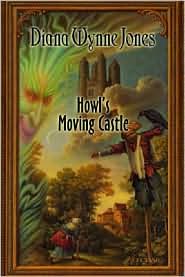
Howl's Moving Castle (MG, YA)


Jones, Diana Wynne. 1986. Howl's Moving Castle. 329 pages.

My new-found love for Diana Wynne Jones became evident only a few pages into Howl's Moving Castle, a wonderful fantasy novel revolving around a moving castle and its inhabitants.

In the land of Ingary, where such things as seven-league boots and cloaks of invisibility really exist, it is quite a misfortune to be born the eldest of three. Everyone knows you are the one who will fail first, and worst, if the three of you set out to seek your fortunes.

Sophie Hatter was the eldest of three sisters. She was not even the child of a poor woodcutter, which might have given her some chance of success. Her parents were well-to-do and kept a ladies' hat shop in the prosperous town of Market Chipping. True, her own mother died when Sophie was too years old and her sister Lettie was one year old, and their father married his youngest shop assistant, a pretty blonde girl called Fanny. Fanny shortly gave birth to the third sister, Martha. This ought to have made Sophie and Lettie into Ugly Sisters, but in fact all three girls grew up very pretty indeed, though Lettie was the one everyone said was most beautiful. Fanny treated all three girls with the same kindness and did not favor Martha in the least.


After the death of Mr. Hatter, the three Hatter sisters are divided up out of necessity--due to debt. One becomes apprentice to a baker/pastry chef. One becomes apprentice to a witch, Mrs. Fairfax. And Sophie, the oldest of the bunch, remains as "apprentice" to Fanny and continues working in the hat shop. Sophie in her people-pleasing, peace-maker role would have been content merely to let life pass her by. If only. If only...she hadn't fallen under the curse of the Witch of the Waste. Cursed to be old (long before her time), Sophie flees the shop (and her village) in shame and frustration. Forced to have an adventure, forced to "seek her fortune" despite being the oldest child, she stumbles across Howl's castle and seeks refuge.

Sophie meets Michael, Howl's apprentice, and Calcifer, Howl's fire demon who resides in the hearth of his castle. Sophie makes an impulsive deal: she'll try to break the contract between the two of them (Howl and Calcifer) if Calcifer will promise to break the curse over her. Sophie's meeting with Howl isn't immediate. And her impressions of him are ever-changing as time goes on.

Who is Wizard Howl? Well, in a way, he is who he chooses to be at that moment. A man of many names certainly. A man who likes having a bad reputation. A man who seems more playful at times than dangerous. A man trying to escape his own curse. Putting aside everything she's heard about him, Sophie begins to like this strange man. She is there to clean and mend for him. And he likes sending Sophie out in the role of his mother.

There are many twists and turns (some expected, some quite unexpected for this reader at least) that unfold throughout the novel. I don't want to go into every little detail and name every character that graces the pages of the book. But I will say this, I really enjoyed this one. It was a book that was fun and playful and delightful. A book that doesn't take itself too seriously.

© Becky Laney of Becky's Book Reviews

Wednesday, April 15, 2009

Travel the World: UK: Horrid Henry


Simon, Francesca. 2009. Horrid Henry. (Originally published in UK in 1994)

I've met a new friend and his name is Henry, Horrid Henry. Until I picked up this wonderful little chapter book by Francesca Simon, I was clueless to this gem of a series. Turns out, Horrid Henry is quite popular--especially in the UK!

This first includes four stories: Horrid Henry's Perfect Day, Horrid Henry's Dance Class, Horrid Henry and Moody Margaret, and Horrid Henry's Holiday. Each story is funny, seriously funny. There is something about Henry that is just so darn lovable. I don't know if every reader can relate. After all, there might be a few Perfect Peters and Moody Margarets lurking about. But whether you're loving Henry, or loving-to-hate Henry, I think you'll enjoy what you find here!

I think the thing that I love best about Henry is his voice. Francesca Simon gets what it means to be a kid, to think like a kid, to talk like a kid, to act like a kid. Everything is just so right.


© Becky Laney of Becky's Book Reviews
If you're reading this post on another site, or another feed, the content has been stolen.

Friday, January 09, 2009

The House at Pooh Corner


Milne, A.A. 1928. The House At Pooh Corner. With illustrations by Ernest H. Shepard.

One day when Pooh Bear had nothing else to do, he thought he would do something, so he went round to Piglet's house to see what Piglet was doing.

Last January, I read and reviewed Winnie the Pooh. It was a reread, as is House at Pooh Corner, an indulgence, too, if you will. Milne's characters: Pooh, Piglet, Eeyore, Rabbit, Owl, Tigger, Kanga, Roo, even Rabbit's friends-and-relations like 'Small' are endearing. They're not just characters in a book, they're friends. And visiting with these particular friends is always pleasant, always welcome. If you haven't read his books--even if you're eighty-two--you really should! It's never too late to go to the 100 Acre Woods.

What will you find in House at Pooh Corner? Poohsticks. Hums. Blustery days. The arrival of Tigger, and so much more. It's written in such a way that you could open it up anywhere and find something quotable. It's just that good.

Here are some of Pooh's thoughts on Poetry taken from House At Pooh Corner.

© Becky Laney of Becky's Book Reviews

Wednesday, December 31, 2008

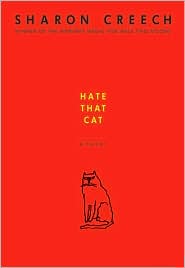
Hate That Cat


Creech, Sharon. 2008. Hate That Cat.

Hate That Cat is the sequel to Love That Dog. It's a verse novel too. Our narrator, Jack, is one year older, but his favorite teacher, Miss Stretchberry, is right there continuing to challenge him and encourage this young poet-in-the-making. (She moved up a grade.) And if this is possible, I think I loved this one just as much if not a tiny smidgen more. We learn more about Jack, more about Sky--the yellow dog he lost, more about his family--his mom. And the more I learn, the more I love.

Here are two poems to give you a glimpse of what it's like:

December 20

When you put up that one line
from the eagle poem--

He clasps the crag with crooked hands

--and used all those different colored chalks
to show how Mr. Tennyson
managed to cram in
ALLITERATION
and
ASSONANCE
and
CONSONANCE
all in one line
well
I was impressed
but that doesn't mean
I remember which is which
and
I will never be able to do all that stuff
that Mr. Tennyson does
and did he know he was doing it
when he did it?

I feel stupid.
I am a bad writer.
I'm going to quit.

December 21

Thank you for telling me
I could FORGET
those confusing words
and that it isn't knowing the words
that describe writing
that is important--
it is the thoughts in our heads
that are most important
and that feeling the rhythm
is even more
wondrous
than hearing the rhythm.

And
thank you for saying
I am a genius
(even though I know
you are exaggerating).

(54-56)

© Becky Laney of Becky's Book Reviews

Thursday, November 27, 2008

How Not To Be Popular


Ziegler, Jennifer. 2008. How Not To Be Popular.

Oh crap. What did I just do?

How Not To Be Popular begs the question how far would you go to not be popular. Maggie Dempsey hates her life, hates her parents. Okay, maybe hate is too strong a word. She hates the fact that just when she's getting settled down, making friends, having a love life, her parents decide it's time to move. Again. And again. And again. This time, Maggie has had it. She's definitely HAD IT. No more settling down. No more making friends. And no more trying to have a love life, hooking a boyfriend only to have to say goodbye.

So Maggie settles on a plan. A plan to make her the most UNpopular girl in Austin, Texas. She'll do the exact opposite of what comes naturally to her. She'll ignore the cute guys that flirt with her. No matter how cute. No matter how persistent. She won't make herself likable to the popular girls. Won't play into their games. Won't worship the ground they walk on. Won't hang on every word or friendly smile. But it's not enough--she soon realizes--to just be neutral. Soon she'll be seeking out the ugliest clothes and shoes to wear, joining the geekiest clubs, and hanging out with all the wrong people. Will it be enough then?

Maggie takes on the persona of the geekiest of the geeks, the weirdest of the weird. Doing cartwheels--in a dress at the movie theatre, flashing panties weird. Carrying a potted plant of rosemary to school to sniff because she has a headache weird. No matter what she does, Maggie finds herself liked and admired and the center of attention.

What does a girl have to do to make no one like her? Will telling the truth do it?

Read and see in How Not To Be Popular.

How Not To Be Popular is as silly as can be. Stretching credibility to the max. Would any teenage girl go to such extremes? Sacrificing dignity every single day of the school year? Not caring what ANY one thought of her? This isn't a novel of a girl being herself, finding herself, learning to love herself as she is. This is a story of a girl living a lie, being a lie. Though I suppose one could definitely argue that Maggie doesn't know herself well enough to distinguish what being real, being authentic, being genuine is...what it means. She could just as easily be living a lie when she's wearing the popular persona as well. Trading one lie for another. Who is she really? Will she ever know? Will we?

I liked elements of How Not To Be Popular. I did. But there were parts of me that hated Maggie as well. Hated her for her hypocrisy. Hated her for how easy it was for her. How easy everyone just "loved" and "adored" her.


© Becky Laney of Becky's Book Reviews

Monday, November 24, 2008

How To Be Bad


How To Be Bad by E. Lockhart, Sarah Mlynowski, Lauren Myracle. 2008.

How To Be Bad is a collaborative novel between three well-known, often-beloved YA authors. It is the story of three girls--three teens--three waitresses from a small-town Waffle House in Florida. Jesse is an uptight religious sort running away from her mom's diagnosis, Vicks is Jesse's best friend who is feeling more and more like a was. The growing distance between the two is unacknowledged, unspoken, but definitely present. Vicks has a boyfriend in Miami. He is also feeling more distant and lost than ever. His name is Brady. Mel is the third wheel. She's a hostess at the Waffle House. New to town. New in so many other ways as well. She's not really friends with anyone--but she wants to be. She wants to belong, to fit in, to be a part of something. These three head off on a road trip to Miami. Mel included only because she offers to pay...and because her presence will help disguise the tension between Vicks and Jesse.

This road trip will in many ways act as a catalyst for the girls' coming-of-age. Life. Friendship. Love. A few mistakes. A few embarrassing moments. A few fights. Can Vicks save her relationship with Brady? Can Vicks save her friendship with Jesse? Will Jesse ever come clean with the truth? Will Mel ever find a friend?

I'll be honest. I didn't much like this one. I guess I just felt the writing was bland...almost boring. (I've had difficulty getting into some of the authors' individual books in the past.)
I'm sure other readers would disagree with me in parts at least. Because I've seen this one get good reviews on other blogs. But it just wasn't for me.

© Becky Laney of Becky's Book Reviews

Wednesday, November 19, 2008

The Humming of Numbers


Sensel, Joni. 2008. The Humming of Numbers.

This one had me at hello. I loved it. I L-O-V-E loved it. This one is going to the top of my oh-so-satisfying-just-can't-praise-it-enough list. Here's how it starts off:

Lana Nicarbith hummed of the number eleven. The sound caught Aidan's attention as he swept the path near the abbey's front gate. He stared, open-mouthed, while Lord Donagh dragged the girl through the entry, past Aidan's poised broom, and inside. Plenty of people filled Aidan's ears with the chiming of four or seven or nine, and many of his brothers in the order purred softly of six. Never in his seventeen years, though, had Aidan O'Kirin met anyone endowed with the energy of a number higher than ten. He'd seen Lana before, but only from a distance--too far to hear the eleven that wafted from her now like fragrance from a flower.

The Humming of Numbers is set during the tenth century. And its primary setting is a Celtic abbey. The premise of this one is simple: Aidan is a novice; he's in training to be a monk. Why does he want to be a monk? Well, two reasons really. The first is that it is really his only career option. He's got three older brothers ahead of him in line to work the family farm. He's got no hope for an inheritance there. But the church, well, the church opens up a whole new world of possibilities for him. It's unfortunate that this career path would call him to be chaste or celibate...but on the other hand, he is fascinated by illumination. He wants to work illuminating texts. And this is a job solely for those in the church. Lana is a village girl, the illegitimate daughter of one of the local lords. She's been taken into custody for trying to sell phony sacred objects to pilgrims on their way to the village, to the abbey. Her father is "asking" (as if the church could refuse) those at the abbey to take her on as a servant girl in the kitchens. But before the girl can become a servant scrubbing floors (and so forth), she must do her time and repent of her sins.

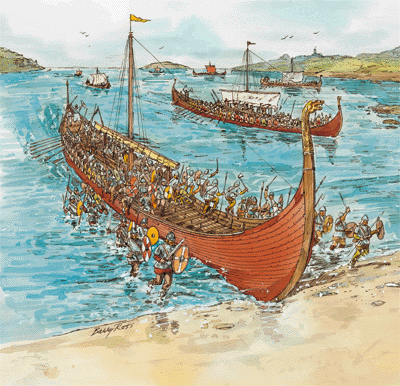
Two young teens...one boy...one girl...you can imagine where this one's going. And yet...and yet it's so very wonderful. It's full of adventure and danger and romance and life and death. What is this danger I speak of...the Vikings. And where the Vikings go...there is sure to be danger and adventure and blood and gore and life and death and drinking.

This novel is so many things: great coming of age story, great romance, great adventure, great historical fiction, nice exploration of religion and spirituality.

http://www.jonisensel.com/numbers.html

Let me just say this too...If I had read it before October 15th....I SO would have nominated this for the Cybils! It kind of makes me sad to see it not on the list.

© Becky Laney of Becky's Book Reviews

Tuesday, November 11, 2008

How To Build A House


Reinhardt, Dana. 2008. How To Build A House.

The third time isn't the charm. (Her first two novels are: A Brief Chapter In My Impossible Life and Harmless.) It may just be time for me to dissent from public opinion and admit that Dana Reinhardt's books just aren't to my liking. It might be easier on both of us. Especially since her books are generally received well. Her first book especially seemed to be buzz-worthy.

I can almost guarantee you will enjoy this one much much more than I did. (I know I'm in the minority in disliking it.) You might even love it. The premise is relatively simple, a teen girl, Harper, goes away for the summer to join a team of other teens. Their project is to build a house for a family whose home was destroyed in a tornado. The themes are love and friendship. It's easily categorized as a coming-of-age story. A story of how this young woman heals herself and becomes older and wiser because she's learned some life-lessons and had some self-realizations. It's a story of a broken woman beginning the journey towards becoming whole. Why does she need healing? Her family is "broken." Her father and stepmother are divorcing. Her stepsister, Tess, is barely speaking to her any more. Her friends-with-benefits, Gabriel, is treating her horribly.

What didn't I like about the novel? The narrator Harper. She's smug. She's condescending. She's a bit stupid. Maybe stupid isn't the best word. She's a bit unwise at times when it comes to acting, thinking, and speaking. She is polar opposite to everything I like. She doesn't believe in wearing jeans--she "can't" wear them. She hates country music*. She's an atheist. Well. Mostly. She's a nonbeliever that is obsessed with listening to Christian rock music** so she can make fun of it. She loves to mock their enthusiasm and passion. She doesn't appreciate it on a musical or spiritual level. And that's not the only thing she mocks. I am not sure if it is the narrator or the author--but something felt very condescending and smug about how the South was treated. But perhaps more annoying than even the mocking of Christianity is her obsession with lecturing every single person she meets with her environmental save-the-world-humans-are-evil spiel.

Did I like nothing about the novel? I did like a few of the characters. In particular, I liked Teddy. I don't know what he saw in Harper. But Teddy himself I liked.

*Now it's not like I *only* love country music. I love many many different types of music. But there are country music phases in my life. In high school particularly I lived for country music--Tim McGraw, George Strait, Garth Brooks, Clay Walker, John Michael Montgomery, Brooks & Dunn, etc.
**I will be the first to admit that a few groups are dinky. And sometimes it feels like the dinky ones are the ones that get the air time. But I seriously doubt if this author listened to actual Christian rock music. If she had, she wouldn't have found much to mock. I have rarely listened to Christian radio. But I'm well-schooled in Christian music because I buy CDs. Have been listening Christian music at least twenty-five years. If she'd called it "gospel" or "Southern gospel" or "praise & worship" or "contemporary" I could understand where she's coming from a bit better. But Christian rock? Methinks she's clueless.

© Becky Laney of Becky's Book Reviews

Thursday, November 06, 2008

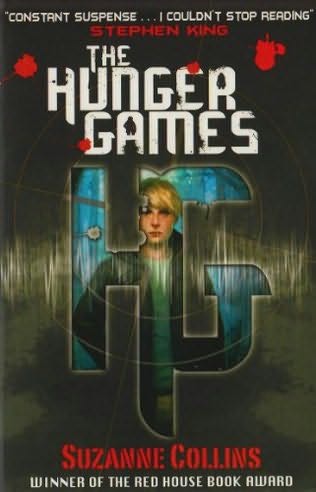
The Hunger Games


Collins, Suzanne. 2008. The Hunger Games.

When I wake up, the other side of the bed is cold.

By now, chances are you've heard of The Hunger Games by Suzanne Collins. It has been making the rounds on book blogs everywhere. And almost everything--note the almost--has been positive, gushing praise even.

What's the premise?
"In the ruins of a place once known as North America lies the nation of Panem, a shining Capitol surrounded by twelve outlying districts. The Capitol is harsh and cruel and keeps the districts in line by forcing them all to send one boy and one girl between the ages of twelve and eighteen to participate in the annual Hunger Games, a fight to the death on live TV."
Our heroine is a young and spunky girl named Katniss. She's smart. She's got several years of hunting experience. But will that be enough--can that be enough--to survive the seemingly impossible task ahead? When Katniss takes her sister's place as "the sacrifice," she's got everything going against her. 24 teens. 12 Boys. 12 Girls. 23 opponents or enemies she'll have to outwit or outbattle to survive and be crowned the victor. Only ONE person will be coming home. But her sister, Prim, wants her to try--to earnestly try--for her sake. And try she will. But does she has what it takes to become a killer? Especially when she starts to develop feelings for some of her opponents?

Of course the book is intense. What else would you expect in this dystopian thriller? And chances are that you won't want to put it down once you've started. There is a second book in the works as well. So much to look forward to...

This one goes on the highly recommended list. Especially for when it's time for future 24 Hour Readathons, 48 Hour Readathons, and my second IT'S THE END OF THE WORLD AS WE KNOW IT challenge which will be this summer. It might also be something to consider for my reading group--Reading With Becky--on google groups.

© Becky Laney of Becky's Book Reviews

Tuesday, August 12, 2008

High Dive


Stein, Tammar. 2008. High Dive.

"The phone rang at 6 a.m. Even though I expected it, my heart leapt at the shrill sound. I lunged for the receiver, picking it up before the ring ended, and looked over at my roommate. She'd burrowed deeper undercover. I could see only a skein of hair on the pillow. Good.
I glanced at the clock to begin the countdown. My mom and I had exactly fifteen minutes for the phone call.
Technically, everyone was allowed two fifteen-minute DSN, the military phone system, calls a week, but we rarely managed two. Usually it was one call, which you might think meant we could talk for thirty minutes, but the army doesn't work that way."

Arden's mom is stationed in Iraq. Arden's dad died several years ago in a car accident in Germany. So when our novel opens our heroine, Arden, finds herself a bit confused, a bit lost, a bit angry, a bit sad, and a lot worried. Her mother has decided to sell the family's vacation home in Sardinia (yes, Italy), and Arden has volunteered to help her mom out by closing the place up. She's in college. And as an army brat she's used to taking care of herself, used to change, used to making the best of whatever comes her way. So a trip to Europe on her own shouldn't really be a problem, right?

Arden is about to get a dose (or two or three) of spontaneity. On her plane trip, she meets three college students, three young women from UT who will be vacationing in Paris. They clicked so well on the ride over, they ask Arden to join them. Though she was scheduled to just lay over in Paris and then catch another plane to her destination in Germany, Arden decides to be un-Arden, to try something a bit scary, a bit new.

With this decision, most of Arden's plans go out the window. And this uncomfortableness begins to open up her heart and mind and soul to the possibilities of life--good, bad, ugly. She begins to think about her dad's death, to think about her mom, to be honest with herself and her mom about her worries. War is dangerous, yes. Everyone knows that. And as a nurse, Arden's mom could very well be hurt. But war also changes a person, scars a person. Arden is afraid her mom might be radically different when her tour in Iraq is over later in the year. No doubt about it, Arden's burdens are genuinely heavy.

During these few weeks in Europe--Paris, Florence, Sardinia--Arden learns a bit about life and a lot about herself. It's her chance to become a better, more honest, more vulnerable, healthier Arden.

Rich in detail and featuring well-crafted characters, High Dive is a great book highlighting the nuances of life.

Other Reviews: Teen.reads.com, YA Book Realm, Patchwork of Books,

© Becky Laney of Becky's Book Reviews

Monday, August 11, 2008

Hurricane Song


Volponi, Paul. 2008. Hurricane Song: A Novel of New Orleans.

"Miles has only been living with his musician father in New Orleans for two months when Hurricane Katrina hits--and they haven't really been getting along. His dad lives for jazz, while Miles's first love is football. But father and son must set aside their differences when they seek refuge in the crowded Superdome."

Need I say more? The above quote from the jacket says it all. Hurricane Katrina fictionalized through an emotional father-and-son story. Did I like it? Yes and no. It was emotional. It was dramatic. I think Volponi has written a handful of complex characters and placed them in a very turbulent setting. And the pacing of those scenes is good. It will keep you reading, keep you engaged. But the ending felt a little bit too contrived.

S
p
o
i
l
e
r

It's not that I wanted Miles and his father to suffer even more than they already did. It's just that the ending seemed to have miraculously erased the losses, the troubles, the trauma, the stress and strain of the hurricane in a blink of an eye or the snap of a finger. And I just don't think that that is the case with most folks who actually did experience Katrina.

136 pages.

Other reviews: Chasing Ray, Richie,

© Becky Laney of Becky's Book Reviews

Sunday, August 03, 2008

How They Met and Other Stories


Levithan, David. 2008. How They Met and Other Stories.

How They Met and Other Stories is a short story collection for young adults. The themes? Love and romance, lust and desire, heartache and joy. What may or may not surprise you--depending on how familiar you are with the name David Levithan--is that most of these stories are about same sex couples. Not all of the stories are, there are a handful of stories featuring straight teens, but most aren't. One review says of Levithan that he is, "
Best known for his positive, normalizing portrayals of teen relationships --- regardless of sexual orientation --- Levithan's stories focus on those longings that are the common denominators for the human heart." There are eighteen stories in all. And they do vary in quality. For example, he features a handful of stories that he wrote when he was a teen in high school. Obviously, they are not of the same quality and depth as some of his newer works. They do, in fact, show just how far he has come through the years. And I think it was rather brave to publish them. (Goodness knows, time does change things. Even a difference of a few years--the stories and poems I wrote in high school that I thought were so "good" and showed "promise" were excruciatingly cringe-worthy when I read them again just a few years later.) Do I have any favorites? Yes. I enjoyed Starbucks Boy, The Alumni Interview, The Number of People Who Meet On Airplanes, Flirting With Waiters, and What A Song Can Do the most. It's not that the others weren't good. Most of them were, but those five were my favorites. Other reviews: Little Willow, TeenReads.com, Flamingnet.

© Becky Laney of Becky's Book Reviews

Saturday, August 02, 2008

Hero-Type

Hero-Type

Lyga, Barry. 2008. (September 2008 release, I believe). Hero-Type.

Overture (aka the Prologue)

You know those pictures of fat people?
I'm talking about the ones in the ads for diets and weight-loss drugs and stuff like that. You know them. They always show the "Before" picture of the person back when they were a big fat slop. And then they show the "After" picture, which is like this totally buff hottie.
Here's the thing about those pictures, though: For the longest time I couldn't figure out why the pictures were labeled "Before" and "After," because to me it was obvious they were two completely different people.
But I get it now--we're at least supposed to think that it's the same person, made over thanks to the miracle of whatever the company is peddling. It doesn't have to be just for weight loss. It can be for any big life change.
I've always been skinny, so I don't need to lose weight, but I think about those pictures a lot. Especially now. After my own big life change.
So why do my "Before" and "After" pictures look exactly the same?

First sentence of chapter one: Everywhere you go, it seems like there's a reminder of what happened, of what I did. You can't escape it. I can't escape it.

I was *thrilled* when I received an ARC of Barry Lyga's latest YA novel, Hero-Type. Boy Toy and The Astonishing Adventures of Fanboy and Goth Girl were great novels; they were novels that established Lyga as someone to be read.

Hero-Type is the novel of a young teen guy that is at first glimpse a true American hero. A young man who just happened to be in the right place at the right time to save a teen girl (Leah) from being raped and murdered. This "heroic" episode in Kevin's life gets him quick fame--national fame and local. But right away, the reader knows there's more to the story. We know because chapter one concludes with the first and barest glimpse of a confession: "Maybe that's because I didn't tell them the whole story."

Hero-Type also chronicles Kevin's fall from grace. From hero to villain. His so-called crime? The act that made the locals turn on him in an instant? He removed the patriotic-support-the-troop magnet ribbons from the car that a local dealership gave him. That's it. Thus begins the long and melodramatic crucifixion of his "good name." Kevin becomes the most hated guy in town. And Kevin's father isn't very far behind. An ex-soldier, a former hero, who is now seen as a villain because he's now anti-war. Because he knows that war is hell, and he doesn't want other people--other soldiers--to go through that hell like he did.

Kevin does find his voice, in a way, in a big way. But no matter what he says or what he does...no one seems to really listen to him. And it's frustrating, beyond frustrating for him. He never wanted to be a hero to begin with. Never wanted the attention. But he doesn't want to be the villain either. He doesn't want to live with this--and who would???--hatred following him around. He's picked on. He's bullied. He's beaten up. Kevin does begin to learn, to grow, from the experience, however. And chances are he'll be a better, stronger man because of it.

The story has many layers, many characters. And I won't get into all of them. It's complex. It's well-written. I didn't love, love, love this one, however. For one, I found bits of it a bit over-the-top. In a way, I can understand how his rescue of a girl might lead to some fame and some attention for a short period of time. Until the next big story hit. But the removal of a ribbon from a car? I don't know how that one act--it's not like he spray-painted "I hate America" on his car or anything--can get such media attention and lead to social disaster. I don't know how this act could go beyond the local media. It doesn't seem headline worthy to me local, state, or national. "Boy removes patriotic magnet." So what? But after a few chapters, I suspended my disbelief and began to get into the story. So it does work. And it is good.


© Becky Laney of Becky's Book Reviews
Blogged with the Flock Browser

Wednesday, July 09, 2008

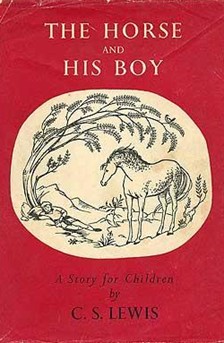
Travel the World: England: Narnia: The Horse and His Boy


Lewis, C.S. 1954. The Horse and His Boy.

"This is the story of an adventure that happened in Narnia and Calormen and the lands between, in the Golden Age when Peter was High King in Narnia and his brother and his two sisters were King and Queens under him."

Our hero is a young boy named Shasta. He meets two talking horses, Bree and Hwin, and a young girl, Aravis. Together--all for various reasons--are traveling secretly to the North, to Narnia. Shasta, for example, is running away because his 'father' wants to sell him into slavery. Bree, one of the horses, is a talking horse that has been "owned" too long for his liking by a foreign soldier. He dreams of Narnia and of freedom. Aravis is running away from an arranged marriage. And Hwin, like Bree, is a horse Narnia-bound. Their journey isn't as easy and as smooth as they'd like. There are a few bumps along the way. Unexpected detours and delays. A few scares. A few close calls. Great danger that they always seem to be one step ahead of. But they soon discover that there is a purpose--strange as it seems to them--behind everything.

One of my favorite things about The Horse and His Boy is that it illustrates Romans 8. Aslan the lion is behind everything. Though silent and unrecognized, unacknowledged, he is traveling with these four on their way. And he has a plan and a purpose.

"Don't you think it was bad luck to meet so many lions?" said Shasta.
"There was only one lion," said the Voice.
"What on earth do you mean? I've just told you there were at least two the first night, and--"
"There was only one: but he was swift of foot."
"How do you know?"
"I was the lion." And as Shasta gaped with open mouth and said nothing, the Voice continued. "I was the lion who forced you to join with Aravis. I was the cat who comforted you among the houses of the dead. I was the lion who drove the jackals from you while you slept. I was the lion who gave the Horses the new strength of fear for the last mile so that you should reach King Lune in time. And I was the lion you do not remember who pushed the boat in which you lay, a child near death, so that it came to shore where a man sat, wakeful at midnight, to receive you."
"Then it was you who wounded Aravis?"
"It was I."
"But what for?"
"Child," said the Voice, "I am telling you your story, not hers. I tell no one any story but his own."
"Who are you?" asked Shasta.
"Myself," said the voice, very deep and low so that the earth shook: and again, "Myself", loud and clear and gay: and then the third time "Myself", whispered so softly you could hardly hear it, and yet it seemed to come from all round you as if the leaves rustled with it.
Shasta was no longer afraid that the Voice belonged to something that would eat him, nor that it was the voice of a ghost. But a new and different sort of trembling came over him. Yet he felt glad too. (281)


So perhaps if this one has a spiritual message it is one of God's providence and sovereignty.

As a child reader, I didn't get this one at all. I didn't get the theme. It wasn't an obvious one to me then. Not even as a teen. It was only in this past reading that I saw some inkling of a spiritual message within the pages. I thought, growing up, that it was a rather dinky story about horses. And I'm not really a horse-loving person. But this time I seem to see just a bit more.

© Becky Laney of Becky's Book Reviews

Tuesday, July 08, 2008

The Hanging Woods


Sanders, Scott Loring. 2008. The Hanging Woods.

What can I say about this one? Really? Truly? It's dark. It's depressing. It's truly dreadful--dreadful in content, not style. It's disturbing, very disturbing. A difficult read, a discomforting read. Warped. Twisted. And oh-so-wrong.

First sentence: "In 1975, when I was thirteen, I killed a fox. It happened a few weeks after I'd snuck into my mother's room and read her diary. That diary told me a lot of things that I didn't want to know. Or maybe I did want to know them. I can't say for sure."

The good news is that you should be able to tell fairly early on whether or not The Hanging Woods is for you. In the first chapter alone we've got the slaughtering of a fox and a chicken. (And the two aren't connected. The fox wasn't after the chicken.) In the second chapter, we see many signs of unhealthy relationships. Relationships between friends. Relationships between families. And we see our first human death. Very bizarre. Not exactly murder. Not exactly calculated. But strange indeed. And in the third chapter, we learn that our narrator, Walter, committed arson. He burned a house down. So right from the start you know this is going to be one dark-and-weird book. It's not for everyone. The language. The violence. The subject matter. It just paints a very dark and unpleasant portrait of humanity. Not that I'm denying that humans can be ugly and cruel and tortured and demented and perverted and whatnot. But dismal, dismal, very dismal.

The Hanging Woods is about the breakdown of friends, of family, of the mind itself.

Personally, I don't like dark and edgy all that much. I prefer my narrators a bit more sane. HOWEVER I know that some readers will appreciate this one. It is well written. If it had been poorly written, I wouldn't have found the strength to keep reading.

Edited to add: I slept on this one. Given it some more thought. And I wanted to add that it was really well done. When characters are so thoroughly written, so powerfully drawn that you have to keep reading even if you personally hate where they are going...then that says something about the writing. So for skills in writing, in characterization this one gets my approval.

© Becky Laney of Becky's Book Reviews

Monday, June 02, 2008

Nonfiction Monday: How To Get A's in College


How To Get A's in College is one of the books in the Hundreds of Heads series. It's composed of advice. Advice on:
  • note-taking & study tips
  • how to limit stress, manage time, and stay motivated
  • acing college tests, papers, labs, and exams
It's an organized book, an informative book, even. But it's not problem-free. Because these "tips" and "advice" are coming from college students and college graduates it has to be weighed extremely carefully. (Let's just say if the book had been written by teachers, professors, or TA's it would have VASTLY different tips.) Alongside sage tips come real "gems" telling students not to read their textbooks, not to attend classes, never go to the library, and always eat sugary cereals or candy while studying. Of course some of the tips are obviously good while others are obviously bad. Which leaves interested-readers, interested-buyers with a dilemma. Why buy a book, spend time with a book that has just as much bad advice, silly advice, as it does good? Well, my guess is that it won't be incoming freshmen who are buying this book. It will be those looking for a gift. Which in a way begs the question... Would a student (not-an-A-or-B-student, but a C, D, F student spend the time reading this book? And if they're already getting A's or B's chances are they already know about these tips. I can't answer that.

While I do value some of the book's resources, I had too many slight issues with it to give it a high rating. Students shouldn't be seeking advice from strangers in this book, students who do not go to their school, who do not have their same professors and same classes. Taking the advice that a professor who assigns a ten page paper or a twenty page paper would be happy to receive a four or six page paper instead as long as what was in those pages had some value...I'm just not so sure that is wise on any level. It could prove disastrous. But my main issue with the book seems to be the students. I think 98% of those giving this advice seem to be all about the shortcut. I think some of them were missing the point of college altogether. It isn't about the end result, it isn't about getting the A. For an "A" to mean anything, you've got to actually learn, absorb, grow. A letter on a piece of paper doesn't make you smart. And to boast that you graduated from college without opening a single textbook doesn't make you wise either.

I suppose I was expecting more meat, more substance. I watched the "Where there's a will, there's an A" videos early on in my high school career. And I found that helpful, life-changing in a way. I watched the high school videos. I never did see the college ones. But this, not so much. The advice is all over the place.

Monday, May 12, 2008

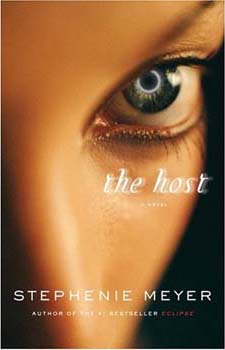
The Host


Meyer, Stephenie. 2008. The Host.

The Healer's name was Fords Deep Waters. Because he was a soul, by nature he was all things good: compassionate, patient, honest, virtuous, and full of love. Anxiety was an unusual emotion for Fords Deep Waters. Irritation was even rarer. However, because Fords Deep Waters lived inside a human body, irritation was sometimes inescapable.

Thus begins the highly anticipated first adult novel by Stephenie Meyer. The opening scene shows a man, occupation Healer, getting ready to implant a Soul into a human being. These souls are parasitic aliens that have spread across the galaxy. They are able to take hosts--different hosts--on each planet. Our narrator is a Soul named Wanderer. She's unusual, in a way, because she has been to many planets--I can't remember if it's seven or eight or nine--and lived that many lifetimes. The souls know no death, they just move onto a new host when their host's body dies. This is Wanderer's first time on Earth, her first time in a human host. Our secondary narrator is a woman named Melanie. And you've probably guessed by now that she is the host body to Wanderer.

These aliens didn't take over the world overnight. They didn't announce their arrival at all. Their goal--if they had a goal--was to assimilate quietly and peacefully with humans. It wasn't until the humans noticed that something was off that there was any resistance, any battles, any blood shed. What was off? Humans were being too nice, too perfect, too Mayberry. From the Souls' perspective, they were doing humanity a huge favor. They were turning these rowdy and unpredictable and altogether too violent and volatile humans into peace-loving, happy-go-lucky people. Souls love everybody, accept everybody, trust everybody. Except for that one teeny tiny little detail that they won't take no for an answer. All humans must be implanted. As long as their are humans without Souls then there is the potential for blood shed and loss. To "protect" themselves--or so they claim--they must either assimilate or destroy those resisting pesky humans. Those Souls that are seeking to destroy and/or assimilate humans are called Seekers.

Melanie's luck has run out. Or so she thinks. On the verge of being captured, she throws herself down an elevator shaft. She thinks that she'll avoid her fate by destroying her body. But Healers are really good at repairing the human body--another so called "benefit" to this alien domination.

Wanderer and Melanie are soon to be linked together for life. Not that that is the plan. Souls are supposed to erase, eradicate, the consciousness, the personality of their hosts. But Wanderer finds that Melanie will not go down without a fight. She guards her life, her secrets, closely. She will not accept the finality of the situation.

Life is about to turn very interesting for this two-in-one package as they journey together into the Arizona desert to find the meaning of it all. It's a story about humanity, about sentient life forms, about right and wrong, about justice, about love, about forgiveness, and grace, and redemption. It's a novel with a lot of heart and soul and gumption.

This concept isn't completely original. They're not as overtly (openly) evil as the goa'uld (go-ah-OOLD) by any means. But the concept of a parasite invading through the neck and wrapping themselves around the spine and brain and 'controlling' the human and 'erasing' the host personality has been done before. So has the concept of a human host living side-by-side compatibly with a parasite--that's a Tok'ra for you. Tok'ras are the 'good guys' in the parasite world (supposedly though Jack still calls them snakeheads) who only enter voluntary hosts. Even the concept of love can be seen to be similar to that found in Stargate--the parasite and host body falling in love with their mate's parasite and host body. Four personalities, two bodies, love all around.

It was hard not to think about goa'ulds and tok'ras while reading The Host. That could be because I tend to relate all things back to Stargate eventually if at all possible. It doesn't have to be oh-so-obvious. In this case, I think if you've seen Stargate at all, you can see the connection in some ways, but not in all ways.

This story has plenty to make it special all on its own. I don't want to get into the particulars but the environment was very unusual but it worked. In some very teeny tiny way it reminded me of Dune. I don't know why. I've only seen the movie once. But there were scenes from that movie that came to mind when reading the book. Maybe it's the desert environment. (There are no giant worms however.) I don't know. At this point, it's irrelevant. (Maybe also slightly Journey to the Center of the Earth). She created a world that is so strange, so different from present day life, from reality. It's a world that it's easy to get swept up into in a way. The setting, the characters. It just worked. It was very rich in detail. I thought the depths of the back-story was just really well done. (The little details that Wanderer discloses in her storytelling and her question and answer sessions.)

I can't say that I fell quite in love with it as much as I did Twilight upon first reading it. But it's good. The romance, the chemistry, isn't quite as intense, quite as magical as it is for Bella/Edward/Jacob. But it isn't a romance without some merit. I personally was more into Ian than Jared, but that's just me.

First sentence of chapter one: I knew it would begin with the end, and the end would look like death to these eyes. I had been warned. Not these eyes. My eyes. Mine. This was me now. (9)

So I definitely recommend it. Do you have to love science fiction? It might help. But if you're not a fan, don't let the genre turn you off. This is a story about what it means to be human. (In some ways it mirrors the themes of the novel Frankenstein--what it means to be human, to live, what it means to be a monster.) It's a human-interest story therefore. It explores the depths--the good, the bad, the ugly--of humanity in general. The fact that some humans have been possessed by aliens while others haven't is just a distinction that separates it from other novels you might have read through the years. But science fiction fans, I hope, will be pleased with it as well as newbies.

I would have read it anyway--it's got Stephenie Meyer's name attached to it--but it comes with a blurb from Orson Scott Card himself. So you know it has to be good.

And for those that are curious, I tend to like Wanda/Melanie much much more than Bella as far as personality goes. In Twilight, Bella didn't annoy me so much. But in some of the sequels, I found myself growing more and more irked at her. Definitely to a point where I understood where all the hate was coming from saying that she was too whiny and mindless (in a way). Not that I'll ever reach a point where I'll stop reading the series. Who could stop now? (I'm on Team Jacob by the way.)

You can read the prologue and the first four chapters here.

© Becky Laney of Becky's Book Reviews

Tuesday, May 06, 2008

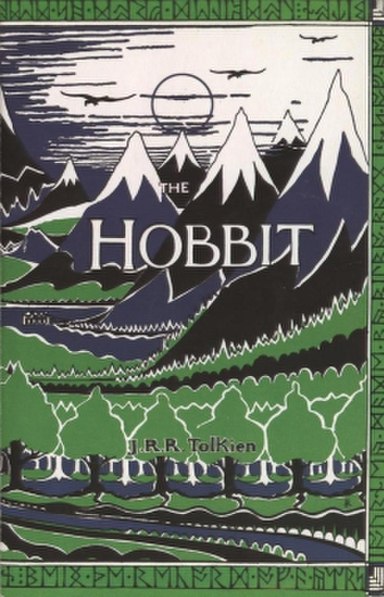
The Hobbit


Tolkien, J.R.R. 1937, 1966. The Hobbit.

In a hole in the ground there lived a hobbit. Not a nasty, dirty, wet hole, filled with the ends of worms and an oozy smell, nor yet a dry, bare, sandy hole with nothing in it to sit down on or to eat: it was a hobbit-hole, and that means comfort. (3)

Hobbits do like to be comfortable. That is a fact. But in The Hobbit, we read of one hobbit in particular, a Mr. Bilbo Baggins, who leaves his life of comfort behind him to go on a once-in-a-lifetime adventure with thirteen dwarves and one wizard. It is the story of how he went from being a respectable hobbit to a very unrespectable, "odd" little hobbit. Bilbo never meant to have an adventure. He was quite clear on that. But never say never. It all starts with a visit from a wizard, Gandalf. That visit leads to another visit--a visit by thirteen dwarves--who call upon him unawares and give him the surprise of his life. They want him--they expect him--to be a part of their expedition, their adventure, their journey to go off and kill a dragon, Smaug by name, and steal his treasure. It's laughable almost, at least at first, but slowly and surely Bilbo gets carried away with it all. And the adventures that follow--oh my!

The Hobbit is a charming and delightful though-not-a-thin adventure book that everyone should read. (Or at least attempt to read! By that I mean, while I loved it--while I think many many people love it--I suppose no one book can please everyone. But this one should at least be attempted, tested to see if you like this sort of thing.)

© Becky Laney of Becky's Book Reviews
Monday, February 05, 2007

Hattie Big Sky

Larson, Kirby. 2006. Hattie Big Sky


Hattie Brooks is a sixteen year old orphan that has been passed around from one distant relative to another. She's always felt like she was 'Hattie Here-and-There'. A girl without a home. A girl without a family. All that changes when she receives a letter.

Being of sound mind, I do hereby leave to Hattie Inez Brooks my claim and the house and its contents, as well as one steadfast horse named Plug and a contemptible cow known as Violet. -- Chester Hubert Wright, Uncle to Hattie Inez Brooks P.S. H--Bring warm clothes and a cat.

Knowing that this could be her chance--her big chance--to find her place in this world, Hattie agrees to move to Montana and finish proving her uncle's claim. She expects the work to be hard, but she's used to hard work...even if it's not quite the same kind. Here she will deal with blizzards, livestock, plowing, planting, harvesting, fencing, etc. It seems the work never ends. But the strange thing is out here surrounded by the big skies of Montana she is not alone. She's never felt so alive. So welcome. So happy. Tired, exhausted, and happy...the months pass. Does Hattie have what it takes to finish proving the claim? Can she survive the harsh environment? Can she make it financially?

Set in 1918, during World War I, the novel presents what life was like at home during the war. Hattie corresponds with a soldier, a childhood friend, whom she ever so secretly wishes would be more than a friend when he returns. Also in her new home in Montana, Hattie befriends a German family. These neighbors know what it means to be in need. Yet they give wholeheartedly to their young neighbor. Their friendship teaches her so much. She cannot understand why the other neighbors openly despise this German family. Discrimination and prejudice are just the beginning. Life is becoming dangerous for Germans and German-lovers.

Hattie Big Sky is a great book. I loved it!

http://www.hattiebigsky.com/
http://kirbylarson.podomatic.com/
http://www.kirbylarson.com/hattiebigsky.html
http://www.kirbylarson.com/blog/
Interactive Reader's Review of Hattie Big Sky

Sunday, February 04, 2007

The Higher Power of Lucky


Ever wondered what it would be to grow up in a town with a population of 43 people? In THE HIGHER POWER OF LUCKY by Susan Patron, the reader gets a guided tour of life in a small, desert town by our young narrator...Lucky. Lucky isn't lucky. Not in the traditional sense at least. She hasn't hit rock bottom, and in fact, she thinks that might be her biggest problem. She knows from eavesdropping on all the various twelve step programs that you have to hit rock bottom before you find the 'higher power' you need to turn your life around. Lucky has never known her father. He divorced Lucky's mother before she was born. And Lucky's mother? You guessed it, has died tragically after a storm while taking a barefoot stroll when she stepped on a downed power line. Lucky's guardian is her father's ex-wife. His first ex-wife. Brigette was leaving in France--she is a French woman after all--when she got the call that her ex-husband needed her to come to California to raise his daughter from his second marriage. What was supposed to be temporary--just until she could be placed into a traditional foster care--became more long term. Thus the sign 'population 43' still rang true despite her mother's death. Readers are introduced to Lucky, Brigette, and a cast of townspeople...some quite colorful such as Miles who makes cookie runs each morning going from house to house to house--or business to business--begging for cookies. Like most books dealing with orphaned/abandoned children, Lucky spends a great deal of time wondering what will happen. Will Brigette adopt her? Will they stay in Hard Pan, California, despite the snakes and scorpions? Or will Brigette return to France and send Lucky into foster care?

The Higher Power of Lucky is the Newbery Award winner this year (2007). And while you almost hate to criticize an award-winner, I have to say that there are better books, more charming books even, on this topic that were written this past year. Foster care was a HUGE theme in 2006. The Road to Paris by Nikki Grimes and Home and Other Big Fat Lies by Jill Wolfson were excellent. Outstanding even. Just truly beautiful books. Different from each other. But wonderful in their own unique way. And I've read the two Newbery Honor books PENNY FROM HEAVEN by Jennifer L. Holm and HATTIE BIG SKY by Kirby Larson. Both of those books were outstanding. Great books. Books that I hope will become classics. But The Higher Power of Lucky doesn't seem like a classic or a future classic to me. It isn't outstanding. It's good. It's not a bad book by any means. But it's not a book that grabbed me. Of the four other books I've mentioned--The Road to Paris, Home and Other Big Fat Lies, Penny From Heaven, Hattie Big Sky--I've not only loved but I've been recommending to everyone I know. They're just so good that I can't stop talking about them. They're books I would want to read and reread and own. The Higher Power of Lucky was a good read once...but I'm not sure I'll ever have the need to read it again. So in conclusion, it's a fine book. There were enjoyable aspects of the book. But it is--to me at least--a forgettable book.