Showing posts with label "C" Authors. Show all posts

Saturday, May 02, 2009

The Queen of Everything


Caletti, Deb. 2002. The Queen of Everything.

Deb Caletti. I personally think she has to be wise and observant on top of being ultra-talented. There is just something about the way she writes, something about her observations, that captures life so fully yet beautifully. Even when capturing the ugliness of life, she gives a turn of phrase so beautiful even if it is beautiful in that aching kind of way that it just resonates.

People ask me all the time what having Vince MacKenzie for a father was like. What they mean is: Was he always crazy? Did he walk around the kitchen with an ice pick in the pocket of his flannel bathrobe every morning as he poured himself a cup of coffee?
Some ask flat out, as if it's their right to know. Others circle it, talk about the weather first, thinking they're beings so sneaky when really they're as obvious as a dog circlking a tree.
When they ask, I always say the same thing. I say, "He was an optometrist for God's sake. You know, the guy who sits you in the big chair and says, 'Better here, or here?' The ones with the little pocket-size flashlights?'" And that's all I say. I try to keep it all in the tone of the voice. I don't even add a, If you must know, you insensitive jackass. Well I did say that once. I don't count it though, because it was to an old man who probably had bad hearing.
What I won't do is tell anyone what he was really like. (1)


Meet Jordan MacKenzie. Her father has committed a crime--a crime of passion. This is her story. Her unveiling of what happened that fateful summer that turned her world topsy-turvy. It's not a melodramatic story, more straightforward and down-to-earth than that.

Besides, that's not what people want to hear anyway--that my father was just a normal guy whom I loved, love, with all my heart. It makes them nervous. Because if he was normal, if he wore Old Spice and liked nacho cheese Doritos, then why not their own fathers? Or themselves? Deep Inner Evil--we like that. It's easier to accept than what Big Mama says, which is that wanting things for the wrong reasons can turn anyone's life into a marshmallow on a stick over a hot fire: impossibly messy and eventually consumed, one way or another. People want to think that I lay in bed awake at night, my heart pounding in fear of him. They don't want to know that I slept just fine, dreaming I'd forgotten my locker combination just like them.
Or that I went to live with Dad because he was the regular one; that it was my mom who I was convinced was nuts. (3)


I love her narrative. I love her voice. How real she seems. She's not a saint. She doesn't sugarcoat her mistakes--or her father's mistakes--she calls it as she sees it. While the book is her sharing about her relationship with her father--the effect his choices have had on her life--it is her story as well. About her relationships. With her mother, with her grandparents, with Big Mama, with her best friend, Melissa, and her best friend's brother, Jackson, and with her bad-boy semi-boyfriend, Kale.

© Becky Laney of Becky's Book Reviews
If you're reading this post on another site, or another feed, the content has been stolen.

Thursday, April 16, 2009

City of Glass


Clare, Cassandra. 2009. City of Glass. Simon & Schuster. 541.

City of Glass is the third in the Mortal Instruments series. (The first being, City of Bones, the second being, City of Ashes.) I honestly don't know how to review this one. Not without spoiling things. I can gush, however. I can tell you how I loved it. Tell you how it was intensely satisfying. How right it felt (for me). But you need to start at the beginning. You need to read the series as a whole. You need to come to know these characters from the very beginning. So I definitely recommend the series. The characters are well developed. Complex. Diverse. Interesting. Evolving. The pacing is suspenseful. Though the books are thick, time flies when you're reading the books. They're just that good. The series as a whole was good. There were some things that were predictable, but not in an oh-no-not-that-again way. It just felt good reading these books. It made reading fun again. I'd love to see this series catch on like the Twilight series has.

© Becky Laney of Becky's Book Reviews
If you're reading this post on another site, or another feed, the content has been stolen.

Tuesday, April 07, 2009

City of Ashes


Clare, Cassandra. 2008. City of Ashes. Simon & Schuster. 453 pages.

City of Ashes is the sequel to City of Bones. What can I say about this one? It was exciting and intense and had near-perfect pacing. The book stars Clary Fray and her friends--among those are a werewolf, a vampire, a warlock, and her fellow Shadowhunters: Jace, Alec, Isabelle. Now that the truth is out about who her parents are...and who Jace's parents are...Clary's feelings are all out of sorts. And who better to turn to than her good friend, Simon, who has been harboring feelings for her all along. But is life ever that easy? Not when you're a Shadowhunter. Not when your evil father, Valentine (boo, hiss) is on the loose. Not when he's scheming for world domination and stealing the mortal instruments. No, life is about to get super-complicated. Again. Clary and her friends have their work cut out for them. Battling demons. Protecting faeries, vampires, and werewolves. Trying to out-scheme the ultimate villain. The book has it all: danger, adventure, incredible fight sequences, romance; just one thrill after another. I like the complexity and the diversity of the characters.

© Becky Laney of Becky's Book Reviews
If you're reading this post on another site, or another feed, the content has been stolen.

Friday, January 23, 2009

Because I Am Furniture


Chaltas, Thalia. 2009. (Pub April 2009) Because I Am Furniture. Viking. 356 pages.

I am always there.
But they don't care if I am
because I am furniture.

I don't get hit
I don't get fondled
I don't get love
because I am furniture

Suits me fine.

Anke has a difficult home life, though that is putting it mildly. Her father is abusive. She sees all. Hears all. Yet though a witness, she's somehow avoided being the subject of his abuse. (Though witnessing it is damaging enough as it is.) Can a teen girl break out of her silence and get help for her troubled family?

Because I Am Furniture is a verse novel about hard issues: physical, verbal, and sexual abuse. With all the negative going on in her life, Anke finds great joy in the one positive of her life: volleyball. Can what she learns on the court change her life off the court?

Here's one of the poems I enjoyed from the novel:

They call us
Nopes
the "out" crowd,
we don't fit their
dog-show guidelines
wealthy-beautiful.

We call them
Yups
they have to
all agree,
yup each other
every day on every thing.

And we say
Nope, don't
want any part
of your Yuppitude
so tight
society will burst
with any change
of thought.

But being a fractured, momentary gathering
and not an actual collective,
we say
Nope
individually
with scrambled cadence

and their
Yup
is way
louder.

(25-26)

Other reviews: Teen Book Review, The Compulsive Reader, Laura's Review Bookshelf, Flamingnet, Karin's Book Nook.


© Becky Laney of Becky's Book Reviews

Tuesday, January 13, 2009

What Would Emma Do


Cook, Eileen. 2008. (Pub December 2008). What Would Emma Do. Simon Pulse. 307.

Modern-day Crucible. That about sums this one up. Set in a small-town in Indiana, Emma (Elizabeth) Proctor attends a private school--a Christian school--and church. It seems anyone and everyone is a believer in Wheaton. (At least on the surface.) Even the title is a play on words, What Would Jesus Do. Emma thinks sitting around and discussing WWJD is pretty lame. She thinks everything that goes on in Wheaton is lame. She's counting down the days, weeks, months until she can leave town forever without once looking back. But before Emma can leave, she has to clean up some of her messes.

The kiss. Her best friend's boyfriend. D'oh. What's Emma to do? Her best friend has 'forgiven' her but does she really and truly trust her? What do YOU think? So when Emma asks Colin (the boy in question) to take her to a party at "The Barn" she knows she's bending and stretching the rules. After all, Joann would never be okay with the two of them hanging out together without her. But an impulsive decision on her part starts her down a long road where she doesn't want to be heading...

Emma and Colin witness something. Something with consequences. No one knows they know. The right thing to do, of course, would be to come clean. To stop this witch-hunt before it even begins. But they don't. And they don't. And chaos sets in. Everything becomes topsy-turvy as the mob mentality takes over. Soon it becomes a "crime" to be different in any way... How long will Emma let this go on? How many innocent people have to get hurt before she steps up and does the right thing?

I liked The Crucible-ness of it. What I'm slightly on the fence about is the irreverence of elements of the story. Each chapter begins out with her 'prayer' to God. It's not out-and-out disrespectful. It's casual. Perhaps too casual--her praying for breasts and listing all the 'good things' she'd do in return if he'd grant her wish. It's questioning. In a way, I think it's down-to-earth and authentic-sounding. It feels honest like it is how a person might feel. However, Emma's vision of God isn't the God in the Bible. And if she was versed in the Bible, I think her tone would be different. That maybe just maybe she wouldn't see herself as being smarter than God and better able to manage the world. These sections--I liked some of them, but a few rubbed me the wrong way. Not enough to dislike the novel as a whole. But I could definitely see how some readers might find a few phrases offensive. I've selected one--not as an example of one I dislike in particular--just one that I think represents the essence of what they're like.

God, you know the Bible story about the tower of Babel, where no one can understand anyone else? Sometimes I think I'm living out that story. Everyone around me is speaking English, but we don't understand one another at all. I have to tell you, if I were going to pick a Bible story to live out, this wouldn't be it. I would prefer to be in the garden with a cute Adam (no fig leaf required). No disrespect to Eve, of course. To be honest, I would prefer Noah's ark, even with the catastrophic flood aspect. I like animals. In fact, I like animals more than I like most people I know. Then again, if I have to live out a Bible story, the Babel story is better than most of Revelation. The horsemen of the apocalypse freak me out. (81)


© Becky Laney of Becky's Book Reviews

Wednesday, December 31, 2008

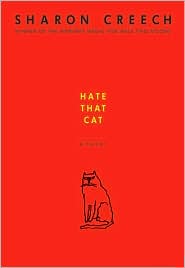
Hate That Cat


Creech, Sharon. 2008. Hate That Cat.

Hate That Cat is the sequel to Love That Dog. It's a verse novel too. Our narrator, Jack, is one year older, but his favorite teacher, Miss Stretchberry, is right there continuing to challenge him and encourage this young poet-in-the-making. (She moved up a grade.) And if this is possible, I think I loved this one just as much if not a tiny smidgen more. We learn more about Jack, more about Sky--the yellow dog he lost, more about his family--his mom. And the more I learn, the more I love.

Here are two poems to give you a glimpse of what it's like:

December 20

When you put up that one line
from the eagle poem--

He clasps the crag with crooked hands

--and used all those different colored chalks
to show how Mr. Tennyson
managed to cram in
ALLITERATION
and
ASSONANCE
and
CONSONANCE
all in one line
well
I was impressed
but that doesn't mean
I remember which is which
and
I will never be able to do all that stuff
that Mr. Tennyson does
and did he know he was doing it
when he did it?

I feel stupid.
I am a bad writer.
I'm going to quit.

December 21

Thank you for telling me
I could FORGET
those confusing words
and that it isn't knowing the words
that describe writing
that is important--
it is the thoughts in our heads
that are most important
and that feeling the rhythm
is even more
wondrous
than hearing the rhythm.

And
thank you for saying
I am a genius
(even though I know
you are exaggerating).

(54-56)

© Becky Laney of Becky's Book Reviews

Tuesday, December 30, 2008

Love That Dog


Creech, Sharon. 2001. Love That Dog.

I can't believe I never knew about this little book. It is so very, very good. It's a book in verse--a verse novel. The narrator, Jack, is in English class. His teacher, Miss Stretchberry, requires them to write. This *appears* to be a journal-assignment. But I could be wrong there, but these poetic entries are written by Jack and read regularly by his teacher...so draw your own conclusions. Jack is your typical boy--he doesn't like reading poetry, analyzing poetry, or writing poetry. In that way, this book becomes very humorous as he slowly but surely starts to see life a little differently. As he becomes a poet himself.

There are SO MANY things I loved about this one...Jack's voice, Jack's poems, the inclusion of the poems that Miss Stretchberry's class studied in the first place, the fact that Jack wrote a fan letter to Walter Dean Myers, that the book included an author visiting a school, the running gag that with each new poem/poet studied that Jack was curious to know if they were alive or not, the fact that Jack used poetry to help heal his brokeness after his dog's death...I could go on and on. This one won't take you long to read...and it is so worth it!!

© Becky Laney of Becky's Book Reviews

Wednesday, November 26, 2008

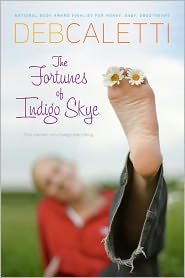
The Fortunes of Indigo Skye


Caletti, Deb. 2008. The Fortunes of Indigo Skye.

I love the way The Fortunes of Indigo Skye is written. Deb Caletti has a way with words. It's almost a magical touch. A way of capturing perfectly ordinary observations--details of daily life--that just sparkles.

In its simplest, The Fortunes of Indigo Skye, is a story of a girl who loses and finds herself. Indigo Skye is a waitress. She's happily content with being a waitress. She loves her life in fact. But when one of her customers leaves her a big tip--as in crazy big--then Indigo's life becomes challenging. What would you do--as a teenager or adult for that matter--if you woke up to discover that someone gave you a little over two million dollars. Would you stay true to you? Or would you begin changing, transforming into a stranger? What makes you you? How grounded would you need to be to stay real?

The Indigo Skye we first meet is charming as can be. Her definition of happiness is simple, "an absence of wanting equals happiness" (44). She's got her waitressing job, school, friends, family, a boyfriend, Trevor. And for the most part, she's content. That's not to say she doesn't have times when she's restless and unsure. Moments when she wonders what she is going to "be" when she's grown up. But the money she receives changes everything...and everyone...especially herself.

I didn't love this one. Don't get me wrong. I loved the writing in parts. There are phrases that I marked as being oh-so-right and oh-so-true. But I wasn't loving the story of this one. Interesting premise. Indigo starts off with potential. But I didn't find myself connecting with her family--her mom and dad, her brother, Severin, and her sister, Bex. I didn't feel her relationship with Trevor was that developed. He seemed a complete bore. Someone she didn't feel much affection or devotion for. And there weren't many friendships--either with her classmates or with her fellow waitresses--that seemed to be important to her. The book was full of observations--vignettes of human personalities and nature. There were sprinklings of characters that were interesting. But none were fully developed. None were fully engaging.

The novel was enjoyable because of the writing--the language, the style. But the characters, the plot? Just so-so. I thought the book was sluggish in the beginning. It takes a little over hundred pages for her to receive the money. And I can see that as a good thing--in a way--it establishes a "before" so that there can be an "after." (In fact, I enjoyed the first half better than the last half.) But still, I felt it was a bit unevenly paced.

© Becky Laney of Becky's Book Reviews

Thursday, November 06, 2008

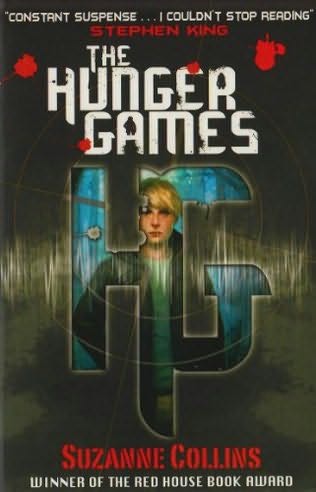
The Hunger Games


Collins, Suzanne. 2008. The Hunger Games.

When I wake up, the other side of the bed is cold.

By now, chances are you've heard of The Hunger Games by Suzanne Collins. It has been making the rounds on book blogs everywhere. And almost everything--note the almost--has been positive, gushing praise even.

What's the premise?
"In the ruins of a place once known as North America lies the nation of Panem, a shining Capitol surrounded by twelve outlying districts. The Capitol is harsh and cruel and keeps the districts in line by forcing them all to send one boy and one girl between the ages of twelve and eighteen to participate in the annual Hunger Games, a fight to the death on live TV."
Our heroine is a young and spunky girl named Katniss. She's smart. She's got several years of hunting experience. But will that be enough--can that be enough--to survive the seemingly impossible task ahead? When Katniss takes her sister's place as "the sacrifice," she's got everything going against her. 24 teens. 12 Boys. 12 Girls. 23 opponents or enemies she'll have to outwit or outbattle to survive and be crowned the victor. Only ONE person will be coming home. But her sister, Prim, wants her to try--to earnestly try--for her sake. And try she will. But does she has what it takes to become a killer? Especially when she starts to develop feelings for some of her opponents?

Of course the book is intense. What else would you expect in this dystopian thriller? And chances are that you won't want to put it down once you've started. There is a second book in the works as well. So much to look forward to...

This one goes on the highly recommended list. Especially for when it's time for future 24 Hour Readathons, 48 Hour Readathons, and my second IT'S THE END OF THE WORLD AS WE KNOW IT challenge which will be this summer. It might also be something to consider for my reading group--Reading With Becky--on google groups.

© Becky Laney of Becky's Book Reviews

Friday, October 31, 2008

Enter Three Witches


Cooney, Caroline. 2007. Enter Three Witches.

Double, double, toil and trouble;
Fire burn, and cauldron bubble.

Act IV, Scene I

Caroline B. Cooney's latest novel, Enter Three Witches, is rich with Shakespeare. Told from the point of view of a young girl, Mary, the reader gets a new perspective of the ever-required play MacBeth.

Back to Enter Three Witches. Mary is a young girl, a daughter of one of the characters who is accused of treason and executed. She had been "adopted" for a time by the Macbeth family and had been staying with them for quite a while when the book (and play) opens. We first meet her visiting and chatting with the servant girls/kitchen staff. Although Mary has not revealed it to another soul, she's been experiencing weird tingles in her thumbs. She's almost convinced it's a sign. A sign that only the three weird sisters could interpret. But everyone is scared of the witches, right? Yet her curiousity leads Mary to be in just the right place to overhear a prophecy--a deadly prophecy given to Macbeth. (The reader will notice that this happens to Mary a lot. She always happens to be in the background, the shadows, listening and watching as all the big drama happens.)

What can I say about Enter Three Witches? It blends original characters with classic Shakespeare characters. It quotes a bit of Shakespeare now and then. While it is told mainly through Mary's point of view, it also includes a bit of the young prince's point of view--Fleance. It is very dramatic. Of course it has its dark moments. Lots of blood. Lots of schemes. Lots of villains.

Looking for another Macbethian novel to read? Try Something Wicked by Alan Gratz.

© Becky Laney of Becky's Book Reviews

Wednesday, October 08, 2008

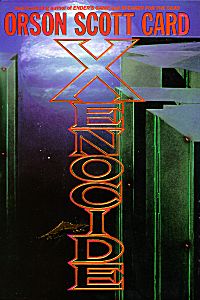
Xenocide


Card, Orson Scott. 1991. Xenocide.

Xenocide is the sequel to Speaker for the Dead. (Speaker for the Dead is the sequel to Ender's Game. Ender's Game is my favorite, favorite book.) Xenocide is an intricately complex plot following the saga of characters (mainly) introduced in Speaker for the Dead. Speaker for the Dead concludes with the threat of the destruction of the planet of Lusitania. Which would mean the destruction of the pequeninos (piggies), the human colonists (including Andrew Wiggin, his wife, his stepchildren, etc.) and the Hive Queen (the Buggers). The Lusitania Fleet has been launched, and the order to destroy the planet using the M.D. Device (Little Doctor) has been given. If it wasn't for Jane, the life-force residing in the ansibles and computers, the impending doom would be absolutely, completely certain. As it is, it is only mostly certain that xenocide will occur once again. (Xenocide being genocide of an entire species. While the human colonists would lose their lives, the human race would go on in the other hundreds of worlds colonized. But xenocide is a very real threat to two alien species: the Hive Queen (and her workers, etc) and the Pequeninos.)

There are so very many characters to keep track of in Xenocide. As I mentioned, most were introduced in Speaker for the Dead. Andrew and Valentine. Andrew's wife, Novinha. Andrew's step-children: Miro, Ela, Quim, Olhado, Quaro, Grego. The piggies of utmost importance are Planter and Glass. (Not counting the fathertrees Human and Rooter, etc.) The Hive Queen of course. Jane, the character that pulls most of the book together. But there are three characters that are brand new to the story. Three people from the Chinese colony of Path: Han Fei-tzu, Han Qing-jao, and Si Wang-mu.

The plot is too intricate and complex to go into all the details. The book is all about life-and-death matters. The colonists are trying to figure out a way to kill the descolada before it destroys them. They hope that if they can destroy it, then perhaps they'll be saved as well. The Hive Queen is busy building star ships. She wants some for herself. But she's also building some for the Pequeninos. She doesn't want another alien species destroyed by human stupidity. But the humans know that while the Hive Queen may be intelligent enough to find a way to kill the descolada from tainting them and their DNA--the Piggies aren't nearly advanced enough to do so. (The descolada is essential for the Pequeninos to survive. It is linked to their DNA. It is how they procreate and continue on in the third life.)

Xenocide is an interesting novel. But one that doesn't stand on its own. It begins in the middle of things, and ends with no resolution. (Or very little resolution.) It's the middle book of a trilogy (in a way) and while it's important...crucial for the progression of the story...it isn't as satisfying in some ways as the others in the series.

That being said, I do like it. I made the mistake, this time round, of not having read it close enough to Speaker for the Dead. It's been about fifteen or sixteen months since I read Speaker for the Dead. And some books are just better read in close proximity.

© Becky Laney of Becky's Book Reviews

Sunday, October 05, 2008

Chicken Feathers


Cowley, Joy. 2008. Chicken Feathers. Illustrations by David Elliot.

Chicken Feathers by Joy Cowley is enjoyable enough for what it is: a mostly charming story about a boy who loves his pet chicken, Semolina. Josh is the only one in his family that knows (and believes) that Semolina is more than just a chicken. She's an extraordinary chicken: a chicken that can talk. Not just squawk. But talk. Actually talk in human words. Every one else....well...let's just say that they don't trust Josh that much. Semolina has her vices, however, and one of them is her addiction to "brown water" or brew.

There are a few story elements going on in this one: Josh's first semi-semi-crush on the girl next door; the family dealing with a difficult pregnancy. (Josh's mom is hospitalized at six months.) The grandmother (mother-in-law) coming to take care of the family while the mom's in the hospital. And the chickens. There is a fox on the loose in the neighborhood. And Semolina's warnings are going unheeded--at least in the very beginning--so there is danger on that front.

I liked this one. It was unique enough. Not many books about talking chickens having special relationships with their owners that I can recollect. But as nice as it was, amusing as it was in places, I didn't quite love it. But I liked it.

Publisher's description:

Feather-flapping fun by one of the best-loved storytellers of our time.

A talking chicken! Josh knows it sounds ridiculous, but that’s just what Semolina is. And she’s not just a talking chicken . . . she’s a spirited, sarcastic, sassytalking chicken. And with Josh’s mom in the hospital about to give birth to his sister, Josh needs Semolina more than ever, even if she will only talk in front of him. But when Semolina tells him that a fox is sneaking into the hen house at night, can Josh get his dad to believe in Semolina before it’s too late?

Chicken Feathers introduces one of children’s literature’s most original, endearing new characters to peck her way onto the page. In the tradition of Charlotte’s Web, here is a book full of tender moments, sparkling humor, and classic black-and-white illustrations.

© Becky Laney of Becky's Book Reviews

Saturday, August 16, 2008

Allie Finkle's Rules for Girls: Moving Day


Cabot, Meg. 2008. Allie Finkle's Rules for Girls: Moving Day.
"I like rules. The reason why is, rules help make our lives easier. For instance, the rule about not killing people. Obviously, this is a good rule.
Another good rule is Everything that goes up must come down. This includes helium balloons. People don't know this, but you shouldn't let helium balloons loose outside, like at weddings or the Olympics or whatever, because what happens is eventually all the helium comes out and the balloons fall down, possibly in the ocean, and sea turtles eat them.
Then they choke to death.
So really that is two rules: Everything that goes up must come down and Don't let go of helium balloons outside.
Science has a lot of rules (like the one about gravity). So does math (like that five minus three will always be two. That is a rule).
That's why I like science and math. You know where you stand with them, rulewise.
What I'm not so crazy about is everything else. Because there are no rules for everything else.
There are no rules, for instance, for friendship. I mean, besides the one about Treat your friends the way you'd want them to treat you, which I've already broken about a million times. Like earlier today, when my best friend, Mary Kay Shiner, and I were making the strawberry frosting for her birthday cupcakes. (1-2)

Allie Finkle has lots of rules. Rules on how to live. But nothing has quite prepared her for the challenges ahead. You see, Allie Finkle is about to move across town and that changes everything. She's losing her best friend (for multiple reasons). She's losing her school. She's losing her room, her house, her neighborhood. And maybe just maybe it would be worth it all if only...if only the house where they're moving wasn't haunted, wasn't so spooky, so dark and uninviting and ugly. Allie, when she's honest, will admit that Mary Kay isn't a great best friend. She cries too much. That plus she will only play one boring game over and over day after day. And the thought of making a new best friend, a great best friend is tempting. So is the thought of a kitten. Her parents have promised--actually promised--to get her a pet of her very own, a kitten--if and only if she behaves during this transition. If she doesn't whine and complain and act out about how awful the move is. But there's one consistent concern as far as Allie is concerned, she knows that the new house has a zombie hand in the attic. She knows her family's life at risk--her mom and dad, her two younger brothers. So it's a definite dilemma. What's a nine year old girl to do?

I loved Allie. I loved her family. I loved how this one was written. Allie's voice is unique and wonderful and above all authentic.

I loved, loved, loved this book. And I can't wait to get to the second book in the series.

© Becky Laney of Becky's Book Reviews

Tuesday, August 12, 2008

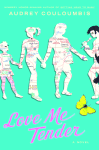
Love Me Tender

Couloumbis, Audrey. 2008. Love Me Tender.

"Early Friday afternoon, Daddy left mad.
He carried his guitar. The weather had turned so hot, the sweaty circles on his T-shirt looked like the wings of an insect against his back.
I followed him, dragging his duffel and panting, "Daddy, this thing is too heavy. What all are you carrying in here?"
What, besides his blue suede shoes and tight white jeans, did he need?"

The narrator of Love Me Tender is thirteen-year-old Elvira. The oldest of what will soon be three children. She's got an eight year old sister, Kerrie, and another sibling on the way. Her mom, whom she calls Mel because that's what her Daddy calls her, is seven months pregnant and very, very cranky. Elvira is worried that it's only going to get worse from here on out--first the hormones of pregnancy, later the diapers and crying and babysitting.

The family is in the beginning stages of crisis. Her dad is unhappy with his job, her mom is unhappy and moody with this unplanned pregnancy, and her younger sister has reverted to acting like a three year old. When we first meet the family, it doesn't look good. The parents have just had a big fight. Her dad is on his way to Vegas. On his way to compete in an Elvis impersonator competition. Her mom is glued to the recliner and hooked to cheesy TV movies. And her sister is driving her crazy.

And then the phone call comes.

It's a strange call. Almost cryptic. Mel's sister, Clare, says simply that their mother's time has come. Thinking that she only has hours--maybe a day or two--to make amends with her estranged family, Mel quickly packs up her two kids, borrows her husband's most prized possession--a classic car in great condition--and heads to Memphis, Tennessee. Taking turns behind the wheel, Mel and Elvira make it to her grandmother's house--just barely with all their nerves and spirits intact. (After a bit of a scare with Kerrie and some "toy" eyelashes.)

This will be the children's first time to meet their grandmother, and to meet their mother's younger sister, Clare. That family--much like Elvira's--seems to be in crisis as well. Clare is convinced that her mother--their mother--needs to be put in a nursing home.

During this weekend, lives will changes, fences will be mended, there will be laughter and tears as well.

Family drama galore (mainly through intense conversations/confrontations) is what you'll find in Love Me Tender.

Honestly, I thought this one was a bit disappointing. When I see the name Coulombis, I expect better things, greater things. Not that this one was bad, it just wasn't as magical as I expected. The premise, the author, the cover, I expected to be wowed a bit more than I was. I kept reading thinking that there was a big reveal on the way, something huge that would shake this family up, something that would act as a catalyst for this family. But nothing really happened.

Other reviews: Flamingnet, Not Acting My Age,

© Becky Laney of Becky's Book Reviews

Saturday, June 28, 2008

Skin Deep


Crane, E.M. 2008. Skin Deep.

First sentence: My name is Andrea.
Last sentence: Then it goes dark again.

Andrea Anderson is a nothing, a nobody, but she's fortunate to be an unnoticed nobody. "That's one thing about high school I've learned--even when you're unnoticed, there's usually someone else with a more painful role than loneliness. Girls who get their bras snapped in gym class, boys who endure a fist squashing their brown-bag lunches in the cafeteria. Both noticed and hated. Sometimes that's a solace, to not be one of them." (7)

She's a sophomore in high school. And her life is about to change forever.

Mrs. Menapace. That "crazy" neighbor down the street. When her neighbor is hospitalized, Andrea ends up with the "duty" (that soon becomes a pleasure) of taking care of Mrs. Menapace's dog. A young teen girl. A large and lovable dog. A woman dying of cancer. (And that's just the start of it.) All the makings for a good coming-of-age novel, right? Well, I think so at least!

The writing is really good. Descriptive yet sparse. Very stylistically pleasing.

270 pages.

© Becky Laney of Becky's Book Reviews

Sunday, June 08, 2008

Oh. My. Gods.


Childs, Tera Lynn. 2008. Oh. My. Gods.

Oh. My. Gods. is a light and mostly refreshing read. Our heroine, Phoebe, is a soon-to-be senior whose life seems to be going according just to her plans. Until. (There's always an until...) Until her mother returns from a family reunion in Greece engaged. Surprise! Phoebe is going to have a stepfather! Surprise! Phoebe is going to have a stepsister! Surprise! The family is going to live in Greece! Forced into saying goodbye to her friends and her high school, Phoebe goes to Greece only to discover quite another BIG surprise is waiting for her.

While this news wouldn't shock many fiction-fans these days, it shocks her something fierce. The Greek gods are alive and doing well. They're real. And she'll be going to school with their children, their descendants.

The premise of this one is fun in spirit. The characters could use a bit more developing; the premise a bit more working out, but overall it's an enjoyable read.


© Becky Laney of Becky's Book Reviews

Saturday, June 07, 2008

Take Me There


Colasanti, Susane. 2008. Take Me There.

I really really enjoyed her first novel, When It Happens, so I think my expectations were a little too high for this one. I think this is a nice read, a good read. One that I wouldn't hesitate to recommend to teen romance fans, or to teen fans of realistic fiction. It's got drama--lots and lots of drama: school, family, friendship, love. It has three narrators. Two girls--best friends--and one guy. All three are friends. This book, in some ways, is just as much about falling out of love as it is falling in it. Both female narrators have recently broken up with their boyfriends. And now that I think about it, the male narrator had also recently broken up with his girlfriend. Funny how I didn't realize that before. Anyway, this novel is about letting go, moving on, and making it through each day. It covers so many things, and the characterization is really quite good. All three are developed nicely. And some of the classmates are as well. Characterization doesn't really extend to the narrators' families, however, the parents are rarely if ever a part of the action. But that's not a bad thing necessarily, it's a typical thing.

Anyway, I liked this one. But I didn't love this one. I think other readers may have a better, stronger response.

© Becky Laney of Becky's Book Reviews

Friday, May 02, 2008

Blackness Tower

Blackness TowerCarl, Lillian Stewart. 2008. Blackness Tower.
Review by Becky Laney.

What can I say about Blackness Tower? On one hand, it did keep me reading. I didn't read it all in one sitting, I read it in three, but it was always pleasant to get back to. I liked reading it. It wasn't a not-that again experience. It held my interest for the most part. And I wasn't ever bored with it. On the other hand, it was one of those almost books. Maybe you know the kind. There were some things I liked about the novel, but there was just something about it that kept me from loving it. Something that kept me from getting excited--really excited about it. It was almost a romance novel, but not quite. It was almost a fantasy book, but not quite. Okay, that last one isn't really fair. But fantasy isn't the right word either. It was all about the paranormal. Mostly. So it's a paranormal-mystery-romance hybrid. An American woman comes to Scotland, comes to explore Black Ness Tower because she's been having dreams and visions. There she meets three men. All seem to be attracted to her, seeking her out in some ways, but all three seem cloaked in mystery as well. All loosely-connected to the same mission she's on. And then there are the spooky girl characters. Essentially the main character is confused and frustrated and has trouble figuring out who to trust and what's really going on. As I said, it kept me reading. But somehow it was a bit disappointing over all. Not terrible. Not awful. But definitely just an okay read for me. I don't regret reading it. I wanted to know what happened. But the way the mystery comes out, the way it all unfolds, it just left me personally a little empty. I think I started out connected with the characters, and then somewhere in the middle, I became slightly disconnected.

Your response, your reaction could be completely different than mine. Especially if you're really into paranormal romances. Though it lacks smut. If it had been a true paranormal romance, then there would have been some smut.

© Becky Laney of Becky's Book Reviews

Tuesday, February 20, 2007

Nick and Norah

Cohn, Rachel and David Levithan. 2006. Nick and Norah's Infinite Playlist.

Nick & Norah's Infinite Playlist won the 2006 Cybils award in the YA fiction category. Its competition was The Book Thief by Markus Zusak (a more serious book), A Brief Chapter In My Impossible Life by Dana Reinhardt (a more melodramatic book), Hattie Big Sky by Kirby Larson (a more family-friendly book), and Rules of Survival by Nancy Werlin (a harsher and more violent book). Of the five books, I can honestly say that I truly enjoyed four of them. (Don't get me started on A BRIEF CHAPTER OF MY IMPOSSIBLE LIFE). But before the Cybils announcement, I had not read Nick & Norah. It was on my stack of to be read books. So with the announcement, it became top of my list.

Perhaps it was no coincidence that in the past few weeks the Middle_School_Lit group on Yahoo has been discussing profanity in YA books. I am not making the connection that Nick & Norah's is a Middle School book--it isn't--but I just find it interesting to be reading all these postings about what is and is not authentic. And what should authors and editors do about profanity. Should they have more? less? the same? Does profanity make a book authentic? Does profanity establish characters and personalities? Are authors being more creative by using profanity or less creative? Is it harder to not use profane language and keep a book clean? If authors know that using certain words will make it offensive why do they keep using them? Do they not care? Are they making an artistic statement? I will add this to the debate. As a reviewer, how much is too much profanity? In a book of 183 pages--for example--how many times should you reasonably expect to see the f word??? 10? 25? 50? 100? Not even close to the number of times that Cohn and Levithan use it in their collaborative work of fiction NICK & NORAH'S INFINITE PLAYLIST. (Don't believe me, check out page 95 where it occurs 26 times). My question when does excessive (and I would argue that 26 times on the same page is excessive) use of profanity lower the quality of a book? The more profanity is used, the more redeeming, the more satisfying the other elements of the book have to be to make up for the fact that it's so profane. At some point you've got to ask yourself, are these characters just one dimensional characters that like to use the f-word over and over and over and over again for apparently no reason whatsoever? Don't they ever say or do anything else? Isn't there more to a person's character than a particular word??? Is profanity really artistic? Is the best an author has to offer the reader?

I will say this. I read NICK & NORAH'S INFINITE PLAYLIST. I enjoyed Nick & Norah NOT because of the profanity but in spite of the profanity. I didn't enjoy it enough to want to buy it. And I'd hate to have to hear an audiobook of this one. But it had a good story at heart. Nick is a young guy, a bass player in a band. A band where he is the only straight guy. So he's playing at a club and he sees his ex-girlfriend in the crowd. He begins to lose it. It's been three weeks since the break-up and he's still not over her. The thought of her still gets to him. Upsets him. He told her never to come see him play again, and so obviously she had to come and bring along her new boy toy. Enter Norah. Norah is at the club with her friends. She sees the band. She's hanging out at the bar afterwards, not drinking but watching her friend drink herself silly. Nick joins her at the bar after his band finishes up. The next band is on stage, and everything is going fine until....Nick sees his ex-girlfriend and her boyfriend heading his way. He panics and does the first thing that pops into his head. He turns to the girl next to him and says: Will you be my girlfriend for the next five minutes????? The big question that starts a long, quirky nighttime adventure between two young strangers.

The characters were even likeable. While they surrounded themselves with the party crowd who drank, did drugs, smoked, etc...Nick & Norah weren't into underage drinking or illegal substances. And as much as the book uses the f-word, there is very little sexual content (the actual act) in the book. Plenty of references. Some temptation. A few very racy scenes that are not going to sit so well with some readers. And a lot of scenes of questionable taste. I can't see the scenes with the transvestite strippers dressed as nuns stripping to Edelweiss and Climb Every Mountain going over so well with some readers. The truth is there is so much that could just as easily offend as entertain. It could go either way.

If you're offended by profanity, gay clubs, stripping transvestites, underage drinking and partying, sexual references both heterosexual and homosexual...then this book is NOT for you.

The developing love story, the relationship as its being formed, is a good one. Nick and Norah are made for each other. It just depends on how much you're willing to put up with to get to that conclusion. For me, NICK & NORAH was like LOVE ACTUALLY. Love Actually was a movie I bought without seeing it first. I had no idea of the content. Did not like 95% of the movie. There were only two possibly three storylines I cared about. The rest was absurd, offensive, distasteful, excessive nonsense. I liked the Colin Firth storyline where he falls in love with a foreign woman and has to learn the language so he can go back and propose to her. And I liked the widower and his young son storyline where they are coping with loss and death and discovering how to live again. The rest of the stories ranged from awful to nasty to pointless to stupid.

I should also mention since I'm focusing on what not to like in the book. That I actually LIKED elements of the writing style. I thought some of the sentences that weren't filled with profanity were actually quite beautiful and rhythmic. Very musical. Very enjoyable. But I think at least one of the authors got confused into thinking that profanity WAS the style of the novel instead of just a minor part of the style.

I am ticking, I am the pulsing, I am underneath every part of this moment. We don't have a drummer....I am the generator. I am listening and I am not listening because what I'm playing isn't something I'm thinking about, it's something I'm feeling all over. All eyes are on us. Or at least that's what I can imagine in my stageblindness. (1)

I throw the chords at them, I drench them in the soundwaves, I am making time so loud that they have to hear it. I am stronger than words and I am bigger than the box I'm in, and then I see her in the crowd and I fall apart. (2)

http://www.randomhouse.com/teens/nickandnorah/home.php#play

Friday, January 05, 2007

A Friend at Midnight

Cooney, Caroline B. A Friend At Midnight.

Caroline B. Cooney is certainly a prolific author, although not as predictable as other authors. You know how some authors you can just trust to write just the way you like with every single book they publish. Sarah Dessen for example. Her YA books are all extemely well written. With Caroline B. Cooney, however, each one is a risk. I really enjoyed her novel Hit the Road. And I loved Goddess of Yesterday. It seems she writes in at least three or four different genres and even more diverse writing styles. There’s nothing predictable about her style. With A FRIEND AT MIDNIGHT, her second 2006 release, I was hoping to find another great novel. What I found was an average one.

Don’t get me wrong, A Friend at Midnight is certainly not a bad novel. It doesn’t come close to being a bad novel. But it lacks, in my opinion, a certain something to make it a great novel. Hit the Road was funny and heartwarming at the same time. It kept you reading. It was just enjoyable cover to cover. A Friend at Midnight is very different. It is a darker book. A more emotionally turbulent book. A teen girl, Lily, is still making adjustments to living life with her mother, step-father, and new baby brother when her father abandons her younger brother, Michael, at the airport. (I believe he’s around 10). No money. No baggage. No telephone call. Michael calls home and Lily gets the surprise of her life. It falls on her young shoulders to find a way to get Michael home safely. You might be thinking why didn’t they just call the police...that is Lily’s instict too...but Michael is insistent that no one--no adults--be told the truth. Now Lily and Michael are living a lie. The novel deals with how both of them react to the abandonment and rejection of their father. Michael still fantasizes about a perfect father who loves him and will always be there for him. Lily never wants to see him or hear from him again. But what happens when Lily’s older sister insists on a reconciliation just in time for her walk down the aisle?

A Friend at Midnight is an angry, dark examination of what it is like to grow up in chaotic dysfuction.