Showing posts with label A ~ Z Reading Challenge. Show all posts

Wednesday, October 08, 2008

A to Z Challenge Wrap-Up


Joy of Thoughts of Joy is hosting the A to Z Challenge. It is to read A to Z authors AND A to Z titles. She writes, "All that's required is that you align the author's last name or the title of a book (excluding "the", "a", etc.) with its corresponding letter in the alphabet. Each author and title entry must be a different book. I will be working on both the author and title lists at the same time; however, you may complete the alphabet lists anyway that suits your fancy. The challenge last throughout the 2008 year."

Your books can overlap with other challenges. So that is GREAT incentive for me. I'm not sure which titles I'll read yet. But I'm sure I'll have fun as I go.


AUTHOR LIST

"A" ~
Foundation and Empire, and Second Foundation both by Isaac Asimov

"B" ~
Bray, Libba. The Sweet Far Thing.
"C" ~
Carroll, Lewis. Alice in Wonderland.

"D" ~
Dahl, Roald. Matilda.

"E" ~
Estes, Eleanor. The Moffats

"F" ~
Field, Rachel. Hitty, Her First Hundred Years.

"G" ~
Gemmell, David. Sword in the Storm.

"H" ~
Higa, Tomiko. Girl with the White Flag.

"I" ~
Irving, Washington. Two Tales.

"J" ~
James, Jessica. Shades of Gray.

"K" ~
Kostick, Conor. Saga.

"L" ~
Lin, Grace. Year of the Rat.

"N" ~
Na, An. The Fold.

"O" ~
O'Brian, Robert. Mrs. Frisby and the Rats of NIMH

"Q" ~
Quinn, Julia. The Duke and I.

"R" ~
Rutherfurd, Edward. London.

"S" ~
Simmons, Michael. Alien Feast.

"T" ~
Tolkien, J.R.R. The Hobbit.

"X" ~
No! That's Wrong by Zhaohua Ji and Cui Xu

"Y" ~
Yolen, Jane. Sword of the Rightful King.

"Z" ~

"A" ~
All of a Kind Family by Sydney Taylor
Accidental Time Machine by Joe Haldeman

"B" ~
By the Shores of Silver Lake by Laura Ingalls Wilder
B is for Betsy by Carolyn Haywood

"C" ~
The Cage by Ruth Minsky Sender

"D" ~
The Diaries of Adam & Eve Translated by Mark Twain
"E" ~
The Entertainer and the Dybbuk by Sid Fleischman

"F" ~
Foundation by Isaac Asimov

"G" ~
Guinevere's Gift by Nancy McKenzie

"H" ~
The Host by Stephenie Meyer

"I" ~
I Will Plant You A Lilac Tree by Laura Hillman

"J" ~
Jessie's Mountain by Kerry Madden

"K" ~
Kristy's Great Idea by Ann Martin

"L" ~
Leftovers by Laura Wiess

"M" ~
The Mozart Question by Michael Morpurgo

"N" ~
Northanger Abbey by Jane Austen

"O" ~
On the Banks of Plum Creek by Laura Ingalls Wilder
Old Twentieth by Joe Haldeman

"P" ~
Persuasion by Jane Austen

"Q" ~
The Queen's Soprano by Carol Dines

"R" ~
The Rules of Gentility by Janet Mullany

"S" ~
Sweethearts by Sara Zarr

"T" ~
Their Eyes Were Watching God by Zora Neale Hurston

"U" ~
Understood Betsy by Dorothy Canfield Fisher

"V" ~
Voyage of the Dawn Treader by C.S. Lewis

"W" ~
Winnie the Pooh by A.A. Milne

"X" ~
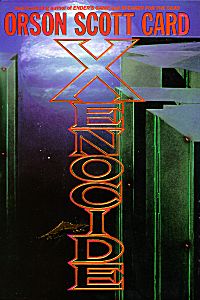
Xenocide by Orson Scott Card

"Y" ~
Yellow Umbrella by Jae Soo Liu

"Z" ~
Zombie Blondes by Brian James

© Becky Laney of Becky's Book Reviews

Xenocide


Card, Orson Scott. 1991. Xenocide.

Xenocide is the sequel to Speaker for the Dead. (Speaker for the Dead is the sequel to Ender's Game. Ender's Game is my favorite, favorite book.) Xenocide is an intricately complex plot following the saga of characters (mainly) introduced in Speaker for the Dead. Speaker for the Dead concludes with the threat of the destruction of the planet of Lusitania. Which would mean the destruction of the pequeninos (piggies), the human colonists (including Andrew Wiggin, his wife, his stepchildren, etc.) and the Hive Queen (the Buggers). The Lusitania Fleet has been launched, and the order to destroy the planet using the M.D. Device (Little Doctor) has been given. If it wasn't for Jane, the life-force residing in the ansibles and computers, the impending doom would be absolutely, completely certain. As it is, it is only mostly certain that xenocide will occur once again. (Xenocide being genocide of an entire species. While the human colonists would lose their lives, the human race would go on in the other hundreds of worlds colonized. But xenocide is a very real threat to two alien species: the Hive Queen (and her workers, etc) and the Pequeninos.)

There are so very many characters to keep track of in Xenocide. As I mentioned, most were introduced in Speaker for the Dead. Andrew and Valentine. Andrew's wife, Novinha. Andrew's step-children: Miro, Ela, Quim, Olhado, Quaro, Grego. The piggies of utmost importance are Planter and Glass. (Not counting the fathertrees Human and Rooter, etc.) The Hive Queen of course. Jane, the character that pulls most of the book together. But there are three characters that are brand new to the story. Three people from the Chinese colony of Path: Han Fei-tzu, Han Qing-jao, and Si Wang-mu.

The plot is too intricate and complex to go into all the details. The book is all about life-and-death matters. The colonists are trying to figure out a way to kill the descolada before it destroys them. They hope that if they can destroy it, then perhaps they'll be saved as well. The Hive Queen is busy building star ships. She wants some for herself. But she's also building some for the Pequeninos. She doesn't want another alien species destroyed by human stupidity. But the humans know that while the Hive Queen may be intelligent enough to find a way to kill the descolada from tainting them and their DNA--the Piggies aren't nearly advanced enough to do so. (The descolada is essential for the Pequeninos to survive. It is linked to their DNA. It is how they procreate and continue on in the third life.)

Xenocide is an interesting novel. But one that doesn't stand on its own. It begins in the middle of things, and ends with no resolution. (Or very little resolution.) It's the middle book of a trilogy (in a way) and while it's important...crucial for the progression of the story...it isn't as satisfying in some ways as the others in the series.

That being said, I do like it. I made the mistake, this time round, of not having read it close enough to Speaker for the Dead. It's been about fifteen or sixteen months since I read Speaker for the Dead. And some books are just better read in close proximity.

© Becky Laney of Becky's Book Reviews

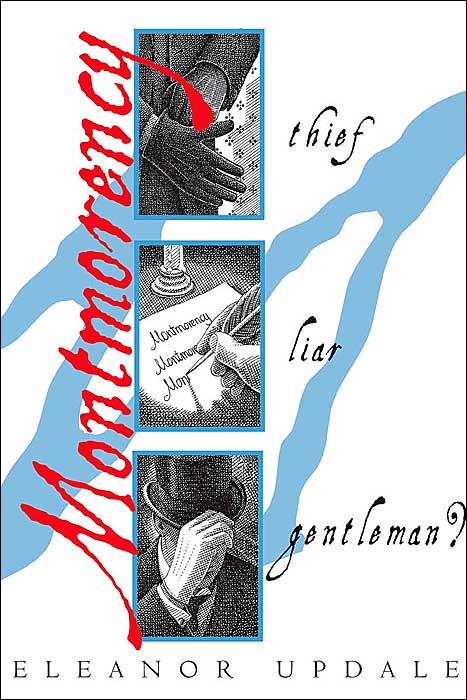
Travel the World: England: Montmorency


Updale, Eleanor. 2003/2004. Montmorency: Thief, Liar, Gentleman?

Originally published in Great Britain in 2003. Montmorency: Thief, Liar, Gentleman is the first in a series. (Montmorency having lots of adventures you see.) Set in Victorian England, it focuses on a thief and con man. We first meet our narrator in prison. We learn that he's been named "Montmorency" by the doctor that saved his life (and made a guinea pig out of him as well), Dr. Farcett. But he goes by another name as well: Prisoner 493.

493 is not well liked by his fellow prisoners. As the subject of study (and experimentation) of Dr. Farcett, he gets to go in and out of prison on a regular basis. True, his times out of prison he is the exhibit, an object on display, of Farcett and his lectures. But the other prisoners think he gets special treatment.

Ever calculating, 493 is already planning for his life out of prison. And he is absorbing everything around him. Absorbing all the information he hears at these lectures. Planning out his next big scheme.

His big plan? After hearing a lecture on the sewer system, he decides that he can use these underground passages as a way to get around during his burglaries. He can sneak into rich neighborhoods, hit his mark, and vanish underground. The scheme is complex--more complex than his previous crimes. So it takes a bit of planning. He soon realizes, he needs to be two people. To play two people. A Mr. Montmorency who is a rich, gentleman. A man who has the look and appearance of a gentleman. A man no one would mistake as a common thief. And Scarper, a lower-class man who can play the role of thief. Not that onlookers would take him as a thief. But he needs to be dirty and grungy and "common" enough that no one cares who he is and what he does. (It is a bit more complicated than that. But he has different "personas" he puts on to act out this scheme.)

Of course, he can plan all he likes when he's in prison...it's a different story to carry it out once he's been released. But Montmorency thinks he can do it.

My thoughts...I know this one is generally well liked (often loved) and it is typically highly recommended. But for me personally, I just didn't like it all that much. So while I think it has a certain amount of appeal to certain readers, I'm not sure I'll be following the series in the future.


© Becky Laney of Becky's Book Reviews

Tuesday, September 02, 2008

Zombie Blondes


James, Brian. 2008. Zombie Blondes.

I loved this book. I just LOVED this book. It was just so readable. Compelling I guess is the proper word for it. I was just hooked from the very beginning. "There aren't any rules to running away from your problems. No checklist of things to cross off. No instructions. Eeny, meeny, pick a path and go. That's how my dad does it anyway because apparently there's no age limit to running away, either." Our narrator, a teen girl named Hannah Sanders, is tired of running away. Dragged away is more like it. Her father, a former cop, is always on the move. But when the two move to the seemingly quiet town of Maplecrest, it will be Hannah who wants to run. And not without good reason.

Zombie Blondes could have been named ... Pretties or I Was a Non-Blonde Cheerleader or Geek Magnet, for example. (I'm not saying that the book resembles the plot lines of those books. Just that taken at face value, the titles could work for Zombie Blondes.) Hannah was hoping--really hoping--that in a town as small as this one, a town as dead as this one--that she'd have a chance to be one of the pretty people, the beautiful people, the popular people. Instead, against all the odds, the town is full of strangely attractive beautiful-and-popular people (from the cheerleaders, the football players, the teachers and coaches, the town sheriff, etc.) Some of these people seem to have a mesmerizing, hypnotic effect on others. (Especially when the cheerleaders perform their routines.)

This is something Hannah notices on her first day of school. How beautiful the popular girls are. How they all look the same. How they do everything the same really. And it's something that Lukas, a geeky boy who is unmistakably drawn to Hannah, points out to her as well. He offers his friendship, yes, but more importantly he offers her advice. Again and again and again and again. His advice is strange to her ears. Very strange indeed. He keeps rambling on and on about how the cheerleaders are zombies. About how she needs to stay away from them...and above all else she MUST not join them or she'll be turned.

IF you were Hannah, you'd be thinking this Lukas is one strange guy. Don't deny it. After all, Hannah doesn't have the benefit of knowing that she's in a book called ZOMBIE BLONDES.

So when one of the cheerleaders offers her a chance to try out....Hannah decides that it's worth a try. What could go wrong, right?

Do I recommend Zombie Blondes? Yes!!! A bit predictable....maybe. But it's fun. Part of the appeal, at least the way I see it, is that it reads like realistic fiction. Hannah is a person that is easy to relate to. Who doesn't wish to have a best friend? to have a boyfriend? to be loved? Hannah wants something that most of us would readily admit to wanting back in high school--a place she fits in, a place to belong, a place to blend in and feel comfortable. She wants to NOT be different. She wants to be "normal." And Hannah's home life, in a way, also adds another layer to the novel. Her father is absent even when present. He's emotionally shut down, unavailable, checked out. And Hannah is tired of being the grown up in the house. Very tired of this relationship being stuck in the same old patterns.

First sentence: "I can usually pick out the popular kids soon after setting foot into a new school. The girls, anyway. They wear popularity like a uniform for everyone to see. From their hairstyles to their expensive shoes. Everything about them is torn from the glossy pages of the latest teen fashion magazines. Everything about them is perfect. At least on the outside, anyway."

Back cover:

He’s about to walk away but stops. Turns to me and opens his mouth and starts to stutter like he’s not sure if he should say what he wants to. Then finally deciding to go ahead and say it, but refusing to take his eyes off the floor when he does. “It’s just . . . you’re kind of pretty . . . and she might try to turn you into one of them . . . one of her clones,” he says. “I don’t want to see that happen to you, that’s all.”
I tuck my lip under my top teeth.
“Is that supposed to be a compliment?”’ I ask.
“Nope,”’ he says.
“Just a warning.”

232 pages.

© Becky Laney of Becky's Book Reviews

Saturday, April 05, 2008

Pictures AND conversations


Carroll, Lewis. 1865. Alice's Adventures in Wonderland.

(This edition is the one published in 1999 featuring the illustrations of Lisbeth Zwerger.)

Alice was beginning to get very tired of sitting by her sister on the bank, and of having nothing to do: once or twice she had peeped into the book her sister was reading, but it had no pictures or conversations in it, "and what is the use of a book," thought Alice, "without pictures or conversations?"

If you're like Alice (when it comes to books), then you'll be pleased to know that Alice in Wonderland has plenty of pictures and conversations to offer readers of all ages. How to describe it? Magically wonderful? Practically perfect in every way? I think I'll go the chattier route, though.

My mom read Alice in Wonderland to us (me and my sister, my older sister) at least once or twice growing up. It was one of those books that was magical. Proof that reading was magic, that reading was the best way to spend an afternoon or evening. She had multiple copies, and we'd all three "read" along together. Of course, mom and my sister could read. I wasn't quite old enough to read it on my own, but oh-how-I-loved-to-pretend. But whether remembering the first time or the next dozen times, one thing was always the same. It was magic to go along on these adventures with Alice.

The story for those that may not be familiar with all the particulars begins when Alice follows a white rabbit down a rabbit hole. She spends some time falling down, down, down, down. But eventually she does reach the bottom. What she finds is an ever-changing, quite-strange world that both puzzles and delights and even at times frights. This strange place, this wonderland, has its own strange set of rules, its own logic, something that Alice can't quite wrap her mind around. (Not that I'd do any better, mind you!) Like her surroundings, she finds herself changing in unpredictable ways as well. Everything is fluid. Just when she starts to make sense of her situation, something changes, something transforms. Wonderland can be portrayed as dark or as light as you imagine. Especially when it comes to film and other adaptations.

The unique characters, the unique settings, the unique logic. All three make Alice's Adventures in Wonderland ever-so-magical and always-memorable.

Alice's Wonderland is strange. No doubt about it. But it has always made sense in a strange sort of way to me. It was like Lewis Carroll was a genius in capturing in conveying the dream world. Haven't you had dreams as strange as this one? Haven't you in-the-moment-of-the-dream gotten caught up in the new reality? Dreams have their own logic and so does Wonderland. And the more of a dreamer you are, I suppose, the more you love Alice and her 'friends.'

Though I read the Zwerger version, I'm going to be honest and admit that I prefer Tenniel's original illustrations. Perhaps because I grew up with them, perhaps because they're just the best and there is no improving on something that is 'the best.' But I will admit that they are good in their own little way.

© Becky Laney of Becky's Book Reviews

Tuesday, April 01, 2008

Guinevere's Gift by Nancy McKenzie


McKenzie, Nancy. 2008. Guinevere's Gift.

"Move over, Gwen. It's my turn." Elaine tugged at her cousin's sleeve. The two girls lay flat on their stomachs on the cold stone floor of the parapet. Guinevere had one eye pressed against a break in the mortar low in the castle wall."

Guinevere's Gift is the story of Guinevere's childhood. She's twelve and living with her aunt, uncle, and cousin. Her uncle is King Pellinore. Her aunt is Queen Alyse. And her cousin is a rather spoiled and bratty Elaine. Guinevere is the ward of her aunt and uncle since the death of both of her parents.

Life isn't easy for Guinevere. King Pellinore is out fighting or marching with his soldiers. And Queen Alyse is strict on a good day, downright severe and cruel on a bad one. Elaine, likewise, can go from nice companion to whiny, spoiled brat in a few seconds. She's used to getting her own way and manipulating people. You could say that she's a mini-Alyse.

But that's not the only problem (difficult people) Guinevere faces. She's the child of prophecy. "On the night of Guinevere's birth, a prophecy foretold she would one day be the highest lady in the land, wed to a great king." (So the jacket reads.) But Guinevere's problem is that some believe it, some fear it, and some would do anything to keep it from coming to pass. Among those who despise Guinevere just-in-case-the-prophecy-proves-true is Queen Alyse. The thought of Guinevere becoming higher than Elaine or higher than herself angers her tremendously.

In her twelfth year, Guinevere faces the most difficult challenge of her life. Lives hang in the balance. Can she be strong enough, brave enough, resourceful enough to save the day?

© Becky Laney of Becky's Book Reviews

Wednesday, March 26, 2008

Tales From the Brothers Grimm & The Sisters Weird


Tales From the Brothers Grimm and the Sisters Weird by Vivian Vande Velde is simply too much fun to resist. Vivian Vande Velde re-envisions thirteen familiar fairy tales and adds sparkle, wit, humor, and irony. I enjoyed each and every story in the collection. I can't really do the book much justice by my review, but I thought I'd share some first lines from the stories. If they don't convince you to pick up the book, nothing will.

Once upon a time, in the days before Social Security or insurance companies, there lived a miller and his daughter, Della, who were fairly well-off and reasonably happy until the day their mill burned down.

Once upon a time when princes still set out to seek their fortunes and when cranky old women still sometimes turned out to be witches, a prince named Sidney came to a well where an old woman asked him for help in getting water.

Once upon a time in a land and time when animals could speak and people could understand them, there lived an old woman whose best friend was a wolf.

Once upon a time, after the invention of teenagers but before there were shopping malls for teenagers to hang around in, there lived a young man named Jack.

Once upon a time before there were toll bridges, there were troll bridges.

Once upon a time, before the invention of water-beds or air mattresses or Craftmatic adjustable beds, there lived a prince named Royal.

Once upon a time, before Medicare or golden-age retirement communities, there lived a beautiful young girl named Isabella, who stayed at home to take care of her parents.

Once upon a time, in a land where even parents had magic, a mother got so upset with her son's bad temper, sloppy clothes, messy room, and disgusting table manners that she said: "If you're going to act like a beast, you might as well look like one, too."

In addition to these stories (from the thirteen) are some fairy-tale themed poems. These are wonderful as well. (I plan to devote at least one or two Poetry Friday posts to these delightful little poems.)

I definitely recommend this one.

Saturday, March 15, 2008

The Duke and I


Quinn, Julia. 2000. The Duke and I.

The Duke and I is the first novel in a series of eight books focusing on the Bridgerton family. There are eight Bridgerton siblings: Anthony, Benedict, Colin, Daphne, Eloise, Francesca, Gregory, and Hyacinth. (4 boys. 4 girls.) Each of the novels focuses on a Bridgerton and on the soon-to-be significant other of the Bridgerton in question. The Duke and I is narrated by Daphne and Simon. Simon is actually Simon Arthur Henry Fitzranulph Basset. (At his birth he was already an Earl, Earl Clyvedon). A child destined for greatness, upon his father's death he'd be the tenth Duke of Hastings.

The prologue sets Simon up as a troubled, bitter, and angry young man. His mother died giving birth to him. His father rejected him because of a childhood stutter. He's been raised by servants. His father lived on another estate and pretended he was dead. It was even hinted that he faked mourning for his son. (Though I could have misread that passage.) If there is one thing that is clear about Simon it is that he hates his father. Hates with a capital-H. He despises everything about him. Because of this angsty adolescence, Simon is not the marrying kind. He doesn't want to fall in love; he doesn't want to get married; he doesn't want to have children; he doesn't want to pass on his title.

The first chapter introduces us to two important characters. (Well, more than that really. But hear me out.) Lady Whistledown. The secret, mysterious authoress of a London's society (gossip) paper. Every chapter of this book (and most of the other Bridgerton series books) begins with a glorious snippet of juicy gossip from the pen of Lady Whistledown. These bits are pure fun, a pure delight to read. The book opens with Daphne and her mother reading that morning's edition of Lady Whistledown.

The heart of this novel revolves around marriage. Violet Bridgerton, the mother, is anxious (extremely anxious) to get her oldest son and oldest daughter married off. She has even given lists of eligible prospects to both. Anthony, as the head of the family since his father's death, is a Viscount and quite a catch. He is the one responsible for overseeing Daphne's courtship. (I don't know if that's the right word. He's in charge of who is allowed and not allowed to call on her, to decide who is a proper enough escort, etc. And ultimately the one to give "permission" for her hand in marriage.) Daphne is a lovely girl but one without many suitors. It's not that there are none, she was proposed to by several men in their late fifties and early sixties, it's just that no man has all of the necessary factors: the intelligence, the wit, the wealth, and the attractive appeal to win her heart or win her respect.

It is when Daphne is fleeing from an ardent (and quite drunk) gentleman, Nigel Berbrooke, that she meets Simon. (The setting is a dance, a ball. A ball at Lady Danbury's home.) Simon is ready to rescue this damsel in distress. Didn't he overhear her telling the gentleman to back off, to leave her alone? It's his duty, his privilege to save her. But before he has a chance to act, Daphne lets Nigel have it. He's down for the count. (I don't think she meant to floor him though! But she's used to standing up for herself and has certainly watched her brothers fighting.) Now Simon and Daphne are in cahoots about the situation. How to get him out of the hallway without causing a big scene. She isn't aware of who he is, but he knows almost from the very beginning that this dynamite of a girl who can pack a punch is the little sister of his good friend, Anthony, whom he attended school with all those years ago.

As soon as she does learn his identity, she lets it slip that her mother told her to stay away from him because he was a Rake. (A.K.A. mad, bad, and dangerous to know) Simon can't let this golden opportunity go, he tries to "scare" her with his ardent charm. It fails miserably. All he does is succeed in giving her the giggles. She tells him, "you shouldn't be so melodramatic. It doesn't suit you. . .Well, actually, it does suit you, I ought to admit . . .You looked quite dangerous. And very handsome, of course. . .That was your intention, was it not? Of course it was. And I would be remiss if I did not tell you that you would have been successful with any other woman besides me." (57) She proceeds to tell him, "I'm quite flattered you thought me worthy of such a magnificent display of dukish rakishness...or do you prefer rakish dukishness?" (58)

The chemistry is there alright. The banter between the two, the easy-going friendship of sorts that starts to form from the very beginning. It all makes for an interesting proposition. Not that kind of proposition either. He wants to woo her, to court her, to keep all the other Ambitious Mamas away along with all their daughters for the season. She agrees because she knows that being wooed by him will make her attractive to all the other men. After she's really and truly fallen in love with someone, she can be the one to end their engagement or courtship or relationship. They both think it's a good (and slightly manipulative) way to maneuver in a society obsessed with the marriage mart. (Her mother won't be after her to find a man because she thinks her daughter is being courted by a duke...quite a catch.) The one with the doubts? Anthony. He knows Simon's reputation. He shares Simon's reputation. He knows exactly the kind of man Simon is. Can he really trust Simon to keep his hands off his sister?

This is a delicious novel. As you can imagine, Simon does put Daphne in a compromising position. And Anthony is all for a shotgun wedding or a duel.

Can Daphne persuade Simon that marriage with her really would be better than certain death?

There is a reason--a very very good reason--that Julia Quinn is my favorite romance novelist. Her books are always well written. (Formulaic in parts yes, but always well written.) Her Bridgerton novels are especially delightful. For Quinn's novels are always always always more than just a lame excuse for (corny) graphic sex. It really is about the characters. Really is about the story. In my opinion, most other novelists have flat characters. The whole book revolves around the smut. You could essentially mix and match heroes and heroines from any romance novel and the novels would read the same. I don't like [insert-name-here] love scenes. I don't. Which is why an occasional Quinn novel will slip into my tbr pile. Yes, it's a guilty-pleasure to indulge in adult romance novels. But reading Quinn is not as guilty and as shameful as indulging in other authors. (She has more nutrition and nourishment for the mind than most others.)

The Rules of Gentility


Mullany, Janet. 2007. The Rules of Gentility.

I was on my way to check out at the library when my eyes happened to catch this title: The Rules of Gentility. I took it off the shelf and read, "Mullany is clearly the witty, secret love child of Jane Austen and Lord Byron." Interesting. Very interesting. As you can imagine, that alone was enough to make me bring it home. Though I didn't know it at the time, the back cover also reads, "A delightful marriage of Pride and Prejudice with Bridget Jones's Diary." That also would have helped persuade me to give this new-to-me author a chance.

First sentence:
It is a truth universally acknowledged that a single woman of fortune and passable good looks amuses herself in London with fashion, philanthropic works, and flirtation, until a suitable gentleman makes an offer. I consider the pursuit of the bonnets and a husband fairly alike--I do not want to acquire an item that will wear out, or bore me after a brief acquaintance, and we must suit each other very well. And although I have several gentlemen who have expressed an interest, I find all of them lack a certain something; and of course, with a gentleman you cannot replace the trim from another to make the perfect object, as tempting a thought as that might be, although indeed it would be an interesting experiment.
(1-2)

Our heroine is Miss Philomena Wellesley-Clegg. When our text opens, we find Miss Philomena on her way to visit her good friend, Julia, Lady Terrant. On the way in, however, she first bumps into a strange man. A man she mistakes for a servant. His name? Inigo Linsley. And, of course, he is no servant. He is the brother-in-law of Julia. A man who stands to inherit quite a nice bit of property if and only if he agrees to settle down and marry a nice girl. (Of course, our heroine doesn't know this last bit quite yet.) The novel alternates between those two narrators: Inigo and Philomena. Philomena, Julia, and several other young ladies (mostly single ladies I believe) have formed a philanthropic club called the Association for the Rescue and Succor of those in Extremis.

It is obvious from the beginning that Inigo has captured her interest, her attention. (I won't say heart. It's simply not true.) She has a list of eligible men. And she deliberately keeps trying to keep him off her list. But he always has a way of popping right back on her list. He intrigues her much too much.

I shall be wise and virtuous concerning Mr. Linsley. I may practice flirting with him, and I may even dance with him at the ball tonight, but I shall certainly not allow him to take liberties of any sort whatsoever, even if I think no one would find out. Absolutely not. Besides, it is as Hen says--his family, who are proud and haughty, would never allow even their youngest and most insignificant son to marry into Trade, and I am sure Mama and Papa would not allow me to form an alliance with a man of such bad reputation. Not that I should wish to do such a thing. I do hope he will wear the dark blue satin coat and breeches tonight, but I resolve to think no more about the latter, which are pleasingly tight, and where, for some reason, I cannot help looking. (34)

Soon the two are courting in jest--a "false engagment" for her to discourage a bothersome beau and for him to get his meddling and nagging brother to leave him alone. But as can be expected, this false courtship soon feels all-too-real to both parties.

The text is fun and flirty in that giddy girlish way. The kind of book that makes you feel good when you read it, a big grin, a few snickers and giggles, but the kind that you feel a bit guilty or sheepish about as well. It isn't your stereotypical bodice-ripping romance novel with a half-naked couple on the cover. It's higher quality than that by all means. It definitely falls into the category of chick lit. Historical chick lit. (You don't often find that!) The concerns are shopping and partying and dating and love. On the sliding scale of if it is 'clean' or 'smutty' I'd say it was PG-13. Not R. Not X. But definitely full of flirtatious innuendos. (Not as clean or as appropriate as Georgette Heyer's novels. But definitely way cleaner than your average romance novel.)

Those familiar with Regency romance novels know that one of the standard story lines is that of a Rake who becomes quite reformed and quite a good husband because of the love and care and devotion of that one, sweet, charming, unforgettable girl. Meeting "the one" makes him forget all the scores of women he's bedded and makes him quite the catch. These heroes are always "mad, bad, and dangerous to know" (Byron) but always reform-able.

While the story might not be that original, the characters, and certainly the writing style are enjoyable. I would describe this one as definitely fun. Pure fun. Not "pure" pure fun. I loved every minute of this novel. I wouldn't hesitate to recommend this one. But I would imagine it's not for everyone. If the idea of a "witty, secret love child" of Austen and Byron intrigues you, I'd encourage you to pick it up.

Saturday, February 23, 2008

The Entertainer and the Dybbuk


Fleischman, Sid. 2008. The Entertainer and the Dybbuk.

The Entertainer and the Dybbuk by Sid Fleischman won the 2008 Sydney Taylor Book Award in the category of books for older readers. Fleischman won the Newbery in 1987 for The Whipping Boy. Set in the late 1940s, The Entertainer and the Dybbuk is the story of an American ventriloquist, the Great Freddie, who while on his tour of Europe becomes haunted or possessed by the spirit of a Jewish child slain in the Holocaust. This boy, Avrom Amos Poliakov, now a dybbuk or spirit, has unfinished business and he needs this former American soldier's help to be at peace. Now inhabited by this friendly, often sarcastic, mournful soul, his act has become better than ever. The dybbuk is winning the hearts of the crowds. The crowds of course don't realize that this isn't all an act put on by The Great Freddie. He's gone almost overnight from a mediocre-at-best performer to a real crowd-drawing attraction. But being possessed isn't all fun, the dybbuk means business. And he'll stop at nothing to accomplish his goals.

The book is very good, and I definitely recommend it.

First sentence: "In the gray, bombed-out city of Vienna, Austria, an American ventriloquist opened the closet door of his hotel. Still in his tuxedo and overcoat, The Great Freddie intended to put away the battered suitcase in which he carried his silent wooden dummy. But there on the floor sat a gaunt man with arms folded across his knees, waiting."

180 pages

Thursday, February 21, 2008

The Moffats


Estes, Eleanor. 1941. The Moffats.

The Moffats may not be the most exciting, thrilling, page-turning book I've ever read, but it is enjoyable none the less in its quiet, subtle, gentle way. The book focuses on the Moffat family. A mother raising her kids alone. The family is not rich--as you can imagine--but there is a loving, caring atmosphere that makes for a very happy home. The book is episodic. The narrator or main character changes from chapter to chapter. And there is no one connecting plot that threads them altogether. (Well, maybe that isn't quite true. If there is such a plot it would be that their landlord has put their house up for sale. This occurs in the first or second chapter. And the house is sold and the Moffats have to move in the last chapter.) Each chapter is a story of sorts about what life is like--daily life around the house, around school, around town, etc. The stories are mostly lighthearted and fun. But there are some serious moments as well, some moments that border on being a lesson in morality. For readers looking for family-oriented, family-friending reading material, The Moffats is sure to satisfy.

First sentences: The way Mama could peel apples! A few turns of the knife and there the apple was, all skinned! Jane could not take her eyes from her mother's hands. They had a way of doing things, peeling apples, sprinkling salt, counting pennies, that fascinated her.

224 pages

Shades of Gray


James, Jessica. 2008. Shades of Gray: A Novel of the Civil War in Virginia.

A piercing blast from a bugle preceded the sound of galloping horses by seconds. Captain Alexander Hunter tore his eyes away from the horse and rider he pursued and focused on a Federal calvary unit now pursuing him.

The title is key here. It lets you know what to expect, and what not to expect. Civil War. Virginia. Any time a novel is set during the Civil War, expect bloodshed. Especially if it's set in Virginia. Shades of Gray. This is of course alluding (is alluding the right word???) to the ethics and morals of war. Not black. Not white. Not even just gray. But shades of gray. So expect lots of ethical dilemmas and 'hard' conversations on what is morally right and wrong and honorable and dishonorable. The first sentence is also important. It lets you know that this isn't a novel about Northern women or Southern women on the home front waiting and praying while their men go off to fight. The narrative places you right in the action.

We have two main characters. One man. One woman. But what you might not be expecting is that both have already been mentioned in that first sentence. One directly, one indirectly. Our hero is a Confederate. A Virginian. Alex Hunter. Our heroine. Well, she goes by many many different names. Andrew Sinclair. Yes, Andrew. Though the Federal army mostly just calls her "Sinclair." Maryann Marlow. Andrea Evans. All but the last being code names. You see, our spunky young heroine (17 when the story opens) is a spy for the Union army. She didn't start out as a spy, not exactly, but her work as a messenger naturally developed into much much more. She is fearless. She is reckless. She is very spirited. She is well matched to oppose Captain Alex Hunter. The two are enemies. Definitely enemies.

The novel is all about torn loyalties, torn allegiances, conflicting interests. The Civil War did tear families apart. It wasn't unheard of for brothers to be on opposite sides facing each other in battle. Immediate and extended families could be torn apart. And lovers. Was it so difficult to imagine that the heart might have its own loyalties? That love might come in unexpected places, in unexpected ways? Alex Hunter does have a brother in the Union army. And this brother is loved. He even goes to his brother's bedside when he is injured. He makes him a promise, a solemn promise to take care of his brother's love, his 'unofficial' betrothed. This woman? None other than Andrea Evans. Though I believe she is going under a different name at the time. She is there too. By his side. He recognizes her not as the boy who has given him chase in the past, but as a woman living in Richmond, Virginia. A woman he's danced with and flirted with. He realizes then that appearances can be deceiving.

Shades of Gray is 524 pages in length. It is complex. The characters are well fleshed out. The plot has many twists and turns. It is an engaging read. Especially the first half of the novel. I didn't want to put it down at all. My eyes kept getting heavier and heavier, but I wanted to keep going. I told myself "just one more chapter" at least half a dozen times. For me, the second half of the novel wasn't quite as good. The plot became a bit messier. The ending, well, I'm not going to have any spoilers but I think the ending should have come 24 pages sooner. If the narrative had ended with the Civil War, I feel it would have been a stronger conclusion. As it is, there are two chapters that serve as an epilogue of sorts. A fifteen years later. And a twenty-five years later (ten years after the fifteen years chapter, but twenty-five years from the Civil War).

Did I like it? Did I enjoy it? Would I recommend it? Yes. Yes. Mostly. I enjoyed this one. I couldn't put it down for the most part. And while the ending left me slightly unsatisfied, the last twenty-four pages do not negate the five hundred pages that I did enjoy. It is still a thoroughly enjoyable read. It was good. I think for those that love Civil War novels it would definitely satisfy. Of course not every one loves historical fiction. And of those that love historical fiction not everyone loves the Civil War setting. And of those that love Civil War settings, not everyone loves those that take place on and off the battlefields. So I think the book definitely should be recommended to those that fall into that area, that target group.

Tuesday, February 19, 2008

B is for Betsy


Haywood, Carolyn. 1939. B is for Betsy.

I'll keep this one short and sweet. I read this book because I've been going way way back this month. (Who knows why???) Anyway, as far as books from the thirties go, this one is charming enough. The heroine is, of course, named Betsy. And the plot is episodic. Each chapter is a new adventure. Most of them center around life at home and life at school. It's not that the book is bad, it's just a bit dated. You can love it, I hope, and still admit that it's dated. (If you grew up with this book and loved it and want to share it with your kids, I don't want to offend you by saying it's "dated." But as an adult reader I've got to be honest and say that I'm not so sure that today's young readers are going to be as charmed with it as their grandmothers may have been. You may pull it off if you do it as a read aloud, but I don't know that a kid would pick this one up on their own and stick with it. Not without some motivation or guidance or exuberance from a trusted adult.)

Another point--that may be neither here nor there. But I think *sometimes* your response to a book is dependent on when you read it. Some books that I only "like" now, I probably would have loved as a kid. Some books I loved as a kid, if I was reading them for the first time as an adult, would only merit a "like" as an adult reader. It's just something to consider.

First sentence: "Betsy lay in her little white bed. She had been awake a long time. Outside her window the birds were calling "Good Morning" to each other, but Betsy did not hear them. All summer long she had jumped out of bed as soon as her eyes were open. She had always run to the window and thrown sunflower seeds out to the birds for their breakfast. But this morning Betsy was so busy feeling unhappy that she forgot all about the birds. Betsy was unhappy because today was the first day of school. She had never been to school and she was sure she would not like it."

159 pages.

Matilda


Dahl, Roald. 1988. Matilda.

I read this one because I was inspired by Melissa. What can I say about it? It's wild. It's definitely out there. But it's fun. Oodles and oodles of fun. Realistic? Never in a million years. Was it meant to be? Of course not. A zany (how often do I use that word???) over-the-top thoroughly enjoyable read. Matilda is a young genius. (4 or 5 years old) An under appreciated genius at that. Her parents are ghastly. There really isn't any other way to say it. They're abominable. So Matilda has a way of getting back at her parents for their cruel and horrid behavior. Then it's time for Matilda to start school. She's got a good teacher--a teacher that is practically a saint--but the superintendent (my guess is the equivalent of a principal) is evil incarnate. The battle between good and evil has never been quite so strange. Anyway, it's a fun read. But as I said, it probably isn't for everyone.

It's a funny thing about mothers and fathers. Even when their own child is the most disgusting little blister you could ever imagine, they still think that he or she is wonderful. Some parents go further. They become so blinded by adoration they manage to convince themselves their child has qualities of genius. Well, there is nothing very wrong with all this. It's the way of the world. It is only when the parents begin telling us about the brilliance of their own revolting offspring, that we start shouting, "Bring us a basin! We're going to be sick!"

240 pages.

Tuesday, February 05, 2008

All of A Kind Family by Sydney Taylor

Taylor, Sydney. 1951. All Of A Kind Family.

Originally published in 1951, Sydney Taylor's novel, All of A Kind Family, is set in New York City around 1912. The family consists of a mom, a dad, and five "step and stair" daughters. (They range in age from twelve to four.) The book is about the adventures the five sisters have together. It's definitely not your typical book if you're judging it by modern standards. There is less plot, for one thing, but the charm--or part of the charm--is in the individual stories, the episodes. The fact that it is more a compilation of loosely connected stories masquerading as a novel isn't a problem in my opinion. (But I'm curious what modern children would make of it all???)

The book does have its charms. There's no doubt about that. And one of the things I do like about the book is the fact that it highlights so many different aspects of being Jewish. For example, I haven't come across too many fiction novels (or picture books for that matter) that show families celebrating Purim and Succos. (These aren't the only celebrations by any means.) It was just interesting to see these aspects of culture and religion interwoven with the typical and traditional threads of family life and social life--going to school, going to the library, going to the beach, going shopping, getting a new baby, etc.

Part of me is curious as to how modern readers would respond to this novel and others like it. Would it be considered too old fashioned? Too dated? Too boring? While I can appreciate it the novel as an adult, I'm not sure what I would have thought of it as a child.

For example, the chapter that is really "out there" for me is how the mother tricks the children into doing housework. The chapter is called "Dusting is Fun." And it doesn't matter if you're 8 or 9 or 29, you KNOW that that sentence is a lie and always will be a lie. The mother successfully tricks her five children into playing a game "find the buttons while you dust" to get them to do their least favorite chore each week. I don't buy it. It's not like finding a button is a great reward. It's not like they get to keep the button. It's not like they can trade the buttons for a penny or two to keep. They're just finding the same buttons over and over again each week and making it an-ever-so-fun game. I just don't buy it at all.

However, the rest of the chapters do work for me for the most part.

First sentence: "That slowpoke Sarah!" Henny cried. "She's making us late!" Mama's girls were going to the library, and Henny was impatient.

It is 189 pages.

Monday, February 04, 2008

By the Shores of Silver Lake


Wilder, Laura Ingalls. 1939. By the Shores of Silver Lake.

Laura was washing the dishes one morning when old Jack, lying in the sunshine on the doorstep, growled to tell her that someone was coming. She looked out, and saw a buggy crossing the gravelly ford of Plum Creek. "Ma," she said, "it's a strange woman coming."

There is a somewhat large gap between On the Banks of Plum Creek and By the Shores of Silver Lake. We last saw Laura at age 8 or possibly 9. In the beginning of By the Shores of Silver Lake, she is thirteen. And the book's action begins after some melancholy life-altering drama: four of the family had had scarlet fever: Mary, Carrie, Grace, and Ma. (Grace appears with no introduction.) This scarlet fever has left Mary blind.

This "strange woman" is a friend and relation. She is Laura's Aunt Docia. She is there to present Pa with a job offer. Her husband works for the railroad, and she thinks Pa should work for them too. He accepts. But it is decided that he should go alone. Mary isn't ready to travel yet. And the family can go most of the way by train. But it is at this point that we are forced to say goodbye to one of the most beloved fictional dogs of all time, Jack. Jack dies on the eve of Pa going West again.

The novel takes the Ingalls family into South Dakota around DeSmet where the rest of the series is set.

It's not that I don't like this novel. Although I don't. Not really. It's just that in comparison to the other novels (especially On the Banks of Plum Creek and The Long Winter) this one doesn't quite do it for me. I'll be honest. I know Jack was old. I know dogs can't live forever. And I know this is historical fiction based on a true story. Still, my childish self can't quite forgive this book for the death of the dog.

By the Shores of Silver Lake is one of five Newbery Honors that Laura Ingalls Wilder received for her historical fiction "Little House" series. (For those that are curious: 1938 for On the Banks of Plum Creek; 1940 for By the Shores of Silver Lake; 1941 for The Long Winter; 1942 for Little Town on the Prairie; 1944 for These Happy Golden Years).

290 pages.

Sunday, February 03, 2008

On the Banks of Plum Creek


Wilder, Laura Ingalls. 1937. On the Banks of Plum Creek.

The dim wagon track went no farther on the prairie, and Pa stopped the horses. When the wagon wheels stopped turning, Jack dropped down in the shade between them. His belly sank on the grass and his front legs stretched out. His nose fitted in the furry hollow. All of him rested, except his ears.

On The Bank of Plum Creek opens when the Ingalls family arrives at their new home. They have bought a place, and their first new "home" is a dugout. They are buying it from a Norwegian man, Mr. Hanson, who is moving further west I presume. This is just temporary. Charles (or "Pa" as he's referred to so often it's hard not to join in) has promised to build them a real house, a real home just as soon as he can. The book opens with promises and hopes and dreams. But most of the book will see those hopes and dreams delayed. What Pa needs--what they all need--are good crops, good wheat crops. What Pa gets is grasshoppers. The Ingalls family does struggle a bit in On The Banks of Plum Creek. But they do settle in and get comfortable. Mary and Laura, for instance, start school. It is the first time for them to ever attend school. And they do meet up with some town folks like Nellie Oleson.

Overall, this is a more than enjoyable read. Some of my favorite chapters are "Nellie Oleson," "Town Party," "Country Party," "Going to Church," and "Surprise."

It is 339 pages.

Understood Betsy


Fisher, Dorothy Canfield. 1917. Understood Betsy.

When this story begins, Elizabeth Ann, who is the heroine of it, was a little girl of nine, who lived with her Great-aunt Harriet in a medium-sized city in a medium-sized state in the middle of this country; and that's all you need to know about the place, for it's not the important thing in the story; and anyhow you know all about it because it was probably very much like the place you live in yourself.

Elizabeth Ann is an orphan raised by her great-aunt Harriet and her aunt Frances. The first chapter shows the reader just how life as she knew it was for Elizabeth Ann. To say she was coddled would be a bit of an understatement. To say that both aunts and niece were a bit psychologically unsound would be a bit closer to the truth. It's not that they're crazy crazy. It's just that they're anxious, jittery, nervous, worrisome, panicky, fidgety, chicken-little-y type people. They're sweet and docile enough, but they lack gumption and ingenuity and vitality.

Understood Betsy is the story of how Elizabeth Ann transforms into Betsy. It all starts when one of her caretakers gets diagnosed with an unnamed disease. (If they named it, I sure missed it. But I think the main point was to get the two aunts out of the picture.) Elizabeth Ann is sent to live with the other side of the family. Her aunt (Abigail) and uncle (Henry) and first cousin (Ann). They live in Vermont, I believe.

From the very beginning, Elizabeth Ann knew that she was entering the unknown. On her way to her new home--in the buggy--she has her first enlightened moment. "It is possible that what stirred inside her head at that moment was her brain, waking up. She was nine years old, and she was in the third-A grade at school, but that was the very first time she had ever had a whole thought of her very own." (21)

Her awakening, her transformation is entertaining enough and the descriptions of life and family are charming as well. I think some readers will love Betsy, understand Betsy; but I'd be silly if I didn't acknowledge the fact that some readers would find Understood Betsy to be boring or quaint. Anyway, long story short...I loved it. I thought it was great. If I had discovered this as a child--like my mother did and most likely my grandmother did--I'm sure I would have loved it. I'm sure I would have read it over and over again.

You can find the entire book--including illustrations--online.

Thursday, January 31, 2008

Fablehaven: Rise of the Evening Star


Mull, Brandon. 2007. Fablehaven: The Rise of the Evening Star.

It has now been a year since Kendra and Seth have visited their grandfather and grandmother (whom we first met as a chicken) on their Fablehaven estate (or preserve to be a bit more accurate). Our narrative opens with Kendra anticipating the last week of school--her last week at a middle school. It's an unusual time for a school--a class--to receive a new student--with only one week to go--but only Kendra knows quite how strange it is. The new student? Not human. A monster. A monster with foul breath. When Kendra's unable to reach her grandfather, she decides to trust the man who claims to be sent at her grandfather's request. A man called Errol. Kendra and Seth thus end their school year with a bit of adventure and danger and mystery. Soon summer will be here. The summer may just hold another action-packed, adventure-filled, mystery-solving, danger-ridden, journey for the two as they visit their grandparents once more. Full of action, suspense, mystery, and adventure...this second book is even better than the first.

Saturday, January 26, 2008

What a Doll!


Field, Rachel. 1929. Hitty: Her First Hundred Years.

The antique shop is very still now. Theobold and I have it all to ourselves, for the cuckoo clock was sold day before yesterday and Theobold has been so industrious of late there are no more mice to venture out from behind the woodwork. Theobold is the shop cat--the only thing in it is that is not for sale, which has made him rather overbearing at times. Not that I wish to be critical of him. We all have our little infirmaties and if it had not been for his I might not now be writing my memoirs. Still, infirmities are one thing, and claws are another, as I have reason to know.

Hitty, Her First Hundred Years won the Newbery award in 1930. Who is Hitty? Hitty is a doll. A wooden doll made from the ever-lucky mountain-ash wood. Her story begins when an Old Peddler--old peddlers are so rarely named in books--takes refuge with a family in Maine. Mrs. Preble is awaiting the return of her husband--who is a whaler--and she has the children to care for. One of her children is a young girl named Phoebe. (The other is a boy named Andy.) The Peddler takes refuge in the storm, but ends up staying quite a while with the family. At some point during his visit, he carves this doll--soon named Mehitabel--for the little girl. Phoebe's told she must sew clothes for the doll before she can be played with--and one of the items Phoebe makes is an undergarment--a chemise--with "Hitty" cross-stitched on it.

Hitty's adventures span the globe and span generations. Sometimes her change of locale is purposeful--when the Preble family takes her on a ship's voyage to the South Seas--and other times it is quite accidental--when Phoebe drops the doll in India and she is "discovered" by a wandering snake charmer. She has many different owners; she has many different adventures. Throughout it all, she tries to hold on to as much grace and dignity as she can. Which isn't always easy. (Like when she's made an idol in the South Seas.)

The book is illustrated by Dorothy P. Lathrop. The illustrations are black and white. And they are very likely the original illustrations for the book. Original art is important I know to preserving the feel of a book at times. (Like I would be monstrously upset if someone removed Garth Williams illustrations from the Little House books. Oh wait, somebody did. And it was wrong, wrong, wrong.) But when I see beautiful new editions of The Wind in the Willows or Alice in Wonderland or The Secret Garden. Editions with incredible illustrations. I can't help but wishing that Hitty will one day get the same treatment. My choice? Bagram Ibatoulline.

When I was reading The Miraculous Journey of Edward Tulane, I thought. I bet this book must be like Hitty. I'd never read Hitty. It was just a hunch. An educated guess. A guess that turned out to be all too accurate. Hitty didn't start out unloved, mind you, and she was never nailed to a stake and used as a scarecrow. However, she did spend decades folded up in a horsehair sofa in an attic. The similarities are interesting.

Hitty, Her First Hundred Years
was a good read for me. I enjoyed it. I thought it was charming in some places. Interesting in others. There were just a few sentences here and there that might be jarring to the modern reader. For example, early on in her life--turn of the nineteenth century--Hitty refers to Native Americans as 'Injuns'. Phoebe and Andy are out picking blackberries or blueberries or some sort of berry. They wander too far away and see Indians in the distance. Both get so frightened that they run away. In the chaos--the Indians never saw them or chased them--Phoebe drops her doll and later worries that the 'Injuns' might have taken her. And a few chapters later, when the Preble family is sailing--in a whaling ship--the South Seas. A storm leaves them stranded on an island with "savages."