Showing posts with label series challenge. Show all posts

Friday, October 24, 2008

Rilla of Ingleside


Montgomery, L.M. 1921. Rilla of Ingleside.

I will try to dry my eyes long enough to type out a review that couldn't hope to do this book justice. Rilla of Ingleside is the final book in the series of Anne books. The novel is set during World War I. For those that think Anne's life was so rosy and so perfect...just consider that her children came of age just in time for the declaration of war. The novel opens in July of 1914. Within the first few chapters, Anne has seen her firstborn son, Jem, off to war. Before the novel closes, she'll send off two more of her sons: Walter and Shirley.

Rilla of Ingleside isn't Anne's story--though we do get glimpse of the fiftyish year old mother and wife--it is Rilla's through and through. Her youngest child is just a few weeks (or is it a few months?) shy of her fifteenth birthday. Her teen years will be impacted greatly by the war. She'll have to say goodbye to her three brothers, two of her childhood chums (Jerry and Carl) and her almost-sweetheart Kenneth Ford. (Kenneth Ford is the son of Leslie Moore and Owen Ford whose story we were swept away with in Anne's House of Dreams.)

What does Rilla do with her time? She doesn't go away to school (high school and college) like her sisters Nan and Di. No, she'll start a Junior Red Cross society for the younger crowd in the village. But perhaps what changes her as a person (as a soul) is when she adopts a war baby. She quite inadvertently discovers a tragic baby--just a month or so old--whose father is a soldier overseas and whose mother has just died. Too compassionate to send to an orphanage, she takes him home--and does so in style. This baby is carried home in a soup tureen. For four long years, Rilla plays the role of mother. And it does change her...and for the better.

Life on the home front worrying about loved ones far far away is hard. Waiting to hear if they're dead or alive or if they're coming home...is difficult, is life changing. War brings hardship and worry and sorrow and grief and new perspectives on life as well.

The heart and soul of this book--the sentimental details that will pull at your heartstrings is Dog Monday. Jem's dog that stays at the train station all the years while his master is away. The dog that can't be tempted or swayed to leave the spot where he lost saw his Jem. The dog's loyalty...to both Jem....and to Walter...is not easily forgotten.

Rilla of Ingleside is a fitting end to a wonderful series. Like Anne of Green Gables, it has its bittersweet moments. It's about life--the good, the bad, the ugly, the joyous, the heartbreaking. I think it's only right that both books can bring both tears and smiles.

© Becky Laney of Becky's Book Reviews

Thursday, October 23, 2008

Rainbow Valley


Montgomery, L.M. 1919. Rainbow Valley.

This book in the series has very little to do with Anne and very much to do with a set of imaginative children. The Blythe children: Jem, Walter, Nan, Di, Shirley, and Rilla. The Meredith children: Jerry, Faith, Carl, Una. And the prone-to-trouble Mary Vance whom Mrs. Marshall Elliot (a.k.a. Miss Cornelia) adopts. The children spend their time (when they're not in school or church) playing together in Rainbow Valley. The focus on this one, however, is not on the Blythe children. No, the stars of this book are the Meredith children. Their father is the preacher. He's a widower. And the kids have a bit of time behaving themselves. For one thing, their father doesn't have any inclination what his children are up to. There is no structure. There are no clear rules. He's a bit of a lost soul...and very unobservant. If it wasn't for good old "Aunt Martha" then the children would be quite alone. (Unfortunately, Aunt Martha isn't that great a cook...or a housekeeper...or a nanny.)

There is a bit of romance in Rainbow Valley. A concerned citizen (any guesses who???) tells the preacher he needs to find a wife, a good woman who can raise his children because someone needs to do it. He finds the perfect woman too...Rosemary West...unfortunately their courtship isn't a sure thing because of a long-ago-promise between siblings.

Full of humor and heart, this one is an enjoyable read.

© Becky Laney of Becky's Book Reviews

Wednesday, October 22, 2008

Travel the World: Canada: Anne of Ingleside


Montgomery, L.M. 1939. Anne of Ingleside.

Out of all of the Anne books--Anne of Green Gables, Anne of Avonlea, Anne of the Island, Anne of Windy Poplars, Anne's House of Dreams, Anne of Ingleside, Rainbow Valley, and Rilla of Ingleside--this one is actually my least favorite of the bunch. Perhaps it is the fact that it was written so many years after the others. Rainbow Valley, the one which chronologically is the sequel to Anne of Ingleside, was published in 1919. This one always seemed a bit tacked on to the others.

Anne is all grown up with children of her own: Jem, Walter, Nan and Di (the Blythe twins), Shirley (boy with a bit of a girly name), and Rilla, the baby of the family. Anne and Gilbert are still happily wed though we don't see too closely or intimately into their relationship. Susan Baker is their live-in helper. Part nanny. Part cook. Full-time storyteller.

The book is episodic. There isn't one narrator. The role of narrator shifts between Anne and each of her children. (I can't remember if Susan ever gets her own chapters or not.) Each child seems to get a turn in the spotlight. From baby-Rilla being frightened to walk through town carrying a cake to Jem's heartbreaking loss of his first dog. The stories are about family and friendship and at times some of the harder things in life.

My favorite sequence in Anne of Ingleside is the visit of Aunt Mary Maria, Gilbert's aunt who invites herself to stay. No one has the gumption to even hint that it's time for her to go back to her own home. But an accidental surprise birthday party does the trick just fine.

I'm not suggesting it isn't worth reading, but it doesn't have that satisfying grinning ear-to-ear something special feeling about it.

© Becky Laney of Becky's Book Reviews

Saturday, October 18, 2008

Anne's House of Dreams


Montgomery, L.M. 1922. Anne's House of Dreams.

Anne's House of Dreams is the perfect blend of bittersweet and happily ever aftering. Anne Shirley has married Gilbert Blythe. She's Anne Blythe now. (Later on she's "Mrs. Dr. Dear" but that won't be until Anne of Ingleside.) The Blythes are moving away from Avonlea and settling down in Glen St. Mary/Four Winds Point. They've got a little cottage by the sea. (There is a brook nearby so Anne is happy.) The book tells of the first few years of wedded bliss for the two. (Though the couple is not without its heartaches as they lose their first baby, Joy, the very day its born.)

Anne's House of Dreams introduces many new characters--some of my favorites I admit--Captain Jim, Miss Cornelia, Leslie Moore, Owen Ford. Marshall Elliot. Susan Baker. Who would ever want to forget their stories? Captain Jim's life-book. Leslie Moore's tragic past but enduring spirit. Miss Cornelia. She's got to be one-of-a-kind. Just a truly spirited character with so much heart and full of gumption. Practically everything out of her mouth is quotable. She sure is great at banter :)

I love this book. I do.


© Becky Laney of Becky's Book Reviews

Thursday, October 16, 2008

Anne of Windy Poplars


Montgomery, L.M. 1936. Anne of Windy Poplars.

If one were to make assumptions, one might assume that I couldn't possibly love Anne of Windy Poplars as much as the other books in the series because of the lack of Gilbert. The book is comprised of just Anne's letters after all. And on top of that, the reader is left out of the romantic correspondence between the two. When Anne has a certain kind of pen...the reader is shut out of her world. But strangely enough, surprising even to me, I just adore Anne of Windy Poplars.

I think Anne of Windy Poplars is marvelous because it introduces dozens of new characters. All original. All full of heart. All human. L.M. Montgomery is great at characterization. She got that humans have a bit of it all...a bit good...a bit bad...a bit crazy too. And her characters are lovable. Especially the flawed ones.

This book is perhaps even more episodic than the previous Anne books. We've got Anne living in Summerside on Prince Edward Island. She's boarding with Aunt Chatty, Aunt Kate, and Rebecca Dew. (And who could forget the cat Dusty Miller?) She's still teaching, and she's got a job as principal at a high school.

I think what makes L.M. Montgomery so unique as a writer is that I care. If she writes about it, when she's storytelling, she's got a knack (that should be she had a knack because I *know* she's dead) for making me care. A knack for making me want to know more. She's got me thoroughly under her spell.

I've got many favorite "side" stories--including the story of little Elizabeth (with a dozen or so different nicknames for each mood but never Lizzie)--but I think one of my favorites is the story of Nora Nelson and Jim Wilcox. That and I love the story of Esme Taylor, Dr. Lennox Carter, and Cyrus Taylor. And then there's that one about Teddy Armstrong and his father. I get veclemped just thinking about it.

This book really is a treasure of good storytelling. My head knows that it doesn't particularly advance the story of Anne and Gilbert along very much. But my heart just knows that it has so many touching little moments of life that I really can't imagine reading the series and skipping it.

© Becky Laney of Becky's Book Reviews

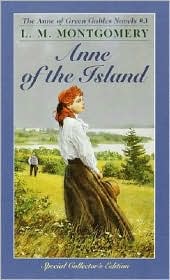
Anne of the Island


Montgomery, L.M. 1915. Anne of the Island.

"Harvest is ended and summer is gone," quoted Anne Shirley, gazing across the shorn fields dreamily.

I don't know if there are enough words to describe how I feel about Anne of the Island. It is one of the most magically, wonderful, giddy-making, purely-delightful, satisfying books I've ever read...and reread...and reread. Reading this book makes all the world seem right. (At least during the reading process.) It picks up shortly after where Anne of Avonlea leaves off. Anne Shirley and Gilbert Blythe are preparing to go off to Redmond college. (Along with Charlie Sloane and Priscilla Grant who you may or may not remember.) Diana Barry is engaged to Fred Wright. And there is a hint of love in the air.

This is the story of Anne's college years; it spans four years. The books focus on her friendships with Priscilla Grant, Philippa Gordon, and Stella Maynard, her roommates. And of course the book focuses on her romantic-and-not-so-romantic dealings with men. Many men propose to Anne during the course of the book including Billy Andrews--who sends his sister in his place--and Sam Toliver with his bumbling, "Will yeh heve me?" (Charlie Sloane, Gilbert Blythe, and Royal Gardner are others.)

There are many side stories in Anne of The Island. And while these little asides and tangents are not employed much in modern fiction, within the works of L.M. Montgomery, they are so thoroughly charming that they just work well. Really really well.

I loved this one. Loved the romance. Loved the characters. Loved everything.

Here's my favorite bit of the book:

There is a book of Revelation in every one's life, as there is in the Bible. Anne read hers that bitter night, as she kept her agonized vigil through the hours of storm and darkness. She loved Gilbert—had always loved him! She knew that now. She knew that she could no more cast him out of her life without agony than she could have cut off her right hand and cast it from her. And the knowledge had come too late—too late even for the bitter solace of being with him at the last. If she had not been so blind—so foolish—she would have had the right to go to him now. But he would never know that she loved him—he would go away from this life thinking that she did not care. Oh, the black years of emptiness stretching before her! She could not live through them—she could not! She cowered down by her window and wished, for the first time in her gay young life, that she could die, too. If Gilbert went away from her, without one word or sign or message, she could not live. Nothing was of any value without him. She belonged to him and he to her. In her hour of supreme agony she had no doubt of that. He did not love Christine Stuart—never had loved Christine Stuart. Oh, what a fool she had been not to realize what the bond was that had held her to Gilbert—to think that the flattered fancy she had felt for Roy Gardner had been love. And now she must pay for her folly as for a crime. (237)

© Becky Laney of Becky's Book Reviews

Wednesday, October 15, 2008

Travel the World: Canada: Anne of Avonlea


Montgomery, L.M. 1909. Anne of Avonlea.

Anne of Avonlea is the second book in the Anne series by L.M. Montgomery. Anne has graduated from Queens now, and is ready to begin her teaching career. She'll be teaching at the Avonlea school. She is still quite chummy with Diana Barry and Gilbert Blythe. And she is almost (but not quite) just as prone to getting into trouble as she ever was.

This second book adds some great characters: Mr. Harrison, the cranky neighbor with a parrot; Davy and Dora, the twins Marilla adopts; Paul Irving, the boy-from-the-States with a big imagination and a way with words; and Miss Lavendar, the "old" maid that has spent most of her years in seclusion but who is a true kindred spirit. And it has some great adventures or "incidents" that I love. Painting the debate hall that horrid shade of blue. Prophesying Uncle Abe's "big storm." The charming love story of Miss Lavendar and Mr. Irving...in which it is shown that it is never too late for one's Prince to return and for love to take hold.

I love Anne Shirley. I love her world. I love her friends. These books are just magical.

© Becky Laney of Becky's Book Reviews

Thursday, May 29, 2008

Series Challenge Season Two

Crazy Cozy Murders is hosting a second series challenge. It *officially* begins June 1rst, 2008. It ends November 30, 2008.

I'm going to try to make my goals very specific this go-round.

The Anne series:

1)
2)
3)
4)
5)
6)
7)
8)

The rest of the Chronicles of Narnia series (a continuation from round one of challenge)

1)
2)
3)

The rest of the Twilight series

1) Breaking Dawn by Stephenie Meyer

The Lord of the Rings

1)
2)
3)

© Becky Laney of Becky's Book Reviews

Series Challenge Wrap-up

Here are the series books I was able to get to. A few of the series I am still a few titles away from completing. But I still have every intention of getting to them this year...if all goes well.

C.S. Lewis:
The Lion, The Witch, and the Wardrobe
Prince Caspian
The Voyage of the Dawn Treader
The Silver Chair

Brandon Mull:
Fablehaven
Fablehaven: Rise of the Evening Star
Fablehaven: Grip of the Shadow Plague

Isaac Asimov:
Prelude to Foundation
Foundation
Foundation and Empire
Second Foundation
Foundation’s Edge
Foundation and Earth


Laura Ingalls Wilder:
Little House in the Big Woods;
Little House on the Prairie;
On the Banks of Plum Creek;
By the Shores of Silver Lake;
The Long Winter;
Little Town on the Prairie;
These Happy Golden Years;
The First Four Years.

Susan Beth Pfeffer
The Dead and Gone

Conor Kostick
Saga

Libba Bray:
Sweet Far Thing

Ruth Stiles Gannett:
My Father's Dragon
Elmer and the Dragon
Dragons of Blueland

Beverly Cleary:
Beezus and Ramona
Ramona the Pest
Ramona the Brave
Ramona and Her Father
Ramona and Her Mother
Ramona Quimby Age 8
Ramona Forever

Julia Quinn:

The Duke and I by Julia Quinn
The Viscount Who Loved Me by Julia Quinn
An Offer From A Gentleman by Julia Quinn
Romancing Mister Bridgerton by Julia Quinn
To Sir Phillip, With Love by Julia Quinn
When He Was Wicked by Julia Quinn

Rick Riordan
The Battle of the Labyrinth

Sisters Grimm: Magic and Other Misdemeanors by Michael Buckley
Sisters Grimm: Tales from the Hood by Michael Buckley

© Becky Laney of Becky's Book Reviews

Monday, April 14, 2008

Ramona Quimby, Age 8


Cleary, Beverly. 1981. Ramona Quimby, Age 8.

Ramona Quimby is eight years old and starting third grade. While in former years, Ramona was a pest--though she'd deny it to her dying day--she has in recent years began maturing, began becoming more thoughtful and responsible. That doesn't mean she doesn't slip up now and then, but it does mean she tries--really tries--to be a good girl. Ramona Quimby Age 8 is one of my favorites in the series. (Probably in the top three. Beezus and Ramona and Ramona the Pest being the top two though not necessarily in that order) Highlights in this one include Ramona taking a raw egg to school--thinking it's hard boiled of course--and throwing up her oatmeal in front of her entire class. It also includes the rather humorous adventures of Beezus and Ramona in the kitchen cooking dinner for their parents! The Quimbys are definitely quite good sports in eating "cornbread" made from cream of wheat and banana yogurt!

I love Ramona. And I love her family. The Quimbys are far from perfect, but they're so loving that you just gotta love them!

© Becky Laney of Becky's Book Reviews

Wednesday, April 09, 2008

Travel the World: England: Narnia: Prince Caspian


Lewis, C.S. Prince Caspian.

Prince Caspian, the second of the novels in the Chronicles of Narnia series, takes place one year after the close of The Lion, The Witch, and the Wardrobe. The four children, Peter, Susan, Edmund, and Lucy, are preparing to return to school when they're instantly, magically transported (or translated) to Narnia. What they find there shocks them. Shocks them for many reasons. You see, it hasn't been a year in Narnia time. It hasn't even been just a hundred years. Their castle, their lands, unrecognizable ruins. The adventures are about to begin. Again. Many surprises, many adventures await them, along with one old friend. A friend that takes a little more faith to recognize these days.

Prince Caspian centers on a new hero. Caspian. The son of Caspian the Ninth, king of Narnia. But it is Caspian's uncle, King Miraz, that rules the land, and rules it harshly. Gone are the days of talking animals and other fantastical creatures. No the "old Narnians" must hide if they are to survive at all. Caspian may have been raised by his aunt and uncle, but his upbringing was left to an old nurse who believed in the old ways. Now, Caspian is a young man who longs to restore the golden days of the past. Who longs to restore Narnia to its former glory. Who longs to create a peaceful age where old Narnians can live and live well. But he can't do it alone. What he needs is help. Divine help.

Can a horn of old bring much-needed help from afar?

I love Prince Caspian. I do. It is exciting. It is thrilling. Again, Lewis has created memorable characters and memorable scenes.

© Becky Laney of Becky's Book Reviews

Friday, March 28, 2008

The Lion, The Witch, and the Wardrobe


The Lion, The Witch, and The Wardrobe by C.S. Lewis

My review of C.S. Lewis' classic children's book The Lion, The Witch, and the Wardrobe is going to be chatty--quite chatty--and there's nothing I can do about it. I first encountered the magic of Narnia in fourth grade when my teacher read it aloud to us. My teacher, Mrs. Watts, was known for many things. She inspired much fear and trembling. Like Aslan, she was not tame, but good. While, other students may remember the discipline or the hard work...I'll always remember my magical introduction to Narnia. Soon after, I added book by book the series to my collection. Most of my copies were used. Most were ugly. But I devoured each one. I seem to remember my sister reading a few of the series at least.

But unlike Little House and Ramona and Anne, this series was more me and less her. Narnia belonged to me--the magic, the wonder, the glory of it all. I remember the pure pleasure I experienced each and every time I opened up a book. I remember the book covers, yes. And I definitely have strong opinions on which book covers through the years are 'the best' of the bunch. But more precisely, I fell in love with the proper order of the series. Few things irritate me more than someone who insists on that new-fangled order. Which is why, if you could see me, you'd know how frustrating it is to read my 7-in-1 novel. But some things must be preserved at all costs.

Once there were four children whose names were Peter, Susan, Edmund, and Lucy. This story is about something that happened to them when they were sent away from London during the war because of the air-raids. (p. 111 in the 7-in-1 edition)

The adventures in and out of the wardrobe that these four experience during the course of the novel are oh-so-magical. The characters--both major and minor--so memorable. The story, familiar yet resilient, even after having read it a dozen times. So many wonderful scenes. Scenes that resonate. In case you haven't read it, let me give you a teaser. Lucy, the youngest of the children, accidentally discovers a magical land of ice and snow while hiding in a wardrobe in the Professor's house. Her three siblings--Peter, Susan, and Edmund--at first don't believe her. They take her tale as a wild, silly, foolish story of a girl whose homesick and wanting attention. Edmund, the brother closest to her in age and thus her biggest tormentor, also wanders into Narnia unexpectedly. But who he meets there, will perhaps undo them all. Narnia is not a land at peace. Not at all. For the land is under a spell--an enchantment--the White Witch--the supposed Queen of the land--has made it always winter and never Christmas. And the lives of the children--all four children--are in grave danger when they're in Narnia. For there is a prophecy that four humans--two sons of Adam and two daughters of Eve--will come to rule the land as Kings and Queens and restore peace and order to the kingdom.

The heart and soul of The Lion, The Witch, and The Wardrobe is the revelation of Aslan, the King of the land, a lion.

And now a very curious thing happened. None of the children knew who Aslan was any more than you do; but the moment the Beaver had spoken these words everyone felt quite different. Perhaps it has sometimes happened to you in a dream that someone says something which you don't understand but in the dream it feels as if it has some enormous meaning--either a terrifying one which turns the whole dream into a nightmare or else a lovely meaning too lovely to put into words, which makes the dream so beautiful that you remember it all your life and are always wishing you could get into that dream again. It was like that now. At the name of Aslan each one of the children felt something jump in its inside. Edmund felt a sensation of mysterious horror. Peter felt suddenly brave and adventurous. Susan felt as if some delicious smell or some delightful strain of music had just floated by her. And Lucy got the feeling you have when you wake up in the morning and realize that it is the beginning of the holidays or the beginning of summer. (141 of 7-in-1 edition)

The children's journey to Narnia, their quest to meet Aslan at the Stone Table, and their battle to save Narnia and their brother from the grasp of the evil and wicked witch....are unforgettable adventures that deserve to be experienced again and again by readers of all ages. You're never too old to experience the magic of Narnia.

© Becky Laney of Becky's Book Reviews

Here's the super-trailer for the movie:

Saturday, March 22, 2008

To Sir Phillip, With Love


Quinn, Julia. 2003. To Sir Phillip, With Love.

To Sir Phillip, With Love is the fifth in the Bridgerton series, a historical romance series set in Regency England. To Sir Phillip, With Love, Romancing Mister Bridgerton, and When He Was Wicked are the three of the series that are most tightly woven together. The action of all three occur within the same few months of 1824.

During the ball scene (the big reveal) of Romancing Mister Bridgerton, Eloise Bridgerton was noticeably absent. There was a big reason. She used her sister and brother-in-law's party as her getaway. She, partly out of jealousy, has decided to do something a bit bold and a bit out of character. She's off to meet her pen pal, a widower with two kids. Their correspondence began the previous year when she wrote condolences upon his wife's death. The letters have given them both a bit of comfort, and on his suggestion, she is on her way to meet them. He wants to see if she'll suit him as a wife.

Phillip never expected Eloise to be attractive. He was expecting a spinster. An unattractive but intelligent companion. That is what he wanted. He definitely didn't expect to find someone so talkative, so opinionated, so set in her ways, so spunky.

But Eloise forgot one thing when making her journey. Okay, she forgot two things. She forgot to write him that she was coming so he hasn't a chaperone ready to receive her and supervise their courtship. But more importantly, she forgot that her family would be worried and quite frantic about her sudden disappearance. She forgot to count on her four brothers--three older, one younger--hunting her down in angry pursuit!!! Poor Phillip. I almost feel sorry for him!

Phillip's kids are another story. A set of 8 year old twins--one boy, one girl. And they're more than a handful. But if anyone can handle this situation, it is Eloise.

The book is enjoyable. The kids add something more to this historical romance novel. I've not read too many Regency romance novels where kids play a role--a big role--in the action.

372 pages.

Tuesday, March 18, 2008

Romancing Mister Bridgerton


Quinn, Julia. 2002. Romancing Mister Bridgerton.

Romancing Mister Bridgerton is my favorite and best. It is the fourth in a series of Regency romance novels by Julia Quinn focusing on the eight Bridgerton siblings: Anthony, Benedict, Colin, Daphne, Eloise, Francesca, Gregory, and Hyacinth. The fourth novel focuses on Colin Bridgerton. If you've read any of the previous novels you know that Colin is the favorite of many--both in and out of the family. His charm, his wit, his good nature make him quite the natural choice. (The other novels are The Duke and I, The Viscount Who Loved Me, and An Offer From a Gentleman. All feature glimpses of Colin.)

Penelope Featherington is not alone in her admiration of Colin Bridgerton. But she might be voted the least likely to marry a Bridgerton. In all honesty, she'd probably be voted least likely to marry anyone. Whether seventeen or twenty-eight, Penelope has always been Penelope. On the outside looking in, always waiting and watching and hoping all the while knowing that this spinsterhood is her destiny.

This is not our first introduction to Penelope. She has appeared in most of the other Bridgerton novels as well. (She has quite a memorable scene or two in An Offer From A Gentleman. And she played an important role in The Duke and I as well. I can't remember if she's got any lines in The Viscount Who Loved Me or not.)

Let me say now that this novel had me at hello.

On the sixth of April, in the year of 1812--precisely two days before her sixteenth birthday--Penelope Featherington fell in love.
It was, in a word, thrilling. The world shook. Her heart leaped. The moment was breathtaking. And, she was able to tell herself with some satisfaction, the man in question--one Colin Bridgerton--felt the same way.
Oh, not the love part. He certainly didn't fall in love with her in 1812, (and not in 1813, 1814, 1815, or--oh, blast, not in all the years 1816-1822, either, and certainly not in 1823, when he was out of the country the whole time anyway). But his earth shook, his heart leaped, and Penelope knew without a shadow of a doubt that his breath was taken away as well. For a good ten seconds.
Falling off a horse tended to do that to a man.

The book opens in 1824. Penelope has had plenty of years to dream and dream and dream about Colin from afar. As the best friend of Eloise, Penelope has long been a regular of the Bridgerton household. For teas. For visits. For parties and dances and balls. There's not a week that goes by where she hasn't spent several hours in the company of one or more Bridgertons. Colin does know she exists. He just doesn't see her in that way. He's not alone, no man thus far in her life has seen her in that way.

Besides being friends with the Bridgerton clan, Penelope has a rather chummy relationship with Lady Danbury, a woman in her seventies who's not afraid to speak her mind when she gets the notion. And lately Lady Danbury has been struck with the notion that Penelope is quite wonderful; unfortunately, not many people are aware of the fact of just how amazingly wonderful she is. But if Lady Danbury has her way, Penelope will soon have her day to shine.

It all starts with a dare, a bet. At a gathering (ball, party, dance), Lady Danbury startles everyone with a proclamation. Wouldn't it be fun to solve the riddle of who this Lady Whistledown really is? She offers a monetary reward. Solve the mystery and win the money. Lady Whistledown, for those unfamiliar with the novels or unfamiliar with my earlier reviews this week, writes a gossip or society column. Twice a week, the ton happily reads about themselves hoping to find praise and anxious to see who will be insulted.

The mystery is eventually solved and it might just keep you guessing for most of the novel.

I loved practically everything about this novel. The characters of Penelope and Colin are special favorites of mine.

Tuesday, March 04, 2008

Fablehaven: Grip of the Shadow Plague


Mull, Brandon. 2008. Fablehaven: Grip Of the Shadow Plague.

On a muggy August day, Seth hurried along a faint path, eyes scanning the lush foliage to his left. Tall, mossy trees overshadowed a verdant sea of bushes and ferns.

The third in the series, Fablehaven: Grip of the Shadow Plague continues the story of Kendra and Seth Sorenson, an unforgettable brother-sister team that (along with several 'responsible' adults including their grandparents) enjoys spending their summer vacations fighting in the ultimate battle between good and evil. If you haven't read the first two in the series, you should definitely do so. (That is if you love fantasy.) I enjoyed the first two. I really did. But this third one is even better--if that's possible. Every page was a pleasure. I didn't want to put it down.

For those that are familiar with the series, expect more of the same. But for those unfamiliar with Brandon Mull's fabulous series here's what you can expect. Adventure. More adventure. Danger. Action. Even more adventure. Some mystery. Some intrigue. Some surprises. If you love action, adventure, and mystery, then Fablehaven is definitely for you!

What's the third one about? Well the subtitle of "Grip of the Shadow Plague" says it all. Book 2 closes with the family securing--saving--Fablehaven, doesn't it? Does it? The traitor, Vanessa, has been captured and imprisoned in the Quiet Box. The Sphinx has taken away the other prisoner--the one who was released from the Quiet Box--and all seems to be well. But then if you remember Kendra discovers a note implying or suggesting that the Sphinx is not who he appears. That he is in fact the bad guy though he's been masquerading as one of the good guys--one of the top good guys--for decades and decades. The third book explores that claim and seeks to solve that mystery once and for all. But that doesn't even begin to capture what the third book is about. It is exciting. It is intense. It is good.

471 pages

Wednesday, February 06, 2008

These Happy Golden Years


Wilder, Laura Ingalls. 1943. These Happy Golden Years.

Sunday afternoon was clear, and the snow-covered prairie sparked in the sunshine. A little wind blew gently from the south, but it was so cold that the sled runners squeaked as they slid on the hard-packed snow. The horses' hoofs made a dull sound, clop, clop, clop. Pa did not say anything.

These Happy Golden Years begins directly after the close of Little Town On the Prairie. Laura is fifteen--a few weeks shy of her sixteenth birthday. She has been hired to teach school for two months. The school where she is to teach is for a community around twelve miles away. Pa is taking her to the place where she'll be boarding. She expects to stay there for eight weeks all on her own--homesick or not; miserable or not. The Brewsters--the family she stays with--are miserable company. Mrs. Brewster is one angry, potentially psycho woman. (I never could quite figure out why she's threatening her husband with a knife.) School is awful. She doesn't really like teaching at all. But the thing that keeps her going--the thing that surprises her week after week after week--is that Almanzo comes to take her home and back each and every weekend no matter how cold. These trips are often silent, but much appreciated.

But when the eight weeks are over, Laura is surprised that his courting--his wooing--continues. Rides in his sleigh. Rides in his buggy. He's an almost constant present every week.

It isn't just rides and courting, however. Laura is back in school, back with her friends, back with her family. Seasons come and go. Other teaching opportunities arise--which she accepts--none are ever as horrid as the first.

Without a doubt, my favorite gleeful, giddy-making chapter is "Barnum Walks."

"I was wondering..." Almanzo paused. Then he picked up Laura's hand that shone white in the starlight, and his sun-browned hand closed gently over it. He had never done that before. "Your hand is so small" he said. Another pause. Then quickly, "I was wondering if you would like an engagement ring."
"That would depend on who offered it to me," Laura told him.
"If I should?" Almanzo asked.
"Then it would depend on the ring." Laura answered and drew her hand away.


The next week...well, I don't want to spoil it. But I love it.

"It will have to be a little house. Do you mind?"
"I have always lived in little houses. I like them."
(214-215)

Anyway, it is a thoroughly enjoyable, perfect, perfect book.

289 pages

Tuesday, February 05, 2008

The Long Winter by Laura Ingalls Wilder


Wilder, Laura Ingalls. 1940. The Long Winter.

The mowing machine's whirring sounded cheerfully from the old buffalo wallow south of the claim shanty, where bluestem grass stood thick and tall and Pa was cutting it for hay.

This first chapter is called "Make Hay While the Sun Shines" and if it's found within a book called THE LONG WINTER, the reader knows what to expect even if the characters don't. The book opens with Ma and Pa and family getting ready for harvest and winter. Laura is helping out Pa. Mary and Carrie are helping out Ma. Laura is especially pleased that she's old enough (around 14 now) to help Pa and do outdoor chores.

The Ingalls family is living in their claim shanty. This would be the first fall/winter they've been there. And they know it will be tough, but when the first blizzard comes in October, they know that it wouldn't only be tough to survive but impossible to survive if they were to try to stay on their homestead. Fortunately, Pa owns property in town. A place where they can be nice and warm and cozy for the winter. Or so they think.

What no one could know is just how hard, how long, how tough this winter was going to be. Some folks are prepared--the Wilder boys for instance--but most are not. Most are relying on the train making regular stops in town. The trains are essential for stocking the stores of supplies. But when almost every day brings a blizzard--with clear days coming only one at a time and never on a predictable schedule--it soon becomes clear that the trains will not be saving the day. Not til spring. The town's survival, the Ingalls' family survival, is a big if at this point.

Cold. Hunger. Starvation. No supplies. What's not to love?

The Long Winter has always been one of my favorites of the Little House series. I'll admit it tends to make you cold and hungry. But that's not a bad thing, right? I didn't think so. Only two books can trick my mind and body--okay maybe three--into thinking it's cold and hungry. One, of course, is The Long Winter. The other two are by Susan Beth Pfeffer. I think one of the reasons I love The Long Winter is that it introduces Almanzo Wilder onto the scene. True, there was Farmer Boy if you didn't skip it like I have done. But this Almanzo is a man--a young man it's true--19 years of age. And he's acting "manly" alright when it's time to save the day. I love every scene Almanzo is in. Laura first meets him when she's lost and trying to find her Pa in the slough of hay. Here is the description: "His blue eyes twinkled down at her as if he had known her a long time." Anyway, I love this book.

334 pages.

Sunday, February 03, 2008

On the Banks of Plum Creek


Wilder, Laura Ingalls. 1937. On the Banks of Plum Creek.

The dim wagon track went no farther on the prairie, and Pa stopped the horses. When the wagon wheels stopped turning, Jack dropped down in the shade between them. His belly sank on the grass and his front legs stretched out. His nose fitted in the furry hollow. All of him rested, except his ears.

On The Bank of Plum Creek opens when the Ingalls family arrives at their new home. They have bought a place, and their first new "home" is a dugout. They are buying it from a Norwegian man, Mr. Hanson, who is moving further west I presume. This is just temporary. Charles (or "Pa" as he's referred to so often it's hard not to join in) has promised to build them a real house, a real home just as soon as he can. The book opens with promises and hopes and dreams. But most of the book will see those hopes and dreams delayed. What Pa needs--what they all need--are good crops, good wheat crops. What Pa gets is grasshoppers. The Ingalls family does struggle a bit in On The Banks of Plum Creek. But they do settle in and get comfortable. Mary and Laura, for instance, start school. It is the first time for them to ever attend school. And they do meet up with some town folks like Nellie Oleson.

Overall, this is a more than enjoyable read. Some of my favorite chapters are "Nellie Oleson," "Town Party," "Country Party," "Going to Church," and "Surprise."

It is 339 pages.

Thursday, January 31, 2008

Fablehaven: Rise of the Evening Star


Mull, Brandon. 2007. Fablehaven: The Rise of the Evening Star.

It has now been a year since Kendra and Seth have visited their grandfather and grandmother (whom we first met as a chicken) on their Fablehaven estate (or preserve to be a bit more accurate). Our narrative opens with Kendra anticipating the last week of school--her last week at a middle school. It's an unusual time for a school--a class--to receive a new student--with only one week to go--but only Kendra knows quite how strange it is. The new student? Not human. A monster. A monster with foul breath. When Kendra's unable to reach her grandfather, she decides to trust the man who claims to be sent at her grandfather's request. A man called Errol. Kendra and Seth thus end their school year with a bit of adventure and danger and mystery. Soon summer will be here. The summer may just hold another action-packed, adventure-filled, mystery-solving, danger-ridden, journey for the two as they visit their grandparents once more. Full of action, suspense, mystery, and adventure...this second book is even better than the first.

Sunday, January 27, 2008

Concluding the Foundation Series


Foundation's Edge by Isaac Asimov was originally the fourth in the Foundation series. The third novel, Second Foundation, was published in 1953. (The two stories that the novel consists of were published in 1948 and 1949.) Foundation's Edge was published in 1982. Unlike the previous Foundation novels, the remaining books in the series--Foundation's Edge, Foundation and Earth, Prelude to Foundation, Forward the Foundation--were written AS novels. Does it make a difference? You bet! A great BIG difference as far as I'm concerned. Why? The novels seem sloppier, wordier, and sleep-inducing. Okay, maybe they won't really PUT you right to sleep. But in a word. Boring. No pizazz. No magic. Few WOW moments. And a whole lot of asides and tangents. Unless sociology, philosophy, science--all hypothetical studies of the three of course--lessons fascinate you and keep you turning pages, you'll find these novels lack the concise power of the original trilogy.

Foundation's Edge is the story of two men really. Golan Trevize and Janov Pelorat. Golan Trevize is a Councilman on Terminus. Janov Pelorat is a historian, a scholar, on Terminus. Trevize is exiled by the Mayor because he voiced doubts about the Seldon Plan. He voiced doubts about psychohistory. He voiced concern that the Second Foundation was still out there and still out to get them. Janov Pelorat is forced into exile as well. Not because he did anything wrong, but because Trevize is thought to need a companion, an excuse, a reason to make the journey. Pelorat's hopes and dreams revolve for a time around finding the OLDEST planet, the planet of origin, the place thought of as Earth. Trevize isn't concerned about Earth. He wants to try to find the Second Foundation--if it exists at all--and wants to destroy it. But the two are forced to live together, work together, travel together. They spend most of this book, and most of the next, together on a small spaceship. (A spaceship for 4.)

These characters aren't the only ones doing the narrating, however. There are plenty of minor roles. Plenty of plot twists. Some members of the Second Foundation contribute a large part to the story. But the heart of this one is the ongoing quest by Pelorat and Trevize. Trevize for one reason or another goes along with this search for Earth, and their search leads them somewhat indirectly to the planet Gaia. Oh how tired I am of hearing about Gaia.

Gaia is perhaps a nicer concept of the Borg. It is a planet of "we" and not "I." The air, the soil, the plants, the animals, the humans, the excrements, the food, the walls, the beds, the clothes, everything IS Gaia. Bliss, the woman they meet, is Gaia. She is a part of the planet. Everything she sees, everything she hears, everything she knows, is part of Gaia. There is just one collective memory, one collective consciousness.

Gaia--Bliss--has been drawing--manipulating--Trevize and Pelorat to the planet. And they're not the only ones. Gaia wants to have a big SHOWDOWN with the Second Foundation, the First Foundation, and Gaia. They want Trevize to decide the fate of the universe. Which of the three--Foundation, Second Foundation, Gaia--he wants to see rule the universe for the rest of eternity. Talk about pressure.

S
P
O
I
L
E
R

For some reason or other--he chooses Gaia's concept of Galaxia. A concept that will turn the entire universe--the entire galaxy--into a super-organism. Every part of the universe--the planet, the air, the humans, the animals, the bacteria, the plants, the curtains, etc. into one collective consciousness. It is the loss of individualism. Every person, every animal, every insect, every blade of grass, every amoeba will be Galaxia. He's told that it will be a time-consuming process that will take several hundred years--probably five or six hundred years. So he chooses it with the thought that he can always unchoose it. But is that really true?

Foundation and Earth picks up right where Foundation's Edge ended. Essentially. But there is some inconsistency between Foundation's Edge and Second Foundation. I don't know how many readers notice this or how many readers care. I don't know if Asimov did this intentionally. But early in Foundation's Edge, one of the main characters, Janov Pelorat, is forced by the Mayor of Terminus into exile alongside Golan Trevize. They make a point of mentioning that Pelorat is leaving behind his wife. Not only is she just his wife--she's his pregnant wife. They refer to her only a handful of times, but apparently, by the end of the novel Pelorat has completely forgotten about his wife. Completely. Forgotten he was married. Forgotten that he was going to be a father. In the last chapter or so, he takes up with a new woman of sorts, Bliss, and for the rest of Foundation's Edge and all of Foundation and Earth not another word is spoken about Pelorat's poor, pregnant, abandoned wife back on Terminus. I believe at one point Bliss even asks if Pelorat is married and he says that he hasn't been married for years. A blatant lie on his part OR a forgetful Asimov at work.

Foundation and Earth is the story of Pelorat, Bliss, and Trevize. These three are out exploring the galaxy doing everything in their power to find Earth. Trevize is convinced that Earth holds all the answers, all the secrets of the universe. It's a quest he's willing to risk his life--and the lives of his friends--time after time after time. They visit a handful of planets. Each one scarier--either physically or psychologically--than the one that came before. Some are truly horrifying places. And of course at the MOST horrifying one of all they pick up a passenger. Travize doesn't want to. He fights it then and almost every chapter after that. But it does no good. No one will listen to him. The passenger is a young child. A child that they were told would be killed. But by saving this child, did they doom the universe?

I'm not going to have any more spoilers. These four and their quest to find Earth....and what they found and what they did....well, you'll just have to read for yourself.

These two had their brief moments of glory where the writing was good and the plot twists intriguing. However, for the most part, they lacked a lot in storytelling power. I think Asimov's problem with these novels is that sometime between 1953 and 1982, he decided, he determined that the world of Foundation had to be combined with the world he created in his Robot series. I haven't read the Robot series myself. But if these latter novels are any indication, I don't know that I want too. Perhaps, the earlier Robot novels are good. Perhaps not. Maybe fans of the Robot series were let down by these latter books too. Maybe they wish Foundation and Robots had not been combined. Who knows. I only know that Foundation's Edge and Foundation and Earth had way too many awkward conversations about humans and robots having sexual relationships.

Here is how the series is supposedly supposed to go these days.

The Complete Robot (collection of short stories)
The Caves of Steel (1954)
The Naked Sun (1957)
The Robots of Dawn (1983)
Robots and Empire (1985)
The Stars, Like Dust (1951)
The Currents of Space (1952)
Pebble in the Sky (1950)
Prelude to Foundation (1988)
Forward the Foundation (1993)
Foundation (1951)
Foundation and Empire (1952)
Second Foundation (1953)
Foundation's Edge (1982)
Foundation and Earth (1986)