Showing posts with label Travel the World. Show all posts

Wednesday, October 07, 2009

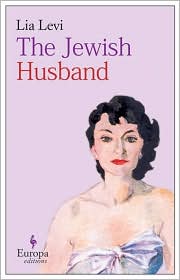
The Jewish Husband


Levi, Lia. The Jewish Husband. 209 pages. (Originally published in Italy in 2001 as L'Albergo della Magnolia. Translated into English by Antony Shugaar. Published in 2009.)

Tonight, unexpectedly, I've decided to write to you. I probably won't mail it. At least not for now. But if I can bring myself to begin, I know I'll keep writing you, and for a long time. Maybe you'll read this all in one piece; perhaps these words will never reach you. Fate will determine that, or I will, if I decide to ask fate to lend me some of its power for a little while.
There was a war here. I imagine you know about it.


Who is our narrator? Who is he writing? I'll gladly answer the first one. But I hope to leave you guessing on the second! Our narrator is a young professor, Dino Carpi, his parents own a great little hotel, the Albergo della Magnolia, in fact, the family lives there. True, his childhood may not have been that typical. With hotel guests coming in and out all the time. Perhaps he's a bit more bookish than he might have been otherwise. But, all things considered, things are good. Then he meets Sonia. And wow. He's in love. Oh, he's in love. He finds himself changing--and fast--just to please her, to please her family. His parents and friends aren't all that happy with this new Dino, but, whatever makes him happy, right? The problem? He's Jewish. She's Catholic. It's Italy. In the 1930s. Mussolini rules. And he's getting chummier and chummier with Adolf Hitler. Will Hitler's master plans for the Jewish race become the new policy in fascist Italy? Can love survive these odds? Will Dino have his happily ever after?

I liked it. It was a compelling story. Well-written. I found this narrative approach interesting, his letters kept me hooked. Especially trying to figure out where the story was going...and who he was sharing his heart with. The details are intimate, in a way, but in a way that's raw and honest. (By intimate, I mean personal. Not sexual. Though there is some of that.) I didn't think the emotions were ever over-the-top. I didn't feel manipulated. Or cheated. Dino was not a political man. He was not an activist. (Though some of his friends were.) But he didn't need to be in order for his story to matter to me. This was his story of how the war interfered with his life, his marriage. A boy meets girl story with obstacles on a larger scale.

This one won the Moravia Prize for fiction.

Other reviews: Bookslut, The Front Table, Jew Wishes,

© Becky Laney of Becky's Book Reviews

Wednesday, September 09, 2009

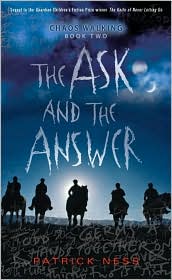
The Ask and The Answer (YA, Adult)


Ness, Patrick. 2009. The Ask and the Answer. Candlewick Press. 519 pages. (Releases September 2009).

"Your noise reveals you, Todd Hewitt."
A voice--
In the darkness--
I blink open my eyes. Everything is shadows and blur and it feels like the world's spinning and my blood is too hot and my brain is clogged and I can't think and it's dark--
I blink again.
Wait--
No, wait---
Just now, just now we were in the square--
Just now she was in my arms--
She was dying in my arms--
"Where is she?" I spit into the dark, tasting blood, my voice croaking, my Noise rising like a sudden hurricane, high and red and furious. "Where is she?"
"I will be the one doing the asking here, Todd."
That voice.
His voice.
Somewhere in the dark.
Somewhere behind me, somewhere unseen.
Mayor Prentiss. (3-4)

The Ask and The Answer is the sequel to Patrick Ness's Knife of Never Letting Go. I don't know how to review this second book in the series without potentially spoiling the first one for readers. So if you plan to read the first book, then you might want to skip this one...(at least the plot summary)... for now. BUT before you go, I'd just like to say that you should read both books because this series isn't to be missed. IF you like science fiction, OR if you like dystopias, OR if you like wonderfully amazing oh-so-thrilling suspense novels. But don't assume that this one is so plot-driven (action, action, more action) that the characterization suffers. Far from it.

My attempt at plot summary. (Don't worry, the plot summary only covers the first few chapters.)

The first novel ended in a cliffhanger, a big cliffhanger. (One that frustrated me to no end and left me bitter.) The second one picks up soon after. Todd and Viola have been separated. And each fear the worst for the other. (Todd is panic stricken at the thought that Viola could be dead...or could be being held captive and being tortured. Viola fears the same. What has happened to Todd? Is he alive? Is he being tortured?) The two arrived in Haven--the place they thought offered some hope and relief--only to discover that Mayor Prentiss beat them there. Mayor Ledger, or should I make that the former mayor, decided to surrender the town to Prentiss--the rumors of Prentiss' army being way too much for him to handle. (Not everyone in the town agrees with this decision. There are some that are plenty angry that they didn't get a chance to fight, to defend themselves. There are some that want war.) Now Todd finds himself held captive by President Prentiss (Yes, he promoted himself!). And Viola finds herself in the care of one of the city's healing houses. (The healing houses are run by women, by healers. Remember, the men can't hear the thoughts of the women.) President Prentiss is putting on quite a show. But is his "I only want peace" routine for real? What do you think? There are some who are not buying it. Not for a minute. But the more important question may be can Prentiss convince Todd and Viola? Can he turn either one of them (or both of them) to his side?

My reflections on the novel...

What did I love about this one? Where to begin?! I loved the characters. Let's start there.

I loved that this one was narrated by both Viola and Todd. While Todd was more than okay as a narrator, I really appreciated Viola. It helped me get to know her better, of course, and this story couldn't have been told half as well as it was without this additional perspective. One person could have never told this story.

I loved the fact that both Viola and Todd are flawed. Wonderfully, perfectly flawed. As in they're so completely fallible and messed up that you can't help but love them all the more because of it.

Minor characters that are anything but minor. There is not a single character in this one that isn't developed. Okay, maybe we don't spend equal amounts of time with each of them. But nonetheless you get the idea that each one is real, that each one is living their own life outside the pages of the novel. (If that makes any sense.) Each one has their own story, their own journey. We don't get the complete story--that would be impossible. What this means for the reader is that instead of having one or two characters you care about, you come to care for a lot of them. And some of these are characters that you might feel--heading into it--that you shouldn't. Each character is so interesting, so fascinating, so human that you want more. Want more not because what is there is lacking--far from it--but because what you do have is so good.

The writing. It's impossible to do justice here. How many ways can I say that Ness amazed and wowed me? Seriously! What was awesome? He has a way with words. There were scenes and passages that just wowed me. Wowed me in different ways. I'd be reading along and find a passage and just have to stop myself to go back and reread. I'd think, "This is what reading is supposed to be like!" I can already tell you that I want to reread the whole thing again. Just to catch all those little things that I might have missed the first time round. I want to spend more time with this one.

The pacing. He knows how to build suspense that's for sure. And he knows how to properly do twists and turns. And he knows how to craft everything just right so that it all fits together amazingly well. There's "action and suspense", and then there's action and suspense. (This one doesn't play around like so many others.)

The complexity. The plot. The characters. The timing. Everything is so very complex. Not in an overwhelming this-is-so-over-my-head way, not in an I-need-to-go-get-the-dictionary-way but in a wow, I didn't know it was even possible for writers to be so brilliant way. It's a smart book. You know how some books are like, "I'm literary look at me." This isn't that type of book. It's literary--don't question that--but it's not stuck on itself. It has all the entertainment value you'd expect. (Probably more than you'd expect if you're a skeptic like me.) But it's got substance and value.

Other reviews: (Spoiler-free) Nymeth, Kids Lit, The Bookbag, Spoilers-beware Persnickety Snark, Strange Horizons, Karin's Book Nook, YAreads.com, Oops...Wrong Cookie,

© Becky Laney of Becky's Book Reviews

Thursday, July 16, 2009

The Grand Sophy


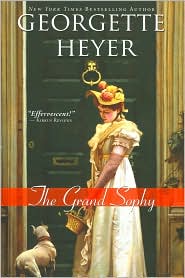
Heyer, Georgette. 1950/2009. The Grand Sophy. SourceBooks. 372 pages.

Why couldn't Emma be more like Sophy? When Sophy Stanton-Lucy comes to visit her cousins (and stay with her aunt and uncle), she brings something vitally refreshing to the household. Charles Rivenhall, the 'man' of the household in a way, since he is the one holding the purse strings, is engaged to be married to a prim-and-proper (and-sometimes-meddling) young lady, Eugenia Wraxton. Cecelia Rivenhall is in love with a poet, Augustus Fawnhope. But her parents--and her brother--would much prefer her to marry Lord Charlbury. Unfortunately right after he spoke with her father but before he could present himself to the lady, he came down with the mumps. While he was out of the picture, Mr. Fawnhope stepped in speaking words of love and admiration. It is up to Sophy to puzzle out the ins and outs of this family and play matchmaker extraordinaire. Throw in a couple of her own suitors buzzing around the place--quite a few eccentrics I might add particularly Lord Bromford--and we've got the makings of a great romantic comedy. Sophy is a firecracker of a heroine with a mind of her own and the gumption to say and do what she pleases. But she also has a big heart. Her good intentions sometimes lead her to make 'poor' choices, but Sophy is strong enough and resourceful enough to take care of herself. A fact that just infuriates her cousin Charles.

Jane Austen's Emma may be a matchmaker like Sophy. But poor Emma is hopelessly stupid and selfish in comparison. The joke is always on Emma, everything is funny and charming in a way--but it is at her expense. Sophy is a delightful heroine. Sophy is far from selfish. She's always thinking of others. Wanting others to be happy--to get their happily ever afters. And she's observant as well. I loved Sophy. I did.

This is a fun little novel that I'm happy to recommend.

© Becky Laney of Becky's Book Reviews

Wednesday, July 15, 2009

Three Men on the Bummel

Jerome, Jerome K. 1900. Three Men On the Bummel. 168 pages.

J, George, and Harris are back. The stars of Three Men In A Boat return for a second adventure. This time round they're not boating. No, these three good friends are biking--biking round Germany. This travel-book (that is anything but a 'travel' book) is much too fun to be missed.

Two of the three gentlemen are married. And at first, there is some concern over how to convince their wives that this trip is a good idea. Why these men should leave their wives (and children) behind to go away together. But to their surprise--almost dismay--the wives seem a bit eager for their husbands to go. So the preparations begin. And that's where the fun starts.

How does this one compare with the first? I don't know how to answer that fairly. I loved, loved, loved the first one. And I really loved the second one as well. There is one place in this second book that had me laughing out loud for a good five or ten minutes. I don't know that ANY book has ever had me laughing so hard and so long. It was enjoyable. It was charming.

About bicycle seats:
There may be a better land where bicycle saddles are made out of rainbow, stuffed with cloud; in this world the simplest thing is to get used to something hard. (199)

About "helpful" travel books:

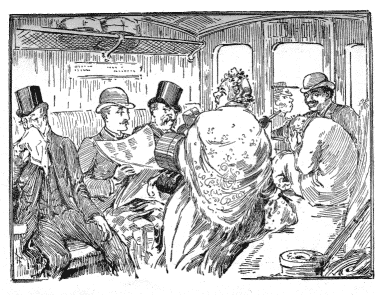
He handed me a small book bound in red cloth. It was a guide to English conversation for the use of German travellers. It commenced “On a Steam-boat,” and terminated “At the Doctor’s”; its longest chapter being devoted to conversation in a railway carriage, among, apparently, a compartment load of quarrelsome and ill-mannered lunatics: “Can you not get further away from me, sir?”—“It is impossible, madam; my neighbour, here, is very stout”—“Shall we not endeavour to arrange our legs?”—“Please have the goodness to keep your elbows down”—“Pray do not inconvenience yourself, madam, if my shoulder is of any accommodation to you,” whether intended to be said sarcastically or not, there was nothing to indicate—“I really must request you to move a little, madam, I can hardly breathe,” the author’s idea being, presumably, that by this time the whole party was mixed up together on the floor. The chapter concluded with the phrase, “Here we are at our destination, God be thanked! (Gott sei dank!)” a pious exclamation, which under the circumstances must have taken the form of a chorus.

At the end of the book was an appendix, giving the German traveller hints concerning the preservation of his health and comfort during his sojourn in English towns, chief among such hints being advice to him to always travel with a supply of disinfectant powder, to always lock his bedroom door at night, and to always carefully count his small change.

“It is not a brilliant publication,” I remarked, handing the book back to George; “it is not a book that personally I would recommend to any German about to visit England; I think it would get him disliked. But I have read books published in London for the use of English travellers abroad every whit as foolish. Some educated idiot, misunderstanding seven languages, would appear to go about writing these books for the misinformation and false guidance of modern Europe.”

“You cannot deny,” said George, “that these books are in large request. They are bought by the thousand, I know. In every town in Europe there must be people going about talking this sort of thing.”

“Maybe,” I replied; “but fortunately nobody understands them. I have noticed, myself, men standing on railway platforms and at street corners reading aloud from such books. Nobody knows what language they are speaking; nobody has the slightest knowledge of what they are saying. This is, perhaps, as well; were they understood they would probably be assaulted.”

George said: “Maybe you are right; my idea is to see what would happen if they were understood. My proposal is to get to London early on Wednesday morning, and spend an hour or two going about and shopping with the aid of this book. There are one or two little things I want—a hat and a pair of bedroom slippers, among other articles. Our boat does not leave Tilbury till twelve, and that just gives us time. I want to try this sort of talk where I can properly judge of its effect. I want to see how the foreigner feels when he is talked to in this way.”

It struck me as a sporting idea. In my enthusiasm I offered to accompany him, and wait outside the shop. I said I thought that Harris would like to be in it, too—or rather outside.

George said that was not quite his scheme. His proposal was that Harris and I should accompany him into the shop. With Harris, who looks formidable, to support him, and myself at the door to call the police if necessary, he said he was willing to adventure the thing.

We walked round to Harris’s, and put the proposal before him. He examined the book, especially the chapters dealing with the purchase of shoes and hats. He said:

“If George talks to any bootmaker or any hatter the things that are put down here, it is not support he will want; it is carrying to the hospital that he will need.”

That made George angry.

“You talk,” said George, “as though I were a foolhardy boy without any sense. I shall select from the more polite and less irritating speeches; the grosser insults I shall avoid.”

This being clearly understood, Harris gave in his adhesion; and our start was fixed for early Wednesday morning. (207-209)

About the teaching of French to English school children:

For they have a way of teaching languages in Germany that is not our way, and the consequence is that when the German youth or maiden leaves the gymnasium or high school at fifteen, “it” (as in Germany one conveniently may say) can understand and speak the tongue it has been learning. In England we have a method that for obtaining the least possible result at the greatest possible expenditure of time and money is perhaps unequalled. An English boy who has been through a good middle-class school in England can talk to a Frenchman, slowly and with difficulty, about female gardeners and aunts; conversation which, to a man possessed perhaps of neither, is liable to pall. Possibly, if he be a bright exception, he may be able to tell the time, or make a few guarded observations concerning the weather. No doubt he could repeat a goodly number of irregular verbs by heart; only, as a matter of fact, few foreigners care to listen to their own irregular verbs, recited by young Englishmen. Likewise he might be able to remember a choice selection of grotesquely involved French idioms, such as no modern Frenchman has ever heard or understands when he does hear.

...

I confine my remarks to French, because that is the only language we attempt to teach our youth. An English boy who could speak German would be looked down upon as unpatriotic. Why we waste time in teaching even French according to this method I have never been able to understand. A perfect unacquaintance with a language is respectable. But putting aside comic journalists and lady novelists, for whom it is a business necessity, this smattering of French which we are so proud to possess only serves to render us ridiculous. (240, 242)


© Becky Laney of Becky's Book Reviews

Thursday, July 09, 2009

Three Men in A Boat


Jerome, Jerome K. 1889. Three Men In A Boat.

If laughter really is the best medicine, then have I got the prescription for you! Read some Jerome K. Jerome. Start with Three Men In A Boat. You might think since it was published so long ago that it would be dry and stuffy. You don't really--or at least I usually don't--think of classics as being laugh-out-loud funny. But give Three Men a try. Get to know J (our narrator) and his friends George and Harris. And let's not forget the dog, Montmorency. These friends are going on a trip--and you're invited. They're going boating on the Thames.

"THERE were four of us - George, and William Samuel Harris, and myself, and Montmorency. We were sitting in my room, smoking, and talking about how bad we were - bad from a medical point of view I mean, of course."

J, our narrator, is an interesting fellow. One that I adored. (You may come to love him too!)

The book is entertaining. It is a 'travel book' that more often than not is stories, jokes and pranks more than actually seeing the sights. J relates this 'current' trip with his two friends but he also shares with readers humorous stories, little asides, about anything and everything. One of my favorite stories is the one about stinky cheese:
Cheese, like oil, makes too much of itself. It wants the whole boat to itself. It goes through the hamper, and gives a cheesy flavour to everything else there. You can't tell whether you are eating apple-pie or German sausage, or strawberries and cream. It all seems cheese. There is too much odour about cheese.

I remember a friend of mine, buying a couple of cheeses at Liverpool. Splendid cheeses they were, ripe and mellow, and with a two hundred horse-power scent about them that might have been warranted to carry three miles, and knock a man over at two hundred yards. I was in Liverpool at the time, and my friend said that if I didn't mind he would get me to take them back with me to London, as he should not be coming up for a day or two himself, and he did not think the cheeses ought to be kept much longer.

"Oh, with pleasure, dear boy," I replied, "with pleasure."

I called for the cheeses, and took them away in a cab. It was a ramshackle affair, dragged along by a knock-kneed, broken-winded somnambulist, which his owner, in a moment of enthusiasm, during conversation, referred to as a horse. I put the cheeses on the top, and we started off at a shamble that would have done credit to the swiftest steam-roller ever built, and all went merry as a funeral bell, until we turned the corner. There, the wind carried a whiff from the cheeses full on to our steed. It woke him up, and, with a snort of terror, he dashed off at three miles an hour. The wind still blew in his direction, and before we reached the end of the street he was laying himself out at the rate of nearly four miles an hour, leaving the cripples and stout old ladies simply nowhere.

It took two porters as well as the driver to hold him in at the station; and I do not think they would have done it, even then, had not one of the men had the presence of mind to put a handkerchief over his nose, and to light a bit of brown paper.

I took my ticket, and marched proudly up the platform, with my cheeses, the people falling back respectfully on either side. The train was crowded, and I had to get into a carriage where there were already seven other people. One crusty old gentleman objected, but I got in, notwithstanding; and, putting my cheeses upon the rack, squeezed down with a pleasant smile, and said it was a warm day.

A few moments passed, and then the old gentleman began to fidget.

"Very close in here," he said.

"Quite oppressive," said the man next him.

And then they both began sniffing, and, at the third sniff, they caught it right on the chest, and rose up without another word and went out. And then a stout lady got up, and said it was disgraceful that a respectable married woman should be harried about in this way, and gathered up a bag and eight parcels and went. The remaining four passengers sat on for a while, until a solemn-looking man in the corner, who, from his dress and general appearance, seemed to belong to the undertaker class, said it put him in mind of dead baby; and the other three passengers tried to get out of the door at the same time, and hurt themselves.

I smiled at the black gentleman, and said I thought we were going to have the carriage to ourselves; and he laughed pleasantly, and said that some people made such a fuss over a little thing. But even he grew strangely depressed after we had started, and so, when we reached Crewe, I asked him to come and have a drink. He accepted, and we forced our way into the buffet, where we yelled, and stamped, and waved our umbrellas for a quarter of an hour; and then a young lady came, and asked us if we wanted anything.

"What's yours?" I said, turning to my friend.

"I'll have half-a-crown's worth of brandy, neat, if you please, miss," he responded.

And he went off quietly after he had drunk it and got into another carriage, which I thought mean.

From Crewe I had the compartment to myself, though the train was crowded. As we drew up at the different stations, the people, seeing my empty carriage, would rush for it. "Here y' are, Maria; come along, plenty of room." "All right, Tom; we'll get in here," they would shout. And they would run along, carrying heavy bags, and fight round the door to get in first. And one would open the door and mount the steps, and stagger back into the arms of the man behind him; and they would all come and have a sniff, and then droop off and squeeze into other carriages, or pay the difference and go first.

From Euston, I took the cheeses down to my friend's house. When his wife came into the room she smelt round for an instant. Then she said:

"What is it? Tell me the worst."

I said:

"It's cheeses. Tom bought them in Liverpool, and asked me to bring them up with me."

And I added that I hoped she understood that it had nothing to do with me; and she said that she was sure of that, but that she would speak to Tom about it when he came back.

My friend was detained in Liverpool longer than he expected; and, three days later, as he hadn't returned home, his wife called on me. She said:

"What did Tom say about those cheeses?"

I replied that he had directed they were to be kept in a moist place, and that nobody was to touch them.

She said:

"Nobody's likely to touch them. Had he smelt them?"

I thought he had, and added that he seemed greatly attached to them.

"You think he would be upset," she queried, "if I gave a man a sovereign to take them away and bury them?"

I answered that I thought he would never smile again.

An idea struck her. She said:

"Do you mind keeping them for him? Let me send them round to you."

"Madam," I replied, "for myself I like the smell of cheese, and the journey the other day with them from Liverpool I shall ever look back upon as a happy ending to a pleasant holiday. But, in this world, we must consider others. The lady under whose roof I have the honour of residing is a widow, and, for all I know, possibly an orphan too. She has a strong, I may say an eloquent, objection to being what she terms 'put upon.' The presence of your husband's cheeses in her house she would, I instinctively feel, regard as a 'put upon'; and it shall never be said that I put upon the widow and the orphan."

"Very well, then," said my friend's wife, rising, "all I have to say is, that I shall take the children and go to an hotel until those cheeses are eaten. I decline to live any longer in the same house with them."

She kept her word, leaving the place in charge of the charwoman, who, when asked if she could stand the smell, replied, "What smell?" and who, when taken close to the cheeses and told to sniff hard, said she could detect a faint odour of melons. It was argued from this that little injury could result to the woman from the atmosphere, and she was left.

The hotel bill came to fifteen guineas; and my friend, after reckoning everything up, found that the cheeses had cost him eight-and-sixpence a pound. He said he dearly loved a bit of cheese, but it was beyond his means; so he determined to get rid of them. He threw them into the canal; but had to fish them out again, as the bargemen complained. They said it made them feel quite faint. And, after that, he took them one dark night and left them in the parish mortuary. But the coroner discovered them, and made a fearful fuss.

He said it was a plot to deprive him of his living by waking up the corpses.

My friend got rid of them, at last, by taking them down to a sea-side town, and burying them on the beach. It gained the place quite a reputation. Visitors said they had never noticed before how strong the air was, and weak-chested and consumptive people used to throng there for years afterwards.
I also enjoyed the story about Harris singing comic songs. And the bit about the tin can of pineapples was great.

Have you read this one? Do you have a favorite scene or story?


© Becky Laney of Becky's Book Reviews

Wednesday, June 17, 2009

Middlemarch


Eliot, George. 1871/1872. Middlemarch. 791 pages.

Miss Brooke had that kind of beauty which seems to be thrown into relief by poor dress.

Who is George Eliot? Mary Ann Evans, a woman writer in the nineteenth century who published many novels including Middlemarch, Silas Marner, Adam Bede, and A Mill on the Floss. Middlemarch is a long novel, quite a chunkster, and it does require commitment from the reader. It's a complex novel with many characters and many story lines. There isn't necessarily one story line that outshines all the others. I think how readers explain what it's all about has more to do with them than with the book in a way. If you're looking for a romance, you'll find the makings of it in Middlemarch, but it is so much more than a romance. If you're looking only for romance, you'll probably find it a bit boring. It addresses the complexities of the time in which it is set--the 1830s--we've got politics, economics, and society--especially society. To sum it up, Middlemarch is a novel about characters who have made really foolish choices and are having to learn to deal with them. Some adapt and change with grace and dignity. Others don't. Other's won't. Some let the weight of their mistakes drag them down. Of course, that doesn't quite describe all the book or all the characters.

Dorothea Brooke makes a big mistake in marrying a much older man, an incompetent scholar, Edward Casaubon, who transforms into a cruel, controlling, jealous man.

Fred Vincy makes a big mistake when he can't pay his debts. He convinces Caleb Garth, the father of the woman he loves, Mary Garth, to agree to pay his debts if and only he can't come up with the funds. Of course, his intentions are that the Garths won't be stuck paying off his debts. But well, you know what they say about good intentions...

Tertius Lydgate makes a big mistake when he marries Rosamond Vincy, a vain, shallow woman who's selfish to the core. I don't know if her selfishness can compete with let's say Scarlett O'Hara, but she's a horrible wife for this doctor!

Will Ladislaw makes a big mistake when he falls in love with Dorothea (she's married to his cousin)...and yet because he can't have the woman he loves...decides to fall into a flirtatious affair with Rosamond Vincy (another married woman).

And then there is poor old Nicholas Bulstrode. But that's a whole other story.

My good friend, Anonymous L, asks, "What did you think about the last lines of Middlemarch?"

I liked the bit about "the growing good of the world is partly dependent on unhistoric acts; and that things are not so ill with you and me as they might have been, is half owing to the number who lived faithfully a hidden life, and rest in unvisited tombs." I think it is very true.

Sandra asks, "Did you enjoy it? Is Middlemarch worth my time or is it just another book about women and romance?"

Yes and no. Don't let the 'and no' scare off potential readers. I thought the text bogged down here and there. It's hard for all readers to find all story lines of equal interest. And there were some chapters that bogged down (for me) in politics. Some characters had back stories that were complex and detailed. And not every chapter furthered the plot, in my opinion. That being said, there were moments where it was pure fun to be reading this book. Some of the best characters, in my opinion, were the minor characters. I liked Mrs. Cadwallader, Celia Brooke, and all of the Garths. And I rather liked Mr. Farebrother.

This isn't strictly speaking a romance though people do fall in love. It's more about what comes after. What happens after the wooing is over. What happens when the people you profess you love, disappoint you. What happens when you're sick and tired of being married and tied down.

It's a novel about expectations (ideals) and reality. And how reality has a way of slapping you in the face.

It's a novel that focuses just as much on men as it does in women.
Rebecca asks, "Is it worth the time and energy? What kinds of readers would be most likely to enjoy it?"

I think it depends on your timing. I think this one can be absorbing and draw readers in. And I think it can be intimidating in parts as well. I'm glad I read it. I liked parts of it. But I didn't like every part of it. I think patient readers will enjoy it. I think folks who are more into character-focused novels will enjoy it. It's a slower-paced novel. I think folks who already have an interest in classics would be more likely to enjoy it.

Eva asks, "Do you enjoy that device [of authors making interjections and asides to the reader] in novels...or does it snap you out of the narrative?"

I like it in certain novels. I think it can add a lot to some books. I didn't notice it as much in Eliot as I have in other novels I've been reading lately. (Though many of the lines I underlined were like this.) But I am love, love, loving it in my Anthony Trollope novels!

Jodie asks, "Is Middlemarch the first book by Eliot that you have read? How were the female characters in the book portrayed?"

I've also read and reviewed Silas Marner. I hope to read more of Eliot in the upcoming years. As for how female characters were portrayed, I think there were diverse representations: all classes of women (lower, middle, upper). I hate to use the word 'types' but for lack of a better one...there were maternal types, pure-and-true-and-faithful types, understanding stand-by-my-man types, gossip-loving types, romantic and idealistic types, mean and spiteful types, shallow, vain, and selfish types. Some of the women characters were intelligent conversationalists, and others were more in the shadows of their husbands. Some women wanted to wear the pants in the family, others not so much. No doubt they'll be some characters you dislike. But you'll probably find some characters to like as well.

© Becky Laney of Becky's Book Reviews

Wednesday, June 10, 2009

Travel the World: Canada: Emily's Quest (YA, Adult)


Montgomery, L.M. 1927. Emily's Quest. Bantam Books. 228 pages.

"No more cambric tea" had Emily Byrd Starr written in her diary when she had come to New Moon from Shrewsbury, with her high school days behind her and immortality before her.

Emily's Quest is the third and final book in the Emily series by L.M. Montgomery. (My review of Emily of New Moon and Emily Climbs.) And as perhaps fitting, Emily's Quest has a different feel than the first two books. Through the course of Emily's Quest, we see her grow-up completely--from recent high school graduate to mid-twenty-something. It's more sorrowful, more serious, more grown-up. From the bittersweetness of her opening a letter from her 14-year-old self on her twenty-fourth birthday, to her on-again-off-again depression and melancholy. Emily isn't as happy-go-lucky as Anne. One doesn't get the sense that every day is a good day. While Anne may have had her Jonah-days, it seems Emily has months of them. It makes Emily easy to relate to in more than a few ways. Here's someone who is thoroughly human.

Emily's Quest isn't so much about anything in particular as it is about relationships: comings and goings, gains and losses. At the start, we have Emily wishing and hoping that Teddy will tell her he loves her, show her he loves her. When he doesn't, at least not in so many words, then she's disappointed. But her Murray pride keeps her going. If Teddy isn't the one, perhaps then her special someone is still out there somewhere. There are men that come and go in her life certainly. And then there's Dean. The one guy that I hate-to-love and love-to-hate. A middle-aged man who has had his eye on her since she was a young thing--early teens maybe? He's always known that he can't have her. That she's too young for him. That their friendship would be something she'd likely grow out of as she grew up and fell in love. But when Teddy disappoints and an traumatic accident (or two) occurs leading to a very quiet, very still winter where it's just the two of them getting all cozy, then Emily tells him that though she doesn't love him, love him, she'd like to marry him. So they start making plans for the "Disappointed House" which is the house of her dreams.

There are many reasons why her marriage to Dean would be wrong. Many. But one of them is how her relationship to him prohibits her from being herself. Dean has never liked her writing. Always discouraged her. Always told her she couldn't or shouldn't write. But can Emily be Emily without it? If Dean really loves her, shouldn't he love all of her? And then there's the little, incidental fact that Emily still loves Teddy with all her heart and soul.

Emily's Quest is about disappointments and heartaches and wrong turns. It's a novel about second chances and reconciliations as well.

My thoughts on this one: It was hard to know Teddy. Maybe that was just me. Maybe I'm expecting Teddy to be like Gilbert and sweep me off my feet. Maybe Teddy's more reserved and shy than most-romantic-heroes. But I didn't ever get that swooney feeling. I know Emily loves him. But he always seemed too distant for me to love. And that hasn't changed with this reading. Emily is easy to love. Her love of writing, her love of words, the way she can capture the world around her. The way she can describe the people she loves and hates. Even her struggles with depression and melancholy. The way she isolates herself. The way that making-friends isn't all that natural for her. Teddy was an absent hero in this one. The novel follows (roughly speaking) a decade and we only see glimpses of him here and there. He might come home for a few weeks to visit every other year or every two years. But he's not a constant in Emily's life. He doesn't even write letters. And with the fact that he never told her he loves her, it's hard for me to think of him as a great romantic hero. True, he begins to redeem himself in the last few chapters. But still. He's no Gilbert. So don't expect that.

Emily is very introspective. And perhaps I'm just now realizing this. Or maybe I'm misreading the novels. But it seems to be mainly introspection in these later books. It's rare for the books to capture dialogue between characters. In Emily Climbs when Emily is off to school, we rarely see her interacting with her friends and classmates. We're not really a witness to her conversations with Ilse and Perry and Teddy. We get a few with Perry. Especially the late-night-window scene that leads to some trouble. And we get the confrontation with Ilse about the mustache drawing accusation. But we don't see her interact with her peers on a daily basis. We see more of her interacting with her family: Aunt Elizabeth, Aunt Laura, Aunt Ruth, Cousin Jimmy. We see a lot of her interacting with Dean Priest. And then there's that touching scene between her and Mr. Carpenter. But where is Teddy in all of this? He's always off painting or drawing. Or else he's off consoling and reassuring his mother that he loves her best.


© Becky Laney of Becky's Book Reviews

Tuesday, June 09, 2009

Emily Climbs (MG, YA, Adult)


Montgomery, L.M. 1925. Emily Climbs. Bantam Books. 325 pages.

Emily Byrd Starr was alone in her room, in the old New Moon farmhouse at Blair Water, one stormy night in a February of the olden years before the world turned upside down.

The second book in the Emily trilogy by L.M. Montgomery. (My review of Emily of New Moon.) This one focuses in on the high school years of Emily Starr. It sees her leaving Aunt Laura and Aunt Elizabeth and going to live with Aunt Ruth in Shrewsbury. Ilse, Perry, and Teddy are all going to high school in Shrewsbury too. (But they get to live in the dorms.) In exchange for being allowed to go, to keep on with her education, Emily has had to promise to give up writing all fiction. She's still allowed to journal, to scribble in her Jimmy Books, but every word she writes must be true. That doesn't mean she can't have fun in her writing. Truth is sometimes stranger than fiction after all. But it is a hardship for her nonetheless.

Emily Climbs has its charming moments. Emily is more determined than ever to be a writer. And within Emily Climbs, she begins to find success. She still receives rejection slips most of the time. But she's beginning to receive good news in the mail as well. A poem published here and there. And some of these publications--not all of them, mind you, have paid her for her work! It seems that Emily might just be able to pay her relatives back for her education, a particular dream for Emily so that she won't have to be that poor orphan relation.

There is something delightful about Emily and her friends and family. Even something delightful in her nemesis: Evelyn Blake.

As she grows into a young woman, Emily is beginning to receive some attention from boys--Perry is as stuck on her as ever. As is the much-older-and-slightly-creepy Dean Priest. And then there's her wooing cousin, Andrew. But the one boy Emily has her heart set on, Teddy, seems to be a bit too shy to make the first move.

Here's one of my favorite quotes, taken from a conversation with Mr. Carpenter, Emily's former teacher and quite close friend.

"Nothing good about this but it's title. A priggish little yarn. And Hidden Riches is not a story--it's a machine. It creaks. It never made me forget for one instant that it was a story. Hence it isn't a story." (91)


There's something so true about that last part. For a story to work, really work, it has to make the reader forget that it's a story. Not easy to do, but the best writers seem to manage it.

Bookshelves of Doom also has a review.

© Becky Laney of Becky's Book Reviews

Wednesday, June 03, 2009

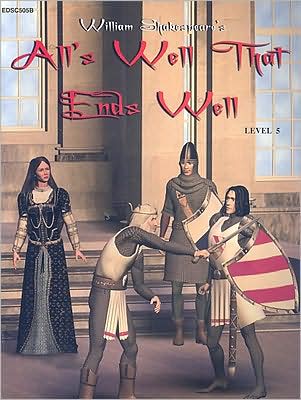
All's Well That Ends Well


Shakespeare, William. All's Well That Ends Well.

What does a girl have to do to catch a husband? Apparently a lot if you're a young maiden named Helena. In All's Well That Ends Well, the readers meet a young woman, Helena, who is madly in love with a young man, Bertram. Bertram is, in my opinion, an ass. He is stupid and lusty, and lusty and stupid. And he hangs out with with a truly annoying guy named Parolles. What is keeping these two apart? I mean, besides the fact that Bertram has no interest in her? Well, Helena, though well-beloved by her guardian, The Countess of Rousillon, is not noble by birth. She's the daughter of a very good (but now dead) doctor. And she can't reasonably hope to marry well--let alone marry her dream guy, Bertram, who is a Count (the son of the (above) Countess). So what's a girl to do, I say?!

Well, if you're Helena, you'll think up a couple of schemes. Scheme #1 being that you will head off to the King of France, who is conveniently dying, cure him with your father's wonderful secret remedies, and earn his devotion, respect, and favor. Once you've been granted the hand of ANY man in the kingdom, then you can go about nonchalantly (or maybe not so much) choosing the man you've loved all along, which in Helena's case is Bertram. Is Bertram extra-stupid, or is he just a typical guy in need of a couple years maturity? I'll leave that up to others to decide. Meanwhile, his response to Helena--and to the King--is to throw a temper tantrum, sulk and pout, and stomp off stealthily (again, not so much) to a whole other country--but not before he says, "I do."

Having won her husband in name only, Helena returns to the Countess who is pleased to see her but annoyed with her son for being the way he is. (He probably needed more spankings, perhaps?) After receiving a letter from him that he will not be her true husband until she has his ring on her finger and his child in her womb, she runs away to plot more schemes. The Countess is upset to see her go, but not too distressed since she has a full-time Clown to entertain her and make bawdy jokes night and day.

Bertram and his companions are in Florence, in the army, and when they're not off, you know, fighting, he is busy trying to have his way with various women. One woman that he is wooing is named Diana, she is the daughter of a widow woman. This widow-woman just happens to meet up with Helena--Helena has followed her husband secretly to Florence--and oh the plotting that these two do!

Can Helena (with some help, of course) win her husband's heart?

My thoughts on All's Well That Ends Well:

This is my first time with this play. I was a little nervous tackling it all on my own. But it was surprisingly easy to follow. At least surprisingly easy to follow....for being Shakespeare. I think the fact that it is a comedy, and that the jokes still translate (at least relatively so) as funny all these centuries later just shows you how some things never change. Is Helena stupid for loving a man who doesn't love her back? Should the Countess--or the King, or the Widow--have just told her that 'he's just not that into you'? Does Helena's loving Bertram make her weak by today's standards? Shouldn't Bertram have some say in who he marries? After all, it is his life. And couldn't Helena's persistent devotion be seen as proof of how stubborn she is? And if she's stubborn about this, she could very well turn out to be stubborn in everything else. I'm not saying Helena's wrong, not really, every single character--almost every single character anyway--seems to praise Helena as being the essence of a good woman, a great woman, an amazingly wonderful woman. But does the reader have enough proof that this is so? She does save the King's life, and that is something, and while her motives may be double in nature--wanting the king's favor to grant her Bertram--she probably does want to see him live for his own sake. And she does save the king by her own skill, her own smarts, so that says something: she is smart in some things at least. Why does she love Bertram? Why is he 'the one' for her? What makes him so wonderful in Helena's eyes? (Fortunately, Shakespeare was no Stephenie Meyer else all Helena's speeches would talk about his eyes.) Do we as readers need to know? It's always nice if we're shown why a hero and heroine belong together. (I think that is why I heart Much Ado About Nothing so much!!!) If the reader comes to feel what the heroine feels, then we have a connection with both hero and heroine. It makes for a more satisfying story. And that is something that is definitely lacking in All's Well That Ends Well. Helena loves him. End of story. Throw a party.

(mini-)
S
P
O
I
L
E
R

With a title like "All's Well That Ends Well," I feel it's not much of a surprise that things end well. For me to be convinced that things were really well, I'd need to feel that Bertram grew up...at least grew up a little. What has Bertram done to prove to readers that he is good-husband-material? Nothing. At all. Sure, he says he'll be a good and true husband to her. But really, what else can he say with all his boasting of how he came to care for her only after Helena's "death"? He could talk big to his mother and to his king when he thought his wife was dead. Yes, I repented of not loving her. Yes, I'm a fool. But having come to love her though too late, I'm a better man now. Can I get married to this other chick, now? I'm suspicious of Bertram still. Why? Because he's not honest. That and he's stupid. He's stupid for thinking he can get away with telling lie after lie. (I wouldn't have been surprised to hear him say emphatically and imploringly, I did not have sex with that woman.) Bertram's also insulting. Not only does he insult Helena (a few times to her face, but mostly by letter), he's insulting to Diana as well. When Diana is before the king, confessing all, he uses the old sure-but-she's-just-a-whore excuse. Of course, Diana wasn't a whore. She's a maiden still, as the reader well knows. (I personally would have written in a few face slaps. You know how Jack Sparrow is always getting his face slapped by women he's done wrong, well, Bertram needs a comeuppance.) Can Helena change Bertram? Really? Truly? Is a happily ever after likely here?

Why did I feel inspired to read this play? Well, I'm in Liv's A Shakespearean Summer Reading Challenge.

Have you read All's Well That Ends Well? Did you like it? What do you think are the chances for these two being happy together? Have you seen a good production of this play? I'd love to hear about it if you have! If you've not read the play (or even if you have, I suppose), what is it about Shakespeare that you love or hate most?

© Becky Laney of Becky's Book Reviews

Wednesday, May 20, 2009

Moribito: Guardian of the Spirit (MG, YA)


Uehashi, Nahoko. 1996/2008. Moribito: Guardian of the Spirit. Translated into English by Cathy Hirano. Illustrated by Yuko Shimizu. Scholastic.

High quality. You'll notice it from the start. This book is very pleasing--to the eyes, yes, but also to the touch. But I'm reviewing the book, not the book jacket, so I need to get back on task.

At the moment the royal procession reached the Yamakage Bridge, Balsa's destiny took an unexpected turn.

Who is Balsa? Why should you care? Well, Balsa is the star of Nahoko Uehashi's Moribito: Guardian of the Spirit. She is a body guard, a female warrior. She is paid to protect. Paid to fight. As to why you should care? This book is a fun fantasy novel with lots of action and adventure. Originally published in Japan in 1996, the book has at last been translated into English and published in America.

When Balsa saves the Prince's life (second prince, not the crown prince), the second queen (second wife, mother of the second prince) shows her gratitude by inviting Balsa to her home, her palace. An offer Balsa cannot ignore. Though she knows that this invitation comes with a hidden cost. The Queen wants something from her. Wants it badly. The Queen feels her son is in danger. She wants Balsa to take the prince, Chagum, and run. Why is he in danger? Well, I could go there. But I'd likely confuse you. Or else you wouldn't believe me. If I told you the prince had a magical/spiritual egg inside him waiting to hatch? And that the whole book resolves around protecting this Prince/egg? You might think it a rather odd plot twist. But it works. And well. It's exciting. It's well written.

This is the first book in a long and seemingly well-beloved fantasy series in Japan. (Beloved enough to inspire anime and manga adaptations. According to Wikipedia, the series will air in the United States in the summer of 09.)

© Becky Laney of Becky's Book Reviews
If you're reading this post on another site, or another feed, the content has been stolen.

Wednesday, May 13, 2009

Travel the World: Germany: Princess Plot


Boie, Kirsten. 2009. The Princess Plot. Translated by David Henry Wilson. Scholastic. 378 pages.

Scandia was in mourning.

The Princess Plot was originally published in Germany (2005) (Skogland was its name), translated into English and published in the UK (2008), and is finally making its American debut. The book stars a teen girl, Jenna, who is tired of her overprotective mother telling her what to do. There's overprotective, and then in a whole category of her own, there's Jenna's Mother. At least that's how Jenna feels. Why does her mother have to be so paranoid? Why does she have to worry about every little detail?

One day Jenna decides to break the rules. She decides to audition along with all her friends and classmates for a movie. She's pushed into it--urged into it--quite aggressively by the recruiters. And she does seem to be exactly what they're looking for. Almost like she was born to play this role. What's the role? A princess. If the director approves, if Jenna makes the final final audition, she'll be playing the role of a princess. But not just any princess. A modern-day-princess. The princess of a little country called Scandia.
But is everything as genuine as it appears? What do you think? Can life be so easy? This one is a fast-paced, highly-addictive read. As the mystery unfolds and the true dangers are revealed, it becomes nearly impossible to put down. I don't want to say much more than that.

I don't know that I'd say Princess Plot was the best, best, best book I'd ever read or anything. But it was so much more than I was expecting. It completely surprised me. And I loved discovering it. I hope you will take the time to give it a try as well.


© Becky Laney of Becky's Book Reviews
If you're reading this post on another site, or another feed, the content has been stolen.

Wednesday, May 06, 2009

Travel the World: UK: The Birth of A Warrior


Ford, Michael. 2008. Birth of a Warrior. Walker Books. 262 pages.

Birth of a Warrior is the second in the Spartan Quest series by Michael Ford. Lysander, a former slave, is continuing his warrior training. The grandson of an important Spartan warrior-leader, he still faces some scorn because of his mixed heritage (half Helot, half Spartan). No doubt about it, Lysander faces his toughest challenges yet within the pages of Birth of a Warrior. For one, he'll be facing the Ordeal. He--along with another warrior-in-training--will under the tutelage of another young warrior (older but not necessarily wiser) be led out into the Wild to see if they can survive. Extremely limited food and water. No cloaks or blankets to shield from the weather. No weapons. Can they survive living off the wild? Can they survive the challenges their guide has for them? Yet as difficult as this Ordeal is, it is almost nothing compared to what's coming. For on the last day, Lysander sees an enemy--the Persians--approaching. He knows this means war. He knows this means death. Not just for the Spartans who seem to welcome both but for the slaves--the Helots--as well.

Lysander has had difficulty in the past getting along with Demaratos. But as they face this Ordeal together--and the coming war--he learns that there are so many more important things to worry about than "liking" the soldier you're fighting besides. Warriors need to trust one another. And Lysander is finally reaching a place--as is Demaratos--where he can.

This is an action-and-adventure-packed book rich--but not too rich that it's inaccessible--in detail.

© Becky Laney of Becky's Book Reviews
If you're reading this post on another site, or another feed, the content has been stolen.

Friday, May 01, 2009

The Fire of Ares


Ford, Michael. 2008. The Fire of Ares. Walker. 245 pages.

'That's fifty. Stop now!' Lysander heard from behind.

Set in Ancient Greece, The Fire of Ares is the often-ruthless story of a young boy (former slave) named Lysander who discovers--quite by chance--his true parentage (he's half-Spartan) and that discovery leads him down a different path. He begins training (though the typical age to begin is seven and he is already twelve or thirteen) to become a Spartan warrior. Lysander's most precious possession--and it's "illegal" for him to "own" anything by the way--is a jewel, a pendant necklace. The so-called Fire of Ares. This gem has been passed from father-to-son for many generations--if the legend is to be believed--since before the fall of Troy. This necklace is legendary for protecting its wearer and giving strength and courage as well. And then there is the ever-mysterious prophecy.

Though Lysander has inherited this necklace from his mother--his father died in battle before he was born--the necklace soon is lost to him. A few chapters into the book, the reader witnesses the theft of the gem and the brutal beating of the boy.

This is an action-oriented novel full of adventure and mystery and above all else violence. It was a bit too violent for my liking. But I suppose it's true to the culture. They are Spartans after all. So if you can get past the brutality of it--the blood and gore of it--then you'll find yourself an interesting story about a boy with a few choices to make about his Destiny.

© Becky Laney of Becky's Book Reviews
If you're reading this post on another site, or another feed, the content has been stolen.

Wednesday, April 22, 2009

Travel the World: UK: Doing It


Burgess, Melvin. 2004. Doing It. (Originally published in UK in 2003.) Henry Holt. 326 pages.

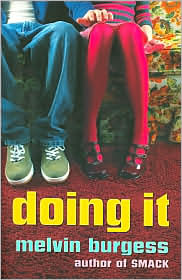
You should be able to tell from the start if Doing It will be to your liking. If the title doesn't clue you in, then surely the first chapter will leave you with no doubts. Doing It is "YA Romance" from the male perspective. (Well, if you can have it be a "romance" without it being particularly romantic.) I'd classify it as humor--and believe me I'm sure there will be some that find it quite humorous--but well, some of the jokes are a bit mean, but perhaps even more importantly it is so much more than bawdy humor. (For me, the elements of humor falls more into the cover-the-eyes, it's so embarrassing kind. You know the sort where you laugh at someone else's misery or humiliation or pain.) There is substance hidden under the first thirty layers of teen guys talking about sex--the sex they want to have but aren't always getting. It's a story of friendship, in a way, three guys: Dino, Ben, and Jonathan. And each guy is at a different place in their lives. Dino is a player pure and simple. He is dating, Jackie, a tease of a girl who will only go so far with him. She's always promising more...and more...and more. But always chickening out, getting angry, running away. Ben is a strange one. He's a guy with more than a few secrets. One involving an inappropriate relationship with a teacher. Jonathan is mostly a good guy. Not perfect by any means, he listens to his friends more than his heart I think. He has a friend, Deborah, that is "plump" to some people but out and out fat to others. He's drawn to her. He wants her, there's no denying it. But he's afraid that everyone will laugh at him if he dates a fat girl. Dino especially can be harsh. So he's torn between his feelings--both like and desire--and his "reputation" as one of the guys. Some of the narrators are more likable than others. Jonathan was the one I liked best, generally speaking.

© Becky Laney of Becky's Book Reviews
If you're reading this post on another site, or another feed, the content has been stolen.

Wednesday, April 15, 2009

Travel the World: UK: Horrid Henry


Simon, Francesca. 2009. Horrid Henry. (Originally published in UK in 1994)

I've met a new friend and his name is Henry, Horrid Henry. Until I picked up this wonderful little chapter book by Francesca Simon, I was clueless to this gem of a series. Turns out, Horrid Henry is quite popular--especially in the UK!

This first includes four stories: Horrid Henry's Perfect Day, Horrid Henry's Dance Class, Horrid Henry and Moody Margaret, and Horrid Henry's Holiday. Each story is funny, seriously funny. There is something about Henry that is just so darn lovable. I don't know if every reader can relate. After all, there might be a few Perfect Peters and Moody Margarets lurking about. But whether you're loving Henry, or loving-to-hate Henry, I think you'll enjoy what you find here!

I think the thing that I love best about Henry is his voice. Francesca Simon gets what it means to be a kid, to think like a kid, to talk like a kid, to act like a kid. Everything is just so right.


© Becky Laney of Becky's Book Reviews
If you're reading this post on another site, or another feed, the content has been stolen.

Wednesday, April 08, 2009

Travel the World: Australia: The Reformed Vampire Support Group


Jinks, Catherine. 2009. The Reformed Vampire Support Group.

Interesting cover and premise. But only moderately pleasing (to me). Nina is a vampire. She's been a vampire since 1973. She's been trapped in a teenagers body for what seems like forever. Nina in her own words, "The plain fact is, I can't do anything much. That's part of the problem. Vampires are meant to be so glamorous and powerful, but I'm here to inform you that being a vampire is nothing like that. Not one bit. On the contrary, it's like being stuck indoors with the flu watching daytime television, forever and ever." (5) Nina and her vampire family don't sparkle, thank goodness, but they're also not fast or strong or powerful. These vampires are nothing like what you read about; instead we find them weak, sickly, powerless, resigned to their oh-so-boring lifestyles. But when one of their own ends up dead--turned to ash--the threat becomes a little too real and pushes them all out of their comfort zones and somewhat unwillingly into an adventure all their own. For what they find is that someone--a stranger--is onto them. Suspects that they are vampires. And is out to kill them "for the good" of mankind. Can they convince this unknown threat that they're no threat?

I was only moderately entertained by this one. The plot seemed a bit too flimsy for me. The storytelling too clumsy. At one point, the author interrupts the action sequence to spoil her own mystery. Something that I found a bit weird and definitely unnecessary. I mean why work up any suspense at all if you're just going to tell your readers the secrets before reaching what should be the climax and explain every little clue away before the "big reveal" that turned out to be mostly deflated by that point.

© Becky Laney of Becky's Book Reviews
If you're reading this post on another site, or another feed, the content has been stolen.

Wednesday, April 01, 2009

The Black Book of Secrets


Higgins, F.E. 2007. The Black Book of Secrets. Feiwel and Friends. 273 pages.

When I opened my eyes I knew that nothing in my miserable life prior to that moment could possibly be as bad as what was about to happen.

And our narrator, Ludlow Fitch*, wasn't lying. What his parents had planned for him? So not good! Just thinking about it makes my jaws ache! Fortunately for both of us, he is able to make a daring dash of an escape. After a rather close call, Ludlow finds himself escaping the City and going away...where...he doesn't know. But anyplace has to be better than where he's been, right? Where Ludlow ends up is in the company of Joe Zabbidou** in his pawn shop of secrets. Both Joe and Ludlow are new to the village of Pagus Parvus. And their destinies are tied together now. Ludlow becomes an apprentice of sort. It's a good thing Ludlow knows how to read and write and has such good penmanship! For Joe has a very special job in mind for the boy. Pagus Parvus is an interesting little place with plenty of interesting people. It's a town full of secrets. And that's just what Joe is in the market for. Good and juicy secrets. You unburden your soul, tell Old Joe all while Ludlow records it all in his black book, and in exchange....you leave with a nice sum of money. Enough money to make a difference. But can old Joe be trusted? What does he want with all those secrets? What is he hoping to gain out of the exchange? Was Ludlow right to trust him?

This one is just deliciously atmospheric. I loved everything about it: the setting, the characterizations, the language. (Especially the names.) I can only imagine this one would be fun to hear aloud.

*Don't you just love that name?
**Again, an awesome, awesome name!


© Becky Laney of Becky's Book Reviews
If you're reading this post on another site, or another feed, the content has been stolen.

Wednesday, March 18, 2009

Travel the World: England: How I Live Now


Rosoff, Meg. 2004. How I Live Now. 194 pages.

My name is Elizabeth but no one's ever called me that.

When Elizabeth (a.k.a. "Daisy") comes to England to visit her British cousins (and aunt), little does she know that life as she knows it--as everyone knows it--is about to change forever. Suffering from an eating disorder, Daisy has been sent far from home--just as much to 'help' her out as to help the evil step-mother who's expecting. She meets her cousins--Osbert, Edmond, Isaac, and Piper--and they seem to be off to a great start. Good thing too, as they'll be spending loads of time together. Daisy's aunt is off on a business trip. A trip from which she'll never return. Why? Long story short, terrorists. An enemy has invaded England--and other countries as well; bombs having gone off in at least the U.S. and England, and probably other places as well though I'm not exactly sure on that. England is now occupied by the enemy. (And the British soldiers have to regroup to try to invade and reconquer their own country.) At first, these changes don't effect the kids (Piper's the youngest; the rest are teenagers). Food rationing here. No electricity. Inconvenient, yes. Life-and-death altering? Not really. You can live without TV and the telephone. But soon the threat comes closer...and closer. Impacting some more than others. But unsettling, disrupting all. Now this war, this invasion means fight for survival. And Daisy has to grow up quickly. And now that food is a scarcity, Daisy realizes just how sick she was to choose to starve.

Daisy's voice is unique: full of snark but not without heart.

It would be much easier to tell this story if it were all about a chaste and perfect love between Two Children Against the World at an Extreme Time in History but let's face it that would be a load of crap. The real truth is that the war didn't have much to do with it except that it provided a perfect limbo in which two people who were too young and too related could start kissing without anything or anyone making us stop. There were no parents, no teachers, no schedules. There was nowhere to go and nothing to do that would remind us that this sort of thing didn't happen in the Real World. There no longer was a Real World. (46)

Every war has turning points, and every person too. (68)


What I liked about this one? I liked the snark for the most part. Daisy's voice is original. You'll either love her or hate her. You'll either think the snark is funny, or you'll be annoyed. I liked the pacing of this one. It is short, yes, but a lot happens. It doesn't drag at any point. Rosoff knows how to tell a story.

© Becky Laney of Becky's Book Reviews
If you're reading this post on another site, or another feed, the content has been stolen.

Wednesday, March 11, 2009

A Finder's Magic


Pearce, Philippa. 2009. (Originally published in Britain in 2006). A Finder's Magic. Illustrated by Helen Craig. Candlewick Press. 121 pages.

When a boy loses his dog in a meadow, a magical quest is the result when a strange old man calling himself a 'Finder' shows up to comfort the boy. Together the old man and the young boy will use 'magic' to discover just what happened to the dog. The magic includes using one of the muddy toys belonging to the dog. The Finder allegedly embeds a message within the toy and when it is thrown at various animals, the finder can 'hear' from the animals in question. (Another example, the boy shoves the muddy toy down into a mole hole and waits for the mole's response.) Not learning much from the birds, only learning the slightest from the mole, they seek a cat--a former familiar from a witch--for further clues. This leads to a riddle of sorts. But it is when they seek information from human witnesses that things begin to move along.

For me, this one was a dull book. I wanted to like this book. I just couldn't make myself feel it. The book is the last one written by Philippa Pearce. And the book was written for two of her grandchildren. It is even illustrated by her grandkids' other grandmother, Helen Craig. It was a heart-felt project, inspired by love. And I wanted to connect with it. It just didn't happen. I do think that others might like it more than I did.

© Becky Laney of Becky's Book Reviews
If you're reading this post on another site, or another feed, the content has been stolen.

Wednesday, February 11, 2009

Travel the World: Belgium: Lovey and Dovey


van Lieshout, Elle and Erik van Os. Lovey and Dovey. Illustrated by Miles van Hout. Boyds Mill Press. 2009.

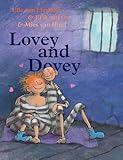
This is an odd but oddly charming, thoroughly unique picture book originally published in Belgium. It is the story of two love birds, love birds who happen to be jail birds too. Their crime? Stealing a pair of blue socks from the corner sock shop. (You'll notice Lovey is wearing one and so is Dovey.) Dovey--the gentleman robber--loves taking care of his woman, Lovey. And if that means sneaking through the bars each night and stealing...well, whatever it takes. What does Dovey steal? The sun, the moon, the stars...and a whole lot more besides. Soon their jail cell is their idea of heaven on earth. I won't go into all the details on this one--but it's cute. Maybe not traditionally cute...after all...how many picture books about happy-go-lucky prisoners are there?


© Becky Laney of Becky's Book Reviews