Showing posts with label "S" Authors. Show all posts

Saturday, June 06, 2009

Alcatraz Versus The Scrivener's Bones (MG, YA, Everybody Really)


Sanderson, Brandon. 2008. Alcatraz Versus The Scrivener's Bones. Scholastic. 322 pages.

Sequel to Alcatraz Versus The Evil Librarians. Here's how it starts off,
"So, there I was, slumped in my chair, waiting in a drab airport terminal, munching absently on a bag of stale potato chips. Not the beginning you expected, is it? You likely thought that I would start this book with something exciting. A scene involving evil Librarians, perhaps -- something with altars, Alivened, or at least some machine guns. I'm sorry to disappoint you. It won't be the first time I do that. However, it's for your own good."
Alcatraz Smedry is back for his second adventure. And oh how he loves to manipulate his readers, tease them, taunt them. It's mean and I love it. If you haven't read the first book, you should. Trust me on that. It's funny and clever. And the best entertainment to be had between the covers of a book.

I'd like to make something clear. I have been unfair to you. That is to be expected, liar that I am.
In the first book of this series, I made some sweeping generalizations about librarians, many of which are completely true.
I need to come clean. There are several kinds of librarians. There are the ones I talked about in my last book -- the Librarians, with a capital L. We also call them the Librarians of Biblioden, or the Scrivener's Librarians. Most of what I said about that particular group is, indeed, factual.
However, I didn't take the time to explain that they're not the only kind of librarians. You may, therefore, have assumed that all librarians are evil cultists who want to take over the world, enslave humanity, and sacrifice people on their altars.
This is completely untrue. Not all librarians are evil cultists. Some librarians are instead vengeful undead who want to suck your soul.
I'm glad we cleared that up. (44-45)

In this second adventure, we have Alcatraz and Bastille teaming up with others--new characters, new talents--on a quest trying to track down Grandpa Smedry and Attica Smedry. (Attica being the long-lost-and-often-presumed-dead father of our hero, Alcatraz.) Alcatraz believes that both can be found in the Library of Alexandria. It is here in this ancient library, that they come across the worst sort of librarian: the kind that can take your soul if you take a book. (If you sign a contract to lose your soul, you have ten hours before the dreaded soul-taking takes place. If you don't sign a contract but happen to pick up a book, then you've got ten seconds.) These librarians taunt and tease. Urging you to read this and that. Good news if you give in: You get to read all the books in the library. And we're not just talking ancient scrolls and the like. New books--American books--are being sent over all the time. (Every book ever written.) Bad news: You're doomed to spend eternity there with no hope of ever leaving. And as a curator, you yourself will join their numbers trying to steal other people's souls.

Can Alcatraz find his father and grandfather and escape this threatening-but-oh-so-tempting library with his soul intact? Will his friends? There's danger. There's threats--new and old. There are traps, traps, and more traps. There are daring rescues (or rescue attempts I should say). There are more than a few surprises. It's great fun. You should try it.

© Becky Laney of Becky's Book Reviews

Saturday, May 23, 2009

Alcatraz Versus the Evil Librarians. (MG, YA, Everybody Else Too)


Sanderson, Brandon. 2007. Alcatraz versus the Evil Librarians. Scholastic. 307 pages.

So, there I was, tied to an altar made from outdated encyclopedias, about to get sacrificed to the dark powers by a cult of Evil Librarians. As you might imagine, that sort of situation can be quite disturbing. It does funny things to the brain to be in such danger -- in fact, it often makes a person pause and reflect upon his life. If you've never faced such a situation, then you'll simply have to take my word. If, on the other hand, you have faced such a situation, then you are probably dead and aren't likely to be reading this.

Alcatraz versus the Evil Librarians is one of those rare gems of a book where you could open it to practically any page and find treasure. It's funny. It's fun. It's exciting. It's clever. Take for instance, this little treasure found at the beginning of chapter four:

Hushlanders, I'd like to take this opportunity to commend you for reading this book. I realize the difficulty you must have gone through to obtain it -- after all, no Librarian is likely to recommend it, considering the secrets it exposes about their kind.

Actually, my experience has been that people generally don't recommend this kind of book at all. It is far too interesting. Perhaps you have had other kinds of books recommended to you. Perhaps, even, you have been given books by friends, parents, or teachers, then told that these books are the type you "have to read." Those books are invariably described as "important" -- which in my experience, pretty much means that they're boring. (Words like meaningful and thoughtful are other good clues.)

If there is a boy in these kinds of books, he will not go on an adventure to fight against Librarians, paper monsters, and one-eyed Dark Oculators. In fact, the lad will not go on an adventure or fight against anything at all. Instead, his dog will die. Or, in some cases, his mother will die. If it's a really meaningful book, both his dog and his mother will die. (Apparently most writers have something against dogs and mothers.)

Neither my mother nor my dog dies in this book. I'm rather tired of those types of stories. In my opinion, such fantastical, unrealistic books -- books in which boys live on mountains, families work on farms, or anyone has anything to do with the Great Depression -- have a tendency to rot the brain. To combat such silliness, I've written the volume you now hold -- a solid, true account. Hopefully, it will help anchor you in reality.

So, when people try to give you some book with a shiny round award on the cover, be kind and gracious, but tell them that you don't read "fantasy," because you prefer stories that are real. Then come back here and continue your research on the cult of evil Librarians who secretly rule the world.

I think everyone should read this book. Seriously. It's the story of a boy--Alcatraz Smedry--who receives his inheritance--a bag of sand--on his thirteenth birthday. His parents are dead, and he's been in the foster care system for years. He has difficulties in settling down with families--he's been moved from foster home to foster home--because he has a way of breaking things just by touching them. When we first meet Alcatraz, he accidentally has broken a stove and set the kitchen on fire. Most would say this 'gift' makes Alcatraz extremely unlucky. But, it may just be his saving grace. When a mysterious old man claiming to be his Grandpa Smedry appears the day after his birthday, the boy is in for a shock or two. Fortunately for us readers, we're along for the ride! What follows is one exciting adventure. Grandpa Smedry claims this world is controlled by a cult: a cult of evil Librarians. Evil librarians that have stolen Alcatraz's inheritance: the bag of sand is missing! Can these two team up and reclaim what is rightfully theirs?


© Becky Laney of Becky's Book Reviews
Subscribe to receive updates in your favorite reader.

Friday, May 22, 2009

When You Reach Me (MG)


Stead, Rebecca. 2009. When You Reach Me. Random House. 208 pages.

So Mom got the postcard today. It says Congratulations in big curly letters, and at the very top is the address of Studio TV-15 on West 58th Street. After three years of trying, she has actually made it. She's going to be a contestant on The 20,000 Pyramid, which is hosted by Dick Clark.

I really, really loved Rebecca Stead's first novel, First Light. So I was excited to get the opportunity to read her second novel, When You Reach Me. It has a completely different feel to it than her first one.

The novel is historical fiction--set in 1978/1979 in New York City. It's not strictly historical fiction. There's some mystery involved, a twist here and there that makes it unique. If I were trying to sell this book--book talk it if you will--I'd say that it was a loving tribute to the children's classic, A Wrinkle In Time. Our heroine, Miranda, just loves A Wrinkle In Time. Loves it to pieces. She probably feels about it the same way I feel about Ender's Game. That's love and devotion folks!

Part mystery. Part historical fiction. Part coming-of age. The plot focuses in on Miranda and her friends and classmates, her family and neighborhood. What's the mystery? Miranda receives a series of mysterious letters through the course of a few months. Letters that are personal and prophetic. Here's the first letter she receives:

M,

This is hard. Harder than I expected, even with your help. But I have been practicing, and my preparations go well. I am coming to save your friend's life, and my own. I ask two favors. First, that you write me a letter. Second, that you remember to mention the location of your house key in the letter. The trip is a difficult one. I will not be myself when I reach you.


The letters are always slightly weird and found in unexpected places. As the novel unfolds, Miranda accepts these strange offerings as a weird but cool part of her life. Who else receives notes predicting the future in an all-too-personal-and-meaningful way?

While I enjoyed First Light more, I still enjoyed this one. It was just so completely different than any other book I've read.

© Becky Laney of Becky's Book Reviews
Subscribe to receive updates in your favorite reader.

Thursday, April 16, 2009

To A God Unknown


Steinbeck, John. 1933. To A God Unknown. 186 pages.

Steinbeck seeks the answer to the age-old question, "Can a man love a tree too much?" in his novel To A God Unknown. What? You don't believe me that that is a universal question that everyone is dying to know the answer to? You've never pondered (to yourself or maybe even with a friend) if you could love a tree so much that you begin to worship it?

This novel focuses on the Wayne family. In particular, Joseph Wayne and his brothers. Determined to head west, to settle in California, Joseph disappoints his father, John, and sets out on his own. When Joseph finally arrives, when he finally sets foot on his own land, his own property, he gets a strange feeling. He knows, he feels, that his father has passed. Around the same time, he feels that his father is right there with him, right there watching him, watching the land. He gets the strongest feeling that his father settles into a tree--becomes one with it in a way. So time passes, as it always does, and Joseph convinces his brothers to come and settle near him. To buy adjoining property, to make one large family ranch that they can own all together and settle. And so it begins, at first it's not quite so obvious, the amount of respect, attention, adoration Joseph feels for 'the tree.' But it can't be hidden forever. One brother knows that his brother has lost touch with reality--at least with good Christian faith--when he sees his brother sacrificing wine and food to the tree, leaving offerings under it, sneaking off at night to speak with it. One brother becomes so angry he decides to do the unthinkable....

Does this tree have magical powers? Is Joseph right in assuming that as long as the tree thrives, the ranch will thrive, the family will thrive?

This is one strange book, I'll admit that up front. Joseph is not easily understood. Not by his wife, Elizabeth. Not by his brothers and their wives. Not by his hired hands. Not by the local priest. No, this Joseph is one-of-a-kind. But is he one-of-a-kind crazy? You be the judge!

I don't want to sound too flippant. I think this book has more literary value than I made it sound like in the first paragraph. A lot of symbols, for example. I think it could be discussed and dissected and explored in depth if readers wanted to get every literary drop out of it. I think it builds up on and explores various mythologies and religious symbols. It weaves together a mythology of its own in a way.

Did I like it? Yes and no. It isn't my favorite Steinbeck by any means. I don't think it is his masterpiece. It is his second novel after all. I'm glad I read it. But I'm not going to go out of my way to buy my own copy either.

© Becky Laney of Becky's Book Reviews
If you're reading this post on another site, or another feed, the content has been stolen.

Wednesday, April 15, 2009

Travel the World: UK: Horrid Henry


Simon, Francesca. 2009. Horrid Henry. (Originally published in UK in 1994)

I've met a new friend and his name is Henry, Horrid Henry. Until I picked up this wonderful little chapter book by Francesca Simon, I was clueless to this gem of a series. Turns out, Horrid Henry is quite popular--especially in the UK!

This first includes four stories: Horrid Henry's Perfect Day, Horrid Henry's Dance Class, Horrid Henry and Moody Margaret, and Horrid Henry's Holiday. Each story is funny, seriously funny. There is something about Henry that is just so darn lovable. I don't know if every reader can relate. After all, there might be a few Perfect Peters and Moody Margarets lurking about. But whether you're loving Henry, or loving-to-hate Henry, I think you'll enjoy what you find here!

I think the thing that I love best about Henry is his voice. Francesca Simon gets what it means to be a kid, to think like a kid, to talk like a kid, to act like a kid. Everything is just so right.


© Becky Laney of Becky's Book Reviews
If you're reading this post on another site, or another feed, the content has been stolen.

Friday, April 10, 2009

This Is What I Want To Tell You


Stone, Heather Duffy. 2009. This Is What I Want To Tell You.

I can't tell you exactly what happened, but I can tell you part of it. My part.

Nadio and Noelle are inseparable twins. They love to hang out together. With Noelle's best friend, Keeley, these three are as close as close to be...until. Until one fall day they just aren't. In a way, perhaps it starts when Keeley goes to England for the summer. Noelle gets a job in an icecream shop and starts hanging out with a different crowd. The two aren't in touch over the summer. And on the night of Keeley's return, Noelle is nowhere to be found. In reality, Noelle chose to hang out with another friend, Jessica, at a party...a party with guys and drinking and oh-so-much-more. It is there--on that night--that she meets Parker. Her first love. From that moment, Noelle chooses Parker--and their secret relationship--over the comfort and security of her former friends and family. But Nadio and Keeley have a secret of their own that they're keeping. Nadio and Keeley, well, they're noticing each other in a whole new way. A wonderful way, a beautiful way. As Noelle and Keeley drift apart, there's love in the air even in the midst of anger and bitterness. But not all relationships are healthy as these teens find out. Not all love is real.

The book is bittersweet; the book chronicles the relationship of Noelle and Parker. But the book isn't so much about discovering that love isn't all that wonderful...it's a book about finding and losing yourself and choosing to be okay...even if your prince charming turns out to be a frog. It's a book about friendship as well.

© Becky Laney of Becky's Book Reviews
If you're reading this post on another site, or another feed, the content has been stolen.

Monday, January 19, 2009

Far From You


Schroeder, Lisa. 2009. (December 2008) Far From You. Simon & Schuster.

I may not have been the most enthusiastic reader of Lisa Schroeder's first novel, I Heart You, You Haunt Me, but I was intrigued enough by her writing to seek out her second entitled Far From You. And I'm so glad I did!

Far From You is a verse novel narrated by the very angsty Alice. (Yes, she was named after that Alice, the one that went down the rabbit hole.) And Alice's problems are understandable. Still grieving the loss of her mother--cancer, I believe--she is upset (angry, bitter) with her father remarrying and starting a new family. Yes, when the novel opens, Alice is about to become a big sister. Her stepmother, Victoria, brings home a baby girl, Ivy. But Alice is so spent feeling sorry for herself she just doesn't get it. Babies are cute and adorable. (Of course, babies can be loud and stinky and worrisome too). Alice has a few things going for her. She's got her music--she loves to play the guitar and sing at her church (not a traditional church); she loves to hang out with her best friend, Claire, who attends church with her and sings, I believe; she is just crazy about--head over heels--with her boyfriend, Blaze (though she can't decide if she's ready to go all the way with him or anyone really).

But Far From You is a story of how Alice's world turns upside down and inside out. Thanksgiving. The powers that be (a.k.a. parental units) have decided that the family--the whole family--should drive to see Victoria's parents. After all, they have a new baby to show off. Alice is bummed to say the least. Victoria's parents aren't her family--or are they?--and why should she be stuck in a car with a family she can't stand? When her father has to leave unexpectedly on business leaving Victoria, Alice, and Ivy to drive back home...the unthinkable happens.

Here's the first poem in the book. (The prologue occurs during the climax of the book and then the book goes back and starts at the beginning.)

Day Four

We're alone
with only
the cold
and dark
to keep us
company.

I know them
so well now,
they're like
old friends.

Familiar.

Old friends
who have stayed
too long
and need to go.

I wish
the angel
would have stayed.

For a second,
I felt warmth.
I felt safe.
I felt love
as she whispered
my name,
"Alice,"
and floated
toward me
before she
disappeared.

Was I dreaming?
Hoping?
Hallucinating?

So hungry.
So tired.

Cold.

I look out the window,
and although it's dark,
the moon
illuminates the scene
as if a faraway
floodlight
is hung
from the sky.

So much whiteness.
Everywhere.

Come back,
angel.

Let us fly
away
from
here.

Please.
Come back.

I knew by the second poem, "Softly Snowing" that I just had to read this one. The premise. The characters. The pacing. The imagery. Everything worked on this one.

© Becky Laney of Becky's Book Reviews

Friday, January 16, 2009

Keeping the Night Watch


Smith, Hope Anita. 2008. Keeping the Night Watch. Illustrated by E.B. Lewis. Henry Holt. 74 pages.

Keeping the Night Watch is a sequel (companion novel?) to The Way A Door Closes. However, you don't have to have read the first book to enjoy and appreciate this one. Our hero and narrator is a young African-American man named C.J. who is struggling with finding his place in his family now that his father has reentered the picture and rejoined his family. C.J. grew into being 'the man' of the family. But now where does he belong? He can't go back to being a child? Can he?

Hope Anita Smith's poems are powerfully authentic as they examine the ins and outs, ups and downs of family life.

Family Cooking Instructions

Their conversation is sweet.
Their words are light and airy
like a just-baked cake.
They sugarcoat it
to cover up any flaws or imperfections.
Try to hide the sunken part.
They are so careful,
each wearing their own apron
to protect their clothed selves.
And that's why,
when I show up,
metal-cold and steel-gray,
they are not prepared.
I slice through
and we ooze out.
That's when we see that
we are not done in the middle.
We need to bake a little longer.

(5)

© Becky Laney of Becky's Book Reviews

Thursday, January 08, 2009

Something, Maybe


Scott, Elizabeth. 2009. Something, Maybe. Simon & Schuster. Pub. March 2009. 224 pages.

Everyone's seen my mother naked.

Our heroine, Hannah, sure has embarrassing parents: between her dad, Jackson James*, and her mom, Candy Madison**, it's no wonder Hannah seeks a life of invisibility. Hannah prefers her "boring" life to the more notorious life she could be leading...if she followed in her parents' footsteps. And on the surface, Hannah's life is lacking a little in the social department. Her time being split between home, school, and work. The novel focuses in particular on her work environment, BurgerTown, and two of her coworkers--Josh and Finn. Hannah has a crush--make that crush--on Josh, a boy with a girlfriend, coffee habit, and 'reputation' for writing poetry and being 'all sensitive' and stuff. Finn, on the other hand, strikes Hannah as being more of a pain in the you-know-where. Though the reader can clearly see that Finn is the better of the two: he's down-to-earth and genuine. Hannah does attend school with both Josh and Finn, but she doesn't really speak to either outside of work. And she hardly speaks to anyone at school anyway. Her only confidante being a girl named Teagan.

The novel equally focuses on the developing relationships (romantic) in her life--Josh and Finn--and on her own topsy-turvy relationship with her parents. Hannah has a good amount of angst: she's still grieving the death of her stepdad Jose***; still bitter over how her last visit with her dad ended****; still hurt that he hasn't tried to contact her in around five years; embarrassed over her mother's lack of clothes; and frustrated that her mom won't talk about Jose even after all these years; she feels alone. ALONE. Alone and misunderstood. I loved her increasing vulnerability, her willingness to finally be open and true to herself, to life, to love.

And to be honest, I just loved Finn. I did. It was satisfying to read their story. It's a romance, yes, but it has heart and soul too. I haven't decided how this Scott novel compares with her previous works: Bloom, Perfect You, Stealing Heaven, Living Dead Girl.

*"Founder of jacksonjamesonline.com, the home of JJ's Girls, and current star of JJ: Dreamworld. He's 72, acts like he's 22, and once upon a time Mom had a child with him."(5)
**Her mom is "famous" for her Superbowl commercial--naked lady with a pizza box--and for briefly starring in a cheesy sitcom, "Cowboy Dad," but she now makes her living from doing live chats on the internet wearing lingerie.
*** whom she lost when she was twelve
****or how it ended up broadcast on her dad's show, how it was edited to make her look like a freak.

© Becky Laney of Becky's Book Reviews

Wednesday, January 07, 2009

The Farwalker's Quest


Sensel, Joni. 2009. The Farwalker's Quest. Pub. Feb 2009. Bloomsbury USA. 400 pages.

Zeke's tree wouldn't speak to him.

The Humming of Numbers was one of my favorite 2008 reads, so I was ecstatic to get a chance to read her newest book The Farwalker's Quest. The book stars two kids--twelve year olds: Zeke and Ariel. They're approaching an important date: Namingfest. Soon they'll take tests to determine what paths their futures will take. Zeke hopes to become a Tree-Singer. Ariel hopes to follow in her mother's footsteps and become a Healtouch. Each person in the community has a gift; a gift that contributes to society as a whole. Of course, for those that fail to pass the test, there is the shame of wearing the name 'Fool' til the next year's festivities. (Though there are a few unfortunate souls that wear that name for life.)

Three days before Namingfest, the two find something in a tree. Something ancient. Something fascinating. Something dangerous. (Though it takes a full day for that to be realized.) Something that will bring strangers into their town. Something that will change both of their lives forever. That something is a magical artifact, a "telling dart" that is capable of flying hundreds of miles and revealing its message only to the intended recipient. That this 'dart' found the girl, Ariel, speaks volumes. It will be the best and worst thing that ever happened to her in her short life.

It brings adventures and dangers and new friends...and enemies...her strength and will be tested every step of the way.

I loved this one. Loved the world Sensel created. Loved that it's set so far into the future that society has collapsed upon itself, entered a dark ages of sorts, and is only just beginning to revive again. Loved the characters. How these relationships are built and developed through the novel. How easy it was to care about them all. Loved that so many of the characters were developed. There is a richness to the characters, to the world. (That's not always the case.) Loved the adventures. Loved the pacing. The intensity of it. Each chapter kept me hooked and wanting more.

I'd say this is perfect for fans of The Giver, City of Ember, and Ursula K. Le Guin's Annals of the Western Shore series (Gifts, Voices, Powers).

I know it's not saying much being as how it's only the first full week of January, but this is my best read so far!

© Becky Laney of Becky's Book Reviews

Monday, January 05, 2009

Flygirl


Smith, Sherri L. 2009. Flygirl.

It's a Sunday afternoon and the phonograph player is jumping like a clown in a parade the way Jolene and I are dancing.

Meet Ida Mae Jones, a young black woman with big, big dreams who won't allow a little thing like prejudice to stand in her way. Set during World War II, Ida Mae's story focuses on her desire to fly. But after Pearl Harbor, even if she had the money and know how, it would be nearly impossible. (She has the know how, but no license. And she certainly doesn't have the money to travel to a place--to an institution of one sort or another--that will give her her flying test and license.) But the dream persists all the same, and in fact this dream intensifies when she sees an ad for the Women Aiforce Service Pilots--the WASP.

For women with pilot's license, the WASP offers a once in a lifetime experience. A chance to fly. And not just fly, but to fly military planes. A chance to serve the country during the war. A chance to release men from these 'tedious' tasks so they can better serve their country by going overseas. The ad doesn't say--white women only--but everyone in Ida Mae's life tries to tell her this is so.

Not just anyone can be a WASP--you have to first pass an interview, then you have to pass almost a full year of training--training which included learning to fly several military planes, learning to fly cross country, learning to fly by instruments only, learning to fly at night, reading maps, plotting courses, etc.

Ida Mae wants this more than anything--and she's willing to risk everything for her one chance. As the lightest in her family, and one of the lightest in her neighborhood, Ida Mae decides to try her hand at passing. Passing for a white woman. Risky business if anyone discovers her little secret. And it's something that displeasures her family. Everyone thinks it's a bad idea--they warn her. Once you go there, once you decide to enter the white world--the white community--it is hard to pass back. You reach a point where you belong in neither community.

Ida Mae has passed the interview, but can she prove to everyone--the military, her family, herself, that she has what it takes to graduate? To become a real WASP?

Rich in details of the time and place--World War II, Sweetwater, Texas--Flygirl is a historical novel that will do more than entertain.

Other perspectives: Pink Me, Flamingnet.

Note: I'm not quite sure if my past life as an editor of WASP oral histories makes me a better judge or a worse one. On the one hand, all the details of WASP life--the interviews, the training, the living arrangements, the clothes, the camaraderie, the assignments, the songs they sang, the reasons most were interested in flying, etc. were very familiar to me. There weren't many surprises along the way which means that for the most part she stayed true to history, true to the facts. Which is a good thing. But at the same time, it kept this one from being a page-turner for me. I knew too much to be on the edge of my seat wondering what happened next.

All that being said, the book is thoroughly original in that it takes true facts and envisions what it would have been like for a young black woman--African American--to have been able to pass and be a part of it all. This is something that history is silent on. We know that they didn't knowingly allow any into their ranks. As far as diversity goes, it was all white women with the exception of two Asian women pilots. But could they have been fooled once or twice? Who's to say? It could have happened though there certainly isn't any proof it happened. No one has stepped forward and admitted such a thing anyway. But I like this exploration into the culture and society of the times. How it might have felt like. What it might have been like.

© Becky Laney of Becky's Book Reviews

Tuesday, December 23, 2008

Everything You Want


Shoup, Barbara. 2008. Everything You Want.

Everything You Want is a coming-of-age story where it's okay to not be okay. On the surface, our narrator, Emma, has everything she 'needs' to be happy. She's got a loving and supporting family. It's her freshman year of college. She has a more-than-decent roommate to share her dorm. But everything feels wrong, feels off to Emma. And this 'offness' is only magnified when her family wins the lottery and becomes millionaires. Money can't buy happiness for Emma, or for her parents who begin to drift apart, or for her older sister. Money isn't the answer it seems on how to make her life feel right. Emma is clueless as to just what to do to "fix" her life. She's unsure of what she wants, uncertain of what she needs. She's uncomfortable in her own skin, but doesn't know how to 'fix' that. No matter where she goes, who she's with, she can't run away from herself, from her struggle to just be...to be content.

I liked this one. Loved it in a few places even. But as a whole, I can't say that I loved it. Emma's problems are all-too-real no matter your age. There are times in life when you're just not feeling it, where no matter what you do you can't seem to be the person you think you want to be or need to be. So I could relate to Emma. But I wasn't so in love with the lottery elements of the plot. Still, I'd feed comfortable recommending this one.

© Becky Laney of Becky's Book Reviews

Saturday, November 22, 2008

The Comeback Season


Smith, Jennifer E. 2008. The Comeback Season.

Opening Day at Wrigley Field isn't always April 8. It's not like Christmas or the Fourth of July, with their dependable calendar slots, the reassurance of a fixed number.

Ryan Walsh is a baseball loving teen who is still aching over the loss of her father--five years or so previous--her mother and sister may have moved on...her mother has remarried and is expecting a baby even. But Ryan can never forget her father--the man who taught her how to keep score while watching the game. The man who passed on his love for the Cubs. That the anniversary of his death should fall on Opening Day? A sign that she should skip school and go to the game.

Ryan is in many ways a girl after my own heart--"she doesn't care about makeup or jewelry, and has grown used to getting the once-over for her lack of fashion sense, an up-and-down stare reminiscent of the way her mom studies produce at the grocery store. Ryan prefers ponytails to curling irons, the soapy smell of her shampoo to the fruity ones all the other girls use. She feels most put together when wearing jeans, and she would never trade her flip-flops for a pair of heels. And mostly, she's okay with this." (27) And this telling passage as well--"Given the choice between future and past, she would always and without hesitation choose to move backward, and for years she has lingered through her life in this way, loitering and meandering, a wanderer with the most aimless of intentions." (38)

On that fateful day, April 8, Ryan meets Nick. Okay, so they've been going to the same school together. And true, she's seen him around enough to know that he's her classmate. But on this day--the two share a purpose--to catch the Cubs game. The two begin talking, chatting, and soon it looks like a beautiful friendship is born. Could it be more than friendship? Ryan certainly hopes so. There is an easiness, a rightness, about when they are together. Perhaps Nick says it best, "Sometimes I feel like talking to you is the same as talking to myself. Like you already know all there is to know, so there's no point in explaining..." (123) For Ryan to find love with Nick, she'll have to risk her heart--risk that it could be broken once more.

The Comeback Season is a bittersweet novel about life, love, hope, and redemption. You don't have to love baseball to love this novel. (Though if you do, it might mean that much more to you.) Ryan Walsh is a character that I won't soon be forgetting. I ache when she does. And her hope became my hope.

This is Jennifer E. Smith's first novel, and it is definitely recommended.

Other reviews: The Compulsive Reader, Not Acting My Age, TeenSpace Blog, Shooting Stars Mag, The Story Siren, Let(t)'er Rip, A Patchwork of Books.

© Becky Laney of Becky's Book Reviews

Friday, November 21, 2008

The Secret Story of Sonia Rodriguez


Sitomer, Alan Lawrence. 2008. The Secret Story of Sonia Rodriguez.

I was born in the United States of America. That makes me legal.
Pero mis padres jumped the border to get here. That makes them illegal.
I have documents.
They don't.
I speak English.
They don't.
I have a social security number, a passport, and a license to drive.
They don't. They don't. They don't.
Actually, mi papi does have a social security number. Three of them. You can buy them for fifteen dollars apiece down at the taqueria.
I know it's wrong, but it's not like he's doing anything different from anyone else...
(1)

Sonia Rodriguez wants to graduate from high school. Desperately. Unfortunately, her family is getting in the way of her big dreams, her big hopes for a brighter and more stable future than her parents have provided. The book is her journey of how she gets there, gets to the finish line.

There were many good things about the novel. I enjoyed it for the most part. The narrator was likable. Was believable. Felt authentic. And her family was as well. Her parents. Her siblings. Her drunk uncle or drunkle. Her grandmother and cousin from Mexico. The angst of first love. The wanting things to be different and the fear that things will never change. I think teens of any culture can relate.

What slowed down my enjoyment of the novel just a bit was that it was just too big a story. It covered too many years. We get little snippets here and there. Small doses of time from various years covering several impactful events in her coming-of-age story. The novel is a fictional autobiography. The narrative is designed that way--it's a purposeful retelling of life-events or life-stories. Reflective in nature at times. Slightly episodic.

Overall, I enjoyed this one. And I'd recommend it happily to others.

© Becky Laney of Becky's Book Reviews

Wednesday, November 19, 2008

The Humming of Numbers


Sensel, Joni. 2008. The Humming of Numbers.

This one had me at hello. I loved it. I L-O-V-E loved it. This one is going to the top of my oh-so-satisfying-just-can't-praise-it-enough list. Here's how it starts off:

Lana Nicarbith hummed of the number eleven. The sound caught Aidan's attention as he swept the path near the abbey's front gate. He stared, open-mouthed, while Lord Donagh dragged the girl through the entry, past Aidan's poised broom, and inside. Plenty of people filled Aidan's ears with the chiming of four or seven or nine, and many of his brothers in the order purred softly of six. Never in his seventeen years, though, had Aidan O'Kirin met anyone endowed with the energy of a number higher than ten. He'd seen Lana before, but only from a distance--too far to hear the eleven that wafted from her now like fragrance from a flower.

The Humming of Numbers is set during the tenth century. And its primary setting is a Celtic abbey. The premise of this one is simple: Aidan is a novice; he's in training to be a monk. Why does he want to be a monk? Well, two reasons really. The first is that it is really his only career option. He's got three older brothers ahead of him in line to work the family farm. He's got no hope for an inheritance there. But the church, well, the church opens up a whole new world of possibilities for him. It's unfortunate that this career path would call him to be chaste or celibate...but on the other hand, he is fascinated by illumination. He wants to work illuminating texts. And this is a job solely for those in the church. Lana is a village girl, the illegitimate daughter of one of the local lords. She's been taken into custody for trying to sell phony sacred objects to pilgrims on their way to the village, to the abbey. Her father is "asking" (as if the church could refuse) those at the abbey to take her on as a servant girl in the kitchens. But before the girl can become a servant scrubbing floors (and so forth), she must do her time and repent of her sins.

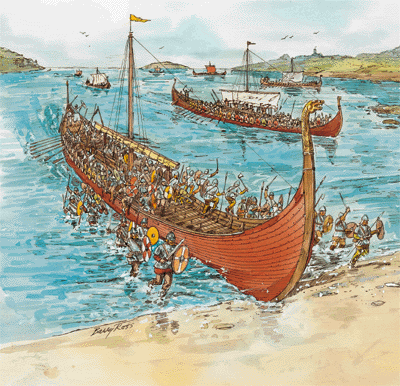
Two young teens...one boy...one girl...you can imagine where this one's going. And yet...and yet it's so very wonderful. It's full of adventure and danger and romance and life and death. What is this danger I speak of...the Vikings. And where the Vikings go...there is sure to be danger and adventure and blood and gore and life and death and drinking.

This novel is so many things: great coming of age story, great romance, great adventure, great historical fiction, nice exploration of religion and spirituality.

http://www.jonisensel.com/numbers.html

Let me just say this too...If I had read it before October 15th....I SO would have nominated this for the Cybils! It kind of makes me sad to see it not on the list.

© Becky Laney of Becky's Book Reviews

Friday, November 14, 2008

My Mother Is A French Fry...


Sydor, Colleen. 2008. My Mother Is A French Fry And Further Proof Of My Fuzzed Up Life.

I'll try to keep this one as short as possible. The jacket calls our heroine, Eli Smythe, "quick-witted, tightly coiled, sarcastic." I call her a whiny self-centered brat. So I didn't much care for this one because of the narrator's voice. I hope that Eli is just going through a phase, I'd hate to think she'll be like this when she's thirty.

My Mother Is A French Fry and Further Proof of My Fuzzed-Up Life is somewhat typical YA fiction. A teen girl whose relationship with her mother is very strained, very heated, very argumentative. A teen girl who is embarrassed by her mother--and to some extent her father--particularly because her mother is pregnant. And the fact that she's pregnant is proof that her parents--gasp--have sex. Something she doesn't want to forgive her parents for. How could they!

It's also typical in that the heroine's own first relationship is explored. Though how her boyfriend, JG (Jeffrey Geoffrey) puts up with her is beyond me.

Not everything in the book is annoying. There are some admittedly humorous bits. But generally this one wasn't to my liking. Of course, that doesn't mean that you won't like it. You may enjoy Eli's narrative more than I did. And you may be able to relate to it more than I did. And you may develop a crush on JG which could help you fall in love with the book.

© Becky Laney of Becky's Book Reviews

Wednesday, November 05, 2008

Mousetraps


Schmatz, Pat. 2008. Mousetraps.

Mousetraps is a busy little book. In a way it reminds me of Sweethearts by Sara Zarr. And it feels like a cousin once or twice removed from a Barry Lyga novel*. At the heart of this novel, is the story of an almost-friendship. Once upon a time (back in elementary school) there was a girl, Maxie, who was quite good friends with a boy, Roddy Nash. After a violent (bullying) incident in middle school (seventh grade, I think), Roddy moves away...only to resurface several years later in high school. He is now calling himself Rick. Maxie is shocked to see him in her chemistry class. Not happy. Not upset. Just shocked. You see in the last year (or two) when she'd known him she had begun to distance herself from him. His nerdiness was becoming more apparent--or perhaps, she just began caring that he was a bit different from the other kids.

Now that he's back, Maxie is trying to decide what their relationship--if any--should be. Just lab partners? Just friends? Just friends outside of school? Boyfriend and girlfriend?

As I said, this is a busy book. There are many different complicating layers to the basic plot. Her cousin, Sean, and his biracial jock boyfriend, Dexter, who is still in the closet. Her best friend, Tay, who is becoming more and more distant as she experiments with drugs. And there are the assumptions and burdens of memory. How traumatized was Roddy from all those years before? Is Rick gay? Is Rick in denial? Does Rick have an anger problem? Now that it's written out, it doesn't seem like those additional story lines would cloud up the text...but it just felt like this was too much of a "problem" novel.

I think the book tried to do too much in a way. (Especially towards the end.) Yes, life is complicated. Yes, people often have more than one problem to deal with at a time. But the characters and the plot seemed to only have dimensions because of the problems. Take away the problems, and what you're left with are very flat characters. The problems define the characters. That isn't true of everyone. There are a few that are multi-dimensional.

Another review of Moustraps: Amanda,
*I'm thinking of The Astonishing Adventures of Fanboy and Goth Girl.

© Becky Laney of Becky's Book Reviews

Monday, September 01, 2008

Dodger and Me


Sonnenblick, Jordan. 2008. Dodger and Me.

Dodger and Me is a gem of a book and the beginning of a new series by Jordan Sonnenblick. The book stars Willie Ryan and his mostly-always best friend, Dodger. Here's how the flap reads, "What would you do if your best friend was: 1) imaginary, 2) an oversize blue chimp in surfer shorts (Potentially embarrassiiing, but, hey, no one else can see him, right?, 3) Proposing a plan to help you improve your life, 4) Did we say imaginary?, 5) Driving you crazy?!?!" And the back reads, "Okay, I was unpopular. But was I so amazingly unpopular that I needed a magical blue chimp for a best friend? Quite possibly."

Here's how the book itself begins, "Look, if I'm going to tell you everything that happened between me and Dodger, you have to promise you won't tell. And you won't laugh. And you won't mention any of this to dumb old Lizzie from England. I have a weird feeling she wouldn't appreciate it. Not that I care what she thinks. Anyway, I guess I'll have to trust you on this, right? Plus, I'm busting to tell somebody about it. So here goes."

Willie Ryan is a baseball loving kid. Of course it's a slight problem that baseball doesn't quite love him as much as he loves it. He's not all that great a player. He wants to be, no doubt about it, he wants it more than anything. But he has a tendency to goof up when he's up to bat. And this is how we first meet him. And how Willie first meets Dodger.

After losing the game, Willie is off on his own. Ignoring his mom's warnings, he is daring enough to take a shortcut through the woods. While there, he picks up a piece of litter. Not something you'd think was life-changing, right? But this piece of trash isn't ordinary. For out springs Dodger--the blue chimp that isn't quite a genie, but passes for one in an emergency. And the powers that be have deemed Willie an emergency. His friendless condition that is. That and the fact that his mom is the most overprotective mom on the planet--or so Willie thinks.

Once Dodger makes his appearance, there is no doubt about it...Willie's life will change. But will it be for better or for worse?

The book is enjoyable. And it's funny. It's the right blend of what a book is supposed to be.

© Becky Laney of Becky's Book Reviews

Monday, August 18, 2008

La Petite Four


Scott, Regina. 2008. La Petite Four.

Lady Emily Southwell, trained from birth to be the refined daughter of a duke, did the unthinkable. (2)

I had every intention in the world of loving this one. I did. When I heard there was a YA Regency Romance being published, I wasn't just vaguely interested, I was happy. I was eager. I love Regency romances, mostly. Austen. Heyer. Quinn. I'm so there. (Jane Austen, Georgette Heyer, Julia Quinn.) Another fun Regency title (for adults) that I discovered this year was Rules of Gentility by Janet Mullany. But this one just felt off for me. It felt a bit modern, a bit rushed, a bit silly, a bit underdeveloped. It's the story of four best friends who are preparing for their first season. Emily. Daphne. Priscilla. Ariadne. But for me, these characters weren't distinct enough to distinguish among. They all blurred together. Even Emily.

But even more problematic for me than the indistinguishable heroines is the plotting. It's flimsy at best. When Emily is told she's to marry a gentleman, Lord Robert, she takes an instant dislike to him. With no real reasoning, no real logic, she comes to the conclusion that Robert is a criminal. And she seeks to convince her three friends of this as well. Here we have the "mystery" element of the story. But for me, I had no proof other than the whim of an immature and often whiny "child" (disguised as a young woman) that Robert was a suspicious-- no, dangerous--character. Her only reasoning a) she doesn't want to get married b) he won't let her go to a Ball c) he thinks her paintings are silly. I can see why she might dislike him. But you can't logically jump from "I don't like you." to "I think you're a criminal." (There are plenty of people that I've met through the years that I've disliked based on first impressions. I've never once leaped to the conclusion that they must be a criminal mastermind. And then proceeded to try to prove it to have that person arrested.) The whole novel revolves around this must-prove-Robert-to-be-a-criminal plot. For this reader to find the book enjoyable, believable, there needs to be clues laid throughout the book--undeniable proof that crimes are being committed and clues and motivations and intent presented. There's none of that until the grand finale of a climax.

So as a mystery, it is a bit weak. When it comes to romance, well, it's a bit sudden and rushed as well. There is a hero--other than Robert--involved, but he seems to pop up and disappear erratically. He's a convenient hero. But he goes from mere acquaintance to soul mate a bit too quickly and without too much development. There is no wooing really. No scenes of courtship. Again Emily is just making a giant leap. My guess is that this hero-she-proclaims-to-love-truly is just a way to escape (and irritate) Robert.
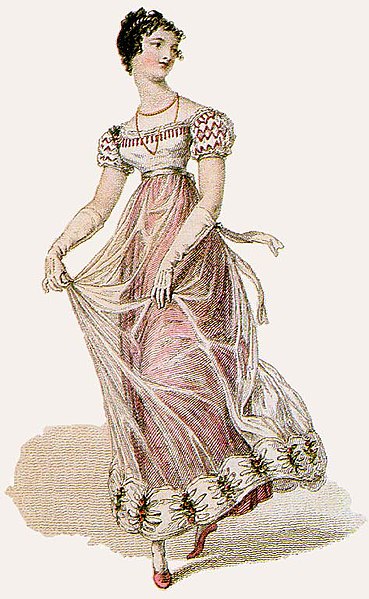
Initial thoughts on the cover: I know the cover is nice, pink and frilly. But it doesn't work for me at all. I see this cover and I don't think "Regency England" I think prom. (Or perhaps I think bride's maid. Or Barbie.) From the half-decapitated model with the glistening gloss on the lips to the wispy wavy hair and the strapless--yes, strapless--pink ball gown. It looks like something from David's Bridal. When I think Regency, I think empire waist gowns. I think most people do. True, I just did a fact check which said that waistlines were lowering and tightening by around 1825, but still this dress doesn't feel right for the era. This image is, for example, from 1823. I don't think the cover will turn away many readers, in fact it may draw in modern readers. But for me, personally, the cover did some damage to the legitimacy of the book. I don't blame Scott for this, however, since covers are rarely the design or brainchild of the author. Her other novels, all adult Regency novels, have fashion appropriate enough for the era.

For fans of Luxe and Rumours, this may work as "historical" fiction. But it didn't quite work for me.

Note: There are three factors that might bias my review a bit. 1) The cover. It's awful. 2) I read this book over a period of three weeks. A chapter or two at a time. This can taint a reading. It might be why I found the characters so indistinguishably whiny. 3) I've read several Austen novels, several Quinn novels, and several Heyer novels this past year. It's hard to go from the really really good stuff to something that feels a bit mediocre without making some comparisons. But one could easily make the argument that a 12 to 14 year old is a lot less likely to have a familiarity with Austen and Heyer and therefore would not find this as lacking.

The good news? I am almost exclusively finding positive reviews (on the blogs) for this one. Apparently, I'm the only one that read this and had a Miss Cranky Pants reaction.

Other reviews: The Story Siren, Genre Go Round, Trainspotting Reviews,

© Becky Laney of Becky's Book Reviews

Saturday, August 16, 2008

Memories of Babi


Siegal, Aranka. 2008. Memories of Babi.

A collection of nine short stories--loosely connected much in the same way as A Long Way From Chicago works--about a young girl spending time with her grandmother. Set in pre-World War II Ukraine (near the Ukraine/Hungary border really), the stories feature a Jewish family living side by side with their gentile neighbors in this small mountain community. The stories are fictional but based on the author's childhood memories of her time with her grandmother. The stories have little life lessons packed into them, but not in a preachy way.

I read this book about a month ago. So the details are sketchy when it comes to individual stories. But I do remember liking the book in a general way.

The author is Aranka Siegal who won a Newbery Honor for her autobiography Upon the Head of The Goat in 1982.

© Becky Laney of Becky's Book Reviews