Showing posts with label Death and Dying. Show all posts

Thursday, October 27, 2022

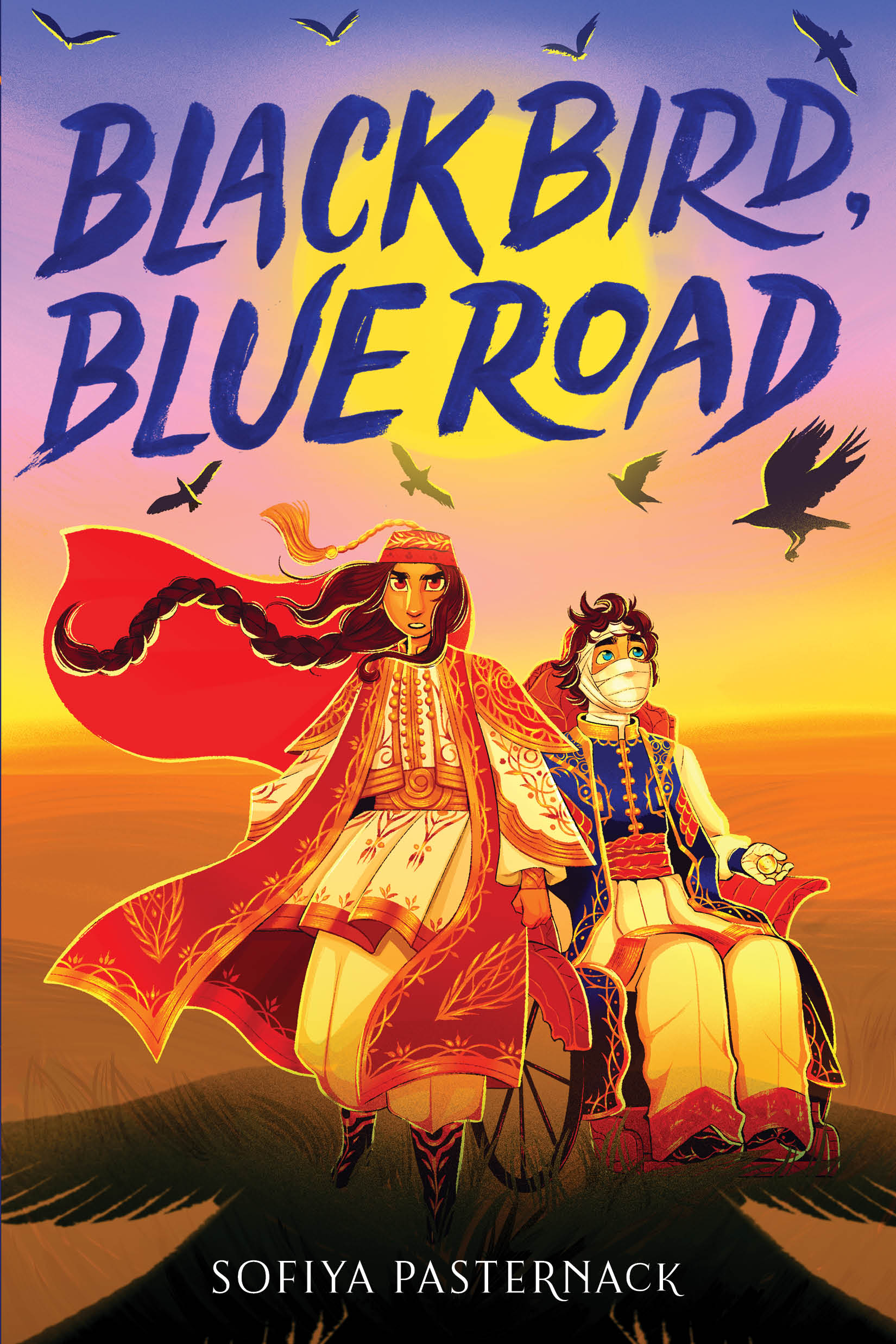
139. Black Bird, Blue Road


Black Bird, Blue Road. Sofiya Pasternack. 2022. [September] 320 pages. [Source: Library]

First sentence: Hello! Come in. Sit down. Don't be scared. This is a very important story, after all, and you shouldn't be afraid to hear it. It's from a very long time ago. A thousand years! In thos days, they used to begin their stories like this: There was one, there was no one. So that's how I'll begin, too. There was one. A girl. Ziva bat Leah, the daughter of a judge and the sister of a prophet. There was no one. No one to believe that Ziva could do the things she set out to do--like find a cure for her brother's illness, or master a demon, or sway the Angel of Death, whom she called malach ha-mavet. Ziva did two of those things, dear listener. Which two? Well. 

Premise/plot: Historical fantasy starring Jewish characters [and community]. Ziva, our heroine, loves, loves, loves her twin brother, Pesah. Everytime someone tells her that her brother is dying, she reacts. NO. No. No. A thousand times no. She is not ready to give up on her brother. He may have leprosy. He may have a gurgling, hagging-nagging cough, but she is not ready to give up on him. She will stand by his side fighting for a cure, clinging to any and every hope for a cure. This ultimately leads her to run away from home--with her brother--in search of a cure. It is an incredible journey. I will refrain from going into specifics of that journey. BUT MY OH MY this book was good.

My thoughts: The first few pages of the prologue grabbed my attention. The first part of the novel (proper) were much slower, in my opinion. But once these two start on their [runaway] journey, this one really takes off. Once these two encounter the half-demon (there was a Jewish name but I don't have a copy of the book in front of me and I didn't take actual notes), Almas, and these three set off in search of a city [Luz] where they can find immortality, the book becomes impossible--absolutely impossible--to put down. They are on a flight to out-run the Angel of Death.


© 2022 Becky Laney of Becky's Book Reviews

Monday, January 24, 2022

13. Big Fish


Big Fish. Daniel Wallace. 1998. 192 pages. [Source: Library]

First sentence: On one of our last car trips, near the end of my father's life as a man, we stopped by a river, and we took a walk to its banks, where we sat in the shade of an old oak tree.

Premise/plot: William Bloom seeks to make the most of his last opportunity to get to know his father--really, truly, honestly--in Daniel Wallace's Big Fish. Edward Bloom is a storyteller, a lover of jokes; he has a story (and then some) for every single occasion. It doesn't matter if everyone has heard them hundreds of times--he LOVES to tell stories. But, William Wallace feels like his father is mostly a stranger. His tales about his own life--Edward's tales about his own life--well they sound more like tall tales (epic exaggerations) than truth. Can William peel back the layers of his father's stories to find the real man? Does he even want to when all is said and done?

My thoughts: I love, love, love, love, love the movie. I do. I discovered it late--only last year--but I have seen it three or four times now and I just love it. It is fantastical, strange, bizarre, and ultimately satisfying. The book and film are quite different. The tall tales are there, but they are different. The book spins tales that the movie doesn't have; the movie spins tales that the book doesn't have. I think the spirit of the book is captured in the film. But the book is perhaps even more ambiguous than the film.

I found the movie to be more satisfying than the book. That being said, the book is definitely readable. It is a quick read--a literary read. It is a blend of tall tales and more serious chapters. There are four chapters titled 'My Father's Death.' These are chapters where William seems to be preparing himself mentally, emotionally, spiritually, to handle the inevitable death of his father. He's imagining how it will play out.


© 2022 Becky Laney of Becky's Book Reviews

Monday, September 27, 2021

123. Ground Zero


Ground Zero. Alan Gratz. 2021. [February] 336 pages. [Source: Library]

First sentence: Brandon Chavez was in trouble.*

Premise/plot: Ground Zero has two protagonists and two time periods. Brandon Chavez, one of our protagonists, is nine years old. He's accompanying his dad to work; his dad works at Windows on the World, a restaurant located on the 107th floor in the North Tower of the World Trade Center. The day is September 11, 2001. Reshmina, our other protagonist, is living in Afghanistan with her family in the present day.** Her twin brother, Pasoon, is wanting to join the Taliban. She is angst-y. She doesn't want him involved in the war...at all. She doesn't seem to think the Taliban or the Americans are the "good guys." There are no "good guys." When the fighting hits really close to him--literally--and brings her into contact with an injured American soldier (named Taz), Reshmina has some tough decisions to make. What she decides may decide the fate of her village and her family.

My thoughts: I spent most of the book wanting to curl up into a ball and moan. Reading it felt like I was continually getting punched in the gut again and again and again. With an occasional stab in the heart. If you are not mentally and emotionally bruised after reading this....tell me how you did that...I'm curious.

Both stories are incredibly intense. There's a definite sense of urgency both within and without (if that makes sense.) There is an urgency in the fictional story. In particular with Brandon's story. Readers most likely will know that it is literally a race against the clock once the first plane hits. Brandon, of course, like all the other characters doesn't realize this. His initial urgency is to get back to his dad--even if his dad is a dozen floors above him when the plane hits. There is urgency in the present day story as well as a battle unfolds and civilians are caught up in it. But there is also an urgency that the reader experiences. At least this reader experienced. Almost the equivalent of ripping a band-aid off. I couldn't allow a slower pace--I just couldn't handle it. The only hope for surviving the utter and complete heartbreak was to keep a steady pace. Page after page, keep turning, keep looking ahead. I couldn't imagine just reading this one chapter a day for weeks. (I read this in two days).

Both stories have substance and depth. Both unfold at a compelling pace. There is some emotional reward for investing in both stories. But for sensitive readers this might be too much to handle.


*The text literally says Brandon Chavez wn trouble. I did my best guess as a reader and interpreted that to mean Brandon Chavez was IN trouble. I suppose it could be "won" "win." But neither made sense in context.

**Before the withdrawal of American troops in Afghanistan. So before the summer of 2021.

© 2021 Becky Laney of Becky's Book Reviews

Monday, September 13, 2021

112. The Shape of Thunder


The Shape of Thunder. Jasmine Warga. 2021. [May] 288 pages. [Source: Library]

First sentence: I like learning things. Especially about math and science, because they help explain why the world is the way it is. A famous mathematician once said, “Mathematics is the music of reason.” I’ve always believed that. The best thing about math is that it makes sense. The actual best thing about math is that everything adds up, all neat and in order.

Premise/plot: Cora and Quinn were best, best friends. But they haven't spoken to each other in months--almost a year. Quinn is at a loss for words knowing that there simply aren't any that would suffice. And Cora? Well, Cora doesn't want to hear anything Quinn has to say. How could she? Something is keeping these two apart--and time alone will tell if these two can find a way back in each other's lives.

Quinn becomes fixated with the idea of time travel. If she could just go back in time and STOP the events of that one fateful day then maybe life would be "fixed" again and everyone could move forward. But if she's going to invent a way to time travel, well, she'll need help. And who better than Cora? She's smart and motivated. Cora may want to time travel just as much as she does.

But how do two girls forever-united, forever-separated invent a way to go back in time????

My thoughts: The Shape of Thunder traces the after-effects of a school shooting. Quinn's brother, Parker, was the shooter. Cora's sister, Mabel, one of his victims. Both are gone now. Yet Cora and Quinn still live next door to each other...forever reminded of how things used to be and how things can never be again.

It is told in alternating chapters. I will say that I thought Cora's family was way more developed than Quinn's family. The characterization is excellent but a bit uneven. I really loved, loved, loved Cora's family--her father and grandmother. Quinn's family isn't that developed--bare bones and more stereotypical than not. I felt that Quinn was very isolated--and not by choice. In a way, this makes Quinn more sympathetic than she might otherwise be. It is easy to pity her because things have been wrong for years in that household.

It is an emotional read, certainly not for everyone. But definitely one that is well written.

Quotes:

“The shape of thunder,” I repeat. I reach for my notebook, and I scribble the quote. I put asterisks around it, which is what I do whenever I’m taking notes in class and my teacher emphasizes a fact so much that it’s obvious it will be on the next quiz.
There’s a faint ringing in my ears. Thunder. Perhaps this is the thing I’ve been missing.
The shape of thunder. What a strange phrase. It doesn’t quite make sense....
It’s more than contradictory; it’s impossible. A thing that doesn’t actually exist, but possibly could. An impossible thing that could actually be possible.
Like finding a wormhole. Like time travel.
Dad points at my notebook. “You like that, huh?”
My heart is racing, but I’m trying to act cool. “It’s a neat quote.”
Dad gives me a knowing look. “I think so, too.”
I clutch my notebook and the book of poems to my chest. “Dad?”
He startles from whatever thought he was having. “Hm?”
“Thank you for the book,” I say. “And for the . . . story.”
Dad grins wide enough that I can see his front two teeth that are crooked. Mabel used to love to tease him about them, but I’ve always liked the way they are. It’s like I wouldn’t have even known they weren’t straight if it hadn’t been pointed out.
And that’s how I feel about Mom leaving. I want to tell Dad that, but I don’t know how without sounding really strange.

© 2021 Becky Laney of Becky's Book Reviews

Sunday, August 22, 2021

91. In the Wild Light


In the Wild Light. Jeff Zentner. 2021. [August] 432 pages. [Source: Library]

First sentence: The human eye can discern more shades of green than of any other color. My friend Delaney told me that. She said it’s an adaptation from when ancient humans lived in forests. Our eyes evolved that way as a survival mechanism to spot predators hiding in the vegetation. There are as many tinges of understanding as there are hues of green in a forest. Some things are easy to understand. There’s a natural logic, a clear cause and effect. Like how an engine works.

Premise/plot: Cash Pruitt is offered a once in a lifetime opportunity: a scholarship to an elite boarding school where his best, best friend, Delaney Doyle, is attending. But it will mean leaving everything--and everyone--he loves behind for a few years. It will mean moving from Tennessee to Connecticut. Just at a time when he wants to be with his Papaw the most. But...ONCE in a lifetime. And everyone is telling him that he'd be a complete fool to pass this up...

In the Wild Light is a coming of age novel that chronicle's Cash's (first) year away at school. It is a GROWING time but also a grieving time.

My thoughts: The characters are oh-so-human. It is an emotional roller coaster of a book. It's tough in some places because the emotions are so genuinely raw. I dare anyone--who's lost a grandparent--to not *feel* that chapter. Not that every page of this one is about punching you in the heart. The strength of this one is in the writing--the narrative--and the characters. BOTH are so well done.

Quotes:

She’s tried to explain how her mind functions, without success. How do you tell someone what salt tastes like? Sometimes you just know the things you know. It’s not her fault we don’t get it. People still treat her like she’s to blame.
Some aren’t okay with not understanding everything. But I’m not afraid of a world filled with mystery. It’s why I can be best friends with Delaney Doyle.

A ray catches a crack in the windshield and illuminates it, a tiny comet. I’ve always loved when the light finds the broken spots in the world and makes them beautiful.

“I got an offer to go to a boarding school up north.”
My heart plummets. With all the press she’s been getting, I knew this day would come.
I swallow, then nod for her to continue. “Oh wow.” The unease in my voice is obvious to my own ears even as the words leave my lips.
“Middleford Academy. In New Canaan, Connecticut.”
“Sounds fancy.” My head swims.
“It’s one of the top five prep schools in America. This lady from Alabama named Adriana Vu, who made hundreds of millions in biotech, went to Middleford. She donated a shitload of money to the school to fund this amazing lab and STEM program. She contacted me and said she’d talked to Middleford and she’d pay for me to go there.”

Ever since I first became aware that the world contains mysteries and incomprehensible wonders, I’ve tried to live as a witness to them. As we came to know each other, I began to see something in Delaney that I’d never seen in another person. I can’t name that thing. Maybe it has no name, the way fire has no shape. It was something ferocious and consuming, like fire.
And I wanted to be close to it, the way people want to stand near a fire.

Where’s my Tess at? No Longmire tonight?” Tess is short for Tesla, which is what he started calling Delaney after she told him that Nikola Tesla was her favorite scientist. Before that, he called her Einstein.
“Tending her half brothers.”
“Y’all are like to have ruint my Saturday night.

Life has given me little reason to feel large, but I see no need to make myself feel smaller.

“Death’s all around us. We live our whole lives in its shadow. It’ll do what it will. So we need to do what we will while we can.”
With that, our conversation dwindles.
I rock and feel on my face the caress of the cool evening air, scented by the damp green of broken vines and cut grass. Beside me, Mamaw and Papaw hold hands but don’t speak.
Above us is an immaculate chaos of white stars and drifting moonlit-silver clouds. I remember how I would sit under the sanctuary of the night sky, into the late hours, waiting for my mama to get home. Or to escape her dopesick moaning and thrashing. Or to avoid the red-rimmed, whiskey-fogged glare of a new boyfriend. Or because I needed to feel like there was something beautiful in this world that could never be taken from me.
Papaw coughs and coughs. Eventually, he collects himself.
I listen to his shallow, uneven respiration. Ask me to number the breaths I wish for you. One more. Ask me a thousand times. The answer will always be one more

I thought the predawn tranquility would help me find some peace. But the quiet is just another clamor in my head, calling me in every direction I can’t choose between.

This must be what it’s like to die. You look around you and see how much of what you love you leave behind.

Delaney nestles herself into my side and asks me, “If you could know everyone who’s ever loved you, would you want to know?”
I think about my answer for a few moments. Would I? Would it be better to know that someone you never thought loved you did love you? Or would it be worse to know that someone you always thought loved you didn’t?
It’s not a question you can answer, like so many she poses, and I go to tell her so. By the time I do, though, she’s sound asleep—soon twitching and jerking as her slumber deepens. Careful not to rouse her, I pull a hoodie out of my backpack and drape it over her. I sit with my ghostly reflection in the finger-smudged window for company, as the new and sprawling American countryside blurs past us in the darkness.

We try to put new students with other new students.” Yolanda scans a paper. “So…Cash. You’ll be rooming with Patrick McGrath III—he goes by Tripp. He’s from Phoenix, Arizona. His father was actually just elected to the US House of Representatives.”
My newly full stomach roils. Hope you’re a good guy, Tripp. Sounds like you’re a rich and powerful one.
“Now for you, Delaney.” Yolanda leafs through her papers. “Here we go. Viviani Xavier. I think I’m saying that right? The X is a sh sound. She comes to us from Rio de Janeiro, Brazil.”
“You better brush up on your Spanish,” I tell Delaney.
“They speak Portuguese in Brazil,” Delaney says. “It’s the language most spoken in South America.”
“Viviani speaks excellent English,” Yolanda says. “You’ll have no trouble communicating.”

“I think of poetry lovers as people who love beautiful things.” He stops to catch his breath. “You love the beauty in this world. Ain’t a reason I can think of you don’t belong in a poetry class.

I’d thought about how funny it would be if when you got to heaven, God could give you a printout with all of your life’s vital statistics. How much hair you produced. How many colds you defeated. How many times you skinned your knees. How many nightmares you endured. How many pancakes you ate.
Every brave thing you did.
Every heartbreak you overcame.
Everyone you mourned.
Everyone you ever loved.
Everyone who ever loved you.

Before I left, Papaw told me that if I’m ever hanging out with a group, I should be the one to suggest getting ice cream, because it’ll always be a good time and it’ll be my doing. So before it’s time to leave, I do exactly that, and he’s right.

But we don’t choose our dreams; they choose us. So instead I dream of doors sealed by death and wake up sweating in the mute darkness, my roommate sleeping in blissful oblivion a few feet away and a world apart.
Memory is a tether. Sometimes you get some slack in the line and you can play it out for a while. You forget and think you’re free. But you’ll always get to the end and realize it’s still there, binding you, reminding you of itself, reminding you that you belong to each other.

Poetry is one of the highest artistic achievements of humankind.
“I told you that there are many things that poetry won’t do. But there are many things poetry will do. Poetry makes arguments. It presents cases for better ways of living and seeing the world and those around us. It heals wounds. It opens our eyes to wonder and ugliness and beauty and brutality. Poetry can be the one light that lasts the night. The warmth that survives the winter. The harvest that survives the long drought. The love that survives death. The things poetry can do are far more important than the things it can’t.”

Life often won’t freely give you moments of joy. Sometimes you have to wrench them away and cup them in your hands, to protect them from the wind and rain. Art is a pair of cupped hands. Poetry is a pair of cupped hands.”

Poets use language in ways I’ve never considered, to describe things I thought defied description.
Dr. Adkins picked poets who write about the world. About rivers and fireflies and formations of geese and deer and rain and wind. Things I love.
By the time I’m done reading at least one poem out of each book (usually more), I’m experiencing a deep calm, like I feel after being on a river, under the sun, in the wind, feeling the spray off my paddle. For those brief moments strolling through the forest of words, everything had disappeared. Papaw wasn’t dying while I was far from him at a place where I didn’t belong, always on the precipice of disappointing him. I had stolen moments of joy from a hungry world that devours them and protected them for a while in cupped hands.
I sit with the feeling for as long as I can before it fades and loses definition, like a cloud formation.
Then I remember the second part of my assignment. To write a poem. This part makes me more apprehensive.

Vi gets to the end of her twig.
“You deserve to do what you love in life.” I pick up another twig and hand it to her.
She gives me a melancholy smile and accepts my offering. “I love my parents, but I think they don’t always know who I am very well.”
“There anything I can do?”
She snaps off a piece of the twig, reaches over, and gently sets it upright in my hair. “Let me grow apple trees on your head so every time we hang out I can have free apples.”
My entire body hums at her closeness and touch. The crackle I felt last night at the game is still present. I sit stone-still. “Anything you want.” I’ve never meant something more.

Sometimes you don’t even realize you are ravenous until you start eating. Dr. Adkins’s story has identified that feeling I get when I read and write poetry: satiety. I didn’t know to call it a hunger until now. I think about my mama. Maybe the Oxys and fentanyl were her attempted cure for a nagging craving she was never able to identify. All she knew was what killed it for a while.
While we talk, the room fills even more with the sumptuous smell of cooking. Alex’s kimchi fried rice adds to the aromatic symphony. We hear Desiree and Alex laughing and talking cheerily in the kitchen. Periodically, one will say something like Nice touch! or Never thought to do that!

Words make me feel strong. They make me feel powerful and alive.
They make me feel like I can open doors.

If only heartbreak were truly what it claims to be, it might not be so bad. But here’s the thing—your heart never gets broken quite enough to stop wanting who broke it.

When he recovers, he says, “Tell you what, Mickey Mouse. You find that right someone, and ever’ minute you spend with them is like a Hawaiian vacation. She’s out there. You’ll figure it out.”
He’s never been to Hawaii.
It feels like he’s bequeathing me an inheritance of the only wealth he possesses—his memories, his quiet joys.

Dignity dies as the body does.
He pulls off his oxygen mask, and it makes a rushing sound, like the advance of wind before a storm. “Tell you a story,” Papaw says in his pale whisper, barely audible above the noise of his mask, as he visibly summons himself from the gloaming. “You was just born. Your mama’s trailer weren’t fit for a baby, so we brought you both home from the hospital. Your mama slept in her old room. Your room.” He pauses to muster his strength and continues. “Your mamaw was wore out too. It was springtime, so I took you out on the porch and sat, just you and me, in the rocker. Had you wrapped up so tight you weren’t but a head poking out of a blanket.” He stops and gathers himself. “Watched you feel the breeze on your face for the first time. Watched you open your little gray eyes and squint out at the trees swaying in the wind. And I says to you, ‘That wind you feel on your face is called wind. Them trees you see are called trees.’ Holiest thing I ever witnessed—you feeling the wind for the first time. Seeing a tree for the first time. Speaking their names to you. Saw the face of God in you that day. Ever’ time you tell a story, it becomes a little more ordinary. So I swore I’d only tell this one the once.” He pauses once more, and with what remains of himself, says, “There was a last time I held you in my arms, and I didn’t even know it.”
He finishes, spent by this effort. He murmurs something else, but I can’t make it out. Something Mickey Mouse.
I wriggle closer to him and pull his arm over me. Let this be the last time you hold me in your arms.
I slip his oxygen mask back on him. He drifts off, and I hold his hand until it goes limp and heavy.
“I love you. I’ll always love you,” I whisper again and again to his unconscious ear, hoping he absorbs it somehow.
Hoping he takes it with him to whatever unmapped land he’s journeying to.
Hoping he returns.
If only once more.

I cried until I was empty—not of feeling but of tears.

I wish our love was enough to keep whole the people we love.

Some people can lift your heart up to the light, reading the truth of you written on it.
I was afraid that being a man meant waging war on what’s beautiful.
I wanted to love the world without taking anything from it.
He knew all this. This is what you remember of the people you love when they’re gone—the ways they knew you that no one else did—even you. In that way, their passing is a death of a piece of yourself.

I don’t know how I’ll do this. I barely managed when I was only cracked. Now I’m broken wide open.

We ordinarily encourage sharing of rooms, to teach students compromise and conflict resolution and to forge lifelong friendships. But you have certainly earned the right to a solo room.”
That sounds pretty great. “What’s the other option?”
“One of your fellow students, who currently resides in a single room, has come forward and asked to be placed as your roommate if you so choose. I believe you know him. Alex Pak. An exceptional young man, from what I gather.”
An ecstatic bloom spreads through me. “Yeah, I know Alex. He is pretty exceptional. Let’s go with that.”

I’ll tell you the truest thing I know: You are not a creature of grief. You are not a congregation of wounds. You are not the sum of your losses. Your skin is not your scars. Your life is yours, and it can be new and wondrous. Remember that.”
“Always.”
“Goodbye for now, Cash.”
“Goodbye for now, Dr. Adkins.”
“My friends call me Bree.”
“Bree?”
She looks at me.
“You said something at Thanksgiving I keep thinking about: that you didn’t inherit your mamaw’s gift for healing. But you did,” I say.

I remember first seeing her across the room at that Narateen meeting. Now we’re gazing at the lights of New York City together.
I wonder where I’d be at this moment, the smaller life I would have led if we’d never spoken.
You can feel when your mind’s building a palace for a memory. A place it lives, glowing and dancing in marble halls. A place you can visit when you need to feel less of the world’s gravity.
I feel my mind building such a palace for Delaney and me.
Sometimes I imagine the two of us at an all-night diner, drawing faces on pancakes with ketchup, drunk on each other, and laughing like nothing beautiful ever dies.
I’ll always love her.
Every wound, every hurt that brought us together—I regret none of it.

I once thought of memory as a tether. I still do, in a way. But now I also see memory as the roots from which you grow toward the sun.
The dreams of closed doors still come, but less now.
I sit with my notebook and pen in the wild light of the day’s end.
In the place where I learned the names of trees and wind, I write.


© 2021 Becky Laney of Becky's Book Reviews

Tuesday, October 06, 2015

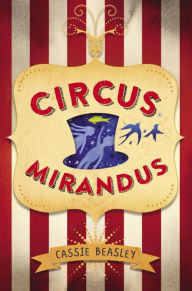
Circus Mirandus

Circus Mirandus. Cassie Beasley. 2015.  Random House. 304 pages. [Source: Review copy]

I found Cassie Beasley's Circus Mirandus to be a compelling read. I'm not convinced that it's the best book ever, ever, or even the best book published in 2015.

First, I do want to mention that I went into this book with little to no expectations. I wasn't expecting it to be wonderful, marvelous, unforgettable, just wow-wow-wow. I'd not read any reviews at all. And I hadn't paid any attention to what others were saying about the book, for better or worse. I do think when you've heard so-much-gush about a book and you've seen all the five-star-reviews that it can change your expectations, and, can at times lead to disappointment.

Second, how I think when I'm actually reading the book sometimes differs greatly from what I think about a book a week or two later after reading. (Not to mention sometimes how great the difference between in-the-moment reading reaction and a year or two from now reflection.) I want this "review" to capture both if at all possible.

As I was reading Circus Mirandus, I was hooked, for the most part. I wanted to know what would happen next. Would the Light-Bender come? What would the Grandfather ask for? While I suspected strongly that the miracle itself would not restore him to oh-so-perfect health and enable him to live forever-and-ever, I hoped that something good would come from his writing to Light-Bender. One thing I greatly enjoyed was the devotion Micah had for his Grandpa, and, his belief in magic, in the circus that he's grown up hearing about. Yes, the book is sad, I definitely found it to be so. It isn't FUN to read about someone, someone that is your everything, dying slowly and painfully. And it particularly isn't fun to read about someone being kept from being with their loved one in the last days. So there were plenty of places in this one that just resonated with pure sadness. But then there were the other scenes: the flashback scenes where readers meet the boy, Ephraim, and the bird-woman, Victoria; and the scenes where Jenny and Micah visit Circus Mirandus themselves. These balance out the sadness, to some degree, by no means erasing or eliminating it. But relieving the situation somewhat. This novel isn't without hope. Sad novels without hope get little love from me. Though I will point out that just because a novel is sad doesn't mean that I will like it. Sadness is no reason to love a novel, and sadness is no reason to automatically hate a novel either.

So as I was reading, I found it compelling. I needed to know what happened next, what happened to the characters, how it all resolved. Once I started reading it, it was the one book I wanted to be reading. I wasn't tempted to pick up any other book. (And I do usually have several going at any time.) So there is something to be said for that.

But. How do I feel days after reading it? My enthusiasm is weakening in places. That's not to say, I don't really like it. But if you'd talked to me while I was reading the book, I'd be GUSHING to say the least. Wanting to tell you how great and wonderful it was. I can't say I'm in a gushing mood right now. It was good. And I'm very glad I read it. It SURPRISED me in some ways. I wasn't expecting it to be a contemporary read. I don't know where I could have gotten the idea that it was historical. I really don't. So it was refreshing to find out it was set relatively contemporary give or take a decade or two. (His grandfather was a child during World War II.)

This is one you should consider reading. You may love it. You may not. But it's worth trying.
© 2015 Becky Laney of Becky's Book Reviews

Friday, July 04, 2014

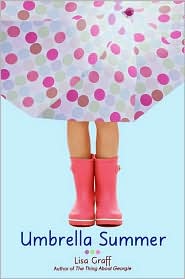
Reread #27 Umbrella Summer

Umbrella Summer. Lisa Graff. 2009. HarperCollins. 240 pages. [Source: Library]

 I have been wanting to reread Umbrella Summer for several years now. I first reviewed it in October 2009. I remember having a good, strong connection with Annie, the heroine. Every single person in the Richards family is struggling with grief--with the loss of Jared, Annie's older brother. But it is Annie whom we come to know and love throughout the book. We see the parents handling of grief, of moving on or not moving on as the case may be. We see how they parent, if they parent, Annie. All this is seen through Annie's perspective. Annie's perspective is seen through a complex range of emotions: fear, anxiety, sadness, and anger. For example, Annie has a hard time sympathizing with her friend, Rebecca, who has lost her pet hamster. Her response to Rebecca's strong grief is understandable, but, problematic for the friendship. He was just a hamster. It's not like you lost your brother. While the book is very much about grief, it is also a very good book about friendship, about what it means to be a friend, about building new friendships and restoring broken ones.

One of my favorite friendships in Umbrella Summer is Annie's friendship with their new neighbor, Mrs. Finch. Mrs. Finch is no stranger to loss, she has also lost someone close to her, her husband. Mrs. Finch and Annie both feel their losses strongly, yet, by coming together, by being honest with one another, by sharing the best memories, the best qualities about those they have loved and lost, they realize that they are beginning to heal a little, and that is a very good thing.

I also thought it was sweet that Annie and Jared's best friend have a special connection and come together as friends to truly celebrate Jared.

© 2014 Becky Laney of Becky's Book Reviews

Thursday, October 17, 2013

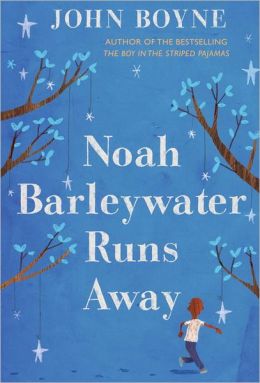
Noah Barleywater Runs Away (2010)

Noah Barleywater Runs Away. John Boyne. 2010/2012. Random House. 240 pages. [Source: Review Copy]

Noah Barleywater left home in the early morning, before the sun rose, before the dogs woke, before the dew stopped falling on the fields.

Would I have enjoyed Noah Barleywater Runs Away if I'd read it as a child? No, I'm sure I wouldn't have. Did I enjoy it as an adult? Yes. I've learned to handle those kinds of books now; I can even predict them early on. Plus I've read a certain children's classic twice now!

John Barleywater is running away from home. It becomes obvious within a few pages that this novel has some magical elements in it. By the time readers meet the talking dog and donkey, it's clear that readers are in for a fantastical treat. They may be disappointed that all the adventure happens in story format as an "old man" shares his life story with sprinkles of advice to John in the quirky corners of an old toy shop. I happened to enjoy this aspect of it. I think they have something to learn from one another; I think 'the gift' worked both ways. The old man was able to persuade the 8 year old boy to return home to his parents; and the young boy was able to give the old man some resolution, perhaps.

I guessed the reason why John Barleywater was running away from home. This is revealed to readers in several stories throughout the novel. While most of the stories concern the life of the "old man," he is able to coax the young boy into sharing stories of his own.

Quote:
'You should never want to be anything other than you are,' the old man said quietly. 'Remember that. You should never wish for more than you have been given. It could be the greatest mistake of your life.' (191)
© 2013 Becky Laney of Becky's Book Reviews

Tuesday, August 07, 2012

Kindred Souls

Kindred Souls. Patricia MacLachlan. 2012. HarperCollins. 119 pages.

My grandfather, Billy, hears the talk of birds. He leans out the open bedroom window with his head tilted to listen in the warm prairie morning.

Kindred Souls is the kind of children's book I have come to appreciate as an adult, but, the kind of book that I would NEVER have wanted to read as a child. In other words, it's one of those books. You know, the kind, the kind that introduces you to a wonderful old man AND a dog. And you have every right to be suspicious that the end will destroy your emotional well-being.

Jake, our narrator, is ten and confident; confident that everything will stay the same, confident that life is good and will stay that way. Sure, his grandfather, Billy, is eighty-eight, sure he's moved in with them. But he will live FOREVER. Don't ask him how he knows, it's enough that he believes. The novel begins with the two going on their usual walk. Billy is talking--again--about the sod house where he was born. He is wishing--again--that it hadn't fallen into such horrible condition. He is telling Jake--again--about the old days. This time Billy seems extra-sad, so Jake asks him a simple question: "How hard is it to cut a brick of sod?" And so the idea is born that a new sod house will be built...

And then there is the arrival of Lucy, a stray dog, that seems to be the perfect companion for Billy. Billy and Lucy seem to be best, best, best friends from the very first moment they meet.

This book is about an unforgettable summer.

Read Kindred Souls
  • If you like bittersweet children's books
  • If you like emotional family stories
  • If you are a fan of Patricia MacLachlan
  • If you like dog stories
© 2012 Becky Laney of Becky's Book Reviews

Friday, June 08, 2012

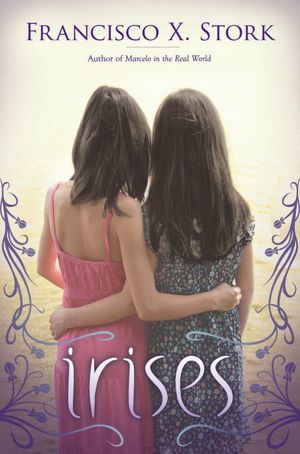
Irises (YA)

Irises. Francisco X. Stork. 2012. Scholastic. 304 pages.

From the prologue: Kate had finally agreed to pose under the willow tree.
From chapter one: Kate and her father sat in the shade of the willow tree, side by side in two wooden chairs. It was unusually hot for an April day in El Paso. 

Kate and Mary are sisters. Kate, 18, dreams of being a doctor, dreams of going away to Stanford for her college education. Mary, 16, is an artist, an artist struggling to recapture her initial joy perhaps, but a very talented, very dedicated artist nonetheless. In the first chapter of Irises, both girls receive a bit of a shock: their father, a pastor, dies. Arguably he knew the end was near for he has a great heart-to-heart with his daughter, Kate, urging her to look to her soul, mend her faith, take care of the family, etc. He tells her: "Love makes everything that is heavy light" (4). Kate, of course, not realizing the gravity of the situation, perhaps just thinking that her oh-so-strict father is just in an odd mood, quickly leaves the house and goes to study with her boyfriend, Simon. It is Mary, ever-sacrificing Mary, who is left behind to care for their Mom, who is in a vegetative state going on two years now, who discovers that her Dad has died in his sleep. While the two sisters have an aunt who lives in California, both girls know that more than likely they'll be on their own. Aunt Julia isn't exactly the most-nurturing type, after all. And Kate and Aunt Julia are like oil and water. The girls are facing at least half-a-dozen BIG, BIG decisions. And coming to agreement may not be easy...

The facts:
  • Mary and Kate have very limited funds, in part because their father's insurance is being denied; the insurance company will not make good with his insurance policy after his death.
  • Kate is having to make a decision about college; she's received a scholarship to Stanford, but taking it  will mean leaving her mother and sister behind. Is it fair to leave the care and to some extent the expense of caring for a mother in a vegetative state to a sixteen year old girl? A job that is emotionally, psychologically, financially, physically challenging for anyone.
  • Mary secretly wishes that there was a way for the family to stay together but she's afraid to disappoint Kate. 
Irises may not appeal to every reader, but, I liked it all the same. Was it too heavy or too heavy-handed? I'm not sure there is a right answer to that. Some might feel it was in-your-face with a somewhat potentially controversial (at least in some circles perhaps?) issue. The issue of when is it "right" or "ethical" to take someone off of life support. Some might feel there was too much God-talk. A few might feel there is not enough God-talk.

Irises is almost by necessity a serious-minded novel. It explores many questions while not necessarily giving ready-made answers to those questions. At least not ready-made-answers for every-single-person. What does it mean to be in a family? Who is in your family? Can you walk away from family without looking back? Is it right to ever turn your back on your family and put yourself first? What is love? How do you know you love someone? Does love always mean making sacrifices? Can you love someone and by your choices cause them hardship? Can you love someone and still love yourself more? By always putting yourself and your needs and wants first are you selfish? Is it always wrong to be selfish? What's the difference between being true to yourself and following your dreams and ambitions and being a horribly selfish self-centered person? Does being honest about how selfish you are help redeem your selfishness in any way? Does being selfish mean indulging your HUGE ego?

The rest of the review will be spoilerish, so I'll go ahead with...

Read Irises
  • If you are a fan of Francisco X. Stork
  • If you are looking for an art appreciation novel; Artistic Mary is a great narrator, and the way she uses art to help Marcus (her potential love-interest) is great. 
  • If you are looking for a YA novel that explores faith, hope, and belief
  • If you are looking for a book that addresses the complexity of what it means to be sisters
  • If you are looking for an issue book, a serious book; this one is about death, dying, grief, letting go, making sacrifices, reaching hard decisions, etc.
  • If you're looking for books with a Texas (West Texas) setting.

If you read the book jacket, you'll learn that there are three men in the picture. Two relate to Kate, one to Mary. I definitely don't want to spoil the book for anyone, but, I have to talk about one of the men: Andy.

S
P
O
I
L
E
R

Reverend "Andy" Soto was certainly charismatic in an oddly appealing and equally revolting way. When readers first meet him, he seems very dynamic, very charismatic, very friendly, very much a good guy. And yet. And yet. His true nature is revealed through the course of the novel. And he's so very, very, very slimy. There are some warning signs we can pick up on as readers--or adult readers may pick up on--but it isn't surprising that Kate doesn't quite see him clearly. 

Is he 100% evil? NO! That's NOT what I'm saying. Though his tact could use a LOT of work, (I hate to think what his bedside manner would be if visited the sick or dying or the family members of the sick or dying.) Some of his advice was actually good advice. Some of what he had to say needed to be said...by someone, by anyone.

M
O
R
E

S
P
O
I
L
E
R
S

I definitely found his EGO to be revolting. He was young, just twenty-two, and ambitious and selfish, and all ME, ME, ME, I LOVE MYSELF. And the way he behaved with Kate, well, it was a bit shocking or surprising. You would think that he'd learn somewhere along the way that inviting an eighteen year old girl, a member of your congregation, into his apartment to spend the night even if it was just "talking" or mainly talking...after his advances were halted...by her...with an apology for sending mixed signals. I do think he plays an extraordinary part in the novel. Mainly by mirroring to Kate the extremities of selfish ambition and pride and ego. His "you should totally do this without feeling guilt in any way whatsoever" attitude actually was a BIG, BIG wake-up call to Kate. I just LOVED her confrontation with him!!!! I was cheering her on!!!! Tell him, tell him, TELL HIM!

© 2012 Becky Laney of Becky's Book Reviews

Tuesday, March 13, 2012

Under the Mesquite (YA)

 Under the Mesquite. Guadalupe Garcia McCall. 2011. Lee & Low. 225 pages.

I am standing just inside
the doorway, watching Mami talk
to the television screen.
As the latest episode
of her favorite telenovela unfolds,
the soap opera drawing her in,
the skins from the potatoes
she is peeling
drop into her apron
like old maple leaves...

Lupita is the heroine of Guadalupe Garcia McCall's verse novel Under the Mesquite. It's an emotional coming of age story. Lupita struggles with the ordinary things of growing up, it's true, but she does it all the while watching her mother die of cancer. She does it while trying to be both mother and father to her younger sisters and brothers. She becomes an adult all too soon as she tries to cope with the devastating news--the diagnosis, the treatment, and the cure that just didn't last long enough. Where does she find the strength to face the day? How does she hold it all together? How does she keep things together enough with her family? Well, it's a mystery to her too. But taking those drama classes sure does seem to be helping. And her coach wonders why she can cry on demand...

If you're looking for an emotional 'cancer' book that is more than just a cancer book, then Under the Mesquite may be just what you're looking for.

Read Under the Mesquite
  • If you're looking for a good multicultural read
  • If you're looking for an emotional book with very human characters
  • If you're looking for a good verse novel

© 2012 Becky Laney of Becky's Book Reviews

Tuesday, January 17, 2012

The Fault In Our Stars (YA)

The Fault In Our Stars. John Green. 2012. Penguin. 336 pages.

Late in the winter of my seventeenth year, my mother decided I was depressed, presumably because I rarely left the house, spent quite a lot of time in bed, read the same book over and over, ate infrequently, and devoted quite a bit of my abundant free time to thinking about death. 
Whenever you read a cancer booklet or website or whatever, they always list depression among the side effects of cancer. But, in fact, depression is not a side effect of cancer. Depression is a side effect of dying. (Cancer is also a side effect of dying. Almost everything is, really.) 

Hazel, our heroine, is dying of cancer. When she ever-so-reluctantly attends a cancer support group, she meets Augustus Waters. After these two meet, well, both have reason to want to live. Augustus definitely loves her and wants to be with her. She's slightly more reluctant because she gets caught up thinking about the future, how there can be no future, since she could end up dying in a matter of weeks, months, whatever. She would rather hurt him now--by refusing to be with him--than hurt him later by her death. But a few things happen to change her mind, to cause her to open her heart and mind to living life in the present.

It's a bittersweet romance. But bittersweet in a good way. Much of the novel does deal with serious subjects--like death, dying, questioning the 'meaning' of life, the 'point' of it all. But it's not without its lighter moments--like the lonely swing set. It's a sad novel, to be sure, but it's not without hope.

I liked this one. I'm not sure that I LOVED it. (Peter Van Houten annoyed me greatly even when he wasn't being super-cranky. I didn't find his book, his writing, oh-so-wonderful like Hazel does. I thought he was obnoxious from the start.) But I definitely found this one worth reading. The book is very well-written. And the dialogue between these two was great.

Read The Fault In Our Stars:
  • If you love John Green, if you've enjoyed his previous books
  • If you are looking for a bittersweet all-too-realistic, all-too-heartbreaking romance
  • If you are looking for a good YA book with plenty of heart (don't mistake heart for cute and sweet though)
Two of my favorite quotes:
"I'm in love with you," he said quietly.
"Augustus," I said.
"I am," he said. He was staring at me, and I could see the corners of his eyes crinkling. "I'm in love with you, and I'm not in the business of denying myself the simple pleasure of saying true things. I'm in love with you, and I know that love is just a shout into the void, and that oblivion is inevitable, and that we're all doomed and that there will come a day when all our labor has been returned to dust, and I know the sun will swallow the only earth we'll ever have, and I am in love with you."
"Augustus," I said again, not knowing what else to say. (153)

"What am I at war with? My cancer. And what is my cancer? My cancer is me. The tumors are made of me. They're made of me as surely as my brain and my heart are made of me. It is a civil war, Hazel Grace, with a predetermined winner." (216)


© 2012 Becky Laney of Becky's Book Reviews

Saturday, June 04, 2011

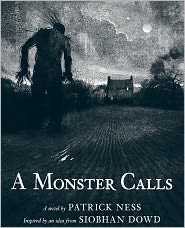
A Monster Calls (MG/YA)

A Monster Calls. Patrick Ness. Inspired by an idea from Siobhan Dowd. 2011. September 2011. Candlewick Press. 224 pages.

The monster showed up just after midnight. As they do.
Conor was awake when it came.
He'd had a nightmare. Well, not a nightmare. The nightmare.
The one he'd been having a lot lately. The one with the darkness and the wind and the screaming. The one with the hands slipping from his grasp, no matter how hard he tried to hold on. The one that always ended with--

There's a part of me that doesn't want to tell you anything at all about this book. The part that says that there is nothing I could say that would do it justice. The part that says this one is best discovered by readers in the moment. That knowing even the littlest things about it--the things the reader can conclude from the second or third chapter--would be knowing too much.

So I could simply tell you that it is beautiful and haunting and emotional and original. I could ask you just to trust me that it's worth a read. But would you believe me?

Conor, our hero, has been having nightmares. But it's the monster he meets shortly after midnight--on more than one occasion--that intrigues him the most. For it is this monster that he's brave enough to face. This monster that he's brave enough to speak with face to face. And if the monster is to believed, this is the monster that the boy called himself. This is the monster that both promises and threatens. He's got three stories--three tales--to share with the boy. But in return, he asks the boy to tell him a true story, his true story. And it is the threat of having to speak the truth out loud that causes Conor anxiety.

I could say more. I could mention the things going on in Conor's life--his daily life in his home and at school. But I really do think this is one you need to read for yourself, to experience for yourself.

© 2011 Becky Laney of Becky's Book Reviews

Wednesday, March 16, 2011

Ways To Live Forever (MG)

Ways to Live Forever. Sally Nicholls. 2008. Scholastic. 224 pages.

List NO. 1 - Five Facts about Me


1. My name is Sam.
2. I am eleven years old.
3. I collect stories and fantastic facts.
4. I have leukemia.
5. By the time you read this, I will probably be dead. 

Sam is dying of leukemia. Sam is also writing a book; a book about himself, a book with stories, a book with lists. One of his lists, for example, is about all the things he'd like to do before he dies. Another lists ways to live forever. Which includes things like "Become a vampire. Hope you don't meet Buffy" and "Find a Greek goddess and make her fall in love with you. Have her get Zeus the king of the gods to make you immortal" (92-93)

Sam isn't facing this alone. He's got his mom and dad, parents who are supportive of him when they're not busy arguing. He's got his sister, Ella, who's nice to be with...some of the time, if only she didn't throw baby tantrums. He's got his best friend, Felix, too. Felix is also dying, though not of leukemia. The two can be oh-so-honest with each other. One of the things they discuss is how Sam's book should end. Since it would be impossible for Sam to write about his own death before it happened. But it's not like they're talking all death, all the time. They enjoy living life too. Like trying to sneak in a cigarette so they know what it's like to smoke. Like trying to watch an R rated movie without getting caught by their parents.

How do you live life knowing your dying? How do you write about it when you're eleven?

This novel is a quick read, but it's a heavy one. It deals with death and dying in a raw, honest way.


© 2011 Becky Laney of Becky's Book Reviews

Saturday, January 08, 2011

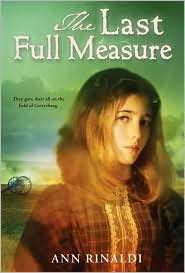
The Last Full Measure (MG/YA)

The Last Full Measure. Ann Rinaldi. 2010. [November 2010]. Harcourt. 218 pages.

"Where are you going, Tacy?"

Set in Gettysburg, Pennsylvania in 1863, The Last Full Measure is Ann Rinaldi's latest historical novel. It stars the Stryker family. Our heroine, Tacy, is fourteen. She has two older brothers and a father in the war. But during these troubling summer months, she's going to mature quickly. She'll have to having witnessed some of the atrocities of war. When the novel opens, Tacy's biggest problem is her brother, David, the brother who was unable to join the army because of his bad leg. He has been put in charge of the family; it is his duty to "protect" his mother and his sister, and to look after their home. The responsibility weighs heavily on him, transforming him into a man Tacy can barely recognize. Who is this bossy brother ordering her about? Who is this man that shouts and yells and threatens? Though, perhaps, Tacy needs someone to tell her no--for her own sake.

As the novel progresses, readers get a glimpse of the war, the battle as it unfolds. Readers see the harshness, the devastation, the madness of war. One might think that the battle itself would provide the climax of this one. That its darkest moments would be in the battle itself. But. That's just the beginning. And Tacy's darkest days come after the battle.

I found The Last Full Measure a compelling read. I read it in one sitting, in one afternoon. I enjoyed Tacy as a character. I liked her perspective. How she wasn't above questioning the world around her. And perhaps most importantly, how she wasn't perfect.

But it was a difficult read for me. I reached a point where I was like NO! Are you serious?! Why?! And after that point, it was hard for me to "like" this one. I'm not saying it's not a good book. I'm not saying that it isn't realistic. Or that it isn't well-researched. That it isn't true to the times. But still, it didn't go the way I wanted it to go.

© 2011 Becky Laney of Becky's Book Reviews

Wednesday, December 08, 2010

Chasing Brooklyn (YA)

Chasing Brooklyn. Lisa Schroeder. 2010. Simon & Schuster. 412 pages.

One year ago today I lost my boyfriend, Lucca.

Chasing Brooklyn is a verse novel, a companion to I Heart You, You Haunt Me. Both are set in the same town, the same high school. Both novels are about the (extended) grieving process. When the novel opens, a year has passed since Lucca's death.

The novel is told in two voices. Readers meet Lucca's girlfriend, Brooklyn, and his brother, Nico. Both are about to be haunted.

Gabe, Lucca's friend, has recently overdosed. His death proves just how emotionally raw and vulnerable this community still is. Since his death, Brooklyn has been haunted. Her dreams are nightmares. The dream-Gabe that haunts her is chasing her, taunting her, almost threatening her.

Nico is having troubling dreams as well--though not of Gabe. No, his brother is telling him night after night after night to help Brooklyn, to protect Brooklyn, to be there for her. So even though Nico and Brooklyn haven't had much to do with one another since Lucca's death, there's nothing he wouldn't do for his brother. So he takes the first steps and a friendship (of sorts) begins.

Is Nico what Brooklyn needs to heal? Is Brooklyn what Nico needs to heal? Is Lucca drawing them together for a reason?

The more I read of Lisa Schroeder, the more I like her work. I'd also recommend Far From You.

© Becky Laney of Becky's Book Reviews

Wednesday, July 28, 2010

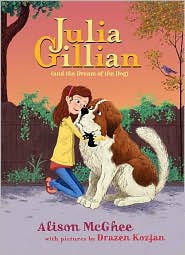
Julia Gillian (And the Dream of the Dog) (MG)


Julia Gillian (And the Dream of the Dog). Alison McGhee. Illustrated by Drazen Kozjan. 2010. July 2010. Scholastic. 336 pages.

Welcome to sixth grade," said Mr. Lamonte. "We have a great many forms to fill out, so let's get started, shall we?"

Julia Gillian (And the Dream of the Dog) is the third in the Julia Gillian series by Alison McGhee. The first two are Julia Gillian (And the Art of Knowing) and Julia Gillian (And the Quest for Joy). I love Julia Gillian. I love her best friend, Bonwit Keller. I love her dog-of-my-dreams, Bigfoot. I love how connected she is with her parents, her neighbors, her community, her school.

Julia Gillian is still uncomfortable with change. She's learned the best way is to move forward, to work past the fear, the anxiety. But it doesn't always make it easier in-the-moment. Her sixth grade teacher has introduced Julia to the concept of controlling variables. And Julia Gillian has taken his words to heart in just about every area of her life. From how to best avoid the Crazy Eights (eighth graders), to how to take care of her aging dog. Yes, Bigfoot, is getting older. And slower. And Julia Gillian isn't ready for what's coming. (I wasn't either.)

I loved this one. It was bittersweet. I have to warn you. But it was good, very good. It not only made me cry, it kept me crying. The last couple of chapters it was impossible to read without tears. To read her project for the Reading Buddy Extravaganza, it was definitely emotional!

© Becky Laney of Becky's Book Reviews

Wednesday, July 14, 2010

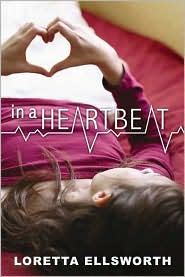
In a Heartbeat (MG/YA)


In a Heartbeat. Loretta Ellsworth. 2010. February 2010. Walker & Company. 216 pages.

I'm fatalistic. I've always had the feeling that time was running out. After 9/11, I started reading end-of-the-world type books: Alas Babylon; Lucifer's Hammer; On the Beach; The Stand. Then I started hoarding bottles of water and granola bars under my bed. Last year I spent my birthday money on two hundred batteries, which I kept in a shoe box at the back of my closet. Of course, I never intended to die.

In A Heartbeat is told in alternating chapters. Eagan, one of our narrators, has died. She was a figure skater whose death was unexpected and tragic. She was an organ donor. Amelia, our second narrator, is the one who received Eagan's heart. She's been sick for six years. Now, for the first time, Amelia has a chance to really live life. But one of the first things Amelia wants to do is learn about her donor. She wants to meet the donor's family. And with the help of her new boyfriend, Ari, she may just get her wish.

Readers meet both teens, both families. One girl is having a hard time letting go, a hard time passing over into the afterlife. The other is just learning how to live again. Just beginning to imagine the possibilities of what her life could be.

I liked this one. I liked both Amelia and Eagan. I liked seeing these two stories come together.

Also by Loretta Ellsworth: In Search of Mockingbird.

© Becky Laney of Becky's Book Reviews

Saturday, June 26, 2010

Mockingbird (MG)


Mockingbird. Kathryn Erskine. 2010. April 2010. Penguin. 224 pages.

It looks like a one-winged bird crouching in the corner of our living room. Hurt. Trying to fly every time the heat pump turns on with a click and a groan and blows cold air onto the sheet and lifts it up and it flutters for just a moment and then falls down again. Still. Dead.

Caitlin, our heroine, is grieving her older brother, Devon. But it isn't just her grief--it isn't just her father's grief--no, readers see a community grieving. How did Devon die? Perhaps that's best revealed in Caitlin's own words, in her own time.

One person whom Caitlin could always count on to understand her, to accept her, to love her was her brother. The two had an incredible bond. After he's gone, Caitlin decides she needs closure...can Caitlin find a way to do this? Can Caitlin find a way to help her dad too?

Caitlin's grief is complicated by her having Asperger's syndrome. Caitlin struggles with understanding people, reading their expressions (or emotions), relating to others. She has a difficult time empathizing. She knows how to be polite. And she tries her best to make eye contact. At least now and then to make eye contact. But it doesn't mean it's easy for her to make friends. There are so many things in life that are too messy for Caitlin to understand, to appreciate. Like colors. That's why she prefers to keep her drawings in black and white. But with the help of her school counselor, Caitlin is trying her best to cope with life, to cope with loss.

I loved Caitlin. I loved her younger friend, Michael. I loved so many things about this one.

I think Mockingbird is a compelling read, a heartbreaking one at that. It is emotional; it is intense; but it is good.

© Becky Laney of Becky's Book Reviews
Tuesday, January 05, 2010

The Dog in the Wood (MG)


The Dog in the Wood. By Monika Schroder. 2009. (November 2009). Boyds Mill Press. 168 pages.

In the distance Fritz heard again the droning of engines.

What a short but incredibly powerful little book this is. Set in Germany in the very last days of the war. It concerns a family in crisis. Fritz's grandfather is a Nazi--even though the cause may be lost, is already lost according to everyone else in the village--his grandfather clings to his beloved cause until he doesn't. One moment he's all, I'll fight to the bitter end to protect my home, my family, my land, and the next moment he's hanging--yes, hanging--alongside his wife. Afraid that the Russians will do even worse if he doesn't go this way. What's a young boy, just ten or so, to do when life as he knows it suddenly isn't. What does the Russian arrival mean for him? For his mom and older sister? Can he find a way to be strong, to make it? Is what his mother say true, is the worst really over? Or is there more horror yet to come? This one is a coming-of-age story that is ugly at times but also very compelling.

The Dog in the Wood is a harsh novel. By harsh I mean realistic. It doesn't sugarcoat the effect of war. On women. On children. On everyone. It's a very human novel as well. One of those books where you see the very human side of war, of what it does to real people (though these people are fictional), to every day people like you and me. It's a haunting story all the more so because you know its based in truth.

© Becky Laney of Becky's Book Reviews