Showing posts with label ghosts. Show all posts

Tuesday, September 27, 2022

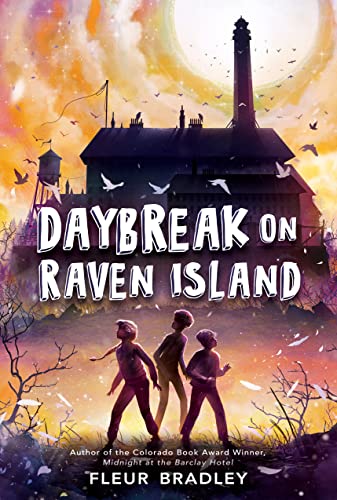
119. Daybreak on Raven Island


Daybreak on Raven Island. Fleur T. Bradley. 2022. [January] 256 pages. [Source: Library]

First sentence: Raven Island was a forgotten place. Sure, you could see the massive rock from the Pacific coast. On a clearer day, you may get a glimpse of the prison, or the empty dock that used to welcome boats and ferries. You could even see the lighthouse, once proud and bright but now extinguished. Forgotten. The ravens were perfectly fine with this situation.

Premise/plot: Seventh grade field trip gone horribly wrong--this is the premise of Fleur T. Bradley's Daybreak on Raven Island. This action thriller OR mystery/suspense novel--for middle graders--is narrated by three seventh graders: Tori, Marvin, and Noah. These three were not friends before the field trip, but the good old "buddy system" assignments has brought them together (ultimately to be terrified). So the seventh grade class is visiting an old (long, abandoned) prison thought to be haunted. This will be the first time any outsider has visited the island in decades. But on this special occasion, a seventh grade class and a film crew (for a ghost-hunting show) are on the island. Some hoping to avoid ghosts; some hoping to see ghosts. For three students (and the film crew) the adventure awaits at night... 

Tori, Marvin, and Noah miss the ferry back home and have to remain on the island overnight....where danger awaits.

My thoughts: This isn't my typical kind of read, but, I do occasionally push myself to read outside my normal comfort zone. This one offers mystery, suspense, action, adventure...and plenty of secrets. I do think this one has plenty of appeal to the thrill-seeking kid. It offers a bit of spookiness with just the tiniest dose of didactic "nutrition." I am not saying that to be mean, I'm not. A book about a prison is certainly an opportunity to talk about the justice system--past and present. 

Without a doubt this one is premise driven and not character driven. If the premise sounds good to you, likely you'll enjoy it. 


© 2022 Becky Laney of Becky's Book Reviews

Wednesday, August 25, 2021

97. Dark Waters


Dark Waters (Small Spaces #3) Katherine Arden. 2021. [August] 198 pages. [Source: Library]

First sentence: Spring is East Evansburg, and the rain poured down like someone had turned on a hose in the sky.

Premise/plot: Brian, Olivia, and Coco are friends who face DANGERS together--for better or worse. In this their third adventure, they are MAROONED on a haunted island in the middle of a lake facing off against a sea monster. Well, a monster that can hunt on sea or on land. The danger is real and the monster isn't the only threat...Olivia's dad was bitten by a snake during this sailing adventure, and they were never able to contact help before their boat...well...let's just say that the monster took a big bite out of their boat...

My thoughts: I mostly enjoyed spending more time with our heroes: Brian Battersby, Olivia Adler, and Coco Zintner. The three are joined by a classmate, Phil Dimmonds. Turns out these three aren't the only one who remember the terrifying adventures in the first book (like they originally thought).

I personally don't understand why these three children agreed to go on a sailing adventure together. Seriously. After the events of the first and second books, you would think they'd be aware of the dangers of such an adventure.

The book packs plenty of thrills and action sequences...and the ending is quite the cliffhanger.


© 2021 Becky Laney of Becky's Book Reviews

Tuesday, July 27, 2021

75. Amber and Clay


Amber and Clay. Laura Amy Schlitz. 2021. [May] 544 pages. [Source: Review copy]

First sentence: Hermes here. The Greek god -- No. Don't put down the book -- I'm talking to you. If the lines look like poetry, relax. This book is shorter than it looks.

Premise/plot: Amber & Clay is historical fiction written in prose AND verse (also exhibits with illustrations). It is set in Ancient Greece (4th century? 5th century? B.C.)

What is it about? Well, perhaps Hermes does a good job of summarizing:

I bring you a story that tells
of the quick and the dead:
the tale of a girl as precious as amber,
the tale of a boy as common as clay.
The meaning, the moral,
is up to you. We gods swap stories,
but you are the ones
who divine what they mean.

He goes on to say,

You poor mortals, you want to know why.
We gods don't suffer, so we don't care why.
Where was I? This story: two children. A boy, Rhaskos,
and a girl, Melisto,
plus a bully, a wise man, and a bear. Wait!

 My thoughts: Despite me being at a lack of words when it comes to summary--read the jacket copy if you really want to know what to expect--I really thought it was a fantastic read. It requires some patience. I won't lie. If you want to read something that requires absolutely no thought, no effort, no engagement, then you might abandon this one rather quickly.

I loved the writing. I thought it was lovely--beautiful. I found myself highlighting line after line after line. Just beautiful "literary" writing that elevates a text. 

I loved the history. She blends some real historical people into her narrative--along with some mythology--but plenty of her own fictional making. Sokrates was a great addition to this novel!

I loved the exhibits. At first I wasn't feeling the exhibits. I thought they were odd, peculiar, strange, throwing me out of the story. By the halfway mark, I was starting to change my mind. I was beginning to see that they were quite significant to the story. By the end, it was magical.

I don't love ghost stories--not really--but this one worked for me.

Quotes:

I've tried to write my story,
but writing's slow,
and Sokrates said
written words can't be trusted. When you read,
you can't ask questions. You have to ask questions.
Those are the most important things:
to remember;
to ask questions.
My memories are like my drawings.
Some are no good. I mean --
when I used to draw in the dirt,
the line was fat and blurred,
and you couldn't tell what the picture was.
Now I draw on clay with a knife,
and my lines are sharp. Clear. Detailed>
Some of my memories are like that.
The early ones are blurred.


Look at him! Silver-crowned in the moonlight,
hoisting himself over the windowsill! He risks his skin
to visit a forbidden room
and worship a painted wonder. How he desires it!
Not the horse only, but beauty:
that is the thing he seeks.
I will give him
the best consolation a mortal can know:
not love, which is fickle
as faithless Aphrodite,
nor power, which makes a man
first drunk,
then thirsty.
I will give him the power to create.
I will make him like myself:
a maker of beautiful things.

--Oh those scholars!
what little ducks they are!
Dabbling into history:
truth-seekers,
archaeologists,
dippers and diggers.
They pore over bits of broken clay
and wonder what went on.

One thing I'm ready to fight for --
that we shall be better, braver, and more active men
if we try to find out what we don't know.

Can there be friendship if only one person loves?
When we say, He's my friend, do we mean
I like him or he likes me?
Or are friends like shoes?
Do there have to be two of them?


© 2021 Becky Laney of Becky's Book Reviews

Tuesday, November 19, 2019

Dead Voices (Small Spaces #2)

Dead Voices. (Small Spaces #2) Katherine Arden. 2019. 256 pages. [Source: Library]

First sentence: Winter in East Evansburg, and just after dusk, five people in a beat-up old Subaru peeled out of town in a snowstorm.

Premise/plot: Dead Voices stars three friends whom we met in Small Spaces: Ollie, Coco, and Brian. The three are spending the first week of winter vacation—along with Coco’s mom and Ollie’s dad—at a soon to be opened ski resort, Mount Hemlock. The storm could be a sign of things to come. If they are advising people to stay off the roads and stay home, then you should listen. But that would be a very short and incredibly boring book! Dangers abound in this one, especially if you’re a child. If you’re an adult, well, then you just cook, eat, sleep, and never observe your surroundings.

My thoughts: This one promises to be a delightfully spooky ghost story. A family is trapped by a blizzard in an haunted house. That’s the premise. Lots of foreboding and build up. One child keeps seeing and hearing ghosts. Another keeps having dreams. Combined there are plenty of warnings. Warnings like don’t listen to the dead, stay out of closets, never look in mirrors. Yet. Yet what do our narrators do?!?! Listen to the dead, look in closets, and look in mirrors. Part of me was screaming at the characters. The other part of me was racing through the book.

I do not want to include any spoilers in my review. But I do have some thoughts on this one. It is not a little creepy—but very creepy. The adventures with a certain someone from a previous book seem to be just beginning. The books are definitely more connected than I originally thought.

On a side note, I did not like the inclusion of the Ouija board and the subplot of trying to communicate with the dead. The first book was creepy but not in a kids are interested in the occult way.

I do like that there are definite clues throughout. Even though the characters themselves didn’t seem to have eyes that see and ears that hear.


© 2019 Becky Laney of Becky's Book Reviews

Tuesday, September 01, 2015

Archivist Wasp

Archivist Wasp. Nicole Kornher-Stace. 2015. Big Mouth House. 268 pages. [Source: Library]

Two words describe Archivist Wasp, in my opinion, confusing and compelling. It's not often a book is equal parts confusing and compelling. Even though I found myself with more questions than answers and lingering confusion, I couldn't stop reading Archivist Wasp. Two more words to describe the book? How about post-apocalyptic and ghosts?

Our heroine is an archivist calling herself "Wasp." I'll be honest, Wasp doesn't have the best of lives, even, when she's not fighting for her life, fighting to stay the Archivist. (She's challenged every year by three Upstarts. That's how she got the job as well, by killing the previous Archivist.) Archivists have a marginally better life than Upstarts. But essentially, no one in this post-apocalyptic world has a happy, easy life. The villagers, well, they have their problems too. But at least they aren't tortured/tormented by the Catchkeep's Priest and brainwashed into a life of hate and violence.

So what does an Archivist do? She hunts ghosts, recording what she learns from each ghost, disposes of ghosts after studying, except, for when a villager wants to buy a ghost for whatever reason. It's a bleak, lonely life. And Wasp does spend a good bit of the book recovering from various injuries.

So the book is about what happens when Wasp meets an out-of-the-ordinary ghost, one that is actually able to communicate with her, one that has a tragic tale to tell and a huge request for her. This nameless ghost (he can't remember his identity, I believe) wants her help in finding another ghost, Catherine Foster. He wants them both to travel to the underworld and search the spirit-world. She agrees, and, in the process learns that life below isn't any more bleak than life above. In fact, in some ways it might even be slightly better. But the search won't be easy. And it will have its own dangers.

The book is about what she learns through this search, it will change her certainly....

Do I understand everything that happened in Archivist Wasp? Not really. The quest was really confusing in places, and, she is thrown in and out of other people's memories. She sees the past on her quest, in bits and pieces, and probably not sequential flashbacks either. She has to piece it all together. And she does a much better job than I did with that!


© 2015 Becky Laney of Becky's Book Reviews

Wednesday, December 31, 2014

Greenglass House (2014)

Greenglass House. Kate Milford. 2014.  Houghton Mifflin Harcourt. 384 pages. [Source: Library]

I had very high expectations for Kate Milford's Greenglass House. I loved, loved, LOVED Kate Milford's The Boneshaker. My love for that one hasn't faded a bit since I first read it. (I've reread it at least once or twice since.) Greenglass House is one that I've been looking forward to reading for most of the year. Almost a book I NEEDED to read instead of merely being one I wanted to read. And the opening paragraph was wonderful:
There is a right way to do things and a wrong way, if you're going to run a hotel in a smugglers' town. You shouldn't make it a habit to ask too many questions, for one thing. And you probably shouldn't be in it for the money. Smugglers are always going to be flush with cash as soon as they find a buyer for the eight cartons of fountain pen cartridges that write in illegal shades of green, but they never have money today. You should, if you are going to run a smugglers' hotel, get a big account book and assume that whatever you write in it, the reality is, you're going to get paid in fountain pen cartridges. If you're lucky. You could just as easily get paid with something even more useless. Milo Pine did not run a smugglers' hotel, but his parents did.Unfortunately, for me, the book proved disappointing. However, just because it was an almost for me does not mean that it would prove equally disappointing to other readers. I think it could definitely work for other readers. In fact, the very elements that annoyed me may be what another reader loves best of all about the book.
For a book set during the Christmas holidays, this is a very un-Christmas-y book. Christmas proves to be the last thing on every character's mind. So if you pick up the book thinking, A Christmas book! A Christmas mystery! How delightful! You may be disappointed.

Greenglass House is very much a mystery. It is a puzzle-solving mystery. It is a book that celebrates brainstorming. Milo, our hero, finds a map. He doesn't know anything at all about the map. Just that one of the new guests must have dropped it--either on purpose or by accident--on his/her way into the inn. Perhaps he first becomes curious out of boredom or frustration. It is the holidays. The inn never has--that he can recall--had guests over the winter holidays. So when three or four guests appear within an hour or two of each other, he's annoyed. Guests mean work. If not work for him directly, then work for his parents. And the guests range from slightly eccentric to VERY eccentric.

Greenglass Mystery is more than a mystery. I can't talk about it without spoiling it, however.

So what annoyed me most about the Greenglass House? The game-playing. The introduction of the role-playing game in order to solve the mystery at the inn. All the details--big and small--that come from the game. Including the names. Most of the book, the characters use their game-names (personas) instead of their real names.

There are also elements of a coming-of-age story within Greenglass House. Milo is adopted. He's Chinese. His parents are white. He thinks about being adopted a lot. Plus, I think he's just at that age where one questions their identity and who they are and why they are and what they want to be and where they fit and how they fit.

© 2014 Becky Laney of Becky's Book Reviews
Friday, November 28, 2014

Reread #48 A Christmas Carol

A Christmas Carol. Charles Dickens. 1843. 96 pages. [Source: Bought]

MARLEY WAS DEAD, to begin with. There is no doubt whatever about that.

 I have watched A Christmas Carol more times than I've read it, and I've read it two or three times at least. The story is oh-so-familiar; the phrasing is oh-so-familiar. It's a book that has an old-friend feel even if you haven't read it dozens of times. There are scenes and descriptions that just feel incredibly right and familiar. For example,
Oh! but he was a tight-fisted hand at the grindstone, Scrooge! a squeezing, wrenching, grasping, scraping, clutching, covetous old sinner! Hard and sharp as flint, from which no steel had ever struck out generous fire, secret, and self-contained, and solitary as an oyster. The cold within him froze his old features, nipped his pointed nose, shriveled his cheek, stiffened his gait, made his eyes red, his thin lips blue, and spoke out shrewdly in his grating voice. A frosty rime was on his head, and on his eyebrows, and his wiry chin. He carried his own low temperature always about with him; he iced his office in the dog-days; and didn’t thaw it one degree at Christmas.
and
“A merry Christmas, uncle! God save you!” cried a cheerful voice. It was the voice of Scrooge’s nephew, who came upon him so quickly that this was the first intimation he had of his approach. “Bah!” said Scrooge. “Humbug!” He had so heated himself with rapid walking in the fog and frost, this nephew of Scrooge’s, that he was all in a glow; his face was ruddy handsome; his eyes sparkled, and his breath smoked again.
“Christmas a humbug, uncle!” said Scrooge’s nephew. “You don’t mean that, I am sure?” “I do,” said Scrooge. “Merry Christmas! What right have you to be merry? What reason have you to be merry? You’re poor enough.”
“Come, then,” returned the nephew gaily. “What right have you to be dismal? What reason have you to be morose? You’re rich enough.” Scrooge, having no better answer ready on the spur of the moment, said “Bah!” again; and followed it up with “Humbug!”
“Nephew!” returned the uncle sternly, “keep Christmas in your own way, and let me keep it in mine.” “Keep it!” repeated Scrooge’s nephew. “But you don’t keep it.” “Let me leave it alone, then,” said Scrooge. “Much good may it do you! Much good it has ever done you!” “There are many things from which I might have derived good by which I have not profited, I dare say,” returned the nephew, “Christmas among the rest. But I am sure I have always thought of Christmas-time, when it has come round—apart from the veneration due to its sacred name and origin, if anything belonging to it can be apart from that—as a good time; a kind, forgiving, charitable, pleasant time; the only time I know of, in the long calendar of the year, when men and women seem by one consent to open their shut-up hearts freely, and to think of people below them as if they really were fellow-passengers to the grave, and not another race of creatures bound on other journeys. And therefore, uncle, though it has never put a scrap of gold or silver in my pocket, I believe that it has done me good, and will do me good; and I say, God bless it!”
Other details, I've found, are less memorable perhaps.
“Forgive me if I am not justified in what I ask,” said Scrooge, looking intently at the Spirit’s robe, “but I see something strange, and not belonging to yourself, protruding from your skirts. Is it a foot or a claw?” “It might be a claw, for the flesh there is upon it,” was the Spirit’s sorrowful reply. “Look here.” From the foldings of its robe, it brought two children, wretched, abject, frightful, hideous, miserable. They knelt down at its feet, and clung upon the outside of its garment. “O Man! look here! Look, look, down here!” exclaimed the Ghost. They were a boy and girl. Yellow, meager, ragged, scowling, wolfish; but prostrate, too, in their humility. Where graceful youth should have filled their features out, and touched them with its freshest tints, a stale and shriveled hand, like that of age, had pinched and twisted them, and pulled them into shreds. Where angels might have sat enthroned, devils lurked, and glared out menacing. No change, no degradation, no perversion of humanity, in any grade, through all the mysteries of wonderful creation, has monsters half so horrible and dread. Scrooge started back, appalled. Having them shown to him in this way, he tried to say they were fine children, but the words choked themselves, rather than be parties to a lie of such enormous magnitude. “Spirit! are they yours?” Scrooge could say no more. “They are Man’s,” said the Spirit, looking down upon them. “And they cling to me, appealing from their fathers. This boy is Ignorance. This girl is Want. Beware of them both, and all of their degree, but most of all beware this boy, for on his brow I see that written which is Doom, unless the writing be erased. Deny it!” cried the Spirit, stretching out its hand toward the City. “Slander those who tell it ye! Admit it for your factious purposes, and make it worse! And bide the end!” “Have they no refuge or resource?” cried Scrooge. “Are there no prisons?” said the Spirit, turning on him for the last time with his own words. “Are there no workhouses?” The bell struck Twelve.
I don't recall thinking much of the two children Ignorance and Want, of thinking about what message Dickens was sending. But when I was reading The Man Who Invented Christmas, Standiford stressed their significance. (Standiford called A Christmas Carol, "a bald-faced parable that underscores Dickens's enduring themes: the deleterious effects of ignorance and want.") Why had I not noticed them before? I can only suppose that I've been rushing through the text looking for what was familiar and beloved, not really considering the book as a whole.

I like A Christmas Carol. I don't love, love, love it. I have found it to be a Christ-less Christmas story. A book that doesn't really focus on the Savior--newborn babe or risen Savior--so much as it focuses on humanity improving and changing and saving themselves. The message to Scrooge isn't, you're a bad man; you need a Savior; consider your eternal soul. The message is whether that even Scrooge, as horrible as he was, can change; he can change the way he lives; he can become a good man, a great man. He can avoid after-life horrors by changing his behavior. That isn't a Christian message.

© 2014 Becky Laney of Becky's Book Reviews
Tuesday, May 20, 2014

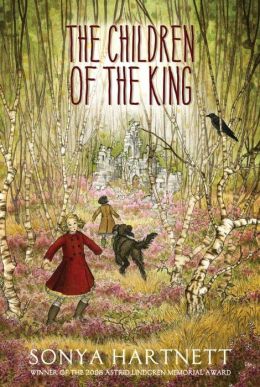
The Children of the King (2014)

The Children of the King. Sonya Hartnett. 2014. Candlewick. 272 pages. [Source: Review copy]

The Children of the King is set during World War II. And it's set in ENGLAND during World War II. There is every reason in the world, why I should love and adore this one.

Cecily and Jeremy and their mom evacuate to the country; since London is fast becoming much too dangerous, they've evacuated to the family's country estate, Heron Hall. They will live with Uncle Peregrine. On their journey, they see hundreds of other children also evacuating. Unlike Jeremy and Cecily, these kids are going to live with strangers. Cecily resents that they're on the same train. "While she pitied the evacuees, part of her wished they had been on a different train so she wouldn't have had to see them and be weighed down by their plight. She had troubles of her own." (17) But oddly enough--unless you've cheated and read the jacket--Cecily decides by the end of the journey that she just HAS to have ONE of these children. She WANTS to choose herself. She examines the children carefully and slowly. She settles on the one that--by appearances at least--will suit her best. She chooses a girl named May.

May, Cecily, and Jeremy. Three kids that, for the most part, are so different from one another. Sometimes their worlds touch: they interact well with each other and seem to enjoy one another's company. And other times, it's selfishness times three.

Jeremy is fourteen. He is ANGRY and scared and perhaps ashamed that he's scared? He feels he has something to prove. He does NOT want to be in the country. He does not want to be stuck with Cecily and May. They may need the safety and comfort of the country. But not him. He's a man, well, almost. Surely, Jeremy is brave enough and strong enough and stubborn enough to think and act independently.

Cecily. Is she simple or complex? I just can't make up mind. On the one hand, she's selfish and bossy and inconsiderate. On the other hand, what she says may not reflect how she feels. She may be hiding how the war is effecting her. Her fears and doubts might be to blame. I did not really like her very much.

May won't be bossed around for long. Cecily may have picked her out like a pet; Cecily may think she's the boss, but, May is more than capable of standing up for herself and doing exactly what she wants. When Cecily and May accept one another as somewhat equals, there is some peace. But instant friends they are not. Still Cecily and May spend over half the novel in each other's company. It is Cecily and May who spend all their time investigating "Snow Castle;" Cecily and May who discover the two strange boys living in the castle ruins. Cecily and May who keep a secret from all the grown-ups.

I will be honest. I didn't exactly "like" any of the children. I did enjoy, however, Uncle Peregrine! He seems to be just what these three children need. He seems to be the only adult there who understands the children deeply. Peregrine is a storyteller. He tells these three children a story. This story takes weeks to tell. He tells just a little at a time, always leaving them wanting more. He does have a way with words.

For better or worse, the story Peregrine tells is of Richard III and the princes in the tower. He does not call the man in the story, Richard III, he calls him Duke. But to adult readers especially, it is clear how his "story" fits into history. Peregine's story, unfortunately, is ambiguous in all the wrong ways. Richard III is clearly the murderer. (Boo, hiss!) In his ambiguous telling, he offers the possibility that the boys were saved, after all, that they were taken to the country to hide for the rest of their lives. And since these two princes match up oh-so-closely with May and Cecily's strange new friends living in the ruins, readers are led to believe this is where their ghosts dwell after all.

I would have much preferred Hartnett to be ambiguous with the identity of the murderer, to at least consider that others had equally strong motives. If Richard himself had hid the children away in the country, it would have been a more enjoyable ghost story.

I typically like World War II stories. I don't usually like ghost stories. Does the fact that the ghosts are the princes of the tower make me change my mind? I'm still thinking on it.

I do appreciate the juxtaposition of these two stories. How Hartnett trusts readers to reach conclusions and find common themes: how children rarely, if ever, have power or a voice; how sometimes children are caught in situations out of their control, are caught in chaos and uncertainty. That war is war, and war can be cruel and ugly.

So in many ways, I can like this one, at least from a distance, but did I love it? I'm not sure I can stretch it that far.


© 2014 Becky Laney of Becky's Book Reviews

Wednesday, December 08, 2010

Chasing Brooklyn (YA)

Chasing Brooklyn. Lisa Schroeder. 2010. Simon & Schuster. 412 pages.

One year ago today I lost my boyfriend, Lucca.

Chasing Brooklyn is a verse novel, a companion to I Heart You, You Haunt Me. Both are set in the same town, the same high school. Both novels are about the (extended) grieving process. When the novel opens, a year has passed since Lucca's death.

The novel is told in two voices. Readers meet Lucca's girlfriend, Brooklyn, and his brother, Nico. Both are about to be haunted.

Gabe, Lucca's friend, has recently overdosed. His death proves just how emotionally raw and vulnerable this community still is. Since his death, Brooklyn has been haunted. Her dreams are nightmares. The dream-Gabe that haunts her is chasing her, taunting her, almost threatening her.

Nico is having troubling dreams as well--though not of Gabe. No, his brother is telling him night after night after night to help Brooklyn, to protect Brooklyn, to be there for her. So even though Nico and Brooklyn haven't had much to do with one another since Lucca's death, there's nothing he wouldn't do for his brother. So he takes the first steps and a friendship (of sorts) begins.

Is Nico what Brooklyn needs to heal? Is Brooklyn what Nico needs to heal? Is Lucca drawing them together for a reason?

The more I read of Lisa Schroeder, the more I like her work. I'd also recommend Far From You.

© Becky Laney of Becky's Book Reviews

Monday, May 10, 2010

The House of Dead Maids (YA)


The House of Dead Maids by Clare B. Dunkle. 2010. September 2010. Henry Holt. 160 pages.

I was not the first girl she saw, nor the second, and as to why she chose me, I know that now: it was because she did not like me.

Our heroine, Tabby Aykroyd, has been chosen to be the new nursemaid at Seldom House. The young master has also been newly chosen. Something that Tabby finds odd indeed. Why adopt a young boy--a wild boy at that--to be the new master?

Of course, if Tabby were waiting for things to make sense at Seldom House, she'd be waiting forever. Everything she's seen, everyone she's met has been strange. Mr. Ketch and Miss Winter especially. And that would also include the ghost haunting her room. (There's something so familiar about that ghost...)

The boy Tabby cares for doesn't have a name exactly. Mr. Ketch, the one who brought him to Seldom House, just calls him his little heathen git. But Tabby chooses to think of the boy as Himself. He doesn't want a Christian name--so he says. Since this one is a mystery, I can't say much more about the plot. But I would definitely recommend this one!

The House of Dead Maids is a prequel to Wuthering Heights. And while I didn't love Wuthering Heights, I did love this one very much. Dunkle knows how to do gothic! The atmosphere of this one is just right. This one would be perfect for Carl's RIP challenge.

You can read the first two chapters at the author's website.
To view a slideshow of the interior illustrations, also visit the author's website.


© Becky Laney of Becky's Book Reviews

Saturday, February 27, 2010

The Hotel Under the Sand (MG)


The Hotel Under the Sand. By Kage Baker. 2009. [July 2009] Tachyon Publications. 144 pages.

Cleverness and bravery are absolutely necessary for good adventures. Emma was a little girl both clever and brave, and destined--so you might think--to do well in any adventure that came her way. But the first adventure Emma had was dreadful.

Emma has lost everything. From the first readers learn,
"One day a storm came and swept away everything that Emma knew. When it had done all that, it swept away Emma too. It might have been a storm with black winds, with thunder and lightning and rising waves. It might have been a storm with terrible anger and policemen coming to the door, and strangers, hospitals, courtrooms, and nightmares. It might have been a storm with soldiers, and fire, and hiding in cellars listening to shooting overhead. There are different kinds of storms. But Emma faced the storm that swept over her, and found a way to save herself." (11-12)
Emma is definitely a survivor. She finds herself in the Dunes. A lonely and bewildering place to be. But she won't be lonely for long. Not with the magic all around. There's the ghost of a bellboy, Winston, who along with Emma uncovers the strangely magical--almost timeless--hotel that's been buried under the sand all these years. The Grand Wenlocke never had its grand opening because before the guests could arrive (but after some of the guests' belongings had arrived) it was buried under the sand by a horrible, terrible storm. And there it has remained lost in the Dune with all its treasure and secrets. And its ghost. (Never could you forget Winston once you've met him.) Now that the hotel has been discovered, uncovered, it seems to draw guests to it. Some guests are quite unusual! And here the adventure starts. But will this new adventure heal Emma?

Kage Baker's The Hotel Under the Sand is one of the finalists for this year's Andre Norton Award*.

*The full title is the Andre Norton Award for Young Adult Science Fiction and Fantasy. It's in great company: Ice by Sarah Beth Durst; Ash by Malinda Lo; Eyes Like Stars by Lisa Mantchev; Zoe's Tale by John Scalzi; When You Reach Me by Rebecca Stead; The Girl Who Circumnavigated Fairyland In A Ship of Her Own Making by Catherynne M. Valente; and Leviathan by Scott Westerfeld.

© Becky Laney of Becky's Book Reviews

Wednesday, September 03, 2008

The Ghosts of Kerfol


Noyes, Deborah. 2008. The Ghosts of Kerfol.

The Ghosts of Kerfol is an enjoyable short story collection that pays tribute to Edith Wharton's short story "Kerfol". I'd encourage you to take a few minutes (about ten or twenty actually) and read this haunting story about an old-and-creepy manor. The Ghosts of Kerfol is a collection of five short stories: "Hunger Moon," "These Heads Would Speak," "The Figure Under the Sheet," "When I Love You Best," and "The Red of Berries." The first two especially--"Hunger Moon" and "These Heads Would Speak" pay tribute to Wharton's original story. The remaining stories are imaginative what-ifs that bring the story into the modern world.

The original story is a story-within-a-story. Kerfol is the manor in question. The framework of the story is about a person (I don't think it says if it is a man or woman; if it did I missed it) who is considering buying Kerfol. The narrator is there at the estate exploring the grounds and hoping for a closer view of the house itself. But the narrator keeps seeing a handful of dogs around the place. We later realize--along with the narrator--that these dogs are ghosts. That one day a year--on the terrible anniversary--they appear. The guardian and his daughter always leave that day to avoid the creepy factor as much as possible. The narrator then reads an account of the history of Kerfol.

This second story, the inner story, is set in the seventeenth century. It involves an old man and a young woman in a "seemingly" "happy" but childless marriage. Happy if you think such a thing is possible when the woman has no freedom to move about on her own even on her own estate in and about her home, her gardens, etc. Sensing on some level at least her loneliness, he buys her a dog. What happens next isn't pretty. One day he becomes jealous and he strangles her dog. And it only gets worse from there. Believe me. Dog-lovers will be crushed at the cruelty. But the husband does get his comeuppance, he's murdered--and according to his wife's claims--by these dead dogs of hers.

The story isn't pretty. It's melancholy at best. And the stories crafted in The Ghosts of Kerfol are bittersweet and haunting. The first, "Hunger Moon," re-envisions the second story (Yves de Cornault and Anne de Barrigan) as told by a servant girl, a waiting woman. The second story, "These Heads Would Speak," is about a young man visiting the estate. He's there while his mother seeks to straighten out his inheritance. Anyway, this story parallels the frame story of the original in a way.

The remaining stories interconnect with the previous and the original. It was a well-crafted book. The creepiness was perfect. I enjoyed all the stories.

Other reviews: Teenreads.com, ReadSpace, The Well-Read Child.

© Becky Laney of Becky's Book Reviews

Thursday, August 14, 2008

I Heart You, You Haunt Me


Schroeder, Lisa. 2008. I Heart You, You Haunt Me.

Ava's boyfriend Jackson Montgomery has tragically died when the novel, I Heart You, You Haunt Me, opens. Our first glimpse of Ava is at his funeral. We see her grieving; we see her distraught. We feel the rawness and vulnerability of her aloneness, her grief.

The novel is written in verse. And it spans the summer--he died at an end-of-school party in May--when she is most lost. What Ava realizes soon after Jackson's been buried is that he's never really left. She feels him, smells him, hears him, sees him. He is haunting her house and her dreams. And at first, Ava is so relieved to be near him--even if he is just a ghost--that she doesn't want to leave the house, doesn't want to visit with her friends, doesn't want to go out and have your typical summer fun. And part of that is certainly understandable. But her parents and friends sense that something is a bit off with Ava. They just don't know quite what.

Ava has a decision to make about her life, about how she lives it. And Jackson is there to help, or is he?


© Becky Laney of Becky's Book Reviews
Saturday, August 09, 2008

Steinbeck's Ghost


Buzbee, Lewis. 2008. Steinbeck's Ghost. (September 2008 release).
"Finally. He finally found the word he had been looking for.
Camazotz.
The moment Travis Williams stepped out of his house into the warm September afternoon, the word came to him. For months, ever since he and his parents had moved into the new house, he'd been trying to figure out what was so creepy about this place. Now he knew.
He stepped off the porch into the bright sunshine and whispered the word.
Camazotz.
A Wrinkle in Time was one of Travis's favorite books. He'd first borrowed it from the library a couple of years ago, when he was eleven, and had probably borrowed it three times since, read it he didn't know how many times. Whenever he thought of the book, he pictured the planet Camazotz.
On Camazotz, everything was perfect. Every house was exactly like every other house, every lawn like all the rest. Every garden grew the same kind of flower, and the exact same number of those flowers. Everyone in Camazotz dressed like everyone else, and they all did the same things and at the same times. One child played ball in front of each house, and each ball bounced to the same beat.
Camazotz was supposed to be a perfect planet. And in a way, Travis thought, it was perfect. Perfectly creepy.
Bella Linda Terrace was supposed to be perfect, too." (1-2)
For anyone who loves to read books about people who love books, Steinbeck's Ghost is the novel for you. Travis Williams loves to read, and he loves his library. When he hears the news that his library, the John Steinbeck library, is closing, he's shocked and disappointed and angry. Luckily, this news effects many people the exact same way. And fortunately, these people--from the elderly to the teens--is willing to put their time, money, and energy into saving it. Set in California, set in Salinas, our narrator, Travis, is fascinated with John Steinbeck. Loves his work. Got a few favorites among his novels, but has a familiarity with the world Steinbeck created. When this fictional world starts coming to life right before his eyes, Travis is both amazed and hesitant. Is he going crazy? Did he saw what he thought he saw? Can other people see these things as well? Travis isn't going crazy--at least we're led to believe that he's not going crazy--and soon Travis and a few select friends are following the trail, following the voices, the messages, that are leading them to discover the story that Steinbeck never wrote. Books. Libraries. Community activism. Friendship. Family. This one has a little bit of everything.
"Every book he recognized opened up the world of that book to him. These weren't stacks of paper bound together with glue or string--they weren't items or products. Every book was an entire universe." (26)

"Reading a library book wasn't something you did on your own. It was something you shared with everyone who had ever read that book. You read the book in private, yes, but other hands had been on it, had softened its pages and loosened its spine. With hardcovers, the clear shiny Bro-Dart, put on to protect the dust jacket, quickly got scuffed and crinkly, and sometimes you'd find a thumbprint pressed into the plastic.
The book, when you were done with it, went back to the library, and from there to other hands. When you read a library book, you were connected to all these strangers." (56)

"When you read, the world really did change. He understood this now. You saw parts of the world you never knew existed. Books were in the world; the world was in books." (89)
Yes, the book has its strange moments. Moments when he's being "haunted" (or prompted) by Steinbeck's fictional characters. But the book is just as much about Travis discovering himself as it is about him discovering the world of books and also discovering the world around him. There is a certain authenticity captured in the pages of this book.

© Becky Laney of Becky's Book Reviews

Monday, October 15, 2007

The Invisible


Wahl, Mats. 2007. The Invisible.

This is an international book only recently translated into English and published in the United States. It has also apparently been made into a movie. Since I don't keep up with these things, I depend on statements such as "now a major motion picture from the producers of The Sixth Sense" to stay informed. I also happened to notice that the movie is being released on dvd soon--very soon. Did I love this one? No. But it was a good book. It is your somewhat typical ghost-narrator story where the ghost has not "passed" or "moved" on and he's still haunting this world...viewing his friends, his family, and in this case following the police detective on the case of this "missing boy." Hilmer Eriksson was a somewhat normal kid--a teen--who went for a simple errand on his bike and never came home. Now it is up to Detective Fors to investigate and discover the grim truth about what really happened that Saturday. What makes this book good is the writing. While I don't really go for ghosts as narrators, this one is an exception for me because the style is so good. I wouldn't say I loved it, but I enjoyed it far more than I expected. (Though I know I'm in the minority, I don't really get the whole ghost-narrator thing as done in Lovely Bones.)

It was on one of the first days in May that Hilmer Eriksson discovered he had become invisible. (1)