This one was enjoyable. (It wasn't a perfect read, but it held my interest to the very end. The ending I was only ho-hum about.) For those looking for fiction with a fairy-tale-esque feel, then you should definitely consider Aurelia. Someone in the kingdom of Tyralt is out to kill the princess, Aurelia, already three attempts have been made on her life. Robert, the son of a former spy, takes on the role of protector, friend, and suitor in this oh-so-delicious novel. This one has most everything: a king blind to the truth, a cold and resentful stepmother/Queen, a bratty step-sister, and a love that goes beyond socioeconomic 'class' or status. There is a mystery, a mystique about everything.
First sentence of prologue: Death disturbed the night. First sentence of chapter one: On the night of her younger sister's coming-out party, Aurelia almost died. Of boredom.
The Silver Chair is the fourth novel in the seven-book series by C.S. Lewis.
The truth? Though many people like or love The Silver Chair...I'm not one of them. Don't get me wrong. I don't hate the book. I even enjoy parts of the novel a great deal. But I don't love it the same way that I love the other three, the first three. Which is my least favorite of the seven? It would be a toss up between The Silver Chair and The Horse and His Boy.
The story. The story. What is the story. Two kids--Eustace, whom we first met in The Voyage of the Dawn Treader, and Jill, whom we are meeting for the first time, have unexpected, unplanned adventures in Narnia, a magical land first introduced in The Lion, The Witch, and The Wardrobe. The two step into the adventure. Their quest? To find the missing prince--a person assumed or presumed dead--the son of King Caspian. (Caspian we met in Prince Caspian and The Voyage of the Dawn Treader.) Aslan, the lion-king, gives instructions to Jill that will help them on their way. But these instructions require familiarity--memorization--and obedience. Neither come naturally to the children. Along the way, the children meet many characters. Some are friends; some are enemies. Puddleglum is the most interesting person that they meet. He is what I remember most about the novel.
Overall, I liked this novel, but I didn't love it. I think others may enjoy it more than I did.
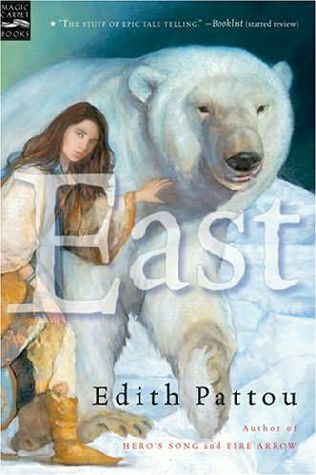
This one is really really really good. A true must-read in the fairy tales novelization genre. Told through many narrators, it retells the fairy tale "East of the Sun and West of the Moon" in a way that just works. I couldn't imagine when I picked it up that I would like it so much. That it would take the place of Beauty by Robin McKinley or Ella Enchanted by Gail Carson Levine. But this one is just oh-so-magical. It's rich in detail and it's just wonderful. If I don't sound quite myself, it's because I'm sick. And I hate being sick. It clouds the mind and makes reviewing difficult. But the book is due back tomorrow...so there was no waiting.
First sentence of prologue: I found the box in the attic of an old farmhouse in Norway. It was large, the size of a footlocker, and there were markings on it; runes, I learned later.
First sentence of chapter one: Ebba Rose was the name of our last-born child. Except it was a lie. Her name should have been Nyamh Rose. But everyone called her Rose rather than Ebba, so the lie didn't matter. At least, that is what I told myself.
Tales from the Hood is the sixth novel in The Sisters Grimm series by Michael Buckley. This is a series that is fun and exciting. A series that I would have absolutely loved if it had been around when I was a kid. One that I still love now even as a grown up. It focuses on Sabrina and Daphne Grimm and their grandmother, Granny Relda, and on their sibling-of-sorts Puck. (Puck isn't a real relation mind you, but he has been unofficially (in a way) adopted into the family by Granny Relda.) Sabrina is beginning to grow up, not mature necessarily, but grow up. In other words, she's starting to get to that age. That difficult age. And as such she's not always the easiest person to get along with. She's not really "listening" or "obeying" the rules laid out for her by Granny Relda and Uncle Jake. This time is difficult for Daphne as well. Daphne has always loved and looked up to her older sister, but now....now her sister is unrecognizable at times. So weird, so mean.
I won't really get much into the plot. It's exciting enough that it will keep you reading. But if I talk about book six, then it would probably spoil some things from earlier books--especially book five--and that just wouldn't be any fun at all.
I like this series a lot. I like how the fairy tales are woven together in a fun, topsy-turvy way. The characterization and the plot twists are just really well done.
Carl, Lillian Stewart. 2008. Blackness Tower. Review by Becky Laney.
What can I say about Blackness Tower? On one hand, it did keep me reading. I didn't read it all in one sitting, I read it in three, but it was always pleasant to get back to. I liked reading it. It wasn't a not-that again experience. It held my interest for the most part. And I wasn't ever bored with it. On the other hand, it was one of those almost books. Maybe you know the kind. There were some things I liked about the novel, but there was just something about it that kept me from loving it. Something that kept me from getting excited--really excited about it. It was almost a romance novel, but not quite. It was almost a fantasy book, but not quite. Okay, that last one isn't really fair. But fantasy isn't the right word either. It was all about the paranormal. Mostly. So it's a paranormal-mystery-romance hybrid. An American woman comes to Scotland, comes to explore Black Ness Tower because she's been having dreams and visions. There she meets three men. All seem to be attracted to her, seeking her out in some ways, but all three seem cloaked in mystery as well. All loosely-connected to the same mission she's on. And then there are the spooky girl characters. Essentially the main character is confused and frustrated and has trouble figuring out who to trust and what's really going on. As I said, it kept me reading. But somehow it was a bit disappointing over all. Not terrible. Not awful. But definitely just an okay read for me. I don't regret reading it. I wanted to know what happened. But the way the mystery comes out, the way it all unfolds, it just left me personally a little empty. I think I started out connected with the characters, and then somewhere in the middle, I became slightly disconnected.
Your response, your reaction could be completely different than mine. Especially if you're really into paranormal romances. Though it lacks smut. If it had been a true paranormal romance, then there would have been some smut.
Gifts had me practically at hello. "He was lost when he came to us, and I fear the silver spoons he stole from us didn't save him when he ran away and went up into the high domains. Yet in the end the lost man, the runaway man was our guide." (1) If the first chapter didn't hook me (which it did) then the second would have certainly, "To see that your life is a story while you're in the middle of living it may be a help to living it well. It's unwise, though, to think you know how it's going to go, or how it's going to end. That's to be known only when it's over." (15) I hope that gives you a small glimpse of just how magical this fantasy can be.
Here is how the jacket describes it, "Scattered among poor, desolate farms, the families of the Uplands possess gifts. Wondrous gifts: the ability--with a glance, a gesture, a word--to summon animals, bring forth fire, move the land. Fearsome gifts: They can twist a limb, chain a mind, inflict a wasting illness. The Uplanders live in constant fear that one family might unleash its gift against another. Two young people, friends since childhood, decide not to use their gifts. One, a girl, refuses to bring animals to their death in the hunt. The other, a boy, wears a blindfold lest his eyes and his anger kill. In this beautifully crafted story, Ursula K. Le Guin writes of the cruelty of power, of how hard it is to grow up, and how much harder still it is to find, in the world's darkness, gifts of light."
Gifts is the story of Orrec and Gry and the outsider, Emmon, that unknowingly showed them the way out. I loved the story; I loved the characters. Highly recommended. It is a story beautifully and powerfully told. It's not quite your typical framework of storytelling. But it works. It really works.
"Grieving, like being blind, is a strange business; you have to learn how to do it. We seek company in mourning, but after the early bursts of tears, after the praises have been spoken, and the good days remembered, and the lament cried, and the grave closed, there is no company in grief. It is a burden borne alone. How you bear it is up to you. Or so it seems to me." (202)
I am huge in my Mati's womb, straining her wide tunic. She is Hannu, Akkan goddess of the earth and of pottery. My pado, Arduk, god of agriculture, sits at Hannu's bedside, awaiting my birth. It is too tight in Hannu's belly! I thread my strong wind into her womb, and my strong wind thrusts me flying out. Fortunately, Arduk catches me in his big, gentle hands. Although Hannu lies in bed and Arduk stands holding me, we are also floating above the earth. In the air over volcanic Mount Enshi hovers Enshi Rock. From its center the temple rises: our home, a tower of porous white stone mounted on four stout stone legs. Never has there been such a temple! When my diaper cloth is tied in place, I kick. When I'm lowered into my sleeping basket, I cry. If a blanket is tucked around me, I bellow. I am the god of the winds, and I hate confinement.
Olus, god of wind, immortal son of immortal parents, has a fascination with mortals. Especially one mortal in particular, a young girl named Kezi. She is young. She is beautiful. She weaves and dances beautifully. (That's not to say she dances while she weaves or weaves while she dances.) She also lives in another country, another region from Akkan; she lives in Hyte. The people worship a different god, Admat. Kezi and her family take their beliefs, their worship very seriously. Which is why her father's oath is so daunting. Her mother is sick. Everyone has done everything they possibly could. They've left it all up to Admat. Her father vows to offer up--as human sacrifice--the first person who congratulates him on his wife's recovery--if she recovers that is. She does. And he does. But no one expected Kezi to be involved. No one. His young daughter, his only daughter, a sacrifice to his god? It must be. And yet....
Olus, the god of wind, is there watching, listening. He loves Kezi. How can he stand by and watch his love be sacrificed. He's got to do something. He won't--can't--let her die.
Olus and Kezi's story--their destiny--unfolds in Ever.
I loved this one. Loved, loved, loved it. It is so wonderfully magical. Olus and Kezi are great narrators. And their story is compelling and fascinating. I could not put this one down at all.
Her earliest memory was of waking from the dream. It was also her only clear memory of her mother.
Rose Daughter is Robin McKinley's retelling of her retelling of Beauty and the Beast. Under no circumstances confuse it with her first retelling of Beauty and the Beast; the one simply titled Beauty. I read Beauty a few years ago back in my pre-blogging days. I remember being charmed with it. It was a beautiful story, a beautiful retelling. Though there is an author's note explaining why the author felt the need to go back and tell this tale twice, part of me (okay, all of me) wishes that she hadn't. Beauty is everything Rose Daughter isn't. It's magical. It's beautiful. It works. Rose Daughter is boring, boring, very boring.
What has changed between the two books? Well, an emphasis on gardening and on roses specifically. All this Beauty ever does is garden, garden, talk about gardening, talk about pruning, and get excited about blooms or get frustrated when there are no blooms. There is also an emphasis on cats. Cats, cats, everywhere. This Beauty seems to have a way of entrancing cats and other animals like bats and spiders and hedgehogs. It's just very odd. Odd for a book to have a chapter on her finding a bat and giving it a place to live and talking about bat poop. A lot about bat poop. More than I wanted to know.
Everything that was beautiful and touching and magical about the first book, the first Beauty, is gone and replaced by hundreds of pages of her pruning and talking about fertilizer and making new cuttings.
I suppose there may very well be garden enthusiasts out there who can't get enough of fictional heroines working in the dirt and making pretty flowers bloom. But I'm so not one of them. The book was dreadfully dull. The small details that made me fall in love with Beauty and the Beast were just not here in Rose Daughter.
"The night before he went to London, Richard Mayhew was not enjoying himself."
My thoughts on Neverwhere. I liked it. It was good. It was interesting. But I didn't love, love, love it the way I loved Stardust. I think that may be in part because of the urban setting. The underground-urban setting. I had a harder time suspending my disbelief. Which may strike some as strange, but I am what I am. I liked the characters. I cared what happened to them. But I wasn't swept off my feet by the story or the storytelling like I was with Stardust. I enjoyed it. I would definitely still recommend it. Where as with Stardust I could see myself rereading it every year or so and feeling the need to own a copy...with Neverwhere, I don't have that compulsion.
It's the story of a man, Richard, who through chance (or destiny) is drawn into a strange underworld London. A London that most never see, most never venture into. A place where the strange, the unbelievable, happens every day and every night. The characters are for the most part eccentric. Richard is most drawn to Lady Door. The star of the show. It is her life that is in danger. It is her life that they are trying to protect. Her mystery they're trying to solve. Richard doesn't know what to believe these days. He can't deny the strange world that he's in, but he's still a little unsure of everything.
As I said, I liked it but I didn't love love love it. But it was good.
I've got to admit right up front that I was intrigued by the opening to Keturah and Lord Death: "I was sixteen years old the day I was lost in the forest, sixteen the day I met my death." Our heroine is Keturah Reeve. This is her story, her tale. It reads like a fairy tale. It does. And it's got a certain atmospheric charm and quality to it. I think that it will appeal to some more than others. Or perhaps I should say that it will satisfy some more than others. It had me reading; it kept me hooked. But, for me, this wasn't the ending that I wanted or needed. Perhaps most readers would disagree with me there though.
Keturah has spent her whole life--all sixteen years--dreaming of her true love. Waiting to find her true love, waiting to settle down, waiting to keep house, waiting to have babies of her own to love and tend to. Waiting for THE ONE. When she wanders into the forest, the woods, her hopes seem all but dashed. She becomes lost. She's lost for three days. Without food, without water. She's on the brink of death. And death does come for her. Death, Lord Death, is handsome enough. And she makes a heartfelt appeal. She tells him her heart's desire, she tells him stories, gives him promises. She in fact bargains with Death. He grants her request.
He does not take her then. He gives her a chance. A day. A day to find her true love. A day to be wed to that love. If she succeeds, then he'll not claim her. She'll be safe this time at least from his clutches.
I won't go on beyond this point. But the stories and tales she weaves as she bargains with Lord Death captivate not only him but the reader as well. Can her words save her? Does she even want to be saved?
Some call this a romance. I don't feel comfortable with that label.
S P O I L E R
I hope that you're not reading this if you have plans of reading it yourself. Though some might think it predictable enough that the spoiler is silly. Anyway, this is your last chance.
Okay. I disliked her choice. While death in itself is neither absolutely good or absolutely evil. The fact that this young girl thinking herself madly and passionately in love with Death would choose to die and be Death's companion and wife when she could have had a life, a love of her own, her every dream realized is silly. Why choose an early death? Why choose Death over John? Why? This baffles me. And it is this reasoning that makes me be on Team Jacob instead of Team Edward. (For those not in the know this is a Stephenie Meyer reference.)
Sword of the Rightful King: A Novel of King Arthur by Jane Yolen is a more realistic, less legendary presentation of King Arthur. What do I mean? Well, it shows the behind-the-scenes drama of Arthur's court, Arthur's kingdom. It shows in some ways how those legends got started--some directly, some indirectly. Merlinnus, for example, created and fabricated the Sword in the Stone. It was a deliberate hoax on his part. A way to fool the people, manipulate them in such a way that the doubters of Arthur would be convinced that he was DESTINED to be king. Arthur was in on the secret. As was Merlinnus' new apprentice, Gawen. This angle removes some of the glamour, some of the glory from the story, in my opinion. But it doesn't necessarily mean that the story is any less compelling. Another legend debunked is Gawaine and the Green Knight.
Told from multiple view points, the reader is able to get into the hearts and minds of Arthur, Merlinnus, Gawaine, Morgause, Gawen, etc. The reader is able to get the full story, the full spectrum of what's going on in this turbulent spring and summer as they prepare for the Solstice.
I enjoyed this book. But I didn't enjoy it as much as The Sword in the Stone. It may be more realistic, more practical, but I like my legends to be legendary. So it's a good book, an enjoyable book, but not a great book.
Avi. 2004. The End of the Beginning: Being the Adventures of a Small Snail (And An Even Smaller Ant).
Originally published in 2004, The End of the Beginning has just recently been published in paperback. (Harcourt for those that are curious). The book is small. (144 pages). The book is charming. And delightful. And funny. I think it's a book that is good for a wide range of ages. I thought it was charming and funny enough that it might just delight adults, and I hope that it would work equally well on children. (I'm not a child. I can only remember my own childhood, and put myself back there when I'm reading. But I think this book would have worked on me then as well.) What makes it so delightful (for me) is that it reminds me in a vague way as being Alice-like and Pooh-like. Something about the humor. Something about the storytelling. It just works. (Alice-like referring to Alice in Wonderland by Lewis Carroll. Pooh-like referring to Winnie the Pooh and House at Pooh Corner by A.A. Milne).
Avon, a rather small snail, read a book every day. He loved to read because books told him all about the things that creatures did when they went on adventures. Now, Avon had noticed that when creatures finished their adventures, and when the stories ended, the creatures were always happy. Because Avon had never had an adventure of his own, the more he read, the sadder he became. It was absolutely necessary, he decided, to have adventures for himself. Only then would he be happy.
So Avon, once encouraged, seeks out his own adventures. But he's not alone. No, he takes as his companion Edward the ant. The two become the best sort of friends. And adventures are sure to follow, right? Well, you'll see. A snail's kind of thrilling adventure may not be the typical variety. But it is always in good fun.
I love the writing. I love the humor. I love the friendship. I think The End of the Beginning would make a great read-aloud. And it's a book that I'll be happy to share with my family now that I'm finished reviewing it. Required reading if you will.
Prince Caspian, the second of the novels in the Chronicles of Narnia series, takes place one year after the close of The Lion, The Witch, and the Wardrobe. The four children, Peter, Susan, Edmund, and Lucy, are preparing to return to school when they're instantly, magically transported (or translated) to Narnia. What they find there shocks them. Shocks them for many reasons. You see, it hasn't been a year in Narnia time. It hasn't even been just a hundred years. Their castle, their lands, unrecognizable ruins. The adventures are about to begin. Again. Many surprises, many adventures await them, along with one old friend. A friend that takes a little more faith to recognize these days.
Prince Caspian centers on a new hero. Caspian. The son of Caspian the Ninth, king of Narnia. But it is Caspian's uncle, King Miraz, that rules the land, and rules it harshly. Gone are the days of talking animals and other fantastical creatures. No the "old Narnians" must hide if they are to survive at all. Caspian may have been raised by his aunt and uncle, but his upbringing was left to an old nurse who believed in the old ways. Now, Caspian is a young man who longs to restore the golden days of the past. Who longs to restore Narnia to its former glory. Who longs to create a peaceful age where old Narnians can live and live well. But he can't do it alone. What he needs is help. Divine help.
Can a horn of old bring much-needed help from afar?
I love Prince Caspian. I do. It is exciting. It is thrilling. Again, Lewis has created memorable characters and memorable scenes.
If this book doesn't have you at hello, I don't know that I can help you. There was once a young man who wished to gain his Heart's Desire. And while that is, as beginnings go, not entirely novel (for every tale about every young man there ever was or will be could start in a similar manner) there was much about this young man and what happened to him that was unusual, although even he never knew the whole of it. What a great beginning. It's just so beautiful, so magical. Doesn't it just feel right?
Stardust is set in nineteenth century England in the community of Wall. (1830s and 1840s to be exact.) This community is built by a large (and by large I mean high and long) grey rock wall. There is a gap in the wall, however, a gap that is guarded at all times. Guarded so no one--especially children--can slip through, and guarded so no one can slip in. Beyond the gap, there is a meadow, a beautiful meadow that is forbidden. Forbidden except for one day (and one night) every nine years when the Faerie market comes to the meadow. This is the only time when the two communities (the rather mundane humans and the fantastical, magical faerie world) interact. Our novel opens with us meeting Dunstan Thorn.
I really can't say much more about it. I could, but I won't. It's magical. It's beautiful. It's adventuresome. It's just great storytelling. I loved every moment of it. There were so many things I loved about it that I couldn't begin to describe them in such a way as to do the book and its characters justice. Just trust me. If you haven't met Neil Gaiman, use Stardust as an introduction!!! This isn't my first Gaiman. It's my third. But it is by far my favorite.
Dokey, Cameron. 2007. Once Upon A Time: Before Midnight: A Retelling of Cinderella.
First paragraph: What do you know about yourself? What are your stories? The ones you tell yourself, and the ones told by others. All of us begin somewhere. Though I suppose the truth is that we begin more than once; we begin many times. Over and over, we start our own tales, compose our own stories, whether our lives are short or long. Until at last all our beginnings come down to just one end, and the tale of who we are is done.
This is the story of Constanze, though even in her own story she is better known as Cendrillon, Child of cinders. Her mother, a beautiful woman, dies in childbirth. Her father sick with grief--anger, bitterness, regret, fear--rejects her. She is raised by her godmother, Old Mathilde. Her childhood companion is a boy named Raoul. Her father returned with him when Cendrillon was just two weeks old. The father does not live with them or acknowledge them. They're in the country, almost completely forgotten. But as you might have guessed, they don't stay forgotten.
It all starts with a wish on her fifteenth birthday. (I believe it is her fifteenth. Anyway, it's a birthday.) She wishes for love; she wishes for family. Her bold wish is that her father will remarry. She wants a mother to love and love her in return. She also wishes for two stepsisters. Two because that way at least one might love her in return. A few weeks (or maybe several months) later her wish comes knocking on the door. Surprise. The stepmother and her two stepsisters are there with no clue who Cendrillon is. Her father, of course, never mentioned her.
This isn't a marriage of love. Nor is it one of convenience. It is an arranged marriage. When the king orders Chantal (the stepmother) to marry Etienne de Brabant (the father), how can either one refuse? An order is an order. The father is rumored to be the Queen's man. The stepmother is rumored to be the King's. (The king and queen hate each other. Hate. And both are looking to control the other. So the kingdom has two sides--those that support the Queen's dominance, and those that support the King's rule.)
The stepmother and her two children are just as cast off as Cendrillon herself. Not wanted. Sent to the country to live forgotten forever.
This uneasy existence might have continued on year after year except for one little thing:
The Prince is giving a ball.
Every eligible maiden must attend.
This story of Cendrillon is perhaps more complex than you're expecting.
"Move over, Gwen. It's my turn." Elaine tugged at her cousin's sleeve. The two girls lay flat on their stomachs on the cold stone floor of the parapet. Guinevere had one eye pressed against a break in the mortar low in the castle wall."
Guinevere's Gift is the story of Guinevere's childhood. She's twelve and living with her aunt, uncle, and cousin. Her uncle is King Pellinore. Her aunt is Queen Alyse. And her cousin is a rather spoiled and bratty Elaine. Guinevere is the ward of her aunt and uncle since the death of both of her parents.
Life isn't easy for Guinevere. King Pellinore is out fighting or marching with his soldiers. And Queen Alyse is strict on a good day, downright severe and cruel on a bad one. Elaine, likewise, can go from nice companion to whiny, spoiled brat in a few seconds. She's used to getting her own way and manipulating people. You could say that she's a mini-Alyse.
But that's not the only problem (difficult people) Guinevere faces. She's the child of prophecy. "On the night of Guinevere's birth, a prophecy foretold she would one day be the highest lady in the land, wed to a great king." (So the jacket reads.) But Guinevere's problem is that some believe it, some fear it, and some would do anything to keep it from coming to pass. Among those who despise Guinevere just-in-case-the-prophecy-proves-true is Queen Alyse. The thought of Guinevere becoming higher than Elaine or higher than herself angers her tremendously.
In her twelfth year, Guinevere faces the most difficult challenge of her life. Lives hang in the balance. Can she be strong enough, brave enough, resourceful enough to save the day?
No one likes to think it of their father, but there are days when I can't help but feel that somehow I got stuck with the biggest loser of all loser dads. It's mostly on days like this when he's off on a house call to buy new stock and I'm stuck minding the store.
Miguel's father has a store--Mike's Used Comics & Records. And it is while Miguel is tending his father's store that he meet the girl. Or perhaps it should be The Girl. Everything had been going along, business as usual, until the moment he sees her through the window. "Ever have one of those moments when everything just kind of stops and it feels as though the whole universe is focused on this one thing that's got your attention? That's what it's like when I see her go by the window, hesitate at the door to look behind her, and then come in. It's gray and dismal outside, but she's got the sun in her hair--long, red-gold tangles that are frizzing because of the damp and give her a halo." (5) This mystery girl, Lainey, and her dog, Em, are from Australia. Everything about them fascinates this young teenage boy. Everything. She is a complete mystery, but one that he's happy to want to solve. He even dreams about her. That might not be completely unusual--boys dreaming about girls--but this dream is highly unusual. But I'll let you see that for yourself!
I'm NOT going to say one word more about the novel. Okay, that's a lie. But I'm not going to talk about the plot in any case. Everything about this novel--the characters, the plot, the language--is well done. I can't think of a single flaw. I can't really get into what I liked most about the characters, but I can say this. They were complex. Definitely interesting to read about, to care about.
Highly recommended to fantasy fans.
This was my first Charles de Lint novel, but it won't be my last.
My review of C.S. Lewis' classic children's book The Lion, The Witch, and the Wardrobe is going to be chatty--quite chatty--and there's nothing I can do about it. I first encountered the magic of Narnia in fourth grade when my teacher read it aloud to us. My teacher, Mrs. Watts, was known for many things. She inspired much fear and trembling. Like Aslan, she was not tame, but good. While, other students may remember the discipline or the hard work...I'll always remember my magical introduction to Narnia. Soon after, I added book by book the series to my collection. Most of my copies were used. Most were ugly. But I devoured each one. I seem to remember my sister reading a few of the series at least.
But unlike Little House and Ramona and Anne, this series was more me and less her. Narnia belonged to me--the magic, the wonder, the glory of it all. I remember the pure pleasure I experienced each and every time I opened up a book. I remember the book covers, yes. And I definitely have strong opinions on which book covers through the years are 'the best' of the bunch. But more precisely, I fell in love with the proper order of the series. Few things irritate me more than someone who insists on that new-fangled order. Which is why, if you could see me, you'd know how frustrating it is to read my 7-in-1 novel. But some things must be preserved at all costs.
Once there were four children whose names were Peter, Susan, Edmund, and Lucy. This story is about something that happened to them when they were sent away from London during the war because of the air-raids. (p. 111 in the 7-in-1 edition)
The adventures in and out of the wardrobe that these four experience during the course of the novel are oh-so-magical. The characters--both major and minor--so memorable. The story, familiar yet resilient, even after having read it a dozen times. So many wonderful scenes. Scenes that resonate. In case you haven't read it, let me give you a teaser. Lucy, the youngest of the children, accidentally discovers a magical land of ice and snow while hiding in a wardrobe in the Professor's house. Her three siblings--Peter, Susan, and Edmund--at first don't believe her. They take her tale as a wild, silly, foolish story of a girl whose homesick and wanting attention. Edmund, the brother closest to her in age and thus her biggest tormentor, also wanders into Narnia unexpectedly. But who he meets there, will perhaps undo them all. Narnia is not a land at peace. Not at all. For the land is under a spell--an enchantment--the White Witch--the supposed Queen of the land--has made it always winter and never Christmas. And the lives of the children--all four children--are in grave danger when they're in Narnia. For there is a prophecy that four humans--two sons of Adam and two daughters of Eve--will come to rule the land as Kings and Queens and restore peace and order to the kingdom.
The heart and soul of The Lion, The Witch, and The Wardrobe is the revelation of Aslan, the King of the land, a lion.
And now a very curious thing happened. None of the children knew who Aslan was any more than you do; but the moment the Beaver had spoken these words everyone felt quite different. Perhaps it has sometimes happened to you in a dream that someone says something which you don't understand but in the dream it feels as if it has some enormous meaning--either a terrifying one which turns the whole dream into a nightmare or else a lovely meaning too lovely to put into words, which makes the dream so beautiful that you remember it all your life and are always wishing you could get into that dream again. It was like that now. At the name of Aslan each one of the children felt something jump in its inside. Edmund felt a sensation of mysterious horror. Peter felt suddenly brave and adventurous. Susan felt as if some delicious smell or some delightful strain of music had just floated by her. And Lucy got the feeling you have when you wake up in the morning and realize that it is the beginning of the holidays or the beginning of summer. (141 of 7-in-1 edition)
The children's journey to Narnia, their quest to meet Aslan at the Stone Table, and their battle to save Narnia and their brother from the grasp of the evil and wicked witch....are unforgettable adventures that deserve to be experienced again and again by readers of all ages. You're never too old to experience the magic of Narnia.
George, Jessica Day. 2008. Sun and Moon, Ice and Snow. Bloomsbury.
Long ago and far away in the land of ice and snow, there came a time when it seemed that winter would never end.
Our heroine is the ninth child and the fourth daughter. Her mother was so angry when she was born that she refuses to bless her with a name. She's called "pika" which means girl. For most of the story, however, we know her as Lass. This child is a blessing--a great blessing--to her oldest brother, Hans Peter. The two are special buddies. He teaches her something that will prove very useful: the written language--the carvings--of the trolls.
Our story really begins when she agrees to go with the white bear. The white bear is isbjorn, enchanted, and he has agreed to give her family riches and riches and riches galore if she will go away with him to live in his castle for one full year. The family is so poor, that it would be unforgivable (at least in her mother's eyes) for her to refuse his request.
Her time with the bear will not be easy. Everything is so strange, so odd, so obviously enchanted and magical. She's accompanied by her wolf, Rollo. I seem to have forgotten to mention that she's able to communicate with animals. (Another long story on how she got her wolf, and how she got blessed with the power to understand and communicate with animals, and how she got a secret name.)
This review isn't going like I had planned. For a novel that was written so beautifully, so smoothly, this review isn't doing it justice. You're just going to have to trust me that the novel is worth reading. Our heroine is brave and strong and full of heart.
Sun and Moon, Ice and Snow is a novelization of the fairy tale East of the Sun, West of the Moon. (At least in part. It's also similar to the myth of Cupid and Psyche and the tale of Beauty and the Beast.)


 .



 Leavitt, Martine. 2006. Keturah and Lord Death.


