Showing posts with label Not Recommended. Show all posts

Tuesday, February 06, 2018

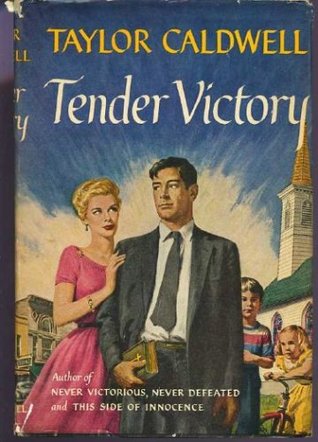
Tender Victory

A Tender Victory. Taylor Caldwell. 1956. 374 pages. [Source: Bought]

First sentence: When matters, events, or people bored or exhausted or troubled Dr. Francis Stevens, he would retire mentally to a pleasant place where he could reflect on the fact that he so closely resembled Francis Cardinal Spellman that it had become an affectionate joke between him and his friend.

Premise/plot: Johnny Fletcher, the hero, is a young military chaplain returning to the States from Europe. He's bringing with him five orphaned children. His friend, Dr. Stevens, has arranged a job for him. He'll be a minister in a small mining town, Barryfield. But adjusting to a "normal" life after the war is tougher than he ever imagined. Both for him and his children. In part because he is determined to raise two of his children as Catholics, two as Protestants, and one Jewish. Fortunately, Barryfield has a Catholic church, a synagogue, and his own Protestant church where he'll be ministering. Unfortunately, Barryfield's residents--except for three or four people--have a mob mentality and are easily upset and ready to explode in outright violence at the drop of a hat. They also are a strong hold of Communists.

My thoughts: Edward Bulwer-Lytton wrote, "The pen is mightier than the sword." The pen--or more likely typewriter--becomes a machine gun in the hands of Taylor Caldwell. Books should never be this poorly written.


Literary issues. The book is not character-driven. It is not plot-driven. It is not even premise-driven. It is driven by ideas or anti-ideas. The book is just as much about what it is FOR as what it is AGAINST. The characters do not exist in their own right but exist merely for being the voices of various ideological ideas or positions. Which leads to the problem I have with the dialogue. I feel like the dialogue is essentially a tool, a hammer. Every single page, the dialogue is hammering something.  Every single time a character opens his or her mouth, it's to hammer down an idea for the readers. The dialogue doesn't come across as natural because every word is an opportunity to preach a message.

Content issues. This book about a minister has a lot of curse words, which may or may not be offensive to the average reader. (Depending on the word and how often it is used--that is my standard.) This one has blasphemy. If the characters weren't supposed to be Christian, if so much of this one didn't take place in the church or in the church parsonage, if this was your typical, modern book--I wouldn't be surprised or taken aback by that.

Theological issues. So the main point of this book seems to be singing the praises of tolerance. All religions lead to the same God; there are many roads, many paths, many ways to finding God. No matter what name you call him, God is God. The content of what you believe doesn't matter so long as you're sincere. One religion is not "better" than the other. One is not "more true" or "less true." Even when the religions disagree with each other unmistakably--they all lead to God in the end, and all is well. It's best to let people come to their own knowledge and understand of who God is. He's there to inspire love and kindness here on earth. If John Lennon's Imagine had been a single, I bet Johnny Fletcher would have gone around singing it day and night, night day.

The extremes irritated me. It seemed there were only two options of thinking in the novel. If you don't agree with Fletcher on whatever issue has come up, then you are the ENEMY with rocks ready to throw, knives ready to stab, matches ready to burn. And there are many issues in this one. For example, the environment, unions, communism, nuclear programs, education, religion, politics, etc.

The low point of this one--and I mention it on purpose--is when the parsonage is BURNED DOWN on Christmas Eve with everyone still inside. It's one thing for the presents to go up in flames and be lost. It's quite another to introduce a new puppy for the children a chapter before and kill off the dog. Oh. His dying from congenital heart problems daughter also dies within a day or two because of the shock and trauma of the fire.
There are moments when Fletcher says something I agree with. A broken clock, a stopped clock, is right at least twice a day.

Quotes:
I can't be minister to people who want their religion comfortable, a kind of dessert at the end of a week's pleasant dinner. You know, I've always been sorry for the Pharisees--they're such cowards. And I can't condone cowardice, and pretend with any congregation that religion's a soothing thing. It isn't. It's a call to the spirit to struggle against the flesh, and against all evil. (50)

© 2018 Becky Laney of Becky's Book Reviews

Tuesday, January 30, 2007

The Pull of the Ocean

Mourlevat, Jean-Claude. 2006. The Pull of the Ocean.

Recently won the Mildred L. Batchelder Award for 2007.

To be honest, which I always am but I like to use prefaces, I never would have read this title if it hadn't just won an award. First of all, I wouldn't have known it existed. Second, if I had seen it on the shelf and been curious enough to pull it out to read the back cover, I probably would have placed it right back on the shelf. The book flap (side flap) reads: that The Pull of the Ocean is a 'social fable' and 'a modern reinterpretation of 'Tom Thumb' that deftly gives life to memorable characters and explores resonating themes. Which leads me to make this point: if someone has to tell you that a book has 'memorable' characters right on the bookcover that tends to make me suspicious. Don't get me wrong, it's fine with classic novels that have been around a generation or two...but for a 2006 book to flaunt or assert how wonderfully memorable the characters are leaves me with a certain degree of doubt. Furthermore to be told that a book 'explores' resonating themes is very condescending. Like a reader can't judge for him/herself that a book has 'memorable' characters and explores 'resonating' themes??? It's like someone is warning you: you SHOULD like this book because it is smart and clever and a social fable. And saying if you don't like this book it is because you're just not smart enough to 'get it.'

But putting aside certain prejudices, after all I don't know who is responsible for the book flap nonsense it could have been a perfectly fine book, I read the book practically in one sitting.

The book is about a young boy, a midget or dwarf, who has six older brothers--three sets of twins. They are very poor. Their situation is desperate. Their father and mother are too poverty-stricken, too stressed, too everything to care about the emotional needs of their children. Particularly their youngest child whom they openly despise because he is different. They blame him for not only being different but they use him as a scape goat. It's okay to verbally abuse him and treat him horribly because he deserves it. He asks for it. I'm a good parent. Really. If he didn't go around thinking he was 'better' than everyone else because he can read and write...then I wouldn't have to smack him around. Some of the twins are nice. Some are violent like their father. But it is the youngest, Yann, the one small enough to fit in a sack who is considered 'wise beyond his years' and 'respected and revered' despite his size and age.

The story is told through many voices. Voices of the young and old. Male and female. All walks of life. The story is one of a young boy leading his brothers on a journey far from home. He wakes them up in the middle of the night with a threat: I just heard Dad say he was going to kill all seven of us tomorrow. Their journey is not an easy one. They listen to Yann and trust Yann no matter what he leads them into.

If this character is supposed to inspire affection from the reader...it falls short. He is not an inspiration. Don't get me wrong. He shouldn't be picked on because he is small. He shouldn't be picked on because he likes to read. But he isn't a likeable character either. He does not talk. The book leaves the reader with the idea that his muteness is one of choice. He doesn't want to communicate with his family, his parents. They allude to the fact that he expresses everything that needs to be said with his eyes. Is the fact that he's a mute midget supposed to make him a hero who can do no wrong??? Not in my eyes.

S
P
O
I
L
E
R

He is a liar. The father was not going to kill him or his brothers. He was going to kill a stray cat and her kittens. If you're struggling to feed seven children should you be expected--on a farm in the country--to provide nourishment and care for stray animals? Apparently, Yann equated the death of cats with a certain amount of cruelty that he felt was intolerable. He would not try to stay in a house with a man who would 'take care' of strays in this manner. True his parents hated him. True they were abusive in the past. True the kids probably deserved a better homelife...but to reward his lies and make him a hero???? He's a liar. He's a thief.

If this is a social fable I fail to see what the message is...

Thursday, November 30, 2006

The Nothingness of Octavian

Anderson, M.T. 2006. The Astonishing Life of Octavian Nothing: Volume 1: The Pox Party.

Unless the 'astonishing' quality of this book is how boring it is, Octavian Nothing is anything but astonishing. That doesn't mean that critics aren't praising Octavian, they are if the National Book Award is any indication. It won in the category of 'Young People's Literature.' Here is how they described this book: "Set against the disquiet of Revolutionary Boston, this novel, the first of two parts, re-imagines the past as an eerie place that has startling resonance for readers today." I have two comments. First, The National Book Award has in my opinion always been slightly out of touch with reality. When a book wins an award decided by adults it doesn't reflect or have any connection with how that book will appeal to its targeted age group. Sometimes a book wins that does. Sometimes the book is a dud. Second, I would like a full ten-page explanation as to how the book could possibly have any startling resonance for readers today. Seriously. The book is boring, boring, boring. Then dull. Then back to boring. The only thing that resonates in this reader's mind is: how could a book EVER be so boring and unappealing? In case you're thinking that I am put off because it's historical fiction, know that historical fiction is one of my favorite genres. I am also not put off by the novel's length, theoretically speaking. Its 351 pages is only tedious because of the book's content and drudgery style.

Octavian Nothing is set in Boston in the early years of the Revolutionary War. It is his 'memoir' of his unusual life beginning with his earliest recollections and continuing at least through his fifteenth or sixteenth year. He is a slave, though for the first eight to ten years he is unaware of this fact.

Right thinking is ever a battle, and often I cast my mind back to these early lessons and pursue these early ideals, though now the ghastly purpose of that dim college has been made clear to me; and he who ran it appears to me not like a man but some monster who instructed me, some beast endued with the speech of man, as the centaur Chiron wrote out lessons for young Achilles with his human hands, and spake his lectures with his human mouth, while his glossy hindquarters dropped faeces upon the Senate lawn. (12)

A man in a topiary maze cannot judge of the twistings and turnings, and which avenue might lead him to the heart; while one who stands above, on some pleasant prospect, looking down upon the labyrinth, is reduced to watching the bewildered circumnavigations of the tiny victim through obvious coils--as the gods, perhaps, looked down on beseiged and blood-sprayed Troy from the safety of their couches, and thought mortals weak and foolish while they themselves reclined in comfort, and had only to snap to call Ganymede to their side with nectar decanted.(37)

And so the answer to my perplexities, which must appear in all its clarity to those who look from above, was finally clear to me: that I too was the subject of a zoological experiment (51).

And in case you hadn't picked up on it, the language, sentence structure, and style of Octavian Nothing is grandiose, archaic, and rarely if ever 'resonate.'

Here is how Octavian describes his tutor:

His knowledge was prodigious; his mastery of philosophic depths was total, though his notions were somewhat eccentric. He worked with me word by word, leaning over my shoulder as I parsed my way through Tacitus and Homer; which instruction much have seemed to him not unlike the sea-captain, who having braved the catastrophic blasts and giddy precipices of the maelstrom, and but skated to their side; having passed with expert haste through the clashing Simplegades; having sat in the sick green eye of the hurricane, surrounded by the hulking wrecks of other, less fortunate, fleets; now wades with a little nephew in the warm shallows, collecting trash and pretty bits of shell. He must have looked out to sea with his glass sometimes, and wished for the spray, and men with whom he could truly speak of the rigors of navigation. (58-59)

Perhaps the only resonate line in the book I discovered was: Shed no tear for me; for I shed none for myself(67).

Add to the confusing language and style of the text the fact that only three or four people are given names and the rest are referred to by numbers. It is hard as a reader to care about these characters and what happens to them. How can you get emotionally involved with someone named 03-01 or 09-01, etc.

What I will grant is this, after about 130 or 150 pages into the novel, the reader is finally able to get adjusted to the style and begins to warm up slightly to these characters. But before that each page is dull drudgery. And I ask you this...what reader...what young reader...would ever be patient enough to sit down with a book that is so boring and dull and pointless for over a hundred pages? It is only towards the end of the novel when Octavian is beginning to contemplate escaping from his masters, once he becomes more like the 'average' slave--forced into work, receiving beatings and punishments--that the book becomes slightly worth all the effort the reader had put into it up until that point.

This is hardly best-book-of-the-year material, but I'm sure other best-lists will follow suit and pay homage to this National Book Award winner. My opinion, this is a year where the winner is a fine example of the Emperor's New Clothes. Lots of praise, lots of acclaim and prestige, but the average, honest reader (with a head of common sense) will find a whole lot of nothing.


http://www.nationalbook.org/nba2006_ypl_anderson.html

Wednesday, November 08, 2006

Ellen Hopkins

Hopkins, Ellen. 2006. Burned.

BURNED by Ellen Hopkins is a verse novel set in Nevada following the life struggles of a troubled teen. Reading about troubled teenagers is nothing new to those familiar with the field of young adult literature and Ellen Hopkins presents a memorable heroine, Pattyn, who is dealing with the complexity and unfairness of life. Why, for instance, does her father repeatedly abuse her mother? Why can't her father go a day without drinking? Why does her mother not only stay in the abusive situation but continue to have child after child after child after child? Why doesn't the community step in and help? The answer to all these questions turns out to be quite simple. At least in Pattyn's mind. Because her family is Mormon and leaving in a Mormon community, her life is essentially doomed to be miserable. Is this a fair assessment of the faith? I would presume not. But like most teen literature the narrator is not objective!

Pattyn's life takes a downhill turn when she discovers boys. She's not drawn to the Mormon boys, the boys her parents would approve of her seeing and dating. No, she likes the bad boys. The popular boys. The boys who are interested in only one thing. After being discovered in the desert "alone" and with a strange non-Mormon boy, her father sends her away to live with her aunt, aunt J, her father's sister whom he hasn't spoken to in decades. But sending her away turns out to be both the best and worst thing that ever happened in her life.

What happens when you take a girl out of a controlling, manipulative, stifled existence and transplant her to a place where she's free to be herself and explore the world? She blossoms. She grows. She transforms. But what happens when her freedom is taken away and she has to go back home? How can she go back to who she was before? How can she survive after tasting what life is supposed to be like?

Pattyn's brief taste of love, freedom, and acceptance is enjoyable to read. But her dismal existence in an alcoholic, abusive home can be painful. Especially since she can't change who she's now become and the hard realization that all actions (whether you regret them or treasure them) have consequences.

http://www.ellenhopkins.com/

Thursday, October 19, 2006

Defining New Ways To Be Stupid

Gerber, Michael. 2006. Freshman.

If you're worried about losing brain cells, don't bother picking up Michael Gerber's new book Freshman. It is 340 pages spent describing and defining new and old ways of being stupid and wasting one's life. Perhaps that wasn't his outset, I believe his intentions were to create a funny and lighthearted story about a guy and his dumb friends and what they like to do to waste their time their freshman year of college. But essentially there is no difference between the two. Guys might find it funny, I wouldn't know and couldn't begin to judge. But unless you're the kind of girl who laughs at the crudest, crassest humor--essentially 90% bathroom humor at that--then don't bother with Freshman. (If you find pee the most funny fascinating subject in the world, this is the book for you!)

Hart Fox is your average guy. He's smart, but not rich enough to go to the college of his dreams. Trip Darling is his enemy. The rich kid. The jock. The very definition of brainless. But Mr. Darling has a plan. He will pay for Hart to go to college IF he takes all of Trip's classes for him in addition to his own. But he's not a saint. He's running for political office. And his generosity doesn't include funds for living OR for books. But deluded into thinking college life at this particular college so incredible it would be worth doing anything even for his biggest enemy...he agrees.

Whan ensues is a rather long description of random events mostly centering on drinking, doing pranks, having sex, and to some extent going to school and studying--barely. But even at its highest moments where the book is enjoyable, it does not make up for the rest of the journey. Perhaps its weakest and stupidest moments are when Mr. Darling offers several fraternities the opportunity to KILL--literally kill--Hart Fox because he's won the election and he doesn't want him around. And then the reader is forced to read about one botched attempt after another.

The author's description of his book: It's school like it ought to be: loud, eventful, and full of swearing!

http://www.mikegerber.com/

Wednesday, September 27, 2006

A Mother's Legacy

Gantos, Jack. 2006. The Love Curse of the Rumbaughs.

Most people wouldn’t equate the word love with a curse. Love is a gift, right? Or is there such a thing as loving someone too much? Wanting to prove that horror stories don’t need “gothic” settings with harsh environments--like Mary Shelley’s Frankenstein--Jack Gantos sets out to prove that nothing is scarier than a psychotic mind convinced that its genetically cursed and free from guilt since it’s playing out its predetermined role set by nature. But be warned, The Love Curse of the Rumbaughs is not for the weak-hearted. (If taxidermy freaks you out, don’t even think about reading this book.) While I can’t say more about the book--I wouldn’t want to give away the ending--The Love Curse of the Rumbaughs is a book that I know will appeal to some readers. (I am not one of them!!!)

Saturday, September 23, 2006

The Silver Donkey

(The UK Book cover) Beware of any book that is a self-proclaimed classic. Candlewick Press’ The Silver Donkey by Sonya Hartnett is one such example. The definition of pretentious is “making usually unjustified or excessive claims (as of value or standing)” or “expressive of affected, unwarrented, or exaggerated importance, worth or stature.” Originally published in Australia in 2004, The Silver Donkey is the story of two sisters, one brother, one runaway soldier, and one miniature silver donkey.

When Marcelle and Therese “Coco” find a ‘dead man’ in the forest they are eager to brag to their brother, Pascal, of their latest discovery--after all, it’s not something that any other child in the village could claim to have done. But wanting to doublecheck the facts before they tell anyone and everyone because it would be embarrassing to tell about a ‘dead’ man who was only asleep, the two go back to discover he is not dead...merely a blind man--a deserter from the army--on his way back home. Still the girls are proud to have discovered him. Their brother has never seen a blind man--let alone found a lost blind man in the forest. The three quickly become friends and their new ‘discovery’ turns out to be quite a storyteller. His stories are all fixated on donkeys. His obsession is seemingly founded on a small, miniature silver donkey he keeps in his pocket and holds for comfort.

(The Australian Book cover) The book alternates between four stories the soldier tells his young listeners--the sisters and finally the brother--and between the ‘present’ day action of the kids trying to find a way to help this blind man find a way across the channel so he can go home. (The novel is set in World War I). The ‘lesson’ of the novel: war is ugly; war is horrific; there is no glory in war.

(The American book cover)

The story in and of itself is not particularly a bad one. Yes, the writing tries a little too hard to be ‘old fashioned.’ And yes, the characters are a little one dimensional, but it wouldn’t be that bad a novel if it wasn’t trying so hard--from its elaborate design, green with silver gilding, to its glossy pages, its shiny silver end pages, its fancy fonts, its silver ribbon bookmark, it’s all much too much. (Not to mention its back cover promoting it as the next treasured classic.) The Silver Donkey is a nostalgic book for adults masquerading as a children’s book. Ultimately designed as a gift book that will appeal to adults to buy for the children and grandchildren in their lives, but may prove to young readers to be more of a bore than pleasure.