Sandler, Martin W. 2006. Trapped In Ice: An Amazing True Whaling Adventure.
Readers in search of amazing survivor stories need look no further than TRAPPED IN ICE, a nonfiction book telling the story of how thirty-two whaling vessels were trapped in the Arctic with only one hope to survive. Their story begins in the Spring of 1871, thirty-nine whaling vessels set sail from Hawaii full of arrogant adventurers seeking a plentiful and prosperous whaling adventure. The book provides readers with the background of the whaling industry, whaling vessels, and an in-depth glimpse of average whalers. (Primary sources such as journals, diaries, letters, etc.) When they arrive in the Arctic circle to hunt whales, they soon see something strange. Eskimos are seeking out each vessel to pass on a warning: winter is coming early. It is unsafe to stay. Most vessels (or should I say most captains) decide that they know better. After all return home with less than a full cargo? They’d be laughed out of the ports. And who would ever hire them for other expeditions? But seven vessels heed the warning and turn back. Thirty-two remain to spend weeks in the frozen waters hunting whales. They are plentiful. Always busy killing and processing whales. But soon trouble begins. One vessel after another becomes trapped, lodged in ice. Some vessels can’t withstand the pressure of the ice and begin to break apart and sink. Others seem stronger and more stable. The thirty-two vessels were carrying 1,219 officers, crewmen, captain’s wives, and children. Now there only hope for survival was to try to send a handful of men in several of the smaller whaleboats to see if the seven whaling vessels were still close enough to rescue them. A small team was elected to go and see if rescue was even possible. The others would have to stay and wait.
The amazing thing? They found the seven vessels, obtained permission for all 1,219 to be distributed among the seven remaining ships, and returned to spread the good news. The journey is not easy. The whaleboats are overcrowded and offer little protection from the harsh climate. Yet through it all, they persevere. Losing wealth and prestige but learning a valuable lessons...human life is more important than making a profit.
Martin W. Sandler is the author of many books, including The Story of American Photography, which was a Boston Globe-Horn Book Award Honor Book. He has been nominated twice for the Pulitzer Prize, and is one of America's most respected television producers, with five Emmy Awards to his credit. He is the author of five other Library of Congress Books: Pioneers, Cowboys, Immigrants, Presidents, and Civil War. Mr. Sandler and his wife, Carol, live in Massachusetts.

Showing posts with label books reviewed in 2006. Show all posts
Showing posts with label books reviewed in 2006. Show all posts
Sunday, December 31, 2006


Friday, September 29, 2006
Light Years
Stein, Tammar. 2005. LIGHT YEARS. New York: Knopf. ISBN 0375830235.
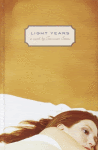 Maya Laor is the narrator of LIGHT YEARS a novel dually set in Virginia and Israel. In alternating chapters, Maya reveals her past and shares her present experiences as a college student at an American university, the University of Virginia.
Maya's past is haunting her. Growing up in Israel, Maya was fully aware of the dangers that the Palestini/Israeli conflict presents. After all, she is fulfilling her years as an Israeli soldier. But through it all, Maya never truly thought that terrorism would effect her quite so closely. Her boyfriend, Dov, is killed at a restaurant by a Palestinian suicide bomber (along with six others).
LIGHT YEARS shares how Maya is able to blend her haunting past with a hope-filled future as she tries to figure out just where she belongs.
Also recommended is REAL TIME (2004) by Pnina Moed Kass and the nonfiction book UNDERSTANDING THE HOLY LAND: ANSWERING QUESTIONS ABOUT THE ISRAELI-PALESTINIAN CONFLICT (2005) by Mitch Frank.
http://www.tammarstein.com/LightYears.html
 Maya Laor is the narrator of LIGHT YEARS a novel dually set in Virginia and Israel. In alternating chapters, Maya reveals her past and shares her present experiences as a college student at an American university, the University of Virginia.
Maya's past is haunting her. Growing up in Israel, Maya was fully aware of the dangers that the Palestini/Israeli conflict presents. After all, she is fulfilling her years as an Israeli soldier. But through it all, Maya never truly thought that terrorism would effect her quite so closely. Her boyfriend, Dov, is killed at a restaurant by a Palestinian suicide bomber (along with six others).
LIGHT YEARS shares how Maya is able to blend her haunting past with a hope-filled future as she tries to figure out just where she belongs.
Also recommended is REAL TIME (2004) by Pnina Moed Kass and the nonfiction book UNDERSTANDING THE HOLY LAND: ANSWERING QUESTIONS ABOUT THE ISRAELI-PALESTINIAN CONFLICT (2005) by Mitch Frank.
http://www.tammarstein.com/LightYears.html
Thursday, September 28, 2006
Child's Perspective on Terror

Hanna Jansen's OVER A THOUSAND HILLS I WALK WITH YOU is a touching tribute to her adopted daughter who was orphaned in the Rwandan war. Based on her daughter's recollections of her childhood--memories both pleasant and bittersweet--Jansen weaves a tale of sorrow, hope, fear, joy, and love. For example, the early chapters of the book feature a young girl living life large. She is visiting her grandmother. She's playing with her cousins. She's fighting with her sister and brother. Her mom works outside the home, her dad is away a lot...and she has an incredibly whiny sister that she struggles with on a daily basis. She's vibrant and unaware that her world would change in just a few short years. Later chapters reveal the pain, the loss, the confusion, the fear of not knowing if one is going to survive another day. Witnessing such atrocities as seeing your parents and siblings killed by strange soldiers. Seeking help from family friends, yet being turned away because they don't want to risk dying too. Her survival story is inspiring.
The story is beautifully told, Jansen has done a great job here. Her book is definitely worth reading.
Wednesday, September 27, 2006
A Mother's Legacy
Gantos, Jack. 2006. The Love Curse of the Rumbaughs.
 Most people wouldn’t equate the word love with a curse. Love is a gift, right? Or is there such a thing as loving someone too much? Wanting to prove that horror stories don’t need “gothic” settings with harsh environments--like Mary Shelley’s Frankenstein--Jack Gantos sets out to prove that nothing is scarier than a psychotic mind convinced that its genetically cursed and free from guilt since it’s playing out its predetermined role set by nature. But be warned, The Love Curse of the Rumbaughs is not for the weak-hearted. (If taxidermy freaks you out, don’t even think about reading this book.) While I can’t say more about the book--I wouldn’t want to give away the ending--The Love Curse of the Rumbaughs is a book that I know will appeal to some readers. (I am not one of them!!!)
 Most people wouldn’t equate the word love with a curse. Love is a gift, right? Or is there such a thing as loving someone too much? Wanting to prove that horror stories don’t need “gothic” settings with harsh environments--like Mary Shelley’s Frankenstein--Jack Gantos sets out to prove that nothing is scarier than a psychotic mind convinced that its genetically cursed and free from guilt since it’s playing out its predetermined role set by nature. But be warned, The Love Curse of the Rumbaughs is not for the weak-hearted. (If taxidermy freaks you out, don’t even think about reading this book.) While I can’t say more about the book--I wouldn’t want to give away the ending--The Love Curse of the Rumbaughs is a book that I know will appeal to some readers. (I am not one of them!!!)
Tuesday, September 26, 2006
School Shooting...

SHOOTER by Walter Dean Myers is a novel about a shooting at Madison High School. The story is revealed through a series of interviews, newspaper articles, police reports/files, and the medical examiner's report, and the killer's journal. Leonard Gray (white, 16) is a teen outsider. Not accepted by any peer group--whether the decision was his or theirs--he forms his own group--primarily with his best friend Cameron Porter (African-American, 17) and his girlfriend, Carla Evans (white, 18). Although both Carla and Cameron notice signs--many signs--that Leonard is more than a little off, they ignore the signs because Leonard consistently accepts them for who they are--and he just "understands" them. So Leonard is able to talk them into doing things that they don't quite like doing--such as going to the shooting range, and shooting brown bag targets in the woods (that they later found out where turtles from the pet store), and he even convinces Cameron to vandalize a church with him. Cameron admits he knew it was wrong at the time he was doing it--but he goes along with Leonard. The story is told primarily through interviews--like I mentioned--with Cameron and Carla. The account is not necessarily chronological either. It's not until the very end that the reader is able to place certain events in the order that they happened. The climax of the book obviously is when Cameron reveals how the events of the shooting happened....2 were killed (1 murdered; 1 suicide) and at least 5+ were injured. It's not your typical novel. The reader knows at the beginning that the shooting has occurred. And the novel is essential a report file on whose fault it was, if it was preventable, and how much risk is the school in for future occurrences of violence.
Monday, September 25, 2006
Real Time
 REAL TIME is a novel by Pnina Moed Kass set in Israel and told by multiple narrators varying in age, gender, religion, nationality, and ethnicity. These people are brought together by a Palestinian terrorist (one of the narrators) blowing up a bus on a highway into Jerusalem. If I had to pick three main narrators--I'd pick Thomas Wanninger who is 16, German, and traveling to Israel to volunteer at a kibbutz; Vera Brodsky who is 19, Russian Jew resettled in Israel and living/working at the kibbutz; and Sameh Laham, 16 Palestinian suspected terrorist. Of course, there are at least a dozen more voices that tell the story.
The novel is an honest look at terrorism, and the reality of living in a war zone. Tells all sides of the story--including the Palestinian view on why it is a GREAT thing to be a suicide bomber.
Anyway, I thought this novel is very UNIQUE. I haven't come across many novels set in the Middle East that discuss terrorism, threat of war....etc....
Sameh Laham--
Hard to think I scare anyone. I'm the dishwasher in the diner kitchen, the floor sweeper, the toilet bowl cleaner, I'm sixteen years old, and I live in a small village of Palestinian Arabs. It's not living in Zebedeid that makes me an illegal worker, it's my age. If I were over forty, with gray hair and a clean record, I would have a work permit and a magnetic card. I would swipe the card through the machine at the border, the machine would click, and I would be legal. You would see me, not see through me. Invisible, and I can earn only what my boss takes out of his back pocket. The cash he counts out is what I give my mother so we can all live: food for my two brothers and two sisters, my little brother's kidney pills, flour, oil for cooking, money for clothes. I don't need anything. My boss gives me old pants, someone's T-shirt, and whatever food is left over in the kitchen at the end of the day. All over the world sixteen is paradise, opportunity, girls, cars, everything. I watch television in Omar's house and see sixteen. Sixteen is the beach, your own room, a cell phone, surfing on waves that never end, different clothes for every day of the week, a refridgerator full of ice cream and chocolates, a mother who waits for you in a kitchen with a washing machine and a dishwasher, and a father who comes home from work. That is sixteen. Here sixteen is the magic age of death. No children, no responsibilities, no wife. A sixteen-year-old is a walking grave. Why give a job to someone about to die? Kids who explode themselves and kill Israelis have no future, so don't give them a future" (21-22).
Sunday, September 24, 2006
Defining Integrity
Ray, Delia. 2006. Singing Hands.
 Set in Birmingham, Alabama, in 1948, Singing Hands is a unique historical novel revealing insight into the hidden--and not-so-hidden prejudices of the times. Augusta “Gussie” Davis is the middle child of her family, not to mention the fact that her father is a well-respected minister...and you’ve got the perfect recipe for rebellious pranks and a summerful of trouble. “Up until the summer of 1948, when I was twelve, probably the worst thing I ever did was hum in church” (v). But there’s more to the story, her parents are deaf; her father ministers not only to the white community but to the black community as well. And his ministry doesn’t stop there, he pastors two churches in Birmingham, and a string of other churches in the South which he travels to during the week. He’s always on the road, never home. And even when he’s home...his attention is never on his hearing daughters. Whether Gussie’s behavior stems from wanting to get her dad’s attention OR is just typical growing pains, the readers will enjoy seeing her get in and out of trouble. Other characters play an important role in her journey to young adulthood as well, the family has two boarders living on the third floor: one, a retired English teacher who loves playing Opera music and runs a milinary shop, and the second a young war-widow who is the town’s librarian.
Singing Hands is the journey of one girl’s unforgettable summer where she learns not only about herself but gains a truer understanding of society as well.
http://www.deliaray.com/content/index.asp
American Sign Language
American Sign Language Browser (video clip dictionary of American Sign Language
http://www.handspeak.com/
http://www.lifeprint.com/
 Set in Birmingham, Alabama, in 1948, Singing Hands is a unique historical novel revealing insight into the hidden--and not-so-hidden prejudices of the times. Augusta “Gussie” Davis is the middle child of her family, not to mention the fact that her father is a well-respected minister...and you’ve got the perfect recipe for rebellious pranks and a summerful of trouble. “Up until the summer of 1948, when I was twelve, probably the worst thing I ever did was hum in church” (v). But there’s more to the story, her parents are deaf; her father ministers not only to the white community but to the black community as well. And his ministry doesn’t stop there, he pastors two churches in Birmingham, and a string of other churches in the South which he travels to during the week. He’s always on the road, never home. And even when he’s home...his attention is never on his hearing daughters. Whether Gussie’s behavior stems from wanting to get her dad’s attention OR is just typical growing pains, the readers will enjoy seeing her get in and out of trouble. Other characters play an important role in her journey to young adulthood as well, the family has two boarders living on the third floor: one, a retired English teacher who loves playing Opera music and runs a milinary shop, and the second a young war-widow who is the town’s librarian.
Singing Hands is the journey of one girl’s unforgettable summer where she learns not only about herself but gains a truer understanding of society as well.
http://www.deliaray.com/content/index.asp
American Sign Language
American Sign Language Browser (video clip dictionary of American Sign Language
http://www.handspeak.com/
http://www.lifeprint.com/
Saturday, September 23, 2006
The Silver Donkey
 (The UK Book cover) Beware of any book that is a self-proclaimed classic. Candlewick Press’ The Silver Donkey by Sonya Hartnett is one such example. The definition of pretentious is “making usually unjustified or excessive claims (as of value or standing)” or “expressive of affected, unwarrented, or exaggerated importance, worth or stature.” Originally published in Australia in 2004, The Silver Donkey is the story of two sisters, one brother, one runaway soldier, and one miniature silver donkey.
When Marcelle and Therese “Coco” find a ‘dead man’ in the forest they are eager to brag to their brother, Pascal, of their latest discovery--after all, it’s not something that any other child in the village could claim to have done. But wanting to doublecheck the facts before they tell anyone and everyone because it would be embarrassing to tell about a ‘dead’ man who was only asleep, the two go back to discover he is not dead...merely a blind man--a deserter from the army--on his way back home. Still the girls are proud to have discovered him. Their brother has never seen a blind man--let alone found a lost blind man in the forest. The three quickly become friends and their new ‘discovery’ turns out to be quite a storyteller. His stories are all fixated on donkeys. His obsession is seemingly founded on a small, miniature silver donkey he keeps in his pocket and holds for comfort.
 (The Australian Book cover) The book alternates between four stories the soldier tells his young listeners--the sisters and finally the brother--and between the ‘present’ day action of the kids trying to find a way to help this blind man find a way across the channel so he can go home. (The novel is set in World War I). The ‘lesson’ of the novel: war is ugly; war is horrific; there is no glory in war.
 (The American book cover)
 The story in and of itself is not particularly a bad one. Yes, the writing tries a little too hard to be ‘old fashioned.’ And yes, the characters are a little one dimensional, but it wouldn’t be that bad a novel if it wasn’t trying so hard--from its elaborate design, green with silver gilding, to its glossy pages, its shiny silver end pages, its fancy fonts, its silver ribbon bookmark, it’s all much too much. (Not to mention its back cover promoting it as the next treasured classic.) The Silver Donkey is a nostalgic book for adults masquerading as a children’s book. Ultimately designed as a gift book that will appeal to adults to buy for the children and grandchildren in their lives, but may prove to young readers to be more of a bore than pleasure.
Friday, September 22, 2006
Beast
Napoli, Donna Jo. 2000. Beast.
 Donna Jo Napoli’s BEAST is a modern retelling of the classic tale Beauty and the Beast told from the point of view of the Beast. Borrowing details from Charles Lamb’s retelling written in 1811, Napoli begins the story in Persia with a young prince named Orasmyn. After a religious mistake--sacrificing an animal unfit for sacrifice--the young man is cursed by a fairy “pari” and transformed into a lion. Told that only a woman’s love would break the spell, Orasmyn wanders Persia, India, and all the way to France making peace with his new self. Not expecting to ever even meet a young woman face to face--let alone try to woo her--he settles in an abandoned castle until one day...
While readers will always be familiar with traditional fairy tales, new retellings offer great pleasure adding new depth and perspectives to old stories.
Charles Lamb's Beauty and the Beast, 1811
SurLaLune: The Annotated Beauty and the Beast
SurLaLune: Modern Interpretations of Beauty and the Beast
Beauty and The Beast Home
http://www.donnajonapoli.com/
 Donna Jo Napoli’s BEAST is a modern retelling of the classic tale Beauty and the Beast told from the point of view of the Beast. Borrowing details from Charles Lamb’s retelling written in 1811, Napoli begins the story in Persia with a young prince named Orasmyn. After a religious mistake--sacrificing an animal unfit for sacrifice--the young man is cursed by a fairy “pari” and transformed into a lion. Told that only a woman’s love would break the spell, Orasmyn wanders Persia, India, and all the way to France making peace with his new self. Not expecting to ever even meet a young woman face to face--let alone try to woo her--he settles in an abandoned castle until one day...
While readers will always be familiar with traditional fairy tales, new retellings offer great pleasure adding new depth and perspectives to old stories.
Charles Lamb's Beauty and the Beast, 1811
SurLaLune: The Annotated Beauty and the Beast
SurLaLune: Modern Interpretations of Beauty and the Beast
Beauty and The Beast Home
http://www.donnajonapoli.com/
Thursday, September 21, 2006
Super Powers in High School

HOW MY PRIVATE PERSONAL JOURNAL BECAME A BESTSELLER by Julia DeVillers is quite a fun little novel--or "teen fairytale."
Jamie Bartlett, is our heroine, she is your "typical" 14 year old dealing with peer pressure and questions of body image and self esteem. She accidentally becomes an almost overnight celebrity when her "journal" becomes the new IT YA book/novel.
Bartlett invents Isabella--a normal teenage girl who becomes a superhero IS when she sees social injustice. IS fights Myrna and the Evil Clique of Populors--the Backstabbor, the Gossipor, the Insultor, the Fashionistor, the Ostracizor, the Dietor, the Betrayor, the Best Friend Stealor (p. 14, 157). IS's weapon of choice is a flick of the wrist--which sends out rays of positivity.
One of IS's encounters is on page 68...
"Size zero is the only way to be," the Dietor said scornfully. "Why I'd be a negative number if I could!" The Dietor turned around to drink her diet soda and eat her single lettuce leaf. Then she gasped. IS! IS raised her fist and FLICK! the Dietor wasted away...to nothing.
Of course, 90% of the book is not about the invented character of Isabella or IS--but is about Jamie. Jamie despite her success and newfound popularity--still has problems. Just because IS has superpowers doesn't make Jamie's life any easier. She still can't seem to win against the real life cliques she faces every day in high school. Although she does grow in confidence and self esteem as the novel progresses.
Jamie is a likable character--one that is very easy to relate to--no matter how old you are.
The novel is told in first person...with a conversational tone. Jamie addresses the reader as "you" and continually engages the reader. (Which I liked)
I thought this book dealt with real problems and issues in a fun way. While the "overnight" success of Jamie as an author is not quite realistic--the issues and problems she faces are quite real.
http://www.girlwise.com/
Wednesday, September 20, 2006
Who's the fairest?
Harrison, Mette Ivie. 2004. MIRA, MIRROR. New York: Viking. ISBN 0670059234.
 Mira and Amanda are two sisters with two different destinies who share a common bond: magic. Amanda has one desire: to become a powerful queen. Amanda will do anything to anybody to make sure that dream becomes reality--even if it means trapping her sister, Mira, in a "magic" mirror. Using the magic mirror, Amanda becomes the fairest in the land. Sound familiar? That's because Harrison's novel MIRA, MIRROR is a new twist on an old tale: Snow White and the Seven Dwarfs.
But MIRA, MIRROR is not the traditional telling. In fact, there is hardly any mention of Snow White or any of her seven dwarfs. Instead, MIRA, MIRROR is the story of what happened a hundred years after the "happily ever after" ending of Snow White. It tells what became of the magic mirror. Alone and abandoned, Mira has almost forgotten what it means to be human. She spends her day hanging on an ivy-covered wall hoping that some day she'll be human again. But in her quest, she realizes that she is just as selfish and manipulative as her sister was.
Mira is found by a young girl, Ivana, who is escaping an abusive father and an arranged marriage. Together the two find themselves far away from their painful pasts and desperate to find new beginnings. Ivana wants the magic mirror to change her face so she'll be safe from the men in her past who want only to use her. Mira, of course, is using Ivana to get her across the country--and hopefully in contact with some magic she can use to transform herself back into a human. Both are in luck when they meet Talia and her father, a merchant, traveling along the road. Encouraged by Mira, Ivana tells a series of lies to convince the traveling pair that she is a merchant's daughter whose father was just killed by bandits when robbing their carriage. Talia's sweet and trusting nature convinces her father, despite his doubts, to take the girl along with them.
That night, the mirror does its work: it changes Talia's face into Ivana's and vice versa. Both Ivana and Mira are surprised when Talia does not protest the change. In fact, she is relieved to trade her plain face for Ivana's beautiful one. She's also relieved to be escaping from the marriage that her father had arranged for her! The father, Merchant Minitz, takes both girls home and soon they are one big happy family.
Mira learns--after time--that being human is more than having power over other people. While her previous experiences with humanity were full of bitterness, cruelty, and hate, she sees for the first time how two sisters should treat each other. She sees two sisters who love and trust one another. Something that her experiences with her sister Amanda had never allowed. Through her experiences as a magic mirror, especially in watching these two young girls, Mira learns what it means to be human.
MIRA, MIRROR is a clever and well-written novel. The characters are well-developed. Mira--both as a human and a mirror--possesses both good and bad character traits. While she is manipulative, selfish, and power-hungry, Mira at the same time questions her own motives and those of the people around her. Surrounded by the love and generosity of Talia and Ivana, Mira for the first time feels compassion, love, and a concern for others above herself. At one point, Mira would have sacrificed anybody or anything for the chance to be human again, but things change. By the end of the novel, Mira would do anything--even sacrificing her existence as a mirror--to protect the two girls.
MIRA, MIRROR is also an examination of how girls (young women) were treated in folk tales or fairy tales. Girls (and/or women) were generally either subject to their father, subject to a husband, or were witches--seen as evil, ugly, and animal-like. They did not have the option to be independent. By the end of most folk tales or fairy tales, the young girl gets married and supposedly lives happily ever after. Talia is a young woman who does not want to get married; she wants to be independent--she wants to become a merchant. Talia is a woman who is strong, confident, full of opinions, and wants to live her life her way.
MIRA, MIRROR is an enjoyable and satisfying read. I wholeheartedly recommend it to readers of all ages. There are many modern books--some YA and some adult--that are new twists on old tales. One of my favorites is a twist on Sleeping Beauty by Orson Scott Card called ENCHANTMENT. (ENCHANTMENT is an adult novel which can easily be read (and enjoyed) by young adults.) Fans of this book should definitely seek it out. For the young adult audience, Robin McKinley has written some great books including Spindle's End, Beauty, and Rose Daughter. For younger readers, Donna Jo Napoli has written many novels which are based on traditional tales (ZEL, BEAST, CRAZY JACK, THE MAGIC CIRCLE, SPINNERS). Jane Yolen has written some as well (for example, BRIAR ROSE).
http://www.robinmckinley.com/
Orson Scott Card official site
http://www.donnajonapoli.com/
http://www.janeyolen.com/
 Mira and Amanda are two sisters with two different destinies who share a common bond: magic. Amanda has one desire: to become a powerful queen. Amanda will do anything to anybody to make sure that dream becomes reality--even if it means trapping her sister, Mira, in a "magic" mirror. Using the magic mirror, Amanda becomes the fairest in the land. Sound familiar? That's because Harrison's novel MIRA, MIRROR is a new twist on an old tale: Snow White and the Seven Dwarfs.
But MIRA, MIRROR is not the traditional telling. In fact, there is hardly any mention of Snow White or any of her seven dwarfs. Instead, MIRA, MIRROR is the story of what happened a hundred years after the "happily ever after" ending of Snow White. It tells what became of the magic mirror. Alone and abandoned, Mira has almost forgotten what it means to be human. She spends her day hanging on an ivy-covered wall hoping that some day she'll be human again. But in her quest, she realizes that she is just as selfish and manipulative as her sister was.
Mira is found by a young girl, Ivana, who is escaping an abusive father and an arranged marriage. Together the two find themselves far away from their painful pasts and desperate to find new beginnings. Ivana wants the magic mirror to change her face so she'll be safe from the men in her past who want only to use her. Mira, of course, is using Ivana to get her across the country--and hopefully in contact with some magic she can use to transform herself back into a human. Both are in luck when they meet Talia and her father, a merchant, traveling along the road. Encouraged by Mira, Ivana tells a series of lies to convince the traveling pair that she is a merchant's daughter whose father was just killed by bandits when robbing their carriage. Talia's sweet and trusting nature convinces her father, despite his doubts, to take the girl along with them.
That night, the mirror does its work: it changes Talia's face into Ivana's and vice versa. Both Ivana and Mira are surprised when Talia does not protest the change. In fact, she is relieved to trade her plain face for Ivana's beautiful one. She's also relieved to be escaping from the marriage that her father had arranged for her! The father, Merchant Minitz, takes both girls home and soon they are one big happy family.
Mira learns--after time--that being human is more than having power over other people. While her previous experiences with humanity were full of bitterness, cruelty, and hate, she sees for the first time how two sisters should treat each other. She sees two sisters who love and trust one another. Something that her experiences with her sister Amanda had never allowed. Through her experiences as a magic mirror, especially in watching these two young girls, Mira learns what it means to be human.
MIRA, MIRROR is a clever and well-written novel. The characters are well-developed. Mira--both as a human and a mirror--possesses both good and bad character traits. While she is manipulative, selfish, and power-hungry, Mira at the same time questions her own motives and those of the people around her. Surrounded by the love and generosity of Talia and Ivana, Mira for the first time feels compassion, love, and a concern for others above herself. At one point, Mira would have sacrificed anybody or anything for the chance to be human again, but things change. By the end of the novel, Mira would do anything--even sacrificing her existence as a mirror--to protect the two girls.
MIRA, MIRROR is also an examination of how girls (young women) were treated in folk tales or fairy tales. Girls (and/or women) were generally either subject to their father, subject to a husband, or were witches--seen as evil, ugly, and animal-like. They did not have the option to be independent. By the end of most folk tales or fairy tales, the young girl gets married and supposedly lives happily ever after. Talia is a young woman who does not want to get married; she wants to be independent--she wants to become a merchant. Talia is a woman who is strong, confident, full of opinions, and wants to live her life her way.
MIRA, MIRROR is an enjoyable and satisfying read. I wholeheartedly recommend it to readers of all ages. There are many modern books--some YA and some adult--that are new twists on old tales. One of my favorites is a twist on Sleeping Beauty by Orson Scott Card called ENCHANTMENT. (ENCHANTMENT is an adult novel which can easily be read (and enjoyed) by young adults.) Fans of this book should definitely seek it out. For the young adult audience, Robin McKinley has written some great books including Spindle's End, Beauty, and Rose Daughter. For younger readers, Donna Jo Napoli has written many novels which are based on traditional tales (ZEL, BEAST, CRAZY JACK, THE MAGIC CIRCLE, SPINNERS). Jane Yolen has written some as well (for example, BRIAR ROSE).
http://www.robinmckinley.com/
Orson Scott Card official site
http://www.donnajonapoli.com/
http://www.janeyolen.com/
Tuesday, September 19, 2006
Spotlight on Laura Gallego Garcia
Laura Gallego Garcia won the prestigious El Barco de Vapor award at the age of twenty-one for her novel, Apocalypse, then won it again three years later for The Legend of the Wandering King. The author of fourteen published books, she is currently completing her doctorate in medieval literature at the University of Valencia. Laura lives in Alboraya, Spain. Two of her books have been translated and published in English.
About Laura Gallego Garcia
Official Laura Gallego Garcia site (in Spanish)
Spanish Lords, Swords, And Magic: An Article about Laura Gallego Garcia's work in Criticas
Garcia, Laura Gallego. 2005. THE LEGEND OF THE WANDERING KING. Translated by Dan Bellm. New York: Arthur Levine (Scholastic). ISBN 0439585562
 As a young man, Walid (Wah-leed) ibn Hujr dreamed of being a great man, a great ruler, and a great poet. He wanted to be loved, admired, appreciated, and respected. And since he was born a prince, son of King Hujr ruler of Kinda (in Arabia), he thought his dreams would be easily attained—especially since many thought he’d been touched by a djinn at birth. (Djinn being a genie). However, Walid failed to consider what fate had in mind.
A gifted and beloved prince, Walid was certain that he was the best poet in Kinda. Wanting to earn his father’s approval to go to Ukaz to enter a poetry contest, he organizes a smaller poetry contest for the kingdom of Kinda—arrogance and vanity assuring him that his winning is a matter of certainty.
However, when a peasant man—a carpet weaver—Hammad ibn al-Haddad, wins the contest three years in a row, the once magnanimous prince becomes embittered and resolves to make the peasant pay for his superiority. He forces the peasant to leave his home, his wife, and his three sons (a merchant, a shepherd, and his youngest son who has not chosen a career yet) to become the kingdom’s archivist and historian. He is told he must read and organize the kingdom’s archives (library). The task is monumental and overwhelming. He begs for mercy, but none is given. Walid does grant him this, however, if he can organize the archives and weave him a carpet, then he can be free to return to his home.
After four years, a thinner and wearier man presents himself to the King—Walid’s father having died in the subsequent years. Walid is surprised, yet wanting to remain a man of his word, he adds a stipulation to his earlier request: he must weave a carpet “that will contain the entire history of the human race” (62). Hammad is subsequently driven mad on his quest to create such a carpet, but in his madness finds unusual peace. Even Walid notices the change in him and becomes scared of him noting that there was something not quite human about him now. Once when Walid visited him in his workshop, Hammad tells him mysteriously, “Know that you are a mere mortal who has unleashed powers more terrible than a mighty storm, and that as a mortal, you cannot stop their wrath. Not anymore. It is far too late” (73).
After considering these seemingly prophetic words, Walid decides to release the man from his “curse” and allow him to go home. He opens the door to discover him dead, collapsed on the floor, and the completed carpet. One look at the carpet and Walid becomes convinced that the old man spoke the truth; in shame and fear, he locks the carpet into his secret room. But his life (and destiny) is forever changed. His kingdom begins to fall apart. His soldiers, his servants, his household begins to distrust him. Betrayal seems inevitable.
In the middle of the night, a former friend and advisor slip into the palace with two companions their goal to steal the king’s treasure. Instead of silver or gold, they find a carpet. The king is awakened by a nightmare about the carpet—and so being a paranoid man—he decides to make sure the carpet is still locked away. He discovers that his dream is all too true, just in time to receive a club on the head. As soon as he awakes, however, he dashes off to the stables for a horse so he can pursue the thieves; he’s still dressed in his nightgown!
Since his plan was foolhardy—to begin a dash across the desert without any provisions—it’s no surprise when he collapses in the sand certain that his death is hours away. He is saved by a stranger, an outlaw. But this close-call with death won’t be his last.
THE LEGEND OF THE WANDERING KING is an adventure quest with unexpected twists and turns. As Walid sets out on his journey to recover the carpet and restore past wrongs, what he discovers is that it is never too late to change one’s self. It is an adventurous quest to restore and redeem his own life.
Set in Arabia in 6th century C.E., THE LEGEND OF THE WANDERING KING is an exciting adventure story with probing questions. Is there such a thing as fate? Can a man ever truly make amends for his past mistakes? Is a man defined by his mistakes? Can a person really change his character?
First published in Spain in 2002, THE LEGEND OF THE WANDERING KING has been translated into English by Dan Bellm. It is rich in pre-Islamic Arabic culture. An author’s note explains the time and culture which is depicted in the book. (Yes, the book is based loosely on a pre-Islamic legendary poet, Imru’l Qays.)
Garcia, Laura Gallego. 2006. The Valley of the Wolves.
 I was first introduced to Laura Gallego Garcia's work when her book LEGEND OF THE WANDERING KING was published in English last year. When I saw she had another book translated and published, I was quite excited. LEGEND had thrilled me last year, and I was hoping for more of the same. There was something about LEGEND that was epic...it was beautiful...it was haunting...it was truly one of the best books I'd ever read. So perhaps I expected too much when I picked up THE VALLEY OF THE WOLVES.
The novel is fantasy. A young heroine is befriended early in her childhood by a playmate only she can see--a ghost--not that she'll know he's a ghost for quite a while. The two have a unique bond that makes it hard for her to relate to kids her own age. But her life, Dana is her name, changes when she is adopted by a mysterious sorcerer named Maestro. He takes her to live in a tower/castle which becomes surrounded by wolves at night. There she learns to become a sorceress. Her fellow companion--in addition to the ghost--is an elf. Not an ordinary elf, but a were-elf...who has the ability to keep the wolves from invading the tower.
Full of magic, VALLEY OF THE WOLVES moves quickly. She ages from 8 to 16 in two or three chapters. The Maestro remains ever-mysterious and untrustworthy. The truth is Dana doesn't know who to trust and who her allies are.
Perhaps the differences--besides subject matter of course--between The Valley of the Wolves and Legend of the Wandering King can be explained partly by the fact that Valley of the Wolves was one of Laura Gallego Garcia's earlier works written and published before Legend.
About Laura Gallego Garcia
Official Laura Gallego Garcia site (in Spanish)
Spanish Lords, Swords, And Magic: An Article about Laura Gallego Garcia's work in Criticas
Garcia, Laura Gallego. 2005. THE LEGEND OF THE WANDERING KING. Translated by Dan Bellm. New York: Arthur Levine (Scholastic). ISBN 0439585562
 As a young man, Walid (Wah-leed) ibn Hujr dreamed of being a great man, a great ruler, and a great poet. He wanted to be loved, admired, appreciated, and respected. And since he was born a prince, son of King Hujr ruler of Kinda (in Arabia), he thought his dreams would be easily attained—especially since many thought he’d been touched by a djinn at birth. (Djinn being a genie). However, Walid failed to consider what fate had in mind.
A gifted and beloved prince, Walid was certain that he was the best poet in Kinda. Wanting to earn his father’s approval to go to Ukaz to enter a poetry contest, he organizes a smaller poetry contest for the kingdom of Kinda—arrogance and vanity assuring him that his winning is a matter of certainty.
However, when a peasant man—a carpet weaver—Hammad ibn al-Haddad, wins the contest three years in a row, the once magnanimous prince becomes embittered and resolves to make the peasant pay for his superiority. He forces the peasant to leave his home, his wife, and his three sons (a merchant, a shepherd, and his youngest son who has not chosen a career yet) to become the kingdom’s archivist and historian. He is told he must read and organize the kingdom’s archives (library). The task is monumental and overwhelming. He begs for mercy, but none is given. Walid does grant him this, however, if he can organize the archives and weave him a carpet, then he can be free to return to his home.
After four years, a thinner and wearier man presents himself to the King—Walid’s father having died in the subsequent years. Walid is surprised, yet wanting to remain a man of his word, he adds a stipulation to his earlier request: he must weave a carpet “that will contain the entire history of the human race” (62). Hammad is subsequently driven mad on his quest to create such a carpet, but in his madness finds unusual peace. Even Walid notices the change in him and becomes scared of him noting that there was something not quite human about him now. Once when Walid visited him in his workshop, Hammad tells him mysteriously, “Know that you are a mere mortal who has unleashed powers more terrible than a mighty storm, and that as a mortal, you cannot stop their wrath. Not anymore. It is far too late” (73).
After considering these seemingly prophetic words, Walid decides to release the man from his “curse” and allow him to go home. He opens the door to discover him dead, collapsed on the floor, and the completed carpet. One look at the carpet and Walid becomes convinced that the old man spoke the truth; in shame and fear, he locks the carpet into his secret room. But his life (and destiny) is forever changed. His kingdom begins to fall apart. His soldiers, his servants, his household begins to distrust him. Betrayal seems inevitable.
In the middle of the night, a former friend and advisor slip into the palace with two companions their goal to steal the king’s treasure. Instead of silver or gold, they find a carpet. The king is awakened by a nightmare about the carpet—and so being a paranoid man—he decides to make sure the carpet is still locked away. He discovers that his dream is all too true, just in time to receive a club on the head. As soon as he awakes, however, he dashes off to the stables for a horse so he can pursue the thieves; he’s still dressed in his nightgown!
Since his plan was foolhardy—to begin a dash across the desert without any provisions—it’s no surprise when he collapses in the sand certain that his death is hours away. He is saved by a stranger, an outlaw. But this close-call with death won’t be his last.
THE LEGEND OF THE WANDERING KING is an adventure quest with unexpected twists and turns. As Walid sets out on his journey to recover the carpet and restore past wrongs, what he discovers is that it is never too late to change one’s self. It is an adventurous quest to restore and redeem his own life.
Set in Arabia in 6th century C.E., THE LEGEND OF THE WANDERING KING is an exciting adventure story with probing questions. Is there such a thing as fate? Can a man ever truly make amends for his past mistakes? Is a man defined by his mistakes? Can a person really change his character?
First published in Spain in 2002, THE LEGEND OF THE WANDERING KING has been translated into English by Dan Bellm. It is rich in pre-Islamic Arabic culture. An author’s note explains the time and culture which is depicted in the book. (Yes, the book is based loosely on a pre-Islamic legendary poet, Imru’l Qays.)
Garcia, Laura Gallego. 2006. The Valley of the Wolves.
 I was first introduced to Laura Gallego Garcia's work when her book LEGEND OF THE WANDERING KING was published in English last year. When I saw she had another book translated and published, I was quite excited. LEGEND had thrilled me last year, and I was hoping for more of the same. There was something about LEGEND that was epic...it was beautiful...it was haunting...it was truly one of the best books I'd ever read. So perhaps I expected too much when I picked up THE VALLEY OF THE WOLVES.
The novel is fantasy. A young heroine is befriended early in her childhood by a playmate only she can see--a ghost--not that she'll know he's a ghost for quite a while. The two have a unique bond that makes it hard for her to relate to kids her own age. But her life, Dana is her name, changes when she is adopted by a mysterious sorcerer named Maestro. He takes her to live in a tower/castle which becomes surrounded by wolves at night. There she learns to become a sorceress. Her fellow companion--in addition to the ghost--is an elf. Not an ordinary elf, but a were-elf...who has the ability to keep the wolves from invading the tower.
Full of magic, VALLEY OF THE WOLVES moves quickly. She ages from 8 to 16 in two or three chapters. The Maestro remains ever-mysterious and untrustworthy. The truth is Dana doesn't know who to trust and who her allies are.
Perhaps the differences--besides subject matter of course--between The Valley of the Wolves and Legend of the Wandering King can be explained partly by the fact that Valley of the Wolves was one of Laura Gallego Garcia's earlier works written and published before Legend.
Monday, September 18, 2006
What are you afraid of?
Gallo, Donald R. ed., 2006. What Are You Afraid Of? Stories About Phobias.
 With contributions from authors such as Neal Shusterman, Kelly Easton, Gail Giles, Jane Yolen, Nancy Springer, David Lubar, Angela Johnson, Joan Bauer, Ron Koertge, and Alex Finn, WHAT ARE YOU AFRAID OF? is an incredible collection of short stories gathered around a central theme: phobias. You might be expecting to read a book about teens with a fear of spiders, heights, dentists, or one of the other 'common' phobias represented in the media.
In "The Door" Alex Flinn introduces us to Cameron whose phobia has grown increasingly worse until he cannot leave the house. What started out as a fear of going to school--after an incident with the school bully--slowly became a fear of leaving his neighborhood, then of leaving his yard, until finally he cannot even open his front door.
In "Calle de Muerte" Ron Koertge introduces us to Robert whose phobia is crossing the street. But with the help of a new neighbor--a young teen girl in a wheel chair--he is closer to getting off the curb than ever before.
In "Thin" Joan Bauer introduces us to a Deenie whose fear is gaining weight. Can she recognize the danger she is putting herself in before it's too late?
In "D'arcy" Angela Johnson introduces us to James whose phobia some readers may not be all that familiar with--string. But readers will see the extent of his phobia when he falls in love with D'arcy who loves to knit.
In "Claws and Effect" David Lubar introduces us to Randy whose phobia is cats. After a traumatic childhood experience, he has a lingering fear. But when his new girlfriend introduces him to "Johnny Depp" he has a choice...face his fear or lose the girl of his dreams.
In "Rutabaga" Nancy Springer introduces us to Lydia whose phobia is knives and sharp objects. With the help of friends, can she finally uncover the true source of her fear and overcome it once and for all?
In "Bang, Bang, You're Dead" Jane Yolen and her daughter Heidi E.Y. Stemple introduce us to Josh whose fear is speaking in public. Living in the shadow of his brother, Aaron, can Josh ever hope to succeed academically. . .especially since one of the requirements for completing 11th grade is making a speech in English class . . . and possibly the whole town if he is chosen to perform on Declamation Night.
In "No Clown Zone" Gail Giles introduces us to Will whose phobia is clowns. Once again the book shows a boy's phobias getting in the way of his love life. But are clowns really the only thing standing in his way?
In "Instructions for Tight Places" Kelly Easton walks the reader through what an elevator ride feels like to a person who is claustrophobic.
In "Fear-For-All" Neal Shusterman introduces us to Gavin whose enrollment at Bleakhaven Academy is a puzzlement to all--since he is the only student without a phobia--until one day his worth, his fearlessness, becomes terrifyingly clear to everyone.
The stories are well written and enjoyable. Common themes in the stories include friendship, first love, self-esteem, and self-acceptance.
http://phobialist.com/
http://didyouknow.cd/phobias/phobias.htm
The 24 Hour Phobia Clinic
 With contributions from authors such as Neal Shusterman, Kelly Easton, Gail Giles, Jane Yolen, Nancy Springer, David Lubar, Angela Johnson, Joan Bauer, Ron Koertge, and Alex Finn, WHAT ARE YOU AFRAID OF? is an incredible collection of short stories gathered around a central theme: phobias. You might be expecting to read a book about teens with a fear of spiders, heights, dentists, or one of the other 'common' phobias represented in the media.
In "The Door" Alex Flinn introduces us to Cameron whose phobia has grown increasingly worse until he cannot leave the house. What started out as a fear of going to school--after an incident with the school bully--slowly became a fear of leaving his neighborhood, then of leaving his yard, until finally he cannot even open his front door.
In "Calle de Muerte" Ron Koertge introduces us to Robert whose phobia is crossing the street. But with the help of a new neighbor--a young teen girl in a wheel chair--he is closer to getting off the curb than ever before.
In "Thin" Joan Bauer introduces us to a Deenie whose fear is gaining weight. Can she recognize the danger she is putting herself in before it's too late?
In "D'arcy" Angela Johnson introduces us to James whose phobia some readers may not be all that familiar with--string. But readers will see the extent of his phobia when he falls in love with D'arcy who loves to knit.
In "Claws and Effect" David Lubar introduces us to Randy whose phobia is cats. After a traumatic childhood experience, he has a lingering fear. But when his new girlfriend introduces him to "Johnny Depp" he has a choice...face his fear or lose the girl of his dreams.
In "Rutabaga" Nancy Springer introduces us to Lydia whose phobia is knives and sharp objects. With the help of friends, can she finally uncover the true source of her fear and overcome it once and for all?
In "Bang, Bang, You're Dead" Jane Yolen and her daughter Heidi E.Y. Stemple introduce us to Josh whose fear is speaking in public. Living in the shadow of his brother, Aaron, can Josh ever hope to succeed academically. . .especially since one of the requirements for completing 11th grade is making a speech in English class . . . and possibly the whole town if he is chosen to perform on Declamation Night.
In "No Clown Zone" Gail Giles introduces us to Will whose phobia is clowns. Once again the book shows a boy's phobias getting in the way of his love life. But are clowns really the only thing standing in his way?
In "Instructions for Tight Places" Kelly Easton walks the reader through what an elevator ride feels like to a person who is claustrophobic.
In "Fear-For-All" Neal Shusterman introduces us to Gavin whose enrollment at Bleakhaven Academy is a puzzlement to all--since he is the only student without a phobia--until one day his worth, his fearlessness, becomes terrifyingly clear to everyone.
The stories are well written and enjoyable. Common themes in the stories include friendship, first love, self-esteem, and self-acceptance.
http://phobialist.com/
http://didyouknow.cd/phobias/phobias.htm
The 24 Hour Phobia Clinic
Sunday, September 17, 2006
Is Ignorance Bliss?
For those who have ever pondered "Can what I don't know hurt me???" consider reading John Boyne's new book The Boy in the Striped Pajamas.
Boyne, John. 2006. The Boy in The Striped Pajamas.
 The Boy in the Striped Pajamas is either the best-worst book I’ve ever read OR the worst-best book I’ve ever read. There are many words I could use to describe this novel or “fable” by John Boyne. Powerful. Gripping. Emotional. Haunting. Tragic. Beautiful. Manipulative. Disturbing. Thought-Provoking. Challenging. Whether you hate it or love it, one thing can’t be denied...it is a novel that stays with you long after you’ve finished reading it. And how many ‘novels’ can you honestly say have that same effect?
What is it about? I’m not going to tell you. Not much anyway. Part of the intrigue of The Boy in the Striped Pajamas is its ambiguous description, at least this was the case for me. I picked the book up and scanned the back cover looking for a description only to find: “The story of The Boy In The Striped Pajamas is very difficult to describe. Usually we give some clues about the book on the jacket, but in this case we think that would spoil the reading of the book. We think it is important that you start to read without knowing what it is about. If you do start to read this book, you will go on a journey with a nine-year-old boy called Bruno. (Though this isn’t a book for nine-year-olds.) And sooner or later you will arrive with Bruno at a fence. Fences like this exist all over the world. We hope you never have to encounter such a fence.”
For those with good deductive reasoning skills, the subject matter may be relatively easy to guess. Without even ‘cheating’ by reading any of the text, I was able to guess that perhaps--just perhaps--this Bruno was about to encounter one of the most horrific crimes against humanity in the twentieth century.
I have described the book itself. But I would like a chance to describe the book’s young hero. Bruno is the poster-child for innocence. He represents everything that is right with the world. Young. Naive. Innocent. Trusting. Care-free. Vulnerable. Honest. Gullible. In some ways The Boy in the Striped Pajamas is a book about the very best in humanity colliding with the very worst in humanity...a novelization of humanity’s struggle with itself.
While The Boy In the Striped Pajamas is not for everyone--it requires a certain emotional maturity and stability--it is a beautiful book. Beautiful and awful at the same time. . . if such a thing is possible. It is a book that I know will haunt me for many years to come, yet I can’t decide if that is a good thing or a bad thing.
Boyne, John. 2006. The Boy in The Striped Pajamas.
 The Boy in the Striped Pajamas is either the best-worst book I’ve ever read OR the worst-best book I’ve ever read. There are many words I could use to describe this novel or “fable” by John Boyne. Powerful. Gripping. Emotional. Haunting. Tragic. Beautiful. Manipulative. Disturbing. Thought-Provoking. Challenging. Whether you hate it or love it, one thing can’t be denied...it is a novel that stays with you long after you’ve finished reading it. And how many ‘novels’ can you honestly say have that same effect?
What is it about? I’m not going to tell you. Not much anyway. Part of the intrigue of The Boy in the Striped Pajamas is its ambiguous description, at least this was the case for me. I picked the book up and scanned the back cover looking for a description only to find: “The story of The Boy In The Striped Pajamas is very difficult to describe. Usually we give some clues about the book on the jacket, but in this case we think that would spoil the reading of the book. We think it is important that you start to read without knowing what it is about. If you do start to read this book, you will go on a journey with a nine-year-old boy called Bruno. (Though this isn’t a book for nine-year-olds.) And sooner or later you will arrive with Bruno at a fence. Fences like this exist all over the world. We hope you never have to encounter such a fence.”
For those with good deductive reasoning skills, the subject matter may be relatively easy to guess. Without even ‘cheating’ by reading any of the text, I was able to guess that perhaps--just perhaps--this Bruno was about to encounter one of the most horrific crimes against humanity in the twentieth century.
I have described the book itself. But I would like a chance to describe the book’s young hero. Bruno is the poster-child for innocence. He represents everything that is right with the world. Young. Naive. Innocent. Trusting. Care-free. Vulnerable. Honest. Gullible. In some ways The Boy in the Striped Pajamas is a book about the very best in humanity colliding with the very worst in humanity...a novelization of humanity’s struggle with itself.
While The Boy In the Striped Pajamas is not for everyone--it requires a certain emotional maturity and stability--it is a beautiful book. Beautiful and awful at the same time. . . if such a thing is possible. It is a book that I know will haunt me for many years to come, yet I can’t decide if that is a good thing or a bad thing.
Saturday, September 16, 2006
Changing First Impressions

Can reading a piece of literature change your life? If you had asked our heroine, Alice Burns, she would have answered a resounding “no” . . . that is until one magical Christmas vacation. The book begins with Alice receiving devastating news--well, devastating news for an A student anyway--she has just gotten a C+ on her paper on Jane Austen’s Pride and Prejudice. Ever merciful, her teacher gives her a way to redeem her grade: reread the book and rewrite the paper over Christmas vacation for a chance at a better grade. While Alice hates the book--considers it a tragedy for “poor” Mary--she hates the idea of a C on her record more. Can reading the book with an open--even imaginative mind--change her life and the lives of those around her? You wouldn’t ordinarily think so . . . but Sachs weaves a magical and ultimately satisfying tale of family, friendship, and first love. Whether you’re a fan of Austen’s Pride and Prejudice or just a fan of YA romance, First Impressions is an enjoyable read.
http://marilynsachs.com/
Friday, September 15, 2006
Elvis, Garth, Ashlee...
Westerfeld, Scott. 2005. Peeps.
 Cal Thompson might seem like your average nineteen-year-old college freshman who is always ‘hungry for sex’ but looks can be deceiving. Cal’s secret, he’s parasite positive. A peep. Well, a carrier peep anyway. What’s a peep you ask? Well, they might commonly be called the ever-so-offensive “v-word”: vampire. Cal has superhuman enhancements: sight, smell, metabolism, speed, etc. But he has none of the bad side effects--cannibalism or anathema. (You see, the parasite controls your mind and one of the parasite's survival techniques is to make the host reject everything they once loved and treasured.) The only down side, Cal can never be with another woman again...it’s too painful seeing ex-lovers become monsters he has to hunt down and lock up. Life is never boring though for a ‘hunter’ tracking down peeps and further outbreaks of vampirism. But one of his investigations leads him into great temption...
Peeps is an exciting book offering a little bit of everything to the reader...danger, adventure, romance, humor, and the truth. The truth? Yes, every other chapter describes the life cycle of an actual parasite and its positive and negative effects on its enviroment. The sequel, Last Days, was released on September 7, 2006.
http://scottwesterfeld.com/
http://www.scottwesterfeld.com/blog/
Interview with Scott Westerfeld
 Cal Thompson might seem like your average nineteen-year-old college freshman who is always ‘hungry for sex’ but looks can be deceiving. Cal’s secret, he’s parasite positive. A peep. Well, a carrier peep anyway. What’s a peep you ask? Well, they might commonly be called the ever-so-offensive “v-word”: vampire. Cal has superhuman enhancements: sight, smell, metabolism, speed, etc. But he has none of the bad side effects--cannibalism or anathema. (You see, the parasite controls your mind and one of the parasite's survival techniques is to make the host reject everything they once loved and treasured.) The only down side, Cal can never be with another woman again...it’s too painful seeing ex-lovers become monsters he has to hunt down and lock up. Life is never boring though for a ‘hunter’ tracking down peeps and further outbreaks of vampirism. But one of his investigations leads him into great temption...
Peeps is an exciting book offering a little bit of everything to the reader...danger, adventure, romance, humor, and the truth. The truth? Yes, every other chapter describes the life cycle of an actual parasite and its positive and negative effects on its enviroment. The sequel, Last Days, was released on September 7, 2006.
http://scottwesterfeld.com/
http://www.scottwesterfeld.com/blog/
Interview with Scott Westerfeld
Thursday, September 14, 2006
When history comes to visit...
Park, Linda Sue. 2006. Archer's Quest
 Kevin is a young boy, Korean-American, who is just following his normal routine of doing his homework--his boring, irrelevant history homework--when history comes to visit him in a quite unlikely way. His baseball hat is quite literally lifted off his head by an arrow of a strange visitor who insists that he just fell off a tiger's back. Unsure whether to call 911 or assume it's a bizarre dream, Kevin goes along with the odd man's requests. As he begins to explain modern life--glass windows break when you try to shoot arrows through them--he determines that the only way to make his life return to normal is to figure out WHO this guy is and WHY he's suddenly in his room. This leads him to do research both online and in person.
The 'quest' is to find a way to send him back to his proper time. The solution--critical thinking skills, communication, math, and cultural research.
While ARCHER'S QUEST is not my favorite Linda Sue Park novel--her other works include A Single Shard (2001), When My Name Was Keoko (2002), and Project Mulberry (2005)--I think this modern-fantasy tale may prove interesting to young readers.
 Kevin is a young boy, Korean-American, who is just following his normal routine of doing his homework--his boring, irrelevant history homework--when history comes to visit him in a quite unlikely way. His baseball hat is quite literally lifted off his head by an arrow of a strange visitor who insists that he just fell off a tiger's back. Unsure whether to call 911 or assume it's a bizarre dream, Kevin goes along with the odd man's requests. As he begins to explain modern life--glass windows break when you try to shoot arrows through them--he determines that the only way to make his life return to normal is to figure out WHO this guy is and WHY he's suddenly in his room. This leads him to do research both online and in person.
The 'quest' is to find a way to send him back to his proper time. The solution--critical thinking skills, communication, math, and cultural research.
While ARCHER'S QUEST is not my favorite Linda Sue Park novel--her other works include A Single Shard (2001), When My Name Was Keoko (2002), and Project Mulberry (2005)--I think this modern-fantasy tale may prove interesting to young readers.
Wednesday, September 13, 2006
Brothers On A Quest
Brooks, Kevin. 2006. The Road of the Dead.
 Ruben has always had a gift for reading other people’s thoughts and emotions. But he never expected to witness--at least paranormally--the rape and murder of his sister, Rachel. Thus begins THE ROAD OF THE DEAD...”When the Dead Man got Rachel I was sitting in the back of a wrecked Mercedes wondering of the rain was going to stop” (1). The emotions which follow are overwhelming for him, after passing out he awakens to “the pain of a jagged knife ripping open my heart” letting him know that his sister is dead.
  “Her last breath had just left her. I could see it stealing away on the wind. I watched it floating over a ring of stones and through the branches of a stunted thorn tree, and then the storm came down with a purple-black light that rolled the sky to the ground, and that was the last thing I saw” (4). His gift--now a curse--leads him and his brother Cole on a dangerous journey to the town where his sister was murdered. Their goal to find their sister’s murderer and bring him to justice so they can have some peace and bury her body. It won’t be easy for the two since they are facing a corrupt police system and a town full of secrets that some are more than willing to kill to protect. The brothers will need supernatural trust to succeed, is Ruben’s gift enough to keep them both alive?
Author Profile: Kevin Brooks
 Ruben has always had a gift for reading other people’s thoughts and emotions. But he never expected to witness--at least paranormally--the rape and murder of his sister, Rachel. Thus begins THE ROAD OF THE DEAD...”When the Dead Man got Rachel I was sitting in the back of a wrecked Mercedes wondering of the rain was going to stop” (1). The emotions which follow are overwhelming for him, after passing out he awakens to “the pain of a jagged knife ripping open my heart” letting him know that his sister is dead.
  “Her last breath had just left her. I could see it stealing away on the wind. I watched it floating over a ring of stones and through the branches of a stunted thorn tree, and then the storm came down with a purple-black light that rolled the sky to the ground, and that was the last thing I saw” (4). His gift--now a curse--leads him and his brother Cole on a dangerous journey to the town where his sister was murdered. Their goal to find their sister’s murderer and bring him to justice so they can have some peace and bury her body. It won’t be easy for the two since they are facing a corrupt police system and a town full of secrets that some are more than willing to kill to protect. The brothers will need supernatural trust to succeed, is Ruben’s gift enough to keep them both alive?
Author Profile: Kevin Brooks
Tuesday, September 12, 2006
Family Legacies
Nelson, Suzanne. 2006. The Sound of Munich.
 Siena Bernstein is a seventeen year old girl on a secret mission: while studying abroad a semester in Germany, she wants to find the man responsible for helping her father and grandparents escape East Berlin. Being half-German has never meant much to Siena, after all, her father died when she was a baby. She’s never known his family--or even if his family is still alive. But when her friend urges her to apply to study abroad in the Students Across the Seven Seas program, it’s an opportunity Siena siezes. Now she’s anxious to connect with her German heritage and perhaps learn a little about who her father was, what she doesn’t expect is to come to a new realization of who she is.The Sound of Munich is an entertaining YA novel with a heart. Siena and friends learn much about life, friendship, and perhaps more than they ever wanted about sausage.
Other titles in the series (S.A.S.S.) include
Getting the Boot by Peggy Guthart Strauss (2005)
Pardon my French by Cathy Hapka (2005)
Spain or Shine by Michelle Jellen (2005)
Westminster Abby by Micol Ostow (2005)
Now and Zen by Linda Gerber (2006)
Heart and Salsa by Suzanne Johnson Nelson (2006)
S.A.S.S. series from Penguin Group
 Siena Bernstein is a seventeen year old girl on a secret mission: while studying abroad a semester in Germany, she wants to find the man responsible for helping her father and grandparents escape East Berlin. Being half-German has never meant much to Siena, after all, her father died when she was a baby. She’s never known his family--or even if his family is still alive. But when her friend urges her to apply to study abroad in the Students Across the Seven Seas program, it’s an opportunity Siena siezes. Now she’s anxious to connect with her German heritage and perhaps learn a little about who her father was, what she doesn’t expect is to come to a new realization of who she is.The Sound of Munich is an entertaining YA novel with a heart. Siena and friends learn much about life, friendship, and perhaps more than they ever wanted about sausage.
Other titles in the series (S.A.S.S.) include
Getting the Boot by Peggy Guthart Strauss (2005)
Pardon my French by Cathy Hapka (2005)
Spain or Shine by Michelle Jellen (2005)
Westminster Abby by Micol Ostow (2005)
Now and Zen by Linda Gerber (2006)
Heart and Salsa by Suzanne Johnson Nelson (2006)
S.A.S.S. series from Penguin Group
Monday, September 11, 2006
Looking for Alaska...literally and figuratively...
I have two reviews for you today. One, Looking For Alaska, deals with a young man's coming-of-age struggle as he finds his place in the world. It is both humorous and philosophical in nature. The second, Alabama Moon, is another coming-of-age novel; however, Moon Blake is many years younger than Miles Halter and has an even longer journey he must take to make sense of his surroundings.
Green, John. 2005. LOOKING FOR ALASKA. New York: Dutton. ISBN 0525475060 [Suggested Grade Levels 9-12]
 LOOKING FOR ALASKA is a coming-of-age novel starring Miles Halter and his eccentric cast of friends. Miles had always been different from his peers; for years he’d been searching for the “Great Perhaps” but he finally begins to understand the meaning of life when he ventures forth into the great unknown leaving his familiar home and school in Florida for his new life at a boarding school in Alabama. Miles, like all the characters in LOOKING FOR ALASKA, has his own eccentricities. Mile’s eccentric obsession—besides his love for philosophy—is his fascination with memorizing the last words of famous people. “It was an indulgence, learning last words. Other people had chocolate; I had dying declarations” (11). Miles, nicknamed, “Pudge,” is soon initiated into a close circle of friends including his roommate Chip Martin (the Colonel) and Alaska Young. It is his relationships with his friends—Alaska in particular—that will change his life forever.
LOOKING FOR ALASKA is well written. It is at times laugh-out-loud funny such as when Pudge and his friends are playing pranks on their peers or pondering the glory of the bufriedo, a deep-fried burrito, and at other times deeply touching such as when Pudge and Alaska are discussing the meaning of life and what it means to truly live.
John Green's Weblog
John Green's Bio
Key, Watt. 2006. ALABAMA MOON. New York: Farrar, Straus, Giroux. ISBN 0374301840. [Suggested Grade Levels 6-9]
 Moon Blake, a.k.a. “Alabama Moon,” is a ten year old boy who bears more weight on his shoulders than any child should ever have to endure. Raised in the forest by a father of questionable mental health, Moon knows more about nature and living off the land than almost anyone. But when his father dies due to complications from a broken leg--he refuses to have Moon seek help from the ‘outside’ world--Moon learns that what he knows about deers, snakes, rabbits, and squirrels won’t help him when it comes to surviving in human society. And human society seems to be a fate Moon can’t outrun as more people become aware of his existence. How can the state allow a ten-year-old-boy to run wild in the forest without proper care and schooling? But can a boy who has only been taught to mistrust and hate ever learn to trust and love other humans or is he destined to be a wondering loner like his father? His father’s dying words spoke to him of his dream that Moon would be able to make his way to Alaska and live free and strong with others ‘of his kind.’ As Moon struggles between awakening dreams of his own--friendship, love, and companionship with his peers-- and his father’s dying request, the boy becomes a strong and confident young man finally free to make his own decisions and merge his two realities.
Watt Key Official Site
Green, John. 2005. LOOKING FOR ALASKA. New York: Dutton. ISBN 0525475060 [Suggested Grade Levels 9-12]
 LOOKING FOR ALASKA is a coming-of-age novel starring Miles Halter and his eccentric cast of friends. Miles had always been different from his peers; for years he’d been searching for the “Great Perhaps” but he finally begins to understand the meaning of life when he ventures forth into the great unknown leaving his familiar home and school in Florida for his new life at a boarding school in Alabama. Miles, like all the characters in LOOKING FOR ALASKA, has his own eccentricities. Mile’s eccentric obsession—besides his love for philosophy—is his fascination with memorizing the last words of famous people. “It was an indulgence, learning last words. Other people had chocolate; I had dying declarations” (11). Miles, nicknamed, “Pudge,” is soon initiated into a close circle of friends including his roommate Chip Martin (the Colonel) and Alaska Young. It is his relationships with his friends—Alaska in particular—that will change his life forever.
LOOKING FOR ALASKA is well written. It is at times laugh-out-loud funny such as when Pudge and his friends are playing pranks on their peers or pondering the glory of the bufriedo, a deep-fried burrito, and at other times deeply touching such as when Pudge and Alaska are discussing the meaning of life and what it means to truly live.
John Green's Weblog
John Green's Bio
Key, Watt. 2006. ALABAMA MOON. New York: Farrar, Straus, Giroux. ISBN 0374301840. [Suggested Grade Levels 6-9]
 Moon Blake, a.k.a. “Alabama Moon,” is a ten year old boy who bears more weight on his shoulders than any child should ever have to endure. Raised in the forest by a father of questionable mental health, Moon knows more about nature and living off the land than almost anyone. But when his father dies due to complications from a broken leg--he refuses to have Moon seek help from the ‘outside’ world--Moon learns that what he knows about deers, snakes, rabbits, and squirrels won’t help him when it comes to surviving in human society. And human society seems to be a fate Moon can’t outrun as more people become aware of his existence. How can the state allow a ten-year-old-boy to run wild in the forest without proper care and schooling? But can a boy who has only been taught to mistrust and hate ever learn to trust and love other humans or is he destined to be a wondering loner like his father? His father’s dying words spoke to him of his dream that Moon would be able to make his way to Alaska and live free and strong with others ‘of his kind.’ As Moon struggles between awakening dreams of his own--friendship, love, and companionship with his peers-- and his father’s dying request, the boy becomes a strong and confident young man finally free to make his own decisions and merge his two realities.
Watt Key Official Site
Subscribe to:
Posts (Atom)