Showing posts with label "D" Authors. Show all posts

Friday, June 12, 2009

Along for the Ride


Dessen, Sarah. 2009. Along for the Ride. Viking. 382 pages.

The emails always began the same way.

I love Sarah Dessen. I do. I know that there are other great romance writers out there for teens. And there's always room for more in this giddy-making genre. But for me, it doesn't really get much better than Dessen. Along for the Ride is her latest YA novel. It stars Auden, a teen girl with a bit of a sleeping problem. (Whether you think it's a problem-problem, or just a reinforced bad habit, I'll let you decide.) Ever since her parents began fighting, she has had trouble sleeping at night. (So she might stay up til the wee morning hours, but then she'll get in her hours of sleep in the morning and early afternoon.) When she was at home, she found refuge in a diner that was open 24 hours a day. But now that summer is here, now that she has decided to pay a visit to her father and stepmother, Heidi, (not to mention her new little baby sister) in a beach-resort type town, she's got to begin to adapt.

At first, Auden isn't quite sure what to make of her new situation. Heidi is exhausted; her dad is aloof--locked away in his office busy working on his new book. And she's really left on her own most of the time. Which isn't a bad thing. Sure, she'd hoped to catch up with her dad and get to know him a bit better before she heads off to college in the fall. But it's not like she expected to spend all her time with good old dad. This summer instead turns into a quest of sorts. Her quest to catch up on all the things she missed out on growing up--making new friends, hanging out, going bowling, flirting, etc. And this being a Dessen novel, expect a great hero.

Eli, like Auden, is a night owl. In fact that is one of the reasons they bond. He shows her all the local delights. They spend weekfuls of nights together, hanging out, laughing, being silly and carefree and forgetting about some of the problems that plague them during the day.

New stepmother. New baby sister. New job. New friends. And her first ever 'real' boyfriend.

Is it my favorite Sarah Dessen novel? Probably not. I think I'll always heart The Truth About Forever the best because it was my first. And while I've truly enjoyed all of her books which I've read (I still need to read Dreamland, by the way), none have quite been able to take the place of it as favorite.

© Becky Laney of Becky's Book Reviews

Tuesday, May 19, 2009

The Silenced (YA)


DeVita, James. 2007. The Silenced. HarperCollins.

Marena hurried down the street, past the long stretch of identical home units, the winter air needling her awake.

Marena can barely remember 'the before.' But when she does, she breaks the rules. She writes down her memories. She fights to remember each little detail--as painful as those memories may be--because they are what keep her her. The Zero Tolerance Party wants people to forget their individuality, to forget their uniqueness, their differences. To embrace the group collective. Marena and her friends attend YTF, which I *think* stands for Youth Training Facility. Marena is suspect because her mother was a "traitor" to the party. She was active in the resistance. Marena lives with her father, whom she hates, and her little brother, whom she tolerates just barely. In Marena's world, sadly, it is illegal to write and read and draw (at least the old-fashioned way). Even illegal to own paper and pen (or pencil). There are exceptions, of course, people can read the sanctioned propaganda of the ZT party to their heart's content. They're required to recite it daily. Required to worship the words of this book which tells them what to think and how to act. Required to make their pledge of loyalty daily before lessons can begin.

Marena's life isn't easy. And by resisting, she's only complicating things. But does she have a choice? The Silenced is a novel about choices. Difficult choices. It's a novel about finding one's voice as well. Does Marena have the right to remain silent in the face of such injustice? When everything is so wrong with the world? Do you?

The Silenced has everything I love in a dystopian fiction. There were so many things I loved about it. Details that if I were to include might spoil it for you. So I'll leave off just why I loved it. But it worked for me.


"I want you to ask yourselves something and really think about it. If I were to take away everything about you that you think is you, who would you be?" He let the question sit. "Because that's what I'm going to do. I'm going to kill whatever you think is you. There's no room for you anymore. There's only room for us." (166)

© Becky Laney of Becky's Book Reviews
If you're reading this post on another site, or another feed, the content has been stolen.

Wednesday, November 12, 2008

Travel the World: UK: Bog Child


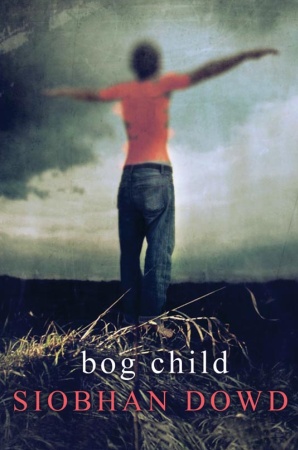
Dowd, Siobhan. 2008. Bog Child.

Don't hate me. But I didn't love Bog Child. I stuck with it because I'm stubborn, not because it was going "good" for me. I found it confusing and a bit on the boring side. Abby has a generally positive take on the novel, but admits that, "This book is not for everyone, but those who can stick with it through the unfamiliar Irish slang and dialog will find a touching, dramatic story of family and sacrifice. Siobhan Dowd's writing is poetic and she builds tension throughout the book. This is an unforgettable story set during a time rife with passion and turmoil."

The novel has received four stars in the review journals. (Kirkus, School Library Journal, Booklist, Publishers Weekly). And those reviewers obviously saw much too praise. It also made Amazon Editors Top 10 List for teen lit. And Publisher's Weekly's Best of 2008 list. I'm sure it will be making many other "best lists" and might even merit an award or honor. [The Printz is notorious at times for choosing books that I wouldn't choose in a million years. Not all the time. Just some years.]

What is it about? A young man, Fergus, on the verge of adulthood discovers half-a-body. The body of a seeming child. (Minus the legs. Plus an ancient-looking bangle). The archaeologists who come to collect the body--and study it--feel it might date from the Iron Age. First century A.D. (What I suppose you'd call C.E. now in these days of political correctness.) The novel is set in Ireland in 1981.

The book is a complex-and-tedious weaving of two or three story lines. Fergus has a brother in prison on a hunger strike. To "help" his brother out, he agrees to smuggle packages across the border at some risk to himself. He doesn't know what he's carrying. He doesn't want to know either. But he fears that it might be materials used in making bombs. During the course of a few months, Fergus begins having dreams about "Mel" the body they discovered. Fergus also falls for a girl, Cora, and has a timid courtship that isn't quite fully explored.

The book offers little in explanations. It presumes that every reader--no matter the age--will have enough background on the troubles haunting Ireland. Their conflicts with the British. In particular the terrorist actions of certain groups within Ireland. I was clueless. I'd imagine many readers would be clueless. And Siobhan Dowd could have easily given just a few brief paragraphs to orientate American readers with what was going on. True, the author is dead. But the publisher might have foreseen that readers might have trouble jumping in on this one.

For a book as complex as this one to work for the reader, you have to care. Care about the characters. Care about the action. Care about something. Obviously Dowd got many readers--at least the ones with review columns--to care and some deeply so. But not this reader.

To read a somewhat spoilerish but thorough review read the Guardian's thoughts on the novel.
Teenreads.com


© Becky Laney of Becky's Book Reviews

Thursday, August 07, 2008

Shooting the Moon


Dowell, Frances O'Roark. 2008. Shooting the Moon.

One of the best books ever. Trust me. Here's how it starts:
The day after my brother left for Vietnam, me and Private Hollister played thirty-seven hands of gin rummy, and I won twenty-one. They were speed-ball games, the cards slapped down on the table fast and furious. My brother, TJ, was going to war, and I was fired up hotter than a volcano. TJ and I had grown up in the Army, we were the Colonel's children, but that was not the same as being a soldier in the very heart of combat.
"Whoa, hoss, slow down," was the first thing Private Hollister said when I'd charged into the rec center that morning, ready for action, but not exactly knowing what to do with myself. I'd been a rec center volunteer for three whole days, which had mostly involved picking up crumbled Coke cans from under the pool tables and handing out Ping-Pong paddles to soldiers. But now I couldn't settle myself down enough to go check the chore list on the clipboard Private Hollister kept on his desk. I wanted to spin around in circles, do jumping jacks, drop to the floor for a hundred push-ups. Big things were happening, and the excitement of it all was running through my veins and winding me up tight.
"Here. Sit." Private Hollister pulled out his desk chair and motioned for me to take a seat. "You got the look of a girl who don't know whether she's coming or going."
He sat down across the desk from me. "You ever play cards? 'Cause back home in Kentucky when we'd get too rowdy, my mom would get out the cards and get us playing poker or Hearts, just anything to make us sit down for a few minutes and relax."
I nodded. All at once my excitement had found a place to land. (1-2)
Beautifully written--almost lyrical in fact--Shooting the Moon is the story of a girl, Jamie Dexter. Twelve-and-going-on-thirteen, Jamie has a lot to learn about life, about love, about family, and about friendship.

Up until the time when it's her own brother being sent to war, Jamie has never doubted the Army for an instant. Never doubted the justness of the war. In fact, even when it's her own brother going, she's happy and proud. She loves him--no doubt about it--yet she doesn't question the rightness of his being a soldier. And his going to war doesn't terrify her. And as strange as it may seem, Jamie wishes it was her going to war. She's grown up idealizing the Army, almost worshiping her father who is a Colonel.

But once her brother is there, once she has seen what he's seen (in a very limited way), then she begins to question everything. How does she "see" the war? Her brother--instead of writing the traditional letter--sends her his film to be developed. He asks her to develop his film for him. So Jamie learns from one of the soldiers at the rec center how to develop film. She finds it to be a very precise, very demanding hobby. But she loves the work. She's excited to be trusted with her brother's film since photography is his hobby, his passion. Working with his film, she still feels connected to her brother. This experience, along with her developing friendships with some of the other soldiers including Private Hollister, change her mind about the war, about many things really. Some of the glamour, some of the glory is removed, it's true. But what she finds is the truth harsh and raw as it may be.

Shooting the Moon is her journey, her story. Full of depth and true meaning-of-life "stuff," Shooting the Moon is one of 2008's must read books.

Other reviews: Read, Read, Read, A Fuse #8 Production, Kiss the Book, Brenda Ferber's Blog, a wrung sponge, Dog Ear, A Year of Reading, 100 Scope Notes,

© Becky Laney of Becky's Book Reviews

Saturday, July 12, 2008

A La Carte


Davis, Tanita. 2008. A La Carte.

An empty plate hits the stainless steel deck in the kitchen of La Salle Rouge with a clatter.

Rarely do I so completely agree with a jacket flap. But in this case, it is right on.

Seventeen-year-old Lainey dreams of becoming a world famous chef one day and maybe even having her own cooking show. (Do you know how many African American female chefs there aren't? And how many vegetarian chefs have their own shows? The field is wide open for stardom.) But when her best friend--and secret crush--suddenly leaves town, Lainey finds herself alone in the kitchen. With a little help from Saint Julia (Child, of course), Lainey seeks solace in her cooking as she comes to terms with the past and begins a new recipe for the future. Peppered with recipes from Lainey's notebooks, this delicious debut novel finishes the same way one feels after a good meal--satiated content, and hopeful.

A La Carte does not overwhelm you with its greatness. Perhaps overwhelm isn't the right word, what I mean is that it is subtle and gentle. It's not overpowering. (It's the kind of 'greatness' that sneaks up on you and takes you by surprise.) Most YA novels in one way or another deal with the 'issue' or 'theme' of identity. And A La Carte is no different. It is without a doubt a coming of age story. Lainey--as a person--grows, changes, evolves, learns, awakens through the course of the novel. The Lainey we meet on page 1 is not the Lainey we say goodbye to on page 280. Some things stay the same, of course, but quite a few things change. One is the way Lainey sees herself, knows herself, respects herself.

But A La Carte also offers an in-depth look at family life. Particularly the relationship between Lainey and her mom. It is so well done. So dimensional. I hope that makes sense. In other words, both Lainey and her mom, Vivianne, are fully developed. And their relationship has depth and life.

And then there's the friendship angle. The popularity angle. Lainey is on the fringes, the outskirts of high school society. She's more of a loner. And content to be that way. Sure she wishes that some of her former friends hadn't ditched her for the cool crowd. But she's happy staying in the kitchen. Or so she thinks most of the time. This book examines what it means to be a friend, to have a friend. What does healthy friendship look like? What doesn't it look like?

In a way A La Carte says a great deal about longing. I don't want to say too much more about that because I don't want to spoil this one for anyone.

A La Carte is good. It resonates in meaning-of-life internal drama. There's a richness to it that I can't quite explain. I suppose I mean it has depth and layers.
Saint Julia always said that in cooking, there are very few mistakes that can't be corrected. You can add a pinch of salt and some chopped herbs to the butter if you forgot to put salt in your bread. If your souffle falls, you can serve it with a sauce over it, and it'll look just fine. Gummy mashed potatoes can be resurrected as potato pancakes. But once you add too much pepper to something--it's over. You can't make something less spicy than it is. (179)
Definitely recommended. (Though I must admit the ending seemed a bit too happy to be realistic. Still, overall, I enjoyed it and found it a satisfying read. In fact, it made me a bit hungry!)

Other reviews: Cheryl Rainfield, Little Willow,

© Becky Laney of Becky's Book Reviews

Thursday, July 10, 2008

No Cream Puffs


Day, Karen. 2008. No Cream Puffs.

This isn't what we usually do. If we have time after lunch, we shoot baskets with the boys in the gym. Today we're lined up in front of the mirror in the girls' bathroom. I stand to the side and twist my mood ring around and around my finger. My mess of curly blond hair is a disaster compared to the new feathered style everyone else has. "This is plushy pink." Casey Cunningham pulls a tube of lip gloss out of her purse and opens it. The sweet smell of cotton candy fills the bathroom. She rolls it onto her lips. "It's new."
She rolls it onto Gina's lips and then reaches for Sara, who stands next to me, holding her new purse with both hands. I'm next.
Casey snaps the cap on the lip gloss and puts it back in her purse. I feel the tops of my ears burn; she left me out on purpose. I glance at Sara, but she won't look at me.
"You smell like a circus," I blurt. Their lips sparkle under the lights. Could my lips look like that too?
"I'm sorry, Madison." Casey looks at me, eyes wide. "I didn't think baseball players wore lip gloss."
(1-2)

Set in the summer of 1980, No Cream Puffs is the story of Madison Mitchell, a twelve-year-old baseball player who hates to be called a tom boy. So what if she likes to play sports? Does that make her a boy not a girl? NO. She's a girl alright. Her developing breasts (which she tries to disguise whenever she plays ball) and a crush on a teammate prove that.

No Cream Puffs is a sports story. No doubt about it. There's baseball games, baseball practice, and plenty of baseball talk. But it is more than that. Much more. It's the story of a girl who feels uncomfortable with herself, her body, her life. A girl who doesn't feel comfortable with her identity. She doesn't want to be solely defined as "the girl" (the only girl) who plays in a baseball league of boys. But as the girl she does get attention at all the games especially by the media who want to turn her into something she's not. It's a story about family. A story about friendship. A story about growing up. Here we see the first glimpses of a young girl changing into a young woman. Her first crushes. This age is often (or should I say always) awkward and painful. Madison's experiences are authentically so. I loved Madison's voice. And I loved her story.

I really loved this book. Karen Day knows how to do real, to do authentic. Everything just feels right about this one.

http://www.klday.com/index.html
© Becky Laney of Becky's Book Reviews

Sunday, June 29, 2008

The Trials of Kate Hope


Downing, Wick. 2008. The Trials of Kate Hope.

This one was just too much fun. Fun might not be the right word. By fun, I don't mean it's fluff. I don't mean it lacks any in substance or heart. I just meant that I liked spending time with it. That I really really enjoyed it. I loved Kate. And I loved her Grandpa. More than I ever thought I would to tell you the truth. Set in 1973 in Denver, Colorado, it follows the life of a most unusual fourteen-year-old. Kate Hope. Lawyer. Yes, lawyer. She's the law partner of her eighty-something year old grandfather. The book focuses in on two cases. It's really much more interesting than the book cover might suggest.

Another review: Feminist Review, Richie,
Author website: http://www.wickdowning.com/About.htm

© Becky Laney of Becky's Book Reviews

Friday, June 27, 2008

The Queen's Soprano


Dines, Carol. 2006. The Queen's Soprano. (Released as paperback in 2007).

Set in seventeenth century Rome during the rule of Pope Innocent XI, The Queen's Soprano is the story of Angelica Voglia, a young woman, a talented woman, who ultimately ended up taking refuge in Queen Christina's court when it became too dangerous for her to remain with her own family. At the time, women were forbidden by the Pope to sing in public. For a woman to take the stage--no matter how talented--would be the undoing of men. Even women singing sacred songs--religious ones--led men to feel "lustful" thoughts or so the Pope's argument went.

Angelica's story is simple really. She's just a young woman who wanted to sing, who loved to sing, who couldn't imagine going through life without singing. She didn't want to entangle men. It was her mother's crafty plans to use her voice to ensnare a rich husband, a noble husband. Angelica didn't want that, didn't need that. She wanted someone to love, yes, but not be possessed by someone she didn't love, could never love.

The Queen's Soprano is rich in detail. Angelica's story is fascinating especially in the realization that this--while fiction--is based on a true historical figure. What we actually know of her we learn from Queen Christina's records. Of course fiction has been blended in as well. But still it makes for a good read, an enjoyable read.

For those that love historical fiction, I'd definitely recommend this one.

© Becky Laney of Becky's Book Reviews

Saturday, June 14, 2008

Out of the Wild

The image “http://www.sarahbethdurst.com/images/OutoftheWildCover_LoRes300.jpg” cannot be displayed, because it contains errors.

Durst, Sarah Beth. 2008. Out of the Wild.

Out of the Wild is the sequel to 2007's Into the Wild. Linda, the evil librarian, is back in this second volume. Her evil plan? Not so obvious to our young heroine, Julie, but that could be because she's in a state of shock. Julie has grown up without her dad. Her mom, Rapunzel, couldn't rescue her prince of a husband from the Wild. Julie has always wondered about her fairy tale dad. Wondered what it would be like to have him be a part of her life. She's about to have her dream come true. One day--completely out of the blue--her dad stumbles out of the Wild (it's still leaving underneath her bed) to be reunited with his family. They're happy to see him, but also puzzled. The Wild has never ever "let" anyone go before. What could it all mean? Is this good news or bad news? So they're off to see Rapunzel's mum, the former witch, the guardian of the wishing well.

Long story short, Julie's got her dad. However, all is not well. The Wild especially feeds on fairy tale characters reenacting fairy tale scenes. But her dad can't help himself. If he sees a glass slipper on the ground, he's got to try it on a maiden's foot. If he sees a beautiful princess in distress, he must rescue her. If he sees a wolf gobble down a young girl, he must save her. But these events aren't just accidents, aren't just coincidences. Someone has an evil plot. And since her mom and grandmother were turned into pumpkins....it's up to Julie to save the day.

Can she once again battle the Wild without becoming trapped herself?  Can she stop the Wild from enslaving, entrapping, all of America? You'll have to read and see for yourself!

© Becky Laney of Becky's Book Reviews
Blogged with the Flock Browser

Thursday, June 05, 2008

Little Brother


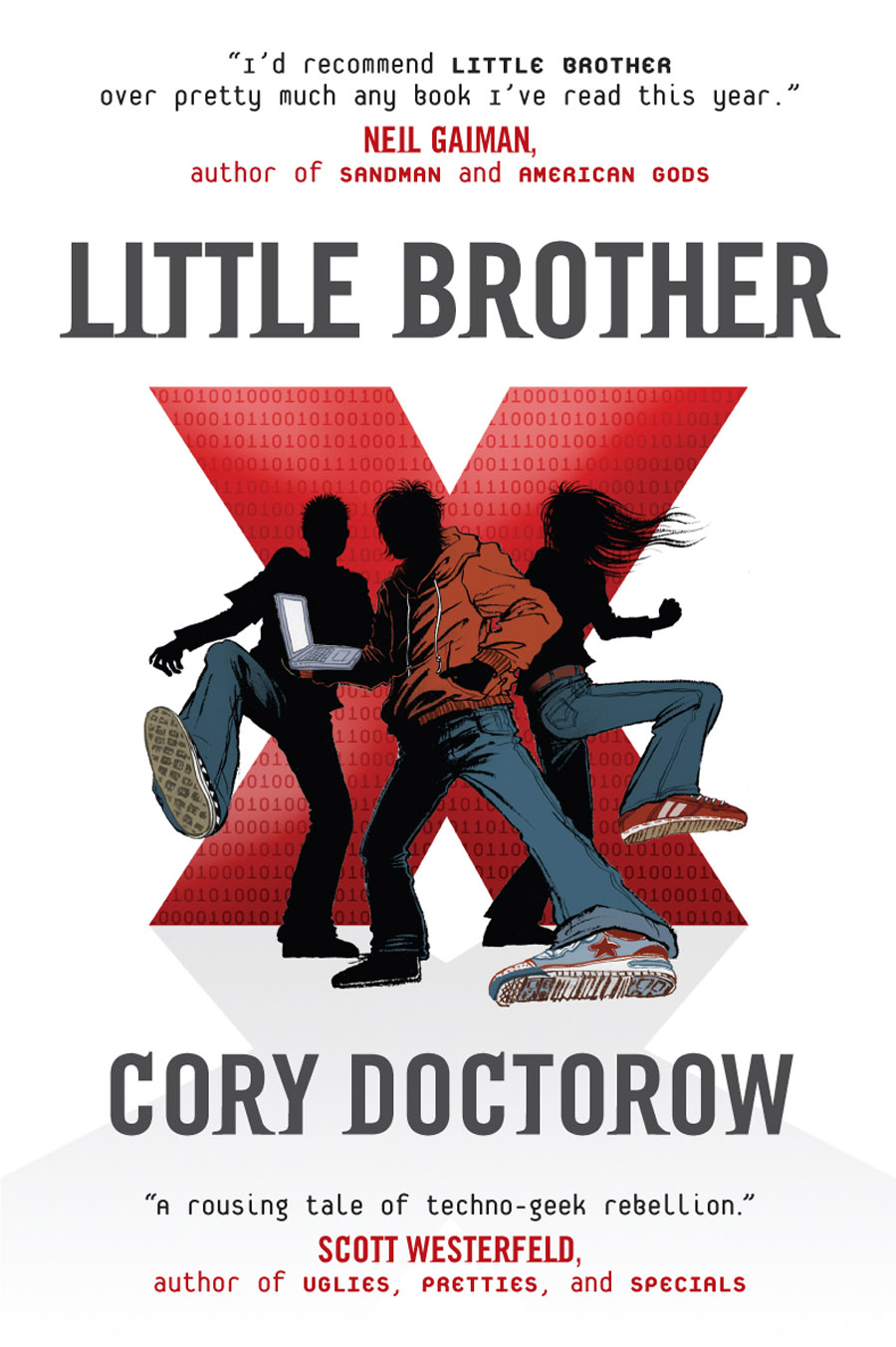
Doctorow, Cory. 2008. Little Brother.

I'm not sure I can adequately cover this one. Wow. Really wow. Then again with Neil Gaiman saying things like, "I'd recommend Little Brother over pretty much any book I've read this year" and "It made me want to be thirteen again right now and reading it for the first time"... I'm not sure my input is needed at all. It's also got, for the record, Scott Westerfeld calling it a, "Rousing tale of techno-geek rebellion--as necessary and dangerous as file sharing, free speech, and bottled water on a plane." Those two names alone would compel me to give this one a go.

Set in the near-future, we see the battle between safety and freedom reach its climax. Marcus and his friends, four techno-geeks, happen to be in the wrong place at the wrong time when terrorists strike the Bay Bridge in San Francisco. The four are taken prisoner by the Department of Homeland Security--not arrested, they just conveniently "disappear" without a trace. They are held prisoner for a week. At the end of a week, three of the four are released. Marcus, our narrator, is told that he's not "safe" yet. They'll be watching him. They feel sure that he must be a terrorist some way or some how.

Feeling the injustice of it all and grieving over the loss of his best friend, Darryl, whom he hasn't seen since the arrest, he vows to take down the DHS. Can he outsmart the bad good-guys by being a good bad-guy? Well, you'll just have to read for yourself.

Freedom. Safety. The Bill of Rights. The Constitution. Terrorists. Courage. Fear. The book is smart, very smart. And it's very effective. Though I know nothing about the world of computer coding and hacking, I could not put this one down.

I would think fans of Evil Genius and Genius Squad would appreciate this one.

You can download the novel here.

© Becky Laney of Becky's Book Reviews

Saturday, May 31, 2008

Neptune's Children


Dobkin, Bonnie. 2008. Neptune's Children.

From the jacket flap: "A dream vacation at the Isles of Wonder theme park becomes a nightmare when biological terrorism causes the death of every adult on the Islands. Younger teens and children survive, only to face the resulting horror and the chaos of a world without authority. The figure of King Neptune, symbol of the Islands, unites them as they begin to build a society within the park, safe from outside dangers. Led by a group called the Core, made up mostly of former park workers' children, the survivors slowly organize their world. But when mysterious events bring danger, some of the Islanders begin to wonder if their home is as safe as they think and if their leaders can really be trusted. As suspicions grow and rivalries intensify, the stage is set for a war that will determine the future of everyone on the islands."

Intrigued? I know I was. The plot centers around Josh and his "family." (He's an older younger teen--13 or 14--and he's caring for his younger sister, Maggie. From the very beginning, he pairs up with another set of siblings--Zoe and Sam. Together they form a family unit.) In the first few days after IT happens, there is confusion. But within 48 hours, order and structure and authority are introduced into the theme park. Josh is one of the contributors to the sanity. The "king," the boy behind King Neptune's oddly soothing voice, is Milo. He calls all the kids together and asks the older ones--minus the babysitters--to help him. Josh is one of his volunteers, and for a while he is one of the Core, but his "family" responsibilities soon prove more important than his social ones. Through the course of a year--a little over a year--these kids survive on their own without too many glitches, but soon that changes. Little questions, little doubts, a few things that rub our characters the wrong way. Why? Why is Milo so insistent that no one ever leave the theme park? Why can't they have the freedom to leave if they want? To explore the outside world for themselves?

While some adults (and a few teens) might find this one predictable, there is much to enjoy in Neptune's Children. I found that even if I was fairly certain where everything was going, I wanted to be along for the ride, for each step in the journey. It was definitely a page-turner for me. Reminiscent of both a Star Trek episode and a Twilight Zone episode, this one was a darkly fun read.
© Becky Laney of Becky's Book Reviews

Thursday, May 08, 2008

The Sky Inside


Dunkle, Clare B. 2008. The Sky Inside.

Where to start? Loved it, loved it, loved it. Not very descriptive though, is it? Enthusiasm only takes you so far I suppose. Why did I love it? Maybe this will clarify: Science fiction dystopian thriller. While I don't love all dystopian novels, chances are good that I'll at least give it a complete read through if you throw out the words dystopia or utopia. Listen to this description on the jacket and the back cover:
The ads had started running on midmorning television the summer after Martin's fourth birthday. "Wonder babies are here!" they announced...Never had the arrival of the stork brought such excitement. Overflowing with charm and intelligence, Wonder Babies were like nothing the suburb had seen before. But that didn't turn out to be a good thing. (back cover)
Martin lives in a perfect world. Every year a new generation of genetically-engineered children is shipped out to meet their parents. Every spring the residents of his town take down the snow they've stuck to their windows and put up flowers. Every morning his family gathers around their television and votes, like everyone else, for whatever matter of national importance the president has on the table. Today it is the color of his drapes. It's business as usual under the protective dome of suburb HM1.

And it's all about to come crashing down.

Because a stranger has come to take away all the little children, including Martin's sister, Cassie, and no one wants to talk about where she has gone. The way Martin sees it, he has a choice. He can remain in the dubious safety of HM1, with danger that no one wants to talk about lurking just beneath the surface, or he can actually break out of the suburb, into the mysterious land outside, rumored to be nothing but blowing sand for miles upon miles. (inside jacket)
Do you see why this one had to come home with me from the library? It just screamed out "read me, read me, read me NOW!" It had me hooked from the beginning. Martin and his sister Cassie and his "toy" dog Chip are characters that had me interested (or should I say invested???) almost immediately. Martin especially. It would have been really easy--almost expected--for the characters to take a back seat to the premise, but that isn't the case in The Sky Inside. Yes, the premise had me at hello. But I really and truly came to believe in Martin.

I don't want to spoil one minute of the book for you by describing the plot or the premise. Half the fun of novels like these is experiencing the unveiling slowly one page at a time as all the details come together to reveal the big picture. It is good, you should definitely read it.

The author has the prologue and first and second chapters of the novel on her site. Read them!

© Becky Laney of Becky's Book Reviews

Friday, February 02, 2007

The Miraculous Journey of Edward Tulane

DiCamillo, Kate. 2006. The Miraculous Journey of Edward Tulane.
This week you’ve noticed that sometimes I begin reading books with slight traces of prejudice...I can judge a book on its cover...(or by what it says on its cover)...or based on what I’ve heard about it from other sources. This can be a good thing or a bad thing. If a book is being praised by everyone as the best book the world has ever seen...it makes me slightly skeptical. It’s like the book-world goes through phrases where certain books and authors are above criticism. They’re considered supreme. To disagree with their pronouncement that the book is perfect...simply shows your ignorance. There were two books this year that everyone seemed to be talking about: one was Octavian Nothing by M.T. Anderson, the second was the Miraculous Journey of Edward Tulane. Well, for those that might have missed my ongoing scorn of Octavian Nothing, let’s just say that something quite different happened when I read The Miraculous Journey of Edward Tulane.

The Miraculous Journey of Edward Tulane is a book that is about one china rabbit’s adventures in a sometimes harsh world. He is commissioned by the grandmother for her granddaughter, Abilene.
Once, in a house on Egypt street, there lived a rabbit who was made entirely of china. He had china arms and china legs, china paws and a china head, a china torso and a chino nose. His arms and legs were jointed and joined by wire so that his china elbows and china knees could be bent, giving him much freedom of movement. His ears were made of real rabbit fur, and beneath the fur, there were strong, bendable wires, which allowed the ears to be arranged into poses that reflected the rabbit’s mood--jaunty, tired, full of ennui. His tail, too, was made of real rabbit fur and was fluffy and soft and well shaped. The rabbit’s name was Edward Tulane, and he was tall. He measured almost three feet from the tip of his ears to the tip of his feet; his eyes were painted a penetrating and intelligent blue. In all, Edward Tulane felt himself to be an exceptional specimen. (5-6)
He has everything a fine toy could want: fine clothes, a fine pocket watch, a girl who loves him, a nice home, a place of prestige among the other toys, and the love of his owner. Abilene loves him. Dotes on him. Treasures him. Yet Edward who has never known any other kind of life is unappreciative. It’s not that he dislikes his owner. The fact is that he’s disinterested in humans altogether. Preferring one over another has never occured to him. He has no love. He has no hate--unless its for neighboring dogs who try to pee on him or carry him in their mouths--or for thoughless maids who vacuum his ears and have the audicity to place him on the shelf with other dolls. He is not an emotional rabbit.
But that is just his first stop on a long journey. His starting place. When Edward accompanies the family on an ocean voyage, his luck begins to change. In the following days, months, years, even decades...his whole world is turned upside down over and over and over again. What he learns are valuable life lessons. What it means to love. What it means to lose someone you love. What it means to grieve. What it means to hope and despair. What it means to be content. What it means to be compassionate. He learns to be content with whatever his lot is in life. To be happy with the small things...no longer is pride in possessions or appearance of the utmost importance. Gone is his dignity. Gone are the days when he could gloat and brag. Whether he is filling the need of an elderly couple who treat him like a young child...or comforting a dying girl in her last days on earth...or companionship for a hobo and his dog...or joy for a young boy as he dances for crowds. If there is a human emotion, he’s felt it. He’s learned through experience what it is to be alive. Here is his journey: the good, the bad, the ugly. Full of sadness, disappointment, heartbreak, despair, but also full of hope and love and joy.
I must admit that for me this book is all about the ending. Yes, Edward Tulane suffers. He suffers a lot. The moment things begin to look up, the moment that he’s happy and all is right with the world, that’s when his world is turned upside down again. Yet, Edward Tulane NEEDED a happy ending. The world wants a happy ending. In life there are times of suffering that no one can really explain away. No one can take the pain away, but to live life without hope of a better tomorrow seems worse than not living at all. Hope is needed. Love is needed. Edward Tulane illustrates this perfectly.
All that being said is Edward Tulane a book really for children? Or is it a children’s book for adults? I can only say this. I loved it as an adult, but I think its darkness would have frightened me as a child. Would it frighten every child? No! But for some--like me--there were places and feelings that I was not ready to go. The fact that this poor toy rabbit suffers one torture after another...that the book depicts death, loss, hate, and despair...it wouldn’t have worked for me then. It would have been disturbing to me. (Heidi was disturbing to me as was Wizard of Oz). But for the right child, this is a great book. Not every children’s book can be loved and appreciated and treasured by adults....this one can.
Does this mean that this book is the most perfectly perfect book in the whole world? No. I still feel no one book is ‘perfect’ for everybody. Everyone is different. Everyone has different needs. Everyone has different tastes. Different life experiences. Different backgrounds. But I can see why some people are putting this one on the top of their ‘best of 2006’ lists.

Wednesday, January 31, 2007

The Last Dragon


Recently was recognized as Mildred L. Batchelder Honor Book for 2007.

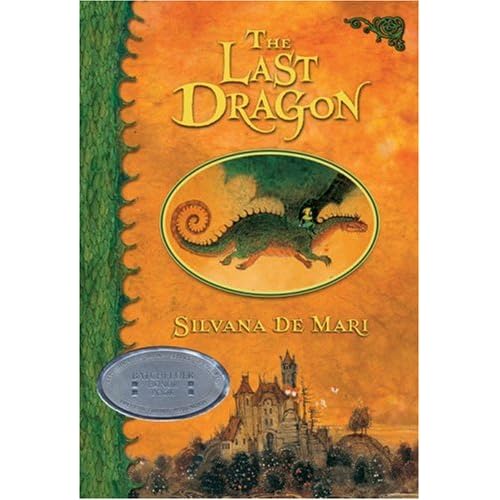
de Mari, Silvana. 2006. The Last Dragon.

Yesterday, I spent quite a bit of time discussing the award-winning title THE PULL OF THE OCEAN. I didn’t feel it had much merit. Granted, I don’t read extensive amounts of international literature so I don’t know what the competition was like this year. But I do know an overrated, much-too-clever-for-its-own-good book when I see one. And one of my all-time favorite books THE LEGEND OF THE WANDERING KING is an international book from a Spanish writer, Laura Gallego Garcia. (Not to mention The Diary of Ma Yan which was translated first into French and then into English). So I know that there are good books out there being translated...just look at Cornelia Funke, a German writer. But I am digressing.

Focusing on the book in hand, THE LAST DRAGON was a treat of a book. I won’t lie. It’s not a perfect book. But it has something going for it: it’s generally entertaining. Yes, some of the jokes and gags might have lost something in the translation. But throughout, it is an interesting, FUN, book. If you can look past a few running gags or punchlines that get a little old after the third or fourth time, you’ll find yourself lost in the story of an elf...the last elf. Yorsh, when we first meet him, is a ‘baby’ elf. He’s new to the world, and not the brightest fellow. He’s confused. He makes mistakes. Some funnier than others. He can cause lots of mischief without really meaning too. It’s not his fault. He just doesn’t know any better. His mother died and his only memories are of his grandmother grieving the loss of her daughter. He has no memories of his father--he just knows he’s dead--perhaps even dead before his birth. So he is the ‘last’ elf on earth. An earth ravaged with floods and wild weather. When he and his two human companions find a prophecy about the ‘last elf’ meeting the ‘last dragon’ and saving the world...he has hope for the first time in his life. Now on a quest, Yorsh is out to save himself and the world. Can two humans and an elf set out to fulfill the ancient prophecy? What will they find when they venture into the mountains where dragons are supposed to dwell?

The Last Dragon is divided into two parts. However, as a reviewer I can’t really review both parts without spoiling everything. Needless to say, the first part of the book deals with the first half of the prophecy, and the second part set ten to twelve years later fulfills the second half of the prophecy. Two parts, two different quests, one very entertaining book. It has humor. It has adventure. It has a teeny bit of romance.

The book is translated from the Italian by Shaun Whiteside.

Saturday, November 18, 2006

Shepherd, Monsters, Heroes...

Druitt, Tobias. 2006. Corydon and the Island of Monsters.


Interesting facts about the authors: Tobias Druitt is the pseudonym for Diane Purkiss and her son, Michael Dowling. Diane is Tutor in English at Keble College, Oxford, and the first Oxford English Faculty member since C S Lewis and JR R Tolkien to publish a children's book. Her key academic interests are classical literature, and women in literature. Her co-author, Michael, is nine years old. They live in Oxford and have two cats, Thelma and Louise, who inspired the characters of Euryale and Sthenno, the gorgons, in the novel.

About Tobias Druitt

Corydon and the Island of Monsters is the first in a trilogy written by the mother-son duo of Diane Purkiss and Michael Dowling. The son is quite young, still in school, I believe he was 9 when they began writing together. The book came about when he was excluded from a school assignment where each child was to write a book with a parent’s help. The two decided it wasn’t quite fair they should miss out on the fun and began working on Corydon, a tale Purkiss describes as “a book about mothers and sons, really, about how difficult and important that love can be.”

Corydon could further be described as a twist on the traditional monster tale. Here the reader sees life through the eyes of the outcasts, the monsters. They see these supposedly ‘scary’ creatures up, close, and personal. They also see the so-called ‘good guys’ (the heroes) come to destroy them for alleged wrong doings...essentially the heroes motto is to destroy anything that is different from yourself and that you don’t understand.

In particular, Corydon is the tale of Perseus’ quest to kill Medusa told from the point of view of a young shepherd, Corydon, and in some ways through Medusa herself. The main characters are Corydon, Medusa, and her two gorgon sisters, Euryale and Sthenno. Perseus is not depicted as a hero, rather as a dimwitted coward.

The second book in the trilogy, Corydon and the Fall of Atlantis, is (according to Amazon) going to be published in February 2007.

Wednesday, October 18, 2006

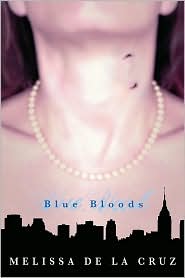
Blue Bloods


De La Cruz, Melissa. 2006. Blue Bloods

Using (fictional) primary source material about the Pilgrims that sailed on the Mayflowers (letters, journals, etc.) to introduce each chapter, Melissa De La Cruz establishes an alternate historical framework in which to begin her novel BLUE BLOODS. (Forget what you know about Pilgrims fleeing to the colonies because of religious persecution, the Pilgrims were vampires fleeing England before their secret could be exposed. And Roanoke? Vampires as well. The mystery only deepens since vampires can rarely if ever be killed.)

The novel is told through multiple perspectives--young teen girls around fifteen or sixteen--who while different (some popular, some unpopular outcasts) all share a legacy: a rich historical legacy: they're vampires but don't know it. Similar to Peeps by Scott Westerfeld, these are vampires that exist to serve the greater good among humans. Our primary heroine is Schuyler Van Alen, an orphan raised by her grandmother. Other key players include Mimi and Jack Force (brother and sister), and Bliss Llewellyn. These young teens are enjoying the finest education--at an elite private school--and most have the money and prestige to break all the rules and get away with it...partying at night clubs, drinking, smoking, etc. But this comfortable existence is about to be shaken up. A dark force is on the move that threatens teen vampires everywhere. The problem? Most lack the foresight to care. Schuyler Van Alen leads the call to action, and in this first book in the series, this fast-paced adventure begins.

Monday, October 09, 2006

John Lennon's Birthday

Delaney, Mark. 2004. PEPPERLAND. Atlanta: Peachtree. ISBN 156145317X.

Pamela Jean Cochran (a.k.a. Star) is sixteen when her mother dies from breast cancer. Struggling to find a way to cope, she turns to her music hoping that if she can write a song to honor her mother then she can finally let go of her anger and pain. While going through her mother's belongings, Star discovers a fan letter to John Lennon and a vintage Gibson guitar--now in need of repair. These two items are the catalyst to Star's healing process. Set in the fall of 1980, Delaney's novel is a wonderful exploration of grief, anger, loss, and confusion. Star and Dooley, her best friend, are remarkably well-developed characters. And Delaney's use of language is impressive. One striking passage occurs when Dooley shows Star his new drawing:

"Before me is a portrait of a young woman. She is strikingly beautiful, her face nearly white and her cheekbones shaded in an ice pale blue. Her eyes are large and pretty, but dark and a little wounded-looking. She's not really smiling. Behind her is a background of burgundy and violet. Within this background, and over the girl's face, are crossing lines, like the squares on a sheet of graph paper. It's as if little parts of her have been painted on hundreds of tiles, and the tiles have assembled themselves to make this image. Except in the upper left-hand corner, the pattern breaks down. The tiles are scattered, the lines no longer forming perfect angles. The pieces seem to be falling, cascading into place. The girl is in the process of becoming a complete picture...And then I understand. I see it. The girl with the wounded eyes, the girl who doesn't quite smile, the girl made of a thousand pieces that are falling, at last, into their proper places...She's me" (105-106).

Sunday, October 08, 2006

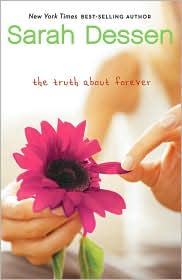
The Truth About Forever


Dessen, Sarah. 2004. THE TRUTH ABOUT FOREVER. New York: Viking. ISBN 0670036390.

Grieving the death of her father, Macy Queen buries her emotions behind a mask of perfection not even allowing her friends and family to see her real self. However, what Macy learns in THE TRUTH ABOUT FOREVER is that "even the smallest fragments can't help but make a whole" (129). When Macy lets go of her need to be perfect and to always be in control, she learns what it means to be free. She learns to just be. "When I was with him I didn't have to be perfect, or even try for perfect. He already knew my secrets, the things I'd kept hidden from everyone else, so I could just be myself. Which shouldn't have been such a big deal. But it was" (187).

THE TRUTH ABOUT FOREVER is an honest examination of one girl's reaction to the death of her father. Through the character of Macy, Dessen shows that there are many aspects to the grieving process. The novel shows the key role open communication plays in the healing process.

http://www.sarahdessen.com/

Thursday, September 21, 2006

Super Powers in High School


HOW MY PRIVATE PERSONAL JOURNAL BECAME A BESTSELLER by Julia DeVillers is quite a fun little novel--or "teen fairytale."

Jamie Bartlett, is our heroine, she is your "typical" 14 year old dealing with peer pressure and questions of body image and self esteem. She accidentally becomes an almost overnight celebrity when her "journal" becomes the new IT YA book/novel.

Bartlett invents Isabella--a normal teenage girl who becomes a superhero IS when she sees social injustice. IS fights Myrna and the Evil Clique of Populors--the Backstabbor, the Gossipor, the Insultor, the Fashionistor, the Ostracizor, the Dietor, the Betrayor, the Best Friend Stealor (p. 14, 157). IS's weapon of choice is a flick of the wrist--which sends out rays of positivity.

One of IS's encounters is on page 68...

"Size zero is the only way to be," the Dietor said scornfully. "Why I'd be a negative number if I could!" The Dietor turned around to drink her diet soda and eat her single lettuce leaf. Then she gasped. IS! IS raised her fist and FLICK! the Dietor wasted away...to nothing.


Of course, 90% of the book is not about the invented character of Isabella or IS--but is about Jamie. Jamie despite her success and newfound popularity--still has problems. Just because IS has superpowers doesn't make Jamie's life any easier. She still can't seem to win against the real life cliques she faces every day in high school. Although she does grow in confidence and self esteem as the novel progresses.

Jamie is a likable character--one that is very easy to relate to--no matter how old you are.

The novel is told in first person...with a conversational tone. Jamie addresses the reader as "you" and continually engages the reader. (Which I liked)

I thought this book dealt with real problems and issues in a fun way. While the "overnight" success of Jamie as an author is not quite realistic--the issues and problems she faces are quite real.

http://www.girlwise.com/