Showing posts with label Printz Award Challenge. Show all posts

Thursday, June 11, 2009

Body of Christopher Creed (YA)

Plum-Ucci, Carol. 2000. The Body of Christopher Creed. Hyperion. 331 pages.

I had hoped that a new start away from Steepleton would make my junior year seem like a hundred years ago, rather than just one.

To say that The Body of Christopher Creed is haunting is an understatement. It is compellingly atmospheric. It completely draws you in. It's nearly impossible to put it down. Our narrator, Victor "Torey" Adams, is giving readers a personal glimpse into his nightmare. When the novel opens, we meet Torey. A new student--a senior--at a boarding school. We learn that there's something from his past that still haunts him. Maybe not quite so torturously as it once did. But something still holds him back from being that "normal" kid from two years ago. The football player.The musician. The boyfriend. The oh-so-normal, somewhat-popular guy. What is this something? Or should I say who is this something?

Who is Christopher Creed? Why should the reader care? The reader only sees Chris Creed through the eyes of various characters. We get impressions of him from Torey, from Bo, from Ali, from Alex and Ryan, etc. According to his classmates, Chris was weird. A definite freak. Someone who was out of touch with reality. A guy with a big, goofy grin who never knew when to shut up. Who never could quite sense when he was being obnoxious and annoying just by being there, by being himself. According to his mother, Chris was a happy, well-adjusted teen. He had no reason whatsoever to runaway from home. No reason to commit suicide. Therefore his disappearance must mean foul play. Surely, Chris, her very own son, would never of his own free will vanish. Who's the primary suspect? Well, that would be Bo, a boy from the wrong side of town. In this small-town, apparently, there is a lot of prejudice going on. It's nothing to talk trash about Boons, (folks from Boondocks; aka poor and trashy side of town, you know, where everything bad happens.) The whole town seems to have an us-versus-them mentality which is just freaky to be a little honest. But Ali and Torey believe Bo is innocent. In fact, there is a lot of disagreement. You've got folks thinking he was murdered. Folks thinking he committed suicide. Folks thinking he just ran away to get away from his controlling parents. Which of these theories is the truth? Will anyone ever be able to puzzle out the truth?

All of this is revealed through Torey. His written account of the events that led him to where he is today...to who he is today.

Writing it was supposed to bring me some quote-unquote "healing," at least that's what Dr. Fahdi had said. Maybe it did; who knows? I got a load off my chest. But I was looking for other things, more important things, like the peace you get when things make sense and life seems fair. I never got that peace. Some nights I would remember and write and remember and write, and I was sure I was just being Dr. Frankenstein, trying to re-create a dead human. The dead never come back the way they were in life. Some nights I got convinced I was creating a monster.


The story is a complex blend of realistic fiction and mystery. (It'd also be right at home in the coming-of-age genre.) And It's just-right in the drama department. Plum-Ucci is a great storyteller. The way she weaves together the story, the way she reveals it bit by bit. It's gripping and intense that's for sure. It's atmospheric as well. I feel this town almost has a persona of its own in an eery kind of way.

This book is very well done. It is easy to see why this one earned a Printz Honor.


© Becky Laney of Becky's Book Reviews

Saturday, October 11, 2008

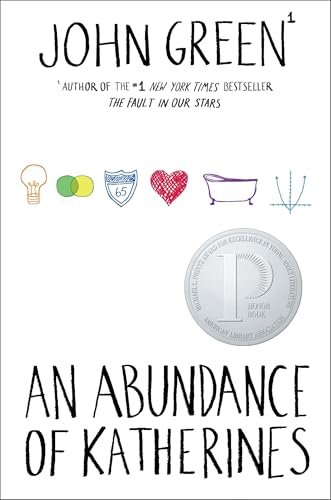
An Abundance of Katherines


Green, John. 2006. An Abundance of Katherines.

An Abundance of Katherines is about nothing and everything all at the same time. If it has a message at all, the message is that you write your own message, tell your own story. Our hero is recent high school graduate, Colin Singleton. And Singleton's problem is that he's single. He's got a long history of being the dumpee (as opposed to being the dumper). He's been dumped nineteen times--so he says--all by girls named Katherine. We first meet Colin after his nineteenth break-up.

Hassan is the best friend a half-Jewish boy could ever hope to have. (Did I mention he was Muslim?) He is Colin's sidekick. And their relationship--this friendship--is quite the motivating force behind the narrative. Two individuals who on their own might be a wee bit odd, but together they make a great team. A hilarious team. Colin is stuck within himself. As a person. He defines himself as the boy who's doomed to fall in love with Katherines and get dumped. That and he defines himself as a child prodigy (high I.Q) who's bound to grow up and NOT be a genuius, NOT matter. He defines himself as a failure. He hasn't found true love. He hasn't made a difference in the world. Half the time he doesn't even know if it's possible for his life to matter when it all comes down to it. He's stuck focusing on himself. All the time. Worrying about his future. Worrying about who's going to dump him next. Worrying if he's ever NOT going to be dumped.

Fortunately, Hassan wants Colin to get it. To learn that life is for living. So the two embark on a road trip. A road trip that soon takes an unexpected turn to an out-of-the-way town of Gutshot. There he meets Lindsay. A girl who while not a Katherine may just be the best thing that ever happened to him. Maybe. But first, he has to stop and ponder the meaning of the universe and write this unbelievably complex theorem on why his love life is so ridiculously awful.

First sentence: The morning after noted child prodigy Colin Singleton graduated from high school and got dumped for the nineteenth time by a girl named Katherine, he took a bath.

© Becky Laney of Becky's Book Reviews

Thursday, April 17, 2008

Speak

Anderson, Laurie Halse. 1999. Speak.

It is my first morning of high school. I have seven new notebooks, a skirt I hate, and a stomachache.

Meet Melinda. A ninth grader, a freshman. Maybe her experiences will remind you of your own high school days. Maybe not. But whether you were popular or among the outcasts, Speak has something vital to offer readers. Her story is powerful, yet not without humor.

THE FIRST TEN LIES THEY TELL YOU IN HIGH SCHOOL

1. We are here to help you.

2. You will have enough time to get to your class before the bell rings.

3. The dress-code will be enforced.

4. No smoking is allowed on school grounds.

5. Our football team will win the championship this year.

6. We expect more of you here.

7. Guidance counselors are always available to listen.

8. Your schedule was created with your needs in mind.

9. Your locker combination is private.

10. These will be the years you look back on fondly.

Speak places high school life under the microscope. In minute detail, the reader sees what high school is like perhaps from a perspective that is new to them. (Or perhaps one that feels all-too-familiar). The teachers. The students. The classmates. The classes. The cafeteria. The bus rides. Melinda isn't happy, and it shows, but she's an example of how appearances can be deceiving. Labeled a trouble maker by a few of her teachers and some of the administration, despised by most of her classmates, she would be easy to brush off, to cast aside as just another lazy, rebellious teen. A teen that needs discipline, punishment, stern lectures, but never a teen that needs compassion and mercy and understanding. But there is always more going on underneath the surface. Always.

I think Speak should be required reading for any adult who is working with teens or who plans to work with teens. As for requiring it for teens within the classroom setting, I'm not so sure. For one, any time a book is required it loses its power. If you "have" to read it, then it strips away most of your natural inclinations to like it. I certainly never "liked" any of my assigned reading. The message of Speak might lose its resonance if it is forced. Especially if it is dissected and analyzed for hidden messages and symbolism. That being said, I do feel it's a true must-read. And it does have much that would be discussion-worthy.

What do I love about Speak? Well, it's authentic. And it's thought-provoking. If you're an adult, it makes you remember (or is prone to making you remember) your own high school days. Rather those days were painful and you're still a bit bitter or if you were one of the rare who actually remember high school "as the best time of your life." It's all in the details. The small things. The small daily interactions of how you relate with others, and how they relate to you. All the little things that add up to create the big picture. I didn't read it as a teen. The book was published when I was in college. But I would hope that the book would help those teens who are going through some of these situations not feel so alone, so isolated. I would hope that they'd feel understood. And for those teens that are bullies, I hope that the book would make them think about their actions a little more, take time to think about how these "little" things are adding up to big-time misery for those that are 'beneath' them. I'm not naive enough to think that this book will have the same impact on every one who reads it. It is just one book after all. But I hope that those who do read it, it will have a strong enough impact that the story will stay with them for a while.

Becky's Online Reading Group.

Wednesday, April 2nd; First Marking Period; Roughly 3-46
Monday, April 7th; Second Marking Period; Roughly 49-92
Friday, April 11th; Third Marking Period; Roughly 95-137
Wednesday, April 16th; Fourth Marking Period; Roughly 141-198

© Becky Laney of Becky's Book Reviews
Tuesday, April 15, 2008

Fat Kid Rules the World


Going, K.L. 2003. Fat Kid Rules the World.

I'm a sweating fat kid standing on the edge of the subway platform staring at the tracks. I'm seventeen years old, weigh 296 pounds, and I'm six-foot-one. I have a crew cut, yes a crew cut, sallow skin, and the kind of mouth that puckers when I breathe. I'm wearing a shirt that reads Miami Beach--Spring Break 1997, and huge, bland tan pants--the only kind of pants I own. Eight pairs, all tan.

It's Sunday afternoon and I'm standing just over the yellow line trying to decide whether people would laugh if I jumped. Would it be funny if the Fat Kid got splattered by a subway train? Is that funny? I'm not being facetious; I really want to know. Like it or not, apparently there's something funny about fat people. Something unpredictable. Like when I put on my jacket and everyone in the hallway stifles laughter. Or when I stand up after sitting in the cafeteria and Jennifer Maraday, Brooke Rodriguez, and Amy Glover all bust a gut. I don't get angry. I just think, What was funny about that? Did my butt jiggle? Did I make the bench creak so loud that it sounded like a fart? Did I leave an indentation? There's got to be something, right? Right?

So it's not a stretch to be standing on the wrong side of the yellow line giving serious thought to whether people would laugh if I threw myself in front of the F train. And that's the one thing that can't happen. People can't laugh. Even I deserve a decent suicide.


Meet Troy Billings. Told in first person, the novel is one of life lost and found. Troy, ready to jump, or at least ready to think about being ready to jump is a young man who thinks he has nothing to live for. Until. And I love this until. Until he meets the most unlikeliest of friends. Curt MacCrae, a homeless teenager of legendary status in the music world. A former student at Troy's school, Troy knows--or thinks he knows--all about Curt MacCrae. The coolest of the cool. But also the skinniest of the skinny.

In this relationship, it's never quite clear (to them or to the reader) who is saving who. 2 kids. 2 sets of problems or issues. 1 unlikely dream. Curt wants--or needs--Troy to be his drummer. The problem? Troy doesn't know how to drum. He has the dream--most boys his age do--of being in a band, a punk band. But he doesn't have the know-how. But Curt is there to see that this is one dream becomes reality.

It's an unlikely pairing. It's an unusual book. But I liked it. I really liked. I had my doubts. His family, Troy's family, seems a bit dysfunctional, a bit disconnected in the beginning. Which of course mirrors how Troy feels about his family life. But as he discovers who he is and what he wants and needs, Troy's family is there with him. His brother. His father. Both are there and willing to stay there, to stay a part of his life. Troy finds out day by day just how lucky he is.

Troy has a big problem. He thinks of himself as 'the fat kid.' His self-esteem (his self-confidence) is non-existent because he believes the lies he tells himself. Through his relationships with Curt and his friends as well as his changing relationships with his family, Troy is becoming someone he can like, someone he can respect, someone he can love.

183

© Becky Laney of Becky's Book Reviews

Wednesday, January 16, 2008

Travel the World: Australia: The Book Thief


Zusak, Markus. 2006. The Book Thief.

The Book Thief may just be the hardest book I've ever tried to review. It is beautiful. Though it can be ugly. It is intense. It is powerful. It is memorable. The first thing you should know about The Book Thief? It is narrated by Death. This is fitting in many ways since the setting is Nazi Germany during the Second World War. Death is the narrator, and he never lets you forget it. But there are many players--many characters--in the story that Death is relating to his audience all these years later. One of them is a girl, Liesel, and is known by Death as 'the book thief.' These thefts provide some structure to the text. (The structure is one of the odd things about the Book Thief. It isn't chronological. Death doesn't tell a story traditionally. He has his own way of jazzing it up, arranging it so it suits his needs and purposes.) The language, the style, is unique. I think it is written in such a way that you either really love it or you really don't. (It's written in such a way that you could almost open it to any page, and find a sentence or two or a whole paragraph that you want to just lift out and let resonate with you for a time.)

This is how it begins:

First the colors. Then the humans. That's usually how I see things. Or at least, how I try. Here is a small fact: you are going to die. I am in all truthfulness attempting to be cheerful about this whole topic, though most people find themselves hindered in believing me, no matter my protestations. Please, trust me. I most definitely can be cheerful. I can be amiable. Agreeable. Affable. And that's only the A's. Just don't ask me to be nice. Nice has nothing to do with me. (3)

It continues:

People observe the colors of a day only at its beginnings and ends, but to me, it's quite clear that a day merges through a multitude of shades and intonations, with each passing moment. A single hour can consist of thousands of different colors. Waxy yellows, cloud-spat blues. Murky darknesses. In my line of work, I make it a point to notice them. As I've been alluding to, my one saving grace is distraction. It keeps me sane. It helps me cope, considering the length of time I've been performing this job. The trouble is, who could ever replace me? Who could step in while I take a break in your stock-standard resort-style vacation destination, whether it be tropical or of the ski trip variety? The answer, of course, is nobody, which has prompted me to make a conscious, deliberate decision--to make distraction my vacation. Needless to say, I vacation in increments. In colors. Still it's possible that you might be asking, why does he even need a vacation? What does he need a distraction from? Which brings me to my next point. It's the leftover humans. The survivors. They're the ones I can't stand to look at, although on many occasions I still fail. I deliberately seek out the colors to keep my mind off them, but now and then, I witness the ones who are left behind, crumbling among the jigsaw puzzle of realization, despair, and surprise. They have punctured hearts. They have beaten lungs. Which in turn brings me to the subject I am telling you about tonight, or today, or whatever the hour and color. It's the story of one of those perpetual survivors--an expert at being left behind. It's just a small story really, about, among other things: a girl, some words, an accordionist, some fanatical Germans, a Jewish fish fighter, and quite a lot of thievery. (4-5)

Before the story gets underway, he invites the reader along for the journey:

Yes, often, I am reminded of her, and in one of my vast array of pockets, I have kept her story to retell. It is one of the small legion I carry, each one extraordinary in its own right. Each one an attempt, an immense leap of an attempt--to prove to me that you, and your human existence, are worth it. Here it is. One of a handful. The Book Thief. If you feel like it, come with me. I will tell you a story. I'll show you something. (14-15)

There is depth, substance, to these words, to this story. The descriptions. The details. The powerful sway of the words whether they're describing the beauty of love and family and friendship or capturing the ugly heaviness of hate, anger, and death. It's not an easy story to read. It's full of emotions. It's full of words. It's a book that at it's very heart and soul captures humanity in all its depths--the good, the bad, the ugly. Here is a book that captures what it means to be human.
One of the most memorable passages for me (224-236), and I hope this isn't much of a spoiler--is the hand drawn--hand written--portion written by "Max" for Liesel. I find it so powerful in its simplicity. So hauntingly beautiful. There is a second story specially written for Liesel by Max, this second one is found on pps 445-450. This is how that one begins, "There was once a strange, small man. He decided three important details about his life: 1) He would part his hair from the opposite side to everyone else. 2) He would make himself a small, strange mustache. 3) He would one day rule the world." (445)

Friday, November 30, 2007

Dewey's Printz Award Challenge


The rules come straight from Dewey at The Hidden Side Of A Leaf who is hosting this challenge:
To participate in the Printz Award Challenge, choose 6 books that have won the Printz Award for Excellence in Young Adult Literature OR one of the Honor books. The challenge runs from January 2008 to December 2008. When you’ve posted your list, please leave the link to your post in the comments.

Here is a list of all the award winners and honor books since 2000. The award hasn’t been around very long, but since each year has several honor books, you should find plenty to choose from.
My list includes

1. Either the 2008 Winner or one the 2008 honor books if I haven't already read them...
2. An Abundance of Katherines by John Green
3. Speak by Laurie Halse Anderson
4. Angus, Thongs, and Full-Frontal Snogging by Louise Rennison
5. Fat Kid Rules the World by K.L. Going
6. A Wreath for Emmett Till by Marilyn Nelson

Alternates

1. The Book Thief by Markus Zusak
2. Airborn by Kenneth Oppel
3. The First Part Last by Angela Johnson
4. Postcards from No Man's Land by Aidan Chambers
5. Monster by Walter Dean Myers

It goes from January 2008-December 2008