Showing posts with label book-to-movie challenge. Show all posts

Tuesday, April 09, 2013

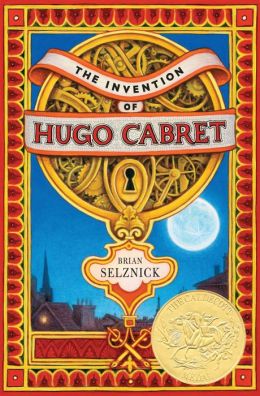
Invention of Hugo Cabret (2007)

Invention of Hugo Cabret. Brian Selznick. 2007. Scholastic. 525 pages.

I hadn't really planned on rereading Brian Selznick's Invention of Hugo Cabret, but this year I joined the book to movie challenge. I'd been curious about the film, Hugo. This "review" will share what I thought about both the book and the movie.

I found the movie wonderful. I found it very compelling. I was drawn into the story--the time and place. This is a movie (and a book) where setting is just as important if not MORE important than the characters. Because it is set in a train station in Paris, France, in the early 1930s, because it focuses on such an intriguing orphan who is desperate to make sense of the world and fix what needs fixing, because it was a story with such a strong emphasis on friendship and making your own family, it worked for me. The book and the movie are different from one another. The movie adds characters and even gives them story-lines. The movie changes some of the relationships as well. But I thought some of the changes--at least--worked better. I liked the Hugo of the movie better than the Hugo of the book! While the novel's focus on old cinema was interesting, on film it meant SO MUCH MORE. This book was meant to be filmed.

I originally read the book in 2007. I watched the movie a few weeks ago and then decided to reread the book. I definitely preferred the movie to the book. But the book is a very quick read! It takes longer to watch the movie than it does to read the book!

© 2013 Becky Laney of Becky's Book Reviews

Friday, November 09, 2007

Book-to-Movie Challenge Update

This challenge was to read three books that have been made into movies. I read six. So even though this one isn't over quite yet. (It ends December 1rst.) I'm declaring myself done. I read three children's books, and three adult books. Overall, I must say I really enjoyed this one.

To Kill A Mockingbird by Harper Lee
Babe by Dick King-Smith
Charlotte's Web by E.B. White
Pride and Prejudice by Jane Austen
Charlie and the Chocolate Factory by Roald Dahl
Journey to the Center of the Earth by Jules Verne

Thursday, October 04, 2007

To Kill A Mockingbird


Harper Lee's To Kill A Mockingbird.

Until I feared I would lose it, I never loved to read. One does not love breathing. (18)
It's when you know you're licked before you begin but you begin anyway and you see it through no matter what. You rarely win, but sometimes you do. (112)
"How could they do it, how could they?"
"I don't know, but they did it. They've done it before and they did it tonight and they'll do it again and when they do it--seems that only children weep. Good night."
(213)

To Kill A Mockingbird is the story of innocence confronting the harsh realities of injustice during the Depression in the American South. Set in Alabama, the novel follows the lives of the Finch family--Atticus, Jem, and Scout (Jean Louise). At first the book seems the simple story of kids learning about life and having adventures all their own in the heat of the summer. Jem and Scout are an unforgettable brother and sister duo. Dill is their visiting friend during the summers. There is much to love about their lazy days and crazy games. The three seemed fascinated with their eccentric neighbors....especially the recluse Boo Radley who never leaves the house. But things rarely stay the same for very long, and all three begin growing and changing and learning. Scout starts school and realizes what a mess the world of civilized folks can be. The heart of the novel, however, is when Atticus Finch, a lawyer, takes the Tom Robinson case. He defends him against some serious charges--rape. The novel is about big issues: justice and injustice, innocence and guilt, love and hate, shame and pride, fear and courage. It's a beautifully told novel about the harsher side of life--the ugly, the raw, the messy. The things that no one wants to talk about or acknowledge.

My favorite thing about To Kill a Mockingbird is our heroine, our narrator, Scout. I absolutely love Scout. I think she's an unforgettable character and her perspective of the world is just priceless.

I read this one for the Book Awards Challenge and in honor of Banned Books week. It also fits in quite well with the Book-to-Movie challenge.

Tuesday, October 02, 2007

That'll Do, Pig.


King-Smith, Dick. Babe: The Gallant Pig.

I read Babe for the Four-Legged Friend Challenge and it is certainly suitable for the book-to-movie challenge as well, though it's not listed on my original list. I love the movie. It's become so much a part of me, that I really can't remember a time when I didn't love it. It is just so good. So quotable. So true. So perfect. It's one of those meaning-of-life, beauty-in-simplicity movies. Anyway, I could gush for hours. How does the book compare? Well, the movie will always be better in my opinion. (Rare I know.) But the book was good. The plot is less complex. There are fewer characters, fewer conflicts. There is no "Rex" just Fly. There is no Ferdinand the duck to lead Babe into trouble. There are definitely no singing mice. It's good; it's enjoyable. But you really can't get better than the movie.

Sad but true...searching YouTube for Babe...even with "pig" added does not lead to the kinds of results you might expect. I was unable to find any clips of the movie, which I feel is kind of surprising given how popular this movie is.

Tuesday, September 25, 2007

Charlotte's Web


Charlotte's Web by E.B. White. Illustrations by Garth Williams.

What can I say about Charlotte's Web that you don't already know? Really. It is a must read for each and every person. If by some chance you never discovered it as a child, you really must read it as an adult. Charlotte's Web is all about the wonder of living. The wonder of life. Seeing the world around you in terrifically radiant ways. Of seeing magic in the small things, the ordinary things. Finding miracles in unexpected places. It captures the beauty of innocence, the heartache of loss, and all the finer points of life in between the two. Wilbur, a spring pig--the runt of the litter--is saved by Fern, a girl who sets out to rid the world of injustice. Fern raises this pig for his first month of life. Bottle-feeding him, caring for him, pampering him. But then it's time for Wilbur to learn to be a pig--to learn about farm life. So he is sold to Uncle Homer. Luckily, the farm is within walking distance and Fern can visit her friend regularly. Wilbur has to make the adjustment to life in the barn. And that adjustment isn't always easy. What Wilbur wants more than anything is a friend--a true friend--but the other animals just aren't interested in providing solace and comfort or entertainment to a pig. Just when Wilbur is at his lowest, he hears a voice whispering soft words of hope and promise. With the dawning of the day, Wilbur learns that his new friend is a spider. What can a spider do for a pig? Well, if that spider is Charlotte--anything and everything imaginable. As the two become friends, as they learn and grow together, Charlotte imparts many words of wisdom to the pig who is innocent, naive, and oh-so-lovable. Charlotte's Web is about life and death and everything in between. It is about the ebb and flow of life. The changing of seasons. An illustration that there is a time and place for everything...things must pass away, must change...because that is the nature of things. Fern can't always be a little girl. She can't always be there for Wilbur. Nor can Charlotte. But some things--like love, friendship, and hope--never pass away. Some things are eternal. It is a beautiful, beautiful story.

I had the pleasure of listening and reading to Charlotte's Web in the past week or so. I first listened to it on audio. It was narrated by E.B. White. It was a special anniversary edition, and I presume that the narration had been restored or put onto cd for the first time most likely. I thought that was very well done. White was especially good at rendering the dialogue of the animals--particularly the gander. There was something so touching, so beautiful about listening to the author read his own book. I know that not every author can be talented in that regards. Sometimes it is better to let professionals do the job, but this one was nicely done.

What can I say about the movie? Well, I loved it. I cried. Who cannot be touched by Charlotte's love and sacrifice? Her devotion, her goodness, her compassionate and wise soul? And Julia Roberts did a great, great job in that role.

Saturday, September 22, 2007

Pride and Prejudice


This post is going to make the rounds. It qualifies as a "Christian" read since this edition was printed by Bethany House. This "insight edition" features notes relevant to everyone, generally speaking, but has a few targeting the Christian crowd specifically. It qualifies as appealing to the young adult crowd--which means I'll be posting it on Becky's Book Reviews. It also qualifies for three challenges I'm participating in: the Something About Me challenge, the book to movie challenge, and the Cardathon Challenge.

Why did I choose to read Pride and Prejudice? I love the novel. I haven't always *loved* the novel. There was a long period of my life where I was unfamiliar with this glorious work. I knew I wanted to read it one day. But I didn't have any immediate plans to make it happen. I picked up a copy--I believe it was a Dover edition--a really cheap edition, by the way, for under three bucks. I got to it in December 2005. Years after buying the book. My motivation then? Well, my best friend, Julie, loved the book. And we were discussing the movie. (The most recent movie had just reached theaters and I wanted to go see the movie...but not until I had read the book.) I read it in probably two to four days. I devoured it really. It was just so wonderful. I was graduating with my degree in library science at the time and had some gift cards to spend, so I bought the A&E DVD version with Colin Firth. If I hadn't been convinced of its wonderfulness before, I certainly would've been after seeing the movie! I remember spending the 23rd and 24th of December watching the movie and wrapping presents and feeling all wonderfully giddy. That January, I introduced the movie to my dad. I didn't know if he would like it. It is rather long. It does have a lot of dialogue. But as soon as Mr. Collins came into the scene, Dad was hooked. That summer, June or July 2006, I introduced the movie to my sister. She was skeptical at first. She thought the first hour or so rather boring. But soon she was a fan as well. Then I introduced everyone to Bride and Prejudice. Of course, Julie was the one who first introduced ME to Bride and Prejudice...so I can't take all the credit. So there was much fun and love being spread all around in the family.

But why reread Pride and Prejudice now? Well, I saw it on the Something about Me challenge. It was tempting. But when I saw that Bethany House was releasing a special edition of the book along with their novel Just Jane by Nancy Moser--and that this edition would feature book club type questions--I really couldn't resist it. So I did request a review copy. And it came late last week. As soon as it arrived, I began reading it.

Did I discover anything new the second time around? Well, I don't know about "new" discoveries, but I certainly appreciated it more. I was able to savor it more. I knew what to expect, what was coming. I knew which bits were the "best" parts. I knew the characters. I knew their strengths and weaknesses. I love the language, the style, the romance, the characters. It really is just oh-so-magical.

For those that are unfamiliar, the plot is relatively simple. Jane and Elizabeth are the two oldest sisters in a family of five daughters. It's Regency England. Their family connections aren't the greatest, and it's really imperative that at least one or two of the daughters marry well so that they can be provided for after their father's death. Mrs. Bennet is all about getting her daughters matched up and paired off. And she's a very silly woman. Mr. Bennet is a caring father, who dotes on Elizabeth and merely tolerates the three younger sisters--who rather take after the mother. Jane is a sweet dear. Elizabeth a wit. And the book is about the complicated courtships of the two oldest children. Of course, Lydia, the youngest has her moments as the center of attention. But this isn't her story, thank goodness! Mr. Bingley, Mr. Darcy, Mr. Wickham and, of course, the unforgettable Mr. Collins play the love interests.

It's a story of love, hate, friendship, family, disdain, disgust, joy, regret, and jealousy. Lots and lots of jealousy. It is a read I recommend to everyone!

What is it about the "Insight Edition" that makes it special? It does feature notes. Mostly cultural notes--not scholarly ones. It likes to comment on the various movie versions of the book. It likes to add in tidbits about Austen's life and time. It points out that Jane is a good "Christian" girl. And it does feature discussion questions. The only thing I am disappointed about in this edition was the fact that I found four typos. One on the very first page. They misspelled first. They even misspelled his on one occasion as "vhis." This is sad, but hopefully it will be corrected with subsequent printings. Typos do happen. But all four could have easily been caught even with spellcheck, and they definitely would have been caught with a human proofreader.

Tuesday, September 18, 2007

Charlie and the Chocolate Factory


What do I love about Charlie and the Chocolate Factory by Roald Dahl? Everything. This is one of my childhood favorites. (I don't know how many times--more than two less than six--I probably read this one growing up.) But I recently, last week, read it for the Book to Movie Challenge. I loved the story. I loved the characters. (Especially Charlie and Grandpa Joe.) I loved the humor. Those oompa-loompa songs are just too much fun! I loved the illustrations. (For the record, the illustrations were by Joseph Schindelman). So when I said everything, I meant everything.

For the few that may not be familiar with the story, Charlie Bucket is a young boy, a poor boy, who wins a Golden Ticket--one of five--and is allowed into the ever-so-mysterious chocolate factory owned by Willy Wonka. Why is it so mysterious? The factory closed down years ago--spies in the company selling secrets--and it reopened years later. But no one ever goes in or out of the factory. The gates remain closed. Who are these "mystery" workers? Is Wonka as 'out there' as he seems?

I love the Charlie and the Chocolate Factory movie as well. The new one. Not that dreadful, dreadful one. Why? It follows the book better. It capture the *essence* of the book. It has the heart and soul of the original even if they change a few details now and then. What do I love most about the movie? A lot of the dialogue comes straight from the book. Not all of it. But enough that when you reread the book you see examples on practically every page. The songs especially are authentic to the book. When you read the book, you hear the songs from this movie. They have brought it to life. What they added to the movie that wasn't in the book was the fact that Willy Wonka's father was a dentist and that they had a strained relationship was an odd twist. In the movie, he had a reluctance to embrace families. He was a loner. In the book, he didn't have this 'odd' quirk and was more than willing to embrace the whole Bucket family from the start. Even though the movie didn't get it quite right at the end, they redeemed it enough where I could accept it.

Do I love Charlie and the Glass Elevator? No. Not really. Not at all. But the first one is classic. It's an unforgettable rags-to-riches story of a deserving boy who finally gets a break.

Of interest:

http://www.hbook.com/history/magazine/camerondahl.asp

Tuesday, August 28, 2007

A Journey To The Center of the Earth


This was actually my first experience reading Jules Verne.

I was actually inspired to read this novel after watching--or should I say enduring--the Hallmark 1999 production of Journey to The Center of the Earth. The movie--originally a miniseries--was broadcast on Ion--an essentially useless station that rarely has anything entertaining on. (It's not always the case, but it's often the case). However, they pride themselves on having four hour long movies on every weekend. This movie starring Jeremy London, Treat Williams, Hugh Keays-Byrne, and Tushka Bergen barely resembles the classic 1959 movie production. It was set in New Zealand for one thing--not Iceland. And the whole point of this expedition was NOT to get to the center of the earth in the name of science and mankind, but to venture down into the unknown ONLY for the sake of trying to find this woman's husband. Alice Hastings is a woman whose philandering husband has undertaken a mysterious journey to the underworld. She 'hires' Theodore and Jonas Lytton to help her find him. They, of course, need a guide but it won't be one named Hans. This one's McNiff. Now Alice's husband, Casper, wasn't seeking this expedition in the name of science and mankind either. He was looking for a way to get rich quick. Different setting. Different emphasis. Different plot twists. And let's just say that they took liberties adding an underground party-driven, sex-crazy tribe. Of course, Jonas Lytton (Jeremy London) has to get busy with one of the natives and cheat on his fiancee. There are just so so so so so many things that are wrong with this movie.

Read some User-Comments from IMDB

Here is one of my favorites:

Marcus Eden-Ellis writes, "Oh my, such a great tale so artlessly told...I guess if you really want to know about this film, watch it and see for yourself but I warn you now, it's about fifteen hours long. At least that is what it felt like! But I guess the best flavour of the piece comes from the fact that the women of an underground undiscovered tribe of natives wear make-up, speak English in a late 20th century idiom and shave their armpits with some kind of incredibly close shaver. And they dance disco style! All this in the nineteenth century...Go on, try it. It's one of those "so bad, it's good" type movies..."

But oddly enough some people actually like it. They even praise it. They even claim it follows the book. Methinks they have never read the book. I'm not a genius but when I kept seeing sex scene after sex scene, I was thinking...this doesn't look very Jules Verney to me.

For a very nice and not too openly saracastic summary (but sarcastic enough to be liked by me), read here.

Here is what I have to say about this movie. One good thing came from having watched it: I went to my local library and checked the book out. True, I did it only to *prove* that the movie was so, so wrong in its spin on the classic. But it did motivate me.

The 1999 movie was set in 1875; I believe, that the 1959 movie is set in 1885. The book was published in 1864. Therefore, I would imagine that it is set in the early 1860s.

The 1999 movie had Theodore Lytton, Jonas Lytton (nephew), McNiff, Alice Hastings.
The 1959 movie had Sir Oliver S. Lindenbrook, Alexander (Alec) McKuen (student), Carla Goteborg, Hans Belker, and Gertrude. (The beloved duck)

The 1959 movie is set in Scotland with largely Scottish and Icelandic characters. The 1999 movie has the Lyttons being American, I believe, although I can't be 100% sure since I'm trying my hardest to forget as much as I can from that experience. The book has the professor/uncle character being German. His name: Professor Von Hardwigg. The nephew is called Harry or at times Henry. (The last name is Lawson. He is English.) The book has a guide named Hans which they pick up in Iceland. I'm not going to search to find out what his last name was. The point being that there is no woman along for the expedition. And sadly, there is no duck.

Another big difference, there are no villains in the book. No race to be the first. No Count Saknussem character that haunts, chases, or threatens them. No murder plots that add the element of danger from another human being. No weeping widow to bargain with.

The book is narrated from Harry's point of view. In the book, he is a reluctant traveler. He wasn't eager to join the expedition. In fact, he does everything in his power to persuade his uncle that it is madness. But his girlfriend, his uncle's goddaughter, Gretchen, is the one coaxing him to go. Pleading with him to go out and be an explorer, an adventurer. His narration is what I enjoyed most about the novel, actually, his skepticism, his sarcasm, his doubts and fears. His observations of this whole 'crazy' scheme from beginning to end.

I do enjoy the 1959 movie. I had seen it at least twice as a child. And I rewatched it this weekend so I could write my review. It has its enjoyable qualities. I especially liked the addition of Gertrude as a character. And I must say that Peter Ronson and Pat Boone weren't hard on the eyes. I had not realized that before. I apparently didn't notice things like that back then. (Or maybe they just didn't rate compared to Michael J. Fox or Kirk Cameron?) It has its laughable moments as well. It's hard not to notice how ridiculous some things are. But overall, I enjoyed revisiting this movie.