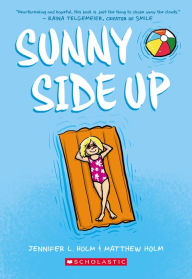
Sunny Side Up. Jennifer L. Holm and Matthew Holm. 2015. Scholastic. 224 pages. [Source: Review copy]
Sunny Side Up is a graphic novel, a coming-of-age story starring Sunny Lewin. It is set in August 1976. It wasn't Sunny's first vacation choice to go visit her grandfather in Florida. The family had planned on a beach vacation, a vacation where Sunny's best friend could come too. But family troubles--troubles concerning Sunny's older brother--changed everything. Now Sunny is on her own for this trip and visiting her grandfather in his retirement community. Flashes reveal much in this one, readers learn about Sunny's life in Pennsylvania: her friends, her family, and what led to this vacation.
I liked this one. I did. I don't read many graphic novels per year--at most three or four. But I am SO GLAD I read Sunny Side Up. I loved the setting. I love stories featuring grandparents and the senior community. I love the main character, Sunny. I loved, loved, loved how by the end of vacation she had found her voice and REALLY opened up. I also loved that she made a new friend and had a few adventures with someone her own age. I loved that she discovered comic books and super heroes. Some of the pages devoted to her discovering super heroes were among my favorites. And I LOVED the ending.
Overall this one is oh-so-easy to recommend. Even to readers who don't typically read graphic novels.
© 2015 Becky Laney of Becky's Book Reviews
Friday, September 04, 2015
Thursday, September 03, 2015
Seventh Most Important Thing
Seventh Most Important Thing. Shelley Pearsall. 2015. Random House. 288 pages. [Source: Review copy]
The Seventh Most Important Thing by Shelley Pearsall is loosely based on a true story. One of the characters in the novel was an actual person, an artist named James Hampton. An author's note tells more of his story. I do wish I'd known this at the start; that is one reason I'm beginning my review with this 'essential' information.
Arthur T. Owens is the hero of The Seventh Most Important Thing; the book is a coming-of-age story set in 1963. Arthur has not been having an easy time of it, life has not been the same for him since his father died. And one day he loses it. He sees "the junk man" walking down the street pushing his cart full of junk, and the man is wearing his father's hat. He picks up a brick, takes aim, and hits him. Fortunately, it hits him on the arm and not in the head. James Hampton is "the junk man" and he urges the court to show Arthur mercy, and sentence him to community service. His community service will be working for "the junk man." Arthur has a list of SEVEN items to collect each Saturday. And the list is the same week to week. To collect these items, he'll need to walk the streets and neighborhoods picking up trash and even going through people's trash. It won't be easy for him, especially at first, to lower himself like that. But this process changes him for the better. And there comes a time when readers learn alongside Arthur just what "the junk man" does with his junk. And the reveal is worth it, in my opinion.
The Seventh Most Important Thing is definitely character-driven and not plot-driven. It's a reflective novel. The focus is on Arthur, on his family, on his new friendships and relationships, on the meaning of life. I liked the characters very much. The story definitely worked for me.
© 2015 Becky Laney of Becky's Book Reviews
The Seventh Most Important Thing by Shelley Pearsall is loosely based on a true story. One of the characters in the novel was an actual person, an artist named James Hampton. An author's note tells more of his story. I do wish I'd known this at the start; that is one reason I'm beginning my review with this 'essential' information.
Arthur T. Owens is the hero of The Seventh Most Important Thing; the book is a coming-of-age story set in 1963. Arthur has not been having an easy time of it, life has not been the same for him since his father died. And one day he loses it. He sees "the junk man" walking down the street pushing his cart full of junk, and the man is wearing his father's hat. He picks up a brick, takes aim, and hits him. Fortunately, it hits him on the arm and not in the head. James Hampton is "the junk man" and he urges the court to show Arthur mercy, and sentence him to community service. His community service will be working for "the junk man." Arthur has a list of SEVEN items to collect each Saturday. And the list is the same week to week. To collect these items, he'll need to walk the streets and neighborhoods picking up trash and even going through people's trash. It won't be easy for him, especially at first, to lower himself like that. But this process changes him for the better. And there comes a time when readers learn alongside Arthur just what "the junk man" does with his junk. And the reveal is worth it, in my opinion.
The Seventh Most Important Thing is definitely character-driven and not plot-driven. It's a reflective novel. The focus is on Arthur, on his family, on his new friendships and relationships, on the meaning of life. I liked the characters very much. The story definitely worked for me.
© 2015 Becky Laney of Becky's Book Reviews
Wednesday, September 02, 2015
The Clone Army Attacketh
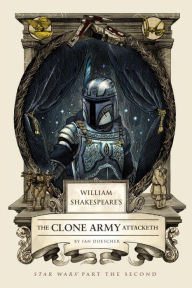
William Shakespeare's The Clone Army Attacketh. Ian Doescher. 2015. Quirk. 176 pages. [Source: Review copy]
I did enjoy reading Ian Doescher's The Clone Army Attacketh. It was a pleasant-enough way to spend two evenings. I haven't enjoyed any of the adaptations nearly as much as the first book in the series--Verily, A New Hope. Perhaps because Verily A New Hope retains so many memorable lines, only slightly adjusted to come from the pen of Shakespeare. Perhaps because it was the first, the concept, the premise was so new, so novel. It was like trying a new dish for the first time and discovering that you love it. I have to confess that the second prequel movie is one of my FAVORITES. I adore this one for so many reasons. And I was hoping that the flavor of the original movie dialogue would shine through. I was a bit disappointed in that. Though probably Doescher's changes are for the better. Most of the changes focuses on Anakin and Padme, and their romance.
If you've enjoyed the previous books in the series, chances are you'll enjoy this one too.
© 2015 Becky Laney of Becky's Book Reviews
I did enjoy reading Ian Doescher's The Clone Army Attacketh. It was a pleasant-enough way to spend two evenings. I haven't enjoyed any of the adaptations nearly as much as the first book in the series--Verily, A New Hope. Perhaps because Verily A New Hope retains so many memorable lines, only slightly adjusted to come from the pen of Shakespeare. Perhaps because it was the first, the concept, the premise was so new, so novel. It was like trying a new dish for the first time and discovering that you love it. I have to confess that the second prequel movie is one of my FAVORITES. I adore this one for so many reasons. And I was hoping that the flavor of the original movie dialogue would shine through. I was a bit disappointed in that. Though probably Doescher's changes are for the better. Most of the changes focuses on Anakin and Padme, and their romance.
If you've enjoyed the previous books in the series, chances are you'll enjoy this one too.
© 2015 Becky Laney of Becky's Book Reviews
Labels:
2015,
adult fiction,
books reviewed in 2015,
Quirk,
review copy
Tuesday, September 01, 2015
Archivist Wasp
Archivist Wasp. Nicole Kornher-Stace. 2015. Big Mouth House. 268 pages. [Source: Library]
Two words describe Archivist Wasp, in my opinion, confusing and compelling. It's not often a book is equal parts confusing and compelling. Even though I found myself with more questions than answers and lingering confusion, I couldn't stop reading Archivist Wasp. Two more words to describe the book? How about post-apocalyptic and ghosts?
Our heroine is an archivist calling herself "Wasp." I'll be honest, Wasp doesn't have the best of lives, even, when she's not fighting for her life, fighting to stay the Archivist. (She's challenged every year by three Upstarts. That's how she got the job as well, by killing the previous Archivist.) Archivists have a marginally better life than Upstarts. But essentially, no one in this post-apocalyptic world has a happy, easy life. The villagers, well, they have their problems too. But at least they aren't tortured/tormented by the Catchkeep's Priest and brainwashed into a life of hate and violence.
So what does an Archivist do? She hunts ghosts, recording what she learns from each ghost, disposes of ghosts after studying, except, for when a villager wants to buy a ghost for whatever reason. It's a bleak, lonely life. And Wasp does spend a good bit of the book recovering from various injuries.
So the book is about what happens when Wasp meets an out-of-the-ordinary ghost, one that is actually able to communicate with her, one that has a tragic tale to tell and a huge request for her. This nameless ghost (he can't remember his identity, I believe) wants her help in finding another ghost, Catherine Foster. He wants them both to travel to the underworld and search the spirit-world. She agrees, and, in the process learns that life below isn't any more bleak than life above. In fact, in some ways it might even be slightly better. But the search won't be easy. And it will have its own dangers.
The book is about what she learns through this search, it will change her certainly....
Do I understand everything that happened in Archivist Wasp? Not really. The quest was really confusing in places, and, she is thrown in and out of other people's memories. She sees the past on her quest, in bits and pieces, and probably not sequential flashbacks either. She has to piece it all together. And she does a much better job than I did with that!
© 2015 Becky Laney of Becky's Book Reviews
Two words describe Archivist Wasp, in my opinion, confusing and compelling. It's not often a book is equal parts confusing and compelling. Even though I found myself with more questions than answers and lingering confusion, I couldn't stop reading Archivist Wasp. Two more words to describe the book? How about post-apocalyptic and ghosts?
Our heroine is an archivist calling herself "Wasp." I'll be honest, Wasp doesn't have the best of lives, even, when she's not fighting for her life, fighting to stay the Archivist. (She's challenged every year by three Upstarts. That's how she got the job as well, by killing the previous Archivist.) Archivists have a marginally better life than Upstarts. But essentially, no one in this post-apocalyptic world has a happy, easy life. The villagers, well, they have their problems too. But at least they aren't tortured/tormented by the Catchkeep's Priest and brainwashed into a life of hate and violence.
So what does an Archivist do? She hunts ghosts, recording what she learns from each ghost, disposes of ghosts after studying, except, for when a villager wants to buy a ghost for whatever reason. It's a bleak, lonely life. And Wasp does spend a good bit of the book recovering from various injuries.
So the book is about what happens when Wasp meets an out-of-the-ordinary ghost, one that is actually able to communicate with her, one that has a tragic tale to tell and a huge request for her. This nameless ghost (he can't remember his identity, I believe) wants her help in finding another ghost, Catherine Foster. He wants them both to travel to the underworld and search the spirit-world. She agrees, and, in the process learns that life below isn't any more bleak than life above. In fact, in some ways it might even be slightly better. But the search won't be easy. And it will have its own dangers.
The book is about what she learns through this search, it will change her certainly....
Do I understand everything that happened in Archivist Wasp? Not really. The quest was really confusing in places, and, she is thrown in and out of other people's memories. She sees the past on her quest, in bits and pieces, and probably not sequential flashbacks either. She has to piece it all together. And she does a much better job than I did with that!
© 2015 Becky Laney of Becky's Book Reviews
Monday, August 31, 2015
August Reflections
In August I read 55 books.
Board books:
© 2015 Becky Laney of Becky's Book Reviews
Board books:
- Board Book: Carry and Learn Shapes. Scholastic. 2015. 10 pages. [Source: Review copy]
- Board Book: I Love My Puppy. Caroline Jayne Church. 2015. Scholastic. 10 pages. [Source: Review copy]
- Board Book: Oh No, George! Chris Haughton. 2015. Candlewick Press. 32 pages. [Source: Review copy]
- Board Book: Ten Playful Penguins. Emily Ford. Illustrated by Russell Julian. 2015. [October] Scholastic. 22 pages. [Source: Review copy]
- Fab Four Friends: The Boys Who Became The Beatles. Susanna Reich. 2015. Henry Holt. 32 pages. [Source: Review copy]
- Friendshape. Amy Krouse Rosenthal and Tom Lichtenheld. 2015. [August] Scholastic. 40 pages. [Source: Review copy]
- The Queen's Hat. Steve Antony. 2015. [August] Scholastic. 32 pages. [Source: Review copy]
- When Sophie's Feelings are Really, Really Hurt. Molly Bang. 2015. [September] Scholastic. 40 pages. [Source: Review copy]
- Your Hand in My Hand. Mark Sperring. Illustrated by Britta Teckentrup. 2015. [November] Scholastic. 32 pages. [Source: Review copy]
- A Lucky Author Has A Dog. Mary Lyn Ray. Illustrated by Steven Henry. 2015. [August] Scholastic. 40 pages. [Source: Review copy]
- Elephant in the Dark. Mina Javaherbin. Illustrated by Eugene Yelchin. 2015. [August] Scholastic. 40 pages. [Source: Review copy]
- Where Did My Clothes Come From? Chris Butterworth. Illustrated by Lucia Gaggiotti. 2015. Candlewick Press. 32 pages. [Source: Review copy]
- Frog on a Log? Kes Gray. Illustrated by Jim Field. 2015. [September] Scholastic. 32 pages. [Source: Review copy]
- Where's Walrus? and Penguin? Stephen Savage. 2015. [August] Scholastic. 32 pages. [Source: Review copy]
- Clifford Goes to Kindergarten. Norman Bridwell. 2015. Scholastic. 32 pages. [Source: Review copy]
- Railroad Hank. Lisa Moser. Illustrated by Benji Davies. 2012. Random House. 40 pages. [Source: Review copy]
- Peppa's Windy Fall Day. Adapted by Barbara Winthrop. 2015. Scholastic. 24 pages. [Source: Review copy]
- (Peppa Pig) Best Friends. 2015. Scholastic. 32 pages. [Source: Review copy]
- Double Play: Monkeying Around With Addition. Betsy Franco. Illustrated by Doug Cushman. 2011. Random House. 32 pages. [Source: Review copy]
- Marvin K. Mooney Will You Please Go Now! Dr. Seuss. 1971. Random House. 36 pages. [Source: Library]
- In A People House. Dr. Seuss. (Theo LeSieg) Illustrated by Roy McKie. 1972. Random House. 36 pages. [Source: Library]
- Did I Ever Tell You How Lucky You Are? Dr. Seuss. 1973. Random House. 47 pages. [Source: Library]
- The Shape of Me And Other Stuff. Dr. Seuss. 1973. Random House. 36 pages. [Source: Library]
- There's a Wocket in my Pocket! Dr. Seuss. 1974. Random House. 30 pages. [Source: Review copy]
- Big Dog and Little Dog. Dav Pilkey. 2015. Houghton Mifflin Harcourt. 24 pages. [Source: Review copy]
- Eva Sees A Ghost (Owl Diaries #2) Rebecca Elliott. 2015. Scholastic. 80 pages. [Source: Review copy]
- Milo Speck, Accidental Agent. Linda Urban. 2015. Houghton Mifflin Harcourt. 272 pages. [Source: Review copy]
- Walk Two Moons. Sharon Creech. 1994. HarperCollins. 280 pages. [Source: Bought]
- The Whipping Boy. Sid Fleischman. Illustrated by Peter Sis. 1986. 96 pages. [Source: Bought]
- Finding Serendipity. Angelica Banks. 2015. Henry Holt. 288 pages. [Source: Library]
- The View From Saturday. E.L. Konigsburg. 1996. 176 pages. [Source: Bought]
- A Girl Named Disaster. Nancy Farmer. 1996. Scholastic. 320 pages. [Source: Review copy]
- Shabanu: Daughter of the Wind. Suzanne Fisher Staples. 1989. 240 pages. [Source: Book I Bought]
- Missing in Action. Dean Hughes. 2010/2015. Random House. 240 pages. [Source: Review copy]
- Terezin: Voices From the Holocaust. Ruth Thomson. 2011. Candlewick. 64 pages. [Source: Review copy]
- A Little In Love. Susan Fletcher. 2015. Scholastic. 288 pages. [Source: Review copy]
- An Ember in the Ashes. Sabaa Tahir. 2015. Penguin. 446 pages. [Source: Library]
- The Life of Charlotte Bronte. Elizabeth Gaskell. 1857/1975. Penguin Classics. 623 pages. [Source: Bought]
- When Books Went to War: The Stories That Helped Us Win World War II. Molly Guptill Manning. 2014. Houghton Mifflin Harcourt. 288 pages. [Source: Library]
- Gut: The Inside Story of Our Most Underrated Organ. Giulia Enders. Illustrated by Jill Enders. 2014/2015. Greystone Books. 288 pages. [Source: Library]
- A Bitter Truth. Charles Todd. 2011. HarperCollins. 352 pages. [Source: Library]
- Go Set A Watchman. Harper Lee. 2015. HarperCollins. 278 pages. [Source: Library]
- Wish You Well. David Baldacci. 2000/2007. Grand Central Publishing. 432 pages. [Source: Library]
- Murder at Longbourn. (Elizabeth Parker #1) Tracy Kiely. 2009. St. Martin's Press. 320 pages. [Source: Library]
- John: That You Might Believe (Preaching the Word) R. Kent Hughes. 1999/2014. Crossway Books. 528 pages. [Source: Bought]
- The Original Jesus: Trading The Myths We Create For The Savior Who Is. Daniel Darling. 2015. Baker Books. 160 pages. [Source: Review copy]
- Compassion: Seeing with Jesus' Eyes. Joshua Mack. 2015. P&R Publishing. 48 pages. [Source: Review copy]
- Ladylike: Living Biblically. Rebekah Curtis and Rose Adle. 2015. Concordia. 224 pages. [Source: Review copy]
- Our Only Comfort. Neal Presa. 2015. Westminster John Knox Press. 160 pages. [Source: Review copy]
- Modesty. Martha Peace and Kent Keller. 2015. P&R Publishing. 176 pages. [Source: Review copy]
- Five Minute Bedtime Bible Stories. Retold by Amy Parker. Illustrated by Walter Carzon. 2015. Scholastic. 192 pages. [Source: Review copy]
- Respectable Sins. Jerry Bridges. 2007. NavPress. 192 pages. [Source: Bought]
- The Unbelievable Gospel: Say Something Worth Believing. Jonathan Dodson. 2015. Zondervan. 240 pages. [Source: Review copy]
- Through Waters Deep. (Waves of Freedom #1) Sarah Sundin. Revell. 384 pages. [Source: Review copy]
- Lady Maybe. Julie Klassen. 2015. Penguin. 400 pages. [Source: Library]
© 2015 Becky Laney of Becky's Book Reviews
Subscribe to:
Posts (Atom)