Showing posts with label author guest post. Show all posts

Friday, February 12, 2010

Guest Post by N.D. Wilson, Part 2 (Exploring One of the Cupboards)

Photobucket

Tired and sore, I, Richard Hutchins, again face new journeys. Anastasia, your grandfather’s tattered and filthy bed invites me to rest my weary bones and nurse my wounds (I still have a pinch in my hip from yesterday’s dangling). But onward I intrepidly press. Cupboard #63 awaits—along with glory, discovery, and the possibility of a grisly and unnatural end. I have already set the combination in the attic.

After yesterday’s sudden drop, I have decided to investigate this cupboard with more of my traditional caution. On all fours, I approach the small door, pencil in hand, sliding this journal ahead of me.

Darkness. I see no sun. No harbor. But I can hear . . . splashing?

!!

I apologize. I had no time to write more in the suddenness of that moment. Sour, warm, sea foam just slopped through the cupboard and onto the carpet. I leapt backward, forced to scramble across the room or become moist. (And I would apologize for damaging the floor, if Henry and your sister, Henrietta, hadn’t already done enough to destroy it years ago when we first met—your father’s bloodstain is still visible).

Should I choose another cupboard? Water has never been my friend, particularly when connected to anything oceanic. No. Courage, Richard.

The wash has crept out again. Wherever the other side of the cupboard is, it is clearly within the reach of waves. When the next wave recedes, I shall make my move. . .

Perhaps after the next one . . . Or the next . . .

I don’t want to do this. But I can’t go home now. You’ll know. You’ll see it on my face. Forward. I’m leaving the journal on your grandfather’s bed. If that’s where you (or any other) find it, then Richard Hutchins has been lost at sea. Do not mourn me unless you mean it.

Never mind. I’m bringing the journal. I need something to hold.


This place is dark. And cold. And wet. Excuse my penmanship, I am writing by the light of a weak moon, perched on a damp rock with very wet feet and trousers clinging to my stinging ankles. In a moment, my eyes will surely to adjust.

The tide seems low by the sound of things. But there is also a clattering with each wave, I don’t know why. Perhaps it is the rattle of tumbling pebbles.

I appear to be in some kind of ruin. A long mound of rubble stretches away into the sea, and I am seated near what must have been the base of a great tower—I’d wager it’s the remains of the lighthouse noted by your grandfather. I can make out ships now, most without sails. Oared ships, but big. No engines. No smokestacks.

The clattering again. The foam is rising. Black objects are rolling around the foot of my pedestal.

Ah, there’s an engine, and a fast one, gauging from its roar. No! Wave!


Horror. Horrible. Anastasia, I shiver. The pages are ruined. Can you read this? Why am I even writing? The water swept me off of my seat, and it is only by luck that I dove for the cupboard—I and ten thousand crabs. They were the rattling pebbles, Anastasia. I have been pinched and snipped and covered with viciously clicking legs. The soaked carpet is swarming with them. I may not be able to leave the safety of this bed. Big crabs, little crabs, and sinister medium crabs. Side-walking villainy surrounds me. Black and green crabs—hungry, I’m sure. Smelling me, no doubt. They want my meat.

What would you expect of Richard Hutchins? Fear? Inaction? Well, I acted Anastasia, and the cannibal crabs can feast on each other tonight—not on me. I jumped from the bed and into the hall (and oh, the awful crunch beneath my feet). Upstairs, I reset the combination and again, I had to face the pinching hordes—this time on my knees. Crunching shells and crushing lives as I crawled, my soft hands easy targets for their revenge, but I overcame. I am home. The streets of Hylfing greet me, though I am afraid that your grandfather’s room will soon be a foul-smelling graveyard. It may be a week before I venture through the worlds again, but when I do, I have chosen my path:


#72. Collected 1907. White ash. Tarnished copper corners. First report: Collector in Constantinople dismayed at having lost items within a locked cabinet. Tested repeatedly, always confirmed. Invited examination. Acquired easily after a rich supper and at the cost of only one drugged bottle of whiskey.


[Southern Cit./Boghazk/Alt pas. Back 4C]

© Becky Laney of Becky's Book Reviews

Guest Post by N.D. Wilson


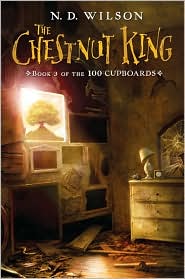
I am happy to be a part of N.D. Wilson's blog tour celebrating the release of The Chestnut King, the third book in the 100 Cupboards series. Please also visit these tour stops Eva's Book Addiction and Fireside Musings.

My mother was (and occasionally is) an English teacher. This story starts with her enthusiasm.

She was making (forcing? obligating? mandating?) us to watch a little documentary called The Story of English. (When I say us, I mean my two sisters and my own self.) All good and noble. Huzzah for English. Huzzah for its story.

But I wasn’t interested. Which is why I was grateful when the house burned down.

If I recall, the key moment in the film came when an old man was wheedling around on his bicycle (carrying baguettes in a basket I believe). Nothing against him or his white beard or his cap or his bicycle wheedling. Good on him. Well wheedled. Well Englished and well storied. But I yawned on.

Until the lights in the kitchen flicked off.

Being eternally helpful, I hopped up to see what had happened. (I think my mom even paused the film so I wouldn’t miss anything.)

Once in the kitchen, I looked around. Yep. The lights were indeed off. I looked up at the beamed cedar ceiling. I cocked an ear. And at that moment, our little movie afternoon became interesting. The ceiling was crackling and popping like a campfire.

“Mom,” I said, and I’m sure that I was smiling. “The house is on fire.”

There was a great deal of “What?” and sisterly excitement and yelling for my dad and running into the kitchen and everybody trying to be quiet to hear the alleged crackling.

Vindicated. We were definitely on fire.

Mom practically threw us out of the house. And our phone line was dead, so she continued her running right over to the neighbors’ house. Dad fired up the garden hose, climbed a ladder, and tried to spritz the thing dead through the attic vent.

My sisters and I, well, I don’t really remember whether or not there was any negative emotion going on with them, but we pretty much kept ourselves busy dancing on the lawn until the firemen arrived.

Men scrambled onto our roof with axes. Holes were chopped. As evening fell, towers of flame suddenly roared free of the attic, converting our little house into heat energy, and releasing it generously into the atmosphere.

Okay, so the house didn’t burn down. It would be more accurate to say that the roof burned off. We didn’t lose everything (like many others have). But we did have to move out.

First, some friends (who were house-sitting themselves) offered us their lower floor. The backyard was a pond. Literally. The patio ended in an iron rail. On the other side of the rail, there was a long expanse of water. Tied to the rail, there was a row-boat.

How could I have regretted that fire? An ancient willow tree wept over that black water, enclosing a secret portion of pond and bank to itself—giving me my own willow world, and material for Leepike Ridge. Mud hens hollered to each other. Cat-tails browned and rattled in the summer wind. Red-wing blackbirds monitored me in my little boat.

Many, many turtles were captured. (Tip: when dealing with a large turtle population and a strict catch and release policy, labeling is helpful. Pink fingernail polish is ideal as it glows well even when the turtle is fully camouflaged against a muddy bottom. A particularly close family friend was always easy for us to spot—the words THIS IS TIM would suddenly appear and ghost past.)

Our time in the pond house expired with the summer. Our house was repaired, and then sold. But we had no place to go. At least no place with a house. My father bought raw land from a farmer, and we dreamed of building. His parents threw open their doors.

For one entire school year, I lived in my grandparents’ attic. The ceiling was baggy. The walls were coved. The pine floorboards squealed like pinched kittens. My younger sister and I shared the attic with piles of the mysterious and archaic. A WWII Navy recruitment poster winked at us. A brick chimney loomed. A swamp cooler throbbed in the window, trying to keep is from stifling. Along the walls, just beneath the cove, there were (and are) small doors, that led into tight crawl spaces, that led to . . .

We explored, my two sisters and I. (Penelope, Henrietta, Anastasia, Henry, and I.) We slid around in the dust, down the ceilings above stairwells, and behind built-in bookshelves. We sneezed. We splintered. We bled.

How could I have known that I was researching, or how much that house fire—that defunct, sparking doorbell wire—would give me?

And I never even had to finish watching the movie.


© Becky Laney of Becky's Book Reviews

Monday, October 05, 2009

Guest Post by Dina Nayeri, Co-Author of Another Faust

Favorite Epigraph that never made it into the book
--Dina

One of my favorite things about Another Faust is the epigraphs at the beginning of every chapter. We actually had a lot of discussion about this whole concept with editors, early readers, and each other. On one hand, the epigraphs can be confusing and they might be a challenge to figure out. (In fact, almost every person I've asked still can't pick out where Goethe makes a guest appearance. I love that!) On the other hand, they add a sense of mystery and timelessness to the novel that makes it unique. And if there's one thing I've learned about being a writer, it's that whether or not people like you, you should strive always to be unique and different.

In the end, I'm glad the epigraphs stayed. My only wish is that we had room to put in all the various ideas we had (for that, of course, we would need a dozen books!). If you're read Another Faust, you know that the main point of the epigraphs is to show Vileroy's work throughout the ages and all the times that her path crosses with famous people in history and literature (and the way she just happens to be there during all the world's momentous events). Below is one of the epigraphs that was cut early in the game: Hector's battle with Achilles. The reason this epigraph was cut was that each epigraph actually relates to its chapter somehow (e.g., the epigraph about the blue box precedes the chapter about the book box, the epigraph about the moths precedes the chapter where the moths are introduced) and this one just didn't fit in.

"The deep iron cauldron swayed at the edge of the foremost battlement like a megakiloton globe on the shoulders of a giant. The archers lined the city wall, squinting to see the battlefield beneath the noonday sun. Under the waving flags, above the main gate, stood the warrior with a crimson flash on his helmet. The archers near him stood away from respect, and from fear of the flaxen-haired woman with him.

The woman with blanched skin was beautiful and awful. She looked into the bubbling oil in the cauldron and touched it with her hand. The warrior saw something in the black pool. It was himself, the day before, fighting outside the city gates, shield and spear cutting through armies. His men rallied behind him, yelling his name, "Hector! Hector!" The woman touched the boiling liquid again. They saw the great Achilles, his stride like a hind, his killing a beautiful dance. Hector understood the vision the woman had given him. His own maid servant, first among his house, had shown him his killer. It would be at the hands of the invulnerable one. Hector looked up, at his men, at the merciless eyes of the woman, at the Greek army advancing. They had already begun battering the gates below. He looked at her and walked down the battlement. He would die a good death‹one worth a good story. She stood above the gates alone, the army churning below her. She turned to leave, but before doing so, tipped the cauldron, the boiling
waterfall, the burning screams, all a sweet epic in her ears."

Aside by me: Another Faust is by Daniel and Dina Nayeri. It released in August 2009.

© Becky Laney of Becky's Book Reviews
Thursday, May 21, 2009

Guest Post: David Ebershoff on The 19th Wife

Since the initial publication of The 19th Wife last August, I have received hundreds of emails from readers eager to share with me an interesting and often poignant story about their own connection to American polygamy. Typically these stories are about Pioneer ancestors who, in the 19th century, embraced the practice of plural marriage as part of their belief. I have heard the story of the great-great-great grandmother who was a 12th wife and I have heard the story of the great-great aunt who was a 6th wife and I have heard from many, many direct descendants of Brigham Young, which is not wholly surprising given that he had 57 children. I’m always happy to receive these emails because with each story told our understanding of American polygamy grows more complex and rich.

But the most unsettling emails, and the ones I both dread and appreciate the most, are those from people who know about polygamy today. While writing The 19th Wife I spoke with a number of people who told me about their experiences as either a plural wife or as a child of a polygamous household. (It’s worth pointing out that not a single man with plural wives was willing to speak to me.) Their stories inform the contemporary portion of the novel, Jordan’s story. It is from these generous people that I learned how a polygamous household works, how the dynamics among the sister wives play out, and how children go about their day, from rising early to get in line for breakfast to begging their fathers for a minute of affection.

But since the book has appeared, I have met via the Internet even more people from polygamous families – plural wives and children of polygamy. Their emails often begin by telling me that The 19th Wife more or less reflects their lives and the world they come from. Although this is artistically gratifying it also upsets me because there is a part of me that wishes I had gotten it all wrong and that in fact such abuse, deprivation, and degradation do not exist. Alas, fiction can be true.

About two months ago I received an email from a woman who grew up in a polygamous community similar to Mesadale, the fictional community Jordan is from in the book. She said that she had read the novel and that the world I described is an accurate depiction of the community she was born into and had lived in as plural wife until 2003. But the real reason she was writing me was more harrowing: One day her younger brother, a boy in his late teens, was found dead under mysterious circumstances. The woman felt certain that her brother had been murdered although she did not know by whom or why. Fearing for her own life, she fled, leaving behind her family and friends – everyone she knew and loved. Now, six years later she was writing me because she knew I had been back to this world and that I had some contacts within. As an apostate, she no longer had any communication with her loved ones and she was writing to me to ask if I could tell her about the people she missed and feared for. She concluded by telling me that she knew some day soon she would have to return to this world to find out the truth about her brother’s death and to seek justice.

Being a writer in 2009 means I can communicate instantly and directly with readers. I never know what will be in my inbox in the morning: a salutation from Salt Lake, a greeting from Galveston, or a cry for help from a woman who has just read about herself in my novel. Writing a book is a lonely act: for a few years I was at my desk writing The 19th Wife, alone except for my dog, Elektra, who is always at my feet. I often wondered who might read the book and how it would be perceived. With each email, I have a sense of how the book sits in someone’s lap and someone’s life. I’m grateful to everyone who has sought me out to share something of themselves with me, whether the story is sad or happy or, as often is the case, something in between.

I hope to hear from many more readers. Don’t be shy! You can reach me at www.19thwife.com

© Becky Laney of Becky's Book Reviews
If you're reading this post on another site, or another feed, the content has been stolen.