Showing posts with label mg poetry. Show all posts

Wednesday, March 26, 2025

31. How Sweet the Sound


31. How Sweet the Sound: A Soundtrack for America. Kwame Alexander. Illustrated by Charly Palmer. 2025. 48 pages. [Source: Library] [4 stars, nonfiction, picture book for older readers, poetry, history]

First sentence: Listen to the fireside chorus
of the motherland
to the talking drums
dancing beneath the golden sun
that beat a bold tapestry
of yesterday's stories
and tomorrow's dreams.
To the magnetic chants that welcome each day
and the praise songs that sing us farewell.

Premise/plot: Picture book for older readers. How much older? A lot older. The premise is simple enough: an overview or history of Black Music in America. The delivery is anything but simple. How Sweet The Sound requires a LOT of unpacking--which requires effort and diligence. NONFICTION POETRY. History is conveyed through poems. Poetry in and of itself requires a good bit of unpacking to appreciate. The lines are coded; in other words, each poem features many coded lines--insider code that requires unpacking. Meaning can only be clarified/understood if you're in the know. Each poem has a decoder, if you will, annotations that go into greater depth explaining most every word. If you don't read the back matter, then you've missed the point. 

My thoughts: I read it the first time and skipped the back matter. I was not impressed. Not really. Sure I knew that my appreciation was expected, was required, was almost mandatory. (Some books are like that.) I decided that before I gave it a review, I'd reread it. I decided to start with the back matter. Would I recommend this method? Maybe. Probably. It wouldn't hurt. I would either a) suggest starting with the back matter b) suggest reading a spread/poem at a time and then flipping to the back matter.

I don't know that I love this one. I think in part because I keep wanting the book to be something else. Which is not at all fair. I'll try to clarify. I love, love, love, love, love reading picture books about jazz, for example. Fiction. Nonfiction. I have read many picture book biographies of black jazz musicians, for example. I've read picture book biographies of other musicians--not just jazz. This book isn't about one genre, or even a handful of genres. It is all encompassing. ALL genres, many centuries, many decades. There's some name-dropping here and there--mainly coded. But this is like a fly-over or skimming. It isn't a deep-dive. Poetry is a natural choice for the narrative. It is. It truly is. It makes sense in so many ways. Yet poetry is another barrier for me personally.


© 2025 Becky Laney of Becky's Book Reviews

Thursday, August 15, 2024

61. Grace Notes

61. Grace Notes: Poems About Families. Naomi Shihab Nye. 2024. 240 pages. [Source: Library] [4 stars] [poetry, nonfiction]

First sentence (from the introduction): Families. They're our first circle. We wake up to them as babies, clicking into focus, identifying, absorbing...forever discovering who they are. Who we think they are is only one little window.

First poem:
My whole life
would not have happened without
a man whose name I do not know
who died in the snow.
He was young,
had been married only three months
to my mama's best friend.


This one is a themed poetry collection; it is without a doubt POETRY. But is it also a memoir or autobiography??? I think one could argue that it might very well be. I believe the author is writing personal poems about HER family. But it's not described as a memoir in its description so I'm hesitant to say emphatically that all the poems are autobiographical and this is a memoir in verse.

The target audience? I think the target audience would be older and not younger. These poems are COMPLEX, layered even. Sure, the words themselves may not be mature in nature, but the meanings and themes are so deep--philosophical and/or abstract in nature--that readers need as much life experience as possible to unpack the meaning. The poems are also REFLECTIVE and best read in the context of how they were written--during the grieving process. The parent-child relationship can be complex no matter the age, but the parent and adult-child relationship is more at play in this collection. It is more a journeying alongside the author as she explores relationships in the family through more adult eyes.

I do NOT under any circumstance expect all books to be written with a Christian point of view. I don't. I don't think that would be fair in general, however, I will note that this one is a patchwork--piecework--of many, many, many religions and spiritual faiths, none of which are particularly Christian. So you have a very reflective, philosophical, abstract book of poetry without a christian world view. This is neither good nor bad--it just is. Again, I do not expect all books to be Christian. 

Quotes

From "How Parents Ever Get Together Anyway"
The fact we exist at all
is a random grace note
of a forgotten symphony.

From "Mother Muscle"
Mother muscles become tough. They have to.
People pulling on them
all the time. Ferocious mamas
stomping through the tangled wilderness
searching for berries. Mamas worrying
night and day.

From "Sides of the Family"
These grandmas did not meet. But I think there were little lines
between them like dotted ripples in a star constellation diagram.
Big Dipper, small dipper, they both shone down on us
all our lives. They were constants.

From "Union Boulevard, St. Louis"
Life
is full of mysteries.
They're not mine, not yours.
They're life's.

From "Out"
No one is big enough to notice
all that might be noticed.
No one is small enough,
no one is big enough.

From "Every Age"
If you open the door
to happiness
what comes through?
Friends come through.
Something new comes through.

 From "Every Age"
Is it possible
to be every age at once,
forever?
Some say so.

From "The Pleaser"
Why do we need someone to say
you make me happy,
you're great.
Is that a basic need
like sleeping and eating?

From "In Morning"

Each morning
we put ourselves together
Try to imagine
what we will do,
gathering tools and
thoughts.
We carry the mysteries
no one explains.

Title: Write a seven-word autobiography right now

  • Addicted to simplicity from very first day.
  • Ever hopeful, every growing always asking why.
  • So many places we haven't seen yet.
  • The space around the poem is best.


© 2024 Becky Laney of Becky's Book Reviews

Tuesday, October 03, 2023

165. Kin: Rooted In Hope


Kin: Rooted in Hope. Carole Boston Weatherford. Illustrated by Jeffery Boston Weatherford. 2023. [February] 193 pages. [Source: Library]

First sentence: Before Alex Haley's novel Roots
proved otherwise, few Black people
thought it possible to trace ancestry
beyond the cold heart of enslavement
to the warm sun of Africa.

My thoughts, initial impression: This is one of those books that just give off Important and Significant vibes. It just screams, "I am a serious book about a serious subject--be in awe of me." I have a love-hate relationship with heavy, "serious" books. Part of me feels obligated to keep up and read every Serious book that comes out just in case they end up winning a literary award. That's why I checked it out from the library.

Premise/plot: Kin is written ALL in verse. There is not a single narrator or protagonist. Not every speaker [narrator] is human. Some of the poems are, I believe, written from the point of view or perspective of more abstract speakers. (Places, objects, abstract subjects?) The premise is that she is giving an account of her ancestry or family tree. That's what it's about on the most surface-level. I think it probably has layers to it.

My thoughts: I found it confusing. I am not objectively saying that it IS confusing just that I found it to be so. It's like some readers see a beautiful cross-stitch embroidery, and I'm seeing the back of it. Poetry can be intimidating. Especially when each poem is from a different speaker, different point of view...especially when the reader is the one mostly responsible for piecing together the poems. Is it worth putting in the work? Maybe. Probably. I don't know because I didn't go the extra mile. 


© 2023 Becky Laney of Becky's Book Reviews

Monday, June 27, 2022

78. Garvey in the Dark


Garvey in the Dark. Nikki Grimes. 2022. [October] 176 pages. [Source: Review copy]

First sentence: Different. The same... That's my answer if you ask how I am after the Invisible Beast broke into our house, and our world.

Premise/plot: Garvey (from Garvey's Choice) returns for a second book in Garvey in the Dark. Garvey's life has been looking up, up, and up. Things are good, really good. He's playing music; he's singing; he's got good, solid friends; he's beginning to have a strong, solid relationship with his father; he's comfortable in his own skin. But life is about to be turned upside down because of COVID-19. The book is set in the spring and summer of 2020. The poems process his experiences and emotions. 

My thoughts: I wonder if this was a book that *needed* to be written. In other words, did Nikki Grimes need to write this book in order to help process the messy-messy-mess that was 2020? Between COVID-19 and the murder of George Floyd and the subsequent protests, 2020 was just...there aren't even words. There are ten billion memes but no words. Garvey, our protagonist, seems an authentic narrator who is trying day by day to survive 2020 and make sense of it all. He's got questions, doubts, worries, concerns. The poems are very straight-forward and honest. Like when his dad has COVID and he's standing outside his dad's bedroom door just listening to make sure he's still breathing. The pain is almost touchable, if that makes any sense at all. 

It was not an easy read. I'm being fair, I think. I don't mean the poetry isn't wonderful. I don't. I mean reading these poems takes you right back in time and it's like you're living through 2020 a second time. Which has its pros and cons. On the one hand, I do think it's a time capsule of sorts. I also imagine that writing the poetry had its healing moments. A way to put into words your thoughts, emotions, etc. Also I think it could be a reminder that you can share your emotions and talk through your stuff. There's no reason that you *have* to keep it bottled up inside, hiding your pain and worries. Another point is that this will be an authentic way to share what it was like to future generations. On the other hand, it's like living through 2020 a second time. It took me RIGHT BACK.


© 2022 Becky Laney of Becky's Book Reviews

Monday, January 28, 2019

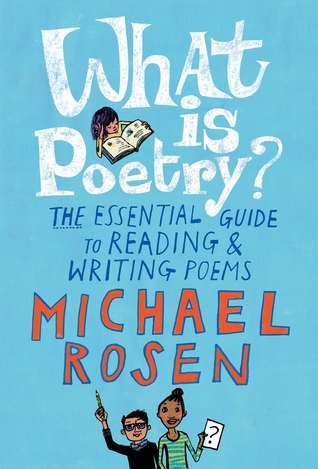
What Is Poetry?

What is Poetry? The Essential Guide to Reading and Writing Poems. Michael Rosen. Illustrated by Jill Calder. 2019. Candlewick Press. 208 pages. [Source: Library]

First sentence from the introduction: Poetry belongs to all of us; everyone can read poems, make up poems, or share poems with others.

First sentence from chapter one: A poem is a poem if the writer and the reader agree it's a poem. But people don't always agree, and when they argue about it, they try to find some special things about poetry that you can't find in other kinds of writing.

Premise/plot: This lovely little book is divided into seven chapters: "What Is Poetry?", "What Can You Do With a Poem?", "My Thoughts as I Was Writing Some Poems," "Ways To Start A Poem," "Writing Poems," "Some Technical Points About Poems," "So What Is Poetry?".

The first chapter should really be named "What Can Poetry Do?" Rosen sets out to illustrate what poems can do. It's show and tell time with poetry. He'll introduce a poem--often a classic--and then write out the thinking process as it's read and reread. He showcases a poem for each point.
  • Poetry Can Suggest Things
  • Poetry Can Give an Impression
  • Poetry Can Play with Words
  • Poetry Can Be Symbolic
  • Poetry Can Be Personal
  • Poetry Can Borrow Voices
  • Poetry Can Capture A Moment
  • Poetry Can Be Ironic
  • Poetry Can Make New Sense
  • Poetry Can Make Familiar Things Feel Unfamiliar and Unfamiliar Things Feel Familiar
Perhaps the list isn't exhausting or comprehensive. But it's a great beginning.

The second chapter is just as valuable and practical as the first. It asks not 'What Can Poetry Do?' but 'What can YOU do with a Poem?' He begins with the obvious, 'read it,' but the list is longer than you might think. I love what he has to say about memorizing poems:
"People say that it's important to memorize poems. I think differently. I reckon it's important only when it's important to you. So if you love a poem, you might want to learn it by heart." (83)
I also love his conclusion:
"In fact, you can do anything you want with a poem. You can ignore it, forget it, decide you don't like it--or leave it for fifty years and rediscover it later." (88)
If chapter one gives readers a behind the scenes glimpse of how Rosen reads poems, then chapter three gives readers a behind the scenes glimpse of how Rosen WRITES poems. He shares one of his own poems and then shares his thoughts on the writing of it.

Chapters four and five are about WRITING poems--some tips and suggestions on how readers can write their own poems.

Chapter six includes some 'technical' details about poems. A traditional approach to teaching poetry might have started with this chapter. Rhythm and Rhyme. Alliteration. Assonance. Metaphor. Simile. Metonymy. Personification. Persona. Allusion.

Chapter seven is BLANK essentially. It gives readers blank pages to answer the question for themselves...what is poetry?

My thoughts: I really thought this was a great little introduction to a subject often thought to be super-intimidating. Poetry doesn't have to be intimidating, overwhelming, scary. Poetry can be FUN, delightful, memorable. I love how we get to see poetry from all sides. I really loved some of the chapters. I can't say that I loved all the chapters equally. Some of his examples were a bit difficult to understand. BUT Rosen gives his readers permission to not understand, to dislike or hate, to skip.


© 2019 Becky Laney of Becky's Book Reviews

Wednesday, January 02, 2019

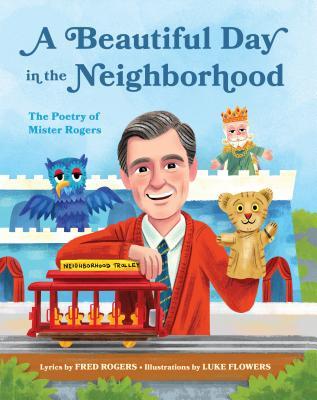
A Beautiful Day in the Neighborhood

A Beautiful Day in the Neighborhood: The Poetry of Mister Rogers. Illustrated by Luke Flowers. 2019. [March] Quirk. 144 pages. [Source: Review copy]

First sentence: 
Won't You Be My Neighbor
It's a beautiful day in this neighborhood
A beautiful day for a neighbor.
Would you be mine?
Could you be mine?
Premise/plot: Quirk is publishing the poetry of Mister Rogers. I'll give you a moment or two to squeal. Most of the pieces are by Fred Rogers. But quite a few are by Josie Carey with the music being by Fred Rogers. These poems--or lyrics if you prefer--are noted as such. The book contains pieces that you'd expect: "Won't You Be My Neighbor," "Everything Grows Together," "Many Ways To Say I Love You," "You Are Special," "I'm Proud of You," "It's You I Like," and "What Do You Do With the Mad That You Feel." But it also contains pieces that you've likely unfamiliar with. The songs that I did not know sometimes offered the most poetic food for thought.

I do not believe the book contains every poem--or song--by Mister Rogers. I can think of a handful it doesn't seem to include. (For example, "I'm Taking Care of You," "Look and Listen," "Peace and Quiet," "One and One are Two," "Everybody's Fancy."

This site seems to have a thorough listing of all the songs--including the ones from the operas

My thoughts: I LOVED this one. I especially loved the illustrations that were connected with Mister Rogers' Neighborhood. For example, the illustration that goes with "It's You I Like" shows Mr. Rogers singing with a boy in a wheel chair. Adults most likely will make the connection to a very memorable episode. I'm not sure if children will be as familiar with the show. But whether your little one knows the shows or not--the words have a way of speaking for themselves. Some of them are timeless and WONDERFUL.

Excerpts from some of my favorites.
It's Good To Talk
People weren't born to be silent
Our tongues make wonderful sounds.
Just try a few phrases for practice
You'll see there are very few bounds.
Things Are Different
You never know the story
By the cover of the book.
You can't tell what a dinner's like
By simply looking at the cook.
Sometimes Isn't Always
Sometimes I DON'T feel like combing my hair.
I DON'T feel like washing my face sometimes.
Sometimes I DON'T feel like saying okay.
But sometimes isn't always.
Are You Brave?
Are you brave and don't know it?
Are you brave and can't tell?
Are you brave and just don't show it?
While others know it very well?
Are you brave and you wonder?
Are you brave and you doubt?
Then Your Heart Is Full of Love
Love is fragile as your tears.
Love is stronger than your fears.
When your heart can sing another's gladness
Then your heart is full of love.
When your heart can cry another's sadness
Then your heart is full of love.

© 2019 Becky Laney of Becky's Book Reviews

Tuesday, March 20, 2018

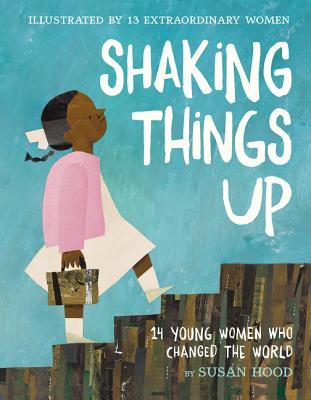
Shaking Things Up

Shaking Things Up: 14 Young Women Who Changed the World. Susan Hood. Illustrated by Selina Alko, Sophie Blackall, Lisa Brown, Hadley Hooper, Emily Winfield Martin, Oge Mora, Julie Morstad, Sara Palacios, LeUyen Pham, Erin K. Robinson, Isabel Roxas, Shadra Strickland, and Melissa Sweet. 2018. HarperCollins. 40 pages. [Source: Library]

Premise/plot: Shaking Things Up is a nonfiction (biographical) poetry book celebrating remarkable women past and present. The fourteen women included are Molly Williams (first known female firefighter in the U.S.), Mary Anning (paleontologist), Nellie Bly (journalist), Annette Kellerman (athlete and designer/inventor of the modern swimsuit), Pura Belpre (Latina author/librarian), Frida Kahlo (artist), Jacqueline and Eileen Nearne (secret agents), Frances Moore Lappe (anti-hunger activist/author), Ruby Bridges (civil rights pioneer), Mae Jemison (first African American astronaut), Maya Lin (architect and sculptor), Angela Zhang (scientist and cancer researcher), Malala Yousafzai (youngest winner of the Nobel Peace Prize).

Each spread includes a biographical poem and is illustrated by a different artist. Just as there is variety in the women highlighted in the book, the poems are written in a variety of styles or forms.

My favorite poem:
TURNING THE TIDE
There once was a mermaid queen,
lovely and lithesome and lean,
who swam afternoons
without pantaloons--
her swimsuit was deemed obscene!
The lady was quickly arrested.
Unafraid, she calmly protested:
Who can swim fifty laps
wearing corsets and caps?
Her statement could not be contested.
She streamlined the suit of the day
and invented our water ballet.
By changing the fashions
she fueled swimming passions
as women made waves in the spray. (15)
My thoughts: I really loved this one overall! Some of the women were completely new to me. I was glad that the back matter included a suggested reading list for each woman. I would recommend this one to anyone who enjoys nonfiction OR poetry OR inspirational reads in general.

Text: 5 out of 5
Illustrations: 4 out of 5
Total: 9 out of 10

© 2018 Becky Laney of Becky's Book Reviews

Wednesday, June 21, 2017

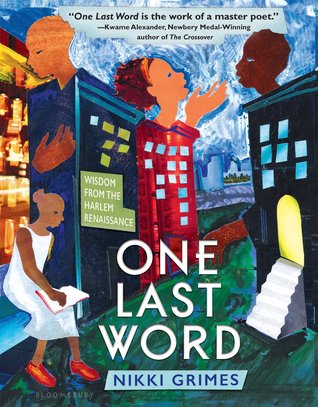
One Last Word

One Last Word. Nikki Grimes. 2017. Bloomsbury. 128 pages. [Source: Library]

First sentence: I was thirteen years old when I read my poetry aloud in front of an audience for the first time.

Premise/plot: Nikki Grimes shares some of her favorite poems from the Harlem Renaissance in her newest book. After sharing the original poem, she follows it with one of her own. All of Grimes' poems are written in the poetry form Golden Shovel.
The idea of a Golden Shovel poem is to take a short poem in its entirety, or a line from that poem (called a striking line), and create a new poem, using the words from the original.
The framework for this poetry collection is a brother and sister discouraged by watching the news come to find hope and inspiration from reading poetry from the Harlem Renaissance. The introductory poem asks, "Can I really find fuel for the future in the past?" In the last poem, we return to the framework. He has found his answer: "The past is a ladder that can help you keep climbing."

The collection includes poems from Gwendolyn Bennett, Countee Cullen, William Waring Cuney, Paul Laurence Dunbar, Langston Hughes, Georgia Douglas Johnson, Clara Ann Thompson, and Jean Toomer. (Biographies for each poet can be found in the back matter.) Each poem features an illustration. So many illustrators contributed to this book.

My thoughts: I really LOVED, LOVED, LOVED this one. I was unfamiliar with the Golden Shovel form before picking this one up, but, WOW what an incredible idea. I imagine it is very challenging yet extremely satisfying to write. I loved the poems Grimes shared. I was familiar with some of these poets, but, not all of them. I think I'll have to seek out more Georgia Douglas Johnson. I also loved Grimes' new poems. What this collection does really well is show how timeless poetry is, and how relevant it remains in our lives.

If you read only one poetry book this year, I'd recommend it be this one. It's SO good.

© 2017 Becky Laney of Becky's Book Reviews

Saturday, April 08, 2017

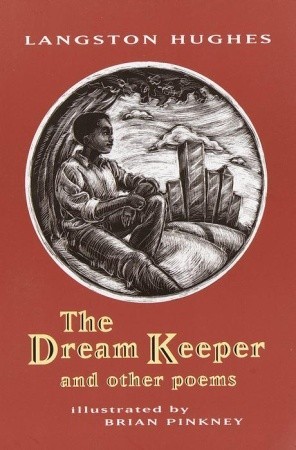
The Dream Keeper and Other Poems

The Dream Keeper and Other Poems. Langston Hughes. 1996. 96 pages. [Source: Library]

First sentence: Bring me all your dreams, You dreamers, Bring me all of your Heart melodies That I may wrap them In a blue cloud-cloth Away from the too-rough fingers Of the world.

Premise/plot: This is an anniversary edition of a collection of Langston Hughes poems originally published in 1932. It is illustrated by Brian Pinkney. The poems are divided into sections: The Dream Keeper, Sea Charm, Dressed Up, Feet o' Jesus, Walkers with the Dawn, and Additional Poems.

My thoughts: I didn't love all sections equally. (Sea Charm has to be my least favorite section.) I did love the sections The Dream Keeper and Dressed Up. Walkers with the Dawn also had some truly memorable poems. The poem you most likely know--perhaps even have memorized is--I, Too which begins: I, too, sing America. I am the darker brother.

Poem
I loved my friend.
He went away from me.
There's nothing more to say.
The poem ends,
Soft as it began--
I loved my friend. (12)
Other favorites:
  • Fairies
  • Song
  • My People
  • I, Too
From Song:
Open wide your arms to life,
Whirl in the wind of pain and strife,
Face the wall with the dark closed gate,
Beat with bare, brown fists--
And wait. (29) 

© 2017 Becky Laney of Becky's Book Reviews

Sunday, February 12, 2017

Freedom Over Me

Freedom Over Me: Eleven Slaves, their Lives and Dreams Brought to Life. Ashley Bryan. 2016. 56 pages. [Source: Library]

First sentence: I mourn the passing of my husband, Cado Fairchilds. He managed our estate alone. Eleven Negro slaves, they carried out the work that made our estate prosper.

Premise/plot: After the death of her husband, Mrs. Fairchilds decides to sell her estate--all of her estate including eleven slaves--and return to Britain. The eleven slaves were: Peggy, John, Athelia, Betty, Qush, Jane, Stephen, Mulvina, Bacus, Charlotte and Dora.

What you should know: Ashley Bryans, the author and illustrator, was inspired to write this picture book by slave documents he'd acquired. This estates appraisal dates from 1828. This picture book is written almost exclusively in verse. The book begins with Mrs. Fairchilds poem, her reasoning as to why she's selling the slaves and leaving the South. The remaining poems are all from the point of view of the eleven slaves. Each slave gets two poems. One poem for how things are; one poem for their dreams, how they want things to be.

From John:
Secretly, Stephen and Jane
are teaching me to read and write.
They say, "We'll be free one day!
And you will teach others."
My thoughts of escaping
to freedom
grow stronger every day.
Oh Freedom, Oh Freedom,
Oh Freedom over me!
From John Dreams:
I plan one day
to draw freely
from free Negro people.
I will create
loving portraits
of their strength
and beauty.
 You should also know that this is a Newbery Honor book, a Coretta Scott King Author Honor book, a Coretta Scott King Illustrator Honor book.

My thoughts: Freedom Over Me is worth reading no matter your age. (By that I mean you're never too old to read a 'children's book.' You can definitely be too young for a book, but never too old.) It would pair well with Julius Lester's Day of Tears--if memory serves--or his To Be A Slave. This is such compelling, emotional book.

© 2017 Becky Laney of Becky's Book Reviews

Saturday, February 11, 2017

Garvey's Choice

Garvey's Choice. Nikki Grimes. 2016. 120 pages. [Source: Library]

First sentence: When I was seven/ and crazy for Mr. Spock,/ a Star Trek lunch box/ was all I craved. Instead, Dad/ bought one blaring the logo/ of some football team/ I'd never heard of./ I shoved that thing in/ the coal black of my closet,/ then celebrated with cake.

Premise/plot: Garvey's Choice is a verse novel. (The verse is written in tanka.) Garvey is an overweight teen who'd much rather sing or read than play sports. There exists between father and son a gap that nothing seems to fill. At least at first. Garvey tries--unsuccessfully--to fill this gap with food. Garvey's dad may talk about sports--a lot--but I don't get the impression that he's actually cruel to his son. The two just aren't speaking the same love languages.

My thoughts: In the novel, Garvey makes several choices. Will he choose to try out for chorus and risk rejection or humiliation? He ultimately decides that he has nothing to lose and everything to gain. After all, he's already being teased by his classmates; he's already hating lunch time. What he finds out is that he's really talented at singing; and his singing not only makes him happy in the process, but makes others happy too. That and he makes a second friend. Another choice he makes regards his weight. Will he try to lose weight? Should he try to lose weight? How should he go about it? What can he change in his life to be healthier and happier?

This aspect of the verse novel was a bit iffier for me. I hated to see him get in the cycle of dieting in unhealthy ways, ways that are doomed to fail. I was yelling DON'T DO IT. JUST DON'T. I think the verses are authentic in that many, many, many, many people turn to food as a way to deal with emotions they don't know how to handle any other way. It's not the best way perhaps, but it is the easy way. I liked how singing took the place of food in some ways as a way to cope with the ups and downs of life.

One of the songs mentioned throughout the book is "Dance with My Father." I encourage you to give it a listen if you pick this one up.

One of my favorite poems: "Summer Lost and Found"
Stories are breadcrumbs.
Just follow the trail of books
and you will find me
lost among the galaxies
of scorched stars and ships to Mars. (4)
And here's another: "Alien"
Over breakfast, Dad
eyes me like an alien
never seen before.
Sometimes, I could swear that he's
hoping to make first contact. (17) 

© 2017 Becky Laney of Becky's Book Reviews

Monday, September 28, 2015

Jump Back, Paul

Jump Back, Paul: The Life and Poetry of Laurence Dunbar. Sally Derby. Illustrated by Sean Qualls. Candlewick Press. 128 pages. [Source: Review copy] 

It had me at hello.
You never heard of the poet Paul Laurence Dunbar? Child, where've you been? I got to have a word with you. Why, back in the day, you'd have whole families sitting around listening while one of them performed "When Malindy Sings" or "Little Brown Baby" or "A Negro Love Song" (which folks most always call "Jump Back, Honey").
Within a page or two, I was just fascinated with the book, with the story, with the narrator, and just HAD to keep reading. I wasn't expecting to find a book about a poet compelling, honestly. But this is a well-crafted narrative.
Readers learn about Paul Laurence Dunbar. Readers get the opportunity to read many of his poems. And that opportunity comes within the context of learning about his life. And I think, in part, that is why it is so compelling. It isn't just "here kid, read some poems." Far from it, readers have all they need--in my opinion--to understand and appreciate the poems. Readers are given a taste only, just enough to make you want more.

I really enjoyed this one. I'm not sure what I enjoyed most: learning about the poet, OR, reading the poems. I think both elements work well together. I think if readers had the biography without the poems, it would fall short. And I think the reverse is also true. Without knowing his life story, the times in which he lived, what mattered and why, the poems lose something--especially with so young an audience.

© 2015 Becky Laney of Becky's Book Reviews

Saturday, March 28, 2015

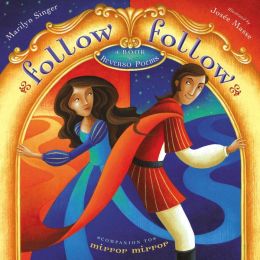
Follow Follow (2013)

Follow  Follow. A Book of Reverso Poems. (Companion to Mirror Mirror) Marilyn Singer. Illustrated by Josee Masse. 2013. Penguin. 32 pages. [Source: Library]

I loved, loved, LOVED reading Marilyn Singer's Follow Follow. If you love fairy tales, you MUST read Follow Follow. If you love good poetry, you MUST read Follow Follow. If you're new to reverso poems, to the concept of this form of poetry, you should really read Follow Follow or its companion Mirror Mirror. I love how the form itself is so engaging. It takes poetry to a whole new level for me! (It may do the same for you. I hope it does!)

Author's note:
The reverso, a form I created, is made up of two poems. Read the first down and it says one thing. Read it back up, with changes only in punctuation and capitalization, and it means something completely different. When you flip the poem, sometimes the same narrator has a different point of view. Other times, there is another narrator all together.
The poems:
  • Your Wish Is My Command (Aladdin)
  • Birthday Suit (The Emperor's New Clothes)
  • Silly Goose (The Golden Goose)
  • Ready, Steady, Go (The Tortoise and the Hare)
  • Will the Real Princess Please Stand Up (The Princess and the Pea)
  • The Little Mermaid's Choice (The Little Mermaid)
  • Panache (Puss in Boots)
  • Follow Follow (The Pied Piper)
  • No Bigger Than Your Thumb (Thumbelina)
  • Can't Blow This House Down (The Three Little Pigs)
  • The Nightingale's Emperor (The Nightingale)
  • On With The Dance (The Twelve Dancing Princesses)
I think I LOVED almost all of the poems. There were a few that I LOVED, LOVED, LOVED however.

The Little Mermaid's Choice

For love,
give up your voice.
Don't
think twice.
On the shore,
be his shadow.
Don't
keep your home
in the unruly sea.
Be docile.
You can't
catch him
playing
"You'll never catch me!"

You'll never catch me
playing
"Catch him."
You can't
be docile
in the unruly sea.
Keep your home.
Don't
be his shadow
on the shore.
Think twice!
Don't
give up your voice
for love.

Reading these poems is just a JOY. I love how engaging it is. How it makes you think and reflect on the familiar stories. I love how the poems play around with voice and perspective!!! So very clever!

Read this book!!!


© 2015 Becky Laney of Becky's Book Reviews