


Have you seen the new Narnia covers yet? They're illustrated by David Wiesner. The covers (link shows the covers BIG) are sparking some interesting discussions in the blog world including this great article by Bookslut. "Weisner’s a superb illustrator, but the Narnia books, with their weird pagan/Christian allegories, pocketknife-carrying children, and genuine moments of terror, are a poor match for him. It appears that a whole new generation of children will be traumatized by bad cover art -- much as I was, as a tender youth, by the disembodied lion’s head on the cover of the '70s paperback edition of Wardrobe sequel The Horse and His Boy. Beloved book, regrettable cover. These are the tragic intersections that beget design critics." I'm not one that is opposed to change just because it's change. After all, these books have seen many covers come and go through the years. Many styles. Many tones. Many moods. I've read the books in various covers. I'm not necessarily attached to any one of them. I would actually if picking a list of my 'favorites' probably mix and match a set between the various illustrators. (Okay, maybe that's not exactly true. I'll let you know my real favorite later on.) My point is that there is not one "right" way for Narnia to be depicted. Though there can probably be concensus on how it shouldn't be done.
 I was introduced to Narnia by my fourth grade teacher. A formidable woman under most circumstances. But I will always, always appreciate her for the fact that she read The Lion, the Witch, and The Wardrobe aloud to her class. The set of books that I got soon afterwards were the aforementioned paperbacks from the seventies. I devoured the series. My sister and I shared them, though I was the biggest fan by far. We added a few more copies now and then when we saw them at the used bookstore or a garage sale. You can never have too many copies of a favorite. Especially when they're paperback to begin with. So I was familiar with Pauline Bayne's cover of The Lion, The Witch, and the Wardrobe as a child. It had a completely different mood. It depicted children gayly playing--leaping, skipping, and dancing around the lion. It is springtime. Not winter. It's happy, yes. But it doesn't really let you know that the book is about the struggle of good and evil. It has no dark overtones. There is no oppression.
 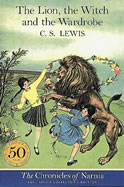 But the art is nice. She was the first. Some might argue that she was the best. She is the one who illustrates the stories inside the books after all. Pauline attended the Slade School of Fine Art, where her sister was completing a diploma course, but after only a year she volunteered to work for the Ministry of Defence, painting camouflage. However, since her kind of attention to detail and accuracy were skills essential for map-making, she was soon transferred to another department to draw maps. This experience was very helpful when she later drew maps of Narnia for Jack, and of Middle-earth for his friend J.R.R. Tolkien. Over the years Pauline Baynes has created many new illustrations for use on book jackets, as well as colouring the original illustrations. In addition, in 1989, she made a series of full-page colour paintings for two books, one called The Land of Narnia, and the other a beautiful, deluxe version of The Lion, The Witch and The Wardrobe. She was awarded the prestigious Kate Greenaway Medal in 1968 in recognition of her outstanding contribution to children's illustration.
I do like the fact that she drew the maps for both Narnia and Middle-earth. But if I had to pick a favorite and best illustrator for Narnia it would be the series of covers done by Chris Van Allsburg. They're beautiful. They're moody. They're practically perfect in every way.


To see the various covers for each one:
The Lion The Witch and the Wardrobe
Prince Caspian
Voyage of the Dawn Treader
Silver Chair
Horse and His Boy
Magician's Nephew
The Last Battle
That being said, I really love Wiesner's version of Voyage of the Dawn Treader. I love the depiction of Eustace as a dragon--a weeping dragon. It is perfect for the book. I also enjoy his cover for The Silver Chair.
I continue my discussion at Reading with Becky. I plan to do this with each one of the series. Today is The Lion The Witch and The Wardrobe.
More of the seventies versions:


I don't think any of the others come close to the "traumatizing" nature of these. It's amazing that anyone would pick them up and read them unless they already knew what treasure awaited them inside. They definitely don't say "read me."


