Wednesday, March 07, 2012

Black Duck

Black Duck. Janet Taylor Lisle. 2006. Penguin. 252 pages.

A rumrunner had lived in town, one of the notorious outlaws who smuggled liquor during the days of Prohibition, that was the rumor. David Peterson heard he might still be around. Where? No one knew exactly. It was all so long ago. Well, who was he? This was equally vague. Someone said to ask at the general store across from the church. It would be a miracle if the man was still alive, David thought. He'd be over eighty. If he were anywhere, he'd probably be in a nursing home by now. But it turned out he wasn't. He still lived in town. Ruben Hart was his name. 

Yesterday, I reviewed Bootleg: Murder, Moonshine, and the Lawless Years by Karen Blumenthal. Reading that fascinating nonfiction book on prohibition led me to indulge in a reread. Black Duck is a historical novel that I just LOVE!!! It is a novel with a framework structure.

Our young hero, David, wants to be a reporter or journalist. (He definitely does not want to limit himself to working for his father's landscaping/yard business.) He needs a good story, a BIG story. So he follows a lead and meets Ruben Hart. He's hoping to find out more about the Black Duck, a ship that was almost legendary--at least locally--during prohibition. It was one of many, many ships that carried bootleg liquor, landing and unloading secretly, of course. Throughout the novel there are newspapers clippings telling the fate of the Black Duck, of the three crew members who died that night it was apprehended by the Coast Guard. There were so many--especially when it first happened--that thought it was murder, that it was a set-up. That someone informed the Coast Guard telling them exactly, exactly where to find the Black Duck. That the Coast Guard shot without any warning, shot at an unarmed ship--or unarmed crew. David definitely feels there is a story to be told, to be uncovered. But will Ruben Hart share it with him?

Most of the novel is set in 1929 in a coastal Rhode Island town. Readers meet Ruben and his best friend Jeddy McKenzie on the day they discover a dead man on the beach. A well-dressed man that had been shot in the neck. They also discover a crate...among other things. They do report the discovery to the police--Jeddy's father is the Chief. But the police seem hesitant to investigate the crime. The boys aren't quite sure if this is the deputy's fault (Charlie Pope) or the Chief's fault. Or perhaps there is someone higher up who doesn't want this death, this murder, to become publicly known. The two are told to be quiet, to keep silent about what they saw. But some things can't be hushed up. The day becomes significant--at least in retrospect--because it was the day that Ruben first started keeping secrets from Jeddy, the day that Ruben first started doubting his friend's loyalty to him--to keeping secrets. Ruben starts to believe that Jeddy will report back to his father, to the police. So he chooses to keep what he's learned, what he's observed, to himself.

This is also a time when Ruben starts questioning everything, starts questioning what is right and what is wrong. If bootlegging is providing much-needed money to families, is it really that evil? These aren't criminals. These are hardworking men, of all ages, who have lived in poverty for so long, who have always struggled just to provide basic necessities for their families, so is it really that wrong for these men to help unload these illegal shipments? Isn't there a difference between murdering mobsters and the simple people caught up in this mess?

So Black Duck is the coming-of-age story of Ruben Hart AND it is the coming-of-age story of David Peterson. It is a novel about families, of the struggles a father and son can go through. It is a novel about friendships and how tricky they can be. I loved seeing Ruben and David's relationship develop through the interview.

Read Black Duck

  • If you like historical fiction
  • If you like historical fiction set during this time period (1920s)
  • If you are interested in a fictional account of prohibition, bootlegging, and gangsters
  • If you like inter-generational stories
  • If you like coming-of-age stories

© 2012 Becky Laney of Becky's Book Reviews

Tuesday, March 06, 2012

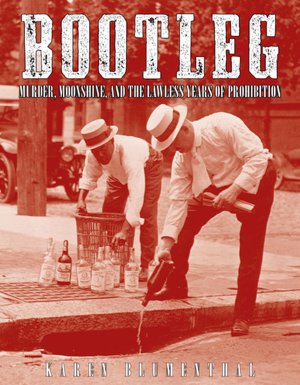
Bootleg: Murder, Moonshine, and the Lawless Years of Prohibition

Bootleg: Murder, Moonshine, and the Lawless Years of Prohibition. Karen Blumenthal. 2011. Roaring Brook Press. 155 pages.

Sometime after 10 A.M. on this shivery cold and windy Chicago morning, seven men gathered in a nondescript garage warehouse on Clark Street.

I'll never be able to do this book justice. I don't think I can adequately convey just how fascinating and engaging and completely interesting this nonfiction book is! Would you believe me when I say that the narrative is just that good that you lose yourself?

I knew this book was for me from the start. The opening paragraphs brought to mind one of my favorite movies--Some Like It Hot. And from there the magic continued. Readers learn about the history of alcohol in the United States, from the colonial days until the beginning of the twentieth century. Readers learn a little bit about saloons and why they weren't especially well-liked by women. And they learn about a couple of groups that formed to response to the problems they saw in society. Men and women who felt the nation--as a whole--had a problem with alcohol. Men and women who thought that the removal of alcohol would lead to the removal of other problems as well. They wanted better men and women. They wanted stable homes, stable lives. The early chapters of the book cover the eighteenth and nineteenth centuries. But most of the book is set during the years immediately following the first World War. In the years when groups were urging legislation through to dry up America. The book covers SO MANY things. And the way the story is conveyed is so engaging, so reader-friendly. I learned so much while reading it!!!

Read Bootleg: Murder, Moonshine, and the Lawless Years of Prohibition
  • If you enjoy engaging nonfiction narratives
  • If you're interested in learning more about the early twentieth century
  • If you're looking for nonfiction companion reads to books such as Moon Over Manifest and The Black Duck

© 2012 Becky Laney of Becky's Book Reviews

Monday, March 05, 2012

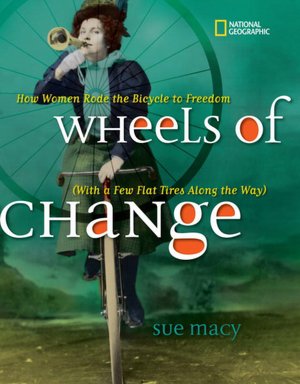
Wheels of Change

Wheels of Change: How Women Rode the Bicycle to Freedom (With a Few Flat Tires Along the Way). Sue Macy. 2011. National Geographic. 96 pages.

Sometime between May and November, 1876, Colonel Albert Augustus Pope took a trip that changed American life forever. 

Wheels of Change is a great little book! It is so well-written, so informative, so engaging! So what is the book about? Well, it's about how the introduction of the bicycle into American culture/society, changed the way women saw themselves, and how others saw them too. Bicycling was fun, yes, and it was physically challenging; but it was so much more than that. At a time when everyone assumed women were weak and mindless and needed to stay that way. Well, I exaggerate slightly, perhaps. But in terms of what women could do--inside or outside the home, in terms of what women could wear, in terms of where women could go, in terms of what kind of relationships and friendships women could have, etc. Forgetting the morality of it all, there were some that believed that women should not exert themselves physically at all. That any type of exercise at all could damage a woman's body or mind. But of course, morality does come into it. What kind of woman rides a bicycle? Who does she ride with? Does she ride on a bicycle built for two? What else is going on besides bike riding in these meetings? And a woman who wears bloomers?! Well, that has to say something about her moral character, right?!

As you can guess, this one is such a great little book. Each chapter is fascinating. And this one is designed so well! It is so reader-friendly. There are so many pictures, so many photographs, so many little asides...this one just says read me, read me, read me!
  • Chapter 1: Inventing the Bicycle
  • Feature: Celebrity Cyclists
  • Chapter 2: The Devil's Advance Agent
  • Feature: Cycling Slang
  • Chapter 3: Fashion Forward
  • Feature: Cycling Songs
  • Chapter 4: Fast and Fearless
  • Feature: The Cycling Press
  • Chapter 5: New Freedoms
  • Feature: Selling with Cycles
This one was well-researched. And I'd definitely recommend it!!!

Read Wheels of Change
  • If you love nonfiction
  • If you are interested in women's history
  • If you are interested in bicycling, the history of it
  • If you are interested in American history during the Victorian period


Women's Independence
Women's Liberation and the Bicycle
Courting with a Bicycle
New Bicycle Technology

© 2012 Becky Laney of Becky's Book Reviews
Sunday, March 04, 2012

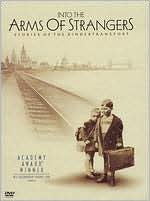
Sunday Salon: Into The Arms of Strangers (2000)

After reading Anne C. Voorhoeve's My Family for the War, I knew I had to find out more about kindertransport. I was quite happy to learn there was a documentary all about it, a documentary with interviews from many of the children who were transported safely--if not exactly happily--to England. (This film even won an Academy Award in 2001 for Best Documentary!!!)

A little bit more about kindertransport...
Great Britain agreed to permit Jewish children between the ages of 5 and 17 to come to the U.K. -- without their parents. Between December of 1938 and August of 1939, some 10,000 German children gained refuge in the U.K. Most were adopted by British families, and many of the older boys served in the British Army, fighting against the Nazis, but the majority were never to see their birth parents again.
Think about that. Really think about that. The choice of it all. To send your kids away to safety knowing that likely you'll not see them again because your own chances at survival are so very slim...or to keep your kids with you to the end and face death all together as a family. Not that there would be any guarantees that you'd be able to stay all together...as it turns out many families were separated in the camps. Husbands from wives. Parents from children. But still. It wasn't an easy choice for parents to make...or for children and teens to accept. The documentary talks about this a great deal.

Watch Into the Arms of Strangers
  • If you are interested in learning more about Kindertransport
  • If you are interested in learning more about the Nazi's treatment of Jews in the late 1930s and throughout the war, leading, of course, to the Holocaust
  • If you are interested in World War II
  • If you are looking for personal stories as a way to effectively share what this time period was really like (the Holocaust is about so much more than numbers)
  • If you enjoy great documentaries

© 2012 Becky Laney of Becky's Book Reviews
Saturday, March 03, 2012

Library Loot: First Trip in March

New Loot:
  • 11/22/63 by Stephen King
  • Midnight in Austenland by Shannon Hale
  • Explorers of the Nile: The Triumph and Tragedy of a Great Victorian Adventure by Tim Jeal
  • Graceling by Kristin Cashore
  • Fire by Kristin Cashore
  • 1001 Children's Books You Must Read Before You Grow Up, edited by Julia Eccleshare
  • 1001 Books You Must Read Before You Die edited by Peter Boxall

Leftover Loot:
  • The War to End All Wars: World War I by Russell Freedman  
  • The Invisible Bridge by Julie Orringer
  • The Great Influenza: The Epic Story of the Deadliest Plague in History by John M. Barry
  • All That I Am by Anna Funder
  • A Woman in Berlin: Eight Weeks in the Conquered City: A Diary by Anonymous
  • Dreamers of the Day by Mary Doria Russell
  • No Time to Wave Goodbye by Ben Wicks
  • Elsie and Mairi Go To War: Two Extraordinary Women on the Western Front by Diane Atkinson
  • The Cult of LEGO by John Baichtal, Joe Meno
Library Loot is a weekly event co-hosted by Claire and Marg that encourages bloggers to share the books they’ve checked out from the library. If you’d like to participate, just write up your post-feel free to steal the button-and link it using the Mr. Linky any time during the week. And of course check out what other participants are getting from their libraries.    
 

© 2012 Becky Laney of Becky's Book Reviews