5 Stars
The Monster At The End of This Book. Jon Stone. Illustrated by Michael
J. Smollin. 1971. Golden Books. 32 pages. [Source: Bought]
Sherlock Chick's First Case. Robert M. Quackenbush. 1986/2019. 48 pages. [Source: Library]
The Tempest. William Shakespeare. 1623. 127 pages. [Source: Bought]
Eyes Like Stars. Theatre Illuminata #1) Lisa Mantchev. 2009. 352 pages. [Source: Library]
4 Stars
Where's The Astronaut. Nosy Crow. Illustrated by Ingela P Arrhenius. Candlewick Press. 10 pages. [Source: Review copy]
Perchance to Dream. Lisa Mantchev. 2010. 341 pages. [Source: Library]
© 2019 Becky Laney of Becky's Book Reviews
Saturday, May 04, 2019
Friday, May 03, 2019
Birdie
Birdie. Eileen Spinelli. 2019. 208 pages. [Source: Library]
First sentence: I pick the hairs from my brush. I put them in my pocket. I will drop them on the grass on my way to Mrs. Bloom's. I do this every Saturday.
Premise/plot: Birdie Briggs is mourning her father (who was a fireman), crushing on her friend, Martin, and wishing--in vain--that life wouldn't be so quick to go on. Why does her Mom need a boyfriend?! Her Grandma also has a new boyfriend in this one. BUT. Birdie welcomes that relationship and the joy it brings Maymee. Life is full of complications.
My thoughts: Birdie Briggs is a bird-loving, Scrabble player. I like her. I do. The book is a quick, often sweet read. If I have a complaint it is that this one is a verse novel that doesn't really need to be a verse novel. Does that make sense? There is nothing lyrical or poem-like about these "verses." The poetic form adds nothing to the story. The book is prose trying to play dress up and be something its not: poetry.
But the story is a good one. I liked it.
© 2019 Becky Laney of Becky's Book Reviews
First sentence: I pick the hairs from my brush. I put them in my pocket. I will drop them on the grass on my way to Mrs. Bloom's. I do this every Saturday.
Premise/plot: Birdie Briggs is mourning her father (who was a fireman), crushing on her friend, Martin, and wishing--in vain--that life wouldn't be so quick to go on. Why does her Mom need a boyfriend?! Her Grandma also has a new boyfriend in this one. BUT. Birdie welcomes that relationship and the joy it brings Maymee. Life is full of complications.
My thoughts: Birdie Briggs is a bird-loving, Scrabble player. I like her. I do. The book is a quick, often sweet read. If I have a complaint it is that this one is a verse novel that doesn't really need to be a verse novel. Does that make sense? There is nothing lyrical or poem-like about these "verses." The poetic form adds nothing to the story. The book is prose trying to play dress up and be something its not: poetry.
VisitorThere are legitimate verse novels. Where the verse is actually verse--where the words, the phrases, the sentences are lyrical.
There are actually
two visitors:
Officer Downey and
Mr. Gray's cat, Olive.
Maymee gives a squeak
of surprise.
Officer Downey
explains.
But the story is a good one. I liked it.
© 2019 Becky Laney of Becky's Book Reviews
Thursday, May 02, 2019
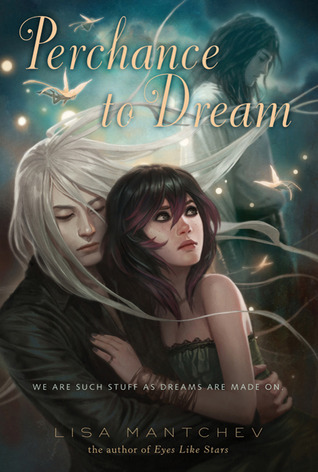
Perchance to Dream
Perchance to Dream. Lisa Mantchev. 2010. 341 pages. [Source: Library]
First sentence: "It is a truth universally acknowledged," Mustardseen said, flying in lazy loops like an intoxicated bumblebee, "that a fairy in possession of a good appetite must be in want of a pie."
Premise/plot: Bertie Shakespeare Smith has left the Theatre. Accompanying her are her best fairy friends (Peaseblossom, Cobweb, Moth, and Mustardseed) and her love interest, Ariel. Bertie is on a quest to save Nate, her other love interest. Nate was kidnapped by Sedna, the Sea Goddess, in the first book in the series Eyes Like Stars. But she's also on a quest to find her father. Bertie grew up not knowing WHO her father or her mother were. Now that she knows who her mother is, she wants to find her father too. She'd LOVE to find her father and convince him to return with her to the Theatre. But wanting something doesn't make it happen. Wishes don't work like that--even for a young woman realizing her own power. Bertie has a gift, a talent, with WORDS. This adventure-packed book has more misadventures than anything else. But Bertie is persistent...
My thoughts: Perchance to Dream was published a year before ONCE UPON A TIME premiered in 2011. Both Eyes Like Stars and Perchance To Dream have a very OUAT feel to them. Bertie is essentially THE AUTHOR. (This story line was from 2015). I suppose this observation is neither here nor there--it just is.
I liked Perchance to Dream. I love the characters in this one. I am very much Team Ariel. I am. It's not that I dislike Nate, but, he's just not the one for Bertie. In my opinion. I have a love/hate relationship with love triangles. I can't help that.
Quotes:
© 2019 Becky Laney of Becky's Book Reviews
First sentence: "It is a truth universally acknowledged," Mustardseen said, flying in lazy loops like an intoxicated bumblebee, "that a fairy in possession of a good appetite must be in want of a pie."
Premise/plot: Bertie Shakespeare Smith has left the Theatre. Accompanying her are her best fairy friends (Peaseblossom, Cobweb, Moth, and Mustardseed) and her love interest, Ariel. Bertie is on a quest to save Nate, her other love interest. Nate was kidnapped by Sedna, the Sea Goddess, in the first book in the series Eyes Like Stars. But she's also on a quest to find her father. Bertie grew up not knowing WHO her father or her mother were. Now that she knows who her mother is, she wants to find her father too. She'd LOVE to find her father and convince him to return with her to the Theatre. But wanting something doesn't make it happen. Wishes don't work like that--even for a young woman realizing her own power. Bertie has a gift, a talent, with WORDS. This adventure-packed book has more misadventures than anything else. But Bertie is persistent...
My thoughts: Perchance to Dream was published a year before ONCE UPON A TIME premiered in 2011. Both Eyes Like Stars and Perchance To Dream have a very OUAT feel to them. Bertie is essentially THE AUTHOR. (This story line was from 2015). I suppose this observation is neither here nor there--it just is.
I liked Perchance to Dream. I love the characters in this one. I am very much Team Ariel. I am. It's not that I dislike Nate, but, he's just not the one for Bertie. In my opinion. I have a love/hate relationship with love triangles. I can't help that.
Quotes:
- "Words are like the delicate stitches in the dress you wear, holding the fabric of the garment together. Without them, the dress and the world are nothing but barren cloth." (172)
- "I thought I had the chance to win your heart, but there's no way to compete against the idea of a man, something you've built up into a terrible fancy in that imagination of yours." (190)
© 2019 Becky Laney of Becky's Book Reviews
Labels:
2010,
books reviewed in 2019,
library book,
YA Fantasy,
YA Fiction,
YA Romance
Wednesday, May 01, 2019
The Tempest
The Tempest. William Shakespeare. 1623. 127 pages. [Source: Bought]
Miranda falls MADLY, DEEPLY in love with the first man she sees, Ferdinand. Fortunately, I suppose, he likewise falls in love with her. This union might be phase two of her father's master plan...
My thoughts: I really enjoyed reading William Shakespeare's The Tempest. It was a new-to-me Shakespeare play. (There are still a good many in this category). I found the play to be compelling and easy to follow--relatively. Yes, it has POLITICS and SCHEMING. But this is all handled in a back-story or info dump. (This info dump actually puts Miranda to sleep.)
There are a few characters in The Tempest that seem like they are unnecessary or superfluous--Caliban and the two drunkards--but perhaps these are solely for comedic effect which doesn't translate well when it is just read and not performed.
Quotes:
© 2019 Becky Laney of Becky's Book Reviews
Master: Boatswain!Premise/plot: Miranda has grown up on an island only knowing her father, Prospero, and Caliban, an unpleasant fellow, the son of a witch. She's in for quite a surprise when a shipwreck brings more people to the island. The shipwreck is no accident; it is the work of her sorcerer father, Prospero, aided by ARIEL. Prospero has a complex, master plan.
Boatswain: Here, master: what cheer?
Master: Good, speak to the mariners: fall to't, yarely, or we run ourselves aground: bestir, bestir.
Miranda falls MADLY, DEEPLY in love with the first man she sees, Ferdinand. Fortunately, I suppose, he likewise falls in love with her. This union might be phase two of her father's master plan...
My thoughts: I really enjoyed reading William Shakespeare's The Tempest. It was a new-to-me Shakespeare play. (There are still a good many in this category). I found the play to be compelling and easy to follow--relatively. Yes, it has POLITICS and SCHEMING. But this is all handled in a back-story or info dump. (This info dump actually puts Miranda to sleep.)
There are a few characters in The Tempest that seem like they are unnecessary or superfluous--Caliban and the two drunkards--but perhaps these are solely for comedic effect which doesn't translate well when it is just read and not performed.
Quotes:
MIRANDA If by your art, my dearest father, you have Put the wild waters in this roar, allay them.
[Enter ARIEL.] ARIEL All hail, great Master! grave sir, hail!
I come To answer thy best pleasure; be’t to fly, To swim, to dive into the fire, to ride On the curl’d clouds; to thy strong bidding task Ariel and all his quality.
MIRANDA I might call him A thing divine; for nothing natural I ever saw so noble.
MIRANDA Why speaks my father so ungently?
This Is the third man that e’er I saw; the first
That e’er I sigh’d for; pity move my father
To be inclined my way!
PROSPERO Soft, sir! one word more.
[Aside.] They are both in either’s powers: but this swift business
I must uneasy make, lest too light winning
Make the prize light.
MIRANDA There’s nothing ill can dwell in such a temple:
If the ill spirit have so fair a house,
Good things will strive to dwell with’t.
SEBASTIAN He receives comfort like cold porridge.
GONZALO It is foul weather in us all, good sir,
When you are cloudy.
SEBASTIAN I do: and surely
It is a sleepy language, and thou speak’st
Out of thy sleep.
What is it thou didst say?
This is a strange repose, to be asleep
With eyes wide open; standing, speaking, moving,
And yet so fast asleep.
SEBASTIAN Do so: to ebb, Hereditary sloth instructs me.
MIRANDA I am a fool
To weep at what I am glad of.
PROSPERO Our revels now are ended.
These our actors,
As I foretold you, were all spirits, and
Are melted into air, into thin air:
And, like the baseless fabric of this vision,
The cloud-capp’d towers, the gorgeous palaces,
The solemn temples, the great globe itself,
Yea, all which it inherit, shall dissolve
And, like this insubstantial pageant faded,
Leave not a rack behind.
We are such stuff
As dreams are made on, and our little life
Is rounded with a sleep.
MIRANDA O, wonder!
How many goodly creatures are there here!
How beauteous mankind is!
O brave new world
That has such people in’t!
© 2019 Becky Laney of Becky's Book Reviews
Labels:
1623,
adult classics,
books reviewed in 2019,
classic,
plays,
William Shakespeare
World at War: The Good Son
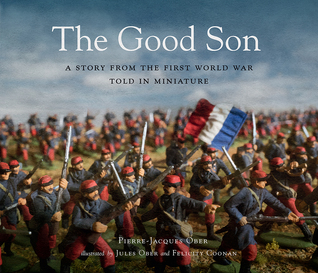
The Good Son: A Story From the First World War Told In Miniature. Pierre-Jacques Ober. Illustrated by Jules Ober and Felicity Coonan. 2019. Candlewick Press. 104 pages. [Source: Review copy]
First sentence: About one hundred years ago, the whole world went to war. The war was supposed to last months. It lasted years.
Premise/plot: The Good Son is set in France during the first world war. Pierre is a French soldier. Pierre wanting to be a good son decided to go home and visit his mother for Christmas--without permission. It was just two days. But those two days may just cost him his life. For in being a good son, his being a good soldier was called into question. As he awaits his fate he writes a letter home to his mother.
My thoughts: Don't be fooled by the format of this one. It may look like a picture book--its shape and size--but if ideas carried weight this one would weigh a ton. It is impossible to judge a book like The Good Son.
On one hand, it's visually wonderful. It is told in miniature and stars VINTAGE TOY SOLDIERS. The book is illustrated with PHOTOGRAPHS. Artistically one can't help celebrating its mastery. I'd be surprised if this one didn't earn STARS and ACCLAIM by critics.
It isn't just the art. The story is technically brilliant as well. I'm currently reading Les Miserables by Victor Hugo. If anyone knows how to slip in philosophy and BIG IDEAS into a fictional story it's Hugo. Ober makes a good, strong effort in The Good Son. Does war have a point? Is there such a thing as a good or just war? Is all war evil? What is it all for? What price does war cost us as humans? As I mentioned earlier, if ideas have weight, this one would weigh several hundred pounds.
On the other hand, The Good Son makes Jude the Obscure look like a bright, cheery, pep-you-up read. Or perhaps compare it to ANIMAL FARM. For being just 104 pages in length it packs in enough sorrow and despair for one hundred books. This book is bleak, dismal, dark, depressing. It packs a philosophical punch or two. But is it a punch readers can withstand?
© 2019 Becky Laney of Becky's Book Reviews
First sentence: About one hundred years ago, the whole world went to war. The war was supposed to last months. It lasted years.
Premise/plot: The Good Son is set in France during the first world war. Pierre is a French soldier. Pierre wanting to be a good son decided to go home and visit his mother for Christmas--without permission. It was just two days. But those two days may just cost him his life. For in being a good son, his being a good soldier was called into question. As he awaits his fate he writes a letter home to his mother.
My thoughts: Don't be fooled by the format of this one. It may look like a picture book--its shape and size--but if ideas carried weight this one would weigh a ton. It is impossible to judge a book like The Good Son.
On one hand, it's visually wonderful. It is told in miniature and stars VINTAGE TOY SOLDIERS. The book is illustrated with PHOTOGRAPHS. Artistically one can't help celebrating its mastery. I'd be surprised if this one didn't earn STARS and ACCLAIM by critics.
It isn't just the art. The story is technically brilliant as well. I'm currently reading Les Miserables by Victor Hugo. If anyone knows how to slip in philosophy and BIG IDEAS into a fictional story it's Hugo. Ober makes a good, strong effort in The Good Son. Does war have a point? Is there such a thing as a good or just war? Is all war evil? What is it all for? What price does war cost us as humans? As I mentioned earlier, if ideas have weight, this one would weigh several hundred pounds.
On the other hand, The Good Son makes Jude the Obscure look like a bright, cheery, pep-you-up read. Or perhaps compare it to ANIMAL FARM. For being just 104 pages in length it packs in enough sorrow and despair for one hundred books. This book is bleak, dismal, dark, depressing. It packs a philosophical punch or two. But is it a punch readers can withstand?
© 2019 Becky Laney of Becky's Book Reviews
Subscribe to:
Posts (Atom)