New Loot:
Nemesis: A Miss Marple mystery by Agatha Christie
Saint Training by Elizabeth Fixmer
Stargirl by Jerry Spinelli
Miles from Ordinary by Carol Lynch Williams
The Rumpelstiltskin Problem by Vivian Vande Velde
Like Sisters on the Homefront by Rita Williams-Garcia
The Mockingbirds by Daisy Whitney
Small Acts of Amazing Courage by Gloria Whelan
Joy in the Morning by Betty Smith
The Story of Beautiful Girl by Rachel Simon
Thrones, Dominations by Dorothy L. Sayers & Jill Paton Walsh
Cat Sitter on a Hot Tin Roof: A Dixie Hemingway Mystery by Blaize Clement
Duplicity Dogged the Dachshund: A Dixie Hemingway Mystery by Blaize Clement
Even Cat Sitters Get the Blues: A Dixie Hemingway Mystery by Blaize Clement
Just Being Audrey by Margaret Cardillo
Soar, Elinor! by Tami Lewis Brown
Leftover Loot:
Sleeping Murder: A Miss Marple mystery by Agatha Christie
A Pocket Full of Rye: A Miss Marple mystery by Agatha Christie
They Do it With Mirrors a Miss Marple mystery by Agatha Christie
The Mirror Crack'd from Side to Side: A Miss Marple mystery by Agatha Christie
Elephants Can Remember by Agatha Christie
Stay a Little Longer by Dorothy Garlock
Keep a Little Secret by Dorothy Garlock
A Presumption of Death by Jill Paton Walsh and Dorothy Sayers
The Attenbury Emeralds by Jill Paton Walsh
Oscar Wilde and a Game Called Murder by Gyles Brandreth
Raining Cat Sitters and Dogs: A Dixie Hemingway mystery by Blaize Clement
Cat Sitter Among the Pigeons: A Dixie Hemingway mystery by Blaize Clement
Library Loot is a weekly event co-hosted by Claire and Marg that encourages bloggers to share the books they’ve checked out from the library. If you’d like to participate, just write up your post-feel free to steal the button-and link it using the Mr. Linky any time during the week. And of course check out what other participants are getting from their libraries.
© 2011 Becky Laney of Becky's Book Reviews
Wednesday, June 15, 2011
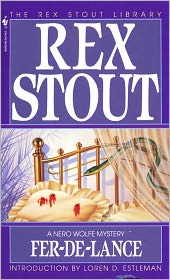
Fer-de-lance
Fer-de-lance. A Nero Wolfe Mystery. Rex Stout. 1934/1997. Random House. 304 pages.
There was no reason why I shouldn't have been sent for the beer that day, for the last ends of the Fairmont National Bank case had been gathered in the week before and there was nothing for me to do but errands, and Wolfe never hesitated about me running down to Murray Street for a can of shoe polish if he happened to need one. But it was Fritz who was sent for the beer.
Fer-de-lance is the first Nero Wolfe mystery. It introduces readers to two private detectives, Nero Wolfe, and Archie Goodwin. I'm tempted to add in two of the BEST DETECTIVES in the world. But, I suppose that's just my opinion!
In Fer-de-lance, Fred Durkin introduces a woman to Nero Wolfe, Maria Maffei. This woman is worried about her brother, Carlo Maffei, who has gone missing. Archie Goodwin is sent to investigate. First he interviews those in the boarding house where Carlo lived--those that overheard Carlo's phone conversation; he then looks at Carlo's room, goes through his room looking for clues. He learns from Miss Anna Fiore that Carlo often gave her his newspaper after he was finished with it. The newspaper she got that Monday afternoon had a big hole in it--an entire article had been cut out. Nero Wolfe wants to know what article it was Carlo took such an interest in. After discovering the article was about the death of a golfer, Peter Oliver Barstow, he becomes interested in that death. Soon after Carlo Maffei is no longer missing at all--his body has been found. Though there is no obvious reason to link the two deaths together, to investigate them at the same time--especially since Barstow's death has been accepted as natural--Wolfe is convinced that the two are related. That Barstow was murdered. That his body should be exhumed and tested for poison. He's convinced that finding the murderer of one will lead him to solving the other murder. Who killed Peter Oliver Barstow? Was it poison? Who had motive and opportunity? And did Carlo know it was murder? Did Carlo know who killed Mr. Barstow? Is that how he ended up dead?
So Archie and Nero have plenty of work to do, plenty of clues to follow!
I enjoyed Fer-de-lance. It was fun to read the first mystery in this series. Archie and Nero are great fun in this one. Their dialogue still satisfies me. It's just so delightful to spend time with these two!
Nero Wolfe:
Nero Wolfe:
Nero Wolfe:
Archie Goodwin:
Archie Goodwin:
Nero Wolfe and Archie Goodwin:
© 2011 Becky Laney of Becky's Book Reviews
There was no reason why I shouldn't have been sent for the beer that day, for the last ends of the Fairmont National Bank case had been gathered in the week before and there was nothing for me to do but errands, and Wolfe never hesitated about me running down to Murray Street for a can of shoe polish if he happened to need one. But it was Fritz who was sent for the beer.
Fer-de-lance is the first Nero Wolfe mystery. It introduces readers to two private detectives, Nero Wolfe, and Archie Goodwin. I'm tempted to add in two of the BEST DETECTIVES in the world. But, I suppose that's just my opinion!
In Fer-de-lance, Fred Durkin introduces a woman to Nero Wolfe, Maria Maffei. This woman is worried about her brother, Carlo Maffei, who has gone missing. Archie Goodwin is sent to investigate. First he interviews those in the boarding house where Carlo lived--those that overheard Carlo's phone conversation; he then looks at Carlo's room, goes through his room looking for clues. He learns from Miss Anna Fiore that Carlo often gave her his newspaper after he was finished with it. The newspaper she got that Monday afternoon had a big hole in it--an entire article had been cut out. Nero Wolfe wants to know what article it was Carlo took such an interest in. After discovering the article was about the death of a golfer, Peter Oliver Barstow, he becomes interested in that death. Soon after Carlo Maffei is no longer missing at all--his body has been found. Though there is no obvious reason to link the two deaths together, to investigate them at the same time--especially since Barstow's death has been accepted as natural--Wolfe is convinced that the two are related. That Barstow was murdered. That his body should be exhumed and tested for poison. He's convinced that finding the murderer of one will lead him to solving the other murder. Who killed Peter Oliver Barstow? Was it poison? Who had motive and opportunity? And did Carlo know it was murder? Did Carlo know who killed Mr. Barstow? Is that how he ended up dead?
So Archie and Nero have plenty of work to do, plenty of clues to follow!
I enjoyed Fer-de-lance. It was fun to read the first mystery in this series. Archie and Nero are great fun in this one. Their dialogue still satisfies me. It's just so delightful to spend time with these two!
Nero Wolfe:
"A pessimist gets nothing but pleasant surprises, an optimist nothing but unpleasant." (3)
Nero Wolfe:
"Some day, Archie, when I decide you are no longer worth tolerating, you will have to marry a woman of very modest mental capacity to get an appropriate audience for your wretched sarcasms." (54)
Nero Wolfe:
"People often find it difficult to think in my presence, I do not leave enough space." (96)
Archie Goodwin:
"Everything that the doctor could tell me I had read three days earlier in the newspapers except for a bunch of medical terms which the papers hadn't tried to print for fear of a typesetters' strike." (139)
Archie Goodwin:
"You know what my boss says? He says that skepticism is a good watchdog if you know when to take the leash off." (143)
Nero Wolfe and Archie Goodwin:
"Tell Fritz there will be guests at lunch. What do boys that age eat?"
"They eat everything."
"Tell Fritz to have that." (165)
© 2011 Becky Laney of Becky's Book Reviews
Labels:
1934,
adult fiction,
adult mystery,
book I bought,
mystery,
Rex Stout
CFBA: Pompeii
ABOUT THE AUTHOR:
A fiction aficionado since grade school, T.L. Higley, author of Pompeii: City on Fire (B&H Publishing House, June 2011) started her first novel at the age of eight.
Now the author of nine historical fiction novels, including the popular Seven Wonders series, Higley isn’t just transporting readers: She’s transporting herself, too.
“My Iifelong interest in history and mythology has taken me to Italy, Greece, Egypt, Rome, Turkey, Jordan and Israel, where I’ve gotten to study those ancient cultures in rich detail,” says Higley. “It’s my desire to shine the light of the gospel into the cultures of the past, and I figure what better way to do that than to visit the cultures themselves?”
In addition to her accomplished novelist career, Higley is a business entrepreneur and a mother. In fact, for Pompeii, she brought her daughter along with her to Italy for the research trip.
“We gave it to her as a graduation present, not only because Italy is terrific, but because I believe in exposing children to global cultures,” says Higley, who became a student herself again this year. She’s now a graduate student at American Public University, earning her master’s degree in Ancient and Classical Studies.
When Higley isn’t traveling on research trips, writing her novels, or studying for class, she operates four online retail companies, including KoolStuff4Kids.com – a family-run business that began as a way for her oldest daughter to make some extra money for camp. Today, it is a go-to site for parents, children and teachers all over the country, looking for beads and other kid-friendly craft supplies.
Higley lives with her husband and her three other children (aforementioned daughter now in college) just outside Philadelphia, Pennsylvania.
ABOUT THE BOOK
Pompeii, a city that's many things to many people. For Cato, it's the perfect escape from a failed political career in Rome. A place to start again, become a winemaker. But when a corrupt politician wrongfully jails Cato's sister, he must oust the man from power to save her.
For Ariella, Pompeii is a means to an end. As a young Jew, she escaped the fall of Jerusalem only to endure slavery to a cruel Roman general. She ends up in Pompeii, disguised as a young man and sold into a gladiator troupe. Her anger fuels her to fight well, hoping to win the arena crowds and reveal her gender at the perfect time. Perhaps then she will win true freedom.
But evil creeps through the streets of Pompeii. Political corruption, religious persecution, and family peril threaten to destroy Ariella and Cato, who are thrown together in the battle to survive. As Vesuvius churns with deadly intent, the two must bridge their differences to save the lives of those they love, before the fiery ash buries Pompeii, leaving the city lost to the world.
Watch the book trailer:
If you would like to read the Prologue of Pompeii, go HERE.
© 2011 Becky Laney of Becky's Book Reviews

Tuesday, June 14, 2011
Oscar Wilde and the Death of No Importance
Oscar Wilde and a Death of No Importance. Gyles Brandreth. 2007. Simon & Schuster. 368 pages.
From the prologue: My name is Robert Sherard, and I was a friend of Oscar Wilde. We met in Paris in 1883, when he was twenty-eight and already famous, and I was twenty-two and quite unknown. "You must not call me, 'Wilde,'" he said to me at that first encounter. "If I am your friend, Robert, my name to you is Oscar. If we are only strangers, I am Mr. Wilde." We were not strangers. Nor were we lovers. We were friends. And, after his death, I became his first--and his most faithful--biographer. I knew Oscar Wilde and I loved him.
I was curious about this mystery series starring Robert Sherard, Oscar Wilde, and Arthur Conan Doyle. The novel is set in 1889-1890, in London, for the most part. Oscar Wilde discovers the body of a young boy, Billy Wood, a male prostitute of his acquaintance. Wilde was his tutor, of course. This murder angers him and he turns to his friends, Robert and Arthur, for help. (Arthur, if I remember correctly, is a new acquaintance.) Arthur suggests that they go to his friend Inspector Aidan Fraser for help. Surely this Inspector of Scotland Yard will take on the case and see that justice is done. But sadly no, to everyone's surprise, Billy Wood's death just isn't "big enough" to investigate. But Oscar Wilde is determined and inspired by the fictional Sherlock Holmes, he decides to solve the case himself. He'll follow each and every clue, he'll get the help of some of his friends, and, using his logic and intuition, he'll solve the case. Robert, our narrator, is a little skeptical. How can Wilde solve this one? It's not like they even have a dozen clues to follow. Just a clean floor in a clean room and a missing body. Will that be enough?
I am not sure I liked this one. In fact, there were elements of this one that I didn't really like at all. It is one thing for a murder mystery to have clues hidden subtly and not-so-subtly throughout so that when the big reveal does happen, you feel like you should have seen it coming. Or to admit that though you didn't see it coming, it all makes perfect sense now that all the dots have been connected. But with this one...I don't know if surprise is a strong enough word. Even though Oscar Wilde was quite proud of himself for piecing it all together, even though his version of events, we're led to believe, proved true, I'm still unsatisfied. I don't know if that is because Oscar Wilde did not share ANY of the clues, any of the leads, any of the theories, with our narrator so that Robert remains completely clueless from the first chapter to the last chapter. Or if Robert just didn't have his eyes and ears open. Or if Robert was so obsessed with the Inspector's fiancee that he wasn't thinking at all--let alone thinking logically. Was Robert clueless on purpose so the reader would stay clueless so the big reveal would hold one surprise after another? Or were readers supposed to be solving this case along with Oscar Wilde? Because if readers were supposed to pick up on the 'clues' left by the author...well, I'm only one reader, but it didn't work for me.
I did like the writing, for the most part. There were passages that I really enjoyed. I just wasn't satisfied enough with the mystery of this one.
© 2011 Becky Laney of Becky's Book Reviews
From the prologue: My name is Robert Sherard, and I was a friend of Oscar Wilde. We met in Paris in 1883, when he was twenty-eight and already famous, and I was twenty-two and quite unknown. "You must not call me, 'Wilde,'" he said to me at that first encounter. "If I am your friend, Robert, my name to you is Oscar. If we are only strangers, I am Mr. Wilde." We were not strangers. Nor were we lovers. We were friends. And, after his death, I became his first--and his most faithful--biographer. I knew Oscar Wilde and I loved him.
I was curious about this mystery series starring Robert Sherard, Oscar Wilde, and Arthur Conan Doyle. The novel is set in 1889-1890, in London, for the most part. Oscar Wilde discovers the body of a young boy, Billy Wood, a male prostitute of his acquaintance. Wilde was his tutor, of course. This murder angers him and he turns to his friends, Robert and Arthur, for help. (Arthur, if I remember correctly, is a new acquaintance.) Arthur suggests that they go to his friend Inspector Aidan Fraser for help. Surely this Inspector of Scotland Yard will take on the case and see that justice is done. But sadly no, to everyone's surprise, Billy Wood's death just isn't "big enough" to investigate. But Oscar Wilde is determined and inspired by the fictional Sherlock Holmes, he decides to solve the case himself. He'll follow each and every clue, he'll get the help of some of his friends, and, using his logic and intuition, he'll solve the case. Robert, our narrator, is a little skeptical. How can Wilde solve this one? It's not like they even have a dozen clues to follow. Just a clean floor in a clean room and a missing body. Will that be enough?
I am not sure I liked this one. In fact, there were elements of this one that I didn't really like at all. It is one thing for a murder mystery to have clues hidden subtly and not-so-subtly throughout so that when the big reveal does happen, you feel like you should have seen it coming. Or to admit that though you didn't see it coming, it all makes perfect sense now that all the dots have been connected. But with this one...I don't know if surprise is a strong enough word. Even though Oscar Wilde was quite proud of himself for piecing it all together, even though his version of events, we're led to believe, proved true, I'm still unsatisfied. I don't know if that is because Oscar Wilde did not share ANY of the clues, any of the leads, any of the theories, with our narrator so that Robert remains completely clueless from the first chapter to the last chapter. Or if Robert just didn't have his eyes and ears open. Or if Robert was so obsessed with the Inspector's fiancee that he wasn't thinking at all--let alone thinking logically. Was Robert clueless on purpose so the reader would stay clueless so the big reveal would hold one surprise after another? Or were readers supposed to be solving this case along with Oscar Wilde? Because if readers were supposed to pick up on the 'clues' left by the author...well, I'm only one reader, but it didn't work for me.
I did like the writing, for the most part. There were passages that I really enjoyed. I just wasn't satisfied enough with the mystery of this one.
It is curious how little we remember--even of experiences that seemed so vivid at the time. The mind's eye is not a camera: it is an artist's brush. It provides no photographic record, alas. It can bring back the colour of the day, the feeling of the moment, but the detail is all gone. It's an adequate instrument for poets and painters, but for detectives--useless! (215)
For most of the journey home his nose was buried in a book. We all read--or pretended to. I leafed slowly through my vade mecum--my annotated edition of the maxims of La Rochefoucauld. Veronica pored over a scientific journal devoted to Louis Pasteur's work on immunisation against anthrax. Aidan Fraser read Jerome K. Jerome's Three Men In A Boat--but not, I think, with close attention. He did not laugh once. (270)
It is important to understand others if one is to understand oneself. (295)
© 2011 Becky Laney of Becky's Book Reviews
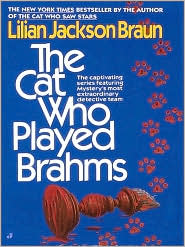
The Cat Who Played Brahms
The Cat Who Played Brahms. Lilian Jackson Braun. 1987. Penguin. 256 pages.
For Jim Qwilleran, veteran journalist, it was one of the most appalling moments of his career.
Jim Qwilleran has had many jobs at The Daily Fluxion, and when the novel opens, he's on his way to being offered a new job as an investigative reporter. But. For Jim that might not be enough. For he's a little unsettled. And what he wants, what he really wants, is time away. He asks for three months vacation. He wants to spend some quiet time in the country at his aunt's cabin by the lake. He may even do a little writing. So he says. But the country may not prove all that quiet and peaceful. And, no, it's not because Koko and Yum Yum, his Siamese, are too lively. (Though to see them in action is something! For example, when someone tries to break into Jim's place, Koko can hold his own and then some!) No, there's something strange going on in this lake community.
For starters, the not-so-hidden messages on cassette tapes...
Even on vacation it seems Qwill and Koko are in demand to solve a mystery! I am enjoying these Cat Who books so much!!! I would definitely recommend them to cat-lovers or mystery lovers!
© 2011 Becky Laney of Becky's Book Reviews
For Jim Qwilleran, veteran journalist, it was one of the most appalling moments of his career.
Jim Qwilleran has had many jobs at The Daily Fluxion, and when the novel opens, he's on his way to being offered a new job as an investigative reporter. But. For Jim that might not be enough. For he's a little unsettled. And what he wants, what he really wants, is time away. He asks for three months vacation. He wants to spend some quiet time in the country at his aunt's cabin by the lake. He may even do a little writing. So he says. But the country may not prove all that quiet and peaceful. And, no, it's not because Koko and Yum Yum, his Siamese, are too lively. (Though to see them in action is something! For example, when someone tries to break into Jim's place, Koko can hold his own and then some!) No, there's something strange going on in this lake community.
For starters, the not-so-hidden messages on cassette tapes...
Even on vacation it seems Qwill and Koko are in demand to solve a mystery! I am enjoying these Cat Who books so much!!! I would definitely recommend them to cat-lovers or mystery lovers!
© 2011 Becky Laney of Becky's Book Reviews
Subscribe to:
Posts (Atom)


