Thursday, February 09, 2017

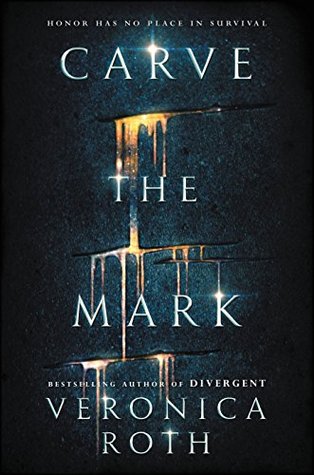
Carve the Mark

Carve the Mark. Veronica Roth. 2017. 468 pages. [Source: Library]

First sentence: Hushflowers always bloomed when the night was longest.

Premise/plot: Carve the Mark by Veronica Roth is YA science fiction. Two peoples share a planet, or war over a planet more like it. The Thuvhe and the Shotet. Cyra is Shotet and her currentgift feels more a curse than a gift. Hers is the gift of pain; pain builds up in her body--especially when she's emotional--and with a touch she can dispense it to another. Her brother sees her not as a person to be loved and respected but a tool or weapon. Akos is Thuvhe. His currentgift is to break the current, stop the current, with a touch. These two might never have met if he and his brother had not been kidnapped. His service to Cyra's family is far from voluntary, but these two have a common enemy: her brother.

My thoughts: I think the world she has created is vaguely interesting. It is an ice planet with two distinct cultures and languages. We hear of other planets and peoples. We even visit one--Pitha, a water planet. The two main characters are nicely done at least. What didn't quite work for me is the confusing progression of time. I didn't love this one, but, I didn't hate it either.

Like the Worthing Saga, Carve the Mark does ask some questions about the meaning of pain. The heroine is "blessed" with the "gift" of pain. She thinks of it as a curse, as does everyone around her, except perhaps for her brother who sees her pain as a blessing to him because he can manipulate her into hurting other people and watch gleefully. She's tested through struggles but eventually realizes that her pain is what makes her strong and capable and wise. 

© 2017 Becky Laney of Becky's Book Reviews

Wednesday, February 08, 2017

Freedom in Congo Square

Freedom in Congo Square. Carole Boston Weatherford. Illustrated by R. Gregory Christie. 2016. 34 pages. [Source: Library]

First sentence: Mondays, there were hogs to slop, mules to train, and logs to chop. Slavery was no ways fair. Six more days to Congo Square. Tuesdays, there were cows to feed, fields to plow, and rows to seed. A moment without work was rare. Five more days to Congo Square.

Premise/plot: Freedom in Congo Square received a Caldecott Honor and a Coretta Scott King Illustrators Honor. It was well deserved. This picture book is set in New Orleans. One day a week, on Sunday, slaves and free blacks could meet together in Congo Square. It was the slaves only day off. The book explains how music and dance continued to be influential during these years.

My thoughts: I loved this one. It was simple enough that I think you could share it as a read-aloud. It didn't lack complexity, by any means, but it wasn't overly wordy. (Older readers can appreciate the foreword and the author's note.) I loved the counting down, the building up of excitement. I loved learning more about the historical roots of jazz music.

Text: 5 out of 5
Illustrations: 5 out of 5
Total: 10 out of 10
© 2017 Becky Laney of Becky's Book Reviews

Tuesday, February 07, 2017

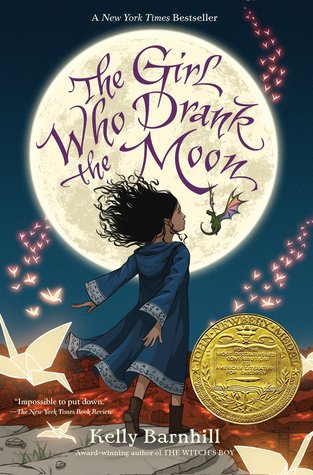
The Girl Who Drank the Moon

The Girl Who Drank the Moon. Kelly Barnhill. 2016. 388 pages. [Source: Library]

First sentence: Yes. There is a witch in the woods. There has always been a witch.

Premise/plot: There are two sides to every story. The villagers of the Protectorate believe that it's a necessary evil to sacrifice the youngest baby to the witch in the woods every year on a certain day. Sorrow hangs about the village certainly even driving a few mad now and then. Xan, who lives in the woods along with a dragon and swamp monster, wonders why the crazy villagers abandon a baby every year leaving it in a particular place. It's nonsense from her perspective. Who would do such a thing? She happily takes the baby through the woods to the safety of one of the free cities. The baby is adopted, loved, cared for.

One year something changes. Xan accidentally draws power from the moon--the full moon--instead of the stars to nourish the baby on the trek through the woods. The baby--soon named Luna--becomes enmagicked. Xan decides that she had better raise the child herself! Luna's real mother forgets her own name, the name of her child, her life before that terrible day when she spoke up against those who were cruelly taking her baby. She's locked away in a tower, kept prisoner by the Sisters.

The truth seems buried, but by the child's thirteenth birthday the truth will shine through the darkest of sorrows and hope will take root.

My thoughts: To readers who are thrilled by all things witchy, this may prove fun. I certainly enjoyed the tiny dragon who truly believed he was simply enormous. The paper birds were truly terrifying but unique in my opinion. The struggles were many for all the characters, and the author didn't give easy solutions. But. As a Christian I found this book less than ideal. There were several places that proved too much for me to ignore. I'm thinking of chapter twelve and forty-seven.
"In the beginning there was only Bog, and Bog, and Bog. There were no people. There were no fish. There were no birds or beasts or mountains or forest or sky. The bog was everything, and everything was the Bog....and so the Bog created a Body: a great Beast that walked out of the Bog on its own strong, boggy legs. The beast was the Bog, and the Bog was the Beast. The Beast loved the Bog and the Bog loved the Beast...the Beast's chest was full of warm and life-giving compassion. He felt the shine of love radiating outward. And the Beast wanted words to explain how he felt. And so there were words." (83-84) 
Clearly drawing from the literary style of the Bible....to turn God into a boggy swamp monster is just too much for me to personally overlook. I would never discourage anyone from reading the book and judging its merit on their own. I do wish this Bog element had been left out though.

© 2017 Becky Laney of Becky's Book Reviews

Monday, February 06, 2017

Twelve Angry Men

Twelve Angry Men. Reginald Rose. 1954/2006. 79 pages. [Source: Library]

First sentence: ...and that concludes the court's explanation of the legal aspects of this case. And now, gentlemen of the jury, I come to my final instructions to you.

Premise/plot: Twelve Angry Men is a play by Reginald Rose. The setting is New York, 1957, a closed jury. Twelve men will decide if a man--the defendant--lives or dies. After the room settles down, after a few minutes go by, the first vote is cast. Eleven men vote within minutes to find him guilty. One man, the 8th juror, votes not guilty. The play is about all that follows next. Will the jury ultimately decide to vote guilty or not guilty? What will be revealed about human nature during that deliberation process?

My thoughts: I saw the movie probably twenty years ago, maybe nineteen. I thought it was outstanding. I thought it was about time I read the play for myself. It was GOOD. I will be rewatching the movie soon. I have a feeling that the movie at least is timeless. (I think sometimes--often times--people are more likely to watch a movie then read a play).

I will say this, not as a warning not to read it, but just so you know: this one does have bad language in it--blasphemy mostly. I would never let that keep me from reading such a compelling, timeless piece of literature.

Favorite quotes:
  • I have always thought that in this country a man was entitled to have unpopular opinions...(27, 11th juror speaking)
  • Facts may be colored by the personalities of the people who present them. (36, 11th juror speaking)
  • It's very hard to keep personal prejudice out of a thing like this. And no matter where you run into it, prejudice obscures the truth. (66, 8th juror speaking)


© 2017 Becky Laney of Becky's Book Reviews
Sunday, February 05, 2017

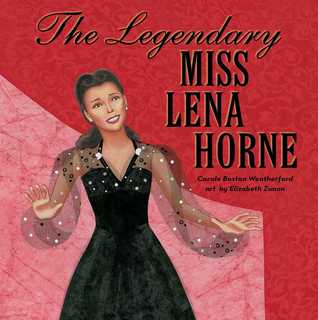
The Legendary Miss Lena Horne

The Legendary Miss Lena Horne. Carole Boston Weatherford. Illustrated by Elizabeth Zunon. 2017. 48 pages. [Source: Library]

First sentence: The Horne family tree was laden with achievers: teachers, activists, a Harlem Renaissance poet, the dean of a black college, and Lena's grandmother Cora Calhoun Horne, a college graduate.

Premise/plot: Carole Boston Weatherford has written a picture book biography of Lena Horne. It is beautifully illustrated by Elizabeth Zunon. It would be appropriate for elementary students certainly. (Not as certain that it would hold the interest of say the preschool crowd.)

My thoughts: I loved this one. I did. To be fair, I love a good biography. But I had a special interest in the subject as well. This one spans decades and reflects the times--before, during, and after the civil rights movement. I loved that the author included quotes by Lena Horne.
  • You have to be taught to be second class; you're not born that way. ~ Lena Horne
  • They didn't make me into a maid, but they didn't make me into anything else either. ~ Lena Horne
 But above all, I loved all the information packed into the narrative. I'm not saying that the narrative is text-heavy or bulky. Far from it. It's very much still a narrative story woven together with facts. But I love learning as I read.

Did you know?
  • That Lena Horne, at age 2, became one of the youngest members of the NAACP? That she was in fact a 'cover girl' for the NAACP Branch Bulletit in 1919!
  • That Lena Horne was a life-long reader and lover of books?!
  • That she spent some of her childhood years on the vaudeville circuit with her mother.
  • That she started her career on the chorus line...before moving on to Broadway, orchestras, and the movies...
  • That she was one of the first black vocalists to front an all-white big band.
  • That she received the first ever studio contract for a black actress.
  • That she refused to play stereotypical roles in movies--maids and mammies.
  • That she often appeared only in singing numbers that could be edited out in Southern theaters.
  • Here's what I found most disturbing: Max Factor created makeup just for her to wear on screen, and, white actresses started wearing it and getting roles for light-skinned black women.
  • That performing for the troops during World War II was segregated and that she eventually became so upset by it that she paid her own way to perform just for black troops. 
  • She was blacklisted during the McCarthy years.
I could go on and on. It was just a super-fascinating read. I think the illustration I loved best was Lena Horne with Kermit the Frog because that I remember!

Text: 5 out of 5
Illustrations: 5 out of 5
Total: 10 out of 10


© 2017 Becky Laney of Becky's Book Reviews