The theater in Chinatown was crowded to the doors. Every night actors brought from Canton played and sang the old Chinese operas. If Billy Pan, the manager, announced a deficit at the end of the lunar year, businessmen contributed money to cover it. The theater was a bulwark of home for them. Their children went to American schools, spoke the American language, acted like American children. The fathers and mothers were not highly educated people and they could not express to the children what China was, except that it was their own country, which must not be forgotten. But in the theater the children could see for themselves what China was. Here history was played again and ancient heroes came to life before their eyes. It was the only place in Chinatown which could compete with the movies. Parents brought their children early and stayed late. They talked with friends and neighbors, exchanged sweetmeats and gossip, and sat spellbound and dreaming when the curtain went up to show the figures who were contemporary with their ancestors.
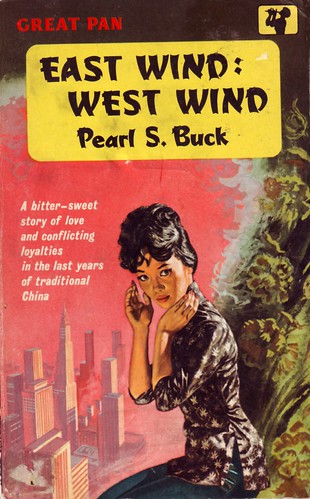
As much as I just loved and adored East Wind: West Wind--my very first Pearl S. Buck novel--I just LOVED, LOVED, LOVED Kinfolk. It is so very different from The Good Earth and Sons. While I struggled to find anyone sympathetic in The Good Earth and Sons, I could name half a dozen characters (if not more) that I liked, loved, respected, or admired in Kinfolk. And here's the thing, even the characters that I didn't necessarily "like", I found them to be well-developed, complex. Unlike the often nameless one-dimensional characters in The Good Earth and Sons. And the language, the style. It wowed me. It really did! So much to love and appreciate.
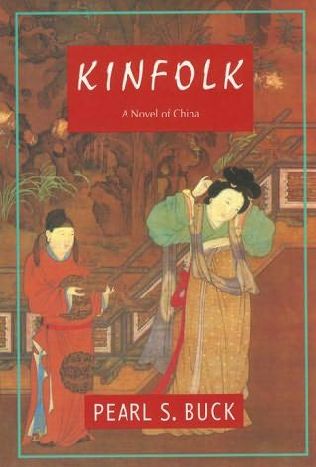 Kinfolk is about the Liang family. Dr. Liang, the father, is a scholar who fled China because it was getting to be too harsh, too ugly, too dangerous, too uncertain. He's a scholar, a teacher, a thinker, a philosopher. He needs peace and quiet and rest. He needs to be surrounded by people who appreciate his intellect, his superiority. (And does he ever think he's superior to just about anyone who's ever lived.) His wife, well, she "appreciates" him as best she can. Knowing that he can be oh-so-difficult to live with. But knowing that it is her place to bring out the best in him. To calm him when he gets furious or frustrated. But this isn't always easy since he doesn't respect her or see her as someone worthy of love and respect. She's the mother of his children. But. That's about it. He doesn't feel like she's intellectually or emotionally his soul mate. And he doesn't see any need to treat her as if she was the love of his life. It's her job to appreciate him, not the other way round.
So the Liangs have four children--two of the children were born in China, two of the children were born in America--James and Mary are the oldest, Peter and Louise are the youngest. James and Mary have a deep longing to return to China, to make their home, their future in China. They know it won't be easy. They know it will require sacrifice and hard work. But neither James or Mary would want to live anywhere else. They wouldn't trade the hardships, the uncertainties for anything because they feel like China is where they belong. James is already having to sacrifice his first love, Lili, because she doesn't share his dream, his vision. She wants to be American, a rich American. James, a doctor, is the first to make the trip. He'll be working in Peking in a hospital. While James knew that Mary was planning on coming to China herself--at some point. He never expected to be joined by Mary and Peter and Louise. But Louise, unfortunately, has a love affair with an American. A love affair which her father found out about. (Louise and Peter are--at least in their parents' opinion--too American.) So Mary, Louise, and Peter are sent away--Louise in disgrace, Mary because that is where she most wants to be, and Peter because his father is afraid of any of his children becoming too American that they begin to lose who they are or who they are supposed to be. Their morals, their values. (It's fine for Americans to act that way, they're American, what do you expect? But you--you shouldn't be acting like that.)

And James, our hero, the man who may just be the most important in Kinfolk, well, he loves China. He shares his sister's dream of returning to their ancestral village, and living with their Uncle Tao and his family. He knows it won't be easy to convince these villagers, these peasants, these farmers that Western medicine is good. That he can heal them, cure them, give them a chance to live life well and healthy. And Uncle Tao may be the one that needs the most convincing. Since James knows that his uncle needs surgery to remove a tumor. But. He knows that China is where he belongs. That China is his destiny, his future. For better or worse. For richer or poorer. James is going to be with the people of China.
We also meet Chen, a fellow doctor, a man who becomes very close with the Liang family. (He's a character that I found so easy to love!) And then there's Young Wang, another man James meets when he's new-to-China. A man that becomes a servant but so much more than a servant. A true friend and guardian to the family.
Much of Kinfolk is set in China. But. We never quite lose touch with the parents in New York. Even separated by all those miles, there's tension between the parents and children.
I absolutely loved James and Mary and Chen and Young Wang. I just LOVED them. And even the characters that I didn't love, I found them to be well-developed and human. I think they could even be studied perhaps. (Kinfolk was one of the novels that I read it and found myself thinking, I could write a dozen papers about this one. It's just that good, that rich, that well-written, that interesting.) It was compelling. It was thought-provoking. It was a marvelous book.
So if the only Pearl S. Buck you've ever read was The Good Earth, I'd urge you to please pick up one of her other books. A book like Kinfolk or East Wind: West Wind. Because you need to give her another try.
Favorite quotes:
James on why he needs to return to China now:
He had never said even to Mary that in some deeply repressed corner of his being he grieved that his own father had chosen to live in exile during the years of the their country's hardship. He knew all the arguments, that a scholar could not work in the midst of turmoil and war. He believed these arguments were true. He knew that his father's delicately balanced mind needed safety and quiet and security in order to do its work. But he had long ago determined that he would work where he was most needed, in the midst of turmoil, even in war. He would not allow his mind to be delicate nor his heart remote. (40)
James trying to convince Lili to join him in China:
"Try to understand how I feel. Our people are good--our people are wonderful. China is great. She is not really weak. She is only in distress. All the great strength is simply waiting until we come to her help. She has lived in an old, old world and she needs to be born into the new one. I am a doctor and I think naturally in terms of birth--of bringing forth life--" (44)
James trying to decide if he's ready to make the leap:
The city was full of such brawls. There were too many starving people, and policemen treated them as criminals. Perhaps they were. There was no line between starvation and crime. He felt himself torn in the division of reality. The world, the whole world, was divided into two parts, the island of the rich and the ocean of the poor. Where would he live? He still had his feet on the island, but he was facing the rough dark waters. He must go back--or else he must leap. (65)
James speaking to Louise about her disappointing love affair:
"All this," he said after a moment, "is because you have let yourself fall in love with an American. At your age love shapes the universe."On differences between the generations, the 'war' between old and new:
She continued to sob, and he went on gently. "I know, too, what it is to love someone. I think I loved Lili with all my heart. Even now when I know we shall never marry, when I think of her, or someone speaks her name, the world trembles. But it does not crash about me. I know there is a life that must be lived happily without Lili. (166)
There was a world of difference between themselves and these kinfolk, centuries of difference, space and time crowded into a single generation. (209)
Dr. Liang (the father) on the necessity of having peasants:
People, he reflected, must live at these different levels. Some must work with the hands, some with the mind. The peasants should not be lifted from their places as workers with the hands, or the higher ones would starve. He himself would, if he lived in China, be quite helpless without the peasants. Even here, he supposed, there were the workers with hands, men on American farms who had to do the crude work of producing food. Such persons must not be taught falsely that they could or should do other work. (228)
And this is just one of the reasons why he can't understand his children, and why his children can't understand him.
One of the reasons why I loved Chen:
"It takes a certain kind of person to live in China now," Chen mused.
"What kind of person?" Mary asked.
"Someone who can see true meanings, someone who does not only want the world better but believes it can be made better, and gets angry because it is not done, someone who is not willing to hide himself in one of the few good places left in the world--someone who is tough!" (251)
Dr. Liang reflecting on the past:
But he had wanted the children to understand the glory of China, the honor, the dignity of an ancient race and country. He himself purposefully dwelled upon these things. It was necessary to do this in order to have a perspective upon the disagreeable present. The present was always transient. It faded away. Only the past and future were eternal. Therefore he had done well to teach his children of their people's greatness. It was what Confucius himself had taught. Confucius too had lived in troubled and divided times, and he had not allowed himself to be troubled or divided. Instead he had gathered together all the greatness of the ancients and he had put this greatness into a book which had lived through the ages. (303)
James and Mary and Chen reflecting together:
The weight of their country, vast and old, lay heavy upon them all, and they were of such conscience that they could not escape.
"What Peter could not see," James said at last, "was that destruction does not heal. For what can be destroyed except people? Yet the people are the treasure store of the nation."
"And our people are good," Chen said.
"I tell you ours are the best people in the world..." (315)
© 2011 Becky Laney of Becky's Book Reviews