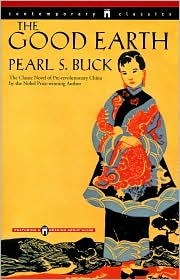
The Good Earth. Pearl S. Buck. 1931/2004. Simon & Schuster. 368 pages.
It was Wang Lung's marriage day. At first, opening his eyes in the blackness of the curtains about his bed, he could not think why the dawn seemed different from any other. The house was still except for the faint, gasping cough of his old father, whose room was opposite to his own across the middle middle room. Every morning the old man's cough was the first sound to be heard. Wang Lung usually lay listening to it and moved only when he heard it approaching nearer and when he heard the door of his father's room squeak upon its wooden hinges. But this morning he did not wait.
The Good Earth was Pearl S. Buck's second novel. (Her first novel was East Wind: West Wind, a novel that I just LOVED AND ADORED!)
The Good Earth is very different from East Wind: West Wind. Though both books are, of course, set in China. East Wind: West Wind focused on a changing China and the tension between the East and West and how that change impacted family life and added drama and stress to family dynamics. How the new way of life threatened centuries-old traditions. The Good Earth is more about the haves and have-nots. It's a novel about poverty and riches.
Wang Lung, our hero, is a humble farmer. He works the land. Slaves on it really. Has barely enough food to feed himself and his father. Most days they can't even afford to have tea leaves in their hot water. Yet he's managed to arrange himself a marriage with a hand-me-down woman, a slave from a rich household--one of the richest households in the village, the House of Hwang. O-lan, his wife, is ugly but hardworking. (For example, she joins her husband in the fields just hours after giving birth to their son.)
The early years of their marriage--the first three to four years of their marriage--are happy. Wang Lung is able to save up money to buy some land--land formerly owned by the House of Hwang. He's working harder than ever. He's got his wife by his side--most of the time. And she's given birth to two sons and one daughter. Things seem to be going well for them. Wang Lung is hopeful that things will keep looking up, that the land will keep producing, etc.
But then drought and famine come and devastate the region. And because he's done better than his neighbors in the past, they don't feel bad for robbing what little he has now in this distress. Things begin to look very bleak indeed. How will Wang-Lung support his father, his wife, his three children, himself, and the new little one on the way?! He can't. Not if he stays where he is.
So the family travels and begins to beg. It's a tough, tough life. A life that calls for HORRIBLE decisions to be made.
Through chance--through morally ambiguous opportunities you might say--their fortunes are reversed. The family goes from being a day away from starvation to being rich enough to return to their former home, rich enough to buy more land, to plant more seed, to hire workers for the land. But does money buy happiness? Does money buy contentment? Does money buy security?
Wang Lung is still a man from humble beginnings. A man who prefers to work his lands himself, a man who prefers to smell of the earth, the land. But he's wealthy enough that he's now beginning to think that his sons could have a different life, a different lifestyle. A lifestyle that begins with education. A lifestyle enhanced by *good* arranged marriages.
If Wang Lung had come to love and appreciate his ugly self-sacrificing wife. (I mean more besides feeling regret or remorse that he doesn't love her as he should. Which is something at least. But not quite the same thing.) If Wang Lung had been a better father to all his children, all the time. (But then again is any father that perfect?) If Wang Lung hadn't had a midlife crisis and become involved with Lotus, a younger woman, a prostitute, whom Wang Lung "buys" to be his own special concubine. Then I'd have an easier time "liking" Wang Lung. Did I hate him? No. Not really. I didn't respect him on each and every page. There were times I wanted to yell at him. But then there were moments where he showed gratitude and loyalty and affection. In particular his relationship with Ching, a neighboring farmer, and Pear Blossom, a young slave girl "raised" in part by Lotus.
The Good Earth is a good novel. But it's a bit uneven at times. It's complex in that it addresses many issues. The tension between fathers and sons. How misunderstandings occur between the generations. How fathers frustrate and/or disappoint their children. How children frustrate/disappoint their parents. Wang Lung is ALL about the land. It is his first and last love. When it comes to his three sons, well, the land means practically nothing. It's just something to be sold after their father dies. Class issues. How the rich get richer--unless they become addicted to opium--how the poor get poorer--unless they starve to death. Why are the rich so wealthy? Why are the poor so poor? Circumstance has just as much to do with it as wisdom and hard work. Society and culture. But in particular gender roles for women. Wives, concubines, slaves. How women are property to be bought, sold, used, discarded. Fortune. Good or bad. Many events in this book appear to depend on chance or luck or circumstance. There are also hints of political unrest--rumors of war and revolution--in this one. But that issue isn't fully explored--though there is a cousin-soldier that comes bringing chaos to the family for a chapter or two.
But while the novel is complex in many ways. It's uneven in its characterization. Besides Wang Lung very few, if any, are well-developed. Some characters remain nameless--including his three sons and daughter, and his two daughters-in-law--others are given names, but we really see very little development beyond "she's ugly" or "she's pretty" or "she's fat" or "she's thrifty." We get a little bit of insight into his three sons and into his wives/concubines. But I'd not really say that they are completely well-developed.
Still. Even though I wouldn't say I loved this one--or even especially liked it--I can't say that it's poorly written. The style is simple and straightforward. Perhaps not quite as beautiful (to me) as East Wind: West Wind. But compelling nonetheless. I'm not exactly sure why but this one reminds me of some of the John Steinbeck I've read. (Not all of them mind you.)
© 2011 Becky Laney of Becky's Book Reviews
Tuesday, May 10, 2011
Monday, May 09, 2011
The Story of Britain
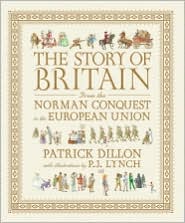
The Story of Britain From the Norman Conquest to the European Union by Patrick Dillon. 2011. Candlewick Press. 352 pages.
From the introduction: Long ago, on the eastern edge of the Atlantic Ocean, there were two islands.
The title for this one says it all. The introduction takes readers from 55 BC to 1066 AD. And the remaining chapters cover the years 1066 to 1999. There are six sections: "The Middle Ages," "The Tudors," "The Stuarts," "The Georgians," "The Victorians," and "The Twentieth Century." So what kinds of things get covered in the entries? Well. Kings. Queens. Parliaments. Wars. Revolutions. Invasions. Religious Conflicts. Politics. Economics. Social class divisions. Scientists and inventors. Explorers and empire-builders. A few influential authors. A little bit of everything really. It isn't just about the monarchy. It isn't just about the wars Britain has taken part in through the centuries. Though both of those take up a significant place in the book. The book also tries to cover Scotland and Ireland and Wales.
The Story of Britain is concise and creative. Within the entries themselves, readers will find it almost impossible to find a date. (I'm guessing that the author did NOT want to be like a text book and use dates to bridge together sentences like "And then this happened. And then this happened. And then this happened.) The dates are instead found within the timeline at the end of each section. The text itself is casual and conversational. And you might say creative. He gives voice to a variety of people in society--groups of people and individuals--by using dialogue. (Most entries have quotation marks--but many of these quotation marks are not quoting a *real* source. Though of course some are. The quotation marks that rely on primary sources or reference materials use italics so readers know what's what.) I'm not sure how I feel about this really. On the one hand, I think it keeps the book light and conversational. But on the other hand, I like to keep fiction and nonfiction separate from one another. And the narrator of this one definitely is not as objective as he could be--as he should be perhaps? I could definitely see some of his statements as having an agenda. For better or worse. I mean when you write with a message, with an agenda, with a slant--readers will either already agree with you because they share your views OR not agree with you because they don't share your viewpoint on that particular issue. While I suppose any history book--any text book--could be seen as having bias, of not really being as objective as it could be, I found this one noticeably so.
Did I like it? In places. I found it informative and reader-friendly. There were gaps in my education--and my education for British history basically came from my literature courses and my love for historical fiction--and this book helped me connect the dots. I don't think I loved it. Not as much as I was hoping. But. It was still an entertaining read.
© 2011 Becky Laney of Becky's Book Reviews
From the introduction: Long ago, on the eastern edge of the Atlantic Ocean, there were two islands.
The title for this one says it all. The introduction takes readers from 55 BC to 1066 AD. And the remaining chapters cover the years 1066 to 1999. There are six sections: "The Middle Ages," "The Tudors," "The Stuarts," "The Georgians," "The Victorians," and "The Twentieth Century." So what kinds of things get covered in the entries? Well. Kings. Queens. Parliaments. Wars. Revolutions. Invasions. Religious Conflicts. Politics. Economics. Social class divisions. Scientists and inventors. Explorers and empire-builders. A few influential authors. A little bit of everything really. It isn't just about the monarchy. It isn't just about the wars Britain has taken part in through the centuries. Though both of those take up a significant place in the book. The book also tries to cover Scotland and Ireland and Wales.
The Story of Britain is concise and creative. Within the entries themselves, readers will find it almost impossible to find a date. (I'm guessing that the author did NOT want to be like a text book and use dates to bridge together sentences like "And then this happened. And then this happened. And then this happened.) The dates are instead found within the timeline at the end of each section. The text itself is casual and conversational. And you might say creative. He gives voice to a variety of people in society--groups of people and individuals--by using dialogue. (Most entries have quotation marks--but many of these quotation marks are not quoting a *real* source. Though of course some are. The quotation marks that rely on primary sources or reference materials use italics so readers know what's what.) I'm not sure how I feel about this really. On the one hand, I think it keeps the book light and conversational. But on the other hand, I like to keep fiction and nonfiction separate from one another. And the narrator of this one definitely is not as objective as he could be--as he should be perhaps? I could definitely see some of his statements as having an agenda. For better or worse. I mean when you write with a message, with an agenda, with a slant--readers will either already agree with you because they share your views OR not agree with you because they don't share your viewpoint on that particular issue. While I suppose any history book--any text book--could be seen as having bias, of not really being as objective as it could be, I found this one noticeably so.
Did I like it? In places. I found it informative and reader-friendly. There were gaps in my education--and my education for British history basically came from my literature courses and my love for historical fiction--and this book helped me connect the dots. I don't think I loved it. Not as much as I was hoping. But. It was still an entertaining read.
© 2011 Becky Laney of Becky's Book Reviews
Labels:
2011,
Candlewick,
Nonfiction,
review copy,
YA nonfiction
Sunday, May 08, 2011
Sunday Salon: Week in Review #19
What I Reviewed at Becky's Book Reviews
City of Fallen Angels by Cassandra Clare. (Mortal Instruments #4) 2011. Simon & Schuster. 424 pages.
Stay. Deb Caletti. 2011. Simon & Schuster. 320 pages.
What I Reviewed at Young Readers
Your Mommy Was Just Like You. Kelly Bennett. Illustrated by David Walker. 2011. Penguin. 32 pages.
My Side of the Car. Kate Feiffer. Illustrated by Jules Feiffer. 2011. Candlewick. 32 pages.
Chicken, Chicken, Duck! Nadia Krilanovich. 2011. Random House. 32 pages.
The Boss Baby. Marla Frazee. 2010. Simon & Schuster. 40 pages.
Tweak Tweak by Eve Bunting. Illustrated by Sergio Ruzzier. 2011. Houghton Mifflin Harcourt. 40 pages.
Everywhere Babies. Susan Meyers. Illustrated by Marla Frazee. 2001/2011. Houghton Mifflin Harcourt. 30 pages.
What I Reviewed at Operation Actually Read Bible
The Holiness of God. R.C. Spoul. 1985. Tyndale. 280 pages.
© 2011 Becky Laney of Becky's Book Reviews
Happy Mother's Day!
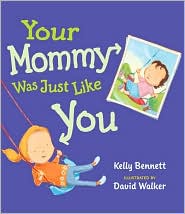
Your Mommy Was Just Like You. Kelly Bennett. Illustrated by David Walker. 2011. Penguin. 32 pages.
Your mommy was born bright-eyed and fuzzy-topped. Just like you.
I'd rock her and blow on her tummy and tickle her toes.
She'd giggle and coo, and play
"Where's Baby Peek-a-boo?"
Just like you.
I really enjoyed this sweet picture book. It's a great story focusing on family life. It's narrated by Grandma! And does she have some stories to tell to her granddaughter! All about when the little girl's mommy. Stories about when she was sweet as sweet can be, and stories about her fits and tantrums! In each story the grandmother shares with her granddaughter, she points out her mommy was once just like her.
It's predictably cute and adorable and sweet. I really found it enjoyable. I loved reading the stories and looking at the illustrations.
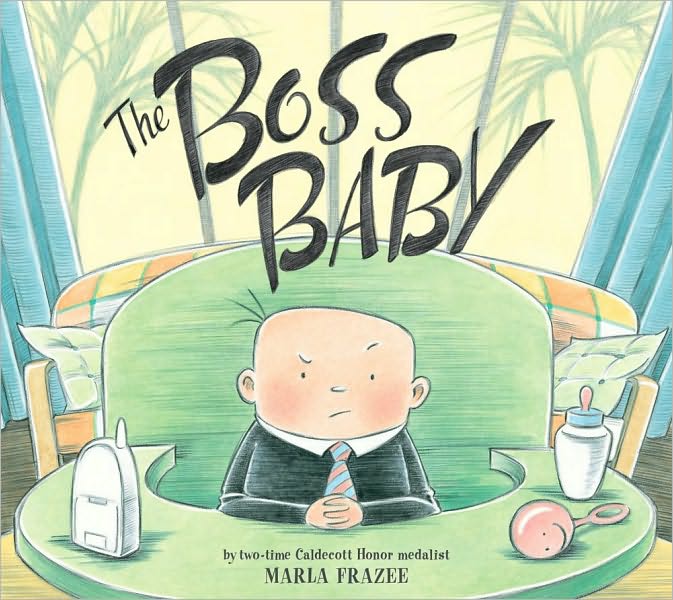
The Boss Baby. Marla Frazee. 2010. Simon & Schuster. 40 pages.
From the moment the baby arrived, it was obvious that he was the boss. He put Mom and Dad on a round-the-clock schedule, with no time off. And then he set up his office right smack-dab in the middle of the house. He made demands. Many, many demands. And he was quite particular. If things weren't done to his immediate satisfaction, he had a fit.
Thus begins The Boss Baby a charming, oh-so-delightful look back at the early days of parenthood written by Marla Frazee. I loved this one from the first spread. The art had me at hello. (It was very retro.) And the text, well, the text was clever and fun. The joke--the 'office' humor--could have gotten old perhaps in the hands of another author. But. I found this one to be so true-to-life, so charming, so funny--in a clever, grown-up way--that it worked from cover to cover.
This is a picture book that I found myself reading and rereading just so I could take in every detail.
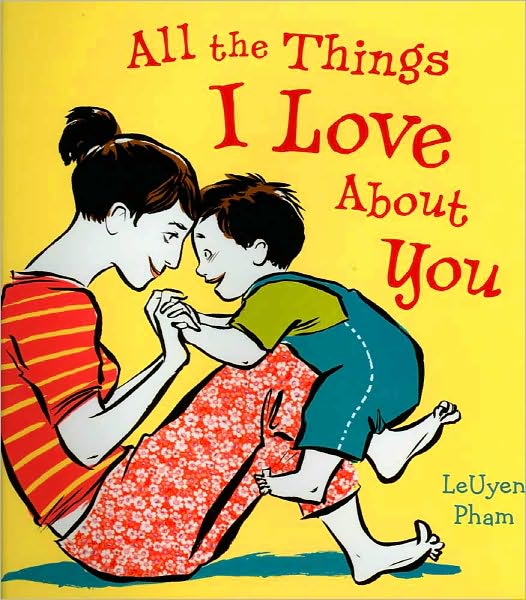
All The Things I Love About You. LeUyen Pham. 2010. November 2010. HarperCollins. 40 pages.
There are oh so many things I love about you.
I love the way your hair looks in the morning.
I love how you look in pajamas.
Although getting you out of them is another story.
I love...how you eat.
I love watching you play with Papa.
Sometimes.
I loved, loved, loved LeUyen Pham's Big Sister, Little Sister, so I was VERY excited to see she had a new book: All The Things I Love About You. I was NOT disappointed! This one is so sweet, so adorable, and oh-so-true! In this one, a mom is sharing the many-many ways she loves her child--her baby. In this case, it's a boy. But it wouldn't have to be a boy. All of the sentiment could just as easily be expressed for a dear baby girl!
This one is focused on the family, on the intimate scenes of family life. From the "struggles" of getting a little one dressed in the morning, to the sweet little hugs, to the sloppy mealtimes, etc. Through text and illustration, this family comes to life for readers.
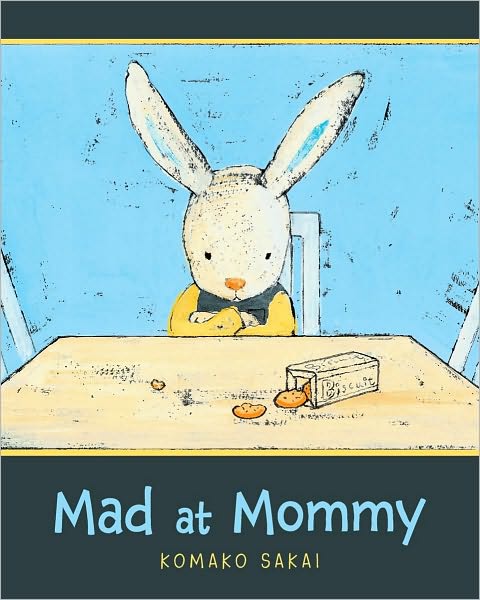
Mad at Mommy. Komako Sakai. 2010. October 2010. Scholastic. 40 pages.
Mommy, I -- I --
I am so mad at you!
You always sleep late,
especially on Saturdays.
Always and always.
You always watch your shows
and never let me watch cartoons.
This little bunny could tell you a dozen reasons why he is so, so mad at his mommy! Perhaps you can relate?! But as our narrator shares his feelings, as he lets his anger out--using words--he begins to calm down. Not at first, perhaps. But by the end, he's ready to make up again. He realizes just how much he loves, loves, loves his mommy!
I really, really liked this one. There were places I loved it. The narrative voice was great. It felt believable, authentic, kid-like. One of the reasons I enjoyed this one so much is because of the illustrations. I thought they were wonderful! I just loved them! Especially the one where this little bunny is waiting and waiting and waiting for his mother to hurry up!
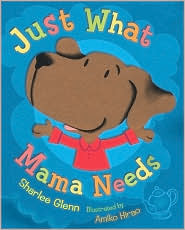
Just What Mama Needs. Sharlee Mullins Glenn. Illustrated by Amiko Hirao. 2008. Harcourt. 32 pages.
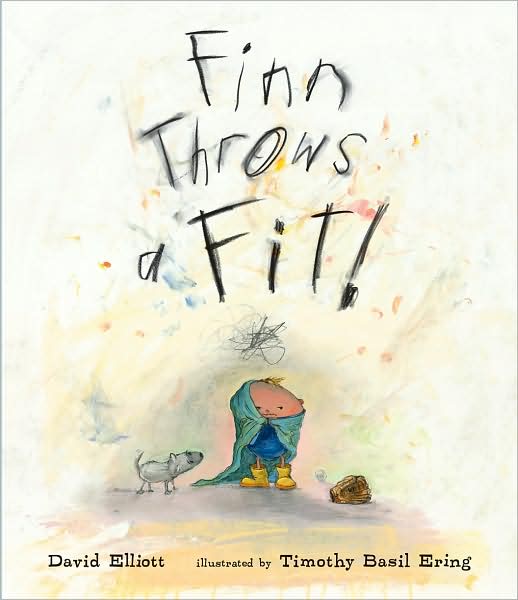
Finn Throws A Fit! By David Elliott. Illustrated by Timothy Basil Ering. 2009. Candlewick Press.
Finn likes peaches.
Usually.
Brilliant from cover to cover. This one is perfect, just perfect. A true been-there-felt-that kind of book just right for parents (and all adults really who've ever been around young children). What is this one about? Finn. Throwing. A. Fit. Not just a little fit. A managed fit. This is a full-blowout-need-back-up-fast kind of fit.
All of the book works, the text just feels right. But my favorite-and-best line that just works oh-so-well (and makes me grin) is this one:
That is just so-very-very true. Anyway, I loved this book. Just loved it. And I think you'll enjoy it too!
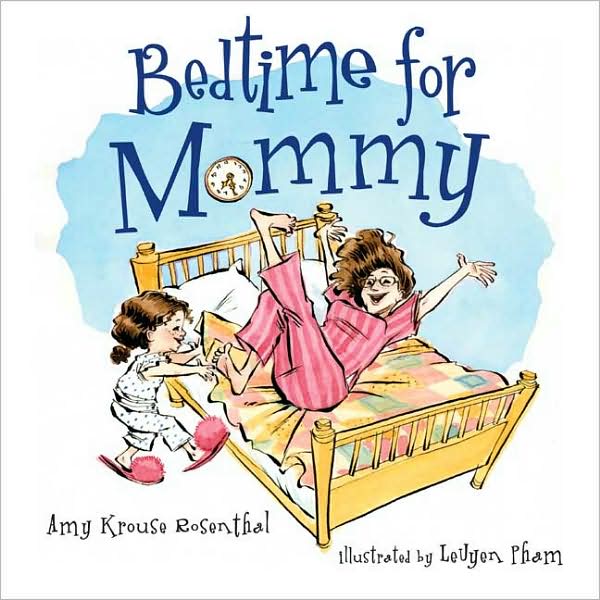
Bedtime for Mommy. Amy Krouse Rosenthal. Illustrated by LeUyen Pham. 2010. (March 2010). Bloomsbury. 32 pages.
Time for bed, Mommy!
This bedtime book is practically perfect in every way. It's written by one of my very favorite authors, Amy Krouse Rosenthanal. It's also illustrated by one of my very favorite illustrators, LeUyen Pham. What is it about? Well, it's about a little girl who puts her mommy to bed. Everything from reminding her that it's getting time for bed, to making sure she's taken her bath and brushed her teeth. It's a sweet book; a cute book; an again-again book. It isn't the first picture book to reverse roles or to put a twist on the traditional bedtime story, but everything is so well done it goes straight to my favorite-and-best list.
I love, love, love the illustrations in this one. Pham takes a fun concept, a fun premise, and makes it work really, really well. I love how both the mom and the daughter are drawn. The way these two interact with each other, their scenes are just perfect, just right.
Bauer, Marion Dane. 2001/2009. My Mother Is Mine. Little Simon. Illustrated by Peter Elwell.
My Mother Is Mine is a wonderfully sweet board book. How would YOU describe your mother? What makes her so special? Why do you love her so? In My Mother Is Mine we get a variety of answers as an assortment of animals answer just this. From the little lamb we have, "My mother is soft." From the little giraffe we have, "My mother is tall and tall and tall." A little bear says, "My mother is brave." (Note to the reader: The animals aren't doing the talking. There is nothing in the text itself that relates these statements back to the animals. It's just that the animals are in the illustrations.) Anyway, the rhyming text is just fun. And I love the sweet message of this one.
It ends with a little girl writing her mother a love letter:
My mother is special.
My mother is fine.
My mother,
My mother,
My mother is mine!
© 2011 Becky Laney of Becky's Book Reviews
Your mommy was born bright-eyed and fuzzy-topped. Just like you.
I'd rock her and blow on her tummy and tickle her toes.
She'd giggle and coo, and play
"Where's Baby Peek-a-boo?"
Just like you.
I really enjoyed this sweet picture book. It's a great story focusing on family life. It's narrated by Grandma! And does she have some stories to tell to her granddaughter! All about when the little girl's mommy. Stories about when she was sweet as sweet can be, and stories about her fits and tantrums! In each story the grandmother shares with her granddaughter, she points out her mommy was once just like her.
It's predictably cute and adorable and sweet. I really found it enjoyable. I loved reading the stories and looking at the illustrations.
The Boss Baby. Marla Frazee. 2010. Simon & Schuster. 40 pages.
From the moment the baby arrived, it was obvious that he was the boss. He put Mom and Dad on a round-the-clock schedule, with no time off. And then he set up his office right smack-dab in the middle of the house. He made demands. Many, many demands. And he was quite particular. If things weren't done to his immediate satisfaction, he had a fit.
Thus begins The Boss Baby a charming, oh-so-delightful look back at the early days of parenthood written by Marla Frazee. I loved this one from the first spread. The art had me at hello. (It was very retro.) And the text, well, the text was clever and fun. The joke--the 'office' humor--could have gotten old perhaps in the hands of another author. But. I found this one to be so true-to-life, so charming, so funny--in a clever, grown-up way--that it worked from cover to cover.
This is a picture book that I found myself reading and rereading just so I could take in every detail.
All The Things I Love About You. LeUyen Pham. 2010. November 2010. HarperCollins. 40 pages.
There are oh so many things I love about you.
I love the way your hair looks in the morning.
I love how you look in pajamas.
Although getting you out of them is another story.
I love...how you eat.
I love watching you play with Papa.
Sometimes.
I loved, loved, loved LeUyen Pham's Big Sister, Little Sister, so I was VERY excited to see she had a new book: All The Things I Love About You. I was NOT disappointed! This one is so sweet, so adorable, and oh-so-true! In this one, a mom is sharing the many-many ways she loves her child--her baby. In this case, it's a boy. But it wouldn't have to be a boy. All of the sentiment could just as easily be expressed for a dear baby girl!
This one is focused on the family, on the intimate scenes of family life. From the "struggles" of getting a little one dressed in the morning, to the sweet little hugs, to the sloppy mealtimes, etc. Through text and illustration, this family comes to life for readers.
Mommy, I -- I --
I am so mad at you!
You always sleep late,
especially on Saturdays.
Always and always.
You always watch your shows
and never let me watch cartoons.
This little bunny could tell you a dozen reasons why he is so, so mad at his mommy! Perhaps you can relate?! But as our narrator shares his feelings, as he lets his anger out--using words--he begins to calm down. Not at first, perhaps. But by the end, he's ready to make up again. He realizes just how much he loves, loves, loves his mommy!
I really, really liked this one. There were places I loved it. The narrative voice was great. It felt believable, authentic, kid-like. One of the reasons I enjoyed this one so much is because of the illustrations. I thought they were wonderful! I just loved them! Especially the one where this little bunny is waiting and waiting and waiting for his mother to hurry up!
On Monday Abby wore a red-striped shirt, raggedy pants, and a black patch over one eye. She swaggered around and sliced the air with her sword. "Yo, ho, ho!" she shouted. "A pirate!" said Mama. "Just what I need." So, Abby helped Mama swab the deck. Swish. Swish. Swash.Abby, our heroine, loves to play dress up, loves to play make believe. Every day of the week readers see Abby at play. And every day of the week readers see just how much Abby is loved by her mom. I loved Abby. I loved seeing how her Mom uses her daughter's creativity--her imagination--to her advantage. I especially loved Saturday when Abby was a queen.
"So Abby helped Mama do the royal shopping. The store doors opened at her command. She rode high in her silver carriage and called out her orders: "Five bananas! Two loaves of bread! One jar of peanut butter!" She helped pay with coins from the imperial treasury. Plink. Plink. Plink."I've never read a book about chores that was so charming.
Finn Throws A Fit! By David Elliott. Illustrated by Timothy Basil Ering. 2009. Candlewick Press.
Finn likes peaches.
Usually.
Brilliant from cover to cover. This one is perfect, just perfect. A true been-there-felt-that kind of book just right for parents (and all adults really who've ever been around young children). What is this one about? Finn. Throwing. A. Fit. Not just a little fit. A managed fit. This is a full-blowout-need-back-up-fast kind of fit.
Today, Finn is cranky.
Anything could happen.
Uh-oh!
Thunder in the nursery!
Lightning in the kitchen!
All of the book works, the text just feels right. But my favorite-and-best line that just works oh-so-well (and makes me grin) is this one:
It lasts until it doesn't.
That is just so-very-very true. Anyway, I loved this book. Just loved it. And I think you'll enjoy it too!
Bedtime for Mommy. Amy Krouse Rosenthal. Illustrated by LeUyen Pham. 2010. (March 2010). Bloomsbury. 32 pages.
Time for bed, Mommy!
This bedtime book is practically perfect in every way. It's written by one of my very favorite authors, Amy Krouse Rosenthanal. It's also illustrated by one of my very favorite illustrators, LeUyen Pham. What is it about? Well, it's about a little girl who puts her mommy to bed. Everything from reminding her that it's getting time for bed, to making sure she's taken her bath and brushed her teeth. It's a sweet book; a cute book; an again-again book. It isn't the first picture book to reverse roles or to put a twist on the traditional bedtime story, but everything is so well done it goes straight to my favorite-and-best list.
I love, love, love the illustrations in this one. Pham takes a fun concept, a fun premise, and makes it work really, really well. I love how both the mom and the daughter are drawn. The way these two interact with each other, their scenes are just perfect, just right.
My Mother Is Mine is a wonderfully sweet board book. How would YOU describe your mother? What makes her so special? Why do you love her so? In My Mother Is Mine we get a variety of answers as an assortment of animals answer just this. From the little lamb we have, "My mother is soft." From the little giraffe we have, "My mother is tall and tall and tall." A little bear says, "My mother is brave." (Note to the reader: The animals aren't doing the talking. There is nothing in the text itself that relates these statements back to the animals. It's just that the animals are in the illustrations.) Anyway, the rhyming text is just fun. And I love the sweet message of this one.
It ends with a little girl writing her mother a love letter:
My mother is special.
My mother is fine.
My mother,
My mother,
My mother is mine!
© 2011 Becky Laney of Becky's Book Reviews
Saturday, May 07, 2011
One book, two book, three book, four...
I saw this meme over at Dolce Bellezza and thought I'd join in the fun! (I believe it originated at Stuck in a Book.)
The book(s) I'm currently reading: I rarely (if ever) just have one book going. These are the books I'm currently reading: The Pickwick Papers by Charles Dickens, The Silent Speaker by Rex Stout, Sons by Pearl S. Buck, and Northanger Abbey by Jane Austen.
The last book I finished: The Story of Britain from the Norman Conquest to the European Union by Patrick Dillon.
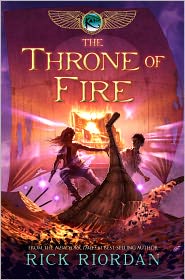
The next book I want to read: The Throne of Fire by Rick Riordan
The last book I bought: I bought Through Gates of Splendor by Elisabeth Elliot so I could do a buddy read with Annette.
The last book that was given to me: My Easter Bible this year was a single-column KJV Bible. When I saw that there was a KJV Bible out there that was a black letter, single column, and in a friendly font size, well, I *had* to have it!
© 2011 Becky Laney of Becky's Book Reviews
The book(s) I'm currently reading: I rarely (if ever) just have one book going. These are the books I'm currently reading: The Pickwick Papers by Charles Dickens, The Silent Speaker by Rex Stout, Sons by Pearl S. Buck, and Northanger Abbey by Jane Austen.
The last book I finished: The Story of Britain from the Norman Conquest to the European Union by Patrick Dillon.
The next book I want to read: The Throne of Fire by Rick Riordan
The last book I bought: I bought Through Gates of Splendor by Elisabeth Elliot so I could do a buddy read with Annette.
The last book that was given to me: My Easter Bible this year was a single-column KJV Bible. When I saw that there was a KJV Bible out there that was a black letter, single column, and in a friendly font size, well, I *had* to have it!
© 2011 Becky Laney of Becky's Book Reviews
Subscribe to:
Posts (Atom)