Saturday, January 21, 2012

Born and Bred in the Great Depression

Born and Bred in the Great Depression. Jonah Winter. Illustrated by Kimberly Bulcken Root. 2011. Random House. 40 pages.

Where you grew up, on the edge of town,
next to the tracks,
you could hear the trains going by
at night.


East Texas,
the 1930s--
the Great Depression.

Set in Texas in the 1930s, Born and Bred in the Great Depression is based on the stories Jonah Winter heard about his father and his childhood during the Depression. The storytelling is simple--poetic, even. I found the text to be engaging as well. It's as if he's writing--or speaking--directly to his father. I think that keeps things interesting. I found the text to be well written. It was simple--yet beautiful. It felt honest. Like a celebration of love and family.

I also enjoyed the illustrations by Kimberly Bulcken Root. I felt they matched the text well. Beautiful, detailed, yet simple and sweet.

Read Born and Bred in the Great Depression
  • If you like family stories
  • If you like historical picture books
  • If you like honest, beautiful, yet simple, stories of the heart

© 2012 Becky Laney of Becky's Book Reviews

Friday, January 20, 2012

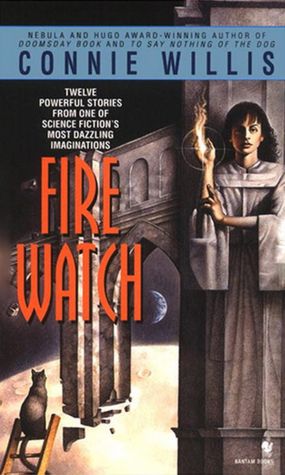
Fire watch

Firewatch. Connie Willis. 1985. Bantam Books. 271 pages.

Firewatch by Connie Willis is the FIRST short story collection I've read for the 2012 Short Story Reading Challenge.

I am SO GLAD this was not my first introduction to Connie Willis. I've discovered that I enjoy her novels so much more than her short stories.

With one little exception, the title story "Fire Watch."

Fire Watch is the FIRST story set in the world of Doomsday Book, To Say Nothing of the Dog, Blackout and All Clear. It introduces readers to the alternate-world where time travel is the way historians LEARN their subject. Readers meet Mr. Dunworthy and Kivrin, though the narrator is another historian, one who is accidentally going to St. Paul's during the London Blitz of 1940. His original assignment had him traveling WITH St. Paul! Quite a difference! This novella is great. It won both a Hugo Award and Nebula Award. And I would recommend this story to just about anyone who likes science fiction and time travel.
There are no guidelines for historians, and no restrictions either. I could tell everyone I'm from the future if I thought they would believe me. I could murder Hitler if I could get to Germany. Or could I? Time paradox talk abounds in the history department, and the graduate students back from their practica don't say a word one way or the other. Is there a tough, immutable past? Or is there a new past every day and do we, the historians, make it? And what are the consequences of what we do, if there are consequences? And how do we dare do anything without knowing them? Must we interfere boldly, hoping we do not bring about all our downfalls? Or must we do nothing at all, not interfere, stand by and watch St. Paul's burn to the ground if need be so that we don't change the future? All those are fine questions for a late-night study session. They do not matter here. I could no more let St. Paul's burn down than I could kill Hitler. No, that is not true. I found that out yesterday in the Whispering Gallery. I could kill Hitler if I caught him setting fire to St. Paul's. (12-13)
You may read the novelette online.

Other stories in the collection include:
  • Service for the Burial of the Dead
  • Lost and Found
  • All My Darling Daughters
  • The Father of the Bride
  • A Letter From the Clearys
  • And Come from Miles Around
  • The Sidon in the Mirror
  • Daisy, in the Sun
  • Mail-Order Clone
  • Samaritan
  • Blued Moon
My second favorite story was The Father of the Bride. This short story is a fairy-tale retelling. It is the Sleeping Beauty story from the father's perspective. It was very enjoyable! Definitely one of the highlights of the book for me. 

I would say that most of the other stories just weren't me. Service for the Burial of the Dead, Lost and Found, A Letter from the Clearys, and And Comes from Miles Around while not quite wowing me had some enjoyable qualities to them.

My least favorite has to be All My Darling Daughters.

Read Fire Watch
  • If you're a fan of Connie Willis
  • If you're a fan of short stories in the science fiction and fantasy genres
  • If you're wanting to read the first Willis time-travel story

© 2012 Becky Laney of Becky's Book Reviews

Thursday, January 19, 2012

All Clear

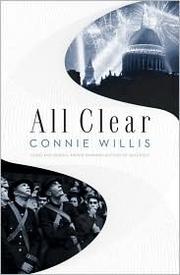
All Clear. Connie Willis. 2010. Random House. 645 pages.

By noon Michael and Merope still hadn't returned from Stepney, and Polly was beginning to get really worried. Stepney was less than an hour away by train. There was no way it could take Merope and Michael--correction, Eileen and Mike; she had to remember to call them by their cover names--no way it could take them six hours to go fetch Eileen's belongings from Mrs. Willett's and come back to Oxford Street. 

All Clear is the sequel to Connie Willis' Blackout. And as I mentioned yesterday, you are going to want to read these two books as if they were one. (There's a good reason these two books were the combined winner for the 2011 Hugo Awards. And the Nebula Awards. Doomsday Book also won both the Hugo and Nebula. To Say Nothing of the Dog just won the Hugo Award. I think it says quite a lot that each of Connie Willis' time travel books has won an award!!!)

So how much is it safe to say in a review of All Clear? Since even talking about the first few chapters of All Clear will spoil the drama of Blackout?! I was thinking about that yesterday as I wrote the review. Would that one review 'do' for both books? What more would I say about the second book? And essentially the only thing I thought of was that All Clear was even better, even more intense. If Blackout was dramatic and exciting, then All Clear is unbelievably dramatic and incredibly fast-paced. Almost dangerously so. In that, I was so WORRIED about the characters, about what was going to happen next, about what it all meant, about where it was all going, that I RUSHED, RUSHED, RUSHED through the chapters. I read a 645 page novel in one day. (Not to mention that it was the same day I finished Blackout.)

Together Blackout and All Clear were an amazing, amazing read. Just incredible. The characterization is great. There were just SO MANY characters I loved. The premise is interesting. And the intensity, the pace, the drama of it, well, few books can match it.

For those that may not have seen my review of Blackout, let me just keep it simple. Three historians (time travelers) have gone back in time to 1940. Each historian is researching or observing something different. Different locations--in England. Different months in 1940. But when SOMETHING happens that 'traps' them in that time period, well, they have to learn how to really live in that time period. Their research stops being research, and it becomes all about surviving.

Read All Clear
  • If you've read Blackout and just HAVE to know what happens next
  • If you're a fan of Connie Willis' other time travel books (Doomsday Book, To Say Nothing of the Dog, Blackout. Just be sure you've read Blackout first. I've also just learned that there is a short story, Fire Watch, available to read here.)
  • If you're a fan of time travel novels
  • If you're a science fiction fan
  • If you're looking to read an award-winning book (Hugo, Nebula, Locus)
  • If you're looking for a novel with GREAT characterization
  • If you're looking for an intense, fast-paced plot
  • If you're a fan of Agatha Christie and mysteries from the time period
  • If you're a fan of historical fiction set in World War II
  • If you're interested in the details and drama of the war
  • If you're a fan of Shakespeare and the theatre

© 2012 Becky Laney of Becky's Book Reviews

Wednesday, January 18, 2012

Blackout

Blackout. Connie Willis. 2010. Random House. 495 pages.

Colin tried the door, but it was locked. 

I thought I'd start with a word of warning. When you get to the end of Blackout, you're going to NEED to have a copy of All Clear ready to go. Because, chances are, you're going to want to pick it up right away. There is no 'real' ending in Blackout. There is no resolution. There's no peace to be had. Usually I might say that's not such a positive thing in a book, but in this case, I'm forgiving.

You might also find it helpful to know that Blackout can be read as part of a series of time travel books by Connie Willis. The books share some characters: Mr. Dunworthy is in Doomsday Book, To Say Nothing of the Dog, Blackout, and All Clear. Although he is only a main character in Doomsday Book. Badri is in Doomsday Book and Blackout. Finch is in Doomsday Book and To Say Nothing of the Dog. Colin is in Doomsday Book, Blackout, and All Clear. Verity and Kindle are in To Say Nothing of the Dog, but are mentioned (very) briefly in Blackout.

But you should also know that it's not essential that all of these books be read in order. It is definitely essential that you read Blackout and All Clear in the proper order. But you don't have to have read Doomsday Book or To Say Nothing of the Dog in order to enjoy or appreciate Blackout/All Clear.

There are three main characters--three main narrators--in Blackout. Each is a historian, a time traveler. Each has plans for multiple assignments in the twentieth century. Each is experiencing frustration as these drops are rearranged and rescheduled. The historians are Merope who is 'observing' the evacuation of children from London to the country. She 'becomes' Eileen O'Reilly and works as a nurse or maid in one of the homes. Under her care are two very, very wild children. Of course, she's responsible for more than two children. Her employer has taken in many children--over a dozen, I think? But those two are the ones that make her life more than a little unpleasant. Her assignment is for the spring of 1940. Polly "Sebastian" is a historian observing the London Blitz in the fall of 1940. Her assignment has her working in a shop on Oxford Street. She is curious in observing how the Blitz effects people. How they are able to cope with the bombs falling over their heads. How they are able to cope with the terror of it all--knowing each and every night that they could die. The third historian is Michael Davies. Since he was supposed to observe Pearl Harbor first, he's got an implant to give him an American accent. But with the shuffling of assignments, he's now observing the Dunkirk evacuation in June 1940. His research has him observing heroes. He's looking to observe the qualities that make someone brave and heroic, what makes a person risk their lives to save others.

If all went according to plan, these three would NOT have met--in the past. Their assignments in 1940 would not have overlapped in time or place. But not all went according to plan...and now these three are going to need each very, very much if they're going to survive...

Read Blackout
  • If you are a fan of historical fiction set during World War II
  • If historical details fascinate you 
  • If you are interested in the London Blitz  
  • If you are a fan of historical fiction set in Britain
  • If you are a fan of science fiction and/or time travel
  • If you are looking for an extremely compelling read
  • If you're looking for an intense read; something very dramatic
  • If you are a fan of Connie Willis
  • If you read Doomsday Book and are interested in finding out what happens to Colin when he grows up...
  • If you're looking for memorable characters 
  • If you are a fan of Agatha Christie and other mystery writers of the time 
  • If you want a book you just CAN'T put down no matter what 
I loved this one. I just LOVED it. It was so intense, so dramatic, so emotional. It just held my attention. I cared about these characters so much! And to see them in danger, well, I just couldn't stand to put this book down!!!

© 2012 Becky Laney of Becky's Book Reviews

Library Loot: Third Trip in January

New Loot:

A Boy Called Dickens by Deborah Hopkinson
Dear Miss Breed: True Stories of the Japanese American Incarceration during World War II by Joanne Oppenheim
Beyond Infinity by Gregory Benford
Hull Zero Three by Greg Bear
Gather, darkness! Fritz Leiber
A Boy Named Shel by Lisa Rogak
Enchantress from the Stars by Sylvia Louise Engdahl
An Acceptable Time by Madeleine L'Engle
The Girl Who Became a Beatles by Greg Taylor
Psychoshop by Alfred Bester and Roger Zelazny
Alas, Babylon by Pat Frank
Sylvia & Aki by Winifred Conkling
The Fault in Our Stars by John Green
Nineteen eighty-four by George Orwell
Redwall by Brian Jacques

Leftover Loot:

In the Garden of Beasts: Love, Terror, and an American Family in Hitler's Berlin by Erik Larson 
Company of Liars by Karen Maitland
Between Shades of Gray by Ruta Sepetys
Everybody Sees The Ants by A.S. King
Loving, Living, Party Going by Henry Green
The Decameron by Giovanni Boccaccio; translated by Guido Waldman
The American Heiress by Daisy Goodwin

Library Loot is a weekly event co-hosted by Claire and Marg that encourages bloggers to share the books they’ve checked out from the library. If you’d like to participate, just write up your post-feel free to steal the button-and link it using the Mr. Linky any time during the week. And of course check out what other participants are getting from their libraries. 

© 2012 Becky Laney of Becky's Book Reviews