Saturday, March 10, 2012

Library Loot: Second Trip in March

New Loot:
  • The Bookends of the Christian Life by Jerry Bridges and Bob Bevington
  • The Complete C.S. Lewis Signature Classics by C.S. Lewis
  • Orthodoxy by G.K. Chesterton
  • Bonhoeffer: Pastor, Martyr, Prophet, Spy: A Righteous Gentile vs. The Third Reich by Eric Metaxas
  • Pandemonium by Lauren Oliver
  • Read This Next: 500 of the Best Books You'll Ever Read by Sandra Newman and Howard Mittelmark
  • The Fat Years by Chan Koonchung, translated from the Chinese by Michael S. Duke.
  • Conscience: Two Soldiers, Two Pacifists, One Family: A Test of Will and Faith in World War I. by Louisa Thomas
  • Macbeth: A True Story by Fiona Watson
  • The Snow Child by Eowyn Ivey
  • 25 Books Every Christian Should Read: A Guide to The Essential Spiritual Classics edited by Julia L. Roller
  • Penny and Her Song by Kevin Henkes
  • No Go Sleep by Kate Feiffer
  • UnBEElievables: Honeybee poems and Paintings by Douglas Florian
  • The Guns of August by Barbara W. Tuchman
  • For All the Tea in China: How England Stole the World's Favorite Drink and Changed History by Sara Rose
  • Kristallnacht: Prelude to Destruction by Martin Gilbert
  • Kasztner's Train: The True Story of an Unknown Hero of the Holocaust by Anna Porter
Leftover Loot:
  • Midnight in Austenland by Shannon Hale
  • The War to End All Wars: World War I by Russell Freedman  
  • The Invisible Bridge by Julie Orringer
  • All That I Am by Anna Funder
  • A Woman in Berlin: Eight Weeks in the Conquered City: A Diary by Anonymous
  • Dreamers of the Day by Mary Doria Russell
  • No Time to Wave Goodbye by Ben Wicks
  • Elsie and Mairi Go To War: Two Extraordinary Women on the Western Front by Diane Atkinson
 Library Loot is a weekly event co-hosted by Claire and Marg that encourages bloggers to share the books they’ve checked out from the library. If you’d like to participate, just write up your post-feel free to steal the button-and link it using the Mr. Linky any time during the week. And of course check out what other participants are getting from their libraries.    


© 2012 Becky Laney of Becky's Book Reviews

Rereading Boneshaker

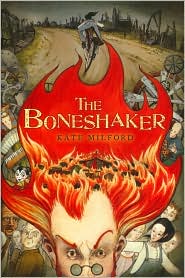
The Boneshaker. Kate Milford. 2010. May 2010. Houghton Mifflin Harcourt. 372 pages.

Strange things can happen at a crossroads. It might look like nothing but a place where two dusty roads meet, but a crossroads can be something more. A crossroads can be something special, a compass with arms reaching to places you might never find the way to again; places that might exist, or might have existed once, or might exist someday, depending on whether or not you decide to look for them.
But whatever else it might be, a crossroads is a place where you choose.


I have now read Kate Milford's The Boneshaker three times. (The first time was in July 2010, the second in December 2010). I can now truly say that this is indeed one of my favorite, favorite historical fantasy novels. Not that it's fully, completely fantasy. It is set in the real world, in a small American town in 1913. And many details do feel authentic for the time period. But. There are characters that have had showdowns with the devil himself. (Think The Devil Went Down To Georgia.) And there is something more--much more--to the traveling carnival that has come to town.

Almost everything from my original review still rings true:

Read this book. Now. Why? Because this book is so very, very good. It's one of those books where the moment you finish it, you want to start it all over again. You don't want it to be over. You want to keep experiencing it.

What did I love about this book? The characters, the story, the storytelling, the setting, the atmosphere, the descriptions. It was such an amazing blend of history, mystery, and fantasy. The Boneshaker is set in 1913, in Arcane, Missouri. This is a town that for whatever reason makes travelers uneasy. It's not a place most would stop and see for fun, for pleasure. Perhaps it's a little too close for comfort to the Old Village, the first settlement of the crossroads that was abandoned several generations before the novel opens. So while Arcane may not seem like much--at least to the outsider--it is home to our heroine, Natalie Minks. She's very smart, very curious. She likes to know how things work. She's fascinated by machines. And she loves spending time with her father who is a mechanic--a bicycle mechanic mostly, though he fixes anything with wheels for the most part.

Arcane doesn't see many strangers. But one day a stranger shows up in town--his wheel broke, you see--and this stranger is none other than Dr. Jake Limberleg. He has a medicine show. The full name is Dr. Jake Limberleg's Nostrum Fair and Technological Medicine Show. And while he's waiting for his wheel to be fixed--so he can go on his way, Arcane was not a planned stop by any means--he decides to go ahead and open up his show, his fair. There are a handful of people in the community who are skeptical about this man and his team of 'doctors' of 'experts.' Among these is Natalie. She may be the cleverest one of them all. She may be the only one able to solve this mystery. But can she do it in time?

The Boneshaker is so compelling. It had me from hello. The characters, the storytelling, the writing, I thought all of it was so well done. Kate Milford made me care about these characters, and she kept me hooked from start to finish.


Read The Boneshaker
  • If you like historical fiction, historical fantasy, historical mysteries
  • If you like stories with a bit of supernatural to them--not TOO much, just enough and no more
  • If you like strong heroines that are on their way to developing their full potential (Loved her resourcefulness, her curiosity, her courage, her determination)
  • If you love stories with well-developed, fascinating characters
  • If you love stories with atmosphere, with a strong setting,
  • If you love stories with mysteriously creepy traveling carnivals or medicine shows

© 2012 Becky Laney of Becky's Book Reviews

Friday, March 09, 2012

11/22/63

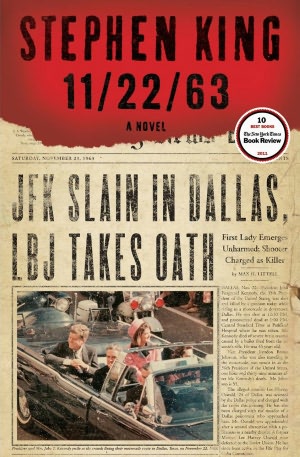
11/22/63. Stephen King. 2011. Scribner. 864 pages.

I have never been what you'd call a crying man. 

This is the second Stephen King novel I've read, and honestly I'm not sure how I'd compare the two I've read: Under the Dome and 11/22/63.

In Under the Dome, the violence is graphic, and the bad language proved problematic...for me. But, oh, the tension. It was such a compelling read. The pacing was amazing. It really was. It was a page-turner. I didn't like the characters particularly. I hated some of them--granted, some of them were evil incarnate. But I HAD TO KNOW what happened next. The premise, well, it was horrifying and intriguing all at the same time.

11/22/63 was in many ways a tamer novel. Less violence, less bad language (though it's still there to a certain degree. I am NOT claiming this is a clean read.) But. Well, how can I say this? For me at least it lacked tension. The premise of time travel should have been wowing me from start to finish. But it didn't. The only one that had to deal with consequences--in my opinion--was the narrator Jake Epping who time-traveled under the name George Amberson. So long as he remained alive and able to return to 2011 through the time-bubble, all other mistakes, all other consequences just didn't matter at all. Not really. Sure, they mattered to him. He, personally, felt those mistakes and had his struggles and doubts. But no one else could ever know the difference between worlds and alternate realities.

I'm not sure how I really felt about the narrator, Jake/George. On the one hand, his "good angel" intentions of playing God and determining the future and making the world a better place by preventing a handful of tragedies were understandable. I mean if you could prevent a death by time-travel, shouldn't you? Jake knew one person whose life was forever-changed one Halloween night when his drunken father came home and murdered his mother, his two brothers, and his sister. He was the only one to survive--and only because he was in the bathroom when the killing spree began. But he saw too much--much too much--and his father tried and failed to kill him too. So when Jake discovers this time-travel-bubble that automatically sends you to September 1958--almost a full month before this tragedy--he feels like he has to "fix" things. He has to test time-travel to see if he can change things...for the better.

But Jake/George's main goal, his main mission, is not to save his friend from a horrible childhood, but to save "the world" or "the nation" from experiencing the tragedy of Kennedy's assassination. A world where Kennedy continued his term (and was reelected) as president would have to be a better world than the one we now live in, right? Especially if you're tempted to think he was the best human, best leader, best politician, best president ever, ever, ever. To think that he was the best, smartest, wisest, kindest, strongest.

So that is his mission: prevent JFK from being assassinated. And, to a certain degree, King stays on task. But his idea of staying "on task" isn't the most thrilling way to spend your time. Readers are treated to five years (at least) of Jake/George living in the past. And part of the focus is on his mission, but much of it is not. Part of it is focused on his career as a teacher/mentor. Part of it is focused on his 'career' as a writer as he prepares a manuscript or two. Part of it--a large part of it--is focused on his finding his one, true love. Yes, a good part of 11/22/63 is a romance novel with focus on feelings, dancing, and secret weekend hideaways. 

While many elements of the story are nice enough in their own way, they don't necessarily add up to the most compelling, most page-turning read ever. I suppose there are several questions that could keep you reading--Will he successfully stop the assassination? (Hint: Don't look at the back cover.) Will he get to stay with his one, true love? Will he stay with her in the past? Or will she go with him to the future? Will this divorced teacher find his happily ever after? But none of those were quite enough for me.

The one area this novel worked for me--and I'm not even sure if this was the intent--was seeing this novel as a test for one man, to see how selfish or selfless one man could be. I can't say more without spoiling it. But essentially he's asked to choose between his own happiness and the greater good of the world at large.

I suppose this one also treats morality and ethics. Do two wrongs make a right? Does shooting a murderer before he's murdered anyone make your murder moral? I also saw this one as dealing with humans playing God. Here we have one man who is determined to remake the world into a "better" place. But what he didn't take into account is how tragedy shapes us. How tragedies and sorrows and struggles shape our character and develop us. I thought of so many scenes from Orson Scott Card's Worthing Saga.

Part of me really, really wishes that more time had been spent on alternate presents. The ending felt incredibly rushed and not completely believable.

Read 11/22/63
  • If you're interested in time travel, in science fiction
  • If you're interested in history, particularly history/culture of the late 1950s to early 1960s
  • If you're interested in politics and issues (Vietnam war, communism, civil rights, etc.) of the times
  • If you're interested in teachers and librarians (our hero and heroine)

© 2012 Becky Laney of Becky's Book Reviews

The Girl of Fire and Thorns (YA)

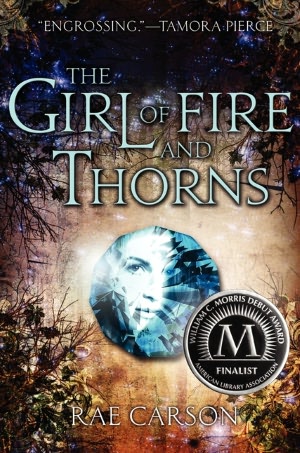
The Girl of Fire and Thorns. Rae Carson. 2011. HarperCollins. 425 pages.

Prayer candles flicker in my bedroom. The Scriptura Sancta lies discarded, pages crumpled, on my bed. Bruises mark by knees from kneeling on the tiles, and the Godstone in my navel throbs. I have been praying--no, begging--that King Alejandro de Vega, my future husband, will be ugly and old and fat. Today is the day of my wedding. It is also my sixteenth birthday.

The Girl of Fire and Thorns was nothing like I expected. I read the first few chapters and imagined it heading in one direction. I didn't expect it to go oh-so-differently than how I imagined it. And yet, I can't say that those differences kept me from enjoying this novel. Not really.

Elisa is a princess, the second princess. But she's been Chosen, chosen almost since birth. For she bears the godstone in her navel. And chosen ones only appear every four hundred years or so. So she's special. But her being special makes her all that much more vulnerable. For it seems that there are oh-so-many ways to view the godstone. Yes, some react with reverence and respect, devotion and loyalty. But not all. There are some who would kill her for the stone in her navel. Some who would see her as expendable, her only worth being the stone itself. So while her 'chosen' status is known in some circles, in others it's a very closely kept secret.

So. The novel opens with Elisa preparing for her marriage. She's nervous for many reasons. She'll be marrying a stranger, a King, a king with a young son, a king that may or may not be over the loss of his first wife, a king that may or may not ever care for her, a king whose character is completely unknown to her. She's nervous about the impression she'll make on him her future husband. She's definitely on the plump side, and she feels her wedding dress makes her look like an over-stuffed sausage. She sees rolls and rolls of fat and worries that that is all he'll see too. She worries that he'll never look at her with respect, with friendship, or love. So part of her hopes that she won't be attracted to him. She hopes that she won't want a real marriage.

But the King is anything but ugly or fat or old. He makes quite a first impression on her. Not that it's love at first sight. It isn't. It really isn't. But he's kind and gentle. And he seems to see her. Enough that readers feel there is potential. That there is a spark of something that will work in the heroine's favor...

So their journey together begins soon after the marriage. The trip to his kingdom is NOT easy. In fact, it clarifies things for readers. Rae Carson is NOT afraid to kill off characters.

They arrive...and she learns that her marriage is to be kept secret...indefinitely. Once they arrive, she barely sees her new husband...at all. And that small spark of potential seems to vanish completely. But her new life isn't horribly lonely. Not really. But before she can adapt to her new role, a role that has her merely as visiting princess, she's kidnapped...and EVERYTHING changes...Elisa most of all. She goes from a shy and uncertain oh-so-vulnerable heroine who doubts that she'll ever live up to being 'the chosen one' to being someone who's incredibly fierce and resourceful and stronger than she ever imagined herself being...

I liked The Girl of Fire and Thorns. There were things I loved about it. There were things I didn't quite love about it. But for the most part I enjoyed it and would recommend it.

Read The Girl of Fire and Thorns
  • If you're a fan of Shannon Hale
  • If you're a fan of Megan Whalen Turner
  • If you're a fan of strong heroines
  • If you're looking for a heroine that doesn't quite look--at least at first--like your typical heroine
  • If you're a fan of fantasy novels
  • If you don't mind losing more than a few characters along the way

© 2012 Becky Laney of Becky's Book Reviews

Thursday, March 08, 2012

The Running Dream (YA)

The Running Dream. Wendelin Van Draanen. 2011. Random House. 336 pages.

My life is over. Behind the morphine dreams is the nightmare of reality. A reality I can't face.

Jessica was a great runner, a star of her school's track team. But one day on the bus ride back from a meet, something horrible happens. Someone crashes into their bus. Lucy, her teammate, dies, and Jessica loses her leg. The novel is about how she copes with that loss. How the loss of a leg, at first, is the loss of a dream. But how through that loss she's able to see some things more clearly than before. Like how much her teammates really do care about her. So much that they sacrifice their time and energy and put all their heart and soul into fund raising for her. Like how she sees another classmate for the first time, a classmate in a wheel chair for quite another reason. Rosa was always so easy to ignore before, but now she's seeing her as a real person worth knowing.

So The Running Dream is a novel about hopes and dreams and perseverance. It is an emotional novel, of course. But it isn't purely inspirational. Jessica is, in many ways, just an ordinary girl with ordinary problems. Like how the guy she has a crush on doesn't really see her like that--not really. And how she struggles with keeping up in math, etc.

Read The Running Dream
  • If you're interested in sports stories with heart
  • If you're looking for an emotional, inspirational read
  • If you're looking for YA novels about friendship and family


© 2012 Becky Laney of Becky's Book Reviews