Saturday, August 16, 2014

Library Loot: Third Trip in August

New Loot:
  • The Magic Half by Annie Barrows
  • The Orphan and the Mouse by Martha Freeman
  • Friends Help Each Other by Farrah McDoogle
  • Thank You Day by Farrah McDoogle
Leftover Loot:
  • Tudors Versus Stewarts by Linda Porter  
  • The Family Romanov by Candace Fleming
  • The Little Girl Who Fought the Great Depression: Shirley Temple and 1930s America by John F. Kasson
  • Rebecca by Daphne du Maurier
  •  Death of a Dowager by Joanna Campbell Slan
  •  Elephant Company by Vicki Constantine Croke
  • Flight by Elephant by Andrew Martin 
Library Loot is a weekly event co-hosted by Claire from The Captive Reader and Linda from Silly Little Mischief that encourages bloggers to share the books they’ve checked out from the library. If you’d like to participate, just write up your post-feel free to steal the button-and link it using the Mr. Linky any time during the week. And of course check out what other participants are getting from their libraries.    

© 2014 Becky Laney of Becky's Book Reviews

Week in Review: August 10-16

The Dog Who Could Fly: The Incredible True Story of a WWII Airman and the Four-Legged Hero Who Flew At His Side. Damien Lewis. 2014. Simon & Schuster. 304 pages. [Source: Library] 
The Convenient Marriage. By Georgette Heyer. (1934) Read by Richard Armitage. 2010. August 2010. Naxos Audiobooks. 5 hrs. 6 minutes. [Source: Review copy]
Kate's Story, 1914. (Secrets of the Manor #2) Adele Whitby.  2014. Simon & Schuster. 160 pages. [Source: Library]
Beth's Story, 1914. (Secrets of the Manor #1) Adele Whitby. 2014. Simon & Schuster. 160 pages. [Source: Library]
The 101 Dalmatians. Dodie Smith. 1956/1989 Penguin. 192 pages. [Source: Owned Since Childhood]
The Glass Sentence. S.E. Grove. 2014. Penguin. 512 pages. [Source: Library] 
Charity Envieth Not. (George Knightley #1) Barbara Cornthwaite. 2009. CreateSpace. 260 pages. [Source: Library]
Lend Me Leave. (George Knightley #2) Barbara Cornthwaite. 2011. CreateSpace. 246 pages. [Source: Library]
The Wonder-Working God. Jared C. Wilson. 2014. Crossway. 192 pages. [Source: Review copy]
Centurion: Mark's Gospel As A Thriller. Ryan Casey Waller. 2013. Interlochen Ink. 190 pages. [Source: Bought]
Captured by Love. Jody Hedlund. 2014. Bethany House. 384 pages. [Source: Review copy]

This week's favorite:

I'm going with nonfiction this week. For the record, I love, love, love The Convenient Marriage by Georgette Heyer. I listened to the audio book narrated by Richard Armitage. It was WONDERFUL. But it was also abridged. I recommend it in spite of it being abridged because Armitage does such a fabulous job. But still I wish it had been unabridged.

The Dog Who Could Fly is my choice this week. I really loved it. I recommend it for those interested in World War II, OR in flying, OR anyone who is a dog lover! It was a compelling and memorable read.

© 2014 Becky Laney of Becky's Book Reviews

Friday, August 15, 2014

#33 Convenient Marriage

The Convenient Marriage. By Georgette Heyer. (1934) Read by Richard Armitage. 2010. August 2010. Naxos Audiobooks. 5 hrs. 6 minutes. [Source: Review copy]

"Lady Winwood being denied, the morning caller inquired with some anxiety for Miss Winwood, or, in fact, for any of the young ladies. In face of the rumour which had come to her ears it would be too provoking if all the Winwood ladies were to withhold themselves."

I can't do justice in my review. I just can't. This audio book is perfect. Not practically perfect. But actually perfect. (Dare I say that Richard Armitage and Georgette Heyer go together better than chocolate and caramel?) Those five hours, well, they feel so delightfully delicious and satisfying. (An audio sample is available from Naxos Audiobooks).

The book itself is one of Georgette Heyer's best. I loved it the first time I read it. And I've appreciated it more with each rereading. (My first review is from 2009; my second review is from 2010; my third review is from 2013.) Best is a tricky word, I admit. Every single Heyer fan has strong opinions on what her "best" books are. And reading is subjective. And opinions can and do change over time. I know I struggle with having a favorite with Heyer BECAUSE whatever book I just read (by Heyer) I may just say is my favorite or best. That's one of the reasons why, last year, I wanted to challenge myself to read ALL of her romances in one year so that I could have them all fresh in my mind and decide--though not decide once and for all--which books were best, which books were definitely my favorites.

Heyer created dozens of heroes and heroines. But Lord Rule (Marcus) and Horatia (Horry) are probably among my favorite and best. They make a great couple!!! But the novel has great overall characterization. There are many characters to love! And in some cases, characters that you can't help loving-to-hate. Not many romance novels spend enough time with other characters, with "minor characters," so it is always wonderful to find.

From my first review:
We meet the Winwood family early on in The Convenient Marriage. We spy on them (in a way) as Mrs. Maulfrey comes to call--or should I say get the juicy gossip on the latest news in the family. Elizabeth, the oldest sister is upset and rightfully so. Her mother, Lady Winwood, has just agreed to an engagement between her and the rich Earl Rule. The problem? Elizabeth is in love with a poor (at least relatively speaking) soldier, a Mr. Edward Heron. Charlotte, the middle sister, doesn't see what the big deal is. After all, in her way of thinking marriage doesn't amount to much. She has no interest--so she claims--in becoming someone's wife. But the youngest sister, Horatia feels her sister's pain. And she's determined--though she stutters or stammers and has thick eyebrows--to do something to solve this dilemma. She gives Mr. Heron her word that she will not let their hearts be broken. Her plan is quite bold and quite wonderful. By that I mean it is deliciously entertaining. The first few chapters of this one are so full of promise. Especially the second and third chapters. If there was an award for the best-ever-second-chapter-in-a-book, I'd nominate The Convenient Marriage.

However, the book soon settles down. As you can probably guess from the title, it is about a marriage--a husband and wife. Marcus Drelincourt (a.k.a. The Earl, or Marcus, or simply 'Rule') and his wife, Horatia (or Horry). And since the marriage occurs early in the book--by page sixty--the reader knows that there must be some drama in the works. And indeed there is. There's the former (and somewhat still current) mistress who's jealous and spiteful, Lady Massey. There's the cousin-who-would-inherit-it-all-if-only-Rule-would-hurry-up-and-die, Mr. Crosby Drelincourt, a cousin. And the villainous and cold-hearted Lord Lethbridge. All three of these people add to the drama--each in their own little way. All want to get revenge on Rule. All want to see the happy little couple become miserable. And oh the plotting that goes on that tries to break up this pair!

Horatia's closest friend is her brother, Pelham. Though he's a bit of a gambler--and often an unlucky one at that--he's got a good heart. I don't know if it was Heyer's intent to make him so likable, so enjoyable, but I just really liked him in spite of his flaws. He truly had his sister's best interests at heart. And she does need someone to look out for her with all the villains roaming about the town (or should that be ton) out for revenge.

None of the characters in The Convenient Marriage are perfect. All are flawed in one way or another. But the relationships are genuinely enjoyable, and are quite well done. The atmosphere of The Convenient Marriage--much like Heyer's other novels--is so rich, so detailed, so luxuriously drawn. The society. The fashion. The wit. The charm. The dangers of being unique in a world where conformity reigns. The delicate balance between being respectable, being boring, and being the Talk or Toast of the ton.
From my second review:
Listening to the novel (abridged though it may be) gave me a greater appreciation for Georgette Heyer. Why? While I've always appreciated Heyer's dialogue--it being a chance for her characters to be witty, charming, or romantic--I appreciate it even more having heard it performed. The wit seems funnier. The action scenes even more dramatic. The love scenes even more romantic. I wouldn't have thought it possible for one narrator to convey the chemistry between two characters--but with Armitage narrating it works really well.
© 2014 Becky Laney of Becky's Book Reviews

Thursday, August 14, 2014

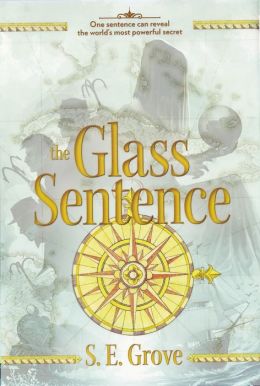
The Glass Sentence (2014)

The Glass Sentence. S.E. Grove. 2014. Penguin. 512 pages. [Source: Library]

The Glass Sentence has an intriguing premise with incredible potential. As soon as I heard the premise, I knew I had to read it. And, in many ways, it is a premise-driven novel. And there's nothing at all wrong with that, not when the premise is so unique. What is the premise? A Great Disruption occurs (roughly 1799) which fragments time itself. Continents and countries are displaced in time, if you will. So explorers are not just traveling from place to place, but also time to time. It makes exploring even more dangerous and unpredictable. Some societies want to forbid travel between Ages, want to stop foreigners from coming to their land, want to forbid travelers from leaving.

In The Glass Sentence, readers meet Sophia Tims. Her parents are explorers that have been missing most of her life. She has been raised by her uncle Shadrack, a cartologer. He insisted that her parents leave her behind. She was just three. She loves him, she does, but she misses her parents. She holds onto the hope that they'll come back OR that she'll go off adventuring and find them. Shortly after the novel opens, he begins to teach Sophia what he knows. He begins to share his secrets with her; he tells her that there are many different types of maps. That maps can be written on things besides paper. They can be written on glass, for instance, or even water. She's looking forward to learning...

But. Just when it is getting started, Sophia returns home to learn that her uncle has been kidnapped and that his study has been destroyed. Sophia and a new friend, Theo, a former zoo exhibit, team up to save the day. Can they find her uncle? Can they rescue him? Can the bad guys be defeated?

The world building works. It's an interesting and complex world. And, as I said, the premise has great potential. It's just an exciting sounding premise with plenty of appeal.

I liked it. I did. I didn't quite love it as I was hoping. But it was well worth a read.

© 2014 Becky Laney of Becky's Book Reviews

Wednesday, August 13, 2014

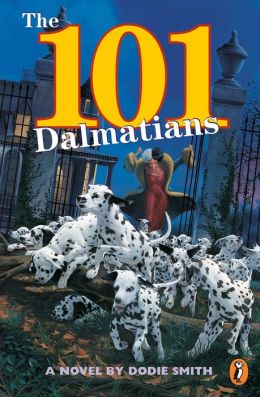
101 Dalmatians (1956)

The 101 Dalmatians. Dodie Smith. 1956/1989 Penguin. 192 pages. [Source: Owned Since Childhood]

I have been meaning to read this one for decades. The Disney adaptation is one of my favorites. It is. I love and adore it. Kanine krunchies can't be beat they make each meal a special treat. It's just a satisfying movie that is practically perfect in every way.

So. What did I think of the book? Well. It's different that's for sure. Missis and Pongo are the lovely dalmatian couple with fifteen adorable puppies. The human couple, Mr. and Mrs. Dearly, seeks out another dalmatian wet nurse, if you will. The vet says that no dog can successfully nurse fifteen puppies and have them all thrive. So seven of the pups become Perdita's to raise. The three dogs become quite close friends. The happy couple pities Perdita for she lost her love, Prince, and her own puppies. (Mr. Dearly does NOT write songs. He's an accountant or something along those lines. The book merely says he's a financial wizard who did something or other for the government.)

Cruella de Vil and her HUSBAND are social acquaintances of Mr. and Mrs. Dearly. She wears fur year-round. Her husband is a furrier, and, she doesn't hide the fact that she married him because of it.

The basics of the story are the same. Cruella de Vil wants the puppies and hires someone to steal the puppies. True, there are two nannies tending to the puppies instead of just one. But, the end result is the same. The puppies are gone. Pongo and Missis do the twilight bark, eventually they hear back that the puppies are found.

I liked this one.

© 2014 Becky Laney of Becky's Book Reviews