Friday, September 05, 2014

Reread #36 Blue Plate Special

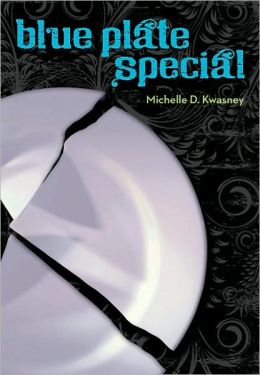
Blue Plate Special by Michelle D. Kwasney. 2009. Chronicle Books. 366 pages. [Source: Library]


I originally reviewed Blue Plate Special in February of 2010. I loved it. I loved it the same way that I love Speak by Laurie Halse Anderson.

Blue Plate Special is a compelling, dramatic story about three daughters. (John Mayer's "Daughters" kept coming to mind. For better or worse. Also Atticus' advice to Scout: "if you can learn a simple trick, Scout, you'll get along a lot better with all kinds of folks. You never really understand a person until you consider things from his point of view--until you climb into his skin and walk around in it.") The book is very much character-driven. I don't know that I'd go so far to say that it is one of those "what it means to be human" books, but, if not it comes very close.

All of the characters are flawed; not one person within the pages of this book is perfect or flawless. Relationships in Blue Plate Special are messy. Readers meet three heroines. Madeline (1977-78). Desiree (1993-1994). Ariel (2009). Their stories are told in alternating chapters. I believe all the heroines are around fifteen to sixteen. As you'd expect, in some ways their stories are the same, yet, in other ways all three are different. All, for example, are coming-of-age stories. All focus on first love, or first significant romantic relationships. All are bittersweet, but in different ways. But each heroine is unique. The book is great at complexities. Of seeing the whole person from different angles, which made it easier perhaps to take Atticus' advice. I cared about all three.

I definitely would recommend this one.

© 2014 Becky Laney of Becky's Book Reviews

Thursday, September 04, 2014

The Lost (2014)

The Lost. Sarah Beth Durst. 2014. Harlequin. 352 pages. [Source: Library]

Running away from possible bad news, Lauren Chase, our heroine, finds herself almost hopelessly lost when a road trip goes wrong. Lauren enters a dust storm on a highway, and, when the dust is cleared she's entering the town LOST. Her first impressions of this town, well, I'm sure we'd share if we were in her place. But Lauren decides that as weird as the town is, it is still better than going back out on the highway this late at night when you have no idea where you are and how to get back to civilization. One of the many weird things about the town is how all the residents act like they know something she doesn't: that she'll not be leaving town anytime soon, that she's just as stuck as they are. Lauren tries to leave town. Most of the day she tries to leave town, to no avail. No one is surprised to see the newbie return to town frustrated and confused. They tell her to find the Missing Man. He might be able to help her find what she's lost and enable her to leave the town of Lost.

The Lost has two symbolic characters, the "Missing Man" and the "Finder." Lauren ends up meeting both men...

In the past, Lauren has evaded her feelings. She's not dealt with everything that has happened in her life. But now, she almost has no choice but to own up to her feelings and reflect on the past and go through her memories one by one. Her focus is on the "possible" bad news. Her mother's latest test results. Is the cancer back? Is it terminal? How long does her mother have left?

Will Lauren find her own way out of Lost? Does she even want to leave Lost?

© 2014 Becky Laney of Becky's Book Reviews
Wednesday, September 03, 2014

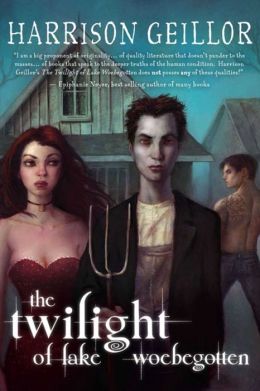
The Twilight of Lake Woebegotten

The Twilight of Lake Woebegotten. Harrison Geillor. 2011. Night Shade Books. 320 pages. [Source: Review copy]

Is it a horror novel or comedy? Readers will be the final judge in the end.

I do not like horror novels. There are a few slight exceptions now and then that I've discovered by accident. But. For the most part, I don't seek out horror novels. So, if I don't seek out horror novels, why would I read The Twilight of Lake Woebegotten? For one reason, primarily. The book pokes fun at Stephanie Meyer's Twilight series. It asks a big 'what if?' What if the heroine is not good, clumsy, and naive? What if the heroine is evil and manipulative? What if she wears a mask in every relationship? Being who she needs to be--in that moment--to get what she ultimately wants?

Bonnie Grayduck is the heroine who appears to fall madly and deeply in love with Edwin Scullen, a vampire. And she is one of the monsters in this horror novel. The events loosely fit into the Twilight books, so, one could definitely see the book as being a parody. But this parody isn't a ha-ha parody.

Bonnie is a dark person. She doesn't think nice, happy thoughts. She wants what she wants when she wants it. It is all about power and control and desire. And she has adult desires. Don't expect the "innocent" tension or chemistry from Twilight. This book is for more mature readers, I'd say.
So Edwin had taken a sudden trip to Canada. Interesting. It was insane to think he'd left town because of me...but in my experience, most things in the world do seem to resolve around me. And if they don't start out that way, they get there eventually. (50, ARC)
"Ike's great," I said, because if I told her I thought he was podgy and dull she'd get offended, "but I like Edwin."
She looked at me, now. "Really? Scullen? You don't like Ike?"
"I like him, what's not to like, but, not that way."
"I don't understand you," J said, voice heavy with mistrust. "Ike is so sweet and good and kind, and Edwin...he's so cold and condescending and superior."
I gave a great sigh. "I know. I've always been attracted to boys like that." (80, ARC)
I'm not much of a reader, but if I was, apparently I'd have a hard time reading any novel written in the last fifty years that didn't have a brooding sexy conflicted vampire in it--the shelves were just full of the stuff. (91, ARC)
"You are a brave, wonderful, suicidally stupid, diplomatic-incident-causing, amazing woman," Edwin said, kissing my face all over. We were in my bed, two nights after Gretchen's very timely demise. He'd only been back for about ten minutes, and he'd already called me names, clutched me to his bosom, sobbed a bit, brooded a fair amount, and proclaimed his love in a fairly operatic fashion. He'd finally settled down to snuggling me in bed which was rather less exhausting. (196, ARC)
© 2014 Becky Laney of Becky's Book Reviews

Tuesday, September 02, 2014

Love by the Morning Star (2014)

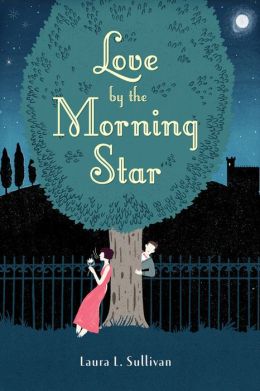
Love by the Morning Star. Laura L. Sullivan. 2014. Houghton Mifflin Harcourt. 320 pages. [Source: Review copy]

I was disappointed by Laura Sullivan's Love by the Morning Star. I wanted to love it. I did. It is a novel set in English countryside in 1938-1939. It offers an upstairs/downstairs view of life. Or supposedly so. Two young women come to Starkers. One is a gold digger spy. Her father is a Nazi-sympathizer to say the least and his gang (for lack of a better word) wants her in position at this estate. She's told she'll be a maid. The other young woman is a Jewish refugee. She is actually a relation of the family who owns the estate. She's coming to Starkers to stay with her aunt and uncle. One girl is Hannah. The other girl is Anna. One will be treated well. The other won't.

In case you haven't guessed it, mistaken identity is the name of the game. These two women also happen to fall in love with the same man.

Why was I disappointed? Well. I'm not sure if it's because of the setting or the tone. I think I might have tolerated the tone--the silliness, the lightness, the double entendres, etc. if it wasn't set during such a dark time. It's hard to make light of the Nazis gaining power and destroying the lives of the Jewish people. The subject is serious and it deserves better. If it had been set twenty-five or thirty years earlier, then, perhaps it would have worked for me.

The romance. I liked the secret meetings between the hero and the heroine. There were only a handful of these scenes, but, they kept me reading.

I just have to add that I HATED one of the characters. I disliked a few more as well. But there was one that stood out above the rest as being AWFUL.

© 2014 Becky Laney of Becky's Book Reviews

Monday, September 01, 2014

Two Get Into Art Books

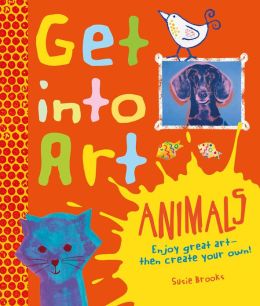
Get Into Art: Animals. Susie Brooks. 2013. Kingfisher. 32 pages. [Source: Review copy]

 If you were going to draw an animal, what would it be? You have so much choice, it might be hard to decide! Animals are a great subject for artists because there are so many shapes, colors, and characters to choose from...Look at the different ways in which animals have inspired famous artists--and then let them inspire you, too!

What a fun concept book for sharing art with children! Get Into Art Animals shares twelve famous artworks with children. Facts about the artists are given for each work of art. In addition, there is a recommended hands-on art project inspired by each work. A glossary in the back defines art terms. There's also a list of everything you'll need to do all the projects.

The Snail, Henri Matisse, 1953
Suspense, Sir Edwin Landseer, 1861
Crinkly Giraffe, Alexander Calder, 1971
The Bird, Georges Braque, 1949
Peacock and Magpie, Edward Bawden, 1970
Fish (E59), M.C. Escher, 1942
Carnival of Harlequin, Joan Miro, 1924-1925
Totem Poles, Wayne Alfred and Beau Dick 1991 and Ellen Neel 1955
Yellow Cow, Franz Marc, 1911
Dragon Wish, Chinese artist 1600-1635
Portrait of Maurice, Andy Warhol, 1976
Jockeys in the Rain, Edgar Degas, 1883-1886

The project for "Totem Poles" is "Crafty Totem." Making your own totem pole out of a cardboard tube and paper. But my favorite may just be "Colorful Cats" a project inspired by Andy Warhol.
Colorful Cats
Warhol's silk-screen method was complicated, but you can get a similar effect with a simple stencil.
1. On a piece of card stock, draw the outline of an animal and carefully cut it out. You'll end up with two stencils like these. (Cut out the eyes, nose and mouth on the second stencil).
2 Lay stencil 1 on a piece of thick paper and attach it with paper clips. Sponge yellow paint all over it.
3. When the paint is dry, lift the stencil and move it slightly down and to one side. Sponge red paint unevenly over it and then leave it to dry.
4. Now lay stencil 2 on top of the picture and sponge blue paint over the holes. Leave it to dry, and then remove the stencil. Cut out the animal and stick it onto a colorful background. (You can print whiskers by dipping the edge of a strip of card stock in paint.)
Warhol often repeated his prints in different colors. Try making a set like this. (27)
Get Into Art: People. Susie Brooks. 2013. Kingfisher. 32 pages. [Source: Review copy]

Can you think of an art subject that's always around? Just look in a mirror for the answer! Artists often base their work on themselves or other people. Some create portraits to remember people by or characters to illustrate a story. Others capture feelings, actions, fashions, or imaginary faces. The great thing is that people are all different, and artists can bring them to life in many ways. See how people have inspired famous artists--then let them inspire you, too!

I have really enjoyed looking at both books in this art-appreciation series. Like the previous book, this one introduces twelve works of art to children. Facts about each artist are shared. Each work is connected to a hands-on art project. A project materials checklist and a glossary are included in the back.

Vertumnus, Giuseppe Arcimboldo, about 1590
Weeping Woman, Pablo Picasso, 1937
David, Michelangelo Buonarroti, 1501-1504
The Scream, Edvard Munch, 1893
Children's Games, Pieter Bruegel the Elder, 1560
Portrait of Adele Bloch-Bauer 1, Gustav Klimt, 1907
A Sunday Afternoon On the Island of La Grande Jatte, Georges Seurat, 1884
Grotesque Faces, Leonardo da Vinci, 1500s
Egyptian Burial Mask, Ancient Egyptian craftspeople, around 3000 BC to A.D. 1st Century
Girl in Mirror, Roy Lichtenstein, 1964
Lawn Tennis, Eadweard Muybridge, 1887
Las Meninas, Diego Velazquez, 1656

There are so many great project ideas in this one! I find myself liking the projects better in Get Into Art People than in Get Into Art Animals. I'm not sure why! I like how the project for "David" is teaching proportion in drawing. It shows step by step how to draw a face (and body) in proper proportion. The Mummy Mask looks like so much fun!!! However, the example I'd like to share with you is inspired by the photograph action sequences of Eadweard Muybridge.
Action Snaps
To photograph your own action sequences you'll need a camera and a friend.
1. Decide what movement you are going to photograph. It's best if it's something that can be done slowly. Get your friend to try moving in slow motion and holding each stage of the pose. When you're ready to start, stand at a good distance from your subject so that he or she fills the camera frame.
2. Keep the same distance between you and your friend as you photograph each stage of the action. If your model moves in one direction, you should move too.
3. If you're photographing something quick, like a somersault, get your friend to repeat the movement and press the shutter button at a different stage each time.
4. Print out your photos and arrange them in sequence--or "stitch" them together on a computer.  (27)
I would recommend both of these books by Susie Brooks. 

© 2014 Becky Laney of Becky's Book Reviews