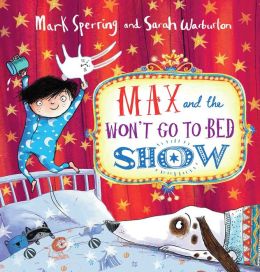
Max and the Won't Go To Bed Show. Mark Sperring. Illustrated by Sarah Warburton. 2014. Scholastic. 32 pages. [Source: Review copy]
Ladies and gentlemen! Boys and girls! Hurry, hurry, for the BEST SHOW ON EARTH! Tonight for your entertainment and delight, we proudly present, from all the way behind the curtain, the world's youngest magician. Please put your hands together for... MAX THE MAGNIFICENT.
DRUMROLL, PLEASE!
Tonight we will see his world-famous and death-defying PUTTING OFF BEDTIME FOR AS LONG AS POSSIBLE SHOW!
For his first trick...
Max and the Won't Go To Bed Show is a delightful picture book. The hero, Max, who is not tired and does not want to go to bed--at least not yet--is putting on a show for his family. The show also involves the family dog, Brian. Brian, well, he's not quite as magnificent as Max himself. The text is lively and clever. I love the descriptive language and the playfulness of it. It is a bit over-the-top, but, in a good way. For example,
And now prepare to be SHOCKED and AMAZED. You are about to witness the seldom seen FLOATING PAJAMA TRICK. Max will cause his pajamas to float off the chair and across the room. And, perhaps the most difficult part of all, he'll attempt to put them on. Audience, be warned, this trick can take up to half an hour to perform...though, luckily, not tonight.
I also love the illustrations. I do. I loved Max's expressions. Overall, this one is oh-so-easy to recommend. (This one was originally published in the UK.)
Text: 5 out 5
Illustrations: 5 out of 5
Total: 10 out of 10
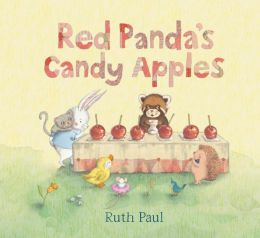
Red Panda's Candy Apples. Ruth Paul. 2014. Candlewick. 32 pages. [Source: Review copy]
Red Panda is selling candy apples. He made them himself. They are delicious and very sticky. Rabbit is his first customer. He gives Red Panda some money. Red Panda counts the coins and puts them in a jar. But Red Panda is sad to give Rabbit the candy apple. He is not very good at selling things he would like to eat himself. Lick. Crackle. Crunch.
I love this book. I do. I love the character of Red Panda. I could sympathize with his dilemma. On the one hand, he has made the apples to sell, and he is making money. On the other hand: Lick, crackle, crunch. He has to watch his customers eating "his" candy apples. I loved this one cover to cover. The text has a just-right feel to it. Not too wordy, not too sparse.
I love the illustrations. They are quaint but not cutesy. I love the subdued colors. I definitely recommend this one. I agree that this book may now wow everyone. (It's not a call-attention-to-myself book like, for example, Max and the Won't Go To Bed Show.) But what picture book ever does, really? (This one was originally published in New Zealand.)
Text: 5 out of 5
Illustrations: 4 out of 5
Total: 9 out of 10
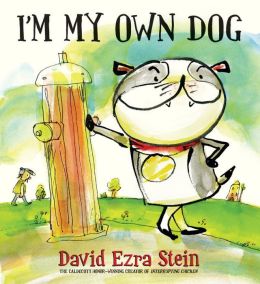
I'm My Own Dog. David Ezra Stein. 2014. Candlewick. 32 pages. [Source: Review copy]
I'm my own dog. Nobody owns me. I own myself. I work like a dog all day. When I get home, I fetch my own slippers. I curl up at my own feet. Sometimes, if I'm not comfortable, I tell myself to roll over. And I do.
What a fun book! I'm My Own Dog is a funny, playful book about a dog and his pet human who follows him home one day. The first half of the book establishes his independence, and the second half focuses on his new relationship. The book ends with a sweet confession.
As I said, it's fun, playful, and a good read-aloud choice. Especially for dog-lovers. I found the text to be quite clever.
Text: 5 out of 5
Illustrations: 4 out 5
Total: 9 out of 10
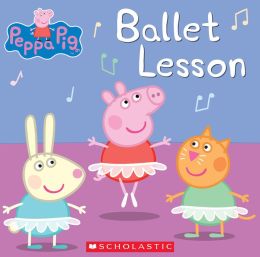
Peppa Pig Ballet Lesson. Adapted by Elizabeth Schaefer. 2014. Scholastic. 24 pages. [Source: Review copy]
Mummy Pig is taking Peppa to her first ballet lesson. Madame Gazelle greets them at the door. "You must be young Peppa," she says with a graceful bow.
I love Peppa Pig. I do. That being said, some Peppa Pig books are better than others. Some seem to capture the magic of the show in book-form better than others. I thought the Ballet Lesson worked well. It captures the playfulness of the episode well. I liked all the thumping. I liked how Mummy Pig and Daddy Pig just happen to have been quite good at ballet back in the day.
For fans of the show, this book is a good read aloud choice. It is also an affordable choice.
Text: 3 out of 5
Illustrations: 3 out of 5
Total: 6 out of 10
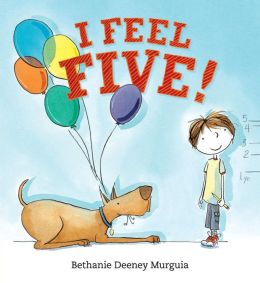
I Feel Five. Bethanie Deeney Murguia. Candlewick. 32 pages. [Source: Review copy]
On his fourth birthday, Fritz Newton ate birthday pancakes, got his very own cape, and picked apples for birthday pie. Being four was fun, but tomorrow...Fritz will be five! And he is quite sure that five will feel very different. He'll probably even lose his first tooth.
Will Fritz wake up FEELING five on his birthday? Will being five really feel differently than being four? Fritz thinks so. At least in the beginning. He has this idea in his mind of what it will be like to be five, what it will feel like. Ultimately, he's disappointed for most of the book. What he does day-to-day at five is essentially the same as what he did day-to-day when he was four. There does come a point in the book where Fritz does start feeling five. This happens when he helps a girl. He helps her by picking an apple for her from the tree. Something he can do--just barely--by jumping in his brand-new shoes.
I Feel Five! is an almost book for me. The premise makes sense, in a way; people of all ages can have high expectations of BIG birthdays and be a little disappointed at the sameness. And it does handle the concept of disappointment relatively well. It is a thoughtful book. But it isn't exactly a happy again-again read-aloud. It's not funny or playful or sweet.
Text: 3 out of 5
Illustrations: 3 out of 5
Total: 6 out of 10
Go To Sleep, Little Farm. Mary Lyn Ray. Illustrated by Christopher Silas Neal. 2014. Houghton Mifflin Harcourt. 40 pages. [Source: Review copy]
Somewhere a bee makes a bed in a rose,
because the bee knows day has come to a close.
Somewhere a beaver weaves a bed in a bog.
Somewhere a bear finds a bed in a log.
Somewhere gray mice hide their bed under roots,
safe from the owl who whoo-whoo-hoots.
Well. It has at least one starred review. (Publishers Weekly) But. This bedtime book didn't quite work for me. Not that it was awful. It wasn't. It leans more towards poetry than most picture books. For better or worse. Some lines, some rhymes seem to work well. Take the opening line, for example, "Somewhere a bee makes a bed in a rose, because the bee knows day has come to a close." This book is all about imagery and language and the sounds of words--being lulling. If a lulling bedtime book works, works dependably to send little ones to sleep quickly, or, efficiently then that has some value especially to parents.
The reason this one doesn't quite work for me is because some of the imagery is a bit too bizarre or whimsical...for me. It doesn't start out that way. It really doesn't. So the whimsy sneaks up on a reader. Is that good? Is that bad? Who can say! I'll show you what I mean, "Now little fish lie still in a brook. Somewhere a story goes to sleep in a book. Somewhere a worm sleeps in the dirt. Somewhere a pocket sleeps in a skirt."
The illustrations. Well. Some spreads I do love. Others seem--at least at first glance--even more bizarre than the text itself. They do match the whimsical, surreal tone of the text. So if you love one, you'll probably love the other.
Text: 3 out of 5
Illustrations: 3 out of 5
Total: 6 out of 10
The Scarecrows' Wedding. Julia Donaldson. Illustrated by Axel Scheffler. 2014. Scholastic. 32 pages. [Source: Review copy]
Betty O'Barley and Harry O'Hay were scarecrows. (They scared lots of crows every day.) Harry loved Betty, and Betty loved Harry. So Harry said, "Betty, my beauty, let's marry! Let's have a wedding, the best wedding yet. A wedding that no one will ever forget." Betty agreed, so they hugged and they kissed. Then Betty said, "Harry, dear, let's make a list." "Just as you say," answered Harry O'Hay. So they wrote down the Things they would Need on the Day: a dress of white feathers, a necklace of shells, lots of pink flowers, two rings and some bells. Then Harry gave Betty O'Barley his arm and the scarecrows set off on a hunt round the farm.
It's certainly an interesting story with a couple of unique elements. I had no idea what to expect, and, it certainly ended up surprising me here and there. Which I guess is a good thing? The first half of this book is focused on Betty and Harry being together and looking for all the things on their list. The trouble occurs when the two go their separate ways. Just one item remains on their list. Harry wants to get it himself. But. Harry is slow, very, very, very, very slow. So slow in fact that the farmer presumably gets another scarecrow to replace him! His name is Reginald Rake. Almost everything that occurs after his arrival is a bit bizarre. (I wasn't expecting cigars in a picture book! I actually found that plot twist a bit disturbing.) It is still plenty predictable though by the end. I'm not quite sure how this book was both predictable and surprising, but, it was.
(This one was originally published in the UK.)
Text: 2.5 out of 5
Illustrations: 3 out of 5
Total: 5.5 out of 10
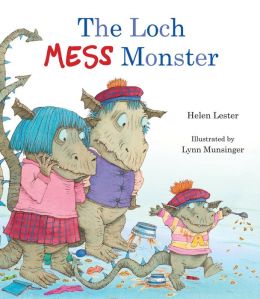
The Loch Mess Monster. Helen Lester. Illustrated by Lynn Munsinger. 2014. Houghton Mifflin Harcourt. 32 pages. [Source: Review copy]
In faraway Scotland there was a famous lake called Loch Ness. And legend had it that deep in this lake lived a monster. No one had ever seen it. But guess what? The legend was false. In truth, way, way, down at the bottom of Loch Ness there lived not one...but three monsters! there was Nessie, her husband, Fergus, and their wee laddie, Angus.
The Loch Mess Monster has a glossary of Scottish terms (in order of appearance) before the story. It is needed. Trust me. Unless you happen to know that hummie-doddies are mittens or that puggy-nits are peanuts. The story will make more sense if you familiarize yourself with the vocabulary!
The Loch Mess Monster is a book about being messy, too messy. It is a book about how one should clean up after himself, to put things back where they belong. Angus is the mess-maker. His messy room is out of control. Some of his mess belongs in the trash. It's simply disgusting. Some of his mess are his own books and toys. Until he sees for himself the dangers of being TOO messy, the problem just keeps growing worse.
The book is obviously a lesson book. For better or worse. This one is not my favorite on the subject. But it's a nice book. This one will appeal especially to storytellers who like to do accents or try to do accents.
Text: 3 out of 5
Illustrations: 2.5 out of 5
Total: 5.5 out of 10
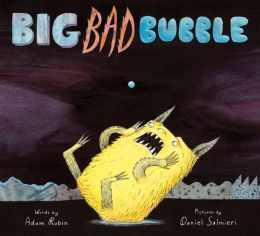
Big Bad Bubble. Adam Rubin. Illustrated by Daniel Salmieri. 2014. Houghton Mifflin Harcourt. 40 pages. [Source: Review copy]
You may not know this, but when a bubble pops, it doesn't just disappear. It reappears in La La Land...where the monsters live. For some reason, all the big, scary monsters are terrified of bubbles. Froofle, why are you running away? Yerburt, what's the matter? Wumpus, stop crying. (Tell Wumpus to stop crying.)
What you see is what you get. For the most part. In my opinion, if a book is going to be strange and bizarre, it's best to know that from the start, preferably from the cover. Monsters and bubbles. That's what readers are promised. Now. Are the bubbles big and bad?! Well, that's a matter of perspective. Readers expect monsters to be big and bad, but, bubbles?
The premise of this one is silly but simple. Monsters live in La La Land. Monsters are scared of bubbles. Bubbles disappear from here--when they're popped--to La La Land. Therefore monsters spend a lot of their summers terrified by bubbles. The narrator (and the reader) try to talk some sense into the monsters. Bubbles are not scary. Bubbles can be easily popped. Especially by monsters. There is no reason to run away from a bubble. Will the narrator successfully help the monsters?
It's silly. It's weird. It's certainly unique. It probably won't be for everyone. It seems like a book people will either love or hate. It was better than I expected. However, I wasn't expecting much.
Text: 4 out of 5
Illustrations: 2 out of 5
Total: 6 out of 10
© 2014 Becky Laney of
Becky's Book Reviews