Showing posts with label 1831. Show all posts

Wednesday, July 07, 2021

58. The Captain's Daughter: Essential Stories


The Captain's Daughter: Essential Stories. Alexander Pushkin. TRANSLATED BY ANTHONY BRIGGS. (New translation copyrighted 2021). 224 pages. [Source: Review copy]

First sentence: Alexander Pushkin (1799–1837) is the father of modern Russian culture, the man who reformed the Russian literary language, and, in a short lifetime of less than thirty-seven years, left a legacy of outstanding works in several genres, some of them newly invented.

Premise/plot: This book features the novella, The Captain's Daughter, and two short stories The Stationmaster and The Queen of Spades. It also features a spoiler-heavy introduction. The book, as a whole, introduces new readers to this Russian author. 

The Captain's Daughter (1836) takes up the bulk of the book. Pyotr Grinyov, our hero, has many adventures and misadventures. But those misadventures may just be his salvation in the end. The novel soon has him underway to his first military posting. It is remote, rural, far from ideal--as far as he's concerned. 

I could be like the introduction and spoil every little detail of the novel. But I won't. I refuse to play that game. No, I'll simply share that it's told in first person and he's recounting his adventures/misadventures. The incidences in his life--some apparently minor, others not so much--that has led him to where he is. 

The title gives away that at some point there will be a captain and a captain's daughter...but I will leave it to readers to connect the dots to predict how it will turn out.

The Stationmaster (1831) is another first hand narrative. If the narrator is clearly named, I personally missed it. But essentially he is recounting three separate visits to this out of the way station. On his first visit, he meets a beguiling, beautiful, flirtatious young woman, Dunya, who is the station master's daughter. On the second visit, he reintroduces himself to the father and learns that the daughter has long been gone. The father is distraught about the circumstances and fears the worst. The third visit has the potential to be the most depressing ever ending (for a non Thomas Hardy book), but a twist makes it only slightly sad or mildly happy.

The Queen of Spades (1834) is the final short story. Hermann, our anti-hero, stars in this short story. His friend tells the story of his grandmother--an elderly countess. This story--a story of a SECRET that every gambler would kill for--leads to obsession and.... well, let's just say it doesn't end well for most of the characters.
 

My thoughts:  Let's begin with the introduction. On the one hand, it did contain some useful tidbits about who Pushkin was, when he lived, when he wrote, what he wrote, how his work was received, who he influenced, etc. On the other hand, why did the introduction have to SPOIL the novel and each story. It's like being handed a balloon, and then having the person handing it to you pop it with a pin and a grin. Seriously.

Now on to the Captain's Daughter. I loved this one. I did. It didn't have me at hello. It took a chapter (or two). But once I settled into the novel, it was love. It was SO enjoyable and not at all intimidating. Perhaps because of its length, perhaps because of its narrative style, perhaps because Pushkin was just that good at setting, characters, pacing, storytelling. I liked how the story blended in an actual historical figure, Yemelyan Pugachov, a revolutionary imposter. You know how reading Russian lit sometimes feel like WORK how it takes a LOT of effort to get a reward. This wasn't like that. It didn't feel like work and there was still a lovely reward.

Now on to The Stationmaster. I liked this one. It actually reminded me of L.M. Montgomery in some ways. It wasn't a thrilling story. There wasn't any adventure or action in it. But the characters felt real. In comparison with The Captain's Daughter it wasn't as satisfying. But it also was just a fraction of the length with just a few characters.

Finally....my thoughts on the Queen of Spades. I am SO GLAD this wasn't my first exposure to Pushkin. If this one short story was all I ever read of Pushkin, it would leave a bad taste in my mouth. (Yes, I know books aren't for eating.) I could see how it could appeal to some literary types. This one gives off major literary (elite) vibes. But it just wasn't for me. 

Overall, I would recommend this book to those wanting to read Russian literature and not knowing quite where to begin. It can be daunting to hand off Anna Karenina, War and Peace, or The Brothers Karamazov, or Crime and Punishment. (I've not read War and Peace, I have read all the others). I also like that he is an EARLY novelist and credited with really transforming the Russian language. (I'll take the editor's word on that.) He switched from writing poetry (he was writing at the same time as the Romantics like Byron) to prose when the public taste changed. 

The Captain's Daughter--the novella--is SO good. Definitely recommend it. The other stories are bonuses as far as I'm concerned. 


© 2021 Becky Laney of Becky's Book Reviews

Wednesday, September 02, 2009

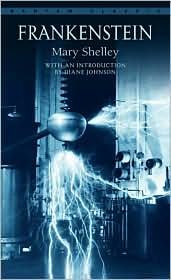
Frankenstein


Shelley, Mary. 1831. Frankenstein. Dover Large Print Classics. 283 pages.

You will rejoice to hear that no disaster has accompanied the commencement of an enterprise which you have regarded with such evil forebodings.

Frankenstein is one of my favorite books. (And this isn't the first time I've reviewed it for the blog). It may seem an odd book to have as a comfort read, but it works for me. What is it about Robert Walton, Victor Frankenstein, and 'the monster' that keeps me coming back for more? What is it about Shelley's story that keeps drawing me back? I think, in part, it's the depth and substance. The beauty. The horror. The fact that each and every time I read it, I walk away with something new.

So what did I find new this time round? What fascinated me this time? Well, the relationship between Walton and Victor Frankenstein. I don't know about you--and I guess I'm being a bit presumptuous assuming that you know the story--but I've never liked Victor Frankenstein. I've never really sympathized with him. He's a miserable fellow, but in my opinion he had it coming. Or so I've always thought up until now. What I noticed was how much Walton genuinely liked Victor Frankenstein. How he actually enjoyed his company. Wanted his friendship.

Walton for those that need a reminder is a sea captain; he hopes to be an arctic explorer as well. That's why his ship is traveling North. That's why he just happens to be in the right place at the right time 'to save' Victor Frankenstein. The two men do have more than a little in common: both have stubborn single-minded ambition with a fair dose of pride. But the two men are different as well. Victor Frankenstein had it all--mostly. True, he lost his mother. But he had, at the beginning, his family and friends. His father. His two brothers: William and Ernest. His best girl, Elizabeth. His best friend, Henry Clerval. I think Frankenstein took everything he did have for granted--at least in the beginning.

We don't know as much about Robert Walton as we do Victor Frankenstein. In his letters to his sister, we do know how lonely and how isolated he feels...at that moment. How much Walton longs for a friend, a companion. How much he is hurting and wanting to have someone or something fill his emptiness. Is this genuine? Or did Robert Walton choose to leave his family and friends much like Frankenstein did all in the name of would-be-glory? How close is Walton to his sister? Are there others he was close to at one time or another?

What did Robert Walton see in Victor Frankenstein that I don't? What did he see to admire? to love? to respect? What was it about Victor's brokenness that touched Walton's soul? Did he recognize himself in Victor and his story? Did he realize that he could one day share Frankenstein's fate if he didn't curb his ambition? What did he take away from the story Frankenstein told? Did he see it as just a tragedy, or did he see it as a warning as well?

There are three points of view in Frankenstein. The frame of the story is Robert Walton's correspondence with his sister, Mrs. Saville. Most of the story is told via Victor Frankenstein himself. (Albeit Robert Walton's recording of said story.) In a handful of places, 'the monster' or 'the creature' or 'the being' speaks for himself. But only once is that done directly--when the monster speaks to Robert Walton. The rest of the time the monster's point of view is embedded in Victor Frankenstein's story. Frankenstein telling Walton what his conversations with the creature were like.

In my previous readings, I've only ever sympathized with 'the monster.' I loathed Victor Frankenstein. Saw him as the only true monster. But in the past two readings, I've expanded my heart a bit. Began to see Walton as a blend of the two extremes: he had the ambition of Victor Frankenstein and the longing soul of the monster. Now I can't say I understand Walton. Being an arctic explorer, going out into the great unknown (the frozen unknown), seeking to be the first, to be the best, having that determination and drive to be 'the one' is something that is beyond me. (Historically, I think it works. I think in the nineteenth and early twentieth century there were many little boys who wanted to grow up to be explorers--both in the Arctic and Antarctica.) But the biggest surprise of all was that in this last reading of the novel, my heart began to thaw even for that meanie Victor Frankenstein.

Alas! why does man boast of sensibilities superior to those apparent in the brute; it only renders them more necessary beings. If our impulses were confined to hunger, thirst, and desire, we might be nearly free; but now we are moved by every wind that blows and a chance word or scene that that word may convey to us.

We rest; a dream has power to poison sleep.
We rise; one wand'ring thought pollutes the day.
We feel, conceive, or reason; laugh or weep,
Embrace fond woe, or cast our cares away;
It is the same: for, be it joy or sorrow,
The path of its departure still is free.
Man's yesterday may ne'er be like his morrow;
Nought may endure but mutability!

(112-113)
Have you read Frankenstein? What did you think of the three main characters? Who do you sympathize the most with? Do you think that Robert Walton "gets it" in the end? Do you think he is a changed man?

© Becky Laney of Becky's Book Reviews