Showing posts with label 1874. Show all posts

Thursday, March 18, 2021

27. Far from the Madding Crowd


Far from the Madding Crowd. Thomas Hardy. 1874. 433 pages. [Source: Bought]

First sentence: When Farmer Oak smiled, the corners of his mouth spread till they were within an unimportant distance of his ears, his eyes were reduced to chinks, and diverging wrinkles appeared round them, extending upon his countenance like the rays in a rudimentary sketch of the rising sun.

Premise/plot: Poor Bathsheba! She can't leave the house without some man falling in love with her. Far From the Madding Crowd is the story of three such men whose lives are forever changed--for better or worse--by knowing and subsequently loving (or "loving") Bathsheba.

Readers first meet Gabriel Oak. He loves her at first sight--even though he isn't quite sure what to make of her. Next, readers meet William Boldwood and Francis Troy. Boldwood loves her madly--emphasis on mad. Bathsheba loves Sergeant Troy madly. In both cases, the love seems something not entirely in anyone's control. It is a love without reason or even against reason. (Though I suppose there are reasons for and against in each case.) In at least two of the three cases to fall into love is to fall into a sort of madness.

My thoughts: I am not a big Thomas Hardy fan in general. But perhaps I just hadn't found the right Hardy to read. I didn't hate Far From the Madding Crowd. And though it has its tragic, melodramatic moments, it is not as DARK and BLEAK as some of his other novels which I have read.

What I liked best about the novel was the dialogue. In particular the dialogue between Gabriel and Bathsheba.

This is their first meeting:

“My name is Gabriel Oak.” “And mine isn’t. You seem fond of yours in speaking it so decisively, Gabriel Oak.” “You see, it is the only one I shall ever have, and I must make the most of it.”
“I always think mine sounds odd and disagreeable.” “I should think you might soon get a new one.” “Mercy!—how many opinions you keep about you concerning other people, Gabriel Oak.”

And soon after he makes his interest known:


Bathsheba went on. “I haven’t a sweetheart at all—and I never had one, and I thought that, as times go with women, it was such a pity to send you away thinking that I had several.”

“Well—that is a tale!” said Oak, with dismay. “To run after anybody like this, and then say you don’t want him!” “What I meant to tell you was only this,” she said eagerly, and yet half conscious of the absurdity of the position she had made for herself—“that nobody has got me yet as a sweetheart, instead of my having a dozen, as my aunt said; I hate to be thought men’s property in that way, though possibly I shall be had some day. Why, if I’d wanted you I shouldn’t have run after you like this; ‘twould have been the forwardest thing! But there was no harm in hurrying to correct a piece of false news that had been told you.” “Well, what I mean is that I shouldn’t mind being a bride at a wedding, if I could be one without having a husband. But since a woman can’t show off in that way by herself, I shan’t marry—at least yet.”

But there is also something about the narrative itself that works for me.

It may have been observed that there is no regular path for getting out of love as there is for getting in. Some people look upon marriage as a short cut that way, but it has been known to fail. 

But a resolution to avoid an evil is seldom framed till the evil is so far advanced as to make avoidance impossible.


© 2021 Becky Laney of Becky's Book Reviews

Sunday, November 15, 2015

Eight Cousins (1874)

Eight Cousins. Louisa May Alcott. 1874. 224 pages. [Source: Bought]

Rose sat all alone in the big best parlor, with her little handkerchief laid ready to catch the first tear, for she was thinking of her troubles, and a shower was expected.

If only I'd first met Louisa May Alcott through Eight Cousins instead of Little Women! It might not have taken me decades to read a second book by Louisa May Alcott. My first book by Louisa May Alcott was, of course, Little Women. It's not that I found it awful--just awfully sad. Eight Cousins, on the other hand, was a delight from cover to cover.

The heroine, Rose Campbell, is an orphan. She has plenty of aunts--or perhaps I should say great aunts--around in addition to seven boy cousins. Her official guardian is Uncle (Doctor) Alec. His aunts aren't pleased with the arrangement, thinking that one of them--any of them really--could do a "better" job of raising George and Rose's daughter. He offers a compromise of sorts. Let him alone and let him be sole guardian with the final say on everything concerning Rose for a full year, and then at the end of the year have a conference to determine if he did a good enough job to remain her guardian for keeps. The book chronicles Rose's first year.

Readers will see Rose adapt to her new life; make friends with Phebe, the maid servant; make friends with all seven of her cousins; come to accept all her fussy and fidgety aunts; have plenty of adventures in all four seasons of the year; grow academically under the teaching of her uncle; learn practical skills from her aunts--sewing, cooking, cleaning, etc.

Rose is a good, sweet, intelligent young girl. And she was a joy to spend time with. She does act "as a magnet" for her cousins, they're drawn to her and want to spend time with her; her aunts and uncle hope she'll use her magnetism for good--to improve the morals of her cousins. Is the book preachy? Yes and no. I mean I don't think it is especially preachy when compared to children's books written in the Victorian period. Compared to children's books written today perhaps, it is somewhat preachy. I did notice that when the book turned preachy most often it was through dialogue; let's just say that Rose has opinionated aunts! Though not always. Here's a good example:
Fathers and mothers are too absorbed in business and housekeeping to study their children, and cherish that sweet and natural confidence which is a child's surest safeguard, and a parent's subtlest power. So the young hearts hide trouble or temptation till the harm is done, and mutual regret comes too late. Happy the boys and girls who tell all things freely to father or mother, sure of pity, help, and pardon; and thrice happy the parents who, out of their own experience, and by their own virtues, can teach and uplift the souls for which they are responsible.

© 2015 Becky Laney of Becky's Book Reviews

Sunday, April 20, 2014

Phineas Redux (1874)

Phineas Redux. Anthony Trollope. 1874. 768 pages. [Source: Book I bought]

Phineas Redux is the fourth in the Palliser series by Anthony Trollope. Previous titles include Can You Forgive Her?, Phineas Finn, and The Eustace Diamonds.

It has been a few years since Phineas Finn left the joys and sorrows of political life to settle down and marry. (For the record, he didn't really have much of a choice in giving up the politics). But now his luck, for better or worse, is changing. His wife has conveniently died, and there is a new opportunity for him to run for a seat in parliament. He's hesitant but as always ambitious. He leaps for it knowing that he could easily regret it.

It has also been a few years since Lady Laura has left her husband, Robert Kennedy, whom she detests. She is still very obsessed with Phineas Finn. She loves him dearly, she makes him--in her own mind--her everything. Phineas Finn, on the other hand, remembers her kindly but rarely. She is NOT his everything: she hasn't been since she turned down his proposal all those years again. He would never--could never--think of her like that again. He respects her, but, he's content to keep his distance. Her confessions to him are improper, in a way, and prove embarrassing to him.

Lady Laura is not the only woman who has given away her heart to Phineas. Madame Max Goesler still loves him though she's at least discreet or more discreet. At the very least, she has a life outside her daydreams; her social life is active and she has many good friends. She's not as isolated, so, her love for Phineas perhaps does not come across as obsession.

While I was indifferent to Madame Max in Phineas Finn, I grew to really like her in Phineas Redux. Other female characters I enjoyed were Lady Chiltern (whom we first met in Phineas Finn as Violet Effingham), Lady Glencora (whom we first met in Can We Forgive Her?), and Lizzie Eustace (whom we first met in Eustace Diamonds). It was interesting to me to see which heroines Trollope allowed a happily ever after. I was so very pleased to see Lord and Lady Chiltern settling down quite happily. It was LOVELY to spend time with both of them. I still adore Lady Glenora and Plantagenet Palliser together. Lizzie reaps what she sows, but is fortunate in many ways!

There was a new romance introduced in Phineas Redux. Two men are in love with Adelaide Palliser: Gerard Maule and Thomas Platter Spooner. Adelaide, of course, has her favorite. But the other is very persistent. 

In terms of plot: A MURDER. A politician is murdered. There are two suspects. One suspect is Phineas Finn. He is put on trial for the crime...but the evidence is all circumstantial. Will he be convicted? Will doubt and uncertainty of his guilt prevent him from politics in the future? 

© 2014 Becky Laney of Becky's Book Reviews
Saturday, December 11, 2010

Lady Anna

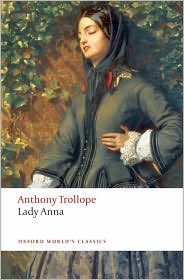
Lady Anna. Anthony Trollope. 1874/2009. Oxford World's Classics. 560 pages.

Women have often been hardly used by men, but perhaps no harder usage, no fiercer cruelty was ever experienced by a woman than that which fell to the lot of Josephine Murray from the hands of Earl Lovel, to whom she was married in the parish church of Applethwaite,--a parish without a village, lying among the mountains of Cumberland, on the 1rst of June 181-. That her marriage was valid according to all the forms of the Church, if Lord Lovel were then capable of marrying, no one ever doubted; nor did the Earl ever allege that it was not so.

While I didn't love the cover, I did love the novel. (Doesn't it look like Lady Anna has a terrible pain in her side? Well, in a way, she does. The pain being her mother.) I almost don't know where to begin.

Did I like it? I loved it! I just LOVED it. Trollope did not disappoint.

Countess Lovel ("Josephine Murray") has spent decades in court trying to "prove" to the world that her marriage was valid. (That Earl Lovel did not have a living wife when the two were married in that small parish church). Also that her daughter, Anna, is legitimate. That being rightly the widow and daughter of the late Earl, they should not only receive their inheritance, but their titles as well. That Countess Lovel should legally be recognized as Countess. That Lady Anna be recognized as Lady. 

But fighting this legal battle is not cheap. And the Countess has not had the money to pay for it herself. When it comes down to it, if it hadn't been for the generosity of the Thwaite family--father and son--the two would not have lasted as long as they have. They have spent most of their lives depending on his money to survive. Daniel, the son, has grown up with Anna. And the two are extremely close. The best of friends. So it's only natural for these two to fall in love with one another, right? Why wouldn't Anna love her best friend, her defender, her provider?

As the legal case progresses, problems arise. That is in finding a compromise, a solution, the difficulty for our heroine arises. Everyone thinks it's a brilliant idea if Anna marries the Earl of Lovel--the young man who has inherited the title. She'll bring the money from the late Earl's estate if her inheritance is proven. He'll bring the title. It would be a perfect match--a flawless one at least on paper. But Anna's heart isn't in that match.

Her heart belongs to Daniel Thwaite, a common working man, a tailor, a Radical too. She has promised to be his wife. And for Anna there can be no breaking of that promise. First, she loves him truly. Second, she's a woman who keeps her word. And the truth is, Daniel wooed her when she had nothing. Daniel's actions match his words. He's proven his worth time and time again. He says what he means, and he means what he says. And this young Earl, well, he is handsome, it's true, and he says the right words--words that might prove tempting to just about any woman. But she knows that these words are at least in part prompted by her (forthcoming) wealth. He seems nice enough. But then again, he is on his best behavior. He's trying to impress her after all. The most Anna will admit is that if they'd met before she'd fallen in love with Daniel--then things might have gone differently.

This match outrages almost everyone. Lady Anna marry a tailor?! Well, that's unthinkable?! How could she--a fine Lady--marry anyone outside her class, her rank? There are many--including her mother--who will try to argue with Anna throughout the novel, will try to threaten her even, to get her to marry the "right" man. Will Anna give into the pressure? Or will she stay true to her lover?

Anthony Trollope was a great storyteller. His characters were always well-developed. All may not have been likable or good. But all the better if they're not. Who can forget Countess Lovel? Or Louis Trevelyan? Or Mr. Slope? (I bet Countess Lovel could have quite a conversation with Louis Trevelyan!)

I read this one as part of the Anthony Trollope Classics Circuit Tour.

© Becky Laney of Becky's Book Reviews