Showing posts with label 1879. Show all posts

Friday, March 10, 2017

Confidence

Confidence. Henry James. 1879. 224 pages. [Source: Bought]
First sentence: It was in the early days of April; Bernard Longueville had been spending the winter in Rome.

Premise/plot: Bernard Longueville and Gordon Wright both fall for the same woman. Angela Vivian, in Henry James' Confidence.

Technically, Bernard meets her first. Their meeting is oh-so-brief. He sketches her, a stranger, a beautiful woman, on the street. He gives the sketch to her--or perhaps to her mother. Weeks later, Bernard is called to visit his scientist-friend Gordon. Gordon is keeping company with a handful of people, and, he's even considering marriage. He wants his friend's opinion. The company he keeps: Angela Vivian and her mother, Mrs. Vivian; Blanche Evers, a woman as silly as she is beautiful, and Captain Lovelock. Bernard recognizes Angela right away. She acts as if she's never seen him, never spoken to him. And the mother does the same thing!

What does he think of her?! What a question?! He doesn't exactly know what kind of woman she is. If she's after his money--Gordon is very wealthy--or if she genuinely likes Gordon. She doesn't act overly in love with him. And she certainly can flirt--when she's of the mind to--with HIM. He can't advise his friend to marry her--at least not right now.

Months later--perhaps even a year later--he hears from Gordon again. Gordon has married married. He's married to Blanche. Bernard has been invited to visit them both when he has the chance...

Bernard soon tires of their company. Well, soon is a relative term, I suppose! He stays in their home three months!!! He travels several places before returning to Europe, to France, I believe? Anyway, he meets Angela and her mother again. This time he finds himself head over heels in love with her. Perhaps he was slightly in love with her before but not wanting to admit it to himself or to his friend?!

What will Gordon do when he hears the news that the two will marry soon?! (You might be thinking, why is it any of his business? After all, he's married. He shouldn't still be lusting after Angela!) But Gordon has a very dramatic reaction....can Angela outwit him?

My thoughts: I like this one. It's a very silly romance. I admit that much is true. But there's a lightness to it that I appreciate.

Gordon to Bernard:
“I want to marry with my eyes open. I want to know my wife. You don’t know people when you are in love with them. Your impressions are colored.” “They are supposed to be, slightly. And you object to color?” 
Bernard and Angela:
“If I have seemed uncivil, let me make it up. When a woman speaks of giving up society, what she means is giving up admiration. You can never have given up that — you can never have escaped from it. You must have found it even at Sorrento.” “It may have been there, but I never found it. It was very respectful — it never expressed itself.” “That is the deepest kind,” said Bernard. “I prefer the shallower varieties,” the young girl answered. “Well,” said Bernard, “you must remember that although shallow admiration expresses itself, all the admiration that expresses itself is not shallow.” 
Other favorites:
But you don’t want to keep smelling a flower all day, even the sweetest; that's the shortest way to get a headache. 
“An opportunity to be wise — not to be foolish!” “Ah, there is only one sort of opportunity,” cried Bernard. “You exaggerate the reach of human wisdom.” 
Since Gordon had determined to marry a little goose, he had chosen the animal with extreme discernment. It had quite the plumage of a swan, and it sailed along the stream of life with an extraordinary lightness of motion. He asked himself indeed at times whether Blanche were really so silly as she seemed; he doubted whether any woman could be so silly as Blanche seemed. He had a suspicion at times that, for ends of her own, she was playing a part — the suspicion arising from the fact that, as usually happens in such cases, she over-played it. Her empty chatter, her futility, her childish coquetry and frivolity — such light wares could hardly be the whole substance of any woman’s being; there was something beneath them which Blanche was keeping out of sight. She had a scrap of a mind somewhere, and even a little particle of a heart.
The soul is a still more tender organism than the body, and it shrinks from the prospect of being subjected to violence.
“I particularly dislike receiving apologies, even when I know what they are for. What yours are for, I can’t imagine.” 
“If pride is a source of information, you must be a prodigy of knowledge!” 

© 2017 Becky Laney of Becky's Book Reviews

Friday, May 10, 2013

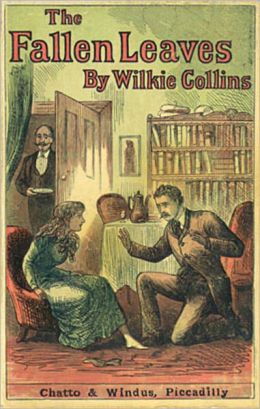
Fallen Leaves (1879)

The Fallen Leaves. Wilkie Collins. 1879. 344 pages.

I have really enjoyed some of the novels I've read by Wilkie Collins. I loved, loved, loved Armadale and The Woman in White. I really enjoyed Man and Wife and The Moonstone. I liked The Fallen Leaves, but, it is not Collins at his best in my opinion.

Claude Amelius Goldenheart is the hero of The Fallen Leaves. He is returning to England at the start of the novel.  (He was born in England, and grew up in the United States. His growing-up-years were spent in a Christian socialist community. He will soon come into an inheritance, but, he discovers that his inheritance isn't big enough for him to take a place in Society. He's introduced to the Farnaby family early in the novel. Mrs. Farnaby is fascinated by him, in a way, and treats him strangely. She pulls him into her confidence, sharing the most intimate secrets in her past. Her excuse? Well, she had a DREAM that he was "the one" who brought her her heart's desire: her missing daughter. (Mrs. Farnaby had a child before she married. When the baby was just a week or possibly two weeks old, it was kidnapped). Because she wants HIM to find her, she feels very strongly that he shouldn't be settling down anywhere and getting married. He definitely shouldn't marry her niece. He needs to be free and independent so he can travel and socialize. But by the time he's discussing this secret with Mrs. Farnaby, he's already incredibly smitten with the niece, Regina. Her father does not approve because Mr. Goldenheart is "poor" in his estimation. If he can increase his annual income by several thousand in the next few years, then he'll consider it. Our hero who has grown up a socialist can't fathom WHY he needs more money to be happy in his marriage. He disagrees significantly with Mr. Farnaby! And the family is hoping that he outgrows his strangeness. They really don't like it when he gives a lecture to the lower classes on "Christian socialism."

There are two big questions in this one: "Will Amelius find Mrs. Farnaby's lost daughter?" and "Will Amelius make a happy marriage?"

I wasn't bored with The Fallen Leaves. But. It certainly wasn't amazing.

Favorite quotes:
'Ah, dear me! Another of the Fallen Leaves!' I knew what he meant. The people who have drawn blanks in the lottery of life--the people who have toiled hard after happiness, and have gathered nothing but disappointment and sorrow; the friendless and the lonely, the wounded and the lost--these are the people whom our good Elder Brother calls The Fallen Leaves. I like the saying myself; it's a tender way of speaking of our poor fellow creatures who are down in the world.
 It is an afternoon concert; and modern German music was largely represented on the programme. The patient English people sat in closely-packed rows, listening to the pretentious instrumental noises which were impudently offered to them as a substitute for melody. 
My sentiments are not altogether favourable to that art [photography]. I delivered a lecture on photographic portraiture at Coolspring; and I described it briefly as justice without mercy.
In less than half an hour he discovered that Hume could do nothing for him. Wisely inspired, he turned to the truer history next, which mean call fiction.
© 2013 Becky Laney of Becky's Book Reviews
Thursday, June 28, 2012

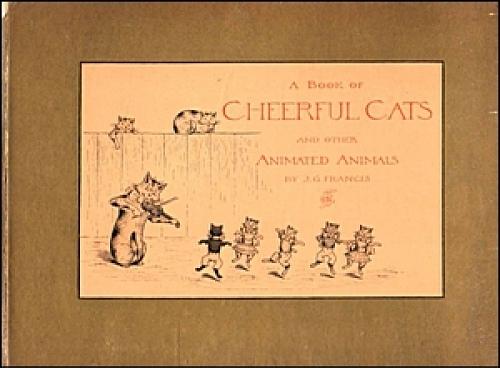
A Book of Cheerful Cats and Other Animated Animals

A Book of Cheerful Cats and Other Animated Animals. J.G. Francis. 1879/1903* Century Co. New York. 45 pages**

Some Cat-land fancies, drawn and dressed
To cheer your mind when it's depressed

I am participating in Literary Odyssey's Victorian Celebration, and I thought it would be great fun to see what types of picture books and story books would have been available at the time. This one was first published in 1879, and it went through a LOT of reprints. The edition they have online was the 1903 reprint.

A Book of Cheerful Cats and Other Animated Animals is an interesting collection of poems, drawings, stories, and sketches. While most of them feature cats, not all of them do. In fact, my particular favorite is the "Study of Hedgehog Stealing An Apple." This one does have a table of contents, by the way. To give you some idea of what to expect, here are a sample of pieces: "Some Fun With a Toy Spider," "The Tea Party," "The Giraffe Ride," "The Bicycle Ride," "The Lion in the Barber-Shop," "The Spring Curtain," "Story of the Catnip Ball," "Coasting Cats," "The Cat-o'-nine Tails."

Here are some of my favorite pages:
Bicycle Ride, page 15

"Oh, dear Papa!" three children cried.
"You promised don't you know?
That next when you should take a ride
All three of us should go."
"I Did," that father said, "You know
I never speak at random.
So get your roller-skates. We'll go
Off in a tearing tandem!" 
Study of Hedgehog Stealing Apple, page 16

 And here is my personal favorite, the one about the hedgehog and the apple!!!

I also found "Spring Curtain. A Drama In Five Acts" to be a lot of fun!!! This one is about courtship, if you will. Which tom cat will she choose? And will the rival get his revenge?


The book does exactly what it promises--it seeks to amuse, to charm, to delight. It shows cats being cats, for example.

Read this picture book of rhymes and stories online.

Read A Book of Cheerful Cats
  • If you love cats, love reading about cats, love looking at vintage drawings of cats
  • If you like historical picture books, vintage picture books
  • If you like the Victorian period

*1879, 1880, 1881, 1883, 1884, 1885, 1886, 1887, 1890, 1892, 1903
**It is really hard to say how many pages this one has. There are 45 numbered pages with illustrations and/or text. However, there are a LOT of blank pages.

© 2012 Becky Laney of Becky's Book Reviews

Thursday, June 21, 2012

Cousin Henry

Cousin Henry. Anthony Trollope. 1879. 336 pages.
“I have a conscience, my dear, on this matter,” said an old gentleman to a young lady, as the two were sitting in the breakfast parlour of a country house which looked down from the cliffs over the sea on the coast of Carmarthenshire.
“And so have I, Uncle Indefer; and as my conscience is backed by my inclination, whereas yours is not ­”
“You think that I shall give way?”
“I did not mean that.”
“What then?”
“If I could only make you understand how very strong is my inclination, or disinclination ­how impossible to be conquered, then ­”
“What next?”
I quite enjoyed Cousin Henry by Anthony Trollope. Perhaps the key to enjoying it is low expectations. In other words, if you don't expect Cousin Henry to be as wonderful and as monumental as Barchester Towers, Last Chronicle of Barset, The Way We Live Now, etc., then perhaps you can just enjoy it for what it is.

Cousin Henry is not an amazing, passionate love story. It is a story primarily about guilt, the weight and burden of not doing the right thing. He lives in fear of being found out, lives in fear of being judged guilty by others. He feels guilty, but these feelings of guilt and regret do not prompt him to do the right thing, to speak up, to tell the truth, to act honorably. He fears his peers and for good reason; he fears they are judging him, they are. He fears that he appears less than a man, appears cowardly; he does and everyone is talking about it. Cousin Henry reveals a tortured soul whom only the most tender-hearted can feel pity towards.

Uncle Indefer Jones is dying. While his heart is telling him to leave his estate to his niece Isabel Broderick, his mind is telling him that the "proper" thing to do is to leave his estate to his nephew Henry Jones. He considers for a very, very short amount of time asking his nephew and niece to marry so he can leave his property to both of them and bring his heart and mind into agreement. But the very things that make him a disagreeable choice for a husband, lead him to feel that he wouldn't be a good heir to the estate either. In other words, he understands exactly why Isabel finds him bad company and he quite agrees with her good taste. If it was up to him, he wouldn't want to spend any amount of time with his nephew. He lets his disgust be known to just about everybody including his nephew. So when in his last days--when Isabel just happens to be visiting her father--he makes a new will that changes everything, well, things get interesting....

...because the "new will" is not found. And every single person has an opinion on what happened to the will.

In a way, I could see why this one wouldn't naturally appeal to every single reader. How some could see this as a book just about some old guy dying and a bunch of people fighting over a will. But I see it as an intense study into the heart, mind, and soul of one individual, Cousin Henry, as he battles and struggles within himself. I see it as being about lies, deceptions, secrets, and betrayals. 

This wasn't only Cousin Henry's story, however, readers also get a chance to know Isabel Broderick, her would-be husband, William Owen, her father and stepmother, etc. And, of course, Uncle Indifer's lawyer, Mr. Apjohn.

Read Cousin Henry
  • If you're a fan of Anthony Trollope
  • If you're a fan of Victorian literature
  • If you're looking for a shorter introduction into the Victorian period
© 2012 Becky Laney of Becky's Book Reviews