Showing posts with label 1902. Show all posts

Wednesday, July 08, 2020

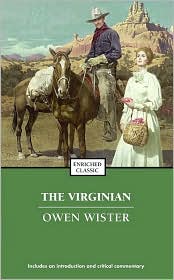
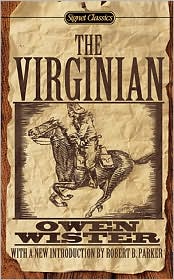
91. The Virginian

The Virginian. Owen Wister. 1902. Penguin Classics. 370 pages. [Source: Bought]

First sentence: Some notable sight was drawing the passengers, both men and women, to the window; and therefore I rose and crossed the car to see what it was. I saw near the track an enclosure, and round it some laughing men, and inside it some whirling dust, and amid the dust some horses, plunging, huddling, and dodging.

Premise/plot: The Virginian is a collection of interconnected stories. Some are more "connected" than others. Some of the stories are told through a first person account, a first person narrator, whom we come to know simply as Tenderfoot or The Tenderfoot. He's an Eastern man that has come west to Wyoming territory. And The Virginian, our real hero, is his protector as this newbie is learning his way. But other stories are told in third person. Through a series of adventures, we get to know The Virginian; we get to know the people close to The Virginian. The men he works with and respects. The men he works with and doesn't respect. His friends. His enemies. My favorite of these may just be the woman, the "school teacher spinster" whom he falls in love with, Miss Molly Wood. 


My thoughts: It was dramatic. It was suspenseful. It was humorous. It was emotional. It was romantic--in places. Some of my favorite scenes were the ones between The Virginian and Miss Molly Wood. I loved their courtship. How steady he was, how stubborn she was. How he took the time to read *most* of the books she loaned him. How he was fond of a good book--Shakespeare especially. But how he really didn't get why she loved Jane Austen so much! I liked their conversations on the books he read. I liked his conversations with her in general.

But The Virginian isn't just a romance. I mean there is a happily ever after at the end. But in between all the courting scenes--and there are really only a handful--The Virginian is busy working and riding and managing the Judge's ranch--he's foreman--and generally seeing that justice is done. (Because there are cattle thieves about!) So there is plenty of action and adventure and humor. There's plenty of good fun in this one. But it's not without its darker moments, its life-and-death moments.

Quotes:
We cannot see ourselves as other see us, or I should know what appearance I cut at hearing this from the tall man. I said nothing, feeling uncertain. "I reckon I am looking for you, seh," he repeated politely. "I am looking for Judge Henry," I now replied. He walked toward me, and I saw that in inches he was not a giant. He was not more than six feet. It was Uncle Hughey that had made him seem to tower. But in his eye, in his face, in his step, in the whole man, there dominated a something potent to be felt, I should think, by man or woman.
  "It's two hundred and sixty-three miles," said the Virginian...Yes, I was dazed. How did they count distance in this country? You spoke in a neighborly fashion about driving over to town, and it meant—I did not know yet how many days. And what would be meant by the term "dropping in," I wondered. And how many miles would be considered really far?
By reason of something,—my clothes, my hat, my pronunciation, whatever it might be, I possessed the secret of estranging people at sight.
Upon the grocery side there stood a cheese too large and strong to sleep near comfortably, and I therefore chose the dry-goods side. Here thick quilts were unrolled for me, to make it soft; and no condition was placed upon me, further than that I should remove my boots, because the quilts were new, and clean, and for sale.
 Sardines were called for, and potted chicken, and devilled ham: a sophisticated nourishment, at first sight, for these sons of the sage-brush. But portable ready-made food plays of necessity a great part in the opening of a new country. These picnic pots and cans were the first of her trophies that Civilization dropped upon Wyoming's virgin soil.
I was soon at the wash trough. It was only half-past six, but many had been before me,—one glance at the roller-towel told me that. I was afraid to ask the landlady for a clean one, and so I found a fresh handkerchief, and accomplished a sparing toilet. In the midst of this the drummers joined me, one by one, and they used the degraded towel without hesitation. In a way they had the best of me; filth was nothing to them.
Thieves are presumed innocent until proved guilty, but a starched collar is condemned at once.
 "I reckon," said he, "you're feelin' about halfway between 'Oh, Lord!' and 'Thank God!'"
 "We are taking steps," said Mr. Taylor. "Bear Creek ain't going to be hasty about a schoolmarm." "Sure," assented the Virginian. "The children wouldn't want yu' to hurry."
 Has any botanist set down what the seed of love is? Has it anywhere been set down in how many ways this seed may be sown? In what various vessels of gossamer it can float across wide spaces? Or upon what different soils it can fall, and live unknown, and bide its time for blooming?
 I was not called by my name after the first feeble etiquette due to a stranger in his first few hours had died away. I was known simply as "the tenderfoot." I was introduced to the neighborhood (a circle of eighty miles) as "the tenderfoot."
 "I fear she has not," said I. "Mighty hon'ble intentions," he observed. "If she can't make out to lay anything, she wants to hatch somethin', and be a mother anyways." "I wonder what relation the law considers that a hen is to the chicken she hatched but did not lay?" I inquired.
Em'ly scratched and clucked, and the puppies ran to her, pawed her with their fat limp little legs, and retreated beneath her feathers in their games of hide and seek. Conceive, if you can, what confusion must have reigned in their infant minds as to who the setter was!
 There always have been such people, I suppose, because the world must always have a rubbish heap.
 Molly Wood was regarding him saucily. "I don't think I like you," said she. "That's all square enough. You're goin' to love me before we get through. I wish yu'd come a-ridin, ma'am."
For this journey she had provided him with Sir Walter Scott's Kenilworth. Shakespeare he had returned to her. He had bought Shakespeare for himself. "As soon as I got used to readin' it," he had told her, "I knowed for certain that I liked readin' for enjoyment."
 There can be no doubt of this:— All America is divided into two classes,—the quality and the equality. The latter will always recognize the former when mistaken for it. Both will be with us until our women bear nothing but kings.
"It's mighty hard to do what your neighbors ain't doin'," pursued the Virginian. 
 "Do you think there ought to be fifteen varieties of good people?" His voice, while it now had an edge that could cut anything it came against, was still not raised. "There ain't fifteen. There ain't two.
There's one kind. And when I meet it, I respect it. It is not praying nor preaching that has ever caught me and made me ashamed of myself, but one or two people I have knowed that never said a superior word to me. They thought more o' me than I deserved, and that made me behave better than I naturally wanted to.
But I'll tell yu' this: a middlin' doctor is a pore thing, and a middlin' lawyer is a pore thing; but keep me from a middlin' man of God."
 If words were meant to conceal our thoughts, melody is perhaps a still thicker veil for them.
"Oh, no! The wild man you're taming brought you Kenilworth safe back." She was smooth. "Oh, as for taming him! But don't you find him intelligent?" Suddenly I somehow knew that she didn't want to tame him. But what did she want to do? The thought of her had made him blush this afternoon. No thought of him made her blush this evening.
 "Science! He doesn't know what Christianity is yet. I've entertained many guests, but none—The whole secret," broke off Judge Henry, "lies in the way you treat people. As soon as you treat men as your brothers, they are ready to acknowledge you—if you deserve it—as their superior. That's the whole bottom of Christianity, and that's what our missionary will never know."
One can look respectfully at a preacher and be internally breaking all the commandments.
We all know what birds of a feather do. And it may be safely surmised that if a bird of any particular feather has been for a long while unable to see other birds of its kind, it will flock with them all the more assiduously when they happen to alight in its vicinity.
"When a man ain't got no ideas of his own," said Scipio, "he'd ought to be kind o' careful who he borrows 'em from." 
But his first message to his lady was scarcely written with ease. It must be classed, I think, among those productions which are styled literary efforts. It was completed in pencil before it was copied in ink; and that first draft of it in pencil was well-nigh illegible with erasures and amendments.
I have read that play Othello. No man should write down such a thing. Do you know if it is true? I have seen one worse affair down in Arizona. He killed his little child as well as his wife but such things should not be put down in fine language for the public. I have read Romeo and Juliet. That is beautiful language but Romeo is no man. I like his friend Mercutio that gets killed. He is a man. If he had got Juliet there would have been no foolishness and trouble.
"if yu' could read me something that was ABOUT something, I—I'd be liable to keep awake." And he smiled with a certain shyness. "Something about something?" queried Molly, at a loss.
 Staring ain't courage; it's trashy curiosity.
 "I expect in many growed-up men you'd call sensible there's a little boy sleepin'—the little kid they onced was—that still keeps his fear of the dark. You mentioned the dark yourself yesterday. Well, this experience has woke up that kid in me, and blamed if I can coax the little cuss to go to sleep again! I keep a-telling him daylight will sure come, but he keeps a-crying and holding on to me."
 I cannot say that I believe in doing evil that good may come. I do not. I think that any man who honestly justifies such course deceives himself. But this I can say: to call any act evil, instantly begs the question. Many an act that man does is right or wrong according to the time and place which form, so to speak, its context; strip it of its surrounding circumstances, and you tear away its meaning.
 
© 2020 Becky Laney of Becky's Book Reviews

Sunday, November 08, 2015

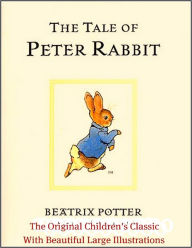
The Tale of Peter Rabbit (1902)

The Tale of Peter Rabbit. Beatrix Potter. 1902. [Source: Bought]

First sentence: Once upon a time there were four little Rabbits, and their names were Flopsy, Mopsy, Cotton-tail, and Peter.

Premise/plot: Will Peter Rabbit follow in his father's footsteps? Will Peter Rabbit end up being PUT IN A PIE by Mrs. McGregor? He just might if he can't control himself and stay out of Mr. McGregor's garden. This naughty little rabbit has quite an adventure!

My thoughts: I love The Tale of Peter Rabbit. I do. I love, love, love, LOVE the original illustrations. The story itself is just great fun.

Have you read this one? Have you read it recently? I'd love to know what YOU think of Beatrix Potter's stories for children. 

Text: 5 out of 5
Illustrations: 5 out of 5
Total: 10 out of 10

© 2015 Becky Laney of Becky's Book Reviews

Friday, January 04, 2013

L.M. Montgomery Short Stories 1902-1903

Lucy Maud Montgomery Short Stories, 1902-1903. L.M. Montgomery. 216 pages.

This short story collection contains twenty-two short stories: "A Patent Medicine Testimonial," "A Sandshore Wooing," "After Many Days," "An Unconventional Confidence," "Aunt Cyrilla's Christmas Basket," "Davenport's Story," "Emily's Husband," "Min," "Miss Cordelia's Accommodation," "Ned's Stroke of Business," "Our Runaway Kite," "The Bride Roses," "The Josephs' Christmas," "The Magical Bond of the Sea," "The Martyrdom of Estella," "The Old Chest at Wyther Grange," "The Osborne's Christmas," "The Romance of Aunt Beatrice," "The Running Away of Chester," "The Strike at Putney," "The Unhappiness of Miss Farquhar," and "Why Mr. Cropper Changed His Mind." So many delightful stories to be enjoyed. Some of the stories are about growing up; some are about falling in love; some are about broken hearts; some are about finding new friends; some are about belonging or the search for belonging; some are about making peace with the past finding forgiveness and redemption; there is even a ghost story.

One of my favorite stories is "Aunt Cyrilla's Christmas Basket." Here is how it begins:
When Lucy Rose met Aunt Cyrilla coming downstairs, somewhat flushed and breathless from her ascent to the garret, with a big, flat-covered basket hanging over her plump arm, she gave a little sigh of despair. Lucy Rose had done her brave best for some years—in fact, ever since she had put up her hair and lengthened her skirts—to break Aunt Cyrilla of the habit of carrying that basket with her every time she went to Pembroke; but Aunt Cyrilla still insisted on taking it, and only laughed at what she called Lucy Rose's "finicky notions." Lucy Rose had a horrible, haunting idea that it was extremely provincial for her aunt always to take the big basket, packed full of country good things, whenever she went to visit Edward and Geraldine. Geraldine was so stylish, and might think it queer; and then Aunt Cyrilla always would carry it on her arm and give cookies and apples and molasses taffy out of it to every child she encountered and, just as often as not, to older folks too. Lucy Rose, when she went to town with Aunt Cyrilla, felt chagrined over this—all of which goes to prove that Lucy was as yet very young and had a great deal to learn in this world.
The holidays may not have gone according to plan, but Providence had a hand! This is a lovely feel-good story! I ended up just LOVING Aunt Cyrilla AND her basket of goodies.

"Our Runaway Kite" is a lovely story of coincidence. Here's how it begins:
Of course there was nobody for us to play with on the Big Half Moon, but then, as Claude says, you can't have everything. We just had to make the most of each other, and we did. The Big Half Moon is miles from anywhere, except the Little Half Moon. But nobody lives there, so that doesn't count. We live on the Big Half Moon. "We" are Father and Claude and I and Aunt Esther and Mimi and Dick. It used to be only Father and Claude and I. It is all on account of the kite that there are more of us. This is what I want to tell you about.
"The Bride Roses" has to be one of my favorite stories. It's about a family feud that has lasted decades, and how one day that feud comes to an end...
Miss Corona awoke that June morning with a sigh, the cause of which she was at first too sleepy to understand. Then it all came over her with a little sickening rush; she had fallen asleep with tear-wet lashes the night before on account of it. This was Juliet Gordon's wedding day, and she, Miss Corona, could not go to the wedding and was not even invited, all because of the Quarrel, a generation old, and so chronic and bitter and terrible that it always presented itself to Miss Corona's mental vision as spelled with a capital. Well might Miss Corona hate it. It had shut her up into a lonely life for long years. Juliet Gordon and Juliet's father, Meredith Gordon, were the only relations Miss Corona had in the world, and the old family feud divided them by a gulf which now seemed impassable. Miss Corona turned over on her pillows, lifted one corner of the white window-blind and peeped out. Below her a river of early sunshine was flowing through the garden, and the far-away slopes were translucent green in their splendour of young day, with gauzy, uncertain mists lingering, spiritlike, in their intervales. A bird, his sleek plumage iridescent in the sunlight, was perched on the big chestnut bough that ran squarely across the window, singing as if his heart would burst with melody and the joy of his tiny life. No bride could have wished anything fairer for her day of days, and Miss Corona dropped back on her pillows with another gentle sigh. "I'm so glad that the dear child has a fine day to be married," she said. Juliet Gordon was always "dear child" to Miss Corona, although the two had never spoken to each other in their lives.
Another favorite story is "The Strike at Putney." The elders of a particular church have decided that a woman guest-speaker that has already been invited cannot use the church. Women have no place in the church, they argue. So the women of the church decide to go on strike: to stop putting flowers in the church, to stop cleaning the church, to stop playing the piano, to stop singing in the choir, to stop cooking and baking for various functions, etc. How long will it take for the men to see that the church could not properly exist without women?
The church at Putney was one that gladdened the hearts of all the ministers in the presbytery whenever they thought about it. It was such a satisfactory church. While other churches here and there were continually giving trouble in one way or another, the Putneyites were never guilty of brewing up internal or presbyterial strife.
The Exeter church people were always quarrelling among themselves and carrying their quarrels to the courts of the church. The very name of Exeter gave the members of presbytery the cold creeps. But the Putney church people never quarrelled.
Danbridge church was in a chronic state of ministerlessness. No minister ever stayed in Danbridge longer than he could help. The people were too critical, and they were also noted heresy hunters. Good ministers fought shy of Danbridge, and poor ones met with a chill welcome. The harassed presbytery, worn out with "supplying," were disposed to think that the millennium would come if ever the Danbridgians got a minister whom they liked. At Putney they had had the same minister for fifteen years and hoped and expected to have him for fifteen more. They looked with horror-stricken eyes on the Danbridge theological coquetries.
Bloom Valley church was over head and heels in debt and had no visible prospect of ever getting out. The moderator said under his breath that they did over-much praying and too little hoeing. He did not believe in faith without works. Tarrytown Road kept its head above water but never had a cent to spare for missions or the schemes of the church.
In bright and shining contradistinction to these the Putney church had always paid its way and gave liberally to all departments of church work. If other springs of supply ran dry the Putneyites enthusiastically got up a "tea" or a "social," and so raised the money. Naturally the "heft" of this work fell on the women, but they did not mind—in very truth, they enjoyed it. The Putney women had the reputation of being "great church workers," and they plumed themselves on it, putting on airs at conventions among the less energetic women of the other churches.
They were especially strong on societies. There was the Church Aid Society, the Girls' Flower Band, and the Sewing Circle. There was a Mission Band and a Helping Hand among the children. And finally there was the Women's Foreign Mission Auxiliary, out of which the whole trouble grew which convulsed the church at Putney for a brief time and furnished a standing joke in presbyterial circles for years afterwards. To this day ministers and elders tell the story of the Putney church strike with sparkling eyes and subdued chuckles. It never grows old or stale. But the Putney elders are an exception. They never laugh at it. They never refer to it. It is not in the wicked, unregenerate heart of man to make a jest of his own bitter defeat.
 I really enjoyed reading this collection of stories. I LOVE L.M. Montgomery. She was a great writer. Her short stories shouldn't be missed because her novels are so good.

© 2013 Becky Laney of Becky's Book Reviews

Wednesday, August 17, 2011

Five Children and It (MG)

Five Children and It. E. Nesbit. 1902/2004. Puffin Classics. 240 pages.

The house was three miles from the station, but before the dusty hired fly had rattled along for five minutes the children began to put their heads out of the carriage window and to say, 'Aren't we nearly there?' And every time they passed a house, which was not very often, they all said, 'Oh, is this it?' But it never was, till they reached the very top of the hill, just past the chalk-quarry and before you come to the gravel-pit. And then there was a white house with a green garden and an orchard beyond, and mother said, 'Here we are!'

It has been almost two years since I first discovered E. Nesbit. Five Children and It was the very first of her novels that I read, and it was definitely LOVE from the very beginning.

The five children are Robert, Cyril, Anthea, Jane, and Lamb. The 'it' is a sand fairy--a Psammead. The four children discover him one day during their summer vacation while they're digging in a nearby sand pit. They're quite delighted to learn that he can grant wishes. Though it's easy for anyone to see that he doesn't like granting wishes all that much. Still, the children are happy to think of one wish after another after another. A wish per day is what they're allowed. And oh the wishes they think up!!! But it doesn't take them very long to realize that they're not all that smart and clever with those wishes. For almost every day their wish leads them into TROUBLE. If wishing leads to trouble, why wish for anything? Well, even bad wishes make for a way to spend the day.

This book is so much fun! Just a delight to spend time with these characters. I'd definitely recommend it!

My favorite quotes:
Grown-up people find it very difficult to believe really wonderful things, unless they have what they call proof. But children will believe almost anything, and grown-ups know this. That is why they tell you that the earth is round like an orange, when you can see perfectly well that it is flat and lumpy; and why they say that the earth goes round the sun, when you can see for yourself any day that the sun gets up in the morning and goes to bed at night like a good sun as it is, and the earth knows its place, and lies as still as a mouse. (5)

I daresay you have often thought what you would do if you had three wishes given you, and have despised the old man and his wife in the black-pudding story, and felt certain that if you had the chance you could think of three really useful wishes without a moment's hesitation. These children had often talked this matter over, but, now the chance had come suddenly to them, they could not make up their minds. (17)

But the happening of strange things, even if they are not completely pleasant things, is more amusing than those times when nothing happens but meals, and they are not always completely pleasant, especially on the days when it is cold mutton or hash. (54)

Lending ears was common in Roman times, as we learn from Shakespeare; but I fear I am getting too instructive. (59)

When the frock was darned, the start for the gravel-pit was delayed by Martha's insisting on everybody's washing its hands -- which was nonsense, because nobody had been doing anything at all, except Jane, and how can you get dirty doing nothing? That is a difficult question, and I cannot answer it on paper. In real life I could very soon show you -- or you me, which is much more likely. (59)

It is very wise to let children choose exactly what they like, because they are very foolish and inexperienced, and sometimes they will choose a really instructive thing without meaning to. (85)

The people who decide what the weather is to be, and put its orders down for it in the newspaper every morning, said afterwards that it was the hottest day there had been for years. They had ordered it to be 'warmer -- some showers', and warmer it certainly was. In fact it was so busy being warmer that it had no time to attend to the order about showers, so there weren't any. (86)

'I was always generous from a child,' said the Sand-fairy. 'I've spent the whole of my waking hours in giving. But one thing I won't give --that's advice.'
'You see,' Anthea went on, 'it's such a wonderful thing -- such a splendid, glorious chance. It's so good and kind and dear of you to give us our wishes, and it seems such a pity it should all be wasted just because we are too silly to know what to wish for.'
Anthea had meant to say that -- and she had not wanted to say it before the others. It's one thing to say you're silly, and quite another to say that other people are.
'Child,' said the Sand-fairy sleepily, 'I can only advise you to think before you speak--'
'But I thought you never gave advice.'
'That piece doesn't count,' it said. 'You'll never take it! Besides it's not original. It's in all the copybooks.' (89-90)

© 2011 Becky Laney of Becky's Book Reviews
Wednesday, May 25, 2011

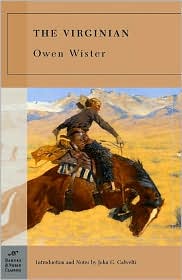
The Virginian

The Virginian. Owen Wister. 1902. Penguin Classics. 370 pages.

Some notable sight was drawing the passengers, both men and women, to the window; and therefore I rose and crossed the car to see what it was. I saw near the track an enclosure, and round it some laughing men, and inside it some whirling dust, and amid the dust some horses, plunging, huddling, and dodging. They were cow ponies in a corral, and one of them would not be caught, no matter who threw the rope.

I do not read many westerns. (If I remember correctly, this is only my second or third western. Depending on if you count These is My Words by Nancy E. Turner. My first western was Riders of the Purple Sage by Zane Grey.) In fact, I have always believed myself to be completely allergic to the genre. Me? Like a western?! Really?! Well, I did more than like this one. I loved it. I maybe even loved, loved, loved it. While I'm not sure that I can echo what Dolce Bellezza said in her review: "It will definitely be in my top ten list for the year, and quite possibly for my life." I definitely agree that it is worth reading. I was very happy to be so surprised!

The Virginian is a collection of interconnected stories. Some are more "connected" than others. Some of the stories are told through a first person account, a first person narrator, whom we come to know simply as Tenderfoot or The Tenderfoot. He's an Eastern man that has come west to Wyoming territory. And The Virginian, our real hero, is his protector as this newbie is learning his way.
When Judge Henry ascertained that nothing could prevent me from losing myself, that it was not uncommon for me to saunter out after breakfast with a gun and in thirty minutes cease to know north from south, he arranged for my protection. He detailed an escort for me; and the escort was once more the trustworthy man! The poor Virginian was taken from his work and his comrades and set to playing nurse for me. And for a while this humiliation ate into his untamed soul. It was his lugubrious lost to accompany me in my rambles, preside over my blunders, and save me from calamitously passing into the next world. He bore it in courteous silence, except when speaking was necessary. He would show me the lower ford, which I could never find for myself, generally mistaking a quicksand for it. He would tie my horse properly. He would recommend me not to shoot my rifle at a white-tailed deer in the particular moment that the outfit wagon was passing behind the animal on the further side of the brush. There was seldom a day that he was not obliged to hasten and save me from sudden death or from ridicule, which is worse. Yet never once did he lose his patience; and his gentle, slow voice, and apparently lazy manner remained the same, whether we were sitting at lunch together, or up in the mountains during a hunt, or whether he was bringing me back my horse, which had run away again because I had again forgotten to throw the reins over his head and let them trail. (45)
But other stories are told in third person. Through a series of adventures, we get to know The Virginian; we get to know the people close to The Virginian. The men he works with and respects. The men he works with and doesn't respect. His friends. His enemies. My favorite of these may just be the woman, the "school teacher spinster" whom he falls in love with, Miss Molly Wood. 

 I found myself enjoying not just the characters, not just the stories, but the writing style itself. After the clumsiness of Zane Grey (at least in Riders of the Purple Sage) I was happy to see a western written by someone who could really write. There was just something about this one that worked for me. It was dramatic. It was suspenseful. It was humorous. It was emotional. It was romantic--in places. Some of my favorite scenes were the ones between The Virginian and Miss Molly Wood. I loved their courtship. How steady he was, how stubborn she was. How he took the time to read *most* of the books she loaned him. How he was fond of a good book--Shakespeare especially. But how he really didn't get why she loved Jane Austen so much! I liked their conversations on the books he read. I liked his conversations with her in general.

But The Virginian isn't just a romance. I mean there is a happily ever after at the end. But in between all the courting scenes--and there are really only a handful--The Virginian is busy working and riding and managing the Judge's ranch--he's foreman--and generally seeing that justice is done. (Because there are cattle thieves about!) So there is plenty of action and adventure and humor. There's plenty of good fun in this one. But it's not without its darker moments, its life-and-death moments.

Favorite quotes:

The Virginian was grave in bearing and of infrequent speech; but he kept a song going--a matter of some seventy-nine verses. Seventy-eight were quite unprintable, and rejoiced his brother cow-punchers monstrously. (62)

No one of her admirers had ever been like this creature. The fringed leathern chaperreros, the cartridge belt, the flannel shirt, the knotted scarf at the neck, these things were now an old story to her. Since her arrival she had seen young men and old in plenty dressed thus. But worn by the man now standing by her door, they seemed to radiate romance. (83)

Molly Wood was regarding him saucily. "I don't think I like you," said she.
"That's all square enough. You're goin' to love me before we get through. I wish yu'd come a-ridin', ma'am."
"Dear, dear, dear! So I'm going to love you? How will you do it? I know men think that they only need to sit and look strong and make chests at a girl--"
"Goodness gracious! I ain't makin' any chests at yu'!" Laughter overcame him for a moment, and Miss Wood liked his laugh very much. "Please come a-ridin," he urged. "It's the prettiest kind of a day."
She looked at him frankly, and there was a pause. "I will take back two things that I said to you," she then answered him. "I believe that I do like you. And I know that if I went riding with you, I should not have an immature protector." (85)

"And now I'll not see you for quite a while. I am going a long way. But I'll be very busy. And bein' busy always keeps me from grievin' too much about you."
Strange is woman! She would rather have heard some other last remark than this.
"Oh, very well!" she said. "I'll not miss you either."
He smiled at her. "I doubt if yu' can help missin' me," he remarked. And he was gone at once, galloping on his Monte horse. Which of the two won a victory this day? (94)

If words were meant to conceal our thoughts, melody is perhaps still thicker veil for them. (142)


© 2011 Becky Laney of Becky's Book Reviews
Wednesday, August 05, 2009

Five Children and It (MG)


Nesbit, Edith. 1902. Five Children and It. Puffin Classics. 237 pages.

The house was three miles from the station, but before the dusty hired fly had rattled along for five minutes the children began to put their heads out of the carriage window and to say, 'Aren't we nearly there?' And every time they passed a house, which was not very often, they all said, 'Oh, is this it?' But it never was, till they reached the very top of the hill, just past the chalk-quarry and before you come to the gravel-pit. And then there was a white house with a green garden and an orchard beyond, and mother said, 'Here we are!'

Robert, Anthea (Panther), Jane, Cyril, and Baby (Lamb) have come (along with their parents, of course) to spend some time in the country. But circumstances being what they are--parents in general being more a nuisance in a children's adventure story than anything else--the children are often all on their own except for some slight interference by Martha their nurse-maid. It is while they are exploring the gravel-pit that the children--much to their surprise--discover a sand fairy, a Psammead. (He is quite a character!) The children are granted a wish a day (thereabouts)...and thus the adventures begin.

I daresay you have often thought what you would do if you had three wishes given you, and have despised the old man and his wife in the black-pudding story, and felt certain that if you had the chance you could think of three really useful wishes without a moment's hesitation. These children had often talked this matter over, but, now the chance had come suddenly to them, they could not make up their minds. (17)
They may have their wish a day, but their wish ends at sunset. And as they discover, this is a VERY good thing!

This one is a funny adventure novel starring brothers and sisters who know how to get in and out of trouble and then some! I'm so happy I finally read this one. It was such a joy to read.

© Becky Laney of Becky's Book Reviews