Showing posts with label 1907. Show all posts

Tuesday, January 30, 2018

Lucy Maud Montgomery Short Stories 1907-1908

Short Stories 1907-1908. L.M. Montgomery. 248 pages. [Source: Bought]

This is a collection of short stories by L.M. Montgomery originally published in various magazines in 1907 and 1908. They vary in genre, style, and quality. But there are some great stories.

My thoughts on the first seven stories in the collection can be found in Keep It Short #1Keep it Short #2 features the next five stories. Keep It Short #4 features the next five stories. The remaining short stories are reviewed below.

The Girl who Drove the Cows

First sentence: "I wonder who that pleasant-looking girl who drives cows down the beech lane every morning and evening is," said Pauline Palmer, at the tea table of the country farmhouse where she and her aunt were spending the summer.

Premise/plot: This one is about snobbery. Aunt Olivia is a BIG snob, and she "despises" the beautiful girl who drives the cows. Pauline, the niece, likes her and is in fact inspired by her. She takes her photograph for her artist collection, and it wins first prize. The photograph gains attention and it is revealed who the girl really is....

My thoughts: I liked it okay.

The Growing Up of Cornelia

First sentence:  Aunt Jemima gave me this diary for a Christmas present. It's just the sort of gift a person named Jemima would be likely to make.

 Premise/plot: A shy girl gets some romance and a happy ending.... Cornelia is anxious that Sidney Elliot's return to town will mean the end to her adventures roaming his property--his woods/gardens. That proves not to be the case. Has she found a kindred spirit?

My thoughts: I enjoyed the narration of this one. This one may just be one of my favorites.
  • People might talk about my not being brought out, but they will talk far more about the blunders I shall make.
  • The doleful fact is, I'm too wretchedly shy and awkward to live. It fills my soul with terror to think of donning long dresses and putting my hair up and going into society.
  • I can't talk and men frighten me to death. I fall over things as it is, and what will it be with long dresses? As far back as I can remember it has been my one aim and object in life to escape company. Oh, if only one need never grow up! If I could only go back four years and stay there!
  • It is rather good to have a diary to pour out your woes in when you feel awfully bad and have no one to sympathize with you. I've been used to shutting them all up in my soul and then they sometimes fermented and made trouble.
  • I've found out what diaries are for ... to work off blue moods in, moods that come on without any reason whatever and therefore can't be confided to any fellow creature. You scribble away for a while ... and then it's all gone ... and your soul feels clear as crystal once more.
 The Old Fellow's Letter.

First sentence: Ruggles and I were down on the Old Fellow. It doesn't matter why and, since in a story of this kind we must tell the truth no matter what happens—or else where is the use of writing a story at all?—I'll have to confess that we had deserved all we got and that the Old Fellow did no more than his duty by us.
 
Premise/plot: A letter written in jest--as a prank by college students--ends up leading to a happily ever ending for one of their professors.
 
My thoughts: I definitely enjoyed this one! It is very silly and definitely old-fashioned.
 
The Parting of Ways
First sentence: Mrs. Longworth crossed the hotel piazza, descended the steps, and walked out of sight down the shore road with all the grace of motion that lent distinction to her slightest movement.
 
Premise/plot: A woman reconsiders leaving her husband and running away with another man after a heart-felt conversation with an artist-friend who idealizes her.

My thoughts: It was okay.

The Promissory Note

First sentence: Ernest Duncan swung himself off the platform of David White's store and walked whistling up the street. Life seemed good to Ernest just then. Mr. White had given him a rise in salary that day, and had told him that he was satisfied with him. Mr. White was not easy to please in the matter of clerks, and it had been with fear and trembling that Ernest had gone into his store six months before. He had thought himself fortunate to secure such a chance. His father had died the preceding year, leaving nothing in the way of worldly goods except the house he had lived in. For several years before his death he had been unable to do much work, and the finances of the little family had dwindled steadily. After his father's death Ernest, who had been going to school and expecting to go to college, found that he must go to work at once instead to support himself and his mother.

Premise/plot: A son with great integrity is put to the test--put through the fire, if you will--before his great reward.

My thoughts: I liked this one. Not all of Montgomery's stories are silly romances.

The Revolt of Mary Isabel 

First sentence: "For a woman of forty, Mary Isabel, you have the least sense of any person I have ever known," said Louisa Irving.Louisa had said something similar in spirit to Mary Isabel almost every day of her life. Mary Isabel had never resented it, even when it hurt her bitterly. Everybody in Latimer knew that Louisa Irving ruled her meek little sister with a rod of iron and wondered why Mary Isabel never rebelled. It simply never occurred to Mary Isabel to do so; all her life she had given in to Louisa and the thought of refusing obedience to her sister's Mede-and-Persian decrees never crossed her mind. Mary Isabel had only one secret from Louisa and she lived in daily dread that Louisa would discover it. It was a very harmless little secret, but Mary Isabel felt rightly sure that Louisa would not tolerate it for a moment.

Premise/plot: Mary Isabel DOES rebel and all is well in the end.

My thoughts: I liked Mary Isabel. I was cheering for her from the start.

The Twins and a Wedding

First sentence: Sometimes Johnny and I wonder what would really have happened if we had never started for Cousin Pamelia's wedding. I think that Ted would have come back some time; but Johnny says he doesn't believe he ever would, and Johnny ought to know, because Johnny's a boy. Anyhow, he couldn't have come back for four years. However, we did start for the wedding and so things came out all right, and Ted said we were a pair of twin special Providences.

Premise/plot: Twins run away from home to see a wedding--they'd been invited, but the parents decided to leave them at home. They get off at the wrong train station, and are bitterly disappointed that they won't see a wedding after all. Or will they? They interrupt an arguing couple...and....well the rest is classic Montgomery.

My thoughts: Definitely an enjoyable read. I'm glad the collection ended with such a fun story. It is a good reminder that sometimes it's not the premise so much as the characters.

 Overall, I'd rank my top five stories as:
  • By Grace of Julius Caesar
  • Matthew Insists on Puffed Sleeves
  • The Growing Up of Cornelia
  • Four Winds
  • Anna's Love Letters


© 2018 Becky Laney of Becky's Book Reviews

Tuesday, December 01, 2015

The Wind in the Willows

The Wind in the Willows. Kenneth Grahame. Illustrated by David Roberts. 1907/1983. Simon & Schuster. 244 pages. [Source: Library]
I loved, loved, loved rereading The Wind in the Willows. I wasn't exactly planning on rereading it this year. I wasn't. But. I was looking for a good audio book to check out from the library. I saw Wind in the Willows on the shelf; I checked it out. I listened to it. That could have been the end of it. But, of course, it wasn't. I had to read it too. I just had to. I could no more resist rereading the book than Toad could resist driving an automobile.

What do I love about the book? Well, many things. I love the characters. I love, love, love the relationships between the characters. And the adventures!!! Plenty happens in this one! Does Toad deserve all that he gets? Maybe, maybe not. But Toad is, without a doubt, unforgettable!!!

The edition I read had illustrations from Ernest H. Shepard. The illustrations were great: some were in color, others were in black and white. They made a great book seem even greater.

Would I be hosting the Edwardian Reading Challenge if it wasn't for me "having" to read The Wind in the Willows right NOW? I'm not sure. But I'm so glad I followed my heart!!!

My favorite quote:
"What are we to do with him?" asked the Mole of the Water Rat.
"Nothing at all," replied the Rat firmly. "Because there is really nothing to be done. You see, I know him from old. He is now possessed. He has got a new craze, and it always takes him that way, in its first stage. He'll continue like that for days now, like an animal walking in a happy dream, quite useless for all practical purposes. Never mind him."

© 2015 Becky Laney of Becky's Book Reviews
Wednesday, November 26, 2014

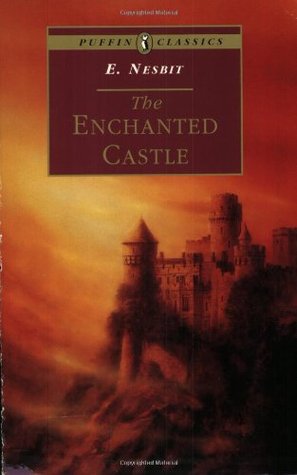
The Enchanted Castle (1907)

The Enchanted Castle. E. Nesbit. 1907. 291 pages. [Source: Bought]

I really enjoyed reading The Enchanted Castle by E. Nesbit. I had started this one at least twice before, but, I had never been in the right mood to properly appreciate this children's fantasy novel. I was in the right mood this time.

If you enjoy adventure fantasy novels, you'll probably enjoy spending time with Jerry, Jimmy, Cathy, and Mabel. Jerry, Jimmy, and Cathy are siblings. When these three first meet Mabel, they mistake her for a princess. At the time, they are having an adventure looking for an enchanted castle. So finding a princess within that castle makes complete sense! Mabel is actually the niece of the housekeeper. She confesses that a bit later on. That first meeting is magical enough! She shows them a secret room behind a paneled wall. This room is fabulous if you're looking for treasures. While in the room, the children find (and pick up) a ring. This ring is central to all their further adventures. And Mabel is their new best friend. She's always part of the group.

This one was a very fun read. It reminded me of why I love E. Nesbit in the first place. It wasn't a perfect novel. But flaws and all, it worked well enough for me. It was a joy to read of their adventures and misadventures. The ring gets them into trouble more often than it gets them out of trouble.

Favorite quotes:
“Go then, and be not more naughty than you must.”
“If we were in a book it would be an enchanted castle — certain to be,” said Kathleen. “It is an enchanted castle,” said Gerald in hollow tones. “But there aren’t any.” Jimmy was quite positive. “How do you know? Do you think there’s nothing in the world but what you’ve seen?” His scorn was crushing.
“I think magic went out when people began to have steam-engines,” Jimmy insisted, “and newspapers, and telephones and wireless telegraphing.” “Wireless is rather like magic when you come to think of it,” said Gerald. “Oh, that sort!” Jimmy’s contempt was deep. “Perhaps there’s given up being magic because people didn’t believe in it any more,” said Kathleen. “Well, don’t let’s spoil the show with any silly old not believing,” said Gerald with decision. “I’m going to believe in magic as hard as I can. This is an enchanted garden, and that’s an enchanted castle, and I’m jolly well going to explore.
“I am so hungry!” said Jimmy. “Why didn’t you say so before?” asked Gerald bitterly. “I wasn’t before.” “Then you can’t be now. You don’t get hungry all in a minute. What’s that?”
“Well, then — a detective.” “There’s got to be something to detect before you can begin detectiving,” said Mabel. “Detectives don’t always detect things,” said Jimmy, very truly. “If I couldn’t be any other kind I’d be a baffled detective. You could be one all right, and have no end of larks just the same. Why don’t you do it?” “It’s exactly what I am going to do,” said Gerald. “We’ll go round by the police-station and see what they’ve got in the way of crimes.” They did, and read the notices on the board outside. Two dogs had been lost, a purse, and a portfolio of papers “of no value to any but the owner.” Also Houghton Grange had been broken into and a quantity of silver plate stolen. “Twenty pounds reward offered for any information that may lead to the recovery of the missing property.”
You know pretty well what Beauty and the Beast would be like acted by four children who had spent the afternoon in arranging their costumes and so had left no time for rehearsing what they had to say. Yet it delighted them, and it charmed their audience. There is a curtain, thin as gossamer, clear as glass, strong as iron, that hangs for ever between the world of magic and the world that seems to us to be real. And when once people have found one of the little weak spots in that curtain which are marked by magic rings, and amulets, and the like, almost anything may happen.And what more can any play do, even Shakespeare’s?

© 2014 Becky Laney of Becky's Book Reviews
Sunday, November 17, 2013

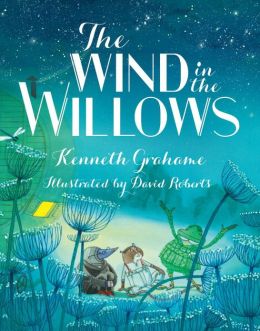
Sunday Salon: Reading Wind in the Willows (1907)

The Wind in the Willows. Kenneth Grahame. Illustrated by David Roberts. 1907/2013. Candlewick. 256 pages. [Source: Review Copy]

I enjoyed spending time with Mole, Rat, Toad, and Badger. I believe this was only the second time I'd read this children's classic. It was a good read. Some chapters I liked more than others, of course. But overall, it was a book that I enjoyed. I'm not sure I loved it however.

Do you have a favorite character? A favorite scene? Do you like Toad despite his obsession with motor cars?! Do you think his friends are right to try to convert him?

Favorite quotes:
He thought his happiness was complete when, as he meandered aimlessly along, suddenly he stood by the edge of a full-fed river. Never in his life had he seen a river before—this sleek, sinuous, full-bodied animal, chasing and chuckling, gripping things with a gurgle and leaving them with a laugh, to fling itself on fresh playmates that shook themselves free, and were caught and held again. All was a-shake and a-shiver—glints and gleams and sparkles, rustle and swirl, chatter and bubble. The Mole was bewitched, entranced, fascinated. By the side of the river he trotted as one trots, when very small, by the side of a man who holds one spell-bound by exciting stories; and when tired at last, he sat on the bank, while the river still chattered on to him, a babbling procession of the best stories in the world, sent from the heart of the earth to be told at last to the insatiable sea.
'Believe me, my young friend, there is NOTHING—absolute nothing—half so much worth doing as simply messing about in boats.
Nothing seems really to matter, that's the charm of it. Whether you get away, or whether you don't; whether you arrive at your destination or whether you reach somewhere else, or whether you never get anywhere at all, you're always busy, and you never do anything in particular; and when you've done it there's always something else to do, and you can do it if you like, but you'd much better not.
Packing the basket was not quite such pleasant work as unpacking' the basket. It never is. 
for it is impossible to say quite ALL you feel when your head is under water. 
Early or late he's always the same fellow.
"What are we to do with him?" asked the Mole of the Water Rat.
"Nothing at all," replied the Rat firmly. "Because there is really nothing to be done. You see, I know him from old. He is now possessed. He has got a new craze, and it always takes him that way, in its first stage. He'll continue like that for days now, like an animal walking in a happy dream, quite useless for all practical purposes. Never mind him.
At this very moment, perhaps, Toad is busy arraying himself in those singularly hideous habiliments so dear to him, which transform him from a (comparatively) good-looking Toad into an Object which throws any decent-minded animal that comes across it into a violent fit. We must be up and doing, ere it is too late. You two animals will accompany me instantly to Toad Hall, and the work of rescue shall be accomplished.' 'Right you are!' cried the Rat, starting up. 'We'll rescue the poor unhappy animal! We'll convert him! He'll be the most converted Toad that ever was before we've done with him!'
At first Toad was undoubtedly very trying to his careful guardians. When his violent paroxysms possessed him he would arrange bedroom chairs in rude resemblance of a motor-car and would crouch on the foremost of them, bent forward and staring fixedly ahead, making uncouth and ghastly noises, till the climax was reached, when, turning a complete somersault, he would lie prostrate amidst the ruins of the chairs, apparently completely satisfied for the moment. As time passed, however, these painful seizures grew gradually less frequent, and his friends strove to divert his mind into fresh channels. But his interest in other matters did not seem to revive, and he grew apparently languid and depressed.
Try and grasp the fact that on this occasion we're not arguing with you; we're just telling you. 
© 2013 Becky Laney of Becky's Book Reviews

Monday, May 13, 2013

Ozma of Oz (1907)

Ozma of Oz. L. Frank Baum. 1907. 126 pages.

Ozma of Oz is certainly an interesting and enjoyable read! This third novel in the Oz series sees Dorothy returning to a magical land; Oz is not the first destination she reaches, however. Instead of a dog, Dorothy's companion is a chicken. One of the reasons Dorothy knows with certainty that she's landed in another fantastical adventure is that the chicken begins to TALK. This chicken, Billena, comes in quite useful! In fact, Dorothy and her friends would have been doomed without her! Another new character we meet is Tik-Tok. (I really liked this mechanical wind-up man.) The main adventure of this one concerns the Nome King.

I definitely enjoyed this one! I'm not sure which of the Oz books is my favorite so far. I've enjoyed elements from all three! I really enjoy the writing and the dialogue! There are plenty of enjoyable scenes throughout all three books. 

Favorite quotes:
But, bye and bye, when she was almost in despair, the little girl came upon two trees that promised to furnish her with plenty of food.
One was quite full of square paper boxes, which grew in clusters on all the limbs, and upon the biggest and ripest boxes the word "Lunch" could be read, in neat raised letters. This tree seemed to bear all the year around, for there were lunch-box blossoms on some of the branches, and on others tiny little lunch-boxes that were as yet quite green, and evidently not fit to eat until they had grown bigger.
The leaves of this tree were all paper napkins, and it presented a very pleasing appearance to the hungry little girl.
But the tree next to the lunch-box tree was even more wonderful, for it bore quantities of tin dinner-pails, which were so full and heavy that the stout branches bent underneath their weight. Some were small and dark-brown in color; those larger were of a dull tin color; but the really ripe ones were pails of bright tin that shone and glistened beautifully in the rays of sunshine that touched them.
Dorothy was delighted, and even the yellow hen acknowledged that she was surprised.
The little girl stood on tip-toe and picked one of the nicest and biggest lunch-boxes, and then she sat down upon the ground and eagerly opened it. Inside she found, nicely wrapped in white papers, a ham sandwich, a piece of sponge-cake, a pickle, a slice of new cheese and an apple. Each thing had a separate stem, and so had to be picked off the side of the box; but Dorothy found them all to be delicious, and she ate every bit of luncheon in the box before she had finished.
"A lunch isn't zactly breakfast," she said to Billina, who sat beside her curiously watching. "But when one is hungry one can eat even supper in the morning, and not complain."
"I hope your lunch-box was perfectly ripe," observed the yellow hen, in a anxious tone. "So much sickness is caused by eating green things."
"Oh, I'm sure it was ripe," declared Dorothy, "all, that is, 'cept the pickle, and a pickle just HAS to be green, Billina. But everything tasted perfectly splendid, and I'd rather have it than a church picnic. And now I think I'll pick a dinner-pail, to have when I get hungry again, and then we'll start out and 'splore the country, and see where we are."
"Haven't you any idea what country this is?" inquired Billina.
"None at all. But listen: I'm quite sure it's a fairy country, or such things as lunch-boxes and dinner-pails wouldn't be growing upon trees. Besides, Billina, being a hen, you wouldn't be able to talk in any civ'lized country, like Kansas, where no fairies live at all."
A princess cannot be expected to remember today what she did yesterday.
The generals commanded the colonels and the colonels commanded the majors and the majors commanded the captains and the captains commanded the private, who marched with an air of proud importance because it required so many officers to give him his orders.
When the bell rang a second time the King shouted angrily, "Smudge and blazes!" and at a third ring he screamed in a fury, "Hippikaloric!" which must be a dreadful word because we don't know what it means.
"I have no reason to complain of my lot," replied the Scarecrow. "A little fresh straw, now and then, makes me as good as new. But I can never be the polished gentleman that my poor departed friend, the Tin Woodman, was." 
"That is the College of Art and Athletic Perfection," replied Ozma. "I had it built quite recently, and the Woggle-But is its president. It keeps him busy, and the young men who attend the college are no worse off than they were before. You see, in this country are a number of youths who do not like to work, and the college is an excellent place for them."

© 2013 Becky Laney of Becky's Book Reviews