Showing posts with label 1918. Show all posts

Wednesday, July 02, 2025

66. The Adventures of Jimmy Skunk


66. The Adventures of Jimmy Skunk. Thornton W. Burgess. 1918. 96 pages. [Source: Online] [5 stars, animal fantasy, children's fantasy, children's classic, j fantasy]

First sentence: The Imp of Mischief, woe is me, is always busy as a bee. That is why so many people are forever getting into trouble. He won't keep still. No, Sir, he won't keep still unless he is made to. Once let him get started there is no knowing where he will stop. Peter Rabbit had just seen Jimmy Skunk disappear inside an old barrel, lying on its side at the top of the hill, and at once the Imp of Mischief began2 to whisper to Peter. Of course Peter shouldn't have listened. Certainly not. But he did. You know Peter dearly loves a joke when it is on some one else. He sat right where he was and watched to see if Jimmy would come out of the barrel. Jimmy didn't come out, and after a little Peter stole over to the barrel and peeped inside. There was Jimmy Skunk curled up for a nap. Peter tiptoed away very softly. All the time the Imp of Mischief was whispering to him that this was a splendid chance to play a joke on Jimmy. You know it is very easy to play a joke on any one who is asleep. Peter doesn't often have a chance to play a joke on Jimmy Skunk. It isn't a very safe thing to do, not if Jimmy is awake. No one knows that better than Peter.

Premise/plot: Though Jimmy Skunk is perhaps the central character in this classic animal fantasy novel by Thornton Burgess, plenty of other characters get their moments to shine as well. (INCLUDING UNC' Billy Possum). Over half the novel features JIMMY SKUNK and UNC' BILLY POSSUM together getting into trouble--chiefly having to do with their love for EGGS. (The first half of the novel focuses on Peter Rabbit and Jimmy Skunk pranking each other.)

Burgess' animal world is DELIGHTFUL.  

My thoughts: I LOVED, LOVED, LOVED this one. Did I love it more than The Adventures of Unc' Billy Possum???? Good question. Fair question. I think I loved them both equally. Because they share main characters--Jimmy Skunk and Unc' Billy Possum.

Quotes:

Jimmy Skunk ambled along down the Lone Little Path through the Green Forest. He didn't hurry. Jimmy never does hurry. Hurrying and worrying are two things he leaves for his neighbors. Now and then Jimmy stopped to turn over a bit of bark or a stick, hoping to find some fat beetles. But it was plain to see that he had something besides fat beetles on his mind.
Up the Lone Little Path through the Green Forest shuffled Unc' Billy Possum. He didn't hurry. It was too warm to hurry. Unlike Jimmy Skunk,62 he does hurry sometimes, does Unc' Billy, especially when he suspects that Bowser the Hound is about. And sometimes Unc' Billy does worry. You see, there are people who think that Unc' Billy would make a very good dinner. Unc' Billy doesn't think he would. Anyway, he has no desire to have the experiment tried. So occasionally, when he discovers one of these people who think he would make a good dinner, he worries a little.
But just now Unc' Billy was neither hurrying nor worrying. There was no need of doing either, and Unc' Billy never does anything that there is no need of doing. So Unc' Billy shuffled up the Lone Little Path, and Jimmy Skunk ambled down the Lone Little Path, and right at a bend in the Lone Little Path they met.

© 2025 Becky Laney of Becky's Book Reviews

Thursday, April 25, 2019

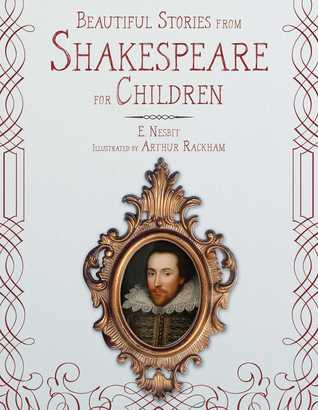
Beautiful Stories from Shakespeare for Children

Beautiful Stories from Shakespeare. E. Nesbit. Illustrated by Arthur Rackham. 1918. 192 pages. [Source: Library]

First sentence: It was evening. The fire burned brightly in the inn parlour. We had been that day to see Shakespeare's house, and I had told the children all that I could about him and his work. Now they were sitting by the table, poring over a big volume of the Master's plays, lent them by the landlord. And I, with eyes fixed on the fire, was wandering happily in the immortal dreamland peopled by Rosaline and Imogen, Lear and Hamlet. A small sigh roused me-- 
"I can't understand a word of it," said Iris.
"And you said it was so beautiful," Rosamund added, reproachfully. "What does it all mean?"

Premise/plot: E. Nesbit has adapted fifteen of Shakespeare's plays into short stories for children. The plays she's chosen to adapt are as follows: "The Tempest," "Romeo and Juliet," "A Midsummer Night's Dream," "Hamlet, Prince of Denmark," "As You Like It," "King Lear," "The Taming of the Shrew," "Cymbeline," "Twelfth Night," "The Winter's Tale," "Pericles, Prince of Tyre," "The Comedy of Errors," "Macbeth," "Othello," and "The Merchant of Venice." Nesbit chose to adapt a few of his comedies and a few of his tragedies but none of his history plays. 

The Tempest
Prospero, the Duke of Milan, was a learned and studious man, who lived among his books, leaving the management of his dukedom to his brother Antonio, in whom indeed he had complete trust. But that trust was ill-rewarded, for Antonio wanted to wear the Duke's crown himself, and, to gain his ends, would have killed his brother but for the love the people bore him. However, with the help of Prospero's great enemy, Alonso, King of Naples, he managed to get into his hands the dukedom with all its honour, power, and riches. For they took Prospero to sea, and when they were far away from land, forced him into a little boat with no tackle, mast, or sail. In their cruelty and hatred they put his little daughter, Miranda (not yet three years old), into the boat with him, and sailed away, leaving them to their fate.
Romeo and Juliet
Once upon a time there lived in Verona two great families named Montague and Capulet. They were both rich, and I suppose they were as sensible, in most things, as other rich people. But in one thing they were extremely silly. There was an old, old quarrel between the two families, and instead of making it up like reasonable folks, they made a sort of pet of their quarrel, and would not let it die out. 
My thoughts: I enjoyed this one. I was familiar with about half of these stories. There are still some of Shakespeare's plays I haven't read yet.

I'm not convinced that Shakespeare's plays make for the best stories for children. His plays usually have quite adult content. But these stories, of course, do not.

Reading these stories back to back one sees how similar Shakespeare's plays can be to one another.

I do wish she'd chosen to adapt some of the history plays. I would LOVE to find a collection that does include the history plays adapted for a younger audience.

© 2019 Becky Laney of Becky's Book Reviews

Thursday, January 11, 2018

My Antonia

My Antonia. Willa Cather. 1918. 336 pages. [Source: LIBRARY]
First sentence: I first heard of Antonia on what seemed to me an interminable journey across the great midland plain of North America. I was ten years old then; I had lost both my father and mother within a year, and my Virginia relatives were sending me out ot my grandparents, who lived in Nebraska.

Premise/plot: Jim Burden recollects his youth in Willa Cather's My Antonia. The novel begins with his journey west to Nebraska. On the same train is an immigrant family, the Shimerdas; there is a teen girl, Antonia, who speaks a little English. The two become friends and sometime playmates despite the age difference. (I believe she is five years older.) But while Jim works on the family farm, Antonia WORKS on farm. After her father dies, she takes to the fields full-time even hiring out to other farms as needed. There is no time for education, no time for fun, no time for anything but surviving. Later, Jim's family moves to town. Antonia comes to town as well as a hired girl. But while the future looks bright and practically limitless to Jim, Antonia's future is less certain. The novel concludes with Jim reconnecting with Antonia several decades later.

My thoughts: I liked it. I'm not sure I loved it though. But it's a solid narrative well worth reading. The novel does a good job in contrasting experiences: new world, old world; men, women; country, town. Jim's relationship with Antonia and the other country 'hired' girls (immigrants all) leave an impact long after he moves away to the big city--New York. Though I'm not sure he truly 'gets' it how lucky he is. Perhaps readers are supposed to feel nothing but pity for Antonia and see her life as a complete waste, see her as a poor, unfortunate soul. I didn't. Antonia may not have left the country; she may still be "trapped" on the farm, trapped in poverty. But she is married to a man she loves; she has children that she loves. Moreover, I get the sense that she is LOVED by her family. Big-city-success is not everything; money isn't everything. Others may see her as a failure, but Antonia herself is content with her lot.

Favorite quotes:
I kept as still as I could. Nothing happened. I did not expect anything to happen. I was something that lay under the sun and felt it, like the pumpkins; and I did not want to be anything more. I was entirely happy. (19-20)
There was a basic harmony between Antonia and her mistress. They had strong, independent natures, both of them. They knew what they liked, and were not always trying to imitate other people. They loved children and animals and music, and rough play and digging in the earth. They liked to prepare rich, hearty food and to see people eat it; to make up soft white beds and to see youngsters asleep in them. They ridiculed conceited people and were quick to help unfortunate ones. Deep down in each of them there was a kind of hearty joviality, a relish of life, not over-delicate, but very invigorating. I never tried to define it, but I was distinctly conscious of it. (135-6)
When boys and girls are growing up, life can't stand still, not even in the quietest of country towns; and they have to grow up, whether they will or no. That is what their elders are always forgetting. (146)
The idea of you is a part of my mind; you influence my likes and dislikes, all my tastes, hundreds of times when I don't realize it. You really are a part of me. (237)
© 2018 Becky Laney of Becky's Book Reviews

Monday, January 08, 2018

Dream Life For Children

Dream Life for Children. Mattie K. Foster. 1918. 178 pages. [Source: Read online]

First sentence: In a great room of a great house in Philadelphia, looking from a great window, out into the great world, stood, one dreary morning, a wee little boy.

Premise/plot: Dream Life for Children is a collection of eight children's stories by Mattie K. Foster. As the title "Dream Life" alludes these stories are fantastical, the work of an imagination.

The eight stories are: "Eliza," "Papagei, The Wonderful Parrot," "Smashemallup's Victory," "The Mermaid's Ball," "The Snail and the Leaf Fairy," "The Fair Leona," "The Famous Oyster," and "A Dream."

In "Eliza," readers meet a "wee little boy" named Charlie and his doll, Eliza. Upset that his cat, Tom, is missing, he follows the advice of his forceful doll and goes upstairs to the garret to see a picture-cat, Elfrieda. But the garret is locked, and, it seems that the only action of the story will be an unwitnessed fit. But this story is about to enter the Twilight Zone, the garret door is unlocked by the cat who has jumped out of the picture on the wall, and ANYTHING is possible now.

In "Papagei, The Wonderful Parrot," readers meet a parrot, of course, who's newly gifted to the royal family. The Prince takes the parrot along with him on his quest for the PERFECT bride.
Be a maiden clever, she will be good; be a maiden good, she will be beautiful; be she all of these, how easy to be rich.
This story is packed with fairy-tale like adventure and is pure delight from start to finish.

"The Mermaid's Ball" is a satisfying story starting Titans, mermaids, a sea monster, and the moon.

The other stories are more of a mixed bag going from odd to quirky to peculiar to STRANGE, STRANGE, VERY STRANGE.

For example, "Smashemallup's Victory" is a quirky story with action and romance. Lady Fay is under the guardianship of Hardknuckle. Once she has learned words--how to talk--she will be given in marriage. She does not like her potential suitor--an ugly dwarf. But there may be a way to defeat him and learn the parts of speech at the same time.

Some of the stories are so strange, so out there that you couldn't possibly believe that any children's story could be THAT over-the-top strange unless you read it yourself.

My thoughts: I liked the story Eliza. It is several chapters long. I enjoyed Charlie and his attachment to his doll, Eliza. I liked that Charlie is so very attached to her that she is REAL to him for better or worse. (Think Velveteen Rabbit.) The story is imaginative and a bit quirky, but it stars a mesmerizing, steal-the-scene cat. Overall, I really enjoyed it. My favorite story, however, was the one about the prince and the parrot. It was one of the longer stories. Out of all the stories in the entire book, this one was the most broadly appealing. I think any reader could enjoy this one.

I am glad I read this one--even the strange stories. This one won't appeal to all readers, of course. But I think it is interesting to see what was being written for children a hundred years ago.

© 2018 Becky Laney of Becky's Book Reviews

Tuesday, May 03, 2016

The Children's Homer

The Children's Homer. Padraic Colum. 1918/1982. 256 pages. [Source: Bought]

I really enjoyed reading Padraic Colum's The Children's Homer, a retelling--originally published in 1918--of the Iliad and the Odyssey. You should know from the start that it is a prose retelling.

The story opens by introducing readers to Telemachus, the now grown son of Odysseus. When Telemachus was just a baby--just a month old--his father went off to war, to fight in the Trojan War. The war took ten long, agonizing years. But it's been over for just as many--ten long years. Telemachus and his mother, Penelope, need to know: Is Odysseus dead or alive? If he's alive, where is he? Why hasn't he come home yet? They are not the only one curious. Plenty of men want to know too. But. They're hoping that Odysseus is dead and not alive. Why?! They want a chance at Penelope. They've come to "woo" her. That and to eat and drink a lot at the estate's expense. Telemachus wants it to stop. It angers him to see so many men about the place anxiously trying to become Penelope's new husband. So what can he do about it?

For one, he can set out on a quest of his own to see if he can find traces of his father's story. Because Telemachus has at least one or two gods or goddesses on his side, he is somewhat mostly successful. He hears ALL about the Trojan war. Not just about his father, but, about many men--many soldiers. Including Achilles and Hector and Paris. He also learns that his father survived the war and is trying to come back home.

The second half of the book is about Odysseus' journey back home and how he handled or resolved the situation with all those men chasing after his wife. It is mainly if not exclusively from Odysseus' point of view. Readers see a couple of happy reunions along the way.

Plenty of action and adventure happens in both sections as the war and its aftermath is recounted. It is an interesting read. Parts of it felt very familiar to me. Overall, it was just a pleasant, enjoyable read.

© 2016 Becky Laney of Becky's Book Reviews

Wednesday, June 03, 2015

The Magic Pudding (1918)

The Magic Pudding. Norman Lindsay. 1918. 144 pages. [Source: Bought]

This is a frontways view of Bunyip Bluegum and his Uncle Wattleberry. At a glance you can see what a fine, round, splendid fellow Bunyip Bluegum is, without me telling you. At a second glance you can see that the Uncle is more square than round, and that his face has whiskers on it. Looked at sideways you can still see what a splendid fellow Bunyip is, though you can only see one of his Uncle's whiskers. Observed from behind, however, you completely lose sight of the whiskers, and so fail to realize how immensely important they are. In fact, these very whiskers were the chief cause of Bunyip's leaving home to see the world, for as he often said to himself--
'Whiskers alone are bad enough
Attached to faces coarse and rough;
But how much greater their offence is
When stuck on Uncles' countenances.'

Several years ago, I read Norman Lindsay's The Magic Pudding. I loved it. I did. I really LOVED it. I found it to be charming and delightful and wonderful. Part of the charm comes from the illustrations. (It is very important to read The Magic Pudding WITH illustrations.) Part of it comes from the songs or the poetry sprinkled throughout the novel. And then there's just the silliness--the absurdness--of the story itself.

The Magic Pudding stars a koala bear, Bunyip Bluegum. He goes off on his adventures primarily because he's tired of his Uncle Wattleberry's whiskers. He soon meets some new friends. Bill Barnacle is a sailor traveling with Sam Sawnoff (a penguin) and Albert (a pudding). Albert is THE magic pudding. And the adventures--in four slices, I believe--center around Albert and those that would steal him away. In each adventure, the three friends are in danger of losing their pudding to pudding thieves. Each adventure seems just a bit sillier than the one that came before. It may seem ridiculous, but, the book truly is a delight to read.


One of the early songs from the book, it was one of the early indicators that it would be LOVE, LOVE, LOVE.
Dear me,' he said, 'I feel quite faint. I had no idea that one's stomach was so important. I have everything that I require, except food; but without food everything is rather less than nothing.
I've got a stick to walk with.
I've got a mind to think with.
I've got a voice to talk with.
I've got an eye to wink with.
I've lots of teeth to eat with,
A brand new hat to bow with,
A pair of fists to beat with,
A rage to have a row with.
No joy it brings
To have indeed
A lot of things
One does not need.
Observe my doleful plight.
For here I am without a crumb
To satisfy a raging tum--
O what an oversight!' 
 The Puddin' Owners' Anthem:

The solemn word is plighted,
The solemn tale is told,
We swear to stand united,
Three puddin'-owners bold.
When we with rage assemble,
Let puddin'-snatches groan;
Let puddin'-burglars tremble,
They'll never our puddin' own.
Hurrah for puddin-owning,
Hurrah for Friendship's hand,
The pudding'-thieves are groaning
To see our noble band.
Hurrah, we'll stick together,
And always bear in mind
To eat our puddin' gallantly,
Whenever we're inclined.

© 2015 Becky Laney of Becky's Book Reviews