Thursday, June 04, 2009

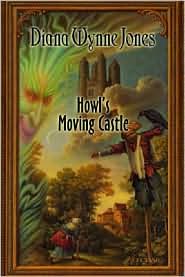
Howl's Moving Castle (MG, YA)


Jones, Diana Wynne. 1986. Howl's Moving Castle. 329 pages.

My new-found love for Diana Wynne Jones became evident only a few pages into Howl's Moving Castle, a wonderful fantasy novel revolving around a moving castle and its inhabitants.

In the land of Ingary, where such things as seven-league boots and cloaks of invisibility really exist, it is quite a misfortune to be born the eldest of three. Everyone knows you are the one who will fail first, and worst, if the three of you set out to seek your fortunes.

Sophie Hatter was the eldest of three sisters. She was not even the child of a poor woodcutter, which might have given her some chance of success. Her parents were well-to-do and kept a ladies' hat shop in the prosperous town of Market Chipping. True, her own mother died when Sophie was too years old and her sister Lettie was one year old, and their father married his youngest shop assistant, a pretty blonde girl called Fanny. Fanny shortly gave birth to the third sister, Martha. This ought to have made Sophie and Lettie into Ugly Sisters, but in fact all three girls grew up very pretty indeed, though Lettie was the one everyone said was most beautiful. Fanny treated all three girls with the same kindness and did not favor Martha in the least.


After the death of Mr. Hatter, the three Hatter sisters are divided up out of necessity--due to debt. One becomes apprentice to a baker/pastry chef. One becomes apprentice to a witch, Mrs. Fairfax. And Sophie, the oldest of the bunch, remains as "apprentice" to Fanny and continues working in the hat shop. Sophie in her people-pleasing, peace-maker role would have been content merely to let life pass her by. If only. If only...she hadn't fallen under the curse of the Witch of the Waste. Cursed to be old (long before her time), Sophie flees the shop (and her village) in shame and frustration. Forced to have an adventure, forced to "seek her fortune" despite being the oldest child, she stumbles across Howl's castle and seeks refuge.

Sophie meets Michael, Howl's apprentice, and Calcifer, Howl's fire demon who resides in the hearth of his castle. Sophie makes an impulsive deal: she'll try to break the contract between the two of them (Howl and Calcifer) if Calcifer will promise to break the curse over her. Sophie's meeting with Howl isn't immediate. And her impressions of him are ever-changing as time goes on.

Who is Wizard Howl? Well, in a way, he is who he chooses to be at that moment. A man of many names certainly. A man who likes having a bad reputation. A man who seems more playful at times than dangerous. A man trying to escape his own curse. Putting aside everything she's heard about him, Sophie begins to like this strange man. She is there to clean and mend for him. And he likes sending Sophie out in the role of his mother.

There are many twists and turns (some expected, some quite unexpected for this reader at least) that unfold throughout the novel. I don't want to go into every little detail and name every character that graces the pages of the book. But I will say this, I really enjoyed this one. It was a book that was fun and playful and delightful. A book that doesn't take itself too seriously.

© Becky Laney of Becky's Book Reviews

BTT: 15 in 15

btt button

I saw this over at Shelley’s, and thought it sounded like a great question for all of you:

“This can be a quick one. Don’t take too long to think about it. Fifteen books you’ve read that will always stick with you. First fifteen you can recall in no more than 15 minutes.”

1. Frankenstein
2. Life As We Knew It
3. Gone With The Wind
4. Their Eyes Were Watching God
5. Winnie the Pooh and House at Pooh Corner
6. Charlotte's Web
7. Ramona the Pest (and Ramona Quimby, Age 8)
8. Anne of Green Gables (well, all the books really)
9. The Long Winter
10. Ender's Game
11. Alice in Wonderland
12. The Bible (particularly John, Isaiah, Ephesians, Romans)
13. Good Morning Miss Dove
14. Mandy
15. The Book Thief


© Becky Laney of Becky's Book Reviews

Wednesday, June 03, 2009

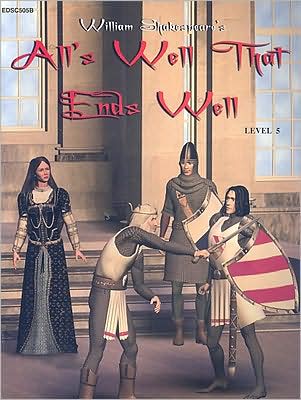
All's Well That Ends Well


Shakespeare, William. All's Well That Ends Well.

What does a girl have to do to catch a husband? Apparently a lot if you're a young maiden named Helena. In All's Well That Ends Well, the readers meet a young woman, Helena, who is madly in love with a young man, Bertram. Bertram is, in my opinion, an ass. He is stupid and lusty, and lusty and stupid. And he hangs out with with a truly annoying guy named Parolles. What is keeping these two apart? I mean, besides the fact that Bertram has no interest in her? Well, Helena, though well-beloved by her guardian, The Countess of Rousillon, is not noble by birth. She's the daughter of a very good (but now dead) doctor. And she can't reasonably hope to marry well--let alone marry her dream guy, Bertram, who is a Count (the son of the (above) Countess). So what's a girl to do, I say?!

Well, if you're Helena, you'll think up a couple of schemes. Scheme #1 being that you will head off to the King of France, who is conveniently dying, cure him with your father's wonderful secret remedies, and earn his devotion, respect, and favor. Once you've been granted the hand of ANY man in the kingdom, then you can go about nonchalantly (or maybe not so much) choosing the man you've loved all along, which in Helena's case is Bertram. Is Bertram extra-stupid, or is he just a typical guy in need of a couple years maturity? I'll leave that up to others to decide. Meanwhile, his response to Helena--and to the King--is to throw a temper tantrum, sulk and pout, and stomp off stealthily (again, not so much) to a whole other country--but not before he says, "I do."

Having won her husband in name only, Helena returns to the Countess who is pleased to see her but annoyed with her son for being the way he is. (He probably needed more spankings, perhaps?) After receiving a letter from him that he will not be her true husband until she has his ring on her finger and his child in her womb, she runs away to plot more schemes. The Countess is upset to see her go, but not too distressed since she has a full-time Clown to entertain her and make bawdy jokes night and day.

Bertram and his companions are in Florence, in the army, and when they're not off, you know, fighting, he is busy trying to have his way with various women. One woman that he is wooing is named Diana, she is the daughter of a widow woman. This widow-woman just happens to meet up with Helena--Helena has followed her husband secretly to Florence--and oh the plotting that these two do!

Can Helena (with some help, of course) win her husband's heart?

My thoughts on All's Well That Ends Well:

This is my first time with this play. I was a little nervous tackling it all on my own. But it was surprisingly easy to follow. At least surprisingly easy to follow....for being Shakespeare. I think the fact that it is a comedy, and that the jokes still translate (at least relatively so) as funny all these centuries later just shows you how some things never change. Is Helena stupid for loving a man who doesn't love her back? Should the Countess--or the King, or the Widow--have just told her that 'he's just not that into you'? Does Helena's loving Bertram make her weak by today's standards? Shouldn't Bertram have some say in who he marries? After all, it is his life. And couldn't Helena's persistent devotion be seen as proof of how stubborn she is? And if she's stubborn about this, she could very well turn out to be stubborn in everything else. I'm not saying Helena's wrong, not really, every single character--almost every single character anyway--seems to praise Helena as being the essence of a good woman, a great woman, an amazingly wonderful woman. But does the reader have enough proof that this is so? She does save the King's life, and that is something, and while her motives may be double in nature--wanting the king's favor to grant her Bertram--she probably does want to see him live for his own sake. And she does save the king by her own skill, her own smarts, so that says something: she is smart in some things at least. Why does she love Bertram? Why is he 'the one' for her? What makes him so wonderful in Helena's eyes? (Fortunately, Shakespeare was no Stephenie Meyer else all Helena's speeches would talk about his eyes.) Do we as readers need to know? It's always nice if we're shown why a hero and heroine belong together. (I think that is why I heart Much Ado About Nothing so much!!!) If the reader comes to feel what the heroine feels, then we have a connection with both hero and heroine. It makes for a more satisfying story. And that is something that is definitely lacking in All's Well That Ends Well. Helena loves him. End of story. Throw a party.

(mini-)
S
P
O
I
L
E
R

With a title like "All's Well That Ends Well," I feel it's not much of a surprise that things end well. For me to be convinced that things were really well, I'd need to feel that Bertram grew up...at least grew up a little. What has Bertram done to prove to readers that he is good-husband-material? Nothing. At all. Sure, he says he'll be a good and true husband to her. But really, what else can he say with all his boasting of how he came to care for her only after Helena's "death"? He could talk big to his mother and to his king when he thought his wife was dead. Yes, I repented of not loving her. Yes, I'm a fool. But having come to love her though too late, I'm a better man now. Can I get married to this other chick, now? I'm suspicious of Bertram still. Why? Because he's not honest. That and he's stupid. He's stupid for thinking he can get away with telling lie after lie. (I wouldn't have been surprised to hear him say emphatically and imploringly, I did not have sex with that woman.) Bertram's also insulting. Not only does he insult Helena (a few times to her face, but mostly by letter), he's insulting to Diana as well. When Diana is before the king, confessing all, he uses the old sure-but-she's-just-a-whore excuse. Of course, Diana wasn't a whore. She's a maiden still, as the reader well knows. (I personally would have written in a few face slaps. You know how Jack Sparrow is always getting his face slapped by women he's done wrong, well, Bertram needs a comeuppance.) Can Helena change Bertram? Really? Truly? Is a happily ever after likely here?

Why did I feel inspired to read this play? Well, I'm in Liv's A Shakespearean Summer Reading Challenge.

Have you read All's Well That Ends Well? Did you like it? What do you think are the chances for these two being happy together? Have you seen a good production of this play? I'd love to hear about it if you have! If you've not read the play (or even if you have, I suppose), what is it about Shakespeare that you love or hate most?

© Becky Laney of Becky's Book Reviews

19th Wife Winner

Congrats to Paula H. Paula, I've sent an email your way.

© Becky Laney of Becky's Book Reviews
The Moon Is A Harsh Mistress


Heinlein, Robert A. 1966. The Moon Is A Harsh Mistress.

I see in Lunaya Pravda that Luna City Council has passed on first reading a bill to examine, license, inspect--and tax--public food vendors operating inside municipal pressure. I see also is to be mass meeting tonight to organize "Sons of Revolution" talk-talk.

Manuel Garcia O'Kelly-Davis (called "Man" or "Mannie" by his friends) is the narrator of this Hugo-Award-Winning science fiction novel. In the first chapter, we meet Mannie and Mike. Who is Mike? Well, technically, he's a computer. The main computer on Luna, or the moon, to be exact. Manuel is the first (but not the last) to discover that this computer is alive. (I had to keep reminding myself that this was probably a new or newish idea at the time it was published. That figures like Data (from Star Trek) and Jane (from Speaker of the Dead) didn't exist. That these characters that I'm familiar with most likely draw their roots from Heinlein's Mike.) That he has a mind, a will, a personality of his own. When we first meet this pair, Mike is wanting to learn about humor, about what makes something funny, what makes for a good joke, and what doesn't. (See, why it reminded me of Data!) And Mannie is trying to help him out. Mike asks a favor of Mannie--well, several favors really. One, he asks Mike to attend a meeting, to record it for him so he can have it in his files. It is a meeting that the computer has been shut out of. It is this "talk-talk" of the Sons of the Revolution. Two, he asks Mike to help him be funny. He prints out a list of jokes, and he wants Mannie to mark which ones are funny and why.

Mannie does attend the meeting. While there, he meets two people who will ultimately change his life: Wyoming Knott (called Wyoh) and Professor Bernardo de la Paz (called Prof). Both have radically different ideas about the future of Luna, but both agree that the Luna Authority (led by The Warden) should be challenged. When the meeting is interrupted--turns quite ugly--the people fight their way out. (Never underestimate a Loonie!) Wyoh and Mannie flee together and hide in an out-of-the-way hotel room. While there, he decides that she is trustworthy and might just make a good friend for Mike. They meet. And Mike becomes Michelle. (He adopts a different personality 'to be' when talking with her.) Then the three of them decide to bring in The Prof into the circle, or mix, and a Revolution is born. Can two men, one woman, and a super-smart-but-not-so-funny computer take over the moon? Read for yourself and see in The Moon Is A Harsh Mistress.

My thoughts on the novel:

The style of this one is a bit sparse or jagged. Which isn't a bad thing. I got used to the abbreviated grammar--the elimination of some personal pronouns and articles and such. But it might come across as awkward until you get used to it.

The novel presents an interesting and strange arrangement of marriage. Marriage on the moon is rarely between one man and one woman. The scarcity of women, led to a woman being allowed (and encouraged) to bring in more men into the marriage. The novel talks (but not too in-depthly) about various kinds of marriages--specifically line marriages and clan marriages. I would have liked to known more, actually, about how these two differed. Mannie, for example, is part of a line marriage. There are several men, several women, all different ages.) The book does say that these marriages are happy ones and that they almost always work out.

The politics. The economics. The ecology. Not always interesting if I'm honest. It was interesting, in a way, to see war as being the answer. Prof believes--and Mike confirms--that the resources of the moon will be depleted in a little under eight years if grain shipments continue to Earth. Earth isn't really compensating Luna very much, for one thing, but another is that the grain is taking precious water out of the eco-system. And it's not being replenished. With each shipment worsening the long-term viability of the planet (at least for human use), something has to be done and fast.

Overall, I thought this one had a great beginning. The first third of the novel (maybe the first half) had me thoroughly hooked. I was loving Mike and Mannie. I was into the drama. Either I began to lose focus all on my own, or the novel got a bit bogged down in the political issues there in the middle. It became "this happened. Then this happened. And then this happened. And then this other thing happened." So it became more distant, at least to me. But at the same time, it didn't bog down enough for me to give up on it either.

So would I recommend it? Yes and no. If you love science fiction, then you'd probably enjoy this one. At least you might consider giving it a try. If it doesn't work out, no harm done. (That's what libraries are there for after all.) If you're not a fan of science fiction and are curious as to what it's all about, I'd probably start with another title if I'm being honest. (Maybe Foundation by Isaac Asimov instead?) The more you love thinking about politics and society and the behind-the-scenes making and breaking of a government, the more you'll enjoy this one. (Orson Scott Card goes there in some of his books, but to me, the more a book becomes about war and politics and power struggles, the boggier it becomes and less of an adventure. Not that all books have to have adventure, mind you.

Have you read this one? What did you think about it? Which other Heinlein novels might I enjoy? If you haven't read this one, what do you think about the merging of politics into sci-fi adventure stories in general?

© Becky Laney of Becky's Book Reviews