New Loot:
Smells Like Treasure by Suzanne Selfors
The Girl Who Circumnavigated Fairyland in a Ship of Her Own Making by Catherynne M. Valente
Austenland by Shannon Hale
Charlotte and Emily Bronte: The Complete Novels
The Complete Novels by Jane Austen
Tortilla Flat by John Steinbeck
Novels, 1942-1952 John Steinbeck (East of Eden, Cannery Row, etc.)
The Grapes of Wrath by John Steinbeck
Leftover Loot:
Cover Her Face by P.D. James
A Mind to Murder by P.D. James
Unnatural Causes by P.D. James
City of Tranquil Light by Bo Caldwell
Sleeping Murder: A Miss Marple mystery by Agatha Christie
A Pocket Full of Rye: A Miss Marple mystery by Agatha Christie
The Mirror Crack'd from Side to Side: A Miss Marple mystery by Agatha Christie
Death in the Clouds by Agatha Christie
Library Loot is a weekly event co-hosted by Claire and Marg that encourages bloggers to share the books they’ve checked out from the library. If you’d like to participate, just write up your post-feel free to steal the button-and link it using the Mr. Linky any time during the week. And of course check out what other participants are getting from their libraries.
© 2011 Becky Laney of Becky's Book Reviews
Thursday, July 07, 2011
Possession (YA)
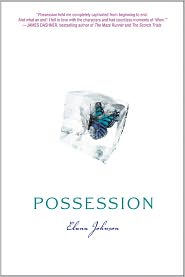
Possession. Elana Johnson. 2011. Simon & Schuster. 416 pages.
Good girls don't walk with boys. Even if they're good boys--and Zenn is the best.
Possession seems like the kind of book a dystopian-lover would love. But this one proved disappointing to me. The more I read, the more that disappointment grew. I'll try to explain.
It's one thing for a dystopian novel to throw the readers into a foreign world where they're unsure of the rules of the society and culture. But to leave readers confused for over 400 pages? To leave readers struggling to even make sense of the basic story structure? That's a big disappointment. As I said, it's one thing if there are a few missing pieces of the puzzle. The author could have done that on purpose, after all. The reader's confusion could be intentional. But I don't know if I believe that an author would intentionally confuse readers for hundreds of pages. (Well, yes, there's James Joyce and T.S. Eliot. But that's a different story.)
I believe that when you read a book, you should be able to turn the pages and know whose head your inside--who is doing the narrating, whose perspective you're seeing. Call me silly, but, that's just the way I am.
Violet, our heroine, has not been quite as obedient as she should have been. She has a way of unplugging from the messages the authorities send--to everybody--messages that tell them how to live, behave, conform, etc. The voices that 'manage' them. But even if she's not brainwashed--she's still capable of thinking for herself, for the most part, she's not extremely rebellious. She's not out to start a revolution, she's not out to break down the powers that be. She just wants to take a little walk with her match and best friend, Zenn. She just wants to have a little alone time now and then. Of course, that breaks the rules. But it hardly seems fair that such offenses would lead to prison either. But that is just what happens to Vi. In prison she meets another boy, Jag, and if labels are to be believed, he is "bad." But this 'bad boy' has a certain appeal and these two seem to share a common destiny, a common enemy. Once these two team up....well, that's when things get started.
The novel has an interesting premise: a mind-controlling government. And the novel has romance potential. Readers know from the start that Vi will at one point or another be called to choose between the boy from her past (Zenn) and the boy of the moment (Jag). Readers--for better or worse--know more about Jag than Zenn. But that isn't necessarily a horrible thing. Zenn is present for the novel, just not in a romantic, heroic way. And Jag, well, even though he's got hero potential. Well, he's not going to go out of his way to act like a ROMANTIC hero when bigger things are at stake. (I actually like that).
While I didn't fall for Jag myself, that is, I didn't find him swoon-worthy, I can see that Vi and Jag belong together. I think they deserve each other. Jag can get under Vi's skin and drive her crazy. And she can get under his skin and drive him crazy. The things she accuses Jag of, she's guilty of doing herself. And the things Jag accuses Vi of, well, he's just as guilty. If either were with a more honest person, there could be trouble. When these two fight--and they do fight--it's impossible to take sides. Because they're the pot and the kettle.
The ending. What can I say? Am I really more disappointed by the ending than I was the middle? It's not fair to say. I do think it's a bit open, a bit of a cliffhanger. If it is truly 'the end.' It is a LOT more open than most YA novels I read. (Which wouldn't be a bad thing.) If it's just trying to build up suspense for a book two, it's a bit annoying, but what else is to be expected these days?
I didn't hate Vi. I didn't hate Jag. I didn't hate Zenn. I didn't hate the world Elana Johnson created. I really didn't feel strongly enough about it to hate it. Hate requires passion and energy. It's just that I didn't connect with them enough to "like" the novel. Readers are different. Some people love plot-driven or premise-driven novels. I tend to care more about the characters, to want a story to be character-driven. So there's a chance you might appreciate Possession more than I did.
© 2011 Becky Laney of Becky's Book Reviews
Good girls don't walk with boys. Even if they're good boys--and Zenn is the best.
Possession seems like the kind of book a dystopian-lover would love. But this one proved disappointing to me. The more I read, the more that disappointment grew. I'll try to explain.
It's one thing for a dystopian novel to throw the readers into a foreign world where they're unsure of the rules of the society and culture. But to leave readers confused for over 400 pages? To leave readers struggling to even make sense of the basic story structure? That's a big disappointment. As I said, it's one thing if there are a few missing pieces of the puzzle. The author could have done that on purpose, after all. The reader's confusion could be intentional. But I don't know if I believe that an author would intentionally confuse readers for hundreds of pages. (Well, yes, there's James Joyce and T.S. Eliot. But that's a different story.)
I believe that when you read a book, you should be able to turn the pages and know whose head your inside--who is doing the narrating, whose perspective you're seeing. Call me silly, but, that's just the way I am.
Violet, our heroine, has not been quite as obedient as she should have been. She has a way of unplugging from the messages the authorities send--to everybody--messages that tell them how to live, behave, conform, etc. The voices that 'manage' them. But even if she's not brainwashed--she's still capable of thinking for herself, for the most part, she's not extremely rebellious. She's not out to start a revolution, she's not out to break down the powers that be. She just wants to take a little walk with her match and best friend, Zenn. She just wants to have a little alone time now and then. Of course, that breaks the rules. But it hardly seems fair that such offenses would lead to prison either. But that is just what happens to Vi. In prison she meets another boy, Jag, and if labels are to be believed, he is "bad." But this 'bad boy' has a certain appeal and these two seem to share a common destiny, a common enemy. Once these two team up....well, that's when things get started.
The novel has an interesting premise: a mind-controlling government. And the novel has romance potential. Readers know from the start that Vi will at one point or another be called to choose between the boy from her past (Zenn) and the boy of the moment (Jag). Readers--for better or worse--know more about Jag than Zenn. But that isn't necessarily a horrible thing. Zenn is present for the novel, just not in a romantic, heroic way. And Jag, well, even though he's got hero potential. Well, he's not going to go out of his way to act like a ROMANTIC hero when bigger things are at stake. (I actually like that).
While I didn't fall for Jag myself, that is, I didn't find him swoon-worthy, I can see that Vi and Jag belong together. I think they deserve each other. Jag can get under Vi's skin and drive her crazy. And she can get under his skin and drive him crazy. The things she accuses Jag of, she's guilty of doing herself. And the things Jag accuses Vi of, well, he's just as guilty. If either were with a more honest person, there could be trouble. When these two fight--and they do fight--it's impossible to take sides. Because they're the pot and the kettle.
The ending. What can I say? Am I really more disappointed by the ending than I was the middle? It's not fair to say. I do think it's a bit open, a bit of a cliffhanger. If it is truly 'the end.' It is a LOT more open than most YA novels I read. (Which wouldn't be a bad thing.) If it's just trying to build up suspense for a book two, it's a bit annoying, but what else is to be expected these days?
I didn't hate Vi. I didn't hate Jag. I didn't hate Zenn. I didn't hate the world Elana Johnson created. I really didn't feel strongly enough about it to hate it. Hate requires passion and energy. It's just that I didn't connect with them enough to "like" the novel. Readers are different. Some people love plot-driven or premise-driven novels. I tend to care more about the characters, to want a story to be character-driven. So there's a chance you might appreciate Possession more than I did.
© 2011 Becky Laney of Becky's Book Reviews
Labels:
2011,
dystopia,
Simon and Schuster,
YA Fantasy,
YA Fiction,
YA Romance,
YA Science Fiction
Wednesday, July 06, 2011
Trauma Queen (MG)
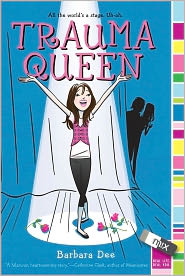
Trauma Queen. Barbara Dee. 2011. Simon & Schuster. 272 pages.
I am standing outside homeroom in yellow flannel monkey pajamas.
Everyone else is dressed normally: jeans, track pants, sweaters, whatever.
Apparently because today, Monday, February 3, is not Pajama Day at Crampton Middle School. Also apparently I am the only one who is celebrating Pajama Day, because I am the only one whose mother told her it was Pajama Day.
Marigold doesn't always love her mom. You see, Marigold's mom is a performance artist. She does crazy, crazy, embarrassing things in front of people...on purpose. Sometimes Marigold wishes her Mom could really stick to one performance: normal, sane, ordinary mother of two. But that's a role she rarely does.
Trauma Queen is about new beginnings. Marigold's family is starting over--again. The last town, well, it didn't end so well. On the positive side, Marigold made a friend--a really good friend--a girl named Emma. And things seemed to be going well until Emma's mom met Marigold's mom. Then it got UGLY, UGLY, SUPER-UGLY. Now Emma isn't allowed to speak with her...at all. So it's just as well, I suppose, that they did start over in a new town. But some things Marigold can't really forget.
One of the things that I LOVED about Trauma Queen were the characters. I thought they were well-developed. I loved how we get to know Marigold's family: her mom, her sister, Kennedy, her Gram. I especially loved to see the conversations between Mari and her Gram. I did. I loved how we get to know Marigold's classmates. Those that like Marigold (Layla, Ethan, Brody, etc.). And those that don't (Jada). WE get to see the tensions in her class. And it's so well done! It felt very authentic. I thought the author did a great job with showing not telling.
It was easy to love Marigold. It was easy to sympathize with her. But it was also easy--at least for me--to see the Mom's strengths. I couldn't not like the Mom. I couldn't. And when she started working with some of Marigold's classmates in an after school program, well, I admired her all the more. Was she perfect? No. Of course not. But she was not "the enemy" out to ruin her daughter's life. Seeing Gram, Mom, and Marigold together, well, it felt right. This novel has substance and depth.
I would definitely recommend Trauma Queen. I've also read This is Me From Now On.
My favorite quote:
© 2011 Becky Laney of Becky's Book Reviews
I am standing outside homeroom in yellow flannel monkey pajamas.
Everyone else is dressed normally: jeans, track pants, sweaters, whatever.
Apparently because today, Monday, February 3, is not Pajama Day at Crampton Middle School. Also apparently I am the only one who is celebrating Pajama Day, because I am the only one whose mother told her it was Pajama Day.
Marigold doesn't always love her mom. You see, Marigold's mom is a performance artist. She does crazy, crazy, embarrassing things in front of people...on purpose. Sometimes Marigold wishes her Mom could really stick to one performance: normal, sane, ordinary mother of two. But that's a role she rarely does.
Trauma Queen is about new beginnings. Marigold's family is starting over--again. The last town, well, it didn't end so well. On the positive side, Marigold made a friend--a really good friend--a girl named Emma. And things seemed to be going well until Emma's mom met Marigold's mom. Then it got UGLY, UGLY, SUPER-UGLY. Now Emma isn't allowed to speak with her...at all. So it's just as well, I suppose, that they did start over in a new town. But some things Marigold can't really forget.
One of the things that I LOVED about Trauma Queen were the characters. I thought they were well-developed. I loved how we get to know Marigold's family: her mom, her sister, Kennedy, her Gram. I especially loved to see the conversations between Mari and her Gram. I did. I loved how we get to know Marigold's classmates. Those that like Marigold (Layla, Ethan, Brody, etc.). And those that don't (Jada). WE get to see the tensions in her class. And it's so well done! It felt very authentic. I thought the author did a great job with showing not telling.
It was easy to love Marigold. It was easy to sympathize with her. But it was also easy--at least for me--to see the Mom's strengths. I couldn't not like the Mom. I couldn't. And when she started working with some of Marigold's classmates in an after school program, well, I admired her all the more. Was she perfect? No. Of course not. But she was not "the enemy" out to ruin her daughter's life. Seeing Gram, Mom, and Marigold together, well, it felt right. This novel has substance and depth.
I would definitely recommend Trauma Queen. I've also read This is Me From Now On.My favorite quote:
But how do you know you're seeing things through your own eyes? Maybe you think you are, but really, you're just collecting other people's points of view. Maybe you're seeing the world through their eyes, and you don't even know it. (211)
© 2011 Becky Laney of Becky's Book Reviews
Tuesday, July 05, 2011
Elephants Can Remember
Mrs. Oliver looked at herself in the glass.
While I tend to prefer Miss Marple to Hercule Poirot most of the time, when Christie's Poirot novels feature Ariadne Oliver, it becomes trickier to play favorites. For Ariadne Oliver is a writer, a writer of detective fiction or mysteries. And her perspective on the genre--and on writing in general--which is shared with readers is just fun. In Elephants Can Remember, Mrs. Oliver is approached by a woman who is memorable for all the wrong reasons:
A large woman. Ample proportions, large white champing teeth. What in French could have been called une femme formidable, but who definitely had not only the French variety of being formidable, but the English one of being supremely bossy. Obviously she either knew Mrs. Oliver, or was intent on making her acquaintance there and then. The last was how it happened to go. (8)Mrs. Burton-Cox is "concerned" about her son who is contemplating marrying Mrs. Oliver's goddaughter. Now, Mrs. Oliver has had many goddaughters through the decades, and this particular one has slipped her mind completely. Well, until forced to remember by Burton-Cox's persistence. Celia Ravenscroft is the goddaughter in question, the "inappropriate" young woman, that Burton-Cox does not want for her daughter-in-law. Why? Well, there was a family tragedy when Celia was just a girl. Her parents died in an apparent suicide. No one knows if her father shot her mother or if her mother shot her father. No one knows what provoked this murder-suicide. Was her mother involved with another man? Was her father involved with another woman? And though it seems almost everyone has forgotten this tragedy except Mrs. Burton-Cox, she's convinced that Celia is not good for her son.
Mrs. Oliver is annoyed by Mrs. Burton-Cox. But she is also curious. She was out of the country when the tragedy happened all those years ago, and, well, part of her wants to know the truth--or as much of the truth can be discerned or concluded--herself. So she decides that if Celia will give her blessing, she'll begin to snoop around. And she'll even call her old friend, Hercule Poirot. He may be able to connect the dots and solve this one.
![]() | |||
Favorite quote:
"Human curiosity," said Poirot. "Such a very interesting thing." He sighed. "To think that we owe to it throughout history. Curiosity. I don't know who invented curiosity. It is said to be usually associated with the cat. Curiosity killed the cat. But I should say really that the Greeks were the inventors of curiosity. They wanted to know. Before them, as far as I can see, nobody wanted to know much. They just wanted to know what the rules of the country they were living in were, and how they could avoid having their heads cut off or being impaled on spikes or something disagreeable happening to them. But they either obeyed or disobeyed. They didn't want to know why. But since then a lot of people have wanted to know why and all sorts of things have happened because of that. Boats, trains, flying machines and atom bombs and penicillin and cures for various illnesses. A little boy watches his mother's kettle raising its lid because of the steam. And the next thing we know is we have railway trains, leading on in due course to railway strikes and all that. And so on and so on." (25)
"As one journeys through life," said Poirot, "one finds more and more that people are often interested in things that are none of their business. Even more so than they are in things that could be considered their business." (117)
© 2011 Becky Laney of Becky's Book Reviews
Labels:
1972,
adult fiction,
adult mystery,
Agatha Christie,
Hercule Poirot,
library book,
mystery
Monday, July 04, 2011
Star-Crossed (YA)
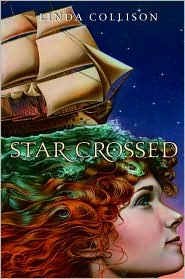
Star-Crossed. Linda Collison. 2006. Random House. 416 pages.
I came aboard with the prostitutes the night before the ship set sail. It was a rash scheme, but I was a brash girl with nothing to my name but a promise.
Patricia Kelley, the heroine of Star-Crossed, was a great annoyance to me throughout the book. I wanted to be honest about that from the start. I don't think that you'll necessarily agree with me on that. And I wouldn't be surprised if others liked this one a lot more than I did.
Some people might not find astupid clueless heroine such an annoyance. (Star-Crossed reminded me of Emma's Harriet.)
Our heroine is the illegitimate daughter of a gentleman who owns a sugar plantation in Barbados. Perhaps her impressions of her father have been 'helped' by the distance between them, perhaps her impression of him remains what it was when she was still six years old and living at the plantation where she was born. She's spent ten of her sixteen years away at a boarding school in the English countryside for 'gentlemen's daughters.' She believes with all her heart that this school is only for the very, very, finest young ladies. (I'm not completely convinced.) She seems to have complete confidence in the fact that she--the daughter who does not even bear his name--will inherit the plantation. You see, she's learned that her father has died. And she's convinced that if she can just go herself to Barbados, to the plantation, then NATURALLY, everything will go her way.
Not having any money or any friends, she resorts to disguising herself as a prostitute and going on board the merchant ship destined for the West Indies. She's discovered, as might be expected, by a sailor, Brian Dalton, who befriends her. But it is only the fact that she is saved by Dr. MacPherson that keeps her on board after their first stop--for either the captain or the owner--not quite sure which--is very angry to have a stowaway. MacPherson agrees to pay for her passage if she'll be his 'loblolly boy.' She agrees. During the day, she's his assistant. At night--in the early morning hours--she sneaks out of the cabin to find Dalton. He's a most kissable boy when no one is around to see her questionable behavior. She decides she likes some aspects of living at sea. She likes dressing as a boy and playing at doing the work of a sailor--when it's convenient, when there's a cute guy around, etc. BUT for the first third of the novel, she's living in a fantasy world where arriving in Barbados will make her every dream come true. It's not that no one on board is asking her exactly what her plan is, for they all seem to be living in the real world, it's just that our heroine insists that she doesn't need a plan to get what is hers.
Can you predict where this one's going? Maybe that was one of the issues I had with it. Maybe it's an issue you won't have. I could see a few things happening very early on. I could predict what was NOT going to happen at Barbados. And I could predict precisely what was going to happen when it came to the 'romance.'
Another issue I had with this one is that I kept having shouting matches at the heroine. It was SO VERY EASY to shout at her. Not that it did any good. It didn't make her any smarter. It didn't make her have even a little common sense. But I felt better while I was reading it.
So. I didn't hate this one exactly. It could have been MUCH worse. For one, if it had been an adult romance novel, it probably would have included attempted rape/rape scenes. And the doctor would have offered "protection" from other men on the ship--at a cost. So. At least this book wasn't predictable in that way. It was historical adventure with romantic elements. (I didn't find the romantic story enjoyable, but other readers may.) The heroine rather reluctantly perhaps becomes a spunky adventurer/sailor. If the heroine becomes independent and free-thinking by the end of the novel, it is more by chance than design. Well, I'm not sure if that is exactly true. She may just have become better at it. While it's true I didn't like the heroine, I did like some of the minor characters, or the minor-minor characters. (There were some characters that were only in one chapter that I liked better than some of the regulars.)
S
P
O
I
L
E
R
ABOUT
THE
R
O
M
A
N
C
E
So when our heroine returns to the ship actually shocked and devastated by the fact that she is NOT a plantation owner and that she has absolutely nothing to inherit; no money of her own, no place to live, no place to go, etc. She's "comforted" perhaps by two men who love her: Dalton, the boy she just LOVES to make out with. And Dr. MacPherson, a man she has no interest in making out with. Can you guess which one she chooses? Can you guess why?
Our heroine is the illegitimate daughter of a "gentleman" with massive amounts of debts and reckless gambling habits. (Her father also had other illegitimate children. Not that she knew that before she arrived to learn 'the truth.') She has such a high opinion of herself, of her place in society, never doubting FOR ONE LITTLE SECOND that she belongs to the highest ranks of society, never doubting that she is so very very superior to everyone else because her father was a gentleman. She can't understand the basic facts of the case. She is illegitimate. She doesn't share her father's name. Their relationship may have been understood in some circles, and she may been treated fairly well at that boarding school in the country. But a country boarding school isn't exactly London society. You can't very well put on your calling card, illegitimate daughter of Mr. So-and-So. The very fact that she was illegitimate would probably keep her out of the best circles in society. Add to the fact that she has NO MONEY AT ALL. Who in the world would accept a penniless illegitimate daughter into their society? Who would marry her? Who of "her class" would marry her? With NO money and no social connections? Who would "sponsor" her into society at all? Who would "introduce" her into society?
So when she rejects Dalton BECAUSE he is her INFERIOR. Well, it irritated me. Not because I liked Dalton. Not because I preferred him to Dr. MacPherson. Not because Dalton had any personality to him at all. What annoyed me was the why behind it. He's not good enough for her. He is not of her class. She thinks he's DREAMY. She loves to kiss him. She loves to daydream about him. BUT. He's just not quality enough for her. It would be one thing if she was equally attracted to the doctor. But she isn't.
The truth? She's so stuck on herself being somebody big-and-important (even though there's no basis in reality to back this up) that she doesn't see that she doesn't have money, she has no place to call home, she has no way of earning money and THEREFORE it doesn't matter "who" she is. Whether she wants a new beginning or not, she's got one. She could CHOOSE to be with the man she loves best and no one would think a thing of it. There is no society that she belongs to at the moment that would judge her or could judge her. She may think she's the center of the universe, but she's not.
So she chooses who she chooses. And, if I'm being honest, I do actually like Dr. MacPherson. (I think our heroine is not good enough for him. I think he deserved much, much, much better.) The middle section of the novel focuses on her marriage to the doctor. We see her grow--or supposedly grow--into a competent nurse or surgeon mate. I don't know if she grows in intelligence as she matures, but, there are less opportunities for her to be stupid. And, to give her the benefit of the doubt, she could be quite a bit smarter from when we first met her.
The third section of the novel is what happens after her husband dies...how she becomes 'a man' and goes to see as a surgeon mate....and you can guess who she accidentally meets....and how that develops....
© 2011 Becky Laney of Becky's Book Reviews
I came aboard with the prostitutes the night before the ship set sail. It was a rash scheme, but I was a brash girl with nothing to my name but a promise.
Patricia Kelley, the heroine of Star-Crossed, was a great annoyance to me throughout the book. I wanted to be honest about that from the start. I don't think that you'll necessarily agree with me on that. And I wouldn't be surprised if others liked this one a lot more than I did.
Some people might not find a
Our heroine is the illegitimate daughter of a gentleman who owns a sugar plantation in Barbados. Perhaps her impressions of her father have been 'helped' by the distance between them, perhaps her impression of him remains what it was when she was still six years old and living at the plantation where she was born. She's spent ten of her sixteen years away at a boarding school in the English countryside for 'gentlemen's daughters.' She believes with all her heart that this school is only for the very, very, finest young ladies. (I'm not completely convinced.) She seems to have complete confidence in the fact that she--the daughter who does not even bear his name--will inherit the plantation. You see, she's learned that her father has died. And she's convinced that if she can just go herself to Barbados, to the plantation, then NATURALLY, everything will go her way.
Not having any money or any friends, she resorts to disguising herself as a prostitute and going on board the merchant ship destined for the West Indies. She's discovered, as might be expected, by a sailor, Brian Dalton, who befriends her. But it is only the fact that she is saved by Dr. MacPherson that keeps her on board after their first stop--for either the captain or the owner--not quite sure which--is very angry to have a stowaway. MacPherson agrees to pay for her passage if she'll be his 'loblolly boy.' She agrees. During the day, she's his assistant. At night--in the early morning hours--she sneaks out of the cabin to find Dalton. He's a most kissable boy when no one is around to see her questionable behavior. She decides she likes some aspects of living at sea. She likes dressing as a boy and playing at doing the work of a sailor--when it's convenient, when there's a cute guy around, etc. BUT for the first third of the novel, she's living in a fantasy world where arriving in Barbados will make her every dream come true. It's not that no one on board is asking her exactly what her plan is, for they all seem to be living in the real world, it's just that our heroine insists that she doesn't need a plan to get what is hers.
Can you predict where this one's going? Maybe that was one of the issues I had with it. Maybe it's an issue you won't have. I could see a few things happening very early on. I could predict what was NOT going to happen at Barbados. And I could predict precisely what was going to happen when it came to the 'romance.'
Another issue I had with this one is that I kept having shouting matches at the heroine. It was SO VERY EASY to shout at her. Not that it did any good. It didn't make her any smarter. It didn't make her have even a little common sense. But I felt better while I was reading it.
So. I didn't hate this one exactly. It could have been MUCH worse. For one, if it had been an adult romance novel, it probably would have included attempted rape/rape scenes. And the doctor would have offered "protection" from other men on the ship--at a cost. So. At least this book wasn't predictable in that way. It was historical adventure with romantic elements. (I didn't find the romantic story enjoyable, but other readers may.) The heroine rather reluctantly perhaps becomes a spunky adventurer/sailor. If the heroine becomes independent and free-thinking by the end of the novel, it is more by chance than design. Well, I'm not sure if that is exactly true. She may just have become better at it. While it's true I didn't like the heroine, I did like some of the minor characters, or the minor-minor characters. (There were some characters that were only in one chapter that I liked better than some of the regulars.)
S
P
O
I
L
E
R
ABOUT
THE
R
O
M
A
N
C
E
So when our heroine returns to the ship actually shocked and devastated by the fact that she is NOT a plantation owner and that she has absolutely nothing to inherit; no money of her own, no place to live, no place to go, etc. She's "comforted" perhaps by two men who love her: Dalton, the boy she just LOVES to make out with. And Dr. MacPherson, a man she has no interest in making out with. Can you guess which one she chooses? Can you guess why?
Our heroine is the illegitimate daughter of a "gentleman" with massive amounts of debts and reckless gambling habits. (Her father also had other illegitimate children. Not that she knew that before she arrived to learn 'the truth.') She has such a high opinion of herself, of her place in society, never doubting FOR ONE LITTLE SECOND that she belongs to the highest ranks of society, never doubting that she is so very very superior to everyone else because her father was a gentleman. She can't understand the basic facts of the case. She is illegitimate. She doesn't share her father's name. Their relationship may have been understood in some circles, and she may been treated fairly well at that boarding school in the country. But a country boarding school isn't exactly London society. You can't very well put on your calling card, illegitimate daughter of Mr. So-and-So. The very fact that she was illegitimate would probably keep her out of the best circles in society. Add to the fact that she has NO MONEY AT ALL. Who in the world would accept a penniless illegitimate daughter into their society? Who would marry her? Who of "her class" would marry her? With NO money and no social connections? Who would "sponsor" her into society at all? Who would "introduce" her into society?
So when she rejects Dalton BECAUSE he is her INFERIOR. Well, it irritated me. Not because I liked Dalton. Not because I preferred him to Dr. MacPherson. Not because Dalton had any personality to him at all. What annoyed me was the why behind it. He's not good enough for her. He is not of her class. She thinks he's DREAMY. She loves to kiss him. She loves to daydream about him. BUT. He's just not quality enough for her. It would be one thing if she was equally attracted to the doctor. But she isn't.
The truth? She's so stuck on herself being somebody big-and-important (even though there's no basis in reality to back this up) that she doesn't see that she doesn't have money, she has no place to call home, she has no way of earning money and THEREFORE it doesn't matter "who" she is. Whether she wants a new beginning or not, she's got one. She could CHOOSE to be with the man she loves best and no one would think a thing of it. There is no society that she belongs to at the moment that would judge her or could judge her. She may think she's the center of the universe, but she's not.
So she chooses who she chooses. And, if I'm being honest, I do actually like Dr. MacPherson. (I think our heroine is not good enough for him. I think he deserved much, much, much better.) The middle section of the novel focuses on her marriage to the doctor. We see her grow--or supposedly grow--into a competent nurse or surgeon mate. I don't know if she grows in intelligence as she matures, but, there are less opportunities for her to be stupid. And, to give her the benefit of the doubt, she could be quite a bit smarter from when we first met her.
The third section of the novel is what happens after her husband dies...how she becomes 'a man' and goes to see as a surgeon mate....and you can guess who she accidentally meets....and how that develops....
© 2011 Becky Laney of Becky's Book Reviews
Labels:
2006,
Random House,
review copy,
YA Adventure,
YA Fiction,
YA Historical Fiction,
YA Romance
Subscribe to:
Posts (Atom)