Saturday, May 11, 2013

Week in Review: May 5-11

Nicholas Nickleby. Charles Dickens. 1839. 817 pages.
Can You Forgive Her? Anthony Trollope. 1865. 848 pages.
The Fallen Leaves. Wilkie Collins. 1879. 344 pages.
The Wonderful Wizard of Oz. L. Frank Baum. 1900. 156 pages.
A Dangerous Inheritance. Alison Weir. 2012. Hutchinson. 515 pages.
Cross My Heart. Sasha Gould. 2012. Random House. 272 pages.
According to the Pattern. Grace Livingston Hill. 1903. 186 pages.
Words to Winners of Souls. Horatius Bonar. 1877. 72 pages.
Gospel: Recovering the Power That Made Christianity Revolutionary. J.D. Greear. Foreword by Timothy Keller. B&H Books. 266 pages.
Christ the Eternal Son. A.W. Tozer. 175 pages.
The Bookends of the Christian Life. Jerry Bridges and Bob Bevington. 2009. March 2009. Crossway Publishers. 160 pages.

© 2013 Becky Laney of Becky's Book Reviews

Library Loot: Second Trip in May

New Loot:
  • The Queen's Governess by Karen Harper
  • The Lady and the Poet by Maeve Haran
  • The Foundling by Georgette Heyer
  • Grumpy Cat by Britta Teckentrup
  • Farm by James Brown
  • Governess: The Lives and Times of the Real Jane Eyres by Ruth Brandon
  • Hiding in the Spotlight: A Musical Prodigy's Story of Survival, 1941-1946 Greg Dawson
Leftover Loot:
  • Because It is My Blood by Gabrielle Zevin
  • Only You Can Save Mankind by Terry Pratchett
  • Here I Stand: A Life of Martin Luther by Roland H. Bainton
  • Six Wives: The Queens of Henry VIII by David Starkey
  • Daughter of York by Anne Easter Smith
  • A Rose for the Crown by Anne Easter Smith
  • The King's Grace by Anne Easter Smith
  • Queen by Right by Anne Easter Smith
  • In A Glass Grimmly by Adam Gidwitz
  • The Adventures of a South Pole Pig by Chris Kurtz
  • Detection Unlimited by Georgette Heyer
  • Rose of York: Crown of Destiny by Sandra Worth
  • Rose of York: Fall From Grace by Sandra Worth
    Library Loot is a weekly event co-hosted by Claire and Marg that encourages bloggers to share the books they’ve checked out from the library. If you’d like to participate, just write up your post-feel free to steal the button-and link it using the Mr. Linky any time during the week. And of course check out what other participants are getting from their libraries.  

© 2013 Becky Laney of Becky's Book Reviews

Friday, May 10, 2013

Fallen Leaves (1879)

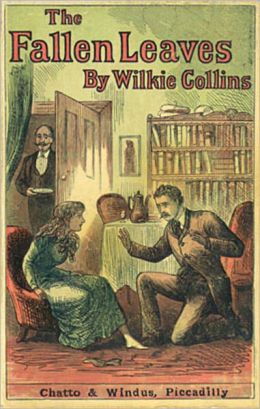
The Fallen Leaves. Wilkie Collins. 1879. 344 pages.

I have really enjoyed some of the novels I've read by Wilkie Collins. I loved, loved, loved Armadale and The Woman in White. I really enjoyed Man and Wife and The Moonstone. I liked The Fallen Leaves, but, it is not Collins at his best in my opinion.

Claude Amelius Goldenheart is the hero of The Fallen Leaves. He is returning to England at the start of the novel.  (He was born in England, and grew up in the United States. His growing-up-years were spent in a Christian socialist community. He will soon come into an inheritance, but, he discovers that his inheritance isn't big enough for him to take a place in Society. He's introduced to the Farnaby family early in the novel. Mrs. Farnaby is fascinated by him, in a way, and treats him strangely. She pulls him into her confidence, sharing the most intimate secrets in her past. Her excuse? Well, she had a DREAM that he was "the one" who brought her her heart's desire: her missing daughter. (Mrs. Farnaby had a child before she married. When the baby was just a week or possibly two weeks old, it was kidnapped). Because she wants HIM to find her, she feels very strongly that he shouldn't be settling down anywhere and getting married. He definitely shouldn't marry her niece. He needs to be free and independent so he can travel and socialize. But by the time he's discussing this secret with Mrs. Farnaby, he's already incredibly smitten with the niece, Regina. Her father does not approve because Mr. Goldenheart is "poor" in his estimation. If he can increase his annual income by several thousand in the next few years, then he'll consider it. Our hero who has grown up a socialist can't fathom WHY he needs more money to be happy in his marriage. He disagrees significantly with Mr. Farnaby! And the family is hoping that he outgrows his strangeness. They really don't like it when he gives a lecture to the lower classes on "Christian socialism."

There are two big questions in this one: "Will Amelius find Mrs. Farnaby's lost daughter?" and "Will Amelius make a happy marriage?"

I wasn't bored with The Fallen Leaves. But. It certainly wasn't amazing.

Favorite quotes:
'Ah, dear me! Another of the Fallen Leaves!' I knew what he meant. The people who have drawn blanks in the lottery of life--the people who have toiled hard after happiness, and have gathered nothing but disappointment and sorrow; the friendless and the lonely, the wounded and the lost--these are the people whom our good Elder Brother calls The Fallen Leaves. I like the saying myself; it's a tender way of speaking of our poor fellow creatures who are down in the world.
 It is an afternoon concert; and modern German music was largely represented on the programme. The patient English people sat in closely-packed rows, listening to the pretentious instrumental noises which were impudently offered to them as a substitute for melody. 
My sentiments are not altogether favourable to that art [photography]. I delivered a lecture on photographic portraiture at Coolspring; and I described it briefly as justice without mercy.
In less than half an hour he discovered that Hume could do nothing for him. Wisely inspired, he turned to the truer history next, which mean call fiction.
© 2013 Becky Laney of Becky's Book Reviews

Thursday, May 09, 2013

Nicholas Nickleby (1839)

Nicholas Nickleby. Charles Dickens. 1839. 817 pages.

I definitely enjoyed reading Charles Dickens' The Life and Adventures of Nicholas Nickleby. Soon after the novel opens, three members of the Nickleby family (Mrs. Nickleby, Nicholas, and Kate) travel to London to visit with Ralph Nickleby (Nicholas and Kate's uncle.) Mr. Nickleby has recently died leaving the family destitute. While they don't demand financial support from the relatively wealthy uncle, they are certainly hopeful that he will at the very least help Nicholas and Kate find positions to earn money.

One thing can be said with certainty: Ralph Nickleby is not a nice man, a kind man, a sociable man. I am not sure he treats anyone with respect or consideration. Emotional support will not be given, nor will direct financial help. He "helps" Nicholas get a job in a family-run school. The owner of the "school" is a scoundrel through and through. He also "helps" Kate get a job as an assistant seamstress. Neither job lasts terribly long. Kate loses her job when the seamstress goes bankrupt; Nicholas runs away from his job--taking along a young man named Smike--after beating up his employer. Any other "help" given to Kate is the opposite of what anyone could ever want. He introduces her to several despicable gentleman-in-name-only men, notably Sir Mulberry Hawk and Lord Frederick Verisopht. Kate finds their attentions repulsive and threatening, to a degree. Mr. Pluck and Mr Pyke are "friends" who help the two gentleman get in closer with the mother and daughter. The mother. OH WHAT I COULD SAY ABOUT HER!!!! Needless to say, the attentions from these two men cause her to lose a second job, a job I believe she found on her own. And Kate believes the danger to be real, as does Newman Noggs; he takes it upon himself to write Nicholas and alert him to the situation, bringing him back to London and reuniting the family for better or worse. (After Nicholas left his first job, he becomes an actor in a theatrical troupe!!!)

Most of the novel concerns the welfare of the Nickleby family as they try to make a life for themselves. Kate and Nicholas just want opportunities to work, to prove themselves capable workers. Mrs. Nickleby, well, she's just looking for someone--anyone--to talk at. They meet plenty of people--some good, some bad. Dickens novel has an extremely large cast of characters, and, yet the stories come together for the most part and a pleasant end is achieved. Nicholas Nickleby is not a romance like Our Mutual Friend. Other Dickens' novels have more romance (David Copperfield, Our Mutual Friend, Little Dorrit, Bleak House), but it is a thoroughly enjoyable novel. I enjoyed spending time with the characters. Some of my favorite "minor" characters were Charles and Ned Cheeryble, Tim Linkinwater, Miss La Creevy, and Mr. Lillyvick. Little details can bring delight. For example, the talk of the "United Metropolitan Improved Hot Muffin and Crumpet Baking and Punctual Delivery Company."

Favorite quotes:
To die is our heavy portion, but, oh, let us die with life about us; when our cold hearts cease to beat, let warm hearts be beating near; let our last look be upon the bounds which God has set to his own bright skies, and not on stone walls and bars of iron! 
'There are shades in all good pictures, but there are lights too, if we choose to contemplate them,' said the gentleman with the merry face. 
'The sun does not shine upon this fair earth to meet frowning eyes, depend upon it.'
'When a man's a bear, he is generally pretty independent.'
'His manner is rough,' said Kate.
'Rough!' cried Miss La Creevy, 'a porcupine's a featherbed to him! I never met with such a cross-grained old savage.'
Spite is a little word; but it represents as strange a jumble of feelings, and compound of discords, as any polysyllable in the language.
 Dreams are the bright creatures of poem and legend, who sport on earth in the night season, and melt away in the first beam of the sun, which lights grim care and stern reality on their daily pilgrimage through the world. 
 The plot was most interesting. It belonged to no particular age, people, or country, and was perhaps the more delightful on that account, as nobody's previous information could afford the remotest glimmering of what would ever come of it.
 Newman stopped; not at all disconcerted.
'I did ring.'
'I knew you did.'
'Then why do you offer to go if you know that?'
'I thought you rang to say you didn't ring,' replied Newman. 'You often do.' 
© 2013 Becky Laney of Becky's Book Reviews

Wednesday, May 08, 2013

A Dangerous Inheritance (2012)

A Dangerous Inheritance. Alison Weir. 2012. Hutchinson. 515 pages.

I didn't exactly like Alison Weir's A Dangerous Inheritance. Yet I have to admit that I found it compelling. This is historical fiction. A Dangerous Inheritance tells the story of two young women: Kate Plantagenet, the illegitimate daughter of Richard III, and Katherine Grey, the younger sister of Lady Jane Grey. Politics is heavy in the alternating narratives. Both narrators seem doomed or trapped to live unhappy lives because of their families, because of who they are.

Kate's story is set in the 1480s. Her narrative provides some glimpses of Richard III. Mainly readers get plenty of scenes with Kate overhearing gossipy things about her father. Kate doesn't truly believe that her father is capable of murdering his two nephews, though she might be convinced that some of the others are murder: men being accused of betrayal and killed without trial. Towards the end, readers get to see Kate unhappy but passionate love affair. (She is in love with one man and married to another).  Not much is known about Richard III's daughter, and Weir's portrait is completely fictional.

Katherine's story begins in the 1550s, I believe. Her story remains tragic throughout the book. In a way, it is her story that makes this novel compelling. Yet, at the same time her sections could be infuriating because of the way the characters talked about Richard III! One element of her story was her curiosity to discover what happened to the two princes in the tower. The focus was also on romance and politics. If Katherine had been born into another family, perhaps, she could have married and been happy. If Katherine had been born into another family, perhaps, the Queen wouldn't have cared if she married. But Katherine served unto two Queens, Mary and Elizabeth. And Elizabeth did not want Katherine married, forbid her to marry actually. So Katherine's story of defiance is bittersweet.

There were many things I didn't exactly like in this one. Yet there were elements in both stories that I did care about to a degree.

© 2013 Becky Laney of Becky's Book Reviews