Since the initial publication of The 19th Wife last August, I have received hundreds of emails from readers eager to share with me an interesting and often poignant story about their own connection to American polygamy. Typically these stories are about Pioneer ancestors who, in the 19th century, embraced the practice of plural marriage as part of their belief. I have heard the story of the great-great-great grandmother who was a 12th wife and I have heard the story of the great-great aunt who was a 6th wife and I have heard from many, many direct descendants of Brigham Young, which is not wholly surprising given that he had 57 children. I’m always happy to receive these emails because with each story told our understanding of American polygamy grows more complex and rich.
But the most unsettling emails, and the ones I both dread and appreciate the most, are those from people who know about polygamy today. While writing The 19th Wife I spoke with a number of people who told me about their experiences as either a plural wife or as a child of a polygamous household. (It’s worth pointing out that not a single man with plural wives was willing to speak to me.) Their stories inform the contemporary portion of the novel, Jordan’s story. It is from these generous people that I learned how a polygamous household works, how the dynamics among the sister wives play out, and how children go about their day, from rising early to get in line for breakfast to begging their fathers for a minute of affection.
But since the book has appeared, I have met via the Internet even more people from polygamous families – plural wives and children of polygamy. Their emails often begin by telling me that The 19th Wife more or less reflects their lives and the world they come from. Although this is artistically gratifying it also upsets me because there is a part of me that wishes I had gotten it all wrong and that in fact such abuse, deprivation, and degradation do not exist. Alas, fiction can be true.
About two months ago I received an email from a woman who grew up in a polygamous community similar to Mesadale, the fictional community Jordan is from in the book. She said that she had read the novel and that the world I described is an accurate depiction of the community she was born into and had lived in as plural wife until 2003. But the real reason she was writing me was more harrowing: One day her younger brother, a boy in his late teens, was found dead under mysterious circumstances. The woman felt certain that her brother had been murdered although she did not know by whom or why. Fearing for her own life, she fled, leaving behind her family and friends – everyone she knew and loved. Now, six years later she was writing me because she knew I had been back to this world and that I had some contacts within. As an apostate, she no longer had any communication with her loved ones and she was writing to me to ask if I could tell her about the people she missed and feared for. She concluded by telling me that she knew some day soon she would have to return to this world to find out the truth about her brother’s death and to seek justice.
Being a writer in 2009 means I can communicate instantly and directly with readers. I never know what will be in my inbox in the morning: a salutation from Salt Lake, a greeting from Galveston, or a cry for help from a woman who has just read about herself in my novel. Writing a book is a lonely act: for a few years I was at my desk writing The 19th Wife, alone except for my dog, Elektra, who is always at my feet. I often wondered who might read the book and how it would be perceived. With each email, I have a sense of how the book sits in someone’s lap and someone’s life. I’m grateful to everyone who has sought me out to share something of themselves with me, whether the story is sad or happy or, as often is the case, something in between.
I hope to hear from many more readers. Don’t be shy! You can reach me at www.19thwife.com
© Becky Laney of Becky's Book Reviews
If you're reading this post on another site, or another feed, the content has been stolen.

Thursday, May 21, 2009


Wednesday, May 20, 2009
Moribito: Guardian of the Spirit (MG, YA)

Uehashi, Nahoko. 1996/2008. Moribito: Guardian of the Spirit. Translated into English by Cathy Hirano. Illustrated by Yuko Shimizu. Scholastic.
High quality. You'll notice it from the start. This book is very pleasing--to the eyes, yes, but also to the touch. But I'm reviewing the book, not the book jacket, so I need to get back on task.
At the moment the royal procession reached the Yamakage Bridge, Balsa's destiny took an unexpected turn.
Who is Balsa? Why should you care? Well, Balsa is the star of Nahoko Uehashi's Moribito: Guardian of the Spirit. She is a body guard, a female warrior. She is paid to protect. Paid to fight. As to why you should care? This book is a fun fantasy novel with lots of action and adventure. Originally published in Japan in 1996, the book has at last been translated into English and published in America.
When Balsa saves the Prince's life (second prince, not the crown prince), the second queen (second wife, mother of the second prince) shows her gratitude by inviting Balsa to her home, her palace. An offer Balsa cannot ignore. Though she knows that this invitation comes with a hidden cost. The Queen wants something from her. Wants it badly. The Queen feels her son is in danger. She wants Balsa to take the prince, Chagum, and run. Why is he in danger? Well, I could go there. But I'd likely confuse you. Or else you wouldn't believe me. If I told you the prince had a magical/spiritual egg inside him waiting to hatch? And that the whole book resolves around protecting this Prince/egg? You might think it a rather odd plot twist. But it works. And well. It's exciting. It's well written.
This is the first book in a long and seemingly well-beloved fantasy series in Japan. (Beloved enough to inspire anime and manga adaptations. According to Wikipedia, the series will air in the United States in the summer of 09.)
© Becky Laney of Becky's Book Reviews
If you're reading this post on another site, or another feed, the content has been stolen.
Tuesday, May 19, 2009
Presenting Nerds Heart YA
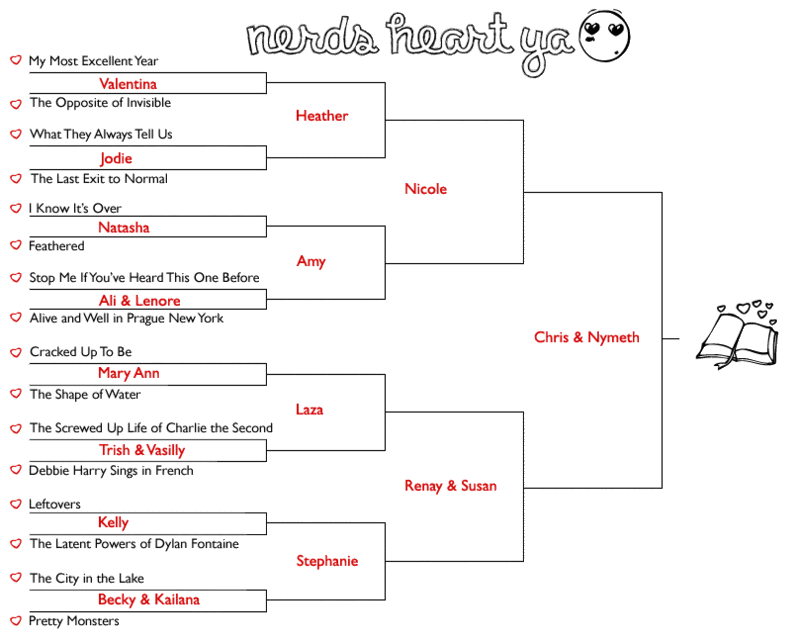
 The brainchild of the ever-fabulous, Renay, Nerds Heart YA brings together twenty bloggers and sixteen YA books--all from 2008, I might add--in a book tournament like no other*. (She promises cake!) You can follow all the action by keeping up with our official twitter account, Nerds Heart YA. Reviews and co-reviews (not to mention the BIG decisions!) will be coming all summer long. Here, revealed for the first time, are the sixteen shortlisted books:


Stop Me If You've Heard This One Before by David Yoo
The Latent Powers of Dylan Fontaine by April Lurie
My Most Excellent Year by Steve Kluger
Alive and Well in Prague, New York by Daphne Grab
I Know It's Over by C.K. Kelly Martin
The Last Exit to Normal by Michael Harmon
Pretty Monsters by Kelly Link
The Screwed Up Life of Charlie the Second by Drew Ferguson
The Shape of Water by Anne Spollen
What They Always Tell Us by Martin Wilson
The City in the Lake by Rachel Neumeier
Cracked Up To Be by Courtney Summers
Debbie Harry Sings In French by Meagan Brothers
Feathered by Laura Kasischke
Leftovers by Laura Wiess
The Opposite of Invisible by Liz Gallagher
Who are the judges? Only some of the best book bloggers out there! But don't take my word for it, see for yourself!
Valentina, Valentina's Room
Jodie, Book Gazing
Natasha, Maw Books Blog
Ali, Worducopia and Lenore, Presenting Lenore
Mary Ann, Libr*fiti
Trish, Hey Lady! Whatcha Readin' and Vasilly, 1330v
Kelly, YAnnabe
Becky, Becky's Book Reviews, and Kailana, The Written World
Heather, A High and Hidden Place
Amy, My Friend Amy
Laza, Gimme More Books!
Stephanie, Stephanie's Confessions of a Book-a-Holic
Nicole, Linus's Blanket
Renay, YA Fabulous and Susan, She's Too Fond Of Books And It's Turned Her Brain
Chris, Stuff As Dreams Are Made On and Nymeth, Things Mean A Lot
Here's the judging bracket!
*True there was that little-old-tournament SLJ's Battle of the Books...but....these sixteen books are lesser known titles, the 'underdogs' of the year if you will.
© Becky Laney of Becky's Book Reviews
If you're reading this post on another site, or another feed, the content has been stolen.
The Silenced (YA)

DeVita, James. 2007. The Silenced. HarperCollins.
Marena hurried down the street, past the long stretch of identical home units, the winter air needling her awake.
Marena can barely remember 'the before.' But when she does, she breaks the rules. She writes down her memories. She fights to remember each little detail--as painful as those memories may be--because they are what keep her her. The Zero Tolerance Party wants people to forget their individuality, to forget their uniqueness, their differences. To embrace the group collective. Marena and her friends attend YTF, which I *think* stands for Youth Training Facility. Marena is suspect because her mother was a "traitor" to the party. She was active in the resistance. Marena lives with her father, whom she hates, and her little brother, whom she tolerates just barely. In Marena's world, sadly, it is illegal to write and read and draw (at least the old-fashioned way). Even illegal to own paper and pen (or pencil). There are exceptions, of course, people can read the sanctioned propaganda of the ZT party to their heart's content. They're required to recite it daily. Required to worship the words of this book which tells them what to think and how to act. Required to make their pledge of loyalty daily before lessons can begin.
Marena's life isn't easy. And by resisting, she's only complicating things. But does she have a choice? The Silenced is a novel about choices. Difficult choices. It's a novel about finding one's voice as well. Does Marena have the right to remain silent in the face of such injustice? When everything is so wrong with the world? Do you?
The Silenced has everything I love in a dystopian fiction. There were so many things I loved about it. Details that if I were to include might spoil it for you. So I'll leave off just why I loved it. But it worked for me.
"I want you to ask yourselves something and really think about it. If I were to take away everything about you that you think is you, who would you be?" He let the question sit. "Because that's what I'm going to do. I'm going to kill whatever you think is you. There's no room for you anymore. There's only room for us." (166)
© Becky Laney of Becky's Book Reviews
If you're reading this post on another site, or another feed, the content has been stolen.
Radiant Darkness (MG, YA)

Whitman, Emily. 2009. Radiant Darkness. HarperCollins.
"Persephone, Daughter of Demeter, the harvest goddess. Kidnapped and forced to--"
Wrong! In every book of myths, the same; in every book, wrong!
Oh, I know it all got complicated because of the choices I made. I'm not trying to pretend I'm blameless. Still, after thousands of years, I wish people knew what really happened when I walked in my mother's flowering vale and the black horses landed, crushing flowers and filling the air with heady perfume. Just once I'd like to set the record straight.
Persephone narrates Radiant Darkness telling her version of how events went down. How she came to be the Queen of the Underworld. What can I say about this one? If you like Greek mythology--novelizations and retellings of mythology--then I think you'll enjoy this one. It's a tell of rebellion and frustration. Perspephone is the daughter of a goddess. And she's tired of it. Tired of her mother alternating between being domineering and controlling and being neglectful. Her mother is always off being worshipped. Off to this or that festival. Persephone feels the time has come. She's ready to be a woman. Ready to be accepted as one. The problem? Her mother treats her like she's six.
So when Persephone meets a tall, dark, handsome stranger, she's all for love. True, she doesn't know his name. True, he's mysterious. But he represents everything that is missing in her life. So she continues meeting him. Again and again. Until one day she learns the truth. He's a god. (Not a big surprise there, after all, her mother is a goddess.) But he's the god of the underworld. If she chooses him, she'll be leaving everything behind. Is she ready to make that choice? To live with her consequences?
© Becky Laney of Becky's Book Reviews
If you're reading this post on another site, or another feed, the content has been stolen.
Subscribe to:
Posts (Atom)